Home Blog Page 454

SEC OKs LUECO direct public offering

BW FILE PHOTO

THE SECURITIES and Exchange Commission (SEC) has approved La Union Electric Company, Inc.’s (LUECO) direct public offering (DPO), making it the second issuer to register under a framework for power generation and distribution firms.

In a Dec. 27 meeting, the Commission En Banc made effective LUECO’s registration statement covering 2.35 million shares, subject to the company completing remaining requirements, the SEC said on Thursday.

LUECO will offer up to 352,950 common shares to the public at P772 each, potentially raising P251.4 million. Proceeds will fund capital expenditures, business expansion and facility and equipment upgrades. The subscription period runs from Jan. 12 to Jan. 16, with shares to be issued by Feb. 6.

Penta Capital & Investment Corp. is serving as the sole underwriter.

LUECO’s franchise covers San Fernando City and the La Union towns of Bauang and San Juan. Its distribution system includes two substations: Bauang at 20 megavolt-amperes (MVA) and Poro at 67.5 MVA as of end-2024.

The offering complies with the Electric Power Industry Reform Act, which mandates that generation companies sell at least 15% of common shares to the public. — Alexandria Grace C. Magno

Disney says Zootopia 2 is China’s top Hollywood film ever

Zootopia 2 (2025)
Zootopia 2 (2025)

WALT DISNEY Co. said Zootopia 2 has overtaken 2019’s Avengers: Endgame to become the biggest Hollywood film ever released in China when measured in local currency.

The animated sequel has grossed about 4.25 billion yuan, the company said in a statement on Monday. That translates into $610 million. It was released in theaters on Nov. 26 in China, the world’s second-largest movie market.

The film’s breakout performance has turned into a broader cultural moment in the country. Fans have flocked to cinemas carrying Zootopia-themed merchandise — from plush toys to handbags — while some screenings have even welcomed moviegoers with pets. Zootopia 2 reclaimed the top spot at the Chinese box office over the first weekend of 2026, dethroning Disney’s Avatar: Fire and Ash which opened Dec. 19.

A surge in demand for animated blockbusters including Zootopia 2 and local hit Ne Zha 2 has helped lift China’s overall box-office revenue in 2025 by 20% to 51.8 billion yuan, even as other releases struggle to attract audiences.

Animated films generated nearly half of last year’s box-office revenue, with 57 titles grossing more than 25 billion yuan, according to a report by Maoyan. While repeat viewings by fans helped boost sales for Ne Zha 2 and Zootopia 2, local films earning less than 1 billion yuan saw a sharp decline, the report said.

Family-friendly films are also doing well in the US, with A Minecraft Movie from Warner Bros. Discovery, Inc. and Disney’s Lilo & Stitch ranking in the top two spots domestically. — Bloomberg

How a scandal is hitting the Philippines’ star economy

STOCK PHOTO | Image from Freepik

THE Philippines’ economy has often struggled to get credit for its solid performance in the past decade. Now, a massive corruption scandal is sapping growth at precisely the wrong time and making for an unhappy start to the year.

With Asia likely to find the going harder in 2026, Manila needs to find its footing quickly. As officials try to frame their message, terms like “goldilocks” and “sweet spot” ought to be banished. When the central bank chief uttered those words in August, the outlook was promising: inflation was receding, the expansion was ticking along, and interest rates were on the way down. Growth was headed for another respectable annual increase and poised to outperform Malaysia, Singapore, Indonesia, and even China.

That narrative has been undermined by revelations that billions of dollars allocated to flood control projects had been misused, and in some instances, vanished. Now, the task before the Philippines is to restore confidence — if policymakers and their political masters can. The scandal has sparked outrage across a nation highly vulnerable to deadly typhoons and flooding.

Testimony at a Senate inquiry in September suggested widespread collusion between government engineers, politicians, and private building contractors, who allegedly pocketed hefty kickbacks. Much of the state-funded infrastructure was found to be defective, or, in some cases, not even built. Losses may amount to more than a trillion pesos ($17 billion), according to one official estimate. At that magnitude, it would surpass the $10 billion in ill-gotten wealth allegedly amassed by the late Ferdinand Marcos — father of the current president — and his cronies during his dictatorship.

Forty years into the democracy era that followed the elder Marcos’s ouster, Filipinos vote freely for leaders. But they failed to shake an underlying problem. The archipelago routinely scores poorly in global corruption indices, sharing the neighborhood with places like Panama and Sierra Leone.

That alone didn’t stop years of rapid economic development, especially since the turn of the century. It sometimes looked like commerce and politics, the latter dominated by jockeying among a handful of powerful families, were on different planets. The point was that things were generally getting better. While the country missed the 1980s and 1990s’ boom in manufacturing supply chains, it plowed ahead in services.

And when it comes to shortcomings in governance, the Philippines is hardly the only sinner. Despite some improvement from the Suharto era, when corruption in Indonesia reached epic levels and the autocrat’s children controlled vast monopolies, malfeasance still bedevils the nation. Former Malaysian Prime Minister Najib Razak sits in prison for crimes related to investment fund 1MDB. China and Vietnam launched crackdowns on wrongdoing.

But it isn’t often that you see such an impact as the fracas that’s rocking the Philippines. Growth slowed dramatically in the third quarter. Gross domestic product rose just 4% in July to September, compared with a year earlier, well down from the 5.5% clocked in the prior three months. Spending slumped, and investment and construction contracted. Officials attributed the downdraft to stricter guidelines before cash was released for public works.

While it’s commendable that contracts get greater scrutiny, business confidence has been shaken. The peso was one of the worst performers last year, weakening about 2% against the dollar, in contrast to the strong gains notched in Malaysia and Thailand. The benchmark index fell more than 7%.

Will any of this improve in 2026? The starting point isn’t great. Overall, growth in Asia will probably slip to 4.1%, according to the International Monetary Fund, from an estimated 4.5% last year as the region faces challenges from US tariffs. Times will feel harder in the Philippines, which has become accustomed to doing better than regional peers. It was a star coming out of the pandemic, clocking an expansion of almost 8% in 2022, the year Ferdinand Marcos, Jr. was elected.

The president inherited a thriving economy. At the time of his victory, there were fears that the country would slide back into authoritarian rule and turn away from the US, with which it has a close security partnership. Those concerns were misplaced. But this scandal will be a blight on his record.

As 2025 drew to a close, Filipinos marked the passing of Juan Ponce Enrile, a former defense minister and political chameleon who turned against Marcos’s father. In that rupture, Enrile joined with then army chief Fidel Ramos, who later served as president. Obituaries of Ramos, who died in 2022, pointed to economic reforms that countered the “sick man of Asia” epithet that had dogged the nation.    

Every economy catches cold. But the country’s contemporary ills come at a particularly inopportune moment.

BLOOMBERG OPINION

Peso rebounds on ‘somewhat hawkish’ BSP hints

PHILIPPINE STAR/JOVANNIE LAMBAYAN

THE PESO on Thursday recovered from its all-time low close as market players digest the latest policy signals from the Bangko Sentral ng Pilipinas (BSP) chief.

The local unit closed at P59.17 versus the greenback, jumping by 18.5 centavos from its record-low P59.355 finish on Wednesday, data from the Bankers Association of the Philippines showed.

The peso opened Thursday’s session stronger at P59.30 versus the dollar, which was already its worst showing against the greenback. Its intraday best was at P59.01.

Dollars traded increased to $1.648 billion from $1.317 billion on Wednesday.

The peso was supported by “somewhat hawkish” sentiment from BSP Governor Eli M. Remolona, Jr., Rizal Commercial Banking Corp. Chief Economist Michael L. Ricafort said in a Viber message.

“The dollar-peso ended lower on higher buying interest for the peso as market players gauged the recent statement from the BSP signaling the end of their easing cycle,” a trader likewise said by phone.

On Tuesday, Mr. Remolona said they could consider another rate cut at the Monetary Board’s Feb. 19 meeting but noted that the current policy rate of 4.5% is already “very close” to where they want it to be, signaling that their easing cycle is about to end.

The BSP has cut rates by 200 basis points since August 2024.

For Friday, the trader sees the peso moving between P59 and P59.30 per dollar, while Mr. Ricafort said it could range from P59 to P59.25. — Aaron Michael C. Sy

When marital strife lands in HR’s lap

I’m the human resources (HR) manager at a medium-sized enterprise. This week, an employee’s wife claims her cheating husband is withholding financial support. She requests that the husband’s salary be paid directly to her. I declined the request for legal reasons. Now, I’m agonizing with that decision as I reflect on sympathizing with the wife. Please advise. — Red Lantern.

I’m not sure how you declined the wife’s request. But you’re right. That’s a legal issue. But what about the ethical component? In today’s complex world of modern employment, HR often finds itself acting as much more than just a recruiter, engagement promoter, or policy enforcer, among others.

From time to time, the personal crisis of an employee’s private life spills into the professional realm. This includes a marital dispute, with an aggrieved spouse claiming the employee’s salary. This is an ethical tightrope walk that requires a strictly policy-driven management response that most companies don’t have.

So, how do we resolve the matter for your future guidance? First things first. Anyone in HR should understand the absolute separation between a worker’s marital life from their employment contract. This is one reason why many organizations don’t require the marital status of job applicants to be disclosed prior to employment.

Doing so could be seen as discrimination under labor regulations, or violations of privacy, or fair employment practices.

ABSOLUTE SEPARATION
The basic principle that must guide HR is the absolute separation of an employee’s marital issues from their employment contract. The company has a contract with the employee, the husband, to compensate him for work rendered. Therefore, the salary is the property of the individual who performed the labor.

The wife’s emotional agony — her husband’s infidelity and financial distress — is deeply valid from a human perspective, but it is legally irrelevant to the employer-employee relationship. HR is not a family court, morality advocate, or marriage counselor.

Its mandate is strictly defined by employment law and company policy.

The single most critical factor in this scenario is the law governing the payment of wages. As a general rule, an employer is legally obligated to pay an employee’s full wages directly to that employee unless there’s a court-issued garnishment ruling, legal support order, government-mandated deductions, or any legally valid assignment of wages.

That means you’re legally right in declining the employee’s spouse if you gave those reasons. Doing otherwise would expose your organization to significant risks, including breach of employment contract.

I’m not sure how you declined the wife’s request. However, HR must project an unequivocal, yet sensitive refusal based on legal constraints, including the Data Privacy Act. You must explain that the company is legally barred from intervening in an employee’s personal finances.

In other words, HR must decline the wife’s request but do it respectfully.

HANDLING THE ALLEGATIONS
The husband’s alleged infidelity must be handled separately and with extreme caution. Unless the cheating involves a coworker and has led to a demonstrable disruption of the workplace — such as creating a hostile work environment, violating anti-harassment policies, or breaching a conflict-of-interest rule (like an affair with a direct report), it is generally considered a private matter.

HR must resist the temptation to investigate issues of morality. Doing so sets a dangerous precedent, intrudes upon employee privacy, and distracts from the company’s core business. HR may want to explore the following key questions:

Did the husband violate the company’s Code of Conduct? Has his alleged infidelity negatively impacted his job performance or the work environment? If the answer to these questions is no, the husband’s infidelity remains off-limits for disciplinary action. Therefore, a well-managed HR response includes the following:

One, ensure strict confidentiality. You, as the HR professional, must ensure the matter is not discussed with anyone else within the company, including the husband’s boss, unless absolutely necessary for legal compliance or to alert management on its adverse effect on work performance.

Two, direct the matter to legal channels. HR may advise the wife to seek proper legal intervention to obtain the necessary court order that would grant her access to his wages. This reframes the problem from an HR issue to a legal one.

Three, offer counseling to the husband. The husband may be given optional access to the company’s legal or counseling assistance program to help him manage the personal stress and financial fallout without forcing HR to act as a therapist or legal advisor.

In conclusion, HR must be ready to act on any matter involving a cheating employee and a salary dispute if such private conduct spills into workplace violations. This is a reminder of the blurry line between an employee’s private life and professional obligations. The path forward is clear, though difficult — legal compliance must always outweigh sympathy.


Consult your workplace issues with Rey Elbo for free. E-mail elbonomics@gmail.com or DM him on Facebook, LinkedIn, X or via https://reyelbo.com. Anonymity is guaranteed.


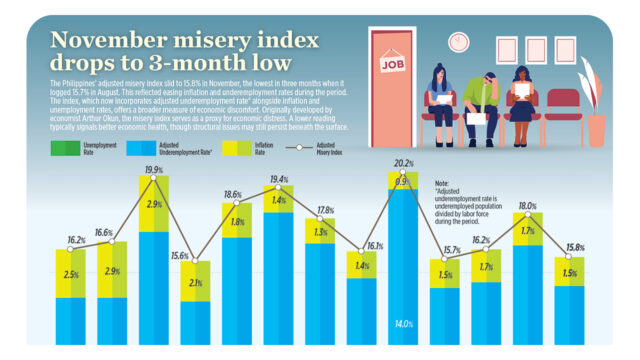
November misery index drops to 3-month low

The Philippines’ adjusted misery index slid to 15.8% in November, the lowest in three months when it logged 15.7% in August. This reflected easing inflation and underemployment rates during the period. The index, which now incorporates adjusted underemployment rate* alongside inflation and unemployment rates, offers a broader measure of economic discomfort. Originally developed by economist Arthur Okun, the misery index serves as a proxy for economic distress. A lower reading typically signals better economic health, though structural issues may still persist beneath the surface.

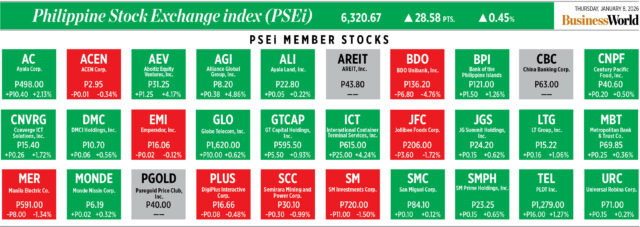
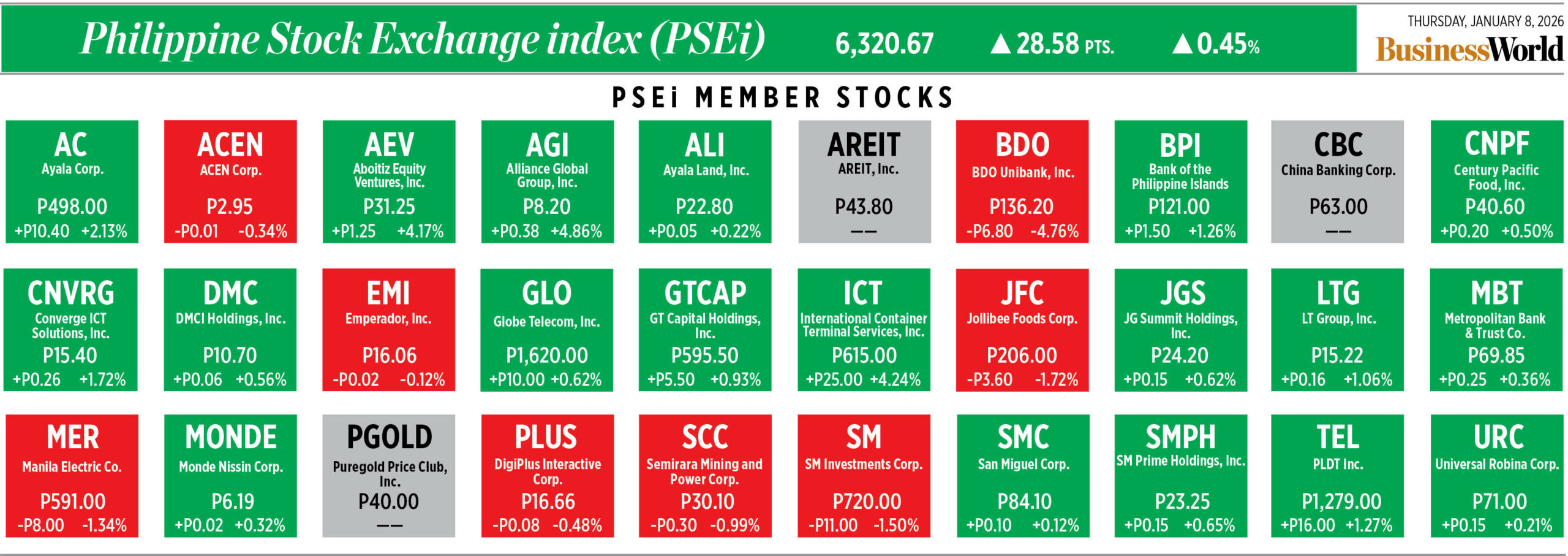
How PSEi member stocks performed — January 8, 2026

Here’s a quick glance at how PSEi stocks fared on Thursday, January 8, 2026.


Green-lane agency to start 2026 with projects worth P2.95 trillion

NICKELASIA.COM

THE Board of Investments’ (BoI) One-Stop Action Center for Strategic Investments (OSACSI) said it ended 2025 with about P2.95 trillion worth of projects not yet registered with investment promotion agencies (IPAs) whose permits it will fast-track under the green lane system.

The OSACSI has reported that 232 projects were endorsed for green lane treatment in 2025. These are expected to generate 398,567 jobs nationwide.

Of the total, 110 projects are registered with the BoI, while a manufacturing project is registered with the Philippine Economic Zone Authority (PEZA). These account for P3.16 trillion of prospective investment.

“For 2025, 34 green-lane projects were registered with the BoI, highlighting the role of the green lane in helping investors navigate regulatory processes and move their projects forward more efficiently,” the BoI said.

Last year, BoI greenlit P1.56 trillion in investment pledges, reflecting a 3.7% dip in investment approvals from 2024.

For 2026, the BoI is hoping to shift the focus of its investment promotion efforts to mining, mineral processing, and digital infrastructure.

“The Philippines is now prioritizing faster project implementation of renewable energy (RE) projects while also promoting investments across various sectors such as infrastructure and manufacturing,” OSACSI Director Ernesto C. Delos Reyes, Jr. said in a statement on Thursday.

“Local government units are essential in simplifying business procedures to facilitate this growth,” he added.

The majority of the projects endorsed for green lane treatment were still in the RE industry, comprising 179 projects worth P5.206 trillion. These are expected to generate 249,801 jobs.

Meanwhile, nine digital infrastructure projects and five public-private partnership, infrastructure, and water projects received green lane status worth P401.69 billion and P416.08 billion, respectively.

The remaining investments were food security projects (P18.7 billion), manufacturing projects (P67.04 billion), and a pharmaceutical project (P45 million).

“The green lane initiative reflects President Ferdinand R. Marcos, Jr.’s administration’s strong commitment to creating an environment conducive to investments,” Trade Secretary and BoI Chairman Ma. Cristina A. Roque said.

“It is a critical step in enhancing the Philippines’ position as an investment hub in Asia, which will ultimately benefit our people by generating jobs and fostering sustainable economic growth,” she added.

According to OSACSI, it estimated an average processing-time reduction of 49% for permits and licenses handled by the green lane system, which helped expedite the completion of strategic investments.

“Further, through the green lane initiatives, resolution of issues and concerns encountered by project proponents in the implementation of the strategic investments were facilitated,” it added.

Of the green-lane projects, 16 are already operational worth a combined P257.98 billion, while six projects worth P5.03 billion are in the pre-operational stages.

Some 163 projects worth P5.48 trillion are in the pre-development stages, while 47 worth P362.91 billion are under construction.

Established through Executive Order No. 18, the green lane initiative aims to strengthen the government’s ability to translate investment commitments into actual, operational projects. — Justine Irish D. Tabile

Central Luzon irrigation disruptions seen resolved as early as January

NIA.GOV.PH

THE National Irrigation Administration (NIA) said repairs at the Upper Pampanga River Integrated Irrigation System are expected to be completed within the month at the earliest.

NIA Administrator Eddie G. Guillen told BusinessWorld that the timetable has been accelerated from the previous estimate of repairs completed and water flow resuming by March.

The repairs involve the Talavera River Phase 1 siphon barrel, part of the CASECNAN Super Diversion Canal, which supplies irrigation to thousands of farmers in Nueva Ecija and Tarlac.

Irrigation in the affected areas was suspended in November due to damage caused by quarrying activities. Mr. Guillen said repairs will cost P53 million.

“The original target was the first week of March, but we are fast-tracking the work,” Mr. Guillen said by phone. “We may finish by mid-January, and if the test run goes well, we can release water by late January or the first week of February.”

Mr. Guillen said a test run will be conducted between Jan. 15 and 20 to ensure leak-free performance before irrigation water is released.

The NIA said the siphon barrel sustained severe damage. Mr. Guillen added that another siphon and a nearby bridge were also affected, also by quarrying.

“The siphon used to be submerged under the riverbed, but because gravel was extracted, it was exposed. Once exposed, it was hit by water and debris, and eventually water passed underneath it, causing serious damage,” he said.

Mr. Guillen said the NIA has filed complaints that led to the suspension of quarrying operations in the area.

The Kilusang Magbubukid ng Pilipinas has warned that the delay in irrigation could affect nearly 40,000 hectares planted to rice and about 25,000 farmers who had already prepared seedlings for the December cropping season.

Despite the setback, Mr. Guillen said the earlier-than-expected resumption of irrigation could allow farmers to adopt a double dry cropping calendar, which he said could boost rice production.

“If we can release water by late January or early February, farmers can still plant and move toward double dry cropping,” he said.

Mr. Guillen said NIA has been pushing for changes in the crop calendar to avoid overlap with the rainy season, which could help increase output. — Vonn Andrei E. Villamiel

Auctions announced for Tacloban, Camiguin, Virac airport projects

FACEBOOK.COM/CAAPHILIPPINES

THE Department of Transportation (DoTr) said it invited interested parties to participate in three airport upgrade projects budgeted for up to P895.12 million combined.

In bid notices issued on Thursday, the DoTr invited potential bidders for the P455.90-million Tacloban Airport development project, the P174.60-million Camiguin Airport development project, and the rebidding of P264.62-million Virac Airport development project.

Proposals will be accepted until Jan. 29, the DoTr said. A pre-bid conference is scheduled for Jan. 16.

The winning contractor for the Tacloban airport project will be given 600 calendar days to complete the works, while the contractors for Camiguin and Virac airports will have 180 and 720 days, respectively.

The Tacloban project covers the construction and upgrade of landside and airside facilities, according to the bid documents. The Camiguin project covers the construction of an initial runway centerline. The Virac project covers the site development as well as the construction of a control tower.

The DoTr has said that the Tacloban airport is due for upgrading, with a new terminal expected to be operational by September, and the runway expansion and reclamation expected to be ready by the second quarter. — Ashley Erika O. Jose

Aurora ecozone hoping to bring in US defense-logistics locator within the quarter

ANGLICOTECH.COM

THE Aurora Pacific Economic Zone and Freeport Authority (APECO) said it hopes to bring in a key US defense-logistics locator within the first quarter following a key meeting scheduled soon in the US.

“I really want more defense manufacturing in APECO. That’s why we’re going back to Washington, DC and Virginia,” APECO President Gil G. Taway IV told reporters in a briefing.

The meeting in the DC area will involve Anglicotech LLC, which optimizes supply chains for defense-industry contractors.

APECO first met with defense-focused companies in the US through an Economic and Security Forum in 2024, during which it met around 30 companies.

“That is where we met Anglicotech. So we want to go back to Virginia and Washington so we can talk with them again,” he said.

“We are actually planning an anchor event in Washington, DC, and Virginia where we will gather defense companies big and small,” he added.

“In March, we are also planning to go to… Los Angeles kasi gusto namin ligawan ’yong mga nasa Burbank, ’yong mga film studios (we would like to pitch to the Hollywood movie companies in Burbank),” he said.

“We are also going to Texas for follow-up discussions,” he added.

According to Mr. Taway, APECO is hoping to benefit from a government initiative to make the Philippines more self-reliant on defense.

“The demand is basically (stemming from) our SRDP, or Self-Reliant Defense Posture. And I think Anglicotech also sees other markets that they can supply to in Asia and even Europe,” he added.

APECO is also meeting with retirement companies in Japan, including Long Life Corp., which specializes in retirement communities. — Justine Irish D. Tabile

CARS firms deserve perks after boosting PHL — CAMPI

USERTRMK-FREEPIK

THE Chamber of Automotive Manufacturers of the Philippines, Inc. (CAMPI) said participants in the Comprehensive Automotive Resurgence Strategy (CARS) program should receive their incentives after having delivered results that have boosted the economy.

“Recent developments have raised serious concerns on the funding for the financial incentive commitments granted under the CARS Program,” CAMPI said in a statement on Thursday.

“The participants should be able to receive their incentives based on their actual performance that already generated economic benefits,” it added.

President Ferdinand R. Marcos, Jr. vetoed unprogrammed appropriations worth P92.5 billion on Monday, which included fiscal support for the CARS program worth P4.32 billion.

The vetoed CARS budget items were meant to fulfill government commitments under the program, including a still-being-evaluated application from one of the participants.

Mr. Marcos also vetoed P250,000 in funding for the Revitalizing the Automotive Industry for Competitiveness Enhancement (RACE) program.

According to CAMPI, the government should implement the RACE program soon.

“Both CARS and RACE are fundamental programs that contribute to overall industrial development. We fully trust and support efforts of key government agencies in urgently resolving these important matters,” it added.

Immediately after the veto, Trade Undersecretary and Board of Investments Managing Head Ceferino S. Rodolfo said that the agency is actively working with other government agencies to ensure payment of CARS participants.

“CAMPI believes in the importance of collaboration between government and industry in securing the future viability of the Philippine automotive manufacturing sector,” it said.

“Such is crucial in creating a positive environment for future investments and help develop a more robust local automotive parts manufacturing industry,” it added. — Justine Irish D. Tabile