How Spain’s Priorat DOC Classification copies French Burgundy
WHEN I attended my first Barcelona Wine Week last February, now considered Spain’s most important wine fair, I got my chance to connect with the newer developments happening with the Spanish wine regions. In a previous column, I wrote about the latest Cava quality classification. Now there is another region making headway too — the Priorat DOQ, one of only two DOCs/DOQs (Denominación de Origen Calificada, or Denominación de Origen Qualificada) in Spain — and one of my personal favorites.
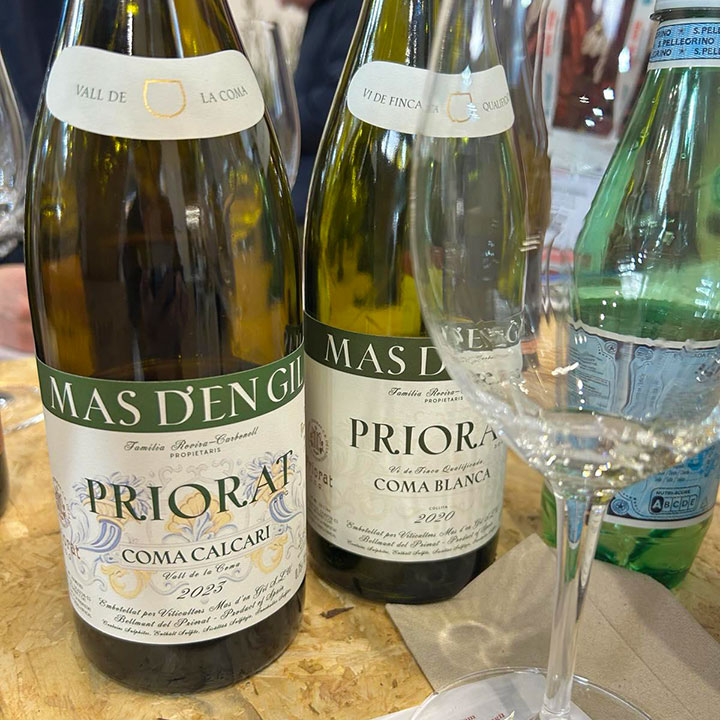
In one of my meetings at the Barcelona Wine Week, I found myself presented with two bottles of white wine from Mas d’en Gil: the Coma Calcari 2023 and Coma Blanca 2020, with the former being a “Vi de Vila” and the latter wine proudly bearing the seal of “Vi de Finca Qualificada” or “Vinya Classificada.” For me, this was more than just a tasting moment, it was a glimpse into how Priorat is reshaping its identity through terroir.
I also had a brief chat with Marta Rovira, the current family-member managing director of the Finca Mas dén Gil, founded in the 19th century.
Ms. Rovira proudly mentioned the exciting new terroir-driven classification happening within the Priorat wine region. She also said that two of her wines, Coma Blanca (a white) and Clos Fonta (red) made the prestigious list of Vinya Classificada, an equivalent of the Premier Cru of Burgundy.
The two white wines I tasted showed their characteristics, precision and elegance, embodying what this new classification system is trying to redefine. With this, I decided to feature the new Priorat quality system in this column, that is very much inspired and patterned after the French Burgundy classification.
PRINCIPLE BEHIND THE NEW CLASSIFICATION
The new Priorat DOQ classification, called Els Noms de la Terra (The Names of the Land), is probably the most ambitious classification undertaken by any Consejo Regulator (Regulatory Council) of a Spanish wine region. This new principle reinforces the Burgundy-inspired model, as opposed to the traditional classification of other wine regions which are based mostly on oak-aging terms like Crianza, Reserva, and Gran Reserva. The new classification goes by terroir and even exceeded Rioja’s new village and single-vineyard additions in their labels.
The Priorat DOQ regulatory council identified 12 villages, 459 sites, and 2,000+ vineyards in this wine region. In comparison, Burgundy has 44 villages. Just like in Burgundy, there is special individuality and unique terroir to the vineyards on these sites. The Priorat DOQ has developed a traceability process which guarantees the origin, the provenance of the grapes used for the wines, and the age of the vineyards. The new classification was first introduced in 2019.
The new Five-Tiered Classification (including varietal blends for reds and vineyard age requirement) are:
• Priorat DOQ (Regional wines) — grapes from across the appellation; no grape varietal blend rule, no vineyard age rule
• Vi de Vila (Village wines) — introduced in 2007 and tied to one of 12 villages; 60% minimum of Grenache and/or Cariñena grapes; 90% of vineyards must be at least 10 years old, and the remaining 10% must be at least five years old
• Vi de Paratge (Single-site wines) — since 2017, focused on specific locality; 60% minimum of Grenache and/or Cariñena; 90% of the vineyards must be at least 15 years old, the remaining 10% must be at least five years old
• Vinya Classificada (Premier cru) — single vineyards of recognized quality; 60% minimum of Grenache and/or Cariñena; 80% of the vineyards must be at least 20 years old, the remaining 20% must be at least five years old
• Gran Vinya Classificada (Grand cru) — the pinnacle, reserved for historic, exceptional plots; 60% minimum of Grenache and/or Cariñena; 80% of the vineyards must be at least 35 years old, the remaining 20% must be at least 10 years old
Right now, only three wineries are allowed to use the term Gran Vinya Classificada, namely: Mas de la Rosa by Vall Llach, 1902 Tossal d’en Bou by Mas Doix, and L’Ermita by the region’s most renowned figure, Alvaro Palacios. Burgundy on the other hand, has 33 Grand Cru wines.
ADOPTION
Not all Priorat bodegas use this classification system. The Priorat DOQ classification is still in its adoption phase with only 44% or 51 of Priorat’s 116 bodegas buying in. Yet the presence of giants like Clos Mogador, Scala Dei, Mas Martinet, and Álvaro Palacios ensures immediate credibility.
This isn’t as polarizing as what happened with Cava DO and the spinoff Corpinnat group as covered in my previous column on Cava.
The leadership of the Priorat DOQ signals that this is not an experiment but a terroir revolution. The challenge lies in educating consumers: while Burgundy drinkers are accustomed to parsing village and cru distinctions, Spanish wine lovers may find the new categories daunting initially.
Still, the payoff is clear — greater transparency, traceability, authenticity, and a premium positioning on the global stage.
THE CHIEF ARCHITECT
No discussion of Priorat’s new classification would be complete without mentioning Alvaro Palacios, the region’s most renowned winemaker and a driving force behind Els noms de la terra. Palacios, whose legendary wine L’Ermita is the most expensive and iconic from Priorat, has long championed the idea that the land itself should define prestige. As a member of the Regulatory Council’s board of directors, he played a pivotal role in shaping the framework that now governs the region’s terroir hierarchy.
His influence is twofold: on one hand, he provides global credibility, ensuring that Priorat’s terroir-first model is taken seriously beyond Spain. And on the other hand, his leadership inspires smaller producers to embrace the system, proving that even the most celebrated estates are willing to submit to rigorous traceability and vineyard classification. Palacios’s L’Ermita was the first wine to qualify as Gran Vinya Classificada, cementing his role as both pioneer and standard-bearer for the movement.
Together with estates like Mas d’en Gil, Palacios demonstrates that Priorat’s future lies in specific terroir recognition. Their participation signals that this is not just a bureaucratic exercise, but a cultural shift, one that elevates Priorat to Burgundy’s level of vineyard-driven prestige while carving out its own proud Catalan identity.
IN CONCLUSION
Priorat’s embrace of Els noms de la terra is more than imitation; it is an adaptation. By borrowing Burgundy’s terroir-first hierarchy and tailoring it to Catalonia’s rugged llicorella soils, Priorat has positioned itself as Spain’s most authentic voice of terroir authenticity. With 51 estates leading the charge, the Priorat DOQ proves that Spanish wine can move beyond oak-aging traditions and into a future where the land and site itself dictate prestige.
The question now is whether Priorat’s daring classification change will remain a singular revolution or become the blueprint for Spain’s next great wine story.
Sherwin A. Lao is the first Filipino wine writer member of both the Bordeaux-based Federation Internationale des Journalists et Ecrivains du Vin et des Spiritueux (FIJEV) and the UK-based Circle of Wine Writers (CWW). For comments, inquiries, wine event coverage, wine consultancy and other wine related concerns, e-mail the author at wineprotege@gmail.com, or check his wine training website https://thewinetrainingcamp.wordpress.com/services/. Also check out his YouTube channel www.youtube.com/@winecrazy.