Pump prices may drop further next week — DoE
By Sheldeen Joy Talavera, Reporter
LOCAL PUMP PRICES may continue to decline next week based on early estimates, despite renewed upward pressure on global oil prices following the US blockade of Iranian ports, a Department of Energy (DoE) official said.
Energy Undersecretary Alessandro O. Sales said the two-day trading average of the Mean of Platts Singapore (MOPS), a benchmark for refined oil products, remains on a downward trend.
“Even with the pronouncement of President [Donald J.] Trump that he stationed his warships at the opening of the Strait of Hormuz, apparently the market is not pricing that in. The MOPS (prices) are still going down,” Mr. Sales said at a briefing on Wednesday.
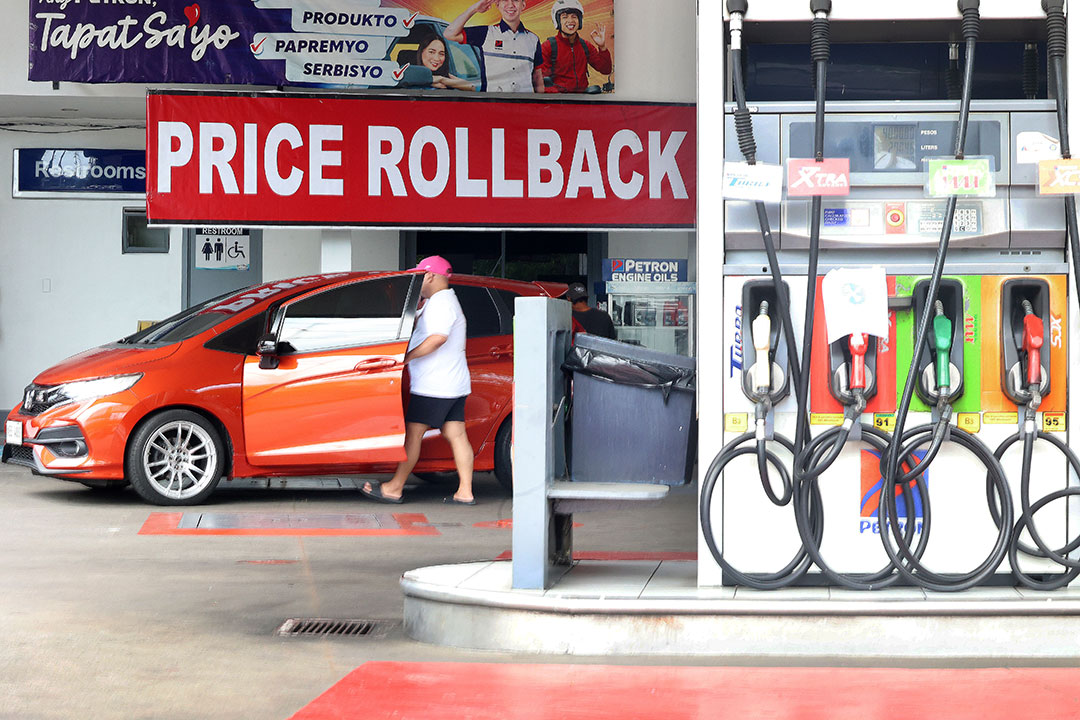
“So, if this market reaction continues, potentially we will have a more stable price or maybe we will have a rollback,” he added.
An industry source told BusinessWorld that there may be another rollback in fuel prices based on the first two days of MOPS trading and foreign exchange averages.
The source estimated diesel prices may decline by P14 to P16 per liter, while gasoline prices may go down by P1 to P2 per liter.
“The ceasefire in the Middle East is holding, reducing some of the immediate risk premium on MOPS prices,” the source said.
This week, several oil companies implemented a price rollback, with diesel prices dropping by as much as P23 per liter. Gasoline and kerosene fell by up to P6.50 and P11.50 per liter, respectively.
Energy Secretary Sharon S. Garin expressed hope that there would be no sudden disruptions, as the Philippines remains vulnerable to price swings in the global market.
“Whatever happens in the international market is reflected in our prices the following week. So, that is the danger. It’s not that we don’t want prices to go down, but we just need the public to know how significant the war is in terms of our price here in the local market,” she said at the same briefing.
To cushion the impact of these external shocks, the government has moved to order at least two million barrels of diesel to boost the country’s oil stockpiles.
The DoE, through state-run Philippine National Oil Co., has secured 471,000 barrels of diesel, all delivered to the Philippines in two shipments from Japan and Malaysia.
Mr. Sales said that a third shipment is expected to arrive by the end of this week, followed by a fourth shipment which will be delivered to Davao.
As of April 10, the country’s average fuel inventory can sustain demand for approximately 50.31 days, covering an estimated 75.55 million liters of consumption.
The average inventory for gasoline is 54.38 days; 48.9 days for diesel, 104.73 days for kerosene, 67.65 days for jet fuel, 45.96 days for fuel oil, and 36.27 days for liquefied petroleum gas.
‘NO POWER INTERRUPTION’
Also, Ms. Garin allayed fears that rising fuel prices may affect supply stability and lead to potential power interruptions, especially in remote diesel-dependent areas.
“One thing I’m sure of is that there will be no power interruptions because of the diesel price, because we have supply,” she said.
While oil makes up only around 3% of the national power generation mix, it is crucial for remote and island areas that are not connected to the main grid. Since these areas are subsidized by on-grid consumers, any increase in oil prices can still impact electricity rates nationwide.
Ms. Garin said that the state-run National Power Corp. (NPC) is studying how to source diesel at a cheaper price to cushion the impact on its operating diesel-based plants.
“The NPC is assuring [us] that they will run their generation sets no matter what the prices,” she said.
TAX ON DIESEL UNDER REVIEW
Meanwhile, Finance Undersecretary Karlo S. Fermin Adriano said that discussions regarding the suspension of excise taxes on diesel are ongoing, with the Development Budget Coordination Committee (DBCC) technical board convening weekly to review the policy.
“The door has not closed on the suspension or reduction for diesel and gasoline,” he said in a mix of Filipino and English during the Legislative Energy Action and Development Joint Committee hearing on Wednesday.
Mr. Adriano said the DBCC did not recommend any reduction or suspension for diesel, as 85% of household diesel consumption is coming from the three richest deciles, according to the Philippine Statistics Authority’s Family Income Expenditure Survey.
“Similar story with diesel, if you remove the excise tax on gasoline, who will benefit from this mostly will be the three richest deciles,” he added.
The DoF estimates revenue losses of about P39 billion, or roughly P430 million a day, if excise taxes on diesel and gasoline are suspended for three months, assuming Dubai crude prices average $100 per barrel.
Last year, excise tax collections reached P173 billion. Excise taxes on gasoline reached P83 billion, while taxes on diesel hit P71 billion. — with Justine Irish D. Tabile