Home Blog Page 377

Former Comelec spox Jaime Jimenez passes away at 52

FACEBOOK.COM/COMELEC.PH

FORMER Commission on Elections (Comelec) Spokesperson Jaime B. Jimenez passed away on Wednesday, the agency announced. He was 52 years old.

Mr. Jimenez, who was born on Feb. 14, 1973, was Comelec’s longest-serving and youngest spokesperson. He also sat as director IV of its Education and Information Department.

In an official statement, the commission said Mr. Jimenez served “with integrity, clarity, and utmost dedication,” describing him as a key figure in communicating complex electoral processes to the public and defending democratic institutions during critical periods.

“From July 2006 to September 2022, he was the public face and steady voice of the commission — explaining complex electoral processes with precision, defending democratic institutions with calm courage, and engaging citizens and media with respect, wit, and transparency,” according to Comelec.

The poll body credited him for helping bridge communication gaps between the institution and the electorate, including pioneering the commission’s official social media presence to provide citizens with direct access to share questions and concerns. He was known for translating legal and technical election matters into more accessible language, a contribution the commission said strengthened public trust in the electoral process.

Beyond his official role, colleagues remembered Mr. Jimenez for his intellectual rigor, humor, and steady presence during challenging periods in election administration.

Comelec extended its sympathies to his family, friends, and loved ones, saying his “voice, professionalism, and quiet courage” will be remembered. — Erika Mae P. Sinaking


DPWH orders completion of Cebu expressway segment within 6 months

THE Department of Public Works and Highways (DPWH) has ordered to expedite the completion of the four-kilometer (km) segment of the Metro Cebu Expressway within six months.

“This Metro Cebu Expressway is one example of a repeated problem; it is only four kilometers. We need to fast-track its completion,” Public Works Secretary Vivencio B. Dizon said in a statement on Wednesday.

The construction of the 4.55-km segment of the Metro Cebu Expressway began in 2018 but remains incomplete due to slow implementation and its collapse in 2023.

Mr. Dizon said he has also ordered the deployment of additional equipment and personnel to ensure the completion of the segment of Metro Cebu Expressway.

The Metro Cebu Expressway is a 56.9-km-long high-standard arterial toll road designed to meet Metro Cebu’s current and future traffic demand.

Segment 3A, which is being implemented by the DPWH, is from Naga City, Cebu to Minglanilla. The project is expected to boost and enhance Metro Cebu’s urban inter-modal transport, economic, and tourism corridors. — Ashley Erika O. Jose

Customs seizes nearly P10-B illegal drugs in Clark, Pasay

PHILSTAR FILE PHOTO

THE Bureau of Customs (BoC) on Wednesday said it seized P9.86 billion worth of marijuana concealed in separate parcels in Clark and Pasay City, as the government intensified border enforcement measures.

In a statement, Customs said it intercepted a shipment from California, intended for San Mateo, Rizal, containing 4.11 kilograms of high-grade marijuana valued at P6.16 million and declared as a “polyester rug runner.”

In addition, the BoC also announced that P3.72 million worth of marijuana was seized by authorities, tucked in inbound parcels at the Central Mail Exchange Center in Pasay City.

The eight inbound parcels declared as various consumer items, including clothing, dog food, and board games, were intercepted on Jan. 22 by authorities, it said.

Customs said the shipments contained a total of 2,482 grams of dried marijuana concealed inside the declared items, which were later turned over to the Philippine Drug Enforcement Agency for proper disposition.

“The successful interception of these illegal drugs reflects the bureau’s sustained efforts to monitor inbound mail and prevent criminal syndicates from exploiting postal channels,” BoC Commissioner Ariel F. Nepomuceno said.

Mr. Nepomuceno pledged to strengthen the bureau’s enforcement to protect the public from dangerous substances.

Customs confiscated P61.7 billion in smuggled goods last year. — Aubrey Rose A. Inosante

Anti-poverty body pushes database integration for faster aid disbursement

PHILIPPINE STAR/ MICHAEL VARCAS

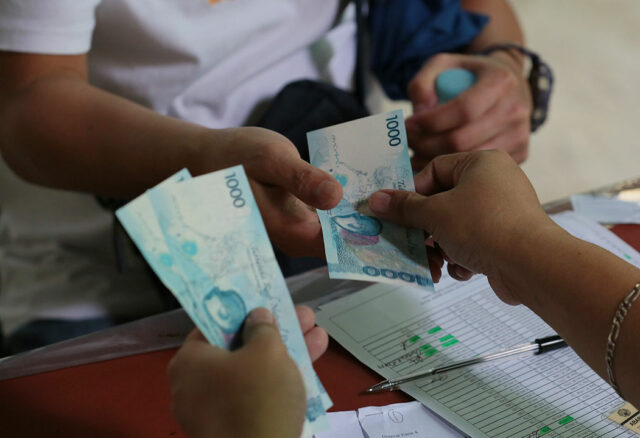
THE National Anti-Poverty Commission on Wednesday called for the integration of government databases to ensure more efficient distribution of aid to beneficiaries under the Assistance to Individuals in Crisis Situation (AICS) program.

During a Senate hearing, Anti-Poverty Secretary Lope B. Santos III said that the integration of the AICS database with the community-based monitoring systems would help streamline the process for beneficiaries.

“This will reduce the documentary burdens to the beneficiaries, and will ensure assistance,” Mr. Santos told a Senate hearing.

The Senate on Wednesday deliberated a proposed measure seeking to institutionalize the AICS program and avoid further cases of misuse and patronage politics.

The agency also pushed for the non-diminution of local social benefit programs, noting that this would augment the AICS program.

“There are already local government units (LGUs) that provide similar assistance, and the AICS should be considered as an augmentation to and not a substitute to the existing local assistance being provided by the LGUs,” Mr. Santos added.

He also called for the strengthening of coordination between the Department of Social Welfare and Development (DSWD) and LGU social workers to hasten the processing of aid for beneficiaries.

“The case study, assessments, and recommendations of LGU social development workers will complement the DSWD personnel on the ground,” he said.

The AICS program provides distressed Filipinos with medical, burial, educational, and transportation aid, along with short term financial aid and psychosocial support. — Adrian H. Halili

DBCC projecting tax revenue to grow 9% per annum until 2030

PHILIPPINE STAR/WALTER BOLLOZOS

THE Development Budget Coordination Committee (DBCC) is projecting 9% growth per annum in tax revenue until 2030, even after assuming weaker than initially expected growth in the near term.

According to DBCC forecasts obtained by reporters on Wednesday, the government eventually intends to generate P6.075 trillion in overall revenue, including non-tax sources, by 2030.

The 2030 projection for overall revenue, if borne out, would represent an increase of 50.11% from the P4.419 trillion raised in 2024.

The projections were arrived at during the DBCC’s December meeting, which also downgraded the Philippine growth outlook through 2027, with the economy still weighed down by the slowdown in government spending and the collapse of confidence following the flood control corruption scandal.

The government slashed its gross domestic product growth target to 5-6% this year, from 6-7% previously. It set a 5.5-6.5% growth goal for 2027.

The government has lowered its revenue targets for this year through 2028 from the original projections contained in the 2026 Budget of Expenditures and Sources of Financing, with weaker economic activity expected to weigh on fiscal performance.

Economic managers said the government is now expected to collect P4.824 trillion this year, about 3.19% less than the P4.983 trillion goal set in June 2025.

For 2027, overall revenue collections are now expected to come in at P5.122 trillion, a 4.55% downgrade from the original target of P5.366 trillion.

The revenue target for 2028 was also cut by 5.86% to P5.568 trillion.

The Bureau of the Treasury’s cash operations report, which includes the December and full-year revenue collections, will be released on March 3.

In the first 11 months of 2025, overall revenue collections rose 1.09% to P4.15 trillion, equivalent to 91.79% of the revised full-year forecast of P4.52 trillion.

This month, the Bureau of Internal Revenue and the Bureau of Customs announced that they missed their targets for 2025 but hope to rebound in 2026. — Aubrey Rose A. Inosante

Tariff on imported rice to stay at 15% until Feb.

PHILSTAR FILE PHOTO

THE Department of Agriculture (DA) said the tariff on imported rice from most favored nations  will remain at 15% until February, with global rice prices not yet at levels that would trigger a higher duty.

Agriculture Assistant Secretary Arnel V. de Mesa told reporters on Wednesday that the benchmark price that will warrant raising the tariff to 20% is $367 per metric ton (MT).

“To trigger a higher 20% tariff, international rice prices must breach the trigger price of $367 per metric ton. Since this has not happened, we have not discussed it yet,” he said.

Under the implementing guidelines of Executive Order (EO) No. 105, rice imports starting this year are subject to a “flexible” tariff scheme that allows duties to rise or fall depending on global prices. The EO permits tariff adjustments in increments of five percentage points, with rates set at a minimum of 15% and a maximum of 35%.

Tariff adjustments are based on the monthly average price of Vietnam 5% broken rice, the grade that accounts for the bulk of Philippine rice imports, as reported by the Food and Agriculture Organization (FAO).

Mr. De Mesa said the FAO’s December price for Vietnam 5% broken rice was $361.3 per metric ton.

He added that the DA decided to retain the P43-per-kilo maximum suggested retail price (MSRP) for imported rice, which was set in July. The DA had earlier considered raising the MSRP to P45 per kilo if tariffs were to rise to 20%.

Meanwhile, the Bureau of Plant Industry reported that between Jan. 1 and 22, around 248,000 MT of imported rice entered the country.

“In January last year, 279,000 MT of imported rice came in. So, for this month (so far), it’s almost the same volume,” Mr. De Mesa said.

He also clarified that the 300,000 MT of rice expected to arrive by the end of February is separate from the projected January import volume. — Vonn Andrei E. Villamiel

GEA for offshore wind could take place in Q3

BUHAWIND.COM.PH

THE green energy auction (GEA) round for offshore wind could take place by the third quarter after the Energy Regulatory Commission sets the ceiling price for project developers next month, Energy Undersecretary Giovanni Carlo J. Bacordo told reporters last week.

“Definitely, there’s going to be a next GEA specific for offshore wind,” Mr. Bacordo said, with the government keen to  unlock the potential of nearly 70 gigawatts (GW) of capacity from identified renewable-energy sites.

The Philippines is hoping to harness electricity from offshore wind farms starting 2028 on the way to generating 35% of its power from renewable energy by 2030.

Last year, the Department of Energy (DoE) launched the first GEA round for fixed-bottom offshore wind power projects, offering an installation target of 3.3 GW.

To date, the DoE has awarded 92 service contracts for offshore wind with a total potential capacity of around 68 GW.

While there is significant potential from upcoming projects, Mr. Bacordo said the constraints are grid and port limitations, resulting in a modest installation target of 3.3 GW.

“That’s why we have to catch up with the grid and with the ports,” he said.

The government has designated Pambujan, Camarines Norte and Sta. Clara, Batangas as ports that will service the industry.

He said the Philippine Ports Authority has committed to finish the repurposing of Pambujan Port by the first quarter of 2027.

Meanwhile, Sta. Clara Port will require a feasibility study to determine its attractiveness to private developers. The project is estimated to cost P3.1 billion, Mr. Bacordo said.

Mr. Bacordo said other ports emerging as candidates to service the offshore industry are Bulalacao, Oriental Mindoro and San Carlos, Negros Occidental. — Sheldeen Joy Talavera

Stiffer regulation of online gaming expected to stall industry’s growth

STOCK PHOTO | Image by NAIPO.DE from Unsplash

THE gaming industry’s growth could stagnate this year in the wake of stiffer regulation imposed by the government, S&P Global said.

“(T)he Philippines may see (its) GGR (gross gaming revenue) dip with declining visitors and regulatory headwinds on online gaming,” S&P Global associate director Flora Chang said in a report on Wednesday.

In the third quarter of 2025, the industry’s GGR slipped 0.11% to P94.51 billion, according to the Philippine Amusement and Gaming Corp.

In August, the Bangko Sentral ng Pilipinas’ ordered electronic wallet companies to remove their payment links to online gambling platforms amid growing concerns about gambling addiction. 

In October, President Ferdinand R. Marcos, Jr. also signed Republic Act No. 12312 or the Anti-POGO Act of 2025 revoking all work permits and visas of individuals in the Philippine Offshore Gaming Operators (POGO) industry.

They signed the official shutdown of offshore gaming hubs in the Philippines.

Analysts have said that modest growth is still possible this year, with online gaming expected to dominate the industry and drive growth further.

However, Ms. Chang said the crackdown may have discouraged the clientele.

“Stricter regulations towards online gambling operators in the Philippines could alter player behavior or increase customer acquisition costs, potentially hindering revenue growth and profitability,” Ms. Chang said.

A law on online gambling is also on the Legislative-Executive Development Advisory Council’s list of 44 priority bills for the 20th Congress.

According to the Development of Economy, Planning, and Development, the online gaming industry accounted for P81.6 billion or 0.37% of gross domestic product in 2024. — Katherine K. Chan

Transport master plan attracts five bids

PHILIPPINE STAR/MIGUEL DE GUZMAN

THE Department of Transportation (DoTr) said five companies have submitted technical bids to prepare the Philippine Transportation System master plan.

The DoTr said the five bidders were all joint ventures: Systra SA,  Systra Philippines Inc., Haskoning Nederland BV, and Haskoning Philippines, Inc.; Tecnica y Proyectos SA (TYPSA), SMEC International Pty. Ltd. and Palafox Associates; IDOM, and INCEO; Artelia Group, Egis Villes ET Transports, Bogazici Proje Muhendislik AS, Systema Consulting SA, and Transporti E Terrirorio SRL; and Ove Arup & Partners Hongkong Ltd. and Ramboll Pte. Ltd.

According to the request for expressions of interest, the DoTr sought consulting services for the formulation of the Philippines Transportation System Master Plan. 

The winning consulting service will prepare the master plan which runs until 2055; organize a transport data management system and data observation; and enhance the implementation competencies of the DoTr and the departments of Public Works and Highways, Economy, Planning, and Development and other agencies.

The DoTr said it obtained $44 million from the Asian Infrastructure Investment Bank to fast-track infrastructure studies, with some of the financing allocated to consulting services.

The winning contractor will be given 30 months to complete the project, the DoTr said.

Interested parties must have completed at least two multinational, national, or regional transport master plans within the last 15 years. Each plan should cover multiple transport modes, including road, railway, water, and air. — Ashley Erika O. Jose

SBCorp. allocates P2B in loans for female-run firms

STOCK PHOTO | Image by Benzoix from Freepik

THE Department of Trade and Industry (DTI) said the Small Business Corp. (SBCorp.), has allocated P2 billion this year for a loan program targeting women-led enterprises.

“We continue to support women entrepreneurs seeking local and global expansion, while also opening opportunities for those ready to expand, create jobs, and strengthen local economies,” Trade Secretary Cristina A. Roque said.

“We understand that capital is a challenge to many, and the DTI through SBCorp. has tailored programs to meet the needs of our MSMEs, like this Women’s Enterprise Fund (WEF),” she added.

Such funding ensures continued support for female entrepreneurs that are ready to grow, hire, and increase their economic impact and profit.

“The fund aims to provide capital to start and expand their business, recognizing their contribution to economic growth,” the DTI said.

Under the WEF, women-owned and -led micro, small and medium enterprises can access loans between P30,000 and P20 million, with terms of up to five years.

Loans will have a one-year grace period, while collateral requirements are waived for loans of up to P5 million. — Justine Irish D. Tabile

Tech-driven exports expected to boost Asia-Pacific growth

REUTERS

ECONOMIES in the Asia-Pacific (APAC) region could gain some growth support from the boom in technology-driven exports, Fitch Ratings said, though tariffs remain a source of uncertainty.

“Fitch Ratings expects continued growth in AI-related exports in 2026, but the fading of front-loaded orders for other products and unfavorable base effects will likely weaken GDP (gross domestic product) growth rates,” Fitch Ratings Senior Director Kathleen Chen and Director George Xu said in a Jan. 27 report. 

According to Fitch, the Philippines had the third-best export performance in the region last year, behind Taiwan and Vietnam.

In 2025, Philippine exports were valued at $84.41 billion, up 15.2%, according to the Philippine Statistics Authority.

This was a turnaround from the 0.5% decline seen the previous year and exceeded the government’s estimate of a 2% drop.

Electronic products remained the Philippines’ top export. They grew 17.6% to $45.96 billion.

Global demand remains high for semiconductors, driving Philippine exports of such products up 18.7% at $34.62 billion last year.

However, Fitch Ratings warned that US tariffs could dampen the supposed growth boost from electronics exports.

“In addition, potential sectoral tariffs are a major risk, including Section 232 duties on semiconductors that make up a sizeable share of APAC exports to the US,” Ms. Chen and Mr. Xu said.

“The US administration imposed 25% duties on certain advanced AI chips albeit with multiple exemptions in January 2026 and is considering broader tariffs on semiconductors and related products,” they added.

Philippine goods entering the US have been charged a 19% tariff since Aug. 7. The US also recently imposed a 25% tariff on certain semiconductors such as advanced artificial intelligence (AI) chips.

However, analysts have said that the new levy will not directly impact Philippine manufacturers as most of the country’s semiconductor exports are legacy chips covered by the World Trade Organization Information Technology Agreement.

“Although new US tariffs have been imposed on certain advanced AI chips, the impact on the Philippines’ semiconductor exports is expected to be minimal,” Metropolitan Bank and Trust Co.’s Research and Market Strategy Department said in a report.

“We expect semiconductor exports, along with other manufactured and agriculture-based products, to sustain momentum in 2026,” it added. — Katherine K. Chan

Philguarantee says P640B in loans covered by its guarantee products

THE Philippine Guarantee Corp. (Philguarantee) said it has provided guarantee support for nearly P640 billion worth of loans since the end of 2019.

In a social media post on Wednesday, the state-run firm said its guarantees were coursed through 200 partner lending institutions.

“As we look ahead of the year, Philguarantee remains a trusted, reliable, and responsive partner, helping financial institutions lend with confidence, and enabling business, homeowners, and communities to move forward,” Philguarantee said.

It said its guarantees enabled lending to socialized and low-cost housing projects that built 640,804 units, supported 327,163 small farmers and fisherfolk, and assisted 71,288 MSMEs (micro-, small-, and medium-sized enterprises),” Philguarantee said.

The company facilitates by pledging to cover debts if borrowers default, and is active in supporting credit access to MSMEs, exporters, infrastructure and energy developers, farms, housing, tourism, and other industries.

Philguarantee remitted P1.28 billion in dividends to the Treasury in 2024. Its revenue rose 103% to P5.32 billion in 2023, generated primarily from guarantee fees and premiums, commitment fees, and the sale or rental of real estate. — Aubrey Rose A. Inosante

ADVERTISEMENT
ADVERTISEMENT