Home Blog Page 86

InLife market share now at 7.5% 

INSULAR LIFE CORPORATE Center in Muntinlupa City — INLIFE

INSULAR LIFE Assurance Co., Ltd. (InLife) has achieved a 7.5% market share in the Philippines’ life insurance industry following strong new business growth last year.

The insurer saw its new business annual premium equivalent (NBAPE) increase by 16% last year, outpacing the industry’s 10.7% expansion, it said in a statement on Monday.

“InLife attributes this sustained success to the synchronized performance of its three core distribution pillars: Agency Sales, which was fueled by manpower and sustainable production growth and a focus on long-term protection products; Bancassurance, which expanded its distribution capacity, and activated new growth engines; and Corporate Solutions with the acquisition of Generali Philippines, now InLife Benefits, signaling a major shift in how Philippine enterprises approach employee protection,” it said.

The insurer’s acquisition of Generali Life Assurance Philippines, Inc. was completed in May 2025.

It said it expects InLife Benefits to continue to remain a key driver for the rest of the year.

“InLife is doubling down on its specialization strategy. It fully divested its interests in its former HMO subsidiary (iCare) earlier this year to focus exclusively on its core mission: delivering world-class life and health insurance and comprehensive employee benefits.”

The insurer sold its shares in Insular Health Care, Inc. (iCare HMO) to Singaporean company Value-Based Healthcare PF Pte. Ltd. in January this year.

“Our growth story is one of focus. Through specialization, we can offer our customers and especially Philippine employers a unified, seamless experience,” InLife President and Chief Executive Officer Raoul Antonio E. Littaua said.

The insurer added that it will continue to prioritize capital stability and the expansion of its digital infrastructure to support its distribution network.

InLife’s premium income stood at P18.46 billion last year, data from the Insurance Commission showed. It booked a net profit of P2.66 billion. — Aaron Michael C. Sy


Calidad Realty expands operations, targets national market

STOCK PHOTO | Image by Gray StudioPro from Freepik

CALIDAD REALTY said it is expanding its operations as it seeks to position itself in the national real estate market.

The brokerage, which started in 2020 during the pandemic, has since grown into a multi-million-peso firm, it said in a statement on Monday.

“In real estate, it’s never just about transactions — it’s about people, trust, and the future they are building,” Calidad Realty Founder and President Zaldy Aquino Herrera, Jr. said.

The company said it started as a small team and has since expanded its operations.

“We started Calidad with the goal of creating opportunities during uncertain times. Today, we celebrate not just growth, but the community we’ve built along the way,” Mr. Herrera said.

Over the past five years, the company said it has received several sales awards, conducted roadshows in North America and the Middle East, and entered into partnerships with developers.

Its property portfolio now totals billions of pesos, with a network of accredited projects across the country, it said.

The company also outlined expansion plans, including the launch of the Elite Group, a team of property specialists.

It also cited the Calidad Foundation, its social development arm.

“As Calidad Realty looks ahead, the company remains anchored in its founding philosophy: delivering quality service and matching clients with properties they truly deserve,” it said. — Alexandria Grace C. Magno

Italy investigates Sephora over marketing cosmetics to children

MAKE-UP retail giant Sephora is under investigation in Italy over marketing adult beauty products to children, which the Italian competition authority says is fueling an obsession with skincare among minors, including some under 10 years old.

The authority, AGCM, said it was the first European regulator to open an investigation over concerns that LVMH-owned brands Sephora and Benefit Cosmetics are using very young micro-influencers on social media to promote premature use of adult cosmetics. This, it said, is encouraging compulsive purchasing of face masks, serums, and anti-ageing creams, behaviors it linked to “cosmeticorexia” — an unhealthy fixation with skincare among minors.

Sephora, Benefit Cosmetics, and LVMH Perfumes & Cosmetics Italy said in a statement that they “operate in strict compliance with the applicable regulations” and will fully cooperate with the authorities. They declined to give any further comment.

Sephora, which has more than 20 million Instagram followers and 2.1 million followers on TikTok, has been at the center of the “Sephora Kids” social media trend, which documents children making cosmetic “smoothies” in stores and sharing their skincare routines or Sephora “haul” purchases in videos.

The “Haul from Sephora for Kids” tag on TikTok shows hundreds of videos of children as young as five buying make-up and skincare products in Sephora stores.

“The investigations were opened over concerns that important information — such as warnings and precautions for cosmetics not intended for, or tested on, minors — may have been omitted or presented in a misleading manner,” AGCM said in a statement, adding that children under the age of 10 to 12 were among those the brands are targeting.

Frequent use of a wide range of cosmetics by minors without proper awareness may be harmful to their health, the regulator said.

AGCM officials and the Italian financial police carried out inspections at the premises of Sephora Italia, LVMH Profumi e Cosmetici Italia, and LVMH Italia on Thursday last week, the authority said. — Reuters

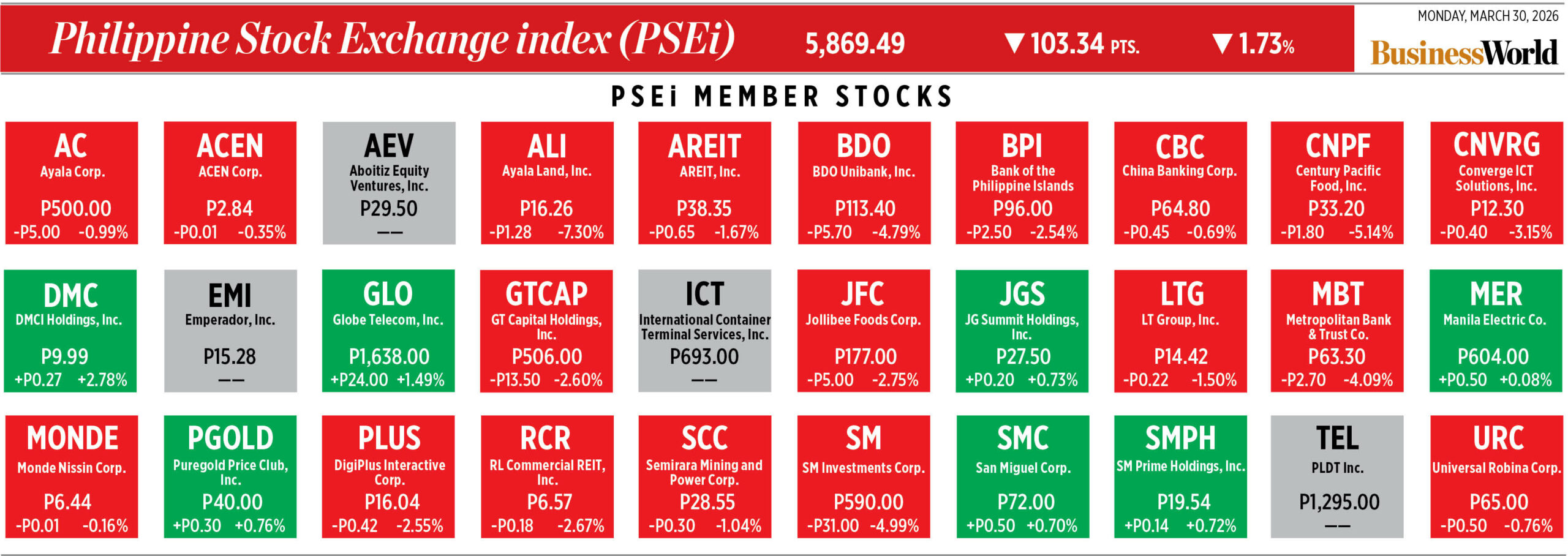
How PSEi member stocks performed — March 30, 2026

Here’s a quick glance at how PSEi stocks fared on Monday, March 30, 2026.


PHL tops ranking of outsourcing destinations

PETR MAGERA-UNSPLASH

By Beatriz Marie D. Cruz, Reporter

THE PHILIPPINES has topped a global ranking for outsourced talent, winning points for strong English proficiency and competitive labor costs, according to Ataraxis, a US hiring platform.

The company’s Global Outsourcing Talent Index, which  evaluated 193 countries, classified the Philippines as an “elite sourcing hub” and described the country as the “most attractive destination for companies hiring global remote talent.”

Rounding out the rest of the top 10 were Malaysia, India, Chile, South Africa, Nigeria, Peru, Indonesia, Argentina, and Romania. 

The index evaluates countries across five key factors that influence global hiring: labor cost (52.5%), English proficiency (20%), talent availability (17.5%), digital infrastructure (5%), and business, legal, and political stability (5%).

According to the report, the Philippines scored 96 on labor cost; 90 on English proficiency; 90 on talent depth; and 70 on digital infrastructure. Its lowest rating (60) was for business stability, where it was classified as “moderate risk.”

Jack Madrid, president and chief executive officer at the IT & Business Process Association of the Philippines, said the ranking represents the industry’s value proposition to global firms. 

“A talent base of 1.9 million digital Filipino workers, validated on a global scale, signals that the country can support both scale and more complex work, making it an attractive destination for companies looking to expand or diversify their operations,” he said in an e-mail.

To retain its position, the industry must focus on upskilling talent to climb the information technology-business process management value chain.

“This requires sustained investment and strong coordination between government and industry to keep policies, education, and training aligned with global demand,” Mr. Madrid said.

Meanwhile, the Philippines’ low stability score reflects concerns about policy consistency and exposure to external shocks, according to Philippine Institute for Development Studies Senior Research Fellow John Paolo R. Rivera.

“The government needs to strengthen policy predictability and regulatory clarity as investors value stable rules, faster approvals, and less bureaucratic friction,” he said via Viber.

Mr. Rivera also cited the need to improve the reliability of power, internet, transport, and cybersecurity infrastructure.

Managing inflation, a stable currency, and credible fiscal policy would also help reduce perceived risks, he said.

“Strengthening governance and ease of doing business, including contract enforcement and institutional coordination, can significantly improve investor confidence and lift the country’s business stability score,” Mr. Rivera said.

FTI seeking buyer support for Mindoro onion growers

PHILSTAR FILE PHOTO

FOOD TERMINAL, INC. (FTI) said it is urging private buyers to join in procuring onions from Occidental Mindoro farmers, saying it has limited capacity to prop up the market on its own.

In a statement on Monday, the government-controlled food processing and logistics company said its own procurement activities are intended to support growers in the face of downward price pressure during the harvest.

FTI Sales and Distribution Manager Edoard B. Medalla said in the statement that the company is working with private investors to expand buying activity.

Mr. Medalla said the partners it has tapped bought around 6,000 27-kilo bags of onions at P32 to P35 per kilo, significantly higher than the prevailing farmgate price of about P22 per kilo.

The average production cost in Occidental Mindoro is estimated at P18 to P24 per kilo, indicating that current farmgate prices are below break-even levels for some farmers.

FTI estimated logistics costs of about P8 per kilo, bringing the effective cost of transporting onions to cold storage facilities in Nueva Ecija to around P40 to P43 per kilo.

Mr. Medalla said Occidental Mindoro has limited cold storage capacity and suffers from unspecified operational constraints.

“These are perishable goods, whose quality deteriorates quickly after harvest,” he said. “This is the first time we entered the onion market in Mindoro, so we have to rely on experts we have engaged in Nueva Ecija to maintain quality.”

Mr. Medalla said Occidental Mindoro’s estimated output is about 3.2 million bags.

“We cannot guarantee buying (the entire harvest), but we will try to support prices at around P35 a kilo, depending on quality and storage availability,” he said.

Meanwhile, in Nueva Ecija, FTI-backed buyers have procured about 110,000 bags at an average price of around P40 per kilo, utilizing part of the 190,000-bag cold storage capacity contracted by the agency.

Agriculture Secretary Francisco P. Tiu Laurel, Jr. said targeted procurement and storage are critical to managing price volatility without distorting market dynamics.

“Strategic buying and storage allow us to support producers during periods of oversupply, while preserving a buffer to prevent sharp increases in retail prices,” he was quoted as saying in the statement.

The Department of Agriculture (DA) said onion production in Occidental Mindoro has expanded significantly, with the planted area increasing to 8,637 hectares this season from 6,000 hectares in 2025.

The expansion is expected to yield an additional 27,000 metric tons, equivalent to about half of last year’s estimated national supply shortfall.

The DA said the increase in output, coupled with limited storage capacity, has placed downward pressure on farmgate prices and given traders greater leverage in price-setting.

Occidental Mindoro currently has eight cold storage facilities with the capacity to handle only about 16% of the projected harvest.

The DA said that even with a planned “mega” cold storage facility expected to be operational next year, total capacity is projected to cover only about a quarter of output. — Vonn Andrei E. Villamiel

PEZA expects P7.3B in export revenue from Singapore maker of manufactured houses

SCIENCEPARK.COM.PH

SINGAPORE’s Total Advanced Future Technology Pte. Ltd. (TAFT) is expected to generate around $120 million (P7.29 billion) in export revenue annually from its upcoming manufacturing facility in Malvar, Batangas, the Philippine Economic Zone Authority (PEZA) said.

In a Facebook post on Monday, PEZA said the initial investment in the facility is P3.6 billion. It will set up at the Light Industry and Science Park IV (LISP IV) – Special Economic Zone.

The company is set to sign its registration agreement with PEZA immediately after a presidential proclamation is issued, it said.

“With the presidential proclamation, the LISP IV expansion will serve as a catalyst for innovation, employment, and competitiveness, reinforcing the Philippines’ potential as a strategic hub for forward-looking investments,” PEZA Director General Tereso O. Panga said.

The first phase of the project will take up 13 hectares, cover TAFT’s manufacturing and export operations in the Philippines.

TAFT will make high-tech, climate-resilient houses for the Japanese market and will also engage in the packaging and export of complete housing products, including components, parts, and accessories.

The company also plans to establish a warehouse facility after the presidential proclamation is finalized.

PEZA noted that TAFT’s registration is expected to boost the Philippines’ role as a destination for high-value exports while supporting job creation.

PEZA’s 2026 goal for ecozone proclamations is 30.

As of February, PEZA approved 52 new and expansion projects expected to take in P35.37 billion in investment. A year earlier, it had approved 39. — Beatriz Marie D. Cruz

Fish landed at regional ports up 10% in February

Buckets of fish are sold at the Navotas fish port in this file photo. — PHILIPPINE STAR/MICHAEL VARCAS

THE Philippine Fisheries Development Authority (PFDA) said fish landed at regional fish ports totaled 39,267 metric tons (MT) in February, up 9.91% from a year earlier.

In a statement, the PFDA said the General Santos Fish Port Complex posted the highest volume for the month, with 19,861 MT of fish landed.

The Navotas Fish Port complex landed 13,964 MT, up 53.75% from a year earlier.

The PFDA said the Davao Fish Port Complex posted the largest year-on-year increase, with volume more than doubling to 614 MT.

Fish unloaded at the Iloilo Fish Port Complex rose 9.32% in February to 2,127 MT.

Fish landed at the Lucena Fish Port Complex in Quezon grew 13.04% to 1,830 MT, while fish landed at the Zamboanga Fish Port Complex dipped slightly to 529 MT.

The Bulan Fish Port Complex in Sorsogon posted landed volume of 342 MT for the month. — Vonn Andrei E. Villamiel

PNOC-EC issued permit for emergency imports

THE Bureau of Internal Revenue (BIR) said it issued a special permit to fast-track petroleum product imports by the Philippine National Oil Co. Exploration Corp. (PNOC-EC).

In a statement on Monday, the BIR said the special permit was issued by the BIR’s Large Taxpayer Service (LTS) as a measure linked to the declaration of the national state of energy emergency.

“PNOC-EC had informed the BIR that it would immediately undertake imports of petroleum products as an emergency measure,” the BIR said in a statement.

“In response, the bureau, through the LTS, worked with PNOC-EC on the documentary requirements to support expedited processing on the bureau’s end,” it added.

President Ferdinand R. Marcos, Jr. in Executive Order (EO) No. 110, declared last week a state of national energy emergency, giving the government expanded powers to obtain fuel and shield the economy from rising oil prices.

BIR Commissioner Charlito Martin R. Mendoza said the bureau will continue working closely with PNOC-EC.

“(This is) to ensure the timely processing of requirements for current and future emergency fuel imports, in support of the whole-of-government response authorized under EO 110 to help safeguard the energy supply,” he added.

On Friday, the Department of Energy (DoE) said PNOC-EC had arranged to ship in 1.04 million barrels of diesel.

Of the total, 142,000 barrels landed on March 26, while other shipments are expected in April. — Justine Irish D. Tabile

Crisis seen adding urgency to RE transition

ROSALINA PALANCA-TAN

THE energy emergency highlights the need for the Philippines to accelerate its shift away from imported fossil fuels to renewable energy (RE), according to the Institute for Climate and Sustainable Cities (ICSC).

In an analysis, the think tank said heavy reliance on fossil fuels exposed the Philippines to global price volatility.

“The situation also puts the spotlight on the clear and massive opportunity to transform the energy system for our archipelago with locally-driven, fit-for-purpose solutions that optimize the abundance of renewable energy resources with available technology, building a more affordable, reliable, and secure power system for all Filipinos in the on-grid and off-grid areas,” the group said.

While coal is the leading fuel in power generation, the Philippines has set targets for the share of RE to 35% by 2030 and 50% by 2040.

Last week, President Ferdinand R. Marcos, Jr. issued an executive order declaring a state of national energy emergency due to global fuel supply disruptions and rising oil prices.

While the measures cited in the order are necessary to allow the use of government resources to stabilize supply, these are still not enough, ICSC said.

Since the impact of the crisis caused by the Persian Gulf crisis will be long-term, the ICSC said the Philippines must pursue structural reforms that reduce its vulnerability to global instability.

With the new entry of new capacity employing various renewable energy technologies, the Philippines is in a strong position to deploy local solutions and reduce reliance on imported fuel, the think tank said.

Since electricity price increases are fully and automatically passed on to consumers, the ICSC said that risks must be shared among the concerned stakeholders.

“Authorities should review pricing mechanisms to ensure that generators, suppliers, and utilities share in fuel price risks, that efficiency improvements are incentivized, and that consumers are not fully and immediately exposed to sudden price spikes,” it said.

“Consistent, fair and firm oversight of energy markets and enforcement of competition rules will ensure that consumers are adequately protected while the power system remains reliable,” the ICSC said.

To further ensure energy security, the think tank said the Philippines must also expand its strategic petroleum reserves, raise minimum oil inventory levels, and set clear protocols for energy conservation during emergencies.

The ICSC also cited the role of rooftop solar systems in lowering electricity bills and reducing demand on the grid. — Sheldeen Joy Talavera

Chambers back G2G oil deals, price stabilization measures

PHILSTAR FILE PHOTO

BUSINESS GROUPS urged the Philippines to pursue government-to-government (G2G) oil procurement deals with Russia, Indonesia, and India, and expressed support for price stabilization measures to protect consumers from rising fuel prices.

In a joint statement, the groups also asked the government to keep interest rates steady, expand subsidy programs for transport groups, and promote domestic industry and Philippine-made products.

“We recognize that volatile global oil prices pose serious threats to our nation’s economic stability and the welfare of our people,” they added.

According to the Department of Energy (DoE), gasoline prices have exceeded P130 per liter, with diesel prices posting a high of P144.20.

The business groups pledged to implement aggressive energy-saving measures and adopt flexible work arrangements to reduce transport and fuel demand.

They also committed to invest and accelerate the adoption of alternative energy solutions — particularly solar power — to reduce Philippine dependence on imported fuel while strengthening energy security over the long term.

The joint statement was signed by the Management Association of the Philippines, Makati Business Club, Philippine Chamber of Commerce and Industry, Federation of Philippine Industries, and the Federation of Filipino-Chinese Chambers of Commerce and Industry, Inc. — Beatriz Marie D. Cruz

PPP Center says oil crisis not yet affecting deal flow

PPP.GOV.PH

By Justine Irish D. Tabile, Senior Reporter

THE Public-Private Partnership (PPP) Center said the war in the Middle East has had no impact so far on interest in PPP contracts, though it is less certain whether sentiment will hold the longer the fighting goes on.

“In terms of the appetite for future PPPs, I do not think in the near future there will be an impact, considering that at the moment we have so much in the pipeline and we have yet to process those, get them approved, and deliver them,” PPP Center Executive Director Rizza Blanco-Latorre told BusinessWorld.

“If (the war is) prolonged, yeah, maybe we will see (an impact), but at least in the near future, there is nothing that we anticipate to be (affecting) the number of PPP projects coming to the center,” she added.

As of March 27, the PPP Center had 250 projects in the pipeline, valued at P3.26 trillion.

The PPP Center said 166 projects worth P3.12 trillion will be implemented by the National Government, while 84 projects worth P137 billion will be overseen by local government units (LGUs).

195 projects are solicited or were initiated by the government, while the remaining 55 projects are unsolicited.

Railways accounted for P1.97 trillion of the project value, followed by property development (P364.99 billion) and land transport (P271.22 billion).

Projects located in the National Capital Region amounted to P2.17 trillion, followed by Central Luzon (P1.26 trillion) and the Ilocos Region (P827.76 billion).

She said the main concern at the moment is to evaluate the impact of the war on operational projects.

“For example, toll roads are giving discounts, and Metro Rail Transit (MRT) Line 3 is giving discounts; many of those are PPPs, so we are checking how that would impact the existing contracts, if any,” she added.

She said the ideal scenario would be to complete ongoing projects as quickly as possible.

“The longer you delay (projects under implementation), the more the uncertainties grow and anxieties increase, so you don’t know how this will all end up. Faster is better, and I think that is also (everyone else’s thinking), to deliver the projects as fast as possible,” she said.

As of March 27, the PPP Center classified 287 projects worth P3.57 trillion as being in the implementation stage.

ADVERTISEMENT
ADVERTISEMENT