Home Blog Page 836

PHL steps up recovery of billions from anomalous flood control programs

PHILIPPINE STAR/MIGUEL DE GUZMAN

By Erika Mae P. Sinaking and Kenneth Christiane L. Basilio, Reporters

THE GOVERNMENT has begun coordinating efforts to recover billions of pesos in assets tied to anomalous infrastructure projects spanning past and present administrations, officials said on Thursday.

The Independent Commission for Infrastructure (ICI) led an interagency meeting on Thursday that gathered officials from the Office of the Ombudsman, Department of Justice, Department of Public Works and Highways (DPWH), Office of the Solicitor General, Anti-Money Laundering Council (AMLC) and several other agencies to exchange information and align recovery measures.

“This is a collective approach on how we can recover assets that may have been illegally obtained from public funds,” ICI Executive Director Brian Keith F. Hosaka told a news briefing.

He said the AMLC has frozen P4.6 billion to P5 billion in assets across almost 280 bank accounts flagged in investigations. Forfeiture proceedings — independent of criminal prosecution — are also being prepared before the Court of Appeals.

The task force is expected to meet regularly to expedite recovery measures, he added.

Public Works Secretary Vivencio B. Dizon said a review is under way for contracts awarded in the past decade including those under the Duterte administration. He said special attention is being paid to deals involving Pacifico F. Discaya II and his wife Cezarah Rowena C. Discaya, contractors alleged to have orchestrated a large-scale flood control scam.

The Discayas’ firm, St. Gerrard Construction, partnered in 2017 with CLTG Builders, a company linked to Senator Christopher Lawrence “Bong” T. Go through his father Deciderio L. Go.

Following the Discayas’ refusal to cooperate with the ICI, citing their right against self-incrimination, Mr. Dizon said Ombudsman Jesus Crispin C. Remulla had instructed him to review all related contracts and joint ventures.

At a separate briefing, Mr. Go denied any involvement with the Discayas or the corruption scandal. “I welcome any investigation,” he said. “Let the facts speak for themselves. I am not involved in any anomalies.”

“I support any investigation by the Ombudsman, and I do not know the Discayas,” he added.

ICI Chairman Andres B. Reyes, Jr., a former Supreme Court associate justice, cited the importance of restitution alongside prosecution. “All those persons responsible for this may be prosecuted and jailed, but to completely heal our nation, justice is not enough. We need restitution,” he said in a speech.

The ICI was formed earlier this year to trace, investigate and recover public funds lost to corruption in infrastructure development.

‘CONFLICT OF INTEREST’
Meanwhile, Batangas Rep. Leandro Antonio L. Leviste said Mr. Dizon should disclose all alleged ties to construction contractors, including those of his appointees, citing connections surfacing amid the fallout from a widening flood control scandal.

The lawmaker told reporters he had heard talk linking Mr. Dizon and his team to contractors, warning of potential conflicts of interest as the government cracks down on corruption tied to the DPWH’s anomalous flood-control deals.

He offered no proof during his hour-long briefing, saying the claims came from fellow lawmakers. He took a call during the press conference and later said the person on the line was among those accused of having ties.

“I’ve heard talk, including in Congress, that Secretary Dizon and his team have connections with DPWH contractors, and that certain members… are, in fact, contractors,” he said.

“If it’s true that new appointees in DPWH have interests in companies that do business with DPWH, are we sure that there will be no conflict of interest in the awarding of contracts under the new leadership?” he asked.

In response, Mr. Dizon committed to purge the agency from top to bottom following claims that some undersecretaries are connected to flood control contractors.

“We have started and we will cleanse the department from top to bottom,” he separately told a news briefing. “I am open to any information you can provide… My commitment is to fire that person immediately and if needed, we file cases.”

President Ferdinand R. Marcos, Jr. last month appointed Mr. Dizon to lead the Public Works department, which has been plagued by allegations of widespread corruption following a multibillion-peso flood control scandal in the flood-prone country.

He has since ordered an agency cleanup and cut the department’s 2026 budget by P255 billion, citing corruption concerns over locally funded flood control deals. — with Ashley Erika O. Jose


Marcos counts on e-vouchers to end hunger by 2027

PHLSTAR FILE PHOTO

PRESIDENT Ferdinand R. Marcos, Jr. on Thursday said his administration would scale up the use of electronic food vouchers under its anti-hunger project, a key part of his plan to eradicate hunger among the country’s poorest families by 2027.

Speaking at the launch of the Reducing Food Insecurity and Undernutrition with Electronic Vouchers (REFUEL) project in Manila City, Mr. Marcos said the shift to digital vouchers is helping streamline aid distribution, improve targeting and ensure families get proper nutrition.

“We’re no longer giving just rice and sardines — we’re helping families afford balanced, healthy meals,” he said in Filipino, according to a transcript from his office. “In this program, food assistance is combined with nutrition education — understanding what kinds of food we need to eat to make our bodies strong and our health resilient.”

The P74-billion REFUEL program is supported by the Asian Development Bank, Agence Française de Développement and the Organization of the Petroleum Exporting Countries (OPEC) Fund.

It expands the Social Welfare department’s anti-hunger program to cover 750,000 food-poor households, up from 300,000 beneficiaries.

“The REFUEL project reflects our joint commitment to design evidence-based, sustainable programs that respond to the needs of Filipino families and promote inclusive growth,” Social Welfare Secretary Rexlon T. Gatchalian said in a separate statement.

The government plans to integrate electronic benefit transfer cards with mobile payment platforms like GCash to simplify transactions and reduce administrative costs.

Each recipient gets P3,000 in monthly electronic food credits through benefit transfer cards usable at accredited partner retailers.

The President said the state’s anti-hunger program has lowered hunger among beneficiary households to 41.5% in March from 48.7% a year earlier.

“This program started with us using small notebooks… Now, we’ve gone high-tech. Everything can be done on the computer,” he said.

Hunger among Filipino families dropped to 16.1% in June, equivalent to about 4.6 million households, according to the Social Weather Stations (SWS).

The reduction in involuntary hunger — defined as having nothing to eat at least once in the past three months — was most notable in Mindanao, while modest improvements were seen in other regions.

The anti-hunger program combines food assistance, technology and nutrition education to reduce food insecurity and improve public health outcomes sustainably.

Beneficiaries are also required to participate in productivity enhancement sessions designed to equip them with skills and prepare them for potential livelihood opportunities.

The program likewise includes a nutrition education component that encourages behavioral change and promotes healthier eating habits among participants. — Chloe Mari A. Hufana

Halt to online visa plan for Chinese sought

BW FILE PHOTO

A PHILIPPINE lawmaker on Thursday called on President Ferdinand R. Marcos, Jr. to suspend a newly announced plan allowing Chinese nationals to apply for tourist and business visas online, warning it could open the door to espionage and criminal activity amid escalating tensions with Beijing.

In a statement, Cagayan de Oro Rep. Rufus B. Rodriguez said the proposed electronic visa (e-visa) system could make it “more convenient” for Chinese spies and criminals to enter the country. He criticized the initiative as poorly timed, given rising security concerns in the South China Sea.

“I am strongly opposed to this plan of our ambassador,” he said, referring to Philippine Ambassador to China Jaime A. FlorCruz, who endorsed the rollout.

The Department of Foreign Affairs (DFA) on Wednesday said the Philippine Embassy in Beijing would implement the e-visa system for Chinese applicants, part of what it described as “continuing efforts to strengthen people-to-people exchange and facilitate trade and tourism.”

Under the policy, Chinese nationals may apply online for a single-entry, 14-day, nonextendible visa for tourism or business. Approved travelers will be limited to entry via the Ninoy Aquino International Airport or Mactan-Cebu International Airport.

Mr. Rodriguez argued that national security risks outweigh potential tourism benefits and urged a return to “a stringent process that will require personal appearance and thorough vetting of visa applicants and their records.”

The Chinese Embassy in Manila did not immediately respond to a request for comment.

Concerns over Chinese intelligence operations in the Philippines have intensified in recent months. In August, former Senator Panfilo M. Lacson warned of a widespread espionage network allegedly operated by China’s People’s Liberation Army, citing the presence of suspected sleeper agents in the country.

Earlier this year, Philippine authorities arrested several Chinese nationals on suspicion of spying on military installations and government facilities.

Maritime tensions between the Philippines and China have also deepened, with repeated confrontations near disputed reefs and shoals in the South China Sea. Manila has accused Beijing of aggressive incursions into Philippine waters, while reaffirming its alliance with the US and other regional partners. — Kenneth Christiane L. Basilio

Canada grants P26-M aid to PHL

A car was submerged in flood water near the corner of Mother Ignacia and Sgt. Esguerra street in Barangay South Triangle, Quezon City after a heavy downpour, Aug. 30. — PHILIPPINE STAR/MIGUEL DE GUZMAN

CANADA on Thursday said that it will provide C$650,000 (P26 million) to support the Philippines’ emergency relief operations, Canada’s Secretary of State said, following typhoons and consecutive earthquakes in the country.

“The Philippines is especially vulnerable to natural disasters, and Canada stands with its people as they face the impacts of these recent disasters,” Canadian Secretary of State Randeep Sarai said in a statement from the Canadian Embassy in Manila.

“This support will help provide some relief, and we will continue to explore additional ways to help as needed,” he added.

The Canadian government said that it would allocate C$350,000 to World Vision Canada to provide relief items and emergency shelter, protection services and water, and sanitation and hygiene services, through the Canadian Humanitarian Assistance Fund.

It added that C$250,000 would be used to support the Philippine Red Cross’ relief operations in Cebu.

The remaining C$50,000 will be used to support the distribution of dignity and hygiene kits and emergency shelter through the non-profit group Angat Pinas, Inc.

“The Philippines has faced multiple natural disasters, including a tropical cyclone and earthquakes, which have resulted in the loss of life, as well as damage to homes and infrastructure, impacting local communities and economies,” the embassy said.

It added that Canada has also offered to deploy relief supplies from its emergency stockpiles prepositioned in the region.

Successive earthquakes rocked various parts of the country recently, causing death and extensive property damage. — Adrian H. Halili

DILG wants to lead Nat’l ID rollout

PHILIPPINE STAR/ MICHAEL VARCAS

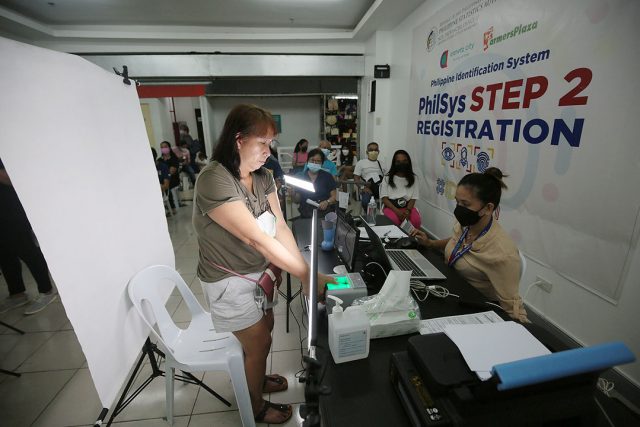
THE Department of the Interior and Local Government (DILG) on Thursday said it is seeking to take over the rollout of the Philippine Identification System (PhilSys), or National ID cards, noting current backlogs.

In a Senate budget hearing, DILG Secretary Juanito Victor “Jonvic” C. Remulla, Jr. said that he is seeking congressional support for the agency to implement the National ID program.

“If I can suggest, if the committee can capacitate DILG to implement the National ID program. We have the sufficient amount of human resources to implement such a program up to the barangay level,” he told senators.

“If you give us the money, we’ll do it in a year,” he added.

Mr. Remulla noted that the current implementation of the ID program by the Philippine Statistics Authority (PSA) is only limited.

“The problem with the current system that we put is that it is the PSA who is limited in its capacity to reach out to the furthest barangays,” he said.

The agency currently handles the implementation of the PhilSys ID program. In January, the agency said that it had a backlog of 36 million National ID cards.

“It’s nothing impossible that we can’t do,” he said. “So, it’s something that if you allow us to do it, then we will pursue it with vigor so that we can have a safer system for our country.” — Adrian H. Halili

DBM OKs P3.4B for PNP bonus

PHILIPPINE STAR/EDD GUMBAN

A P3.39-billion fund release was approved by the Department of Budget and Management (DBM) to fund the payment of the 2023 performance-based bonus for police officials and personnel.

In a statement on Thursday, the DBM said each Philippine National Police (PNP) official and personnel will receive a performance-based bonus equivalent to 45.5% of their monthly basic salary as of end-2023.

“This is a big help for our police officers and their families. Whether it goes toward buying food, additional tuition for their children, household expenses—or however they choose to use it—the important thing is that they feel we value their sacrifice,” Budget Secretary Amenah F. Pangandaman said in Filipino.

The DBM added that those in the first, second, and third levels should have at least a “very satisfactory” rating under the Civil Service Commission-approved Strategic Performance Management System.

The funds will be sourced in the Miscellaneous Personnel Benefits Fund under the 2025 General Appropriations Act.

Meanwhile, the DBM on Tuesday formally launched the Project Managed Intelligent Network for Advanced Insights (MINAI), an artificial intelligence (AI)-enabled centralized platform that handles legal, budget, at administrative documents.

Through the AI chatbot developed under Project MINAI, agency personnel gain faster access to validated, up-to-date information critical for decision-making. — Aubrey Rose A. Inosante

Education, farming keys to poverty reduction, VP says

VICE-PRESIDENT Sara Duterte-Carpio held a press conference with Kamuning Bakery Café owner and Philippine Star columnist Wilson Lee Flores to celebrate World Pandesal Day in Quezon City on Thursday. — PHILIPPINE STAR/MIGUEL DE GUZMAN

VICE-PRESIDENT (VP) Sara Duterte-Carpio on Thursday pushed for more state investment in education and agriculture to address poverty and food insecurity, fending off political questions surrounding her involvement into the ongoing flood control investigation.

“The main solution to poverty is education — modernized and responsive to the times,” Ms. Duterte said at a Pandesal Forum in Quezon City. “For food security, the state must invest in modern farming and fully utilize agricultural lands.”

Ms. Duterte said the government must modernize education and support farmers through assisted and state-backed farming to ensure long-term development.

The forum, hosted by the Kamuning Bakery Café, also touched on governance and accountability, with Ms. Duterte denying any link to the infrastructure probe.

“There are no flood projects under the OVP (Office of the Vice-President) or DepEd (Department of Education),” she said. “Even DPWH (Department of Public Works and Highways) officials can attest that there were no insertions from my office.”

While rejecting claims that the investigation was politically motivated, Ms. Duterte said the Marcos administration’s reaction to dissent revealed “paranoia and insecurity.”

“Freedom of speech and expression are not destabilization,” she added. “If the government sees dissent as a threat, maybe it’s fear or insecurity.”

Ms. Duterte, questioned on President Ferdinand “Bongbong” R. Marcos, Jr.’s assurance that scandals won’t reach his office, said, “Maybe he already knows the outcome of the inquiry. I have not met anyone who knows what will happen tomorrow — except him. Only BBM.”

In response, Palace press officer Clarissa A. Castro on Thursday said Mr. Marcos’ confidence stemmed from his clean governance.

“A person becomes confident when he knows he is serving the nation, not personal interest,” Ms. Castro said in a Viber message to reporters. “The President was the key to preventing anomalies — something the previous administration failed to do.” — Erika Mae P. Sinaking

4 drug dealers linked to terror groups in central Mindanao busted

COTABATO CITY — Non-uniformed policemen clamped down four drug peddlers, reportedly linked to the two now weakened local terror groups, in separate police operations in this city.

Ranking officials of intelligence units under the Army’s 6th Infantry Division and the Police Regional Office-Bangsamoro Autonomous Region (PRO-BAR) confirmed on Thursday, that all four suspects are in their list of shabu and marijuana traffickers sharing fractions of earnings to certain leaders of the outlawed Dawlah Islamiya and Bangsamoro Islamic Freedom Fighters (BIFF) in central Mindanao.

Brig. Gen. Jaysen C. De Guzman, director of PRO-BAR, told reporters on Thursday that the four suspects, who fell in three operations supervised by Col. Jibin M. Bongcayao, director of the Cotabato City Police Office, are now all detained, awaiting prosecution.

Local government officials said a 27-year-old resident of Barangay Awang in Datu Odin Sinsuat was arrested by operatives of the Cotabato City Police Precinct 2 after he sold a heat-sealed sachet containing shabu along Gonzalo Javier Street in Barangay Rosary Heights 7 on Tuesday.

Another shabu peddler was clamped down on the same day after combined agents of the Cotabato City Police Drug Enforcement Unit and the Cotabato City Police Precinct 1 procured from him two sachets of shabu during a tradeoff along Almonte Street in Barangay Poblacion 5.

Senior members of the multi-sector Cotabato City Peace and Order Council, led by Mayor Bruce C. Matabalao, said two more shabu dealers fell in an anti-narcotics sting on Wednesday in Purok Pagkakaisa in Barangay Poblacion 2, enforced by personnel of the Cotabato City Police Precinct 3 and other PRO-BAR units.

Mr. Bongcayao and Mr. De Guzman separately told reporters that policemen seized three sachets of shabu from the duo in the entrapment operation assisted by barangay officials.

“These are street level narcotics traffickers but what is good about these three entrapment operations is that these were all carried out with the direct support of city officials and barangay leaders,” Mr. De Guzman said.

Local executives and Moro datus in towns in the Bangsamoro region’s adjoining Maguindanao del Sur and Maguindanao del Norte provinces told reporters that remaining leaders of the now virtually defunct Dawlah Islamiya and BIFF had allowed the four peddlers to sell shabu in their far-flung enclaves in exchange for money. — John Felix M. Unson

PSE index slips as market looks for new catalysts

BW FILE PHOTO

THE MAIN INDEX slipped on Thursday to end its three-day climb, with the market moving sideways in the absence of fresh leads.

The benchmark Philippine Stock Exchange index (PSEi) edged down by 0.43 point to close at 6,093.67, while the broader all shares index inched up by 0.03% or 1.32 points to 3,672.20.

“The market ended flat on the lack of new catalysts,” AP Securities, Inc. Research Head Alfred Benjamin R. Garcia said in a Viber message.

“The local market inched down amid last-minute profit taking,” Philstocks Financial, Inc. Research Manager Japhet Louis O. Tantiangco said in a Viber message. “Investors booked gains following a three-day rally, which got extended in the middle of today’s trading.”

The PSEi opened Thursday’s trading session at 6,104.47, rising from Wednesday’s close of 6,094.10. It climbed to a high of 6,130.17 but gave up its gains due to profit taking, finishing the session at its intraday low.

He added that trading activity remained weak, “reflecting weak market confidence amid lingering concerns, including the Philippines’ corruption issues and their impact on local economic growth, and renewed US-China trade tensions.”

Philippine economic growth may slow until early 2026 as the controversy surrounding anomalous infrastructure projects dampens government spending, Finance Secretary Ralph G. Recto said on Tuesday. Despite this, he said he remained confident that gross domestic product growth would still meet the lower end of the government’s 5.5% to 6.5% goal this year.

Value turnover increased to P9.82 billion on Thursday with 3.12 billion shares traded from Wednesday’s P7.89 billion with 2.58 billion shares changing hands.

“The PSEi ended flat as both buying and selling pressures showed strength throughout the session. Some investors are likely positioning themselves ahead of the earnings season, with several companies already releasing their reports,” Regina Capital Development Corp. Head of Sales Luis A. Limlingan said in a Viber message.

Sectoral indices ended mixed on Thursday. Services dropped by 1.09% or 25.62 points to 2,304.66; industrials retreated by 0.73% or 66.51 points to 8,932.49; and mining and oil decreased by 0.66% or 100.91 points to 15,064.26.

Meanwhile, holding firms increased by 0.88% or 43.22 points to 4,911.37; property rose by 0.65% or 14.73 points to 2,272.33; and financials climbed by 0.39% or 8.02 points to 2,055.79.

“San Miguel Corp. led the index for the day, jumping 5.87% to P60.40. Monde Nissin Corp. was at the tail end, falling 3.47% to P7.24,” Mr. Tantiangco said.

Advances outnumbered decliners, 108 to 92, while 58 names closed unchanged.

Net foreign selling went down to P148.75 million on Thursday from P233.37 million on Wednesday. — Sheldeen Joy Talavera

ATI weighing new Ro-Ro berth to handle automobile demand

ASIANTERMINALS.COM.PH

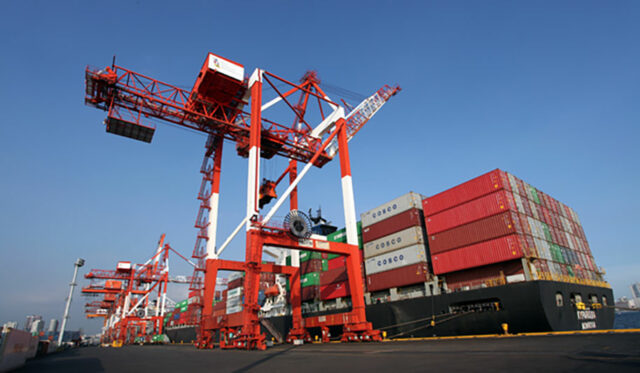
ASIAN TERMINALS, INC. (ATI) said it is weighing the construction of an additional roll-on/roll-off (Ro-Ro) berth in Batangas in anticipation of growing demand for automobiles.

Reginald L. Rivera, assistant vice-president for commercial ports and terminals at ATI, said a new berth will help the company support demand for cars, shipped in as completely built units (CBUs).

“Last year we handled 200,000 CBUs … but again, we understand that there is also that possibility that new volumes can come in,” he said.

“We are expanding the Port of Batangas. We have an area in the Port of Batangas where we are considering building another roll-on/roll-off berth,” he added.

He said the contemplated facility will include a staging area and warehousing.

“Whatever is going to make things convenient for everyone who needs a helping hand in logistics, I think Batangas could be an answer to that moving forward,” he added.

He said that the expansion is an indication of the company’s robust outlook for CBUs.

“The fact of the matter is we’re handling only 60% of the volume of CBUs. The other side is handling at least, I think, 40%, so there’s still room to get more of that volume,” he said, referring rival ports.

“It is starting now. If all goes well, it should be operational by 2028 or 2029,” he added.

For this year, he said that the company expects to handle 220,000 to 230,000 CBUs at the Batangas Port.

ATI operates Manila South Harbor, Batangas Port, and other facilities in the Philippines. — Justine Irish D. Tabile

Premium F&B seen as top tourism spending driver

FREEPIK

TOURISM SPENDING in the Philippines is expected to recover to pre-pandemic levels this year, with premium food and beverage (F&B) experiences being identified as the leading growth opportunity, Oxford Economics said.

“This is clearly a sector that is still in recovery. Our projections suggest that international arrivals will finally recover to those 2019 levels next year, in 2026, in the Philippines,” according to James Lambert, director of economic consulting at Oxford Economics.

“In actual fact, in the Philippines, arrival spend has recovered a little bit quicker. We estimate that tourism spending levels will have surpassed 2019 levels this year, reaching about $87 billion of inbound tourism spending,” he added.

However, he said for the Philippines to position itself as a top destination within the next five years, it must invest in high-value tourism experiences.

“The goal with this is a more sustainable, higher-quality tourism sector that can attract greater levels of spending over the course of the year,” he added.

A survey conducted by Oxford Economics, in collaboration with the Asia-Pacific International Spirits and Wines Association, found that visitors to Southeast Asia are willing to pay $250 more per person per day when visiting destinations that offer premium F&B experiences.

“This extra willingness to pay exists at all different income levels. This is not just a picture of how to target the richest travelers,” he said.

In particular, 71% of the 1,800 potential Southeast Asian tourists from China, South Korea, Australia, the US, and the UK have identified the quality of F&B as more important than the availability of historical and cultural sites of interest.

Meanwhile, visitors to Southeast Asia were found to be 2.5 times more likely to choose a destination when premium F&B experiences are available.

The study however found that 78% of the tourists regard value for money as important when selecting a destination.

Further, it found that a $20 increase in price for a premium F&B experience would cause 10% of the travelers to choose a less-premium option.

To better compete, Mr. Lambert said tourism policymakers should embrace premium F&B experiences, facilitate variety in the development of F&B experiences, and ensure that policy frameworks do not incentivize behavior that compromises safety and reliability.

It also recommended working with the industry to understand how products and services can be improved and nurturing a business environment that supports competitively priced products and services. — Justine Irish D. Tabile

Japan provides grant to set up Isabela rice facility

Workers load sacks of flour in a delivery truck in Manila, July 11, 2022. — PHILIPPINE STAR/ MIGUEL DE GUZMAN

THE Department of Foreign Affairs (DFA) said it signed an agreement with Japan to establish a 1.7 billion yen (P384.17 million) rice processing facility in Isabela.

The government of Japan expects the facility to reduce post-harvest losses, improve the value chain for rice, and help the National Food Authority (NFA) maintain a rice reserve.

Chargé d’affaires Ad Interim Ono Sho and Foreign Affairs Secretary Maria Theresa Lazaro signed the exchange of notes on Thursday, Oct. 16.

“For almost seven decades, Japan has been a steadfast partner for the country’s agricultural sector. Its assistance has manifested in infrastructure, machinery and farm tractors, irrigation projects, and through technical expertise,” Mr. Ono said.

He also highlighted the importance of improving agriculture, which “underpins both food security and broader economic development.” — Andre Christopher H. Alampay

ADVERTISEMENT
ADVERTISEMENT