Home Blog Page 792

US and EU avert trade war with 15% tariff deal

STOCK PHOTO | Image by Bruno from Pixabay

 – The U.S. struck a framework trade agreement with the European Union on Sunday, imposing a 15% import tariff on most EU goods – half the threatened rate – and averting a bigger trade war between the two allies that account for almost a third of global trade.

U.S. President Donald Trump and European Commission President Ursula von der Leyen announced the deal at Mr. Trump’s luxury golf course in western Scotland after an hour-long meeting that pushed the hard-fought deal over the line, following months of negotiations.

“I think this is the biggest deal ever made,” Mr. Trump told reporters, lauding EU plans to invest some $600 billion in the United States and dramatically increase its purchases of U.S. energy and military equipment.

Mr. Trump said the deal, which tops a $550 billion deal signed with Japan last week, would expand ties between the trans-Atlantic powers after years of what he called unfair treatment of U.S. exporters.

Ms. Von der Leyen, describing Mr. Trump as a tough negotiator, said the 15% tariff applied “across the board”, later telling reporters it was “the best we could get.”

“We have a trade deal between the two largest economies in the world, and it’s a big deal. It’s a huge deal. It will bring stability. It will bring predictability,” she said.

The agreement mirrors key parts of the framework accord reached by the U.S. with Japan, but like that deal, it leaves many questions open, including tariff rates on spirits, a highly charged topic for many on both sides of the Atlantic.

The deal, which Mr. Trump said calls for $750 billion of EU purchases of U.S. energy in coming years and “hundreds of billions of dollars” of arms purchases, likely spells good news for a host of EU companies, including Airbus, Mercedes-Benz and Novo Nordisk, if all the details hold.

German Chancellor Friedrich Merz welcomed the deal, saying it averted a trade conflict that would have hit Germany’s export-driven economy and its large auto sector hard. German carmakers, VW, Mercedes and BMW were some of the hardest hit by the 27.5% U.S. tariff on car and parts imports now in place.

The baseline 15% tariff will still be seen by many in Europe as too high, compared with Europe’s initial hopes to secure a zero-for-zero tariff deal.

Bernd Lange, the German Social Democrat who heads the European Parliament’s trade committee, said the tariffs were imbalanced and the hefty EU investment earmarked for the U.S. would likely come at the bloc’s own expense.

Mr. Trump retains the ability to increase the tariffs in the future if European countries do not live up to their investment commitments, a senior U.S. administration official told reporters on Sunday evening.

The euro rose around 0.2% against the dollar, sterling and yen within an hour of the deal’s being announced.


MIRROR OF JAPAN DEAL

Carsten Nickel, deputy director of research at Teneo, said Sunday’s accord was “merely a high-level, political agreement” that could not replace a carefully hammered out trade deal: “This, in turn, creates the risk of different interpretations along the way, as seen immediately after the conclusion of the U.S.-Japan deal.”

While the tariff applies to most goods, including semiconductors and pharmaceuticals, there are exceptions.

The U.S. will keep in place a 50% tariff on steel and aluminum. Von der Leyen suggested the tariff could be replaced with a quota system; a senior administration official said EU leaders had asked that the two sides continue to talk about the issue.

Ms. Von der Leyen said there would be no tariffs from either side on aircraft and aircraft parts, certain chemicals, certain generic drugs, semiconductor equipment, some agricultural products, natural resources and critical raw materials.

“We will keep working to add more products to this list,” von der Leyen said, adding that spirits were still under discussion.

A U.S. official said the tariff rate on commercial aircraft would remain at zero for now, and the parties would decide together what to do after a U.S. review is completed, adding there is a “reasonably good chance” they could agree to a lower tariff than 15%. No timing was given for when that probe would be completed.

The deal will be sold as a triumph for Mr. Trump, who is seeking to reorder the global economy and reduce decades-old U.S. trade deficits, and has already reached similar framework accords with Britain, Japan, Indonesia and Vietnam, although his administration has not hit its goal of “90 deals in 90 days.”

U.S. officials said the EU had agreed to lower non-tariff barriers for automobiles and some agricultural products, though EU officials suggested the details of those standards were still under discussion.

“Remember, their economy is $20 trillion … they are five times bigger than Japan,” a senior U.S. official told reporters during a briefing. “So the opportunity of opening their market is enormous for our farmers, our fishermen, our ranchers, all our industrial products, all our businesses.”

Mr. Trump has periodically railed against the EU, saying it was “formed to screw the United States” on trade. He has fumed for years about the U.S. merchandise trade deficit with the EU, which in 2024 reached $235 billion, according to U.S. Census Bureau data.

The EU points to the U.S. surplus in services, which it says partially redresses the balance.

Mr. Trump has argued that his tariffs are bringing in “hundreds of billions of dollars” in revenues for the U.S. while dismissing warnings from economists about the risk of inflation.

On July 12, Trump threatened to apply a 30% tariff on imports from the EU starting on August 1, after weeks of negotiations failed to reach a comprehensive trade deal.

The EU had prepared countertariffs on 93 billion euros ($109 billion) of U.S. goods in the event a deal to avoid the tariffs could not be struck. – Reuters

DigiPlus, BingoPlus Foundation bring urgent relief to storm-hit Cavite

BingoPlus Foundation, the social development arm of DigiPlus Interactive Corp., continues to deliver critical relief to storm-stricken communities, reaching hundreds of families in Cavite while also preparing a major donation to the Department of Social Welfare and Development (DSWD) for next week.

Upon declaration of the province of Cavite under a State of Calamity, the Foundation responded with relief operations in affected areas. In coordination with Imus Councilor Mark Villanueva and barangay officials, the Foundation on July 26 handed over 400 food relief packs for families in Barangays Poblacion 4A, Poblacion 4B, Malagasang 2B, and Anabu F. An additional 55 packs were provided by the local government, bringing the total to 455 families served.

Brgy. Pulvorista in Kawit, Cavite

These efforts form part of the P5-million relief commitment announced by DigiPlus and BingoPlus Foundation earlier this week in response to widespread flooding across the country following Typhoon Crising. The relief is made possible by the combined strength of DigiPlus’ brands, BingoPlus, ArenaPlus, and GameZone, whose success fuels the company’s growing commitment to social impact.

The Foundation also donated 1,000 relief packs to families in Kawit, Cavite, valued at P450,000. This was part of its ongoing P2-million relief partnership with ABS-CBN Sagip Kapamilya, which began in 2024 and continues to support communities in need through 2025. This effort is separate from the Foundation’s newly announced P5-million relief commitment for Typhoon Crising response.

Brgy. Tabon in Kawit, Cavite

“In moments like these, what families need most is the reassurance that help is on the way,” said Angela Camins-Wieneke, executive director of BingoPlus Foundation. “At BingoPlus Foundation, we do our very best to act fast, to help put food on tables, lighten the burden, and remind them that they are not facing this alone.”

Looking ahead, the Foundation will deliver 100 cabans of rice to the DSWD National Resource Operations Center in Pasay City next week, enough to support over 800 families. More than 50 DigiPlus employee volunteers have pledged to join the repacking effort, marking one of the company’s largest hands-on community mobilizations to date. Further relief operations are under way in affected areas in Metro Manila, CALABARZON and North Luzon provinces.

Brgy. Poblacion in Imus, Cavite

“We know that rebuilding doesn’t happen overnight,” Ms. Camins-Wieneke added. “That’s why we’re staying the course, not just responding to emergencies, but standing by communities as they rise again, stronger.”

Through sustained partnerships and the power of collective action, DigiPlus and BingoPlus Foundation reaffirm their mission: to multiply the good, and stand with Filipinos when they need it most.


Spotlight is BusinessWorld’s sponsored section that allows advertisers to amplify their brand and connect with BusinessWorld’s audience by publishing their stories on the BusinessWorld Web site. For more information, send an email to online@bworldonline.com.

Join us on Viber at https://bit.ly/3hv6bLA to get more updates and subscribe to BusinessWorld’s titles and get exclusive content through www.bworld-x.com.

US tariff may trim PHL GDP growth

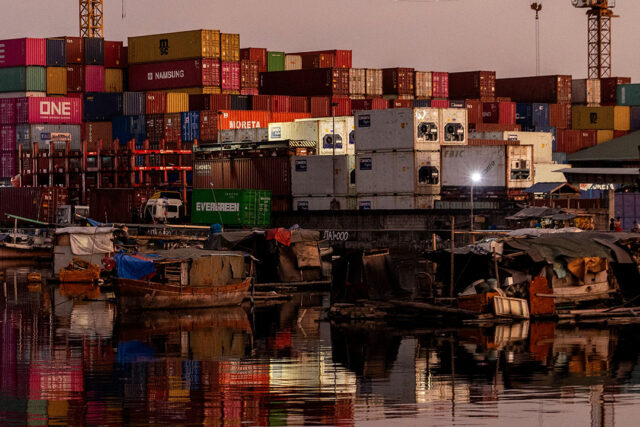
A container terminal is seen from Navotas, Metro Manila in this photo taken April 11, 2025. — REUTERS/ELOISA LOPEZ

By Luisa Maria Jacinta C. Jocson, Senior Reporter

THE United States’ 19% tariff on Philippine goods could cut the Philippines’ gross domestic product (GDP) growth by 0.4 percentage point (ppt), Nomura Global Markets Research said.

In a report, Nomura said the US tariff of 19% on Philippine goods is “fairly high” and poses downside risks to growth.

“We estimate the direct effects could reduce our baseline GDP growth forecasts by a still-substantial 0.4 ppt in the Philippines.”

Nomura said this projection is “relatively substantial” compared to its baseline growth forecasts of 5.3% and 5.6% for this year and 2026, respectively.

“This is partly because we assigned 10% as the level where the reciprocal tariff rate could settle, on the assumption that the Philippines is a strong ally of the US and is not a third country for transshipments,” Nomura said.

“As it turns out, despite the visit to Washington by President Marcos and both sides reiterating the need for a strong partnership, the tariff was still set at 19%, which is even higher than the ‘Liberation Day’ level of 17%.”

Last week, Philippine President Ferdinand R. Marcos, Jr. met with US President Donald J. Trump at the White House in Washington, DC.

Mr. Trump announced a 19% tariff would be imposed on Philippine goods, which will take effect starting Aug. 1.

“The trade ‘deals’ therefore represent upside surprises in terms of tariff rates, especially for the Philippines,” Nomura said.

“As a result, if implemented and these tariff rates are sustained, these will likely further weigh on growth in both countries relative to our current baseline forecasts.”

The government expects GDP to grow by 5.5-6.5% this year, lower than its previous target of 6-8%.

“While these ballpark estimates make sense to us, uncertainty remains high and these are ‘only’ taking into account the direct effects on these ASEAN countries’ exports to the US,” Nomura said.

These estimates do not account for sectoral tariffs, such as in semiconductors and pharmaceuticals, which are currently exempted, it added.

“But as our US team highlights, the risk is these could be set higher, though some countries could be exempted, adding to the uncertainty. As mentioned above, the details of the trade deals with Indonesia and the Philippines are still limited.”

“Meanwhile, other major trading partners, particularly the European Union, are still in negotiations and an escalation of trade tensions could pose additional risks for the region,” it added.

The Department of Trade and Industry has said it is still negotiating the final details of the trade agreement with the US to ensure the protection of local industries.

ONE BIG BEAUTIFUL BILL
Meanwhile, Mr. Trump’s recent One Big Beautiful Bill Act could also impact the Philippines’ own economy, Metropolitan Bank & Trust Co. (Metrobank) Research said in a separate report.

“While the US faces the direct effects of Mr. Trump’s mega bill, the Philippines will feel the aftershocks. After 2027, the federal funds rate is forecasted to tick up after rate cuts in the short-term.”

Metrobank noted this will have spillover effects on the Bangko Sentral ng Pilipinas’ (BSP) monetary policy and overseas Filipino workers’ (OFW) remittances.

“This can, in turn, push up the BSP’s reverse repurchase rate, hindering domestic consumption. To add, if US GDP growth is dampened by crowding out of private investment, demand for exports and OFW remittances may also take a hit.”

Under the bill, Mr. Trump’s 2017 tax cuts are made permanent and also introduces new tax breaks.

“As the US seeks funding to address the increased expenditure, interest rates are expected to edge higher, perhaps as early as next year. Elevated US rates would in turn attract foreign capital to the US away from emerging market economies like the Philippines,” Metrobank said, adding the BSP could hike rates to “ensure the Philippines remains a competitive choice for investors.”

The Philippine central bank lowered interest rates by a total of 125 basis points (bps) since it began its easing cycle in August last year. It delivered a second straight rate cut in June, reducing borrowing costs by 25 bps to bring the key rate to 5.25%.

Metrobank said higher rates would discourage consumption and business investment, which could potentially slow Philippine growth.

Slowing US growth could also hit the Philippines’ exports sector, as the US is the top destination for Philippine export goods, it said.

“With potentially hampered US economic growth, goods from the Philippines could face a reduction in demand. Fewer exports combined with steeper tariffs can make the trade deficit more drastic and weigh on overall GDP,” it said.

Metrobank said softer US growth may also dampen foreign direct investment in emerging markets like the Philippines.

Meanwhile, OFW remittances may also be dampened as the US starts imposing a 1% excise tax on cash remittance transfers from the US to other countries in 2026.

“The US is a hotspot for OFWs, with approximately 2 million OFWs in the US. OFWs influence the Philippine economy through remittances, which could be negatively impacted by a slowdown in US growth,” Metrobank said.

Around two-fifths of the Philippines’ remittance flows come from the United States. The US was the top source of remittances in the five-month period, accounting for 40.2% of the total, latest central bank data showed.

“If OFWs get pay cuts or even lose their jobs, this would cap remittances headed for home. Remittance payments spur household spending, which contributes 78.2% of the Philippines’ GDP.”

The BSP earlier estimated that the remittance tax could trim the country’s remittance growth by 0.5 ppt. The central bank expects cash remittances to grow by 2.8% this year and by 3% in 2026.

“A decline in remittances pulls down household expenditure, rocking the boat for growth,” Metrobank added.

Auto sales on track to hit 500,000 by yearend

SPORTS cars are parked along Bonifacio Global City, Taguig. — PHILIPPINE STAR/ WALTER BOLLOZOS

By Justine Irish D. Tabile, Reporter

THE Philippine automotive industry is on track to sell 500,000 units by yearend, an industry official said.

“The auto industry is doing very well. This year, actually, it is up by about 6% as of the first half. So it is really doing well,” GT Capital Auto and Mobility Holdings, Inc. (GTCAM) Chairman Vicente Jose S. Socco told reporters on the sidelines of the Auto Parts & Vehicles Expo 2025 on Friday.

Mr. Socco said the Philippine auto industry is the second-fastest growing in the region after Vietnam.

“I think (500,000 sales) is possible. As of the first half of this year, if we annualize it, I think we are tracking just about 490,000. So hopefully the second semester will not have any major hiccups or bumps along the road,” he added.

For this year, the Chamber of Automotive Manufacturers of the Philippines, Inc. (CAMPI) set a sales target of 500,000 units. Last year, the industry sold 467,252 units.

The latest report by CAMPI and the Truck Manufacturers Association (TMA) showed that new vehicle sales increased by 1.7% to 190,429 units in the January-to-May period, from 187,191 units a year ago.

“So, a very positive outlook for this year. Hopefully breaking half a million, that puts us in the same category as Malaysia, Thailand, and Indonesia. It’s really a very strong signal about the motorization of this country,” he said.

Mr. Socco said that the government’s push to expand infrastructure and road networks is also encouraging motorization.

“I think what we expect from the government is really how to promote more local component manufacturing. That’s very important,” he said.

“And I think now that the vehicle population is growing to half a million, we’re starting to get to the point where we have economies of scale. So I think this is something that we should be looking forward to,” he added.

Meanwhile, Mr. Socco said that the industry is still waiting on the specifics of the US-Philippines trade deal to gauge how this will impact the automotive sector.

“We are not exporting cars to the US. We are exporting components, and those might be affected. But as I understand it, the details are still being worked out,” he added.

Last week, US President Donald J. Trump announced that a 19% tariff will be imposed on Filipino goods entering the US market starting Aug. 1.

After his meeting with Mr. Trump, President Ferdinand R. Marcos, Jr. said the Philippines will open up the automotive sector to US imports as part of the trade deal.

“American brands are already present here. But for the most part, they are sourcing their vehicles from ASEAN, where there is already zero tariff,” Mr. Socco said.

For this reason, he said that US car brands will likely keep sourcing their vehicles from Southeast Asia as the shipping cost is much cheaper.

“But of course, with the zero tariffs, they can introduce more models. There are also completely built units that are not produced in the ASEAN region, which they may hope to bring into the market, which will be good for the consumers,” he added.

On Friday, Trade Secretary Ma. Cristina A. Roque said that the government is hoping to complete negotiations with the US by Aug. 1.

“We have already finalized the zero tariff, and then those that are not included, which are the agriculture products,” Ms. Roque said.

She said that the 19% US tariff is the final rate for now as it is what Mr. Trump has announced.

“But of course, they are still talking; of course everybody wants to bring it down,” she said.

However, Ms. Roque said the country has already given “the best we can give” during the negotiations with the US. “We cannot give agriculture, like sugar and rice,” she added.

Marcos faces rising discontent as he delivers 4th SONA

PEDESTRIANS walk past a poster of President Ferdinand R. Marcos, Jr. ahead of his State of the Nation Address scheduled on July 28. — PHILIPPINE STAR/MIGUEL DE GUZMAN

By Kenneth Christiane L. Basilio, Reporter

THREE YEARS into his presidency, President Ferdinand R. Marcos, Jr. faces mounting public frustration as Filipinos say many of the promises he made during his 2022 campaign remain unfulfilled.

As he prepares to deliver his fourth State of the Nation Address (SONA) on July 28, the disconnect between his pledges and the public’s daily experience casts a shadow over his administration’s achievements.

Emmanuel V. Punzalan, a 44-year-old taxi driver, is one of many citizens who feel left behind.

Scorecard: Philippine Development Plan 2023-2028

“A lot of his promises remain unfulfilled, and he didn’t really do much either,” Mr. Punzalan said in Filipino, as he navigated ankle-deep floodwaters in Metro Manila.

Mr. Marcos campaigned on a platform of economic revival, promising to reduce rice prices, boost agriculture, and usher in a new industrial era. But many Filipinos like Mr. Punzalan say those ambitions have yet to trickle down to their daily lives.

Palace Press Officer Clarissa A. Castro did not respond to requests for comment.

As Mr. Marcos enters the second half of his term, political analysts say he has a critical window to enact long-term reforms that could define his legacy before the 2028 presidential election.

“The Marcos administration wants to be recognized for having fixed the economy after the storm that is the coronavirus pandemic,” Arjan P. Aguirre, a political science professor at the Ateneo de Manila University, said by telephone.

The Philippine economy shrank by a record 9.5% in 2020 amid a coronavirus pandemic. Since then, the government has ramped up borrowing, raising debt from 39.6% of gross domestic product (GDP) in 2019 to 62% in the first quarter.

Meanwhile, inflation surged in the early years of Mr. Marcos’ term, peaking at 6% in 2023. Though prices have since eased — down to 1.4% in June from 3.7% a year earlier — economic growth has slowed. GDP expanded by 5.4% in the first quarter — slower than expected — from 5.9% a year earlier.

“The Marcos administration should now pivot to attracting more foreign investors,” Reinielle Matt M. Erece, economist at Oikonomia Advisory and Research, Inc., said in a Viber message. “Expect them to focus on infrastructure development, attracting investments, and better trade agreements not just with the US but other countries as well.”

The Development Budget Coordination Committee has lowered its growth forecast to 5.5-6.5% for 2025, citing external risks such as higher tariffs imposed by the US.

After a meeting between Mr. Marcos and US President Donald J. Trump last week, the White House announced a 19% tariff on goods from the Philippines, increasing pressure on the administration to diversify export markets.

Economist Leonardo A. Lanzona of Ateneo de Manila University cited the importance of targeting industries with export potential, urging the government to craft an industrial policy that would identify priority sectors and offer incentives to attract capital.

Philippine Chamber of Commerce and Industry Chairman George T. Barcelon said the high cost of logistics continue to deter investors. “A lot of investors are concerned that our logistics cost is one of the highest in the region,” he said by telephone.

He urged reforms to improve port operations and reduce maritime costs. “We have to [cut] the logistic costs of shipping vessels, international sea liners and also the operations in the port area.”

BETTER BUSINESS ENVIRONMENT
Robert M. Young, president of the Foreign Buyers Association of the Philippines, called for strengthening the Anti-Red Tape Authority (ARTA). “It seems that ARTA is lacking in teeth, it’s almost just a reporting agency,” he said by telephone.

He also pushed a national export commission to coordinate a strategic export blueprint. “The commission will create a comprehensive export plan so they can fully discharge promotion, subsidies and measures to uplift our export industry.”

Philippine exports climbed 0.8% to $34.2 billion in the five months to May, led by electronics. However, Mr. Young said local exporters don’t get enough state support including subsidies.

He asked lawmakers to further liberalize the Philippine economy by removing constitutional restrictions that hamper foreign investors.

Amid ballooning public debt, which stood at P16.92 trillion as of May, fiscal sustainability is another concern.

“We should prioritize improving tax collection efficiency and expanding the base before introducing new taxes,” John Paolo R. Rivera, a senior research fellow at the Philippine Institute for Development Studies, said in a Viber message.

The Bureau of the Treasury recently reported a P241.6-billion budget deficit in June, as spending outpaced revenue.

“We need better collection and revenue-generating schemes,” Mr. Rivera said. “The broader goal should be a fair and growth-friendly tax regime, one that does not overburden consumers or small businesses.”

He also called for pension reform, citing the ballooning cost of military pensions. “Without reform, the pension system remains fiscally unsustainable. Over time, this crowds out spending for health, education, and infrastructure.”

Mr. Rivera recommended phased contribution schemes and adjusting retirement ages to ensure the system’s longevity.

On agriculture, the Marcos administration should modernize the sector by easing access to the latest seeds and technologies, while pouring in investments directly to farmers, all of which could lead to making food cheaper, Mr. Rivera said. He also urged the government to support value-added agricultural exports to boost incomes.

POLITICAL HEADWINDS
But looming political tensions could obstruct key reforms. The May midterm elections saw Duterte-backed candidates win four of 12 Senate seats, while the Marcos slate won six — a historically weak result for an incumbent.

The President is also locked in a growing feud with Vice-President Sara Duterte-Carpio, who has declared her interest in running in 2028. Mr. Aguirre warned of “obstructionist” behavior from Duterte allies in both chambers.

“We can expect Duterte allies in the Senate, and even potential Duterte allies in the House of Representatives… to become obstructionists,” he said. “They’ll be the ones tearing down the bills being pushed by the Marcos administration.”

Ederson DT. Tapia, a political science professor at the University of Makati, said the SONA is likely to carry a message of political unity. “The first half of the Marcos administration has laid down a credible scaffolding for development, but its effects are yet to be felt by ordinary Filipinos.”

“Marcos has poured the foundation: macroeconomic stability, infrastructure and digital expansion, broader health coverage and a firmer foreign policy,” Mr. Tapia said. “But he has to convert those into felt gains in incomes, food security and political cohesion.”

As Mr. Marcos addresses the nation, citizens like Mr. Punzalan are hoping for more than rhetoric.

“He should carry out everything he vowed because that’s what the people are counting on,” he said.

Despite the frustrations, many Filipinos remain hopeful that the second half of Mr. Marcos’ term will bring the change they were promised. — with Chloe Mari A. Hufana and Adrian H. Halili

Loan demand likely steady in 3rd quarter — BSP survey

BANGKO SENTRAL NG PILIPINAS

MOST Philippine banks expect loan demand to remain steady in the third quarter, according to a survey by the Bangko Sentral ng Pilipinas (BSP).

In the latest edition of the Senior Bank Loan Officers’ Survey (SLOS), the BSP said the banking sector anticipates demand for both business and household loans to remain unchanged.

“In the (third) quarter, 71.4% of banks said they expect loan demand from businesses to stay the same, 1.8% expect a decline, and 26.8% expect an increase.”

Meanwhile, 72.5% of respondents also see demand for household loans to stay the same during the quarter while 27.5% expect demand to rise.

“No bank expects to see a decline in households’ credit demand in the third quarter,” it added.

Rizal Commercial Banking Corp. Chief Economist Michael L. Ricafort said the BSP’s rate-cutting cycle increased banks’ loanable funds and reduced intermediation costs. This helps spur demand for loans that boost business activities, he added.

Bank lending rose by 11.3% year on year to P13.37 trillion as of May from P12.02 trillion, faster than the 11.2% expansion a month earlier, latest data from BSP showed.

The Monetary Board began its easing cycle in August last year, lowering interest rates by a total of 125 basis points so far. This brought the benchmark to 5.25%.

“Possible BSP rate cuts for the rest of 2025 and possible RRR cut in 2026 would further help reduce financing costs that would help sustain loan demand,” he added.

BSP Governor Eli M. Remolona, Jr. has signaled the possibility of two more rate cuts amid benign inflation.

The survey showed that businesses’ demand for credit was mostly unchanged (75%) in the second quarter compared to the quarter prior. On the other hand, 19.6% of banks recorded higher loan demand while 5.4% registered a decline.

Meanwhile, 77.5% of respondents said demand for household loans were likewise steady in the second quarter versus the first quarter.

“10% reported lower loan demand, and 12.5% indicated an increase in loan demand,” it added.

CREDIT STANDARDS
Meanwhile, the survey also showed that Philippine banks expect to maintain lending standards for businesses and households in the July-September period.

“Among respondent banks, 91.1% said they will likely keep their lending standards for enterprises the same in the third quarter, compared with 82.1% in the second quarter.”

“Similarly, about 85% of banks are expected to maintain their lending standards for households from 82.5% in the same review period,” it said.

Credit standards cover credit scores, income requirements, collateral, loan size, interest rate, and repayment period.

Based on the diffusion index (DI), the survey showed there is an expectation of net tightening of credit standards for businesses (5.4%) and for households (5%) in the third quarter.

“This indicates that any future change is more likely to be a tightening than a loosening. In the second quarter, there was a net tightening of 14.3% for loans to enterprises and 12.5% for loans to households.”

The central bank uses a modal approach for the SLOS, which means the results of the survey are analyzed by looking at the option (tightening, easing, or unchanged) with the highest share of responses.

Under the DI approach, a positive DI for credit standards indicates that the number of banks that have tightened their credit standards exceeds those that eased (net tightening), while a negative DI indicates the opposite (net easing).

Meanwhile, unchanged means the number of banks that have tightened is equal to those that eased their credit standards. — Luisa Maria Jacinta C. Jocson

ASEAN Sparks begins second phase to back Southeast Asia’s top climate innovators

The ASEAN Sparks accelerator program has entered its second phase, Catalyse, with selected clean energy and climate tech startups from across Southeast Asia now undergoing capacity-building and mentorship activities through October 2025.

Organized by the ASEAN Centre for Energy (ACE) in partnership with the United Nations Industrial Development Organization (UNIDO), and supported by the Japan-ASEAN Integration Fund (JAIF) and Japan’s Ministry of Economy, Trade and Industry (METI), the Catalyse phase offers intensive workshops and expert-led sessions aimed at helping early-stage startups scale their impact and prepare for cross-border growth.

The program supports innovators in energy efficiency, renewables, clean mobility, and climate resilience. Startups in the Catalyse phase will also have the opportunity to pitch their solutions at the ASEAN Energy Business Forum 2025, providing international visibility and potential investment linkages.

Following the successful completion of the first phase, Ignite, which engaged 40 early-stage startups in foundational workshops and mentoring, ASEAN Sparks: Catalyse serves as the next critical step in the program journey.

“Many startups in ASEAN face limited access to the support they deserve, making it difficult for them to transition from early-stage development to commercial success,” said Dr. Zulfikar Yurnaidi, acting manager of Energy Efficiency and Conservation (CEE) Department of the ASEAN Centre for Energy.

He added, “Catalyse is designed to address these gaps between the startups and the support from the whole energy ecosystem stakeholders. Another important goal of the program is to strengthen the capacity of local stakeholders to foster a sustainable climate technology innovation ecosystem.”

While Ignite focused on helping startups refine their business fundamentals and validate their energy solutions, Catalyse offers a deeper, more targeted accelerator experience for more mature startups.

Over the course of three months, selected startups will benefit from: extensive workshop sessions covering key topics from business strategy and market expansion to IP strategy and social impact; in-depth development with dedicated mentors, tailored to each startup’s needs; and the opportunity to pitch at the ASEAN Energy Business Forum 2025, where the 20 selected startups will present their solutions to a high-level audience of energy policy makers, investors, and industry leaders.

This second phase ensures that startups not only build on the insights gained during Ignite but also gain the strategic tools and exposure needed to scale regionally and beyond.


SparkUp is BusinessWorld’s multimedia brand created to inform, inspire, and empower the Philippine startups; micro, small and medium enterprises (MSMEs); and future business leaders. This section will be published every other Monday. For pitches and releases about startups, e-mail to bmbeltran@bworldonline.com (cc: abconoza@bworldonline.com). Materials sent become BW property.

Globe, CCP partner to empower student creatives and future Filipino artists

Center of the Philippines (CCP) President Kaye Tinga and Globe’s Chief Marketing Officer Rochelle Vandenberghe (center), along with CCP Vice-President for Administration Jose Gaite (left), were present at the signing of a partnership seeking to foster creativity and support the next generation of Filipino artists.

Globe Telecom has entered into a year-long partnership with the Cultural Center of the Philippines (CCP) to support arts programming and expand access to creative education, particularly among students and young aspiring artists.

Under the agreement, Globe will serve as co-presenter of several CCP initiatives, including Cinemalaya 2025, Virgin Labfest XX: Hinog, and the CCP Arts Education Program, which launched in schools nationwide this June.

The partnership includes support for CCP’s outreach and training efforts, as well as the integration of Globe’s Community Builders Program. Participating students will have access to connectivity, mentorship, and internship opportunities, along with limited grants and volunteer placements. The collaboration aims to foster creative and digital skills development in line with CCP’s goal of cultivating the next generation of Filipino artists.

“Together with CCP, Globe continues to champion creativity and innovation among the Filipino youth. We’re proud to enable future filmmakers, playwrights, and digital creatives through grassroots programs that give them both the inspiration and the infrastructure to succeed,” said Rochelle Vandenberghe, Globe’s chief marketing officer.

The CCP Arts Education Program consists of workshops on multidisciplinary art forms and techniques for educators and students in select schools.

Meanwhile, the Virgin Labfest (VLF) celebrates its 20th year with a fresh batch of untried, untested, and unstaged plays from young Filipino playwrights. It features educational components like the VLF LabTuro consisting of Theater Talks and a Playwrights’ Fair. Some of its much anticipated components are the VLF Writing Fellowship Program, with eight fellows under the age of 30, and a Dramaturgy Fellowship, where young artists undergo training in playwrighting and theater production.

Furthermore, Cinemalaya 2025, the country’s premier independent film festival, will spotlight full-length and short films of established names in the industry and emerging student filmmakers this October.

“We are grateful to partner with Globe as we continue to deliver our mandate of promoting and safeguarding our country’s arts and culture. This partnership empowers CCP to bring the arts closer to young people — our future artists and creators — in ways that are both accessible and impactful. Together, we aim to create more platforms for artistic expression that speak to the heart of our identity,” said CCP President Kaye C. Tinga.

The partnership underscores Globe’s long-term strategy to enrich learning experiences through technology and foster a thriving creative community among the Filipino youth.


SparkUp is BusinessWorld’s multimedia brand created to inform, inspire, and empower the Philippine startups; micro, small and medium enterprises (MSMEs); and future business leaders. This section will be published every other Monday. For pitches and releases about startups, e-mail to bmbeltran@bworldonline.com (cc: abconoza@bworldonline.com). Materials sent become BW property.

DLSU, Manila Observatory launch initiative to build platform work resilience

The De La Salle University-Social Development Research Center (DLSU-SDRC), in partnership with the Manila Observatory (MO), launched the project Resilient Platform Work PH through a Stakeholders Forum held on June 4.

The Forum convened experts from the government, academia, policy think tanks, NGOs, grassroots actors, and labor organizations to assess the current state of platform work and chart actionable pathways for research and policy development.

Resilient Platform Work PH examines the vulnerabilities of platform workers in the context of severe weather events. The project aims to identify gaps in social protection, develop a skills framework to enhance mobility pathways, and support the creation of governance and policy frameworks that foster a more resilient platform workforce.

Ground truthing platform work across sectors

Principal Investigator and DLSU Professor Dr. Cheryll Soriano provided context on the purpose of the project and the Stakeholders Forum. She said, “globally, the Philippines ranks fourth among countries most affected by extreme weather events from 2000-2019, and continually experiences vulnerability to these events that affect many workers and their livelihoods. Along the platform labor economy continues to grow — both for app-based ride-hailing and delivery, or for remote freelance workers — helping address employment gaps and providing opportunities to displaced workers.”

“Yet among the most directly at risk with climate change are these app-based couriers and motorcycle ride-hailing drivers, whose outdoor work makes them particularly susceptible to extreme weather events. Poor public infrastructure and unsafe road conditions compound the impacts of climate change on these workers.”

DLSU Vice-President for Research and Innovation Dr. Raymond Tan opened the Forum by underscoring the importance of research institutions in the country to become knowledge hubs for sustainability issues. He noted that “amid a growing population heavily reliant on such platforms as a primary source of livelihood, this dependence increases their vulnerability, particularly as many lack access to essential protections and adequate healthcare that is worsened by climate change.”

Fr. Jose Ramon Villarin, executive director of the Manila Observatory, highlighted the critical role of “ground truthing,” or ensuring that the lived experiences of those on the frontlines inform research and shape practical interventions. “It is through the voices of key stakeholders who directly encounter these challenges that research can gain depth and relevance, ultimately leading to more effective solutions.”

The Forum serves as the initial ground for the formation of an Advisory Group that will sustain meaningful dialogues and co-develop policy and governance frameworks across relevant agencies and organizations. Participants included representatives from the Department of Economy, Planning, and Development (DEPDev), Department of Labor and Employment-Occupational Safety and Health Center (DoLE-OSHC), Filipina Homebased Moms (FHMoms), Foundation for Media Alternatives (FMA), KAGULONG, RIDERS-SENTRO, Philippine Institute for Development Studies (PIDS), Fairwork Philippines, ITU-BDT, and International Labor Organization (ILO).

Resilient Platform Work PH is part of the FutureWORKS Asia Project, a multidisciplinary research network spearheaded by LIRNEasia and supported by the International Development Research Centre (IDRC) of Canada.


SparkUp is BusinessWorld’s multimedia brand created to inform, inspire, and empower the Philippine startups; micro, small and medium enterprises (MSMEs); and future business leaders. This section will be published every other Monday. For pitches and releases about startups, e-mail to bmbeltran@bworldonline.com (cc: abconoza@bworldonline.com). Materials sent become BW property.

Tracking Marcos administration’s progress in the first half

PRESIDENT FERDINAND “BONGBONG” R. MARCOS, JR. — PRESIDENTIAL COMMUNICATIONS OFFICE

Later today at the Batasang Pambansa, President Ferdinand “Bongbong” R. Marcos, Jr. is set to deliver his fourth State of the Nation Address (SONA), which comes at the midpoint of his six-year term.

With only three years left, expectations are mounting for the Marcos administration to show results of its earlier commitments and present concrete plans on how it intends to address ongoing national issues.

Although the Palace has kept specific points under wraps, the public is expecting the President to lay out how his administration plans to manage inflation, encourage employment, and push through infrastructure projects that remain unfinished or delayed.

Meanwhile, a report from Vera Files shows that only 42 out of 165 promises made across his first three SONAs have been completed. 91 are listed as in progress; another 28 are stalled; while four are found to have failed entirely.

Advancing economic growth

Mr. Marcos has achieved more in the economic sector, fulfilling 11 or roughly 35% of 31 promises in the past three SONAs. 11 others are under way, five have stalled in Congress, and five remain unfulfilled.

The administration set a goal of growing the economy by 6.5%-8% annually until the term ends. While gross domestic product (GDP) grew by 7.6% in 2022, it slowed to 5.6% in both 2023 and 2024. The 2024 Philippine Development Report (PDR) cited weak global demand and sector-specific challenges as factors behind sluggish performance.

Inflation, on the other hand, eased to 3.9% in May 2024, within the government’s target of 2%-4%. However, food inflation remained high at 6.1% due to weather-related supply disruptions and external pressures. In response, the administration reduced tariffs on imported rice and removed some trade barriers to stabilize prices.

Despite underwhelming economic performance, the administration kept the national deficit and debt levels within targets. The fiscal deficit narrowed to 5.1% of GDP in 2024, while debt-to-GDP ratio stayed close to 60%.

On infrastructure, only three of the 16 major promises made in SONAs are found to have been completed as of last June. Ten are still being worked on, and three are stalled. Meanwhile, the Department of Public Works and Highways reports that eight out of 207 flagship projects have been completed under the Marcos administration, part of a broader pipeline worth $178 billion. At least 70 are ongoing, and 23 have been approved for rollout. The rest are still awaiting final clearances or are under preparation.

Promoting quality labor and education

Unemployment in the Philippines dropped since Mr. Marcos took office in 2022, but the quality of jobs and wage levels remain uneven, especially outside city areas.

Based on the data shared by the Philippine Statistics Authority (PSA), there were 2.93 million unemployed Filipinos just before Marcos assumed office. Underemployment showed signs of improvement from 6.67 million in May 2022 to 4.82 million in May 2024. However, the number climbed to 6.6 million this year.

According to the PDR 2024, salaried jobs in private establishments made up 50.7% of total employment — slightly below the government’s 50.9-51.5% target. Wage quality remains inconsistent across sectors, particularly outside urban centers.

In the education sector, the national education budget exceeded P1 trillion under the 2025 General Appropriations Act. Economy, Planning, and Development Secretary Arsenio M. Balisacan said the record-breaking budget was allocated to “boost growth and inclusion,” with a focus on curriculum improvements and educational quality.

Investing in social development

Data from the PSA show a slight drop in poverty from 23.7% in 2021 to 22.4% in 2023. Subsistence poverty also declined from 9.9% to 8.7% during the same period.

The flagship Pantawid Pamilyang Pilipino Program (4Ps) program received a P106.3 billion budget this year to assist 4.4 million families. As of the first quarter of 2024, it reached 98% of its annual target.

To alleviate hunger and malnutrition, the administration launched the “Walang Gutom 2027” Food Stamp Program. The pilot phase began in December 2023 and served 2,366 households.

The government also expanded the Enhanced Partnership Against Hunger and Poverty, signing new orders to boost coordination among agencies. As of May 2024, 122 community-based organizations secured P207 million worth of supply contracts under the program.

Mr. Marcos has repeatedly expressed his goal of bringing rice prices down to P20 per kilo since his 2022 campaign. While this price point is available in Kadiwa stores, the market price of commercial rice in Metro Manila remains far above the target, ranging between P38 to P57 per kilo. The government continues to expand the Kadiwa program, but broader measures to reduce farm input costs and improve local production have yet to fully materialize.

Mr. Marcos, who also served as Agriculture secretary from July 2022 to November 2023, said boosting local production is key to lowering food costs. But the slow pace of reforms and high dependence on imports continue to challenge food affordability.

In healthcare, the Department of Health (DoH) increased its budget by 15% from 2022 to 2024, while new health facilities opened nationwide. More than 6,000 Health Facilities Enhancement Program projects were completed, including 218 new Super Health Centers and 23 Bagong Urgent Care and Ambulatory Service (BUCAS) Centers.

PhilHealth also introduced benefit expansions to cover more treatments and lower costs for patients. This included improved dialysis coverage, increased outpatient drug access under the “GAMOT” program.

However, the country still faces a shortage of doctors, nurses, and midwives. As of mid-2024, the healthcare system was short of nearly 200,000 workers needed to meet sustainable development goals, according to the DoH.

Meanwhile, the government spent heavily on housing construction and financing. Since July 2022, P11.59 billion has been allocated to build over 66,000 homes. Another P241 billion went to the Pag-IBIG Fund to help more than 189,000 families either buy or improve homes.

The administration’s Pambansang Pabahay Para sa Pilipino program received a P250 billion credit line from Pag-IBIG, with P7.24 billion already approved for nine developments.

Informal settlers also received support through housing agencies like the National Housing Authority and the Social Housing Finance Corp. Nearly 32,000 housing units were completed under their resettlement programs, with P6.34 billion in total assistance.

Other Accomplishments

The Marcos administration has checked off some major promises midway through his term, including shutting down offshore gaming hubs and enacting a law to regulate online business.

The Philippine Amusement and Gaming Corp. confirmed the closure of all 304 licensed Philippine off-shore gaming sites by the end of 2024. However, the agency admitted that illegal offshore gaming still exists in the country during a Senate hearing earlier this year. 

The government also marked progress in digital regulation with the approval of the Internet Transaction Act. This law is meant to protect consumers and businesses by setting clear rules for online transactions.

In the past year, the administration also made several defense and maritime improvements, including two new laws and a public campaign to clarify the Philippines’ position in the West Philippine Sea. But other national security reforms remain stalled.

Mr. Marcos also signed the Republic Act No. 12024 or Philippine Self-Reliant Defense Posture Program Act to reduce the country’s dependence on foreign defense imports by strengthening local weapons and equipment production. The President earlier said the Armed Forces of the Philippines needs to be restructured to respond better to modern security threats. — Mhicole A. Moral

Treasury bill, bond offers may fetch mixed rates

BW FILE PHOTO

RATES of the Treasury bills (T-bills) and Treasury bonds (T-bonds) to be auctioned off this week could end mixed, with yields on longer tenors expected to rise due to lingering uncertainties overseas.

The Bureau of the Treasury (BTr) will auction off P25 billion in T-bills on Monday, or P7 billion in 91-day securities, P8.5 billion in 182-day debt, and P9.5 billion in 364-day papers.

On Tuesday, the government will offer P20 billion in reissued 20-year T-bonds with a remaining life of 18 years and 10 months.

T-bill and T-bond yields may track the week-on-week movements in the rates of their comparable secondary market benchmarks, Rizal Commercial Banking Corp. Chief Economist Michael L. Ricafort said in a Viber message.

“The upcoming Treasury bill auction yields could be mixed after most short-term PHP BVAL (Bloomberg Valuation Service) yields were mostly slightly higher,” Mr. Ricafort said.

“The upcoming 20-year Treasury bond could be similar to the 20-year PHP BVAL yield, slightly higher week on week, … amid relatively higher comparable US Treasury yields recently after US President Donald J. Trump signed into law his $3.4-trillion fiscal package. The comparable 20-year US Treasury yield hovered among one-month highs recently at 4.95%,” he added.

A trader said in an e-mail that Tuesday’s offering of reissued 20-year bonds could be “well received” and fetch rates ranging from 6.575% to 6.625%.

At the secondary market on Friday, the 91-day T-bill went down by 4.02 basis points (bps) week on week to end at 5.4104%, based on PHP BVAL Reference Rates data as of July 25 published on the Philippine Dealing System’s website. Meanwhile, the 182- and 364-day T-bills increased by 1.06 bps and 2.22 bps to fetch 5.5817% and 5.68%, respectively.

For its part, the 20-year bond saw its yield rise by 3.48 bps week on week to end at 6.569%.

On Friday, US Treasury yields drifted higher in a subdued trading as investors braced for a data-heavy week, updates on US trade talks, and a Federal Reserve policy meeting, Reuters reported.

The yield on benchmark US 10-year notes fell 2.4 bps to 4.384% from 4.408% late on Thursday.

The 30-year bond yield fell 2.3 bps to 4.9265% from 4.949% late on Thursday.

The 2-year note’s yield, which typically moves in step with interest rate expectations for the Federal Reserve, fell 1 bps to 3.915% from 3.925% late on Thursday.

The Fed is expected to convene this week for a two-day monetary policy meeting, which is expected to culminate in a decision to let its federal funds target rate stand in the 4.25% to 4.50% range. The meeting comes at a moment in which Fed Chair Jerome H. Powell is facing criticism from US President Donald J. Trump for not cutting rates.

Meanwhile, the nonpartisan Congressional Budget Office has estimated that the One Big Beautiful Bill’s tax cuts and spending provisions would add $3.4 trillion to the US’ $36.2-trillion debt and only increase inflation-adjusted gross domestic product by an average of 0.5% over 10 years.

Last week, the government raised P28.4 billion from the T-bills it auctioned off, higher than the P25-billion plan, as the offer was almost four times oversubscribed, with total bids reaching P92.163 billion.

Broken down, the Treasury borrowed P7 billion as planned via the 91-day T-bills as total tenders for the tenor reached P35.648 billion. The three-month paper was quoted at an average rate of 5.422%, down by 5.3 bps from the previous auction, with bids accepted having rates of 5.39% to 5.422%.

Meanwhile, the government raised P11.9 billion from the 182-day securities, higher than the P8.5-billion program, as bids amounted to P27.14 billion. The six-month T-bill’s average rate inched down by 0.9 bp at 5.566%, slipping by 0.9 bp from the previous week, with accepted yields ranging from 5.55% to 5.574%.

Lastly, the Treasury sold P9.5 billion via the 364-day debt papers as programmed as demand for the tenor totaled P29.375 billion. The average rate of the one-year T-bill inched down by 1.9 bps to 5.631%. Accepted bids carried rates ranging from 5.6% to 5.649%.

Meanwhile, the reissued 20-year bonds to be offered on Tuesday were last auctioned off on May 15, where the government raised P25 billion as planned at an average rate of 6.486%, below the 6.875% coupon.

The BTr wants to raise P250 billion from the domestic market this month, or P125 billion through T-bills and P125 billion via T-bonds.

The government borrows from local and foreign sources to help fund its budget deficit, which is capped at P1.56 trillion or 5.5% of gross domestic product this year. — A.M.C. Sy with Reuters

Progressive care for dementia

Dr. Zhao Yi Jing

The human brain is fundamentally the main control center of the body, controlling every process related to body movement. But as people age, the brain naturally undergoes changes that can affect their abilities as they get older.

The dilemma comes when these changes begin to interfere with daily life. A prime example is memory loss, which can get severe and can even lead to dementia.

Dementia is defined as loss of brain cognitive function that affects an individual’s visual spatial skills, language abilities, and executive functions. This often arises when one experiences severe memory loss seen from everyday life — including forgetting medications, the current date and time, or certain situations.

“Sometimes, individuals with dementia may not realize the extent of their cognitive changes. That’s why caregivers often play a vital role in detecting early signs and symptoms, to aid in the early diagnosis and detection,” Dr. Zhao Yi Jing said in an interview with BusinessWorld.

Treatments for dementia have progressed throughout the years. One common treatment Dr. Zhao mentioned is pharmacological, which includes medications like cholinesterase inhibitors that slow down the progression of the condition. A more recent treatment that emerged is the new anti-amyloid monoclonal antibodies. These antibodies help to directly target and decrease levels of beta-amyloid in the brain — a protein known to cause damage to the memory, neurons, and other cognitive functions.

“In the new paradigm of dementia treatment, the monoclonal antibodies have been pretty effective, very targeted in helping patients with early dementia, specifically Alzheimer’s dementia,” Dr. Zhao explained. “We have hopes that this new medication can help the patient better than the older generation of treatment.”

Alongside treatments, it is essential for dementia patients to make necessary lifestyle modifications. To slow down the progression of the condition, Dr. Zhao highlighted the importance of exercise and maintaining an active lifestyle, especially for those at an early age.

Shifting to a healthier eating lifestyle is highly recommended. A diet to consider is the Mediterranean diet, where patients focus on eating whole foods, plant-based foods, and healthy fats. Neurotoxins, more specifically alcohol or alcoholic drinks, should be avoided as these are harmful to the brain.

Keeping the mind active is also important. Engaging in conversations and activities, and learning new skills are effective ways to exercise the brain and improve its cognitive functions.

According to a report by the World Health Organization, the number of people aged 60 and above is projected to rise dramatically, reaching 22.9% in 2050, compared to 12.2% in 2024. Among this rising population are people prone to get dementia if left undiagnosed early on. Yet, with increasing dementia awareness, patients, families, and communities are now equipped with the knowledge to understand and manage the health condition — enabling those affected to still live a better life.

“Dementia is a problem we see in Asia, as well as globally as the population ages. And being aware about it, understanding it, learning when to identify signs and symptoms that suggest dementia early on is quite important, so that adequate prevention, early diagnosis, and good treatment can be started.” Dr. Zhao said.

Many hospitals are advancing in the development of treatments and patient care in terms of neurological conditions. Mount Elizabeth Hospital in Singapore is pioneering a new frontier in dementia care. By harnessing cutting-edge diagnostic technology and innovative, targeted treatments, they provide new standards of optimal outcomes for dementia patients.

For inquiries, please contact Mount Elizabeth Hospital’s patient assistance center, IHH Healthcare Singapore — Philippine Office, located at G/F-B, Marco Polo Hotel, Meralco Avenue and Sapphire Street, Ortigas Center, Pasig City 1600; e-mail manila.ph@ihhhealthcare.com; or call 0917-526-7576.


Spotlight is BusinessWorld’s sponsored section that allows advertisers to amplify their brand and connect with BusinessWorld’s audience by publishing their stories on the BusinessWorld Web site. For more information, send an email to online@bworldonline.com.

Join us on Viber at https://bit.ly/3hv6bLA to get more updates and subscribe to BusinessWorld’s titles and get exclusive content through www.bworld-x.com.