Home Blog Page 791

Culinary veteran Glenda Barretto wins Lifetime Achievement Award

While slowing down, she is still working on canning her Via Mare goodies for the Middle East

GLENDA BARRETTO, the founder of Via Mare and caterer to grand feasts for world leaders visiting the Philippines, was honored with a Lifetime Achievement Award at the 6th Bravo Empowered Women Awards.

The Bravo Awards, given every two years by the Zonta Club of Makati & Environs Foundation, Inc., with the support of Security Bank, was held on July 2 at the Security Bank Center in Makati.

The event also honored two other Filipinas with ties to food. Doreen Alicia Gamboa (niece and namesake of Doreen Gamboa Fernandez, the late pioneering food writer) won the award for the Culinary category, for her achievements as president of Slow Food Negros. Andie Estrada won the award for the Social Services category for her organization, Rural Rising, which connects farmers with rescued produce (which would otherwise go to waste) directly to consumers. Ms. Gamboa said, “Change is not easy, and working towards this goal means going against the tide.”

Ms. Estrada, meanwhile, said during her acceptance speech, “This recognition holds deep meaning because it shines a light on something easily overlooked: the persistence, the hard work, and the resilience of Filipino farmers, who plant in hope, even when there’s no certainty that the harvest will find a buyer.”

Other awardees include Maria Mikaela Enriquez Oreta for Business, Maryan Cabasag Diaros for Education, Sittie Habiba Sarip for Media and Public Affairs, Jamie Christine Berberabe Lim for Sports, and Dr. Emmeline Elaine Lambengco Cua-De Los Santos for Science, Technology, Engineering, and Mathematics (STEM).

50 YEARS IN THE BIZ
“I am humbled to be named this year’s Bravo Outstanding Women Lifetime awardee,” said Ms. Barretto in her acceptance speech. “For 50 years, I’ve had the privilege of doing what I love — sharing my passion, the richness of Filipino cuisine with the world, refining our food traditions, and building spaces where women in the culinary field can thrive.

“To the teams I’ve worked with, to the people I’ve mentored, and to everyone who has believed in our local flavors — thank you for being part of this journey. May we continue to uplift Filipino culture in every dish we serve.”

Ms. Barretto was “discovered” by former first lady Imelda Marcos. During a chance encounter at a wedding anniversary dinner catered by Ms. Barretto, Mrs. Marcos hired her to cater the state visit of former US President Gerald R. Ford in 1975. In a previous BusinessWorld story, Ms. Barretto recalled having to tell Mrs. Marcos, “‘Ma’am. This is all I have. My restaurant is small. I don’t have the equipment.’”

“She said, ‘Go buy.’”

Ms. Barretto went on to cater for more occasions in Malacañang, even through regime changes. She went on to serve other VIPs, including Queen Maxima of the Netherlands.

CANNING DISHES
Mostly in a wheelchair during the awarding ceremony, Ms. Barretto seemed like she’d slow down. During an interview after the ceremony, we asked her if she would enter retirement. “Kinda,” she said, but “I still go to the office.”

She talked about her slower days now: she sold her house in Makati’s Dasmarinas Village, and moved to Westgrove Heights in Silang, Cavite. “The air is so clean. Ang sarap (it’s so good).” She talked about the birds (“Beautiful. Multicolored.”) she sees through her day, and confesses that she turns on the TV or grabs something to read, but falls asleep almost immediately (she credits the clean air for this effect).

The days when she is in the office, she’s busy, though. “I have new projects for the second generation,” she said. “I’m canning Filipino food for the Middle East.” The biggest supermarket chain there, according to her, received canned samples from her, and they’re now in negotiations to place Via Mare favorites on supermarket shelves in the Filipino-rich Middle East (they haven’t decided on a name for the product line, though). “They loved it,” she said. “That’s where the second generation is going.”

Asked how she would like her career to be remembered, she surprisingly skips past the grand dinners and the world leaders. “A lot of people have stories about our food, that they made lihi (had maternal cravings) and had different dishes.” These included her takes on bibingka and puto bumbong (two kinds of rice cake; puto bumbong is purple); but also her pancit luglog (a noodle dish).

Nakakatuwa nga eh (that brings me joy).” — Joseph L. Garcia

Life insurance sector optimistic on growth

THE LIFE INSURANCE industry is bullish on its growth prospects despite global uncertainties, the Philippine Life Insurers Association (PLIA) said.

“More branches and more expansion into the countryside markets will continue to lead the growth of the market because this is kind of a continuous recovery from COVID times. Second is the continuous acceptance and awareness about medical insurance products… These key drivers will see a continuous growth in the market on a year-on-year basis,” PLIA President Rahul Hora, who is the president and chief executive officer of The Manufacturers Life Insurance Co. (Phils.), Inc. (Manulife Philippines), told reporters on Tuesday.

Mr. Hora said health products are insulated from economic fluctuations and global uncertainties and should continue to see increased demand.

Lower interest rates will also help drive the life insurance sector’s growth as customers shift from fixed return instruments, he said.

“From a customer wallet standpoint, we are always in competition as a savings tool between insurance and bank products. So, with interest rates going down, you always have people moving away from term deposit kinds of products and back to insurance where the fixed term deposit rates start to go down. So, falling interest rates also create more demand for it.”

However, other product lines could be affected by the market volatility and economic uncertainties caused by global trade concerns, Mr. Hora said.

“Health is only part of our product. The other part is still savings, and a lot of that is still unit-linked. There, economic uncertainties continue to be a challenge for us,” he said.

“Most of the companies go through that experience where customers are educated to shift out of the current funds if the current set of markets are not doing well… Secondly, we are also seeing an increased investment in diversified funds. So, they’re not putting their money in a certain sector or in a certain country… Because of the availability of these kinds of funds, the interest for unit-linked products continues to be there,” Mr. Hora added.

The life insurance industry’s premium income rose by 13.96% year on year to P99.9 billion in the first three months of the year, the latest data from the Insurance Commission showed.

The sector’s net income increased by 12.22% to P10.83 billion as of March. — A.M.C. Sy

SMPC and UP establish first academe-based Failure Analysis Hub in the Philippines

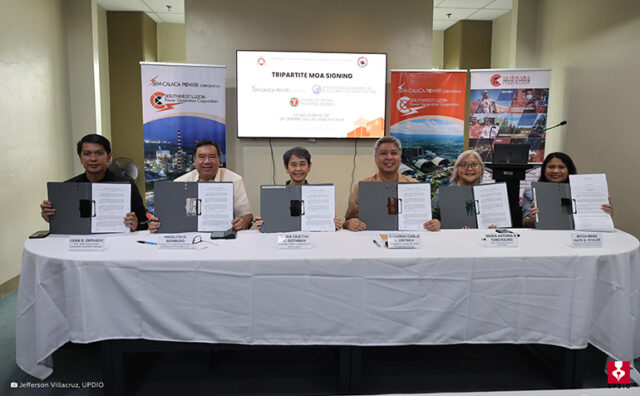
From left: SEM-Calaca Power Corporation OIC-Operations Manager Lean G. Depusoy; UPERDFI President Angelito D. Bermudo; SMPC President, COO and CSO Maria Cristina C. Gotianun; UP Chancellor Edgardo Carlo L. Vistan II; UP Diliman College of Engineering Dean Maria Antonia N. Tanchuling; and UP DMMME Chairperson Mitch-Irene Kate G. Oyales during the MoA Signing last July 17

Semirara Mining and Power Corporation (SMPC), through subsidiary SEM-Calaca Power Corporation (SCPC), together with the University of the Philippines (UP) and the UP Engineering Research and Development Foundation, Inc. (UPERDFI), has formally launched the country’s first academe-based Failure Analysis (FA) Hub.

The partnership agreement establishes the FA Hub with its own funding and operational structure. This enables engineers and researchers to independently offer failure analysis services that identify the causes of material and structural failures.

This builds on SMPC’s 2023 donation of specialized equipment to the Department of Mining, Metallurgical and Materials Engineering (UP DMMME), which provided engineering students additional opportunities for hands-on experience in materials testing and failure analysis.

“Genuinely empowering people is not a one-time act of support, but a continuous effort that fosters self-sufficiency and long-term stability,” said Charlie V. Robles, SMPC Vice-President and Power Complex Manager.

SMPC donated specialized equipment for material science to the UP DMMME last December 2023.

Empowering local engineers

UPERDFI President Angelito D. Bermudo emphasized the importance of empowering Filipino engineers, and that easier access to failure analysis could help reduce unplanned power plant outages.

“We extend our sincere appreciation to SMPC for investing in the future of Filipino engineers, and for empowering the UP to lead in the critical fields of failure analysis and material science,” he added.

UP Chancellor Edgardo Carlo L. Vistan II hailed the partnership as an exercise in nation-building that will benefit not only industries but also the public at large.

“This Failure Analysis Hub is more than just a new facility — it is a strategic investment in the future of Philippine engineering by building DMMME’s capacity to offer failure analysis techniques,” Mr. Vistan said.

Through this collaboration, SMPC, UPERDFI, and the University of the Philippines aim to nurture a new generation of globally competitive Filipino engineers, committed to innovation and nation-building.

Failure analysis involves examining components to predict when industrial equipment may fail — a critical process for ensuring safety and continuity in heavy industries.

Due to limited local access to FA, many utility providers have had to outsource these services overseas, incurring higher costs and longer turnaround times. With SMPC’s investment in the FA Hub, these services can now be conducted locally, reducing costs and building local expertise.


Spotlight is BusinessWorld’s sponsored section that allows advertisers to amplify their brand and connect with BusinessWorld’s audience by publishing their stories on the BusinessWorld Web site. For more information, send an email to online@bworldonline.com.

Join us on Viber at https://bit.ly/3hv6bLA to get more updates and subscribe to BusinessWorld’s titles and get exclusive content through www.bworld-x.com.

17 power projects endorsed for grid impact study

NGCP.PH

THE Department of Energy (DoE) endorsed 17 power projects to the National Grid Corp. of the Philippines (NGCP) in June to undergo a system impact study (SIS).

“In June 2025, the DoE issued 17 SIS endorsements, including 14 new applications and three amendments,” the agency said in a document posted on its website.

The SIS determines the adequacy and capability of the grid to accommodate new connection.

The DoE approved SIS endorsements for 15 renewable energy projects, consisting of 10 wind, four solar, and one hydroelectric power project (HPP).

Among the large-scale wind projects are CI San Jose Corp.’s 1,246-megawatt (MW) Roxas Onshore Wind Power Project (WPP), 500-MW San Roque Onshore WPP, and 260-MW Mauban Onshore WPP.

The government also endorsed Philippine New Energy Development Inc.’s 500-MW Cebu WPP; Alba Renewables Philippines Corp.’s 300-MW Aurelius WPP; Econergy Renewable Power Philippines, Inc.’s 200-MW Sorsogon 2 WPP, 150-MW Camsur WPP, and 100-MW Northern WPP.

The DoE also issued SIS endorsements to SE Renewable Energy, Inc. for its 112-MW Lian Batangas WPP and to Mainstream Renewable Power Philippines Corp. for its 49.999-MW Panaon WPP.

The solar projects include Embrace Nature Power1 Corp.’s 180-megawatt-peak (MWp) Agrovoltaic Solar Power Project (SPP); Aboitiz Solar Power, Inc.’s 168.953-MW direct current Calatrava SPP; RE Resources, Inc.’s 92.545-MWp San Manuel SPP; and Joy-Nostalg Solaris Inc.’s 62.010-MWp Ajuy 1 SPP.

The DoE also endorsed Alsons Energy Development Corp.’s 8.810-MW Siayan 1 HPP for grid impact study.

For other technologies, the DoE endorsed Upgrade Energy Philippines, Inc. for its 25-MW Upgrade Santiago and 25-MW Upgrade Samar battery energy storage systems (BESS).

Over the first six months of the year, the DoE approved 78 power projects to undergo grid impact studies. — Sheldeen Joy Talavera

ArteFino does food with pop-up resto

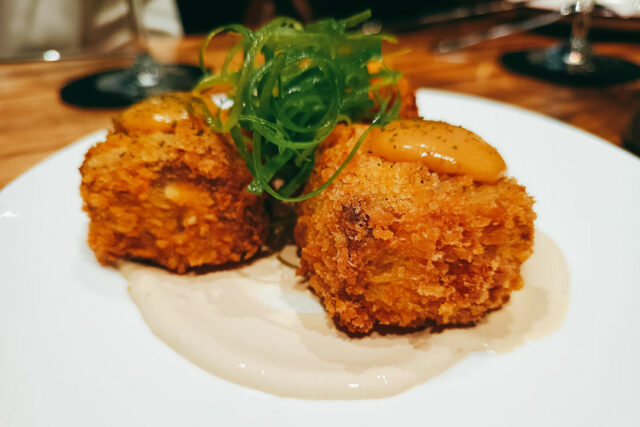
MONGHE, a minced pork, cheese, homemade banana ketchup, toyomansi cream meatloaf from Rizal Province. — JOSEPH L. GARCIA

AHEAD of the ArteFino Fair opening on July 31, the artisanal trade fair cooked up something else (literally), the ArteFino Lounge.

Daily until Aug. 3, the ArteFino Lounge features a collaboration with chefs Angelo Comsti and Don Baldosano’s Offbeat Bistro. Their new venture opened just a few months ago, featuring dishes that the chefs either grew up with, or Mr. Comsti has researched in his capacity as a food writer.

“This happened because we got word of a story that Angelo was doing research at the Lopez Library for heirloom and heritage recipes rooted in Philippine history,” said Marimel Francisco, ArteFino co-founder in a speech on July 25, at a tasting at the Chef’s Table at Rockwell’s Balmori Suites.

ArteFino Lounge, held a few floors below the main fair, will feature jewelry and accessories from ARAO, Caro Wilson, Golden Monstera, Katha Pilipinas, and Peewee Benitez. The preview and tasting also allowed us to see some furniture and home decor pieces which are also to be sold at the lounge.

The menu features small plates like Rizal Province’s take on meatloaf called Monghe (minced pork, cheese, homemade banana ketchup, toyomansi cream; P580) and Bread and Butter (beef fat Kabayan bread, crab fat butter, fried sweet potato leaves; P250). Unfortunately, these were the only courses we were able to enjoy because we had to leave early, but we’ll say that the Monghe was much better than expected with a dense, forward meat flavor; while the Bread and Butter, still warm, was incredibly rich and very indulgent (thanks to the contrast between the beef fat brushed on the crust; then the crab fat butter giving a hearty kick).

There’s more to look forward to, such as the TNT Pancit (noodles tossed in crab fat, egg yolk, smoked queso de bola, and shrimp salad; P490), and Lengua at Tinapa (tongue with smoked fish mayo, gribiche, and brioche). For the sides, they’ve got rice (plain, garlic, and Inihaw na Baboy Rice: smoked rice, egg, pork belly, and garlic chips) as well as a winged bean and egg salad. Big plates include a Seabream Miswa (noodle) dish, and a Steak Adobo. Prices range from P450 for fried chicken inasal — grilled chicken — to P2,400 for the steak adobo. Dessert selections include Mamon Tres Leches and Mais (Corn) Ice Cream.

“A lot of these recipes are rooted in our history,” said Ms. Francisco. “We value heritage and craft. We have not featured the culinary arts [in ArteFino], which is an art form in itself. Why not put a spotlight on that this year?”

Entrance to ArteFino will cost P150. One hundred percent of the ticket sales go towards HeArteFino, their nonprofit arm that awards grants to small artisanal brands. — Joseph L. Garcia

Meralco, Vietnam firms eyeing to build EV charging network

IN PHOTO ARE (L-R) Senior Vice-President and Chief Revenue Officer Ferdinand O. Geluz, Meralco Executive Vice-President and Chief Operating Officer Ronnie L. Aperocho, Meralco Chairman and Chief Executive Officer Manuel V. Pangilinan, Vingroup JSC Chief Corporate Development and Strategic Finance Officer Thuy Vu Dropsey, V-Green Philippines Chief Executive Officer Luu Viet Hung, and Green GSM Philippines Chief Executive Officer Dao Quy Phi.

POWER DISTRIBUTOR Manila Electric Co. (Meralco) has entered into a partnership with a Vietnamese electric vehicle (EV) firm and a ride-hailing service provider to support the development of green mobility solutions.

In a statement on Wednesday, Meralco said it signed a memorandum of understanding (MoU) with EV charging firm V-Green Global Charging Station Development Corp. and ride-hailing company Green and Smart Mobility Joint Stock Co. to support the country’s shift toward cleaner and more sustainable transport.

Under the partnership, the companies will identify and evaluate sites for EV charging stations and electric taxi hubs, support the rollout of charging networks, explore opportunities to scale up EV adoption, and engage in technical cooperation and knowledge exchange on EV technologies and system design.

“This partnership brings together our collective strength in infrastructure, technology, and experience that will redefine our cities and our communities. Together, we intend to reframe the way we think about energy, transport, and sustainability,” Meralco Chairman and Chief Executive Officer (CEO) Manuel V. Pangilinan said.

As the country’s largest electricity distribution company, Meralco said it is committed to taking the initiative in advancing the goals of the Electric Vehicle Industry Development Act through the deployment of integrated EV and charging infrastructure for businesses and the public.

V-Green CEO Nguyen Thanh Duong said that the partnership with Meralco would help the company in its mission to accelerate the “green mobility revolution” in Southeast Asia.

“By combining our expertise in EV charging infrastructure with Meralco’s strong local presence, we aim to rapidly deploy a reliable and accessible charging network across the Philippines,” he said.

“Together with VinFast and Green GSM, we are proud to contribute to a comprehensive EV ecosystem that supports the country’s journey towards a cleaner and more sustainable future,” he added.

Green GSM Philippines’ CEO Dao Quy Phi sees the Philippines as a “vibrant and fast-growing market” for clean mobility solutions.

“Through this collaboration with Meralco and V-Green, Green GSM is excited to expand our 100% electric ride-hailing service to more cities nationwide. Our goal is not only to provide safe, convenient, and affordable transportation, but also to play an active role in building a greener future for Filipino communities,” he said.

In Vietnam, V-Green serves as the exclusive charging infrastructure partner for VinFast electric vehicles. Green GSM, meanwhile, is an innovative electric ride-hailing platform that operates a fleet powered entirely by VinFast EVs.

“This collaborative model is poised to deliver meaningful benefits to the public, from cost-effective mobility to safer and seamless travel experiences, while laying a strong foundation for the country’s transition to a greener future,” Meralco said. — Sheldeen Joy Talavera

AI writing assistant Jenni AI sees PHL market as key growth driver

By Beatriz Marie D. Cruz, Reporter

JENNI, Inc. the US-based company that built artificial intelligence (AI)-powered writing assistant Jenni AI, is optimistic about expanding its presence in the Philippines as more universities explore the benefits of using AI tools in the academic setting.

“The Philippines is poised to become one of Jenni AI’s fastest-growing markets over the next 18–24 months for several reasons,” Justin Wong, head of commercial operations at Jenni AI, said in an e-mail. “Although English is considered a second language for most of the population, the Philippines ranks as one of the highest English-proficient countries in the world, which gives academics an advantage since the majority of scientific and research articles are published in English.”

Jenni AI is an AI-powered tool that provides writing and research assistance for both the academic and professional setting.

At present, it is being used by over 4.5 million academics worldwide, including 300,000 researchers, post-graduate students, and faculty based in the Philippines, the company said.

“We see that universities in the Philippines, such as the University of Santo Tomas and De La Salle University, are now pushing new digital transformation initiatives to implement ethical AI tools like Jenni into both learning and research workflows,” Mr. Wong said.

AI writing assistants like Jenni help ease academic workload by allowing users to focus on tasks that require more critical thinking, he said.

“By instantly cleaning grammar, suggesting specific phrasing, and automatically generating relevant citations, Jenni lowers the language and formatting barriers, enabling Filipino scholars to earn more recognition from top scholarly journals.”

Philippine users of Jenni AI mainly use its productivity features like the auto-citation, fluency improver, and outline builder, the company said.

Moving forward, Jenni AI is looking to roll out new features and product improvements every two weeks to better support academic users, including allowing document collaboration.

To help ensure the ethical use of AI, the company is also set to release an AI Usage Report feature, Mr. Wong said. This will help users strike a balance between their own inputs in their manuscripts with Jenni AI’s contributions.

This feature is expected to help users “ensure they are following the appropriate guidelines set by scholarly journals or their university,” the official said.

Another feature the company is working on is personalized article recommendations, where users can find new papers based on the sources they upload to Jenni AI.

The company also recently teamed up with CE-Logic, Inc. a local educational publishing and e-learning provider, to introduce AI solutions that can help enhance research productivity and learning in academic institutions nationwide.

“In partnership with leading experts and researchers, we’ve developed introductory and advanced modules to teach academics at every level how to use Jenni ethically,” Mr. Wong added.

The official said he believes banning the use of AI, especially in schools, is unrealistic.

“It is more important to keep the author in the driver’s seat, preserve academic integrity through transparent audit trails, and ultimately accelerate the journey from an idea to a peer-reviewed research contribution,” Mr. Wong said.

From content creator to business enabler

FACEBOOK.COM/REALTALKDARBS

In this plugged-in and socially connected age, we have grown to admire content creators — creative individuals who use their platform for entertainment, for selling, for education, and more. One such content creator is Real Talk Darbs, who I had the good fortune of speaking to in my podcast.

Most may know Darbie Kim Estrebillas as his online persona, Real Talk Darbs. Catapulted to online fame in 2020, Darbs has since expanded his lucrative role as content creator into, not one, but two more entrepreneurial avenues — selling personally branded food supplements and snacks, and establishing House Creatives. The latter is a swiftly growing company that enables other businesses to do what he has done so well: create content that clicks and sells online.

What I find genius about the evolution of Real Talk Darbs from content creator to business enabler and educator is how each of his businesses is a natural expression of his innate personality and passion.

CONTENT CREATION AS A SPRINGBOARD
Real Talk Darbs began his entrepreneurial journey as a content creator in 2020 when he resigned from a sales job in Dubai. It was just before the pandemic hit, and soon many workers around the world would be worried about job security. But Darbs recounted that he was ready for the challenge.

“I didn’t realize it at that time,” he said, “but that was the best time to quit because everybody was in their home listening to social media.”

He advised other entrepreneurs to “take that moment as an opportunity to really push forward because sometimes not having an option is a blessing.”

When Darbs started creating content on his page, he would be happy to make P3,000 from a single video. Soon, he was earning seven figures per month by the monetization of his content alone — a feat which is difficult to do these days, he quickly added, as the landscape has irrevocably changed.

This success didn’t come overnight. It was borne on the back of 10 years of struggle in Dubai, first as a call center customer service agent and then working in sales. And even before that, Darbs had struggled as a nursing student. But all the struggles led him to create the Real Talk Darbs page in 2018.

Many entrepreneurs say that they were lucky or they were simply in the right place at the right time. But not Darbs. “If somebody tells me right now that I’m lucky,” he said, “I’m gonna punch them in the face. No, I was not lucky.”

Through his long journey towards content creation, Darbs discovered that he had a gift, something inside him which he described as “innate.”

He said, “Mas maraming mas magaling sa akin na content creator. [There are many content creators who are better than me.] I truly believe my strength is [that] I’m able to transfer my knowledge efficiently.”

Darbs’ love and life advice on his channel has clearly found an audience. He credits his passion for his ability to create content that resonates. And it is this passion which would eventually lead him to other business ventures.

“I believe you can outperform other individuals if what is work for others is not work for you,” he said.

VENTURING INTO ONLINE SELLING
From there, Darbs didn’t stand still. He ventured into other businesses but these were still centered around his abilities as a content creator.

“I didn’t wait until the well dried up,” he said. “I dig another well while the other one is still working.”

With his ability to reach a wide audience, Darbs began to sell personally branded food supplements and snacks. He told the story of how his success selling products alone led to another breakthrough moment — and another business.

With just one video, he was able to sell P6 million worth of food supplements in 10 days — even without spending on ads. Darbs realized that he could share his newfound online selling knowledge with other business owners.

“I think there are businesses out there that if they just know this part, their business would explode,” he said. “And I think there’s a gap in that market.”

Darbs knew that he had something most business owners would want to have.

“In FB ads or paid ads right now, which most multi or billion businesses are built on, one thing is for certain, you need to have great creatives. So that’s where I come in.”

ENABLING BUSINESSES WITH HOUSE CREATIVES
For business number three, Darbs founded House Creatives, a company that is dedicated to “Create creators that influence transformation.”

In short, House Creatives is about education. It teaches other entrepreneurs how to create quality content that works.

This doesn’t mean going viral, Darbs insisted.

In his typically straightforward — yet strangely illuminating — manner, Darbs said, “Sa totoo lang, mabilis mag-viral. Kumain ka lang ng tae sa labas ng restaurant. [Truth be told, going viral is easy. Just eat shit outside a restaurant.] You can go viral. It’s hard to go viral if you’re pushing through the [brand] values, quality content, gourmet content.”

This gourmet content — in contrast to fast food content — is what House Creatives teaches.

Darbs continued: “Most of the time, people would not opt for gourmet content because it’s hard to do. Most of the time, the views are low. But in the long run, you develop quality viewers.”

Today’s content creation game isn’t just about views or impressions. It’s about quality — something that was rare five or 10 years ago. That’s why with House Creatives, Darbs focuses on “depth, not width.”

He explains, “Ang dami mo ngang followers (You have a lot of followers). Are they able to afford whatever it is that you’re selling? Just focus on the depth, the quality of the followers that you will have. Because at the end of the day, those are the people that could really impact other people’s lives as well.”

Today, House Creatives is rapidly growing, with plans to build their office later this year, which will enable them to expand to 60 employees. Darbs envisions House Creatives becoming a billion-peso company “hopefully in the next couple of years.”

In closing, Real Talk Darbs encourages other entrepreneurs to build their own “castle.”

“Having the opportunity to build your own castle is addicting,” he said. “Having the opportunity to build my own castle with my own bricks, that gave me a sense of fulfillment, even if it was difficult. Mind you, it was not easy. It was very, very difficult, but it was worth it.”


RJ Ledesma (www.rjledesma.com) is a Hall of Fame Awardee for Best Male Host at the Aliw Awards, a multi-awarded serial entrepreneur, motivational speaker, and business mentor, podcaster, an Honorary Consul, and editor-in-chief of The Business Manual. Mr. Ledesma can be found on LinkedIn, Facebook and Instagram. The RJ Ledesma Podcast is available on Facebook, Spotify, Google and Apple Podcasts. Are there entrepreneurs you want Mr. Ledesma to interview? Let him know at ledesma.rj@gmail.com

3-Michelin-star Paris restaurant Arpège switches to plant-based dishes

FRENCH CHEF Alain Passard poses in his restaurant Arpège, the three-Michelin-star restaurant which serves an exclusively plant-based menu in Paris, France, July 23. — REUTERS/GONZALO FUENTES

PARIS — French chef Alain Passard, known for his mastery of roasting techniques, has decided to drop almost all animal products from the menu at his three-Michelin-star restaurant, Arpège.

The decision follows his earlier move to eliminate red meat from Arpège’s dishes in the early 2000s. Mr. Passard’s updated menu excludes meat, fish, and dairy, although honey sourced from the restaurant’s own beehives will remain an exception.

Mr. Passard said he was motivated by his passion for nature, adding that using seasonal vegetables would also reduce the restaurant’s environmental impact.

Mr. Passard, 68, rose to fame for his roasted dishes, including poulet au foin, or chicken cooked in hay, but has since become a leader in Paris’ growing vegetable-based dining scene.

“Everything I was able to do with the animal will remain a wonderful memory,” Mr. Passard told Reuters.

“Today, I’m moving more towards a cuisine of emotion, a cuisine that I could describe as artistic. It’s closer to painting and sewing… Today, I’m a different chef.”

Arpège is the first restaurant with three Michelin stars in France to move to plant-based food, joining the ranks of Eleven Madison Park in New York, which made a similar transition under chef Daniel Humm.

On the menu is a “mosaic” of tomatoes, flamed aubergine with melon confit, and a dish made up of carrot, onion, shallot and cabbage. The priciest set menu costs €420 ($493) and lunch costs €260.

Some countries have seen consumers turn away from meat in recent years. At the Paris Olympics last year, organizers set out to cut the amount of meat served to athletes and spectators. — Reuters

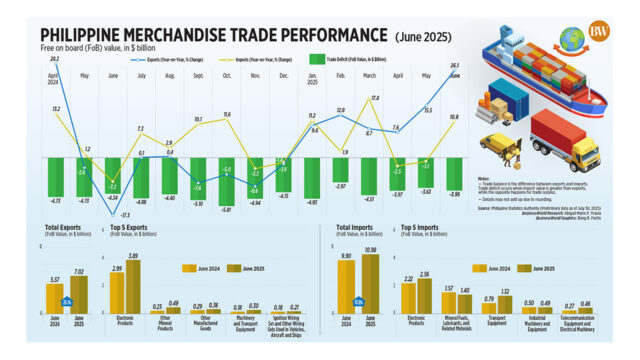
Philippine Merchandise Trade Performance (June 2025)

THE Philippines’ trade-in-goods deficit narrowed to $3.95 billion in June, as double-digit export growth was driven by frontloading in the run-up to higher US tariffs, the Philippine Statistics Authority (PSA) said on Wednesday. Read the full story.

Philippine Merchandise Trade Performance (June 2025)

PXP Energy Q2 net loss widens to P13.37M

PXP ENERGY CORP. saw a wider attributable net loss of P13.37 million for the second quarter of 2025, compared with P6.55 million in the same period last year, amid lower revenues and higher expenses.

In a stock exchange disclosure on Wednesday, the upstream oil and gas company reported a 22.9% decline in its petroleum revenues to P12.82 million from P16.62 million in the previous year.

Costs and expenses rose by 14.6% to P25.21 million from P22 million a year ago.

For the six months ended June, PXP said it had incurred a core net loss of P21.1 million, primarily due to softer crude prices, lower volumes from Galoc operations, and higher petroleum production costs.

Revenues dipped by 22.6% to P33.2 million, reflecting a 9.2% drop in sales volume to 280,742 barrels and a 13.9% decrease in the average realized crude price to $70.70 per barrel, amid global market adjustments.

“Galoc operations remained stable during the period, providing consistent output,” the company said.

Costs and expenses climbed by 12% to P33.2 million, mainly due to higher petroleum production costs and a one-off increase in overhead at a foreign subsidiary.

Regarding prospects, PXP said it continues to evaluate the feasibility of the Dalingding prospect under Service Contract (SC) 40, located onshore in northern Cebu. It is also keeping its doors open to pursuing other oil and gas opportunities across the country.

Furthermore, the company and its joint venture partners are awaiting the anticipated awarding of two pre-determined areas offshore in the southwest portion of the Sulu Sea basin for potential petroleum exploration. It is also on standby for its SC applications covering the former SC 6A Octon and SC 6B Cadlao blocks located offshore in northwest Palawan.

“Despite the ongoing force majeure over SCs 72 and 75, PXP and FEL (Forum Energy Limited) remain committed to the long-term potential of these blocks, maintain a prudent approach in managing existing commitments and continue to monitor developments across its portfolio of SCs,” the company said.

FEL, in which PXP holds a 99.35% controlling interest, is a company incorporated in the United Kingdom that focuses on the Philippines. — Sheldeen Joy Talavera

Peso plunges to four-month low before US GDP report

BW FILE PHOTO

THE PESO on Wednesday plunged to its worst close in four months against the dollar on expectations of strong US gross domestic product (GDP) data and before the US Federal Reserve’s policy decision overnight.

The local unit closed at P57.58 per dollar, dropping by 27 centavos from its P57.31 finish on Tuesday, Bankers Association of the Philippines data showed.

This was the peso’s lowest close in over four months or since its P57.69 finish on March 26.

The local opened the session stronger at P57.20 against the dollar. Its intraday best was at P57.115, while its worst showing was at P57.60 against the greenback.

Dollars exchanged increased to $1.86 billion on Wednesday from $1.73 billion on Tuesday.

“The dollar-peso closed higher due to lower trade balance data and anticipation of a stronger US GDP and ADP employment data,” the first trader said in a phone interview.

“The peso weakened anew amid expectations of a strong rebound in US economic growth for the second quarter,” the second trader likewise said in an e-mail.

US economic growth likely rebounded in the second quarter as the flow of imports subsided, but with consumer spending anticipated to have increased moderately and business investment in equipment stalled that would grossly exaggerate the economy’s health, Reuters reported.

The Commerce Department’s advance gross domestic product report on Wednesday would be heavily distorted by trade as was the case in the January-March quarter when GDP contracted for the first time in three years. Economists said President Donald J. Trump’s protectionist trade policy, including sweeping tariffs on imports as well as delaying higher duties, had made it difficult to get a clear pulse on the economy.

They urged focusing on final sales to private domestic purchasers, viewed by economists and policymakers alike as a barometer of underlying US economic growth, which is forecast to have slowed from the first quarter’s moderate growth pace.

A Reuters survey of economists forecast GDP likely increased at a 2.4% annualized rate last quarter after declining at a 0.5% pace in the first quarter. The size of the economy is also expected to swell above $30 trillion for the first time ever before accounting for inflation.

The survey was, however, concluded before data on Tuesday showed the goods trade deficit shrinking to its smallest in nearly two years in June and inventories rising marginally. That prompted economists to upgrade their GDP growth estimates by as much as 0.8 percentage point to as high as a 3.3% pace.

Trade chopped off a record 4.61 percentage points from GDP in the first quarter. Though a reversal is expected, some of the boost could be offset by low inventories, the result of the ebb in the flow of foreign merchandise. Trade and inventories are the most volatile components of GDP. Inventories added 2.59 percentage points to GDP in the January-March quarter.

Economists estimated the economy grew less than 1.5% in the first half of the year. They anticipated a lackluster second half, which would limit growth to around 1.5% or even less for the full year, a sharp slowdown from the 2.8% notched in 2024.

Though the White House has announced a number of trade agreements, economists said the nation’s effective tariff rate remained one of the highest since the 1930s and noted that about 60% of the nation’s imports remained uncovered by a deal.

The first trader added that the dollar remained strong on Wednesday amid higher global crude oil prices after fresh tariff threats from US President Donald J. Trump.

For Thursday, the second trader said the peso could rebound on potentially dovish hints from the Fed overnight after their policy meeting that could hint towards a rate cut at their September review.

The first trader sees the peso moving between P57.20 and P57.45 per dollar on Thursday, while the second trader expects it to range from P57.45 to P57.70. — A.M.C. Sy with Reuters