Home Blog Page 759

Philippines declares national calamity as Typhoon Tino kills more than 100

DEBRIS from damage caused by Typhoon Kalmaegi, locally called Tino, covers the ground in Talisay, Cebu. — REUTERS/ELOISA LOPEZ

THE PHILIPPINES declared a state of national calamity after Typhoon Kalmaegi (locally known as Tino) left more than 100 people dead and widespread destruction across the Visayas and Mindanao, with another powerful storm expected to hit within days.

President Ferdinand R. Marcos, Jr. said the measure would fast-track the release of emergency funds and ease procurement rules to speed up aid delivery.

“Several regions — almost 10 to 12 — have been or will be affected,” he said at a situation briefing in Quezon City. “With that scale and scope, it’s clear that this is a national calamity.”

The National Disaster Risk Reduction and Management Council recommended the declaration as Typhoon Tino unleashed torrential rains and strong winds that triggered landslides, floods and power failures, displacing thousands of families.

Authorities are now bracing for Typhoon Uwan, forecast to intensify into a super typhoon by Friday, threatening areas still reeling from Tino’s destruction.

The death toll from Typhoon Tino rose to 114, with about 127 people still missing, the disaster agency said, as the storm that devastated the country’s central regions regained strength as it headed towards Vietnam.

Tino battered large parts of central and southern Philippines this week, inundating towns, submerging villages and triggering landslides that left scores dead and thousands displaced.

In Vietnam’s Gia Lai province, some 350,000 people were expected to have been evacuated by the middle of the day as authorities warned of heavy rains and damaging winds that could cause flooding in low-lying areas and disrupt agricultural activity.

In the Philippines’ hardest-hit province of Cebu, the scale of the destruction became clearer as floodwaters receded to reveal flattened homes, overturned vehicles and streets choked with debris.

More than 200,000 people were evacuated in the Philippines ahead of Tino hitting on Tuesday. Some have returned to find their homes destroyed, while others have begun the arduous cleanup, scraping mud from their houses and streets.

“The challenge now is debris clearing… These need to be cleared immediately, not only to account for the missing who may be among the debris or may have reached safe areas, but also to allow relief operations to move forward,” Raffy Alejandro, a senior civil defense official, told DZBB radio.

ANOTHER STORM DEVELOPS
Even as Typhoon Kalmaegi exited the Philippine monitoring zone, weather forecasters were tracking a brewing storm east of Mindanao that could strengthen into a typhoon, raising concerns for potential impacts early next week.

The devastation from Kalmaegi, the 20th storm to hit the Philippines this year, comes just over a month after a magnitude 6.9 earthquake struck northern Cebu, killing dozens and displacing thousands.

As Kalmaegi moved over the South China Sea ahead of its landfall in Vietnam, it was regaining strength. It was forecast to affect several central provinces, including key coffee-growing areas, where the harvest season is under way.

Authorities were mobilizing thousands of soldiers to help with potential evacuations, rescue operations and recovery efforts.

Vietnam’s aviation authorities said operations at eight airports, including the international airport in Da Nang, were likely to be affected. Airlines and local authorities have been urged to closely monitor the storm’s progress to ensure passenger safety.

Mr. Marcos said the full extent of the damage was still being validated but described the casualty count as “very high.”

“We are continuing our relief and support for those hit by Typhoon Tino, but we are also doing everything that we can to anticipate and prepare for Typhoon Uwan,” Mr. Marcos said.

The President said government responders deployed in the Visayas might be reassigned to areas expected to be affected by the second storm, depending on how quickly relief operations stabilize in Cebu and nearby provinces.

After the devastation caused by Typhoon Tino, the Office of the President released P760 million in financial assistance to affected local governments across the country.

The provinces of Cebu, Capiz, Surigao del Norte, Iloilo, Bohol and Negros Occidental each got P50 million, while Eastern Samar, Surigao del Sur, Southern Leyte, Antique and Aklan were given P40 million each.

Leyte and Masbate each received P30 million; Guimaras, Agusan del Norte and Dinagat Islands, P20 million each; and Biliran, Camarines Sur, Sorsogon, Misamis Oriental, Negros Oriental and Palawan, P10 million each.

Smaller allocations of P5 million were extended to Albay, Romblon, Batangas, Northern Samar, Siquijor, Quezon, Samar, Agusan del Sur, Laguna, Zamboanga City, the City of Manila for stranded passengers, Camiguin, Occidental Mindoro, Camarines Norte, Zamboanga del Norte and Iligan City.

The Philippines, a country located in the Pacific Ring of Fire, is battered by about 20 typhoons annually. — Chloe Mari A. Hufana with Reuters
Scarborough buoys not for reclamation — NMC

FACEBOOK.COM/NAVALINSTITUTE

By Kenneth Christiane L. Basilio, Reporter

THE PHILIPPINES does not see China’s buoy placements at Scarborough Shoal as a precursor to island-building, but has prepared a flurry of responses if such activities happen, its maritime council spokesman said on Thursday.

National Maritime Council (NMC) spokesman Alexander S. Lopez said authorities were monitoring developments in the hotly contested feature on a “day-to-day basis,” adding that there would be no letup in efforts to prevent reclamation activities.

“There’s no reclamation activity and we are closely monitoring it,” he told BusinessWorld on the sidelines of a security forum in Manila. “If ever there will be, we will come up with the appropriate actions to it.”

“But definitely, we will go through peaceful means,” he added, saying the government prefers to handle tensions at the shoal and other features in the South China Sea diplomatically but is not shying away from responding militarily. He did not elaborate.

Scarborough, named Panatag by Manila and called Huangyan Dao by China, has been at the center of renewed tensions between the countries that lay competing claims over features in the South China Sea, where trillions of dollars worth of trade passes through annually.

The shoal is a vast fishing lagoon that lies within the Philippines’ 200-nautical-mile (370 kilometers) exclusive economic zone and was seized by China in 2012 after a standoff with Philippine forces.

In September, China approved the creation of a 3,500-hectare reserve at the northeast rim of the shoal, which it said is intended to preserve the ecological diversity of one of the most contested areas in the strategic waterway.

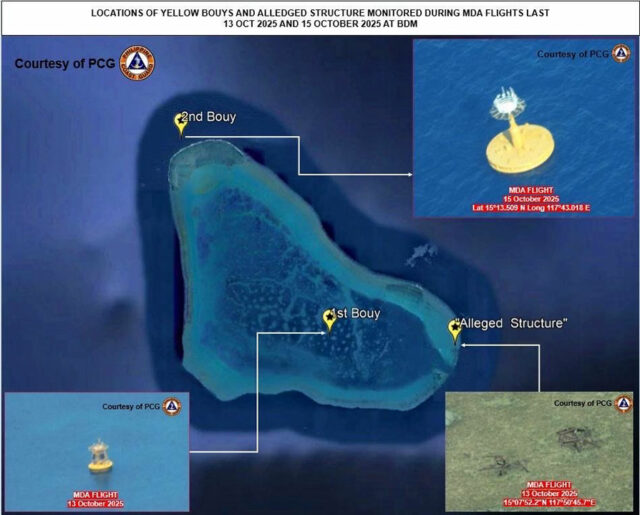
A Philippine maritime surveillance mission last month spotted buoys at the center and northern tip of the maritime feature, saying their findings could indicate “ongoing activities.”

“The two buoys installed at Scarborough are of different sizes and designs,” the Asia Maritime Transparency Initiative (AMTI) said in a report on Wednesday, noting that the buoy north of the feature is larger and resembles those found in the Yellow Sea by the South Korean Navy in June.

Satellite imagery showed that the northern buoy looks like a “standardized” 10-meter ocean environment monitoring buoy, AMTI said. “This design is among the ‘most widely used, oldest, most technologically mature’ types of buoys used in China’s coastal waters.”

It added that the buoy spotted in Scarborough’s center resembles 3-meter Chinese weather and sea monitoring buoys.

“Each type of buoy seen at Scarborough is produced by multiple manufacturers in China and can be outfitted with instruments for collecting a wide variety of marine data,” AMTI said, noting that the deployed buoys could be used to monitor waves, air pressure, temperature, wind speed and humidity.

Mr. Lopez acknowledged the Chinese buoys could have military purposes. “They can be for dual use,” he said, but noted they could help guide ships through the shoal’s rocky underwater terrain.

AMTI said China’s deployment of buoys at the feature could be part of efforts “to formalize Chinese control over the feature.” “More worryingly, it is a step toward physically occupying Scarborough.”

The Chinese Embassy in Manila did not immediately reply to a Viber message seeking comment.

“We don’t see the presence of the buoys as a prelude to any reclamation,” Mr. Lopez said. “The buoys are aids to navigation.”

Security experts earlier told BusinessWorld China might be preparing for island-building at Scarborough, warning that the spotted buoys and Beijing’s nature reserve plan could be used as cover for land reclamation.

“With regard to reclamation, I think that there’s no basis for it yet,” Mr. Lopez said.

Also on Thursday, Manila’s Defense department said Defense Secretary Gilberto C. Teodoro, Jr. met with US General John Daniel Caine on Wednesday at the Philippine military’s headquarters, where they discussed ways to enhance military engagements.

Mr. Caine, chairman of the US Joint Chiefs of Staff, and Mr. Teodoro “discussed the progress of alliance initiatives and explored ways to further operationalize bilateral and multilateral defense cooperation,” the agency said in a statement.

The Philippines and the US are close allies, with their partnership anchored on a 1950s treaty binding both to defend one another in case of an armed attack. Their alliance has flourished in recent years, with joint military drills becoming more complex and involving advanced weapon systems.

“Discussions covered expanding interoperability between the Armed Forces of the Philippines and US military forces, strengthening information-sharing mechanisms and enhancing joint humanitarian assistance and disaster response operations,” the Defense department said.

Philippine infrastructure watchdog flags P95-M ‘ghost’ flood project in Bulacan

PHILIPPINE STAR/MIGUEL DE GUZMAN

By Erika Mae P. Sinaking and Aubrey Rose A. Inosante, Reporter

THE INDEPENDENT Commission for Infrastructure (ICI) on Thursday urged the ombudsman to file criminal charges over another flood control project in Bulacan that was fully paid for but never built.

The agency said the P95-million Bocaue flood management project — later adjusted to almost P99 million — showed no signs of construction despite records claiming it was completed in January 2025.

The project, implemented by the Department of Public Works and Highways (DPWH) Bulacan First District Engineering Office through Topnotch Catalyst Builders, Inc. and Beam Team Developer Specialist, Inc. was found to be entirely fictitious, the commission said in a report to the Office of the Ombudsman.

A technical inspection by the Commission on Audit (CoA) confirmed no slope protection or waterway improvements were built, contradicting documents that certified completion.

Payments had been made based on falsified statements of work accomplished, which claimed the project was 51% done in mid-2024 and fully completed by early 2025.

The ICI recommended graft, malversation and falsification charges against several DPWH officials, including former Public Works Secretary Manuel M. Bonoan, former undersecretaries Roberto R. Bernardo and Maria Catalina E. Cabral, and district engineers Henry C. Alcantara and Brice Ericson D. Hernandez.

“It appears that several DPWH public officials were grossly negligent, if not remiss, in ensuring that the project was properly implemented and that government funds were lawfully disbursed,” the ICI said in its report.

Mr. Bonoan was also named in a separate referral earlier this week involving a similar “ghost” project in Plaridel, Bulacan. The commission said his repeated inclusion reflected his central role in project oversight and fund releases.

“Public trust was reposed on Secretary Bonoan to exercise control of DPWH as its secretary,” it said. “He miserably failed to exercise simple diligence tantamount to fraud in ensuring the judicious use of public funds.”

The commission added that the scheme might have gone unchecked if not for President Ferdinand R. Marcos, Jr.’s state of the nation address in July that triggered broader scrutiny of public infrastructure spending.

Mr. Bonoan has denied any wrongdoing, saying project execution lies with local engineering offices. He earlier said he does not tolerate corruption and had suspended those implicated in the ghost project.

Also on Thursday, the Bureau of Internal Revenue (BIR) filed criminal complaints against three former DPWH officials linked to the multibillion-peso ghost flood control projects in Bulacan, citing P1.6 billion in unpaid taxes.

BIR Commissioner Romeo D. Lumagui, Jr. told reporters the agency filed separate tax evasion cases before the Department of Justice against Mr. Alcantara, Mr. Hernandez and Jaypee de Leon Mendoza, covering tax deficiencies from 2020 to 2024.

He said lifestyle checks and asset reviews showed that the officials’ declared income did not match their spending patterns or reported assets.

“The statement of assets, liabilities and net worth (SALN) and tax returns of Alcantara, Hernandez and Mendoza cannot justify their lavish lifestyle,” he said in a separate statement. “Their casino records, properties, financial transactions and business interests are grossly disproportionate to their declared sources of income.”

Mr. Alcantara had the highest tax liability at P903.68 million, followed by Mr. Hernandez with P593.78 million and Mr. Mendoza with P180.64 million, according to BIR data.

The BIR said the officials earned “proponent shares” or kickbacks from the fake flood control projects and laundered the money through casino gaming. Investigators said the men exchanged large sums of cash for casino chips “grossly disproportionate” to their reported income.

Mr. Lumagui said the agency would pursue the recovery of assets to cover the unpaid taxes and coordinate with casino operators for future probes.

This marks the second batch of tax evasion complaints filed in connection with the DPWH ghost project scandal. Earlier, the BIR filed a P7.1-billion case against building contractors Cezarah Rowena C. Discaya and Pacifico F. Discaya.

The BIR has now filed 10 criminal cases covering P8.86 billion in tax liabilities as part of its broader crackdown on corruption-linked tax evasion.

“We will compel them to pay and will pursue all their assets to ensure it gets paid,” Mr. Lumagui said, adding that more than 200 other people are under investigation for similar tax discrepancies.

Bill seeks 30% discount for senior PWDs

PHILIPPINE STAR/MIGUEL DE GUZMAN

A BILL that seeks to raise the discount for senior citizens but only for those with disabilities was filed at the House of Representatives last month.

Elderly Filipinos with disabilities will be entitled to a 30% discount on medicines, healthcare services, transportation, accommodation and funeral costs under House Bill No. 5189 filed by Party-list Rep. Rodolfo M. Ordanes.

Filipino senior citizens get a 20% discount under a law designed to enhance their access to healthcare and social services, with the goal of improving their overall quality of life.

“However, there exists a distinct sector composed of individuals who are both senior citizens and persons with disabilities (PWD),” Mr. Ordanes said in the bill’s explanatory note.

He said the discount hike is “necessary,” noting that elderly PWDs find it doubly hard to meet their needs, and that inflation has eroded their purchasing power.

He added that the proposal would not hurt businesses since the discounts they grant could be deducted from their income tax.

“The 30% discount for senior PWDs is not a loss for businesses,” Mr. Ordanes said in a separate statement on Thursday. “It actually lowers the taxable income of businesses.”

“So, I urge businesses and their employees not to look at seniors as bad for business or burdens because of their discounts,” he added, noting that elderly Filipinos often come with their families when dining in or renting an accommodation. “They also buy for their families.”

Any person or establishment that fails to grant the mandated discounts to elderly PWDs could face imprisonment of two to six years, along with fines ranging from P100,000 to P200,000 for repeated violations, according to the bill.

Those who abuse the privileges granted under the House bill could face a minimum of six months’ imprisonment and a fine of as much as P100,000, it added. — Kenneth Christiane L. Basilio

PHL, Bangladesh deepen labor ties

THE PHILIPPINES and Bangladesh are looking to sign a memorandum to improve labor ties, the Department of Migrant Workers (DMW) said, following a meeting between officials from the two countries.

“The meeting centered on the proposed Philippines-Bangladesh Memorandum of Understanding (MoU) on labor migration management, highlighting cooperation on ethical recruitment, skills development, digitalization, and reintegration,” the agency said in a statement on Thursday.

The DMW said that Migrant Workers Secretary Hans Leo J. Cacdac had met with Bangladeshi Foreign Secretary Mohammad Nazrul Islam and his delegation on Nov. 3.

“Secretaries Cacdac and Islam reaffirmed their shared dedication to protecting migrant workers and promoting decent work,” the statement said.

The agency added that the meeting also discussed potential reforms in fair salary standards and incentives.

“Both parties also provided updates on their partnership with the International Organization for Migration (IOM) and discussed reforms, such as fair salary standards and incentives for compliant employers,” it said.

The DMW said that Manila and Dhaka remain aligned in promoting transparent recruitment practices, stronger protection systems, and improved welfare for all migrant workers. — Adrian H. Halili

Typhoon-hit families get P3-M aid

Aboitiz Group provides clean drinking water as part of its relief efforts for communities affected by Typhoon Tino.

ABOITIZ FOUNDATION and Aboitiz business units, through their OneAboitiz initiative, mobilized over P3 million worth of relief and recovery operations in disaster-stricken communities in Cebu and other parts of Visayas and Mindanao following the onslaught of Typhoon Kalmaegi, locally called Tino.

In partnership with local government units, Aboitiz Foundation distributed 7,200 food packs and non-food items and delivered 158,000 liters of drinking water to more than 12,500 families in Cebu, Bohol, Negros Occidental, Iloilo, and Dinagat Islands.

“Our collective action shows what OneAboitiz is all about standing together for our people and our communities,” Sabin M. Aboitiz, chairman of the Aboitiz Foundation, was quoted as saying in a media release on Thursday.

“These floods remind us that while we can’t control nature, we can control how we respond with compassion, courage, and care. Let’s look out for one another, not just today but through the recovery that follows.”

Aboitiz Foundation, which kicked off relief distribution on Wednesday, will continue extending support this week to areas such as Cebu City, Mandaue, Liloan, Toledo, Talisay, and Balambang among others.

Aboitiz InfraCapital Water will particularly provide potable water, while AboitizPower distribution utilities, including Visayan Electric, Davao Light and Cotabato Light teams, will work to restore power lines downed by the typhoon.

Also among the Aboitiz units that supported the operations were: Aboitiz Renewables, Inc., Aboitiz Land, Aboitiz Economic Estates (Cebu), Aboitiz Foods and Coca-Cola Europacific Aboitiz. — CAT

PMA boosts education standards

FORT DEL PILAR, Baguio City — The Philippine Military Academy (PMA) promised to continue strengthening its academic standards after joining the 9th ASEAN University Network-Education Quality International (AUN-EQI) Outcome-Based Education Training-Workshop.

The PMA delegation, led by Col. Jesus Francisco M. Torbela, Director of the Center for Leadership and Excellence, attended the 4-day training in Bangkok, seeking to enhance the Academy’s programs on curriculum design, teaching methods, and outcome-based assessment.

The workshop focused on Future-Ready Education, which helps institutions create measurable and adaptive learning outcomes.

The training forms part of PMA’s ongoing efforts to improve its academic quality assurance systems through the AUN Quality Assurance (AUN-QA) framework.

Since 2024, the Academy has participated in several AUN-QA activities to align its standards with global benchmarks.

In April this year, PMA made history as the first military school in Southeast Asia to be recognized as an AUN-QA associate member.

PMA Public Affairs Office chief Lt. Jesse Saludo explained that these initiatives seek to make PMA’s education system more competitive and relevant to modern challenges. PMA seeks to produce graduates who are not only skilled in military leadership but also capable of critical thinking, innovation, and adaptability, he stressed.

PMA’s active participation in ASEAN academic programs also highlights the Philippines’ support for regional cooperation and knowledge sharing.

The Academy believes that military schools can play an important role in promoting education and leadership development across the region.

By investing in international partnerships and training, PMA continues to move toward becoming a globally competitive defense learning institution, dedicated to producing future-ready leaders for the Armed Forces of the Philippines. — Artemio A. Dumlao

Citizen action, accountable leaders vital in curbing corruption

GROUPS gathered at the People Power Monument in Quezon City for the Trillion Peso March on Sunday, amid calls for accountability and action against widespread corruption in the government. — PHILIPPINE STAR/RYAN BALDEMOR

CITIZEN PARTICIPATION and accountable leadership remain central to curbing corruption amid scandals and growing public distrust, as institutions renew efforts to strengthen transparency, reform systems, and restore confidence in government, public officials said on Thursday.

“Every peso lost to corruption is a peso stolen from our people’s future. This is why integrity is not just a principle — it is an economic imperative,” former Vice-President and Naga City Mayor Maria Leonor “Leni” G. Robredo said at a public governance summit.

“Citizen participation is not an afterthought — it is a constitutional duty,” added former Interior Secretary Mel Senen S. Sarmiento, who also served as mayor of Calbayog City. “If this process were properly followed, many controversies in local governance could have been prevented.” 

The call for stronger accountability and reform comes as the Institute for Solidarity in Asia (ISA) marks its 25th year through the “ISAng Bansa, ISAng Pangarap: National Summit for Public Governance,” a gathering of reform advocates, leaders, and integrity champions from both the public and private sectors held in Makati City.

The summit underscored the growing urgency for systemic reform as the Philippines grapples with recurring governance crises, misuse of public funds, and eroding public trust.

“For 25 years, ISA has been building the architecture of integrity in our institutions,” said ISA Executive Director Christian P. Zaens. “But integrity is not a one-time act — it is a culture that must be built, lived, and sustained.”

At the summit, Armed Forces of the Philippines (AFP) Chief of Staff Gen. Romeo S. Brawner, Jr. said the military’s ongoing transformation program has strengthened accountability, transparency, and innovation within the institution.

“The adoption of the Performance Governance System framework has significantly shaped our culture and way of working,” Mr. Brawner said. “It enabled us to institutionalize systems and processes that promote integrity, transparency, and operational excellence.”

Ramon R. del Rosario, Jr., chairman and chief executive officer of PHINMA Corporation, said education is a concrete tool for empowering citizens and strengthening governance. He highlighted PHINMA’s programs that provide accessible quality education to disadvantaged communities.

“When students from underprivileged areas gain access to higher education, they not only improve their own lives but also elevate their families and communities, becoming citizens who can hold government accountable,” he said.

Mr. Del Rosario also said that sustainable reform requires active government leadership, partnership with the private sector, and institutional oversight.

He called for continued investment in education as a national priority and urged all stakeholders to ensure that resources are properly used, scholarships are granted, and schools are equipped. — Erika Mae P. Sinaking

Insurers project medical cost growth of 16% in 2025, 2026

PHILIPPINE STAR/MIGUEL DE GUZMAN

INSURERS said the affordability of medical insurance could be at risk with growth in the cost of medical treatment expected to rise 16% in 2025 and 2026.

Mercer Marsh Benefits said the projection was based on the results of a survey of eight insurers.

Growth in the cost of treatment far outstrips the inflation forecasts of 2.6% for 2025 and 2.9% for 2026.

In 2024, treatment costs rose 18%, also exceeding the 3.2% inflation rate.

“Another year of widespread double-digit medical trends across Asia is a wake-up call: cutting benefits may ease budgets now, but it shifts financial risk to employees and undermines retention.

“Employers should partner with insurers on data-driven plan design and targeted funding for high-cost claimants, tackle inefficiency and waste, and prioritize preventive care and mental health to preserve long-term affordability,” Mercer Marsh Benefits Asia Leader Steven Yu said.

In the Philippines, the firm surveyed First Life Financial Co., Inc., Generali Life Assurance Philippines, Inc., Insular Health Care, Inc. (iCare), Maxicare Healthcare Corp., PhilhealthCare, Inc., The Insular Life Assurance Co. Ltd., United Coconut Planters Life Assurance Corp., and Value Care Health Systems, Inc.

The projected rise in medical costs in the Philippines exceeds the average growth projections for Asia of 12.4% for 2025 and 12.5% for 2026.

Globally, medical costs are expected to increase 10.7% this year and by 11% next year, according to 268 insurers across 67 markets surveyed.

The report said insurers expect plan utilization to rise due to ageing populations and the prevalence of chronic health conditions; healthcare staff shortages delaying access to primary care and greater reliance on virtual care, urgent care, or hospital treatment; pressures on public health systems, particularly in Europe, leading more people to use  private health plan benefits; higher-cost treatments, notably advanced cancer therapies, adding complexity to care delivery and management; and dependence on imported medical goods and services in many markets, creating delays and disruptions in supply chains.

Trade policy shifts in the US are also a factor in rising medical costs, with more than half (52%) of surveyed insurers expecting tariffs and supply chain disruptions to have a significant or very significant effect on the cost of treatment in 2026.

“On average, insurers are adding between 1.0 to 2.5 percentage points into their trend projections to reflect market uncertainty created by these policy shifts,” the firm said. — Aaron Michael C. Sy

Fourth round of Green Energy Auction awards top 10,159 MW, 96% of target

REUTERS

THE Department of Energy (DoE) said on Thursday that updated totals from the fourth round of the green energy auction (GEA-4) now show awards of 10,195.49 megawatts (MW) worth of projects, or 96% of the installation target.

In a statement on Thursday, the DoE said the awarded projects are committed for delivery between 2026 and 2029.

“This overwhelming response reflects the growing confidence of investors in the Philippines’ renewable energy sector and underscores the country’s commitment to achieving its clean energy goals,” the agency said.

GEA-4 projects involve technologies like ground-mounted, roof-mounted, and floating solar; onshore wind, and integrated solar with energy storage systems (IRESS).

Ground-mounted solar projects accounted for over 4,179.09 MW, floating solar 2,284 MW, onshore wind 2,518.29 MW, IRESS 1,189.29 MW, and roof-mounted solar 24.82 MW.

The updated totals exceed the preliminary auction results of 9,423.622 MW announced in September.

Winning bidders include Citicore Renewable Energy Corp., San Miguel Global Power Holdings Corp., ACEN Corp., Aboitiz Power Corp., and Basic Energy Corp.

The DoE requires all successful bidders to submit key compliance documents, including affidavits of undertaking, performance bonds, system impact studies, and proof of financial obligations by Dec. 6.

The GEA program aims to build up renewables as a primary source of energy. The supply contract for winning renewable energy projects will run for 20 years, starting from the start of commercial operations.

The Philippines hopes to hit a 35% share of RE in the power generation mix by 2030. — Sheldeen Joy Talavera

Gov’t agencies urged to directly procure palay

A farmer threshes newly harvested palay grains at a ricefield in Mogpog, Marinduque in central Philippines, March 22, 2016. — REUTERS

THE departments of Agriculture (DA) and Agrarian Reform called on government agencies and government-owned or -controlled corporations (GOCCs) to procure palay (unmilled rice) directly from farmers in compliance with their legal obligations.

In a joint briefing, the two departments cited the importance of harnessing government procurement to support farmers and ensure they obtain fair prices for their grain.

The briefing was convened to discuss Executive Order (EO) 100, which directs officials to establish regional floor prices for palay, and EO 101, which pushes for the full implementation of the Sagip Saka Act to boost enterprise development among farmers and fisherfolk.

Republic Act No. 11321, or the Sagip Saka Act, requires government agencies and GOCCs to procure agricultural and fishery products directly from accredited Farmers and Fisherfolk Cooperatives and Enterprises.

The Sagip Saka process exempts procuring entities from public bidding rules.

Kinakailangan kung mamimili ng mga bigas na gagamitin para sa mga feeding program, disaster response, at iba pa, kinakailangan itong magmumula sa palay na itinanim ng mga kamay ng magsasakang Filipino (When buying rice for feeding programs, disaster response, and other government initiatives, it should come from palay grown by Filipino farmers),” Agrarian Reform Secretary Conrado M. Estrella said at the briefing.

EO 100 also tasks the DA and a yet-to-be-formed steering committee to set and adjust the palay floor price per region.

While specific guidelines are still being developed, the floor price is expected to align with current National Food Authority regional price levels, which range from P17 to P23 per kilo for fresh palay and P23 to P30 per kilo for clean, dry palay.

Sen. Francis Pancratius N. Pangilinan, principal author of the Sagip Saka Act, said the two EOs will help local farmers and consumers.

“These measures are timely lifelines for Filipino farmers, fisherfolk, and consumers amid surging fuel costs and successive calamities affecting quake- and typhoon-affected provinces,” Mr. Pangilinan said in a statement.

The DA will also set up Sagip Saka Desks in its regional field offices to register farmers and fisherfolk to qualify them to sell to government agencies.

Farmer groups raised concerns over the limitations of the executive orders.

“EO No. 100 covers only government procurement of palay, but without a substantial increase in the government’s procurement budget, the state can purchase only 2–4% of the harvest, leaving approximately 95% of our palay under the control of private traders and trader-importers,” Samahang Industriya ng Agrikultura Executive Director Jayson H. Cainglet said in a statement.

Agriculture Secretary Francisco P. Tiu Laurel, Jr. said the goal is to increase government procurement to have a better influence over prevailing rice prices.

Ang target natin next year is 20% ang government procurement (Our target next year is 20% of the rice trade accounted for by government procurement). We will have new facilities, silos, that will be more than double our capacity to store (rice),” Mr. Laurel told reporters. — Vonn Andrei E. Villamiel

Price freeze in place for Cebu City, Dinagat until Jan. due to Typhoon Tino

FACEBOOK.COM/COASTGUARDPH

THE Department of Trade and Industry (DTI) said a price freeze will be in place for Cebu City and Dinagat Islands following Typhoon Tino.

In a Facebook post, the DTI said the order follows the declaration of a State of Calamity in the two areas.

“The coverage period will be from Nov. 5 to Jan. 4, or for 60 days, unless sooner lifted by the President,” it said.

“This measure ensures that the prices of basic necessities remain stable and accessible to consumers during the period of rehabilitation,” it added.

In a separate post, the DTI announced that a price freeze on basic necessities was also in effect in the Municipality of Guiuan, Eastern Samar.

“(This is) pursuant to the declaration of a State of Calamity due to the life-threatening conditions brought about by Typhoon Tino, which affected safety, livelihoods, and economic activities in the municipality, including its island barangays,” it added.

The price freeze in the municipality took effect on Nov. 4 and is expected to be in place until Jan. 3, unless lifted sooner.

According to an advisory, price controls in Guiuan cover 555 Bonus Pack Sardines (Green), Atama Sardines Easy-Open-Can and Regular Lid (Green), Lucky 7 Sardines (Green), Mikado Sardines Regular Lid (Green), and Sallenas Sardines Regular Lid (Green).

The price freeze also covers 3-in-1 packs of Blend 45 and San Mig Super Coffee Original, 350 ml, 500 ml, and 6-liter bottles of Absolute Pure Distilled Water, and 7-liter bottles of Wilkins Distilled Water.

Prices of 350 ml Summit Natural Drinking Water, one-liter Wilkins Pure Purified Water, 250- and 500-gram Fidel Refined Salt, and 500-gram Fidel Coarse Salt were included in the price freeze list.

Liwanag Esperma numbers 3, 5, and 18 candles are subject to price freezes at P62.25, P83, and P72, respectively.

Also covered are laundry soaps like Champion Bar Citrus Fresh and Supra Clean Original Scent and Surf Active Clean Kalamansi and Power Bula Power Puti.

Also subject to price controls are chicken- and beef-flavored instant noodles under the Ho-Mi, Lucky Me!, Payless, and Quick Chow brands. — Justine Irish D. Table