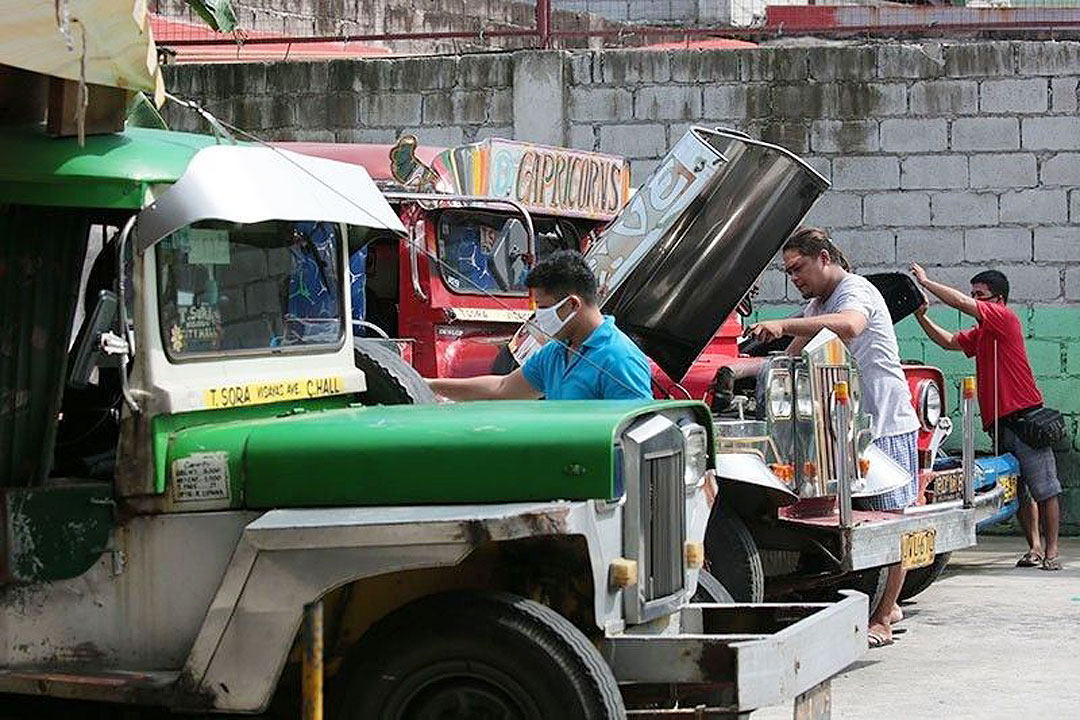
THE GOVERNMENT must increase targeted subsidies to the transport industry to cushion the impact of the fuel price shock and stabilizing employment, a government think-tank said.
At a briefing on Wednesday, Philippine Institute for Development Studies (PIDS) Senior Research Fellow Francis Mark A. Quimba said local transport could absorb a 22% drop in revenue under a 100% oil price shock scenario.
“That means (transport firms) need to collectively generate 22% more sales on top of what they are already making, simply to neutralize the impact of the oil shock while keeping all the other workers employed,” he said.
“In the short run, this is very difficult. That is why government intervention in terms of subsidies, fare increases or something, is needed.”
Under a 100% oil shock scenario, the mining industry could be subject to a “revenue gap” of 10%, agriculture 5% and construction 3%.
The gap represents “the revenue that is needed for them to keep their workers, but also manage the increase in costs,” Mr. Quimba said.
Fuel prices in the Philippines have surged since the US and Israel attacked Iran, which led to the closure of the Strait of Hormuz.
If the fuel crisis runs on until June, PIDS Senior Research Fellow Jose Ramon P. Albert said the additional cost burden on the Philippine economy would be P550 billion, equivalent to 2.58% of gross domestic product (GDP).
These are cost-push pressures that may squeeze industry margins, could be passed on the consumers through inflation, or both.
If the war continues, the cost burden could double to P942 billion. In the worst-case scenario, the additional cost burden on the economy could hit P1.3 trillion or over 6% of GDP, he said.
Cement costs may also increase by about 12% under the current scenario, which could affect fixed-price government infrastructure contracts being pursued by the flagship Build Better More program.
“Cost overruns in public works tend to cascade into the private construction supply chain as well,” Mr. Albert said.
The oil crisis may also raise freight costs by up to 14%, which could drive up goods prices, he said.
Mr. Albert also noted that a 9% increase in electricity generation costs under the current scenario would ripple into the power bills of industrial, commercial and residential consumers.
The fuel crisis may also worsen the country’s long-standing poverty issue, he also said.
“Our household modeling shows that under the current scenario, we will have an estimated 1.34 million more Filipinos (sinking below) the poverty line,” Mr. Albert said.
The newly poor will be from low-income households that were above the poverty threshold before the global oil shock, he added.
“We need to be able to provide them some assistance to offset the purchasing-power losses, especially at the bottom three deciles of income distribution,” Mr. Albert said. — Beatriz Marie D. Cruz