Home Blog Page 6057

Rivers loses franchise workhorse

Not a few quarters saw fit to second-guess Sixers head coach Doc Rivers’ decision to leave top dog Joel Embiid on the floor in the dying minutes of Game Six of their first-round series. After all, the pundits noted, the red, white, and blue were already up by 21 when the fourth canto began, and the Raptors could go no closer than 18 the rest of the way. And given the Most Valuable Player candidate’s injury history, prudence dictated that his minutes be managed well. Instead, he burned rubber for all but the last three minutes and 58 seconds of the payoff period, and only because he was on the wrong end of an elbow that, it was subsequently learned, gave him a concussion and facial fracture.

Hindsight makes for 20/20 vision, to be sure, and Rivers could not have known Embiid would be the victim of a freak play. Predictably, it’s what he pointed out to scribes that greeted him after practice yesterday. “Everyone was in there, and the other team had all their guys in, too,” he said. And he’s right. Then again, the Raptors’ situation — what with the deficit necessitating full force (aside from no small measure of good fortune) to overcome — was markedly different from their own. Taken in this context, his defense was that he had already planned to take the Sixers’ leading scorer and rebounder out prior to the fateful play came off as more of an excuse.

It bears noting that Rivers traditionally tightens his rotations in the playoffs. Embiid normed close to 34 minutes in 68 regular-season games, in contrast to the 39-per-match average against the Raptors. It’s also reflective of the bench tactician’s desire to avoid a Game Seven after the Sixers claimed the first three contests; he counted on his best charges to close the deal, perhaps with his previous postseason failures at the back of his mind. In any case, what’s done is done, and he has no choice but to prepare for the conference semifinals without his franchise workhorse.

Needless to say, the burden is on Rivers to steer the Sixers to success without Embiid on tap — which may well be a tall order against the resilient Heat. With no one on the roster close to approximating the lost talent level at the slot, he’s bent on using a platoon to tide them over. How that will work out remains to be seen. “We just have to be very smart in how we plan our bigs,” he argued. And, given their leader’s indefinite period of convalescence, how “smart” figures to determine how much — and, yes, how long — they will stay competitive.


Anthony L. Cuaycong has been writing Courtside since BusinessWorld introduced a Sports section in 1994. He is a consultant on strategic planning, operations and Human Resources management, corporate communications, and business development.

Who is most competent to grow our economy?

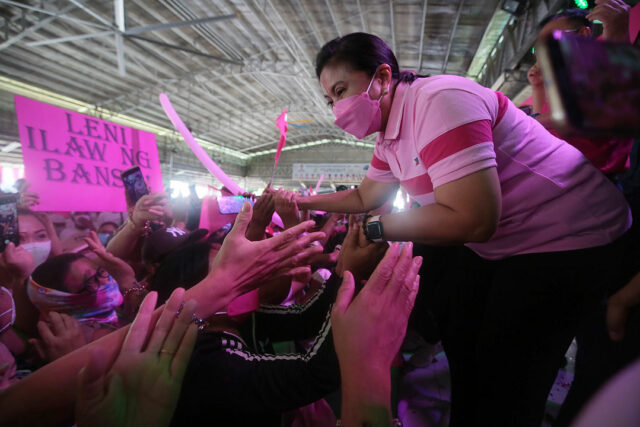
PRESIDENTIAL ASPIRANT Vice-President Leni Robredo greets her supporters during a sortie at Brgy. Calipahan, Talavera, Nueva Ecija, March 22. — PHILIPPINE STAR/MICHAEL VARCAS

“The economy, stupid.” This was a campaign slogan of Bill Clinton in the US’s 1992 presidential election. It was a most fitting message at a time when the US was suffering from recession. Hammering home to voters the message it’s “the economy, stupid” made Clinton win the election.

Thirty years after, “the economy, stupid” as a catchphrase resonates in the Philippines and elsewhere. The pandemic, aggravated by how authorities bungled the pandemic response, led to the worst recession that the Philippines has suffered since independence.

An internal, unpublished survey done in December 2021 showed that the main fears of the voters were: 1) “getting sick,” 2) “not having a job and salary,” and 3) “not being able to afford basic needs.” Here, health or containing the pandemic was a primary concern, and it was inextricably tied to economic well-being.

But as infection rates, severe cases, and deaths have declined significantly since the pandemic’s peak in January this year, the people’s attitude and behavior have changed. One can observe pandemic fatigue and even complacency.

A more recent survey (April 2022), likewise unpublicized, showed that the chief concern of voters is the revival of the economy. Similarly, the survey pointed out that voters want “a clear tangible plan for reviving the economy.”

The question thus is who among the candidates for President is most capable, most competent to address an economic recovery? Since the race has boiled down to a “two-way race” between Bongbong Marcos and Leni Robredo, let’s focus on these two candidates.

Based on background, record, and articulation of economic platform, Robredo has the clear advantage.

Robredo is an alumna of the University of the Philippines School of Economics (UPSE). UPSE is the premiere school of economics in the Philippines. Although Robredo is not a practicing economist (for she specialized in lawyering for the poor and the oppressed), the schooling and training she received from the leading economics professors and the firm support she has gotten from economists — in the academe, think tanks, civil society, and business — demonstrate the credibility and confidence she enjoys managing the Philippine economy.

More importantly, Robredo has articulated a well-thought-out economic plan. She grasps well the link between fighting COVID-19 and growing the economy. Her many initiatives to stop the spread of COVID-19 do facilitate economic revival and job protection or creation.

She likewise has a good grasp of the issues of fiscal policy. She is committed to increasing spending on health, education, climate change, technological innovation, and infrastructure. And she will do this by creating fiscal space by reducing waste, inefficiency, and corruption in government spending and, at the same time, increasing the tax effort through reforms in tax policy and tax administration.

Under a Robredo administration, we can expect policy continuity with respect to the reforms that have led to Philippine economic transformation (but which were disrupted by the pandemic) in the last decade.

On the other hand, Marcos Jr. spells trouble for the Philippine economy.

His grasp of economics ever since has been poor. In a column titled “Yes, I tutored Bongbong in Economics” (Inquirer, Nov. 6, 2021), Solita Collas-Monsod wrote that at Oxford, Marcos Jr. applied for the bachelor’s degree in Philosophy, Politics and Economics. “Well, he passed Philosophy, but failed in Politics and Economics.”

So, Professor Monsod was assigned by the UPSE Dean Jose Encarnacion to tutor Marcos Jr. in economics. The young Marcos had an attitude problem; he didn’t even bother to show up for the first tutoring session.

One can argue that Marcos Jr. can appoint qualified economic managers to his Cabinet. But a serious problem arises. Whoever will be Marcos’s economic managers, they must follow the leader. But Marcos Jr.’s answer to the complex economic problems we have is “Unity,” which is empty-headed.

Marcos Jr. also promises subsidies left and right. But where will he get the resources considering the budget constraint? His populism is of the worst type, because he is opposed to taxation, which is necessary to have the space for increased spending. For instance, he opposed the sin tax law, a reform that has provided substantial financing for universal healthcare. (Robredo supported the sin tax reforms.)

The truth is, even the technocrats under the Duterte administration fear a Marcos presidency will reverse the economic reforms. Do ask them, and they will give their honest answers.

Incidentally, Secretary Sonny Dominguez recently said that the “Department of Finance’s successes on Duterte watch” are a result of the “good work” of predecessors, a result of “policy continuity.”

But the “good work” is threatened. The title of an article from Focus Economics (Economic Forecasts from the World’s Leading Economists) goes: “Philippines: Marcos Jr. vs. Robredo: Economists prefer Robredo despite Marcos Jr.’s poll lead” (April 26). The article said, “the election is already having a macroeconomic impact” and uncertainty prevails. “Moreover, investor perceptions of Marcos appear weak, raising market jitters.” Further, said article posited that “the most salient aspect of Marcos Jr.’s economic platform is its lack of clarity.”

We have been subject to a lot of misinformation. There’s the myth of Marcos and Marcos Jr. There’s the lie about the competency of Robredo — her being lugaw and lutang. I hope this piece has given the information that Robredo is the best candidate (and that Marcos is the poor candidate) to tackle “the economy, stupid.”

If Keynes were alive, he would have informed voters: “When my information changes, I alter my conclusions.”


Filomeno S. Sta. Ana III coordinates the Action for Economic Reforms.

www.aer.ph

PPPs — Partnerships towards a Progressive Philippines

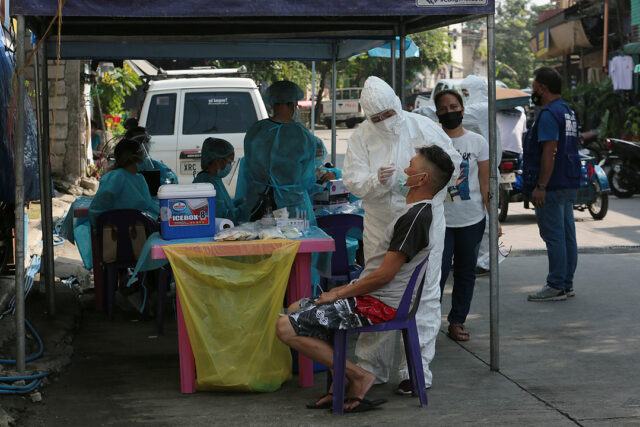
A RESIDENT of Brgy. Old Balara undergo swab testing in their community at Sitio Liwanag. — PHILIPPINE STAR/MICHAEL VARCAS

(Part 1)

It has often been observed that our best qualities as a people emerge during times of national catastrophe — typhoons, flooding, volcanic eruptions, earthquakes, tsunamis. This spirit is expressed in a word that does not directly translate to English: “bayanihan.” Defined as the enduring value of the Filipino “to help fellow countrymen in times of need without expecting anything in return,” this comes from the word “bayani” (hero). Bayanihan is an invitation for heroes from all walks of life to work together.

The once-in-a-generation COVID-19 pandemic is perhaps the mother of all catastrophes in terms of duration, global reach, and the suddenness and severity of its impact on peoples’ lives and the economy — truly an existential threat to individuals and institutions. It is fortunate that our national response, both public and private, has been proportionate to the disaster, showcasing the best of public-private partnerships (PPPs).

In April 2020, responding to a call from the government for a partnership to manage COVID, the private sector created Task Force T3 (Test, Trace, Treat). Starting initially with a small group composed of Ayala, AC Health, McKinsey, MPIC Hospitals, the Philippine Disaster Resilience Foundation (PDRF), Unilab, and Zuellig Pharma working with the Inter-Agency Task Force for the Management of Emerging Infectious Diseases (IATF), Department of Health, the Asian Development Bank, Presidential Adviser for Entrepreneurship Joey Concepcion’s Go Negosyo, and the Foundation for Economic Freedom, under the baton of Bill Luz and Fred Ayala, T3 quickly expanded to cover the entire business community in a consortium working with government across many different fronts of the COVID response.

At the outset, the work focused on expanding the RT-PCR testing capacity nationwide, from 4,500 tests per day in the third week of April 2020 to 30,000 by the end of May (and eventually to over 100,000 tests daily). A second job of increasing PPE (personal protective equipment) inventory was also given to the task force. Eventually, T3 worked on over a dozen projects, all the way to the national vaccination rollout with Secretaries Charlie Galvez and Vince Dizon.

COVID-19 showed, in a tremendously tangible way, the power of bayanihan in successfully meeting a massive challenge. I share the belief that this same spirit of partnership can likewise propel us to solve our most burning, persistent problems, and truly create a Progressive Philippines.

KEY THEMES AND LESSONS OF T3
Partnerships work. Both sides of the partnership complemented each other’s strengths and covered for each other’s limitations. For instance, the agility of the private sector made immediate response measures possible as the government realigned its budgets and mobilized its machinery. Meanwhile the public sector’s size, reach, and resources made massive impact at scale possible, supplementing what the private sector had started. Building on these, key themes begin to surface on what truly made T3, as a cooperation model, successful:

Speed is of the essence. As noted, the private sector’s agility was crucial during the early stages of the crisis, while the more bureaucratic and massive ship of the State undertook the required legislation and organizational effort. We saw this quite clearly across all the partnership initiatives, from the earliest relief undertaking (Project Ugnayan) and in expanding testing capacity, building quarantine facilities, building up PPE supply, data management, communications, and vaccine deployment, among others.

Private sector investments in technology, supply chains, and human capital made the difference. The resource base, capabilities, and access of the private sector taken together across industries, and, most especially, globally, appears to be at an advantage versus most governments. This was most evident in vaccine logistics and administration, data management and analytics, communications, and the development and application of internationally recognized best practice protocols and the latest scientific findings on the virus.

Taskforces over traditional reporting lines. A multifaceted catastrophe such as COVID-19, cannot just rely on official “boxes and lines” on who is responsible for what. In this case, this is not just a “public health crisis” that would normally fall under the Department of Health, which has historically been limited in its resources, but also a “socioeconomic crisis,” as severely affected livelihoods, ultimately translates to lives impacted. We have heard many stories of Filipinos who were risking infection by continuing to make ends meet outside of quarantine: say in many ways, “Hindi nga ako mamamatay sa sakit, mamamatay naman ako sa gutom” (Yes, I won’t die of disease, but then I’ll die of hunger).

Initially, the IATF used what was once considered as the strictest quarantines to control contagion, driven by understandably cautious health professionals. However, through well-organized, targeted consultations involving the government economic managers; and the severely impacted, but committed private sector groups across industries (healthcare, retail, transportation, construction, education, etc.); while drawing on the experience and expertise of other countries secured from global knowledge banks (the Asian Development Bank, McKinsey, and Boston Consulting Group), the strategies and policies were refined that allowed us to eventually “dance with the virus” and minimize the adverse impact on our people. Proposed measures now had to go through this multistakeholder group during their regular cadences before implementation. Thus, after a severe 9.6% contraction of the GDP in 2020, we have bounced back and are enroute to full recovery.

Public sector scale augments private sector speed. While the private sector can contribute early and quickly, especially technological resources not available to government, the reality is that for adversities of this magnitude, only the public sector has the massive financial resources, and legislative and executive powers needed to address them systematically. This is especially relevant as the private sector itself was severely impacted commercially and needed fiscal support from the government.

This was highly evident in the government’s large-scale, and wisely diverse vaccine procurement — which built upon the initial vaccine procurement effort of the private sector for their stakeholders — the “ayuda programs,” and the actual vaccination at the local government level, after private experts helped develop data-based strategies. All told, counting public spending, lending, fiscal stimulus, and the government’s COVID-19 response amounted to P3 trillion or 15.6% of GDP from March 2020 to April 2022, according to the Department of Finance.

Inclusive Capitalism emerges as an idea whose time has come. As these partnership efforts materialized alongside government, a heightened sense of social responsibility and a greater appreciation of stakeholder impact appeared to manifest within private institutions. These have certainly long been present within the Philippine private sector and have been building up for many years through coalitions and alliances, such as the Philippine Business Groups (FINEX, MAP, MBC, PCCI, PBEd, PBSP, etc.), and the Philippine Disaster Resilience Foundation, among others.

Amidst COVID-19, further strengthening its alignment to a stakeholder-centric model of doing business became a compelling proposition to the private sector. As a tangible expression of this, in November 2020, more than 20 business associations launched the Covenant for Shared Prosperity, inspired by a similar movement of the Business Roundtable in the United States.

PPPs AS A PLATFORM FOR NATIONAL DEVELOPMENT PRIORITIES
The pandemic was certainly an existential crisis. It’s almost impossible to consider anything else that may be as severe, immediate, and all-encompassing in its impact on the nation and its people. Yet there are disaster-proportion adversities already upon us that are perhaps not so apparent, since they do not come in a big blow, but creep up on us slowly — the proverbial thief in the night, or the lobster in the boiling pot. I can point to subpar education and healthcare quality, outdated infrastructure, poor child nutrition, lethargic FDI, poor ease of doing business metrics, and many others, as fundamental and persistent challenges that the country continues to suffer from.

There may be opportunities for harnessing more PPP to address these, based on more long-term commercial contracting commitments, rather than pure altruism for one-shot short-term undertakings during an existential crisis.

Fortunately, we have in place one of the more advanced PPP legal, regulatory, and governance frameworks that has yielded globally cited examples of successful partnerships benefiting the public. Since the passage of the Build-Operate-Transfer Law, we have seen multiple examples of success in the expansion of our power, water, expressway, and airport infrastructure.

T3 only cemented the value of this engagement model with the private sector, given its tremendous contributions to the fight against COVID and in bringing much-needed attention to our healthcare space.

Looking forward, we can build on these PPP successes in physical infrastructure and, in light of the COVID crisis, the social sector to address some of these fundamental problems that we face.

(To be continued. Part 2 covers possible PPP interventions in health services and education and suggests revisions in government mindset and policies for a more enabling PPP environment.)

I am grateful for the valuable input from Fred Ayala, Paolo Borromeo, Bill Luz, and Paolo Monteiro. Mistakes are all mine, the author.


Romeo Bernardo served as finance undersecretary during the President Cory Aquino and President Fidel Ramos administrations. He currently sits on the boards of the Foundation for Economic Freedom, the Management Association of the Phil. and the FINEX Foundation.

romeo.lopez.bernardo@gmail.com

Who is more prepared for the presidency?

As the election season reaches its last mile, the race for the presidency has become a two-horse race. On one hand, we have Ferdinand Marcos, Jr. who operates with the advantage of money, machinery, and might of political dynasties. On the other hand, we have Vice-President Leni Robredo whose campaign is propelled by an army of hard-working, dedicated volunteers.

On the shoulders of the next president are serious problems that will require immediate attention. The economy has lost momentum following the pandemic. Foreign debts are at their maximum tolerable levels while poverty and unemployment have spiked anew. In terms of national security, China’s creeping invasion continues to advance, emboldened by President Rodrigo Duterte’s passive (or permissive) policy towards China’s encroachment. Exacerbating matters are national emergencies such as the state of education in the country.

Who between Marcos and Robredo is in a better position to solve these problems? I would have wanted to make a point-by-point comparison between the two but Marcos offers no platform or leadership plan except to say that we must all unite. Robredo, on the other hand, offers a comprehensive agenda.

Without basis for comparison, let me focus on Robredo’s intentions in as far as the economy, China, and education are concerned.

ON THE ECONOMY
Robredo offers a sensible plan on how to move the economy forward amid crippling debt and loss of competitiveness. At the heart of it all is job generation. In one masterplan called “Hanapbuhay para sa lahat” (Livelihood for all), Robredo ventures to solve the nation’s biggest problems — poverty, unemployment, and income inequality. The creation of jobs also translates to wealth generation for individuals and the country. This will help solve such threats as the rising national debt, a gaping budget deficit, and the lack of funds for social services. Indeed, job generation cuts through most of our problems. I reckon the plan to be well considered.

Foreign direct investment (FDIs) is the silver bullet that can address our immediate problems and accelerate development. That said, fundamental to Robredo’s plan is to restore trust in government. Restoring trust means leveling the playing field, quashing corruption, and reverting to rule-based governance. Robredo promises to clamp-down on influence peddling, syndicates, and red tape since these are the tumors that make the Philippines unideal for doing business and uncompetitive in attracting investors. With confidence restored, FDIs will pour in, jobs will be created, and lives will improve.

The second aspect of her plan is to awaken Philippine industries. I was delighted to see the inclusion of maritime industries or “the blue economy” in the plan. Blue industries include ship building, ports and shipyards management, logistics services, seafarer crewing, maritime financing, aquaculture, and offshore energy exploration. I’m glad Robredo recognizes the potential of the blue economy — no other president has.

The re-activation of manufacturing industries is another component of Robredo’s economic agenda. There is simply no way out of it — we must industrialize if the country is to grow in wealth. We must recalibrate the economy from being 73% consumption-driven and only 27% production-driven. High growth can only be sustained by a production-based economy. It cannot be done on the back of consumption without stressing debt levels.

Robredo aspires to climb the technology value chain in the IT-KPO (Information Technology-Knowledge process outsourcing) space. She commits to positioning the country as a center of excellence in artificial intelligence, cloud services, genetic medicine, and the like. She also aims to make the Philippines the center of climate industries. This includes manufacturing of electric vehicles and parts, adoption of climate-resilient agriculture, and use of renewable energies.

As for the development of MSMEs (Micro, small and medium enterprises), Robredo plans to give small businesses a shot in the arm by giving them first priority in government procurement.

ON POLICY TOWARDS CHINA
Robredo will pursue an inclusive and independent foreign policy that favors no specific nation except our own. This is loud and clear.

As for China, Robredo expressed willingness to cooperate in the realms of trade and investments. When it comes to the West Philippine Sea, however, China must first recognize Philippine sovereign ownership over the disputed territories before deals like joint exploration of resources can be pursued. Fundamental to all is China’s recognition of the arbitration ruling of the International Tribunal for the Law of the Seas.

Robredo categorically opposes China’s territorial grab and militarization of the West Philippine Sea. To that, she plans to further strengthen relations with our oldest ally, the United States, to help protect our sovereign rights.

And make no mistake, she will do everything in her power to enforce the decision on the West Philippine Sea in favor of the Philippines.

ON EDUCATION
Declaring an educational crisis is one of the first acts Robredo will do as President, she said. This will open the door for immediate high-impact reforms and the expeditious release to budgets. Access and quality of education is the challenge that must be addressed.

To this, she commits to appropriate 6% of GDP (from 3% today) towards education to give the Department of Education the ammunition needed to address the struggling sector. Among the priority areas are the overhaul of curriculums to put emphasis on STEM learning (Science, Technology, Engineering and Mathematics); better alignment of curriculums with job opportunities; increasing the salaries of public-school teachers; and improving teacher training programs to re-skill and up-skill.

More teachers will be hired to decrease student-to-teacher ratios. In addition, administrative work will be relaxed for teachers so they can dedicate more time to remedial classes and one-on-one tutoring.

Collaboration between the public and private sectors will be pursued to build more classrooms, dormitories, transportation facilities, and nutritional programs for students. Robredo will also establish Regional Excellence Centers to focus on research and development and to foster closer collaboration between the academe and industry.

In a column last month, I already came out as a supporter of Robredo. My decision stems from her well-considered leadership plan, a solid track record, and a character marked by honesty and humility. As the undecideds contemplate who to vote for, may we look beyond personal biases and choose according to who is truly better prepared for the presidency.


Andrew J. Masigan is an economist

andrew_rs6@yahoo.com

Facebook@AndrewJ. Masigan

Twitter @aj_masigan

Here’s to Elon Musk’s new adventure

COUNT ME among those celebrating Elon Musk’s acquisition of Twitter. Not because he’ll be able to fix it — the only way to do that would be to shut it down, which would make his $44 billion outlay hard to justify, even for a man of Musk’s means — but because it will be fascinating to watch him try. Meanwhile, the apoplexy this news is causing in progressive circles is very entertaining.

Musk’s intentions aren’t clear. Is he hoping to make a profit? Or does he expect to lose money in serving the public interest while amusing himself? He might not know; he might not care. Whatever the answers, it’s hard not to be impressed by what he’s already achieved and his astonishing appetite for new challenges. I, for one, am looking forward to what happens next.

His comments so far raise many questions. He says Twitter is “kind of the de facto town square” where people should be able to speak freely “within the bounds of the law.” The implication is that he’ll reverse some the platform’s decisions to suppress comments it deems harmful and/or allow certain controversial speakers, notably former President Donald Trump, back on the platform. This is the prospect that has many people who call themselves liberal rending their garments.

As it stands, the “town square” principle doesn’t really work. In a truly public space, protections for free speech are far-reaching. They permit speech so dishonest or disgusting that it would repel not just political partisans but all decent people regardless of their ideological attachments. These protections also forbid prior restraint. Twitter isn’t a public space in that sense, so it retains the right to control its content and disqualify users. But the point is that the great majority of its users will want it to control content beyond what is called for by “the bounds of the law.” Does Musk really want to ignore the great majority of his new customers?

What’s more plausible — and would be more valuable — is the commitment to wider diversity of opinion that Musk says he wants, combined with tools to give users more control. Vivek Ramaswamy and Jed Rubenfeld make some good suggestions. For instance, they say, Twitter could keep its existing offensive-speech protocols but let users opt out of them. If you want to see what Twitter deems hateful, or sexually explicit, or whatever, turn the respective filters off. Algorithms using “block this kind of content” buttons could refine and automate the process while still allowing users to choose.

User-enabled moderation of content would be better than the slanted top-down policing of news and opinion that Twitter has sometimes engaged in. Unfortunately, it wouldn’t solve the underlying problem — one by no means confined to Twitter: In the US, at least, there is no longer any such thing as a trusted authority.

Top-down moderation to filter out falsehoods would be a true service if the moderators were disinterested and authoritative, and seen to be. But in the US, political polarization has gone so far as to make this impossible. Yes, the lack of trust often arises from the political right’s paranoia and instinct to ignore disobliging facts. But this instinct isn’t confined to conservatives and other deplorables.

Many — let’s call them legacy moderators — have taken it upon themselves to defend Truth as opposed to truth. Academic experts, reporters, fact-checkers and the like are much to blame for knowingly or otherwise indulging their own political biases. They police opinions, not facts, undermining their own authority.

An Impossible Twitter — one that was open to all opinions and equipped with trusted and disinterested fact-checkers — would be better than the platform Musk just bought. But even that wouldn’t make it a public good. Its biggest and irremediable defect is built into its very business model. It is a platform optimized for expostulation not conversation, reflex not deliberation, disdain not civility. It takes what’s worst about modern American politics and amplifies it.

As a recovering user, I found that, on balance, Twitter diminished my respect for people I’d previously held in high regard, making it professionally counterproductive. In my dreams, Twitter just goes away.

The saddest thing for a liberal — an actual liberal — such as myself is to have witnessed its success. After all, it succeeded by giving users what they want. On the other hand, it means I’m not worried about the harm Musk might do. Disrupt it as much as you can, Elon. We have nothing to lose but our tweets.

BLOOMBERG OPINION

Moscow steps up assault in Ukraine’s south, eastern Donbas

Army soldier figurines are displayed in front of the Ukrainian and Russian flag colors background in this illustration taken, Feb. 13, 2022. — REUTERS/DADO RUVIC/ILLUSTRATION

DOBROPILLIA/KYIV, Ukraine — Ukraine’s shelling killed and injured its own civilians in the southern region of Kherson, Russia said on Sunday, after pounding southern and eastern areas with missile strikes, while some civilians got away from a steel plant in besieged Mariupol.

Moscow has turned its focus to Ukraine’s south and east after failing to capture the capital Kyiv in a nine-week assault that has flattened cities, killed thousands of civilians and forced more than 5 million to flee abroad.

Its forces have captured the town of Kherson, giving them a foothold just 100 km (60 miles) north of Russian-annexed Crimea, and have mostly occupied Mariupol, the strategic eastern port city on the Azov Sea.

Russia’s defense ministry accused Ukraine’s forces of shelling a school, kindergarten and cemetery in the villages of Kyselivka and Shyroka Balka in the Kherson region, the Russian RIA news agency said on Sunday.

The ministry gave no further details. There was no immediate response from Ukraine to the report, which Reuters could not independently verify.

Russia declared victory in Mariupol on April 21, even as hundreds of Ukrainian troops and civilians took shelter in the Azovstal steel works.

The United Nations has urged an evacuation deal. On Saturday a Ukrainian fighter inside said some 20 women and children had made it out.

“We are getting civilians out of the rubble with ropes — it’s the elderly, women and children,” said the fighter, Sviatoslav Palamar, referring to wreckage within the plant, which sprawls 4 sq km (1.5 sq miles).

Mr. Palamar said Russia and Ukraine were respecting a local ceasefire, and he hoped the evacuated civilians would be taken to the Ukrainian city of Zaporizhzhia to the northwest.

There was no comment from Russia or the United Nations on the evacuations. Hundreds of Ukrainians remain inside the steel works, Ukrainian officials say.

ODESA STRIKE
A Russian missile launched from Crimea destroyed the runway at the main airport in the city of Odesa to the west, said regional governor Maksym Marchenko, but no one was hurt.

The airport could no longer be used, Ukraine’s military said. President Volodymyr Zelensky vowed to rebuild it, saying in a late-night video speech, “Odesa will never forget Russia’s behavior towards it.”

There was no comment on the strike from Moscow, whose forces have sporadically targeted Ukraine’s third-largest city, where eight people were killed in a recent Russian strike, Ukrainian officials said.

Moscow’s assault in the south aims in part to link the area with Crimea as it pushes for complete control of Ukraine’s eastern Donbas region, where Russian-backed separatists already controlled parts of Luhansk and Donetsk provinces before Moscow’s Feb. 24 invasion.

In his speech, Mr. Zelensky said Russia was “gathering additional forces for new attacks against our military in the east of the country” and “trying to increase pressure in the Donbas”.

Moscow calls its actions a “special operation” to disarm Ukraine and rid it of anti-Russian nationalism fomented by the West. Ukraine and the West say Russia launched an unprovoked war of aggression.

Despite weeks of peace talks, both sides looked to be as far apart as ever on Saturday.

Ukraine accuses Russian troops of carrying out atrocities in areas near Kyiv in early April, a claim denied by Moscow. Negotiators last met face-to-face on March 29, and have since spoken by video link.

The United States and its European allies have imposed sweeping sanctions on Russia’s economy and supplied Ukraine with weapons and humanitarian aid.

Britain will continue “to give the Ukrainians the equipment they need to defend themselves”, Prime Minister Boris Johnson said on Saturday.

US President Joseph R. Biden is seeking a $33 billion aid package for Kyiv, including $20 billion for weapons.

Mr. Biden praised the courage of journalists covering the Russian invasion of Ukraine in comments at the White House Correspondents’ Association dinner in Washington.

“A poison is running through our democracy… with disinformation massively on the rise,” Mr. Biden said on Saturday night. “You, the free press, matter more than you ever did in the last century.”

Britain’s Foreign Office warned on Sunday that Russia was using a troll factory to spread disinformation about the war in Ukraine on social media.

“We cannot allow the Kremlin and its shady troll farms to invade our online spaces with their lies about Putin’s illegal war,” Foreign Secretary Liz Truss said in a statement. — Reuters

Angelina Jolie visits Lviv, trip interrupted by sirens

ACTRESS and United Nations High Commissioner for Refugees Special Envoy Angelia Jolie poses for a picture with children, as Russia’s attack on Ukraine continues, in Lviv, Ukraine, April 30. — PRESS SERVICE OF THE LVIV REGIONAL STATE ADMINISTRATION/HANDOUT VIA REUTERS

LVIV, Ukraine    Hollywood actress Angelina Jolie visited the Ukrainian city of Lviv on Saturday, going to the station to meet people displaced by the war with Russia before later leaving after air-raid sirens sounded.

Ms. Jolie, 46, is a special envoy for the United Nations refugee agency, which says more than 12.7 million people have fled their homes in the past two months, which represents around 30% of Ukraine’s pre-war population.

During the visit to the station, Ms. Jolie met volunteers working with the displaced, who told her that each of the psychiatrists on duty spoke to about 15 people a day. Many of those in the station are children aged from two to 10, according to volunteers.

“They must be in shock … I know how trauma affects children, I know just having somebody show how much they matter, how much their voices matter, I know how healing that is for them,” she said in reply.

At one point during her visit to the station, she tickled a small girl dressed in red, who laughed out in delight. She also posed for photos with the volunteers and some of the children.

Later on, air-raid sirens started to sound, and Ms. Jolie together with her aides walked quickly out of the station and got into a waiting car.

Last month, in her role as special envoy, Ms. Jolie visited Yemen, where millions of people have been displaced by war. — Reuters

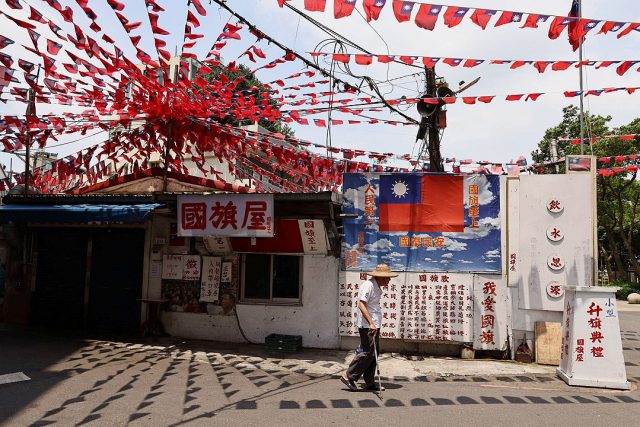
Taiwan calls China’s COVID lockdowns ‘cruel,’ says won’t follow its steps

REUTERS

TAIPEI — China’s lockdowns to control the spread of coronavirus disease 2019 (COVID-19) are “cruel” and Taiwan will not follow suit, Premier Su Tseng-chang said on Sunday.

Having controlled the pandemic with tough border controls and quarantines, Taiwan has been dealing with a surge in domestic infections since the start of this year, with some 75,000 infections driven by the Omicron variant.

But with more than 99% of those having mild or no symptoms, a handful of deaths so far and high vaccination levels, the government has moved to ease restrictions as it seeks normalcy and to gradually reopen the island of 23 million people to the outside world.

Taiwan’s giant neighbor China, by contrast, has enacted tough lockdowns in Shanghai and tightened controls in capital Beijing.

Speaking during a visit to Taiwan’s Centers for Disease Control, Su said their pandemic-containment measures had been “praised by the world”.

“We will not lock down the country and cities as cruelly as China,” he said, adding Taiwan’s methods were “gradual”.

“We have a plan, and there is a rhythm to it.”

China claims democratically governed Taiwan as its own territory, and the two have rarely missed an opportunity to exchange barbs during the pandemic.

Last week, China’s Taiwan Affairs Office said Taiwan’s new model of handling the pandemic would lead to many deaths.

Life has continued mostly as normal in Taiwan, though there has been disruption to some schools, and the government is eyeing further easing of quarantine rules.

All arrivals into Taiwan have to isolate for 10 days, rules that large parts of Asia have already ditched. — Reuters

New Mexico ‘megafire’ could more than double in size

TAOS, N.M.  — A drought-driven wildfire in northern New Mexico exploded into a “megafire” of 100,000 acres, or 157 square miles, on Saturday and could still more than double in size, a fire official said.

Fueled by ferocious spring winds in parched mountain forests, the Calf Canyon fire is by far the largest and most destructive currently burning in the United States.

Around 30 miles (48 km) east of Santa Fe, the fire has destroyed hundreds of properties, triggered thousands of evacuations and on Saturday burned within a few miles of the city of Las Vegas, New Mexico, population 14,000.

“It’s already 100,000 acres. It could easily double in size, maybe even bigger than that,” Incident Commander Carl Schwope, told a briefing.

The blaze grew about 50% in 24 hours as a giant column of flame collapsed on Friday night, raining embers and starting new fires. Residents of Las Vegas awoke to pieces of charred wood the size of a US quarter coins carpeting the city.

Officials feared another “column collapse” at any time.

“It’s a big fire and it’s all around us,” San Miguel County Manager Joy Ansley said by phone, adding that authorities were making plans in case Las Vegas was told to evacuate.

Firefighters believe the US West faces a grim fire year, with US Department of Agriculture data showing 80% of the area in severe drought.

Under the scenario of a two-degrees-Celsius rise in global temperatures, scientists expect US West wildfires to burn twice the area they do now by as early as mid-century.

Over a third of the 2,800 firefighters now deployed in the United States were on the Calf Canyon fire, bulldozing firebreaks to defend Las Vegas and fighting ember-sparked “spot fires” creeping towards villages in the Mora Valley.

So far this year US wildfires have burned more than twice the area than in the same period of 2021 and about 70% more than the 10-year average, according to the National Interagency Fire Center. — Reuters

The perfect vacation home you would want to invest in

Live in a destination home of your own at the new tower of AmiSa Private Residences in Mactan, Cebu

Cebu has been one of the go-to vacation spots in the Philippines because of its rich and thriving culture as well as the beautiful and serene scenery it offers. In the rise of “revenge travel” due to improving vaccination rates and relaxed travel curbs, it’s nice and strategic for you to secure a place where you and your loved ones can escape to at any moment’s notice.

RLC Residences presents a worthy investment located in Punta Engano, Lapu-Lapu City, Mactan. A promise of breathtaking seascape views and a resort-like lifestyle is waiting when you choose to bank on their latest and soon-to-rise development.

From the comforts of your unit, have a well-deserved rest topped with a relaxing and unobstructed panorama. Take a pick among immense one-bedroom and two-bedroom unit types that have large windows and a balcony facing the majestic Magellan Bay, Olango Island, and Hilutungan Channel.

Complete the ultimate vacation experience in the new Sky Lounge featuring a picturesque backdrop and a large open area designed for recreation. There are also spacious grilling and picnic areas for getting together with family and friends.


When traveling for business and leisure, surely you only want the most convenient access to work and play. Among the notable perks of being a resident here are the exclusive hotel privileges from the renowned Dusit Thani Mactan Cebu Resort.

Enjoy world-class facilities and services which will be shared with you and your loved ones. These include beach access as well as shuttle pick-up and drop-off to and from the property!

On the topic of travel, worry no more about catching flights on time as AmiSa Private Residences is strategically placed within arm’s reach of the Mactan International Airport. If you’re someone that needs to be in different locations from time to time, now you can travel with ease and show up to important matters at hand.

Furthermore, this promising development gets even more worthy as your next investment with its built-in Smart Home features and fiber-optic readiness for you to accomplish tasks efficiently. Own a unit that is guaranteed to appreciate in no time with deliverables such as Smart Lock, Smart Light, Audio and Video Intercom, all easily accessible within your fingertips via any smartphone.

Surely, a relaxing lifestyle and a stand-out investment is something that you wouldn’t want to miss. Avail a 5% launch discount when you book an appointment with an RLC Residences Property Specialist as early as now. Check out other top-notch developments in and out of the Metro by visiting their website or following their social media pages on Facebook and Instagram.


Spotlight is BusinessWorld’s sponsored section that allows advertisers to amplify their brand and connect with BusinessWorld’s audience by enabling them to publish their stories directly on the BusinessWorld Web site. For more information, send an email to online@bworldonline.com.

Join us on Viber to get more updates from BusinessWorld: https://bit.ly/3hv6bLA.

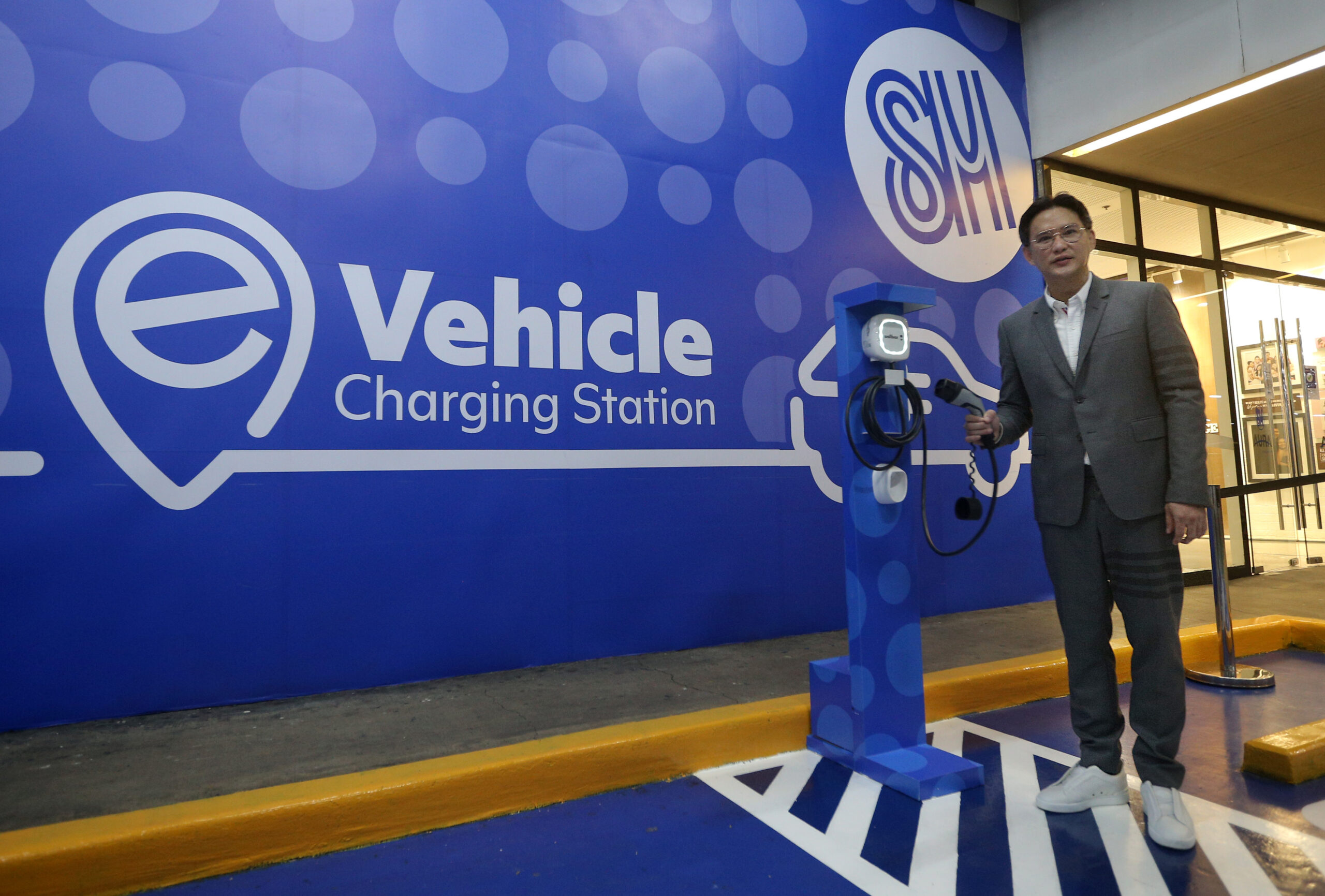
SM Supermalls powers up sustainability efforts, installs e-Vehicle charging stations in NCR malls

From L-R, Porsche Managing Director Mr. William Angsiy, SM Engineering Design and Development President Mr. Hans Sy, Jr., PGA Cars Chairman Mr. Roberto Coyiuto III, SM Supermalls President Steven Tan, and Audi Managing Director, Mr. Christopher Chan.

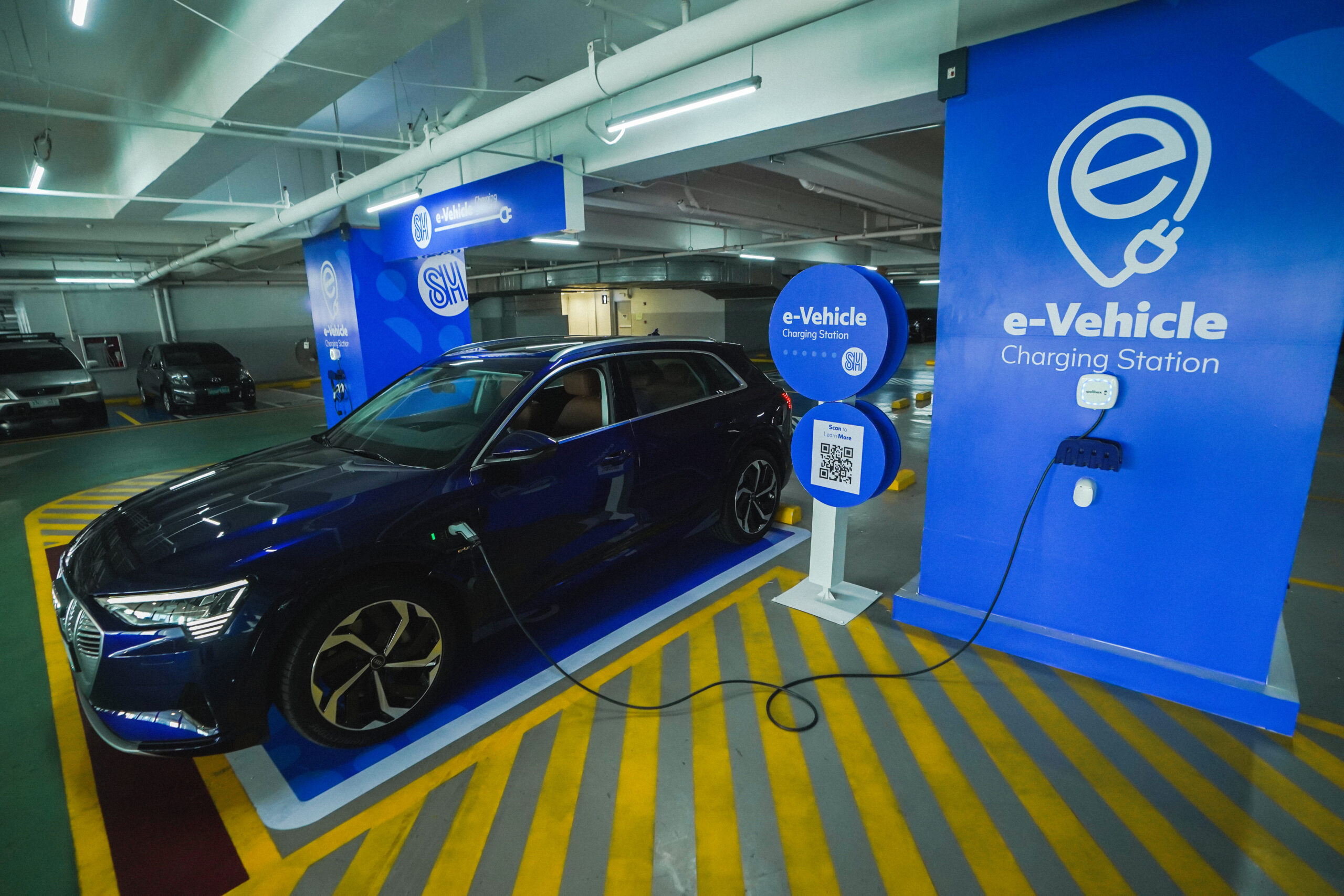
SM Supermalls has deployed the first ever in-mall free charging stations in the Philippines for e-Vehicles (EV) at select SM malls as part of its efforts to create a safer, greener future for all.

The free EV charging stations were simultaneously launched today at SM Aura in Taguig City, SM North Edsa in Quezon City, SM Mall of Asia in Pasay City, and SM Megamall in Mandaluyong; with PGA Cars providing the car displays at the official launch event in SM Aura.

This initiative is part of SM Supermall’s push to support technological innovations for a more sustainable and eco-friendly future.

“SM Supermalls will remain true to our promise of creating a safe malling experience for our mallgoers, and part of that commitment is building a greener environment for everyone. We will always strive to ramp up our efforts to give back to our communities through our innovative projects in driving sustainability in our 79 malls nationwide. We want to urge everyone to consider more sustainable options in their everyday life, and shifting to e-Vehicles is a giant leap towards a greener future for all of us,” SM Supermalls President Steven T. Tan said.

SM Prime, through the leadership of Disaster Resilience Champion Mr. Hans Sy, has officially launched their EV Charging Stations at SM Aura, SM Mall of Asia, SM Megamall, and SM North EDSA. As part of the SM Green Movement initiative, the SM Group continues its commitment to helping make the planet greener through projects such as this. For the first 6 months, SM’s E-vehicle Charging Stations will be free of charge for all shoppers. From L-R, DOE Supervisor for the Energy Utilization Management Bureau Usec. Jesusito Sulit, DENR Field Operations for Luzon and Visayas Asec. Gilbert Gonzales, SM Engineering Design and Development President Mr. Hans Sy, Jr., DOST Administration and Legal Affairs Asec. Teodoro Gatchalian, SM Supermalls President Mr. Steven Tan, DTI Competitiveness and Innovation Usec. Rafaelita Aldaba, DTI Secretary Ramon Lopez, and DOTR I-ACT Chief Charlie Del Rosario.

The in-mall charging stations is conveniently located in SM AURA B1 Parking, SM Mall of Asia 3rd Level North Parking Building, SM Megamall B1 Parking Mega Fashion Hall, and SM North Edsa 3rd Level North Parking Tower, have two Wallbox Pulsar Plus 7.4KW AC chargers per mall. These chargers support e-Vehicle brands such as Audi, BMW, Fiat, Ford, GMC, Mercedes-Benz, Porsche, Volkswagen, and Hyundai, among others.

The official launch at SM Aura presented the EV charging stations, with PGA Cars providing the car displays featuring their electronic vehicles.

The launch of the EV charging stations in premier SM malls is a product of SM Supermalls’ continuous partnership with the Department of Energy, Department of Transportation, Department of Environment and Natural Resources, Department of Science and Technology, and Department of Trade and Industry in assisting the government accelerate its renewable energy and sustainability initiatives.

“SM Supermalls will continue our staunch support of the government’s new EV law and the National Renewable Energy Program to promote a more eco-friendly society for all Filipinos. We remain steadfast in our goal of increasing our share of renewable energy sources by 50 percent by the end of 2022,” Tan said.

E-vehicles are true zero emission vehicles that have electric motors instead of internal combustion engines. As of 2020, there are 12,965 registered EVs in the Philippines. SM Supermalls is one of the first mall chains to establish in-mall e-Vehicle charging sites in the country.

SM Supermalls is the first mall chain to establish in-mall e-Vehicle charging sites in the country. In 2018, SM North Edsa inaugurated its first EV charging station to service electric public transport routes and most recently these EV chargers have been updated.

SM Supermalls President Steven Tan expressed, “SM Supermalls will continue our staunch support of the government’s new EV law and the National Renewable Energy Program to promote a more eco-friendly society for all Filipinos. We remain steadfast in our goal of increasing our share of renewable energy sources by 50 percent by the end of 2022.”

In the coming months, expect that more fast chargers will be installed in other SM Malls nearest you.

The EV Charging Stations Project supports The SM Green Movement towards a greener planet. #smgreenmovement @smsupermalls. For more information, visit www.smsupermalls.com and follow @smsupermalls on all social media accounts.


Spotlight is BusinessWorld’s sponsored section that allows advertisers to amplify their brand and connect with BusinessWorld’s audience by enabling them to publish their stories directly on the BusinessWorld Web site. For more information, send an email to online@bworldonline.com.

Join us on Viber to get more updates from BusinessWorld: https://bit.ly/3hv6bLA.

Marcos declines debate with top presidential rival

FACEBOOK.COM/BONGBONGMARCOS

PRESIDENTIAL frontrunner Ferdinand “Bongbong” R. Marcos, Jr.,  on Friday turned down his closest rival’s challenge to a debate, saying a face-off with Maria Leonor “Leni” G. Robredo will never happen and he prefers to communicate directly with the public.

Ms. Robredo, who narrowly beat Mr. Marcos in the 2016 vice presidential election, challenged the son and namesake of the late dictator to a debate “anytime, anywhere” so voters can scrutinize their characters and compare their visions. 

Mr. Marcos has attended just one of four presidential debates since campaigning for the May 9 election began, compared to Ms. Robredo’s three. 

Mr. Marcos led Ms. Robredo by 32 points in the latest survey in March and the two have a bitter rivalry, with Ms. Robredo’s affiliation firmly with the movement that toppled his late father in a 1986 “people power” uprising. 

“I am inviting Mr. Marcos to a debate to give the public a chance to face him and ask him about the controversies surrounding him,” Robredo said in a statement. 

“We owe it to the people and to our country.” 

Mr. Marcos’s spokesman, Victor D. Rodriguez, said “Bongbong,” as Mr. Marcos is commonly known, wanted to keep campaigning civil. 

“Bongbong Marcos’s Uniteam is guided by positive campaigning, no badmouthing. It sends its message and call for unity directly to the public,” he said in a statement. 

Mr. Marcos’s ducking of debates has been criticized by opponents and academic groups, who say the public is being denied the opportunity to see all candidates challenged and scrutinized.

Political analyst Earl Parreno said shunning debates was Mr. Marcos’s way of ensuring his “shallow knowledge of issues will not be exposed.”

Though incumbent leader Rodrigo R. Duterte’s daughter, Sara Duterte-Carpio, is Mr. Marcos’s running mate and his party has backed Mr. Marcos, the president himself has said he wants to be neutral and has not endorsed anyone.

More than 67 million Filipinos have registered to vote in the elections, which historically have a high turnout. 

Posts contested include the presidency, vice presidency, 12 senate seats, 300 lower house seats, and roughly 18,000 local positions. — Reuters