An intense battle to stem currency declines in the face of dollar strength is reminding some emerging markets of the trauma inflicted by the 1997 Asian financial crisis. Just ask authorities in the Philippines.
Fearing a weaker peso could fuel inflation and spark social unrest, Bangko Sentral ng Pilipinas has unleashed aggressive intervention in recent weeks to prevent it from sliding past 59 against the greenback. As Southeast Asia’s worst performer plunged 11% this year, the government has declared the 60 level as a no-go area. However, forecasts compiled by Bloomberg show some bearish strategists predicting a slump of almost 8% to 62 by June.
The central bank has spent $6.4 billion of its foreign-exchange reserves in the first 10 months of this year to support the peso, according to Exante Data Inc. The amount is equivalent to 5.9% of its end-2021 stockpile. Authorities have also more than doubled the benchmark interest rate this year, and said they will raise it again by 75 basis points at a meeting Thursday.
“The lessons of the Asian financial crisis are still very much in mind in the Philippines,” said Carlo Asuncion, chief economist at Union Bank of the Philippines in Manila. “Officials want to prevent any perception they are lax in managing economic risks, including the risk of a collapsing currency.”
In 1997, after the Thai baht’s devaluation sparked a deep crisis across much of the region, the peso slumped 34% as money managers pulled billions of dollars from Asia. Philippine economic growth cratered in the aftermath, while inflation soared to more than 10%.
We look at the main concerns behind the latest efforts to support the peso:
INFLATION The biggest worry is cost of living in a country that’s still struggling to reduce extreme poverty. As the nation imports almost all of the oil it needs, a weaker currency hurts local consumers.
While growth is still holding up for now, inflationary pressure is already building, with the gauge set to exceed the central bank’s target this year for the first time since 2018.
“Imported inflation remains an ongoing concern for the Philippines given pronounced currency weakness,” said Sonia Zhu, associate economist at Moody’s Analytics in Singapore. The 59-per-dollar level “has perceived importance because it is assumed that a breach will add to existing bearish sentiment and snowball existing currency weakness and volatility,” she said.
Imports increased 25% in January to September from a year ago in dollar terms. Higher purchases of goods from abroad are also pressuring the nation’s current-account balance with officials expecting the gap to widen to a record, equivalent to 5% of gross domestic product this year.
CAPITAL OUTFLOWS A weaker currency is bad news for overseas investors as it diminishes the value of their assets in dollar terms. A resulting risk is capital outflows, which could, in turn, exert further downward pressure on the peso.
At the moment, such a danger isn’t elevated, though data show foreign funds offloaded almost $1.2 billion of equities this year, the largest in Southeast Asia.
POLITICAL PRESSURE The peso’s slide is the biggest economic challenge faced by President Ferdinand Marcos Jr., who won election this year on a campaign promise that included measures to spur an economy recovering from the pandemic. In October, the son of the late dictator said the nation may have to defend the peso.
His father oversaw a period of peso depreciation that brought the currency’s loss to more than 200% from 1970 to 1986, the year he was ousted in a popular uprising.
“At some point, currency weakness becomes political and it appears that the 60 per dollar is a key psychological level,” Union Bank’s Asuncion said.
Central bank Governor Felipe Medalla has commented on political pressure to keep the peso stronger than 60, while Finance Secretary Benjamin Diokno last month signaled the need to safeguard that level.
WHAT’S NEXT So far, the strategy has worked out well. The peso has rebounded 3% to 57.21 from the record-low 59 per dollar it touched in late September.
But structural factors, including fiscal and current-account deficits along with elevated inflation will weigh on the peso, said Lavanya Venkateswaran, an economist at Mizuho Bank Ltd. in Singapore. The median forecast in the Bloomberg survey shows the peso will likely end the year at 59.
Raphael Mok, head of Asia country risk at Fitch Solutions in Singapore, doesn’t see 59 as a significant support level.
“Weak external demand, combined with strong import growth, will see the current-account deficit remain wide, exerting further downside pressures on the peso,” Mok said. — Bloomberg
WASHINGTON — A deadly explosion occurred in North Atlantic Treaty Organization (NATO) member Poland’s territory near its border with Ukraine on Tuesday, and the United States and its allies said they were investigating unconfirmed reports the blast had been caused by stray Russian missiles.
The explosion, which firefighters said killed two people, raised concerns of Russia’s war in Ukraine becoming a wider conflict. Polish authorities said it was caused by a Russian-made rocket, but Russia’s defense ministry denied involvement.
If it is determined that Moscow was to blame for the blast, it could trigger NATO’s principle of collective defense known as Article 5, in which an attack on one of the Western alliance’s members is deemed an attack on all, starting deliberations on a potential military response.
As a possible prelude to such a decision, however, Poland has first requested a NATO meeting on Wednesday under the treaty’s Article 4, European diplomats said. That is a call for consultations among the allies in the face of a security threat, allowing for more time to determine what steps to take.
The following is an explanation of Article 5 and what might occur if it is activated:
WHAT IS ARTICLE 5? Article 5 is the cornerstone of the founding treaty of NATO, which was created in 1949 with the US military as its powerful mainstay essentially to counter the Soviet Union and its Eastern bloc satellites during the Cold War.
The charter stipulates that “the Parties agree that an armed attack against one or more of them in Europe or North America shall be considered an attack against them all.”
“They agree that, if such an armed attack occurs, each of them, in exercise of the right of individual or collective self-defense recognized by Article 51 of the Charter of the United Nations, will assist the Party or Parties so attacked by taking forthwith, individually and in concert with the other Parties, such action as it deems necessary, including the use of armed force, to restore and maintain the security of the North Atlantic area,” it says.
AND WHAT IS ARTICLE 4? Article 4 states that NATO members “will consult together whenever, in the opinion of any of them, the territorial integrity, political independence or security of any of the Parties is threatened.”
Within hours of the blast in Poland on Tuesday, two European diplomats said that Poland requested a NATO meeting under Article 4 for consultations.
HOW COULD THE UKRAINE WAR TRIGGER ARTICLE 5? Since Ukraine is not part of NATO, Russia’s invasion in February did not trigger Article 5, though the United States and other member states rushed to provide military and diplomatic assistance to Kyiv.
However, experts have long warned of the potential for a spillover to neighboring countries on NATO’s eastern flank that could force the alliance to respond militarily.
Such action by Russia, either intentional or accidental, has raised the risk of widening the war by drawing other countries directly into the conflict.
IS INVOKING ARTICLE 5 AUTOMATIC? No. Following an attack on a member state, the others come together to determine whether they agree to regard it as an Article 5 situation.
There is no time limit on how long such consultations could take, and experts say the language is flexible enough to allow each member to decide how far to go in responding to armed aggression against another.
HAS ARTICLE 5 BEEN INVOKED BEFORE? Yes. Article 5 has been activated once before — on behalf of the United States, in response to the Sept. 11, 2001, hijacked-plane attacks on New York and Washington.
WHAT HAS BIDEN SAID ABOUT ARTICLE 5 COMMITMENTS? While insisting that the United States has no interest in going to war against Russia, President Joseph R. Biden, Jr., has said from the start of Moscow’s invasion that Washington would meet its Article 5 commitments to defend NATO partners.
“America’s fully prepared with our NATO allies to defend every single inch of NATO territory. Every single inch,” Mr. Biden said at the White House in September.
He had declared earlier that there was “no doubt” that his administration would uphold Article 5. — Reuters
NEW DELHI — India’s Tata Group is planning to open at least 20 “beauty tech” stores where it will use virtual makeup kiosks and digital skin tests to get young, affluent shoppers to buy premium cosmetic products, according to a company document and a person familiar with its strategy.
The move pits Tata, whose interests range from cars to jewelry, against LVMH’s Sephora and domestic rival Nykaa for a share of the fast-growing $16 billion beauty and personal care market in the world’s second-most populous country.
Tata is eyeing what it calls a “beauty enthusiast” in India aged between 18 and 45 years who likes to buy foreign brands such as Estee Lauder’s M.A.C and Bobbi Brown, according to the document, which lists The Honest Company, Ellis Brooklyn and Gallinee as potential partners. Tata is in talks with more than two dozen companies to supply exclusive products to the new stores, according to the person familiar with the strategy, who did not name specific brands.
Tata declined to comment on its planned beauty stores and the contents of the document seen by Reuters. Representatives of The Honest Company, Ellis Brooklyn and Gallinee did not respond to Reuters requests for comment.
The store opening plans, still under wraps, follow the recent launch of Tata’s beauty shopping app, called Tata CLiQ Palette. The company is already in the brick-and-mortar retail business in India, where it has joint-venture partnerships with global brands such as Zara and Starbucks.
The stores will have a bright red facade showing Tata CLiQ Palette branding, with 70% of the products inside being skincare and make up, according to the Tata document. Inside the stores, Tata is planning to install technology allowing customers to try on dozens of lipstick shades virtually on screens and to get digital skin tests to find out what products might work best for them, according to the document.
The technology is not new and is in use by other beauty retailers around the world, but this venture into what industry experts call “experiential retail” is still a relatively new concept in Indian malls and high street shops.
“Experiential retail is going to be a big thing in India as more customers will spend their leisure time at such stores,” said Pankaj Renjhen, joint managing director at India’s Anarock Retail consultancy. “In the premium segment — where a customer is looking for things beyond price — experiential retail helps trigger impulse shopping and can entice them.”
Mr. Renjhen added, however, that “the product and the brands have to be exclusive and good — if they are not that, she (the customer) is not going to come back.”
MILLENNIAL DRIVE As India’s economy grows, and people return to shops after coronavirus lockdowns, Tata is looking to target relatively young and affluent customers who like to shop in comfortable surroundings and are willing to pay the sticker price for premium international brands. Tata calls such customers “non-bargainers” in the document seen by Reuters, in contrast to most Indians who buy low-priced local brands of lipsticks or skin creams from small mom-and-pop beauty stores where haggling for discounts is common.
The company is targeting shoppers with an annual income of at least 600,000 rupees ($7,358), which is more than three times the average earnings of $2,000 per year among India’s 1.4 billion inhabitants. The new stores should drive “sales across channels as a leading Beauty Tech destination for Gen Z & Millennials,” the Tata document says.
India’s $16 billion beauty and personal care market is much smaller than China’s $92 billion, but market research firm Euromonitor estimates India’s will grow an average 7% a year over the next few years.
“The Indian beauty market is not saturated — far from it,” said Devangshu Dutta, head of New Delhi-based retail consultancy firm Third Eyesight. “If you are investing for the long term, with higher income profiles and changing lifestyles in mind, there’s a long runway of growth ahead.”
Tata faces strong competition to take advantage of the projected growth. Sephora, which has been in India for around a decade, has 26 outlets selling beauty and fragrance brands. Reliance, led by billionaire Mukesh Ambani, has a long-term plan to open 400 beauty stores, the first of which may open inside a Mumbai mall next month, according to a person familiar with its plans. Reliance did not respond to a request for comment.
Indian beauty retailer Nykaa, backed by private equity firm TPG, asset manager Fidelity and endorsed by a Bollywood celebrity, has said it plans to open as many as 300 stores, from 124 now. The 10-year-old company, which started as an online-only retailer, attracted attention to the sector last year when its stock nearly doubled after listing on the Mumbai stock exchange, valuing the company at the time at $14 billion.
HURDLES AHEAD Tata’s first “beauty tech” store will likely open by March, with further expansion stretching into next fiscal year beginning April that could see it open as many as 40 stores, according to the person familiar with the plan, who added the company will start with bigger cities such as New Delhi before considering smaller places.
However, Tata is struggling to persuade owners of upscale malls, where space is scarce, to take on a new beauty store where one already exists, if it does not have enough exclusive products or another differentiating factor to attract new customers and increase foot traffic to the mall as a whole, according to another person with direct knowledge of the discussions.
Alongside exclusive product launches, Tata is focusing on the in-store technology, which the document seen by Reuters describes as a “key differentiator.”
One of the tech tools will be a device Tata calls a “skin analyzer,” a device with a mirror that can read and analyze a customer’s skin to reveal 25 to 30 attributes that can help make product choices. There will also be “virtual try-on” kiosks for eye and face makeup. Among them will be a circular stand with lipsticks slotted in; as someone lifts one, a digital mirror-screen in front will automatically start showing how the color shade will appear on the face, eliminating the need for repeated manual try-ons before a purchase.
Tata is also testing use of so-called geofencing technology to allow its store staff to detect when a customer using its app enters, and share the shopping history and wish-lists with staff to make better recommendations, the person familiar with the plans said. — Reuters
Vice President Kamala D. Harris. — Official White House Photo by Lawrence Jackson
WASHINGTON — US Vice President Kamala D. Harris will visit the Philippine islands of Palawan on the edge of the disputed South China Sea, a senior administration official said on Tuesday, in a move that may be interpreted by Beijing as a rebuke.
The visit, scheduled for next Tuesday, will make Ms. Harris the highest-ranking American official to visit the island chain adjacent to the Spratly Islands. China has dredged the sea floor to build harbors and airstrips on the Spratlys, parts of which are also claimed by Brunei, Malaysia, the Philippines, Taiwan, and Vietnam.
Beijing claims some territories in the waters off Palawan and much of the South China Sea, citing domestic historical maps. A 2016 international arbitration ruling, however, said the Chinese claims had no legal basis, in a victory for Manila that has yet to be enforced.
Coming days after a three-hour, face-to-face meeting between US President Joseph R. Biden, Jr., and Chinese leader Xi Jinping intended to ease tensions, the trip may frustrate Beijing.
The South China Sea, which contains massive oil and gas deposits, is the stage for $5 trillion in ship-borne trade each year but also a flashpoint for Chinese and US tensions around naval operations.
In Palawan, Ms. Harris is expected to meet with “residents, civil society leaders, and representatives of the Philippines Coast Guard,” the senior administration official said.
The trip will show the administration’s “commitment to stand with our Philippine ally in upholding the rules-based international maritime order in the South China Sea, supporting maritime livelihoods and countering illegal, unregulated and unreported fishing,” that official said.
The Philippines is a defense ally of the United States, but under former President Rodrigo R. Duterte it avoided criticizing Beijing, eyeing Chinese investment.
Manila announced earlier on Tuesday that Washington would spend $66.5 million to start building training and warehouse facilities at three of its military bases there under a 2014 joint security deal.
Ms. Harris’ trip marks her second to Asia in three months and follows Mr. Biden’s week-long trip to the region. Both trips were aimed at shoring up both defenses and alliances to discourage aggressive steps by China, including in self-ruled Taiwan. The Harris trip also includes a stop in Thailand for the Asia-Pacific Economic Cooperation leaders meeting.
During her last trip to the region, Ms. Harris accused China of actions to “coerce and intimidate” neighbors.
South China Sea expert Gregory Poling said the visit could send a strong message to the Philippines without angering Beijing because it is not a visit to a disputed territory.
“It will be reassuring to the Philippines by sending a clear signal that, even with Ukraine and Taiwan center stage, the United States still recognizes the South China Sea as central to the future of the US-Philippine alliance,” said Mr. Poling, who is director of the Southeast Asia Program at Washington’s Center for Strategic and International Studies.
Mr. Poling expected Ms. Harris would also visit a facility being established under the US-Philippines Enhanced Defense Cooperation Agreement at Antonio Bautista Air Base in Puerto Princesa, which is the home of the Philippines military command in charge of defending and patrolling the Spratly Islands. — Reuters
PERINTHALMANNA/KATHMANDU, India/Nepal — A li Aksar is rooting for Argentina to win the upcoming football World Cup in Qatar — a tournament he will be watching on a big community screen set up near his home in southern India.
After a stint driving hundreds of workers back and forth from stadium construction sites in Qatar’s capital Doha, Mr. Aksar returned home empty handed.
No souvenirs, no gifts, and most crucially — no savings.
His dream of better wages, regulated work hours and decent labor laws came to naught, despite leaving home for 18 months to help turn Qatar’s arid landscape into a venue fit for 64 televised games and some 1.2 million visitors.
“I did not get anything extra or earn more because (the) World Cup is going to happen,” the 33-year-old said from a football ground near his home in Perinthalmanna in Kerala.
“Recently, we had to pledge (for a loan) some family gold because expenses shot up. What I earned in Qatar was just enough for daily expenses of my family back home. I have no savings even though I often did overtime to earn more.”
Qatar, too, has seen some of its dreams dashed as it had hoped the World Cup, which starts on Sunday, would showcase Doha as a model place to do business rather than be a magnet for bad press over unpaid wages, sweltering conditions, and contract breaches.
Labor rights campaigners say Qatar has failed workers by falling short on the reform commitments it made in order to become the first Arab country to host the tournament.
Qatar has rejected demands for a $440 million fund to compensate workers for labor rights abuses, including injuries and deaths, pointing to its own raft of reforms, such as higher minimum wages and an end to exit permits.
The International Labor Organization has said reforms enacted in Qatar have improved the lives of hundreds of thousands of workers and are “significant for the region.”
Isobel Archer, Gulf program manager with the non-profit Business & Human Rights Resource Center, said that “migrant workers are the real beating heart of the tournament.” “However, our research demonstrates that labor reforms in Qatar have not been adequately or consistently implemented, with little improvement on the ground,” she said in a statement.
Between 2016 and November 2022, her organization recorded 346 cases of abuse impacting Indian or Nepalese workers, with complaints often linked to a group of workers.
About 85% or Qatar’s 3 million population are foreign workers, mainly from Nepal, India, Bangladesh, Sri Lanka, Kenya, and the Philippines.
In an email to the Thomson Reuters Foundation, a Qatari government official said that “Qatar has always acknowledged that work remains to be done, notably to hold unscrupulous employers to account.”
“The reality is that we have always committed to a zero-tolerance policy to enforce our laws, and that we are already seeing the number of offences declining year-on-year as compliance increases among employers.”
‘SHUTDOWN JOBS’ Mr. Aksar’s neighborhood — typical of the region — is football mad.
A model of the World Cup trophy, which 32 teams will vie for, has been erected outside a local restaurant; posters of the players are up and sales of football jersey are rising.
Fans of footballer Lionel Messi even installed a giant cut-out of their Argentine hero in the middle of a river in Kerala, pointing to the mounting excitement ahead of kickoff.
As local football clubs draw up plans for special community screenings of the matches, there is also a buzz about World Cup “shutdown” jobs advertised by placement agencies for stewards, hawkers, cleaners and waiters during the tournament.
The “shutdown” jobs will last three months, offer free visa and passport services and a higher remuneration package.
But campaigners say some might not be legitimate, pointing to pending labor complaints.
“There was a request for 300 drivers for the World Cup that I received from a friend in Doha,” said one recruiting agent who did not wish to be identified.
“There was no proper contract that would be given to the workers, no benefits or insurance and they would have to return after three months. In some cases the pay is higher but it is risky for workers in case of a mishap. I said ‘no.’”
But such jobs are a big pull, especially after the pandemic forced thousands of migrants to return home, often unpaid.
WhatsApp and Facebook groups are flooded with workers desperate to see if the new job offers are legitimate.
Electrical engineer Hassan Shaik, 39, who helped build new metro lines to the stadiums, is on one such Facebook group.
“If one goes on a proper visa with a good company, the salaries are good,” he said from his parents’ home in Kerala.
“There is a lot of buzz around the World Cup, which is why people have to be more careful while looking for jobs.”
GULF MONEY In Mallapuram — a district in the Indian state of Kerala — the legacy of mass Gulf migration is omnipresent, with food stalls selling Middle East stalwarts from mandi to shawarma.
Locally the area is called “mini Gulf” and every family has at least one relative away working in the Gulf, most in construction or hospitality.
This migration route has brought in remittances that have sustained the local economy, helping families build lavish homes, finance weddings, or buy better education and healthcare.
Haseebudheen K, 28, belongs to one such family.
In July, he exchanged rings with his new wife and celebrated the marriage with a party for family and friends.
The wedding cost him roughly 400,000 rupees ($5,008) — half earned setting up exhibition counters ahead of the World Cup and the rest was borrowed.
Following in the footsteps of his father, who worked as a tailor in Saudi Arabia for 27 years, Haseebudheen spent more than two years in Doha, watching the city transform pre-World Cup.
“I only heard that it has become better for workers now, with salaries being directly transferred to accounts and online complaint mechanisms being available,” Haseebudheen said.
“I saved 10,000 rupees for two years and used it for my wedding. I still have a loan to pay and will return to Doha, maybe in time to see a few football matches.”
LACK OF OPTIONS Football fever is running high in Nepal, too.
Bishwo Sunar grew up in Nepal admiring the silky skills of Brazilian legend Ronaldo; now he is 33 and wants France to lift the trophy this year.
Much as he would have liked to watch a match live in one of the stadiums where he worked as an air-conditioning technician, Mr. Sunar’s family wanted him back home — and fast.
“My family was worried because it had been a long time (I’d been away). My employer was also not good. So, I prioritized family over the World Cup and returned home,” he said.
Mr. Sunar’s memories of working in Qatar are of high heat, long shifts and delayed wages — an experience echoed by Santosh Kumar Yadav, who was hired to set up the wiring for three stadiums.
“The job was not that hard, but it would be difficult during the hot summer days,” said the 29-year-old Nepali, who is back home with his wife and newborn baby.
“Although I worked indoors, the new buildings had no air conditioning. I also worked in the underground floors of the stadiums where there was limited access to fresh air … I have heard of people collapsing due to the heat.”
Mr. Sunar used his monthly income of 1,400 riyals ($373) to start a poultry farm with 300 chickens, though he wishes he could have built a house.
“Building a new home is still a dream for me,” he said. “It was my bad luck that I couldn’t even make a decent house working for eight years in the extreme heat in Qatar.”
Yet the lure of big money remains high in the region.
Mr. Aksar’s local elected representative in Perinthalmanna has long worried about the pull of the Gulf on young Keralites, despite the continued stories of abuse.
“Many finish school and queue up for a Gulf job, hoping to earn big bucks,” said Najeeb Kanthapuram, an ardent fan of the Brazilian team.
“It is a vicious cycle we are trying very hard to break with better education facilities and work options… but for now, Qatar is where all the action is.” — Thomson Reuters Foundation
Meralco First Vice-President and Head of Information, Communication, Technology and Transformation Rocky D. Bacani
Meralco First Vice-President and Head of Information, Communication, Technology and Transformation (ICTT) Rocky D. Bacani has been recognized as one of the winners at the 2022 Info-Tech CIO Awards.
Bacani, who has been instrumental in Meralco’s digital transformation journey, is the only Filipino among the 14 awardees globally under the Large and Enterprise Business category.
Organized by Info-Tech Research Group, one of the world’s leading IT research and advisory firms, the Info-Tech CIO Awards recognizes outstanding IT leaders for delivering exceptional value to their organizations and achieving high scores in stakeholder satisfaction through the Info-Tech’s CIO Business Vision program. This program measures an organization’s satisfaction with IT’s core services and provides CIOs with the foundation to jump-start a successful IT strategy.
Through Bacani’s leadership, Meralco successfully embarked on a digital transformation journey through its Customer Centricity Transformation Program and Digital Projects (CCTP+D), a holistic and end-to-end approach that aims to improve the company’s customer touchpoints and operations. Meralco also launched the Meralco Data Platform (MDP), a platform that enables the creation of management and operational dashboards and insights crucial for business decision making.
“This recognition signifies the importance of strong synergy between business operations and technology along with the collective commitment to excellence that led to the effective execution of our digital transformation strategy. This is also a clear testament that Meralco’s IT platforms and processes are on par with other companies globally. I share this award with my colleagues in Meralco who relentlessly work to deliver valuable services for our stakeholders, including our employees and our customers,” said Rocky D. Bacani.
The winners of the Info-Tech CIO Awards were selected from hundreds of eligible contenders and were determined based on IT satisfaction and value scores as assessed and quantified by their direct business stakeholders.
“The most critical metric for any IT leader is stakeholder satisfaction. The 2022 Info-Tech CIO Award recipients have demonstrated excellence through this key outcome and delivered exceptional value to their organizations,” said Geoff Nielson, senior vice president, global services, and delivery for Info-Tech Research Group. “It is our privilege to recognize and honor this year’s award winners for the business and industry value they have delivered, and we wish them continued success.”
Spotlight is BusinessWorld’s sponsored section that allows advertisers to amplify their brand and connect with BusinessWorld’s audience by enabling them to publish their stories directly on the BusinessWorld Web site. For more information, send an email to online@bworldonline.com.
Fintech Alliance.PH, the country’s leading and largest association of fintech and digital players, is hosting the second edition of Inclusion and Digital Transformation (INDX) Summit 2.0 on Nov. 22-23, 2022 at the Enderun Tent, McKinley Hill, Taguig City. This high-level summit will focus on accelerating the new administration’s massive digitalization thrust under its 8-point socioeconomic agenda and the country’s first-ever Medium-Term Fiscal Framework.
The FinTech Alliance membership collectively generates over 90% of digital-initiated transactions volume in the Philippines today. It was established in November 2017 and was launched at the Bangko Sentral ng Pilipinas (BSP) with the late BSP Governor Nestor A. Espenilla, Jr., championing inclusive digital finance and financial education.
As the digital industry supports the national government in promoting the National Strategy for Financial Inclusion and the Digital Payments Transformation Roadmap, the two-day Summit has adopted a theme focusing on “Accelerating Digital Economy: Issues, Impact and Innovation.” Key sectors such as agriculture, education, health, energy, transportation, finance, and the economy will be covered within the two-day summit.
Following a successful event pre-pandemic in 2019, FinTech Alliance.PH will again bring together the economic policy makers, industry leaders, practitioners, legislators, and government partners involved in digital finance, digital transformation, innovations, and strategy to build an in-depth discussion and actionable ideas through presentations, panels, insights, and collaborative learning opportunities that will evolve within the core pillars of transformation, people, technology, and process.
The Summit is being staged in collaboration with the Department of Finance, Department of Information and Communications Technology, Bangko Sentral ng Pilipinas, Department of Trade and Industry, Securities and Exchange Commission (SEC), Department of Transportation, National Economic and Development Authority, Insurance Commission, National Privacy Commission, Credit Information Corp., Department of Health, Department of Agriculture, and other key government agencies.
Among its keynote speakers include Finance Secretary Benjamin Diokno, BSP Governor Felipe Medalla, SEC Chairman Emil Aquino, Insurance Commissioner Dennis Funa, and other local and international shakers and movers in the fintech and digital space discussing national digital transformation focusing on inclusive finance, healthtech, agritech, eductech, quantum technology, metaverse, digitizing mSMEs, digital assets, decentralized finance, blockchain, and open banking, to name a few.
Given the exponential growth of these industries, INDX Summit 2.0 will empower key sectors to achieve their goals towards the digital future and support those who seek advancement in the fintech landscape — progressively closing a gap in terms of producing high-quality digital talents.
The two-day INDX Summit will be capped by an Ambassadors’ Gala where key heads of missions and other international development agencies as well as partner regional and global partners will gather. One of the highlights of this event would be the inaugural launch of the Fintech and Regulatory Innovation (FTRI) Programme in the Philippines on Nov. 23, 2022 at 6:00 p.m. This exciting new program will be delivered by the Mapua University and the FinTech Alliance.PH, and powered by the Cambridge Centre of Alternative Finance (CCAF), University of Cambridge Judge Business School. This initiative is the first off-campus Cambridge FinTech and Regulatory Innovation Programme by the CCAF, University of Cambridge Judge Business School in the ASEAN region.
“This FinTech Alliance INDX Summit 2.0 will be the biggest gathering of movers and shakers not only in the Philippines, but globally, with the common aim of accelerating inclusive and sustainable Philippine digital economy,” said Lito Villanueva, founding chairman of FinTech Alliance.PH, and executive vice-president and chief innovation and inclusion officer of RCBC.
The INDX Summit is a flagship event of FinTech Alliance.PH and has been running since 2019. It is an excellent learning and networking platform for professionals and stakeholders striving for sustainable digital transformation success.
Employees are the backbone of any organization and as such, companies must take good care of them. Happy employees mean a motivated workforce with higher productivity and lower turnover, which can be very expensive in the long run.
Businesses who don’t prioritize employee welfare may end up losing over $1 trillion1because of high employee turnover rates. And with the benefits package one of the most critical elements considered by employees when deciding to stay in their current jobs, it’s an important aspect of human resource management.
For those who are not aware of the ideal basic benefits they should receive, these should include group life insurance, total and permanent disability compensation, accidental hospital reimbursement, hospital income benefit, and critical illness benefits. These benefits are provided to employees and some even extend it to their families as well.
Investing in these protection and health-related benefits for employees is a must, and companies must find an insurance provider with the strength and stability to deliver on its promises. Fortunately, AIA Philippines, the country’s premier life insurance company, has all these protection and health benefits covered—and more!—to empower more businesses in providing the most important benefits to their people.
AIA Philippines recognizes that the growing small to medium enterprise business owners are eager to keep their employees satisfied and cared for, which is why it developed packaged yet flexible solutions to cater to organizations’ specific needs, with comprehensive solutions against death and sickness.
Moreover, AIA Philippines is equipped with ready rates for ease of premium computation, as well as mental and social wellness programs as added value offerings on top of the packaged solutions offered. The life insurer is even extending these healthcare benefits to employees who travel across Southeast Asia.
The Regional Passport is a program that connects beneficiaries to select quality providers in key healthcare hubs within the ASEAN region for easy cashless access to treatment. This program’s benefits include elective in-patient hospitalization, preferential rates on medical services, and seamless coordination with healthcare providers.
AIA Philippines’ benefits go beyond the physical wellness of its customers. It supports organizations’ efforts to care for their people holistically through the Think Well program. This initiative grants employees access to benefits for behavioral health, emotional support, and legal guidance. By availing of this premium service, employers can safeguard the entire workforce’s well-being.
To help employees make better financial decisions, AIA Philippines has partnered with the Praxis Company through a comprehensive program called Financial Literacy Gameplay. This premium benefit educates employees on responsible finances through fun games. By signing up to this benefit, more employees can make better financial decisions to attain their goals and help them live better.
“An organization is only as strong as its employees, and that’s why we at AIA Philippines are empowering more companies to provide its people with the most holistic benefits,” Andy Rubio, AIA Philippines Associate Director for Corporate Solutions Sales, said. “By developing flexible protection and wellness solutions to our corporate partners, we are able to make protection and quality healthcare more accessible to more Filipinos, allowing us to bring to life our purpose of helping them live healthier, longer, better lives.”
Click here for more information about AIA Philippines, or here to visit the AIA Philippines Facebook page, email customerservice.ph@aia.com or call (02) 8528-2000 to know more.
Spotlight is BusinessWorld’s sponsored section that allows advertisers to amplify their brand and connect with BusinessWorld’s audience by enabling them to publish their stories directly on the BusinessWorld Web site. For more information, send an email to online@bworldonline.com.
By Adrian Paul B. Conoza, Special Features and Content Editor
The Philippines is proudly represented in the global financial technology (fintech) space as Union Bank of the Philippines (UnionBank) once again joined the Singapore Fintech Festival (SFF), which returned on-site this year at the Singapore Expo Hall last Nov. 2 to 5.
Held since 2016, the SFF is considered as the premier platform for the global fintech community to engage, connect, and collaborate on issues relating to the development of financial services, public policy, and technology. This year’s edition was expected to draw participants from more than 110 countries and 2,000 organizations.
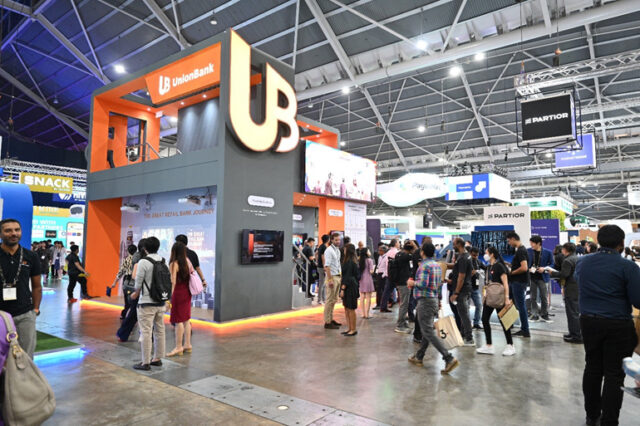
With an exhibition booth that stood out among various banks, financial institutions, and fintech players in and outside of Singapore, UnionBank showcased its digital journey toward powering a solid future for banking in the Philippines.
Throughout the three-day SFF, UnionBank gave attendees a broad view of its evolving ecosystem, which brought forth financial solutions and innovations that are beginning to draw and benefit a wide range of clients.
Foremost of these products that the Abotiz-led bank showcased in its booth is its digital banking subsidiary, UnionDigital.
A year and a few months after it was given a digital banking license by the Philippine central bank, UnionDigital announced during the first day of SFF that it has acquired 1.73 million customers, reached US$70 million in loan book size, and collected US$50 million in deposits from its first four months of operations.
Mike Singh, chief lending officer of UnionDigital, attributed the digital bank’s initial growth to how it was able to leverage customers within UnionBank’s ecosystem.
“We were starting with UnionBank’s several million customers. Some of them need additional banking services like credit; some of them fall to the middle to lower part of the income pyramid,” Mr. Singh shared in a media roundtable.
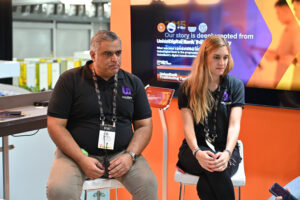
From left: UnionDigital Chief Lending Officer Mike Singh, and UnionDigital Chief Product, CX and Operations Officer Maria Gaitanidou during a media roundtable
“The benefit of the digital bank is we have a very low cost to serve. So, that allows us to serve the lower half of the income pyramid with lower average loan tickets,” he added.
Maria Gaitanidou, UnionDigital’s chief product, CX, and operations officer, added that the digital bank’s progress validates its strategy of focusing on communities, particularly underbanked ones, which could benefit from UnionDigital’s offerings.
“We know that we will keep executing on that basis, and we know we can unlock additional potential portfolios,” Ms. Gaitanidou said, adding that the UnionDigital is very open to collaborating with more communities that they can serve by bringing out solutions that will meet their needs the best.
Mr. Singh also attributed UnionDigital’s recent performance to its utilization of alternative data and machine learning in predicting the credit risk of borrowers.
“The ability to predict risk for someone where you don’t see their inflow of cash, that’s really the opportunity. And we believe we have an edge there because of our data science capabilities and our access to various data sources,” he said.
Further showing the bank’s growing ecosystem, startup White Cloak Technologies, Inc., the bank’s partner behind the UnionBank Online and The Portal apps, is a major part of the development team behind UnionDigital.
Donn Carlo Gamboa, chief executive officer of White Cloak, expressed his appreciation for the bank’s continuing partnership with them since they won UnionBank-supported U:HACK hackathon.
“We’re drawn to their disposition about innovation and their compassion [being integrated] to technology. It’s been such a proud moment to see UnionDigital being so successful, and we want to be part of that journey all throughout,” Mr. Gamboa said.
Open finance
UnionBank’s booth also showcased the lender’s strides in enabling and realizing open finance in the Philippines through its own open finance platform, UBX.
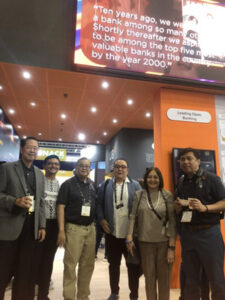
Gracing the UnionBank booth are BSP Deputy Governor Chuchi Fonacier and Director Mhel Plabasan (2nd and 3rd from right) welcomed by UnionBank President and CEO Edwin Bautista (3rd from left) together with (from left) Board Director Roberto Manabat, UnionDigital President and CEO Arvie De Vera, and UnionBank CTOO/CTO Henry Aguda.
Jaime P. Garchitorena, managing director for payments and commerce of UBX, explained that open finance promises to bring all of the entities that a consumer transacted and give them the ability to communicate with each other so that they can attest to the consumer’s “individual-ness.” As a result, when one wants to deal with a third party, he or she does not have to gather manually all the data, since open finance has already brought those data together.
Seeing these possibilities open finance can give to consumers, UBX seeks to create a space where its ecosystems of merchants, lenders, and other participants can interact with each other.
“We’ve developed a community already, so now we’re developing the layer that will allow these communities to interact with each other and their data subjects, both at an identity and a transaction [level],” Mr. Garchitorena said.
Mario R. Domingo, global chief technology officer of UBX, added that these connections are grounded on the technologies the UnionBank ecosystem is utilizing, such as blockchain and artificial intelligence (AI).
“It’s built on performance, trust, and, most importantly, privacy and information security,” he said.
UBX’s solutions include, among others, i2i, a banking-as-a-service solution connecting hundreds of financial institutions and service providers; BUx, an end-to-end payment gateway focused on micro, small, and medium enterprises (MSMEs); SeekCap, a same-day approval digital lending marketplace; and Xpanse, a platform for building new financial solutions through application programming interfaces and customer-controlled data sharing across hundreds of member institutions.
In addition, Mr. Garchitorena announced on the first day of SFF the launch of the Philippine Open Finance Foundation, which intends to bring in stakeholders from both technology and user ends to help build the policies that will define how open finance will be used in the Philippines.
SEC Commissioner Kelvin Lester K. Lee (left) with UnionBank Chief Marketing Officer Albert Cuadrante, and UnionDigital PCEO Arvie De Vera
“The whole point of the foundation is to make sure that the adoption of open finance, whether as a technology or a function of customers, is premised by a well-educated and trustworthy set of participants. When things go wrong, all of the participants, particularly the consumers, [should] have a strong dispute resolution mechanism to be able to help them solve the problem,” he said.
Open finance could also allow banking functionalities such as remittances, mortgages, and payments to be accessible to business partners on whatever platform they are using.
“This time, we try to make it open to them not necessarily while being inside the bank, but being in their platforms of choice, [like e-wallet or e-commerce apps,]” said Pauline Limgenco, who leads UnionBank’s Open Finance & Digital Services Center of Excellence.
Through its Digital Business Solutions, UnionBank is partnering with other businesses to enable interoperable and efficient banking functions, UnionBank Fintech Business Group Manager Jose Paolo Miguel Lozada shared.
“The goal is to dive more and be more proactive in bannering the open finance space, where you want to embed not only backend functionalities but different financial services and products into different platforms,” Mr. Lozada said.
UnionBank’s Digital Business Solutions, another area showcased in the bank’s booth, gives space for synergy between banks and other businesses with the goal of bringing digitalization to our consumers.
“UnionBank already has its own powerful tools, but we want to share that with our partners. We partner with experts in other industries, and we try to make them part of our accredited functions so that our clients can have access to more digital solutions,” Ms. Limgenco said.
Data-enabled capabilities
UnionBank also showcased its capabilities in data science and AI during the SFF, particularly in terms of hyper-personalization.
Julie Anne C. dela Cruz, data science solutions head of UnionBank, shared that using data and AI enables the bank to personalize offers specific to what they look for.
From left: UnionBank Chief Cross-Sell Officer Anton Corro, BSP Deputy Governor Mamerto Tangonan and UnionBank Chairman Erramon I. Aboitiz
“We are able to use the information that we have on them to be able to develop products that cater to their needs and address financial inclusion in terms of offering more [choices] to our customers,” Ms. dela Cruz said during the second day of SFF.
Dr. Adrienne Heinrich, head of the Artificial Intelligence and Innovation Center for Excellence at Aboitiz Data Innovation, added that through data and AI read through piles of customer feedback, they can now understand customers in a more personalized way.
“We’re using natural language processing to automatically analyze all these texts, even in such a way that we understand which customer group has which concerns and feels very happy about which experiences,” Ms. Heinrich said.
CitySavings, the thrift bank subsidiary of UnionBank which is notable for its lending to teachers and lending of motorcycles, is also benefitting from UnionBank’s data innovation capabilities, its president, Lorenzo T. Ocampo, noted.
“We work a lot with Aboitiz Digital Innovation; they create models for us. We’ve been able to build up enough data from lending that they can already create predictive patterns that will allow us to either approve or disapprove very quickly,” Mr. Ocampo said.
UnionBank’s Supply Chain Finance (SCF), which facilitates credit and payments between businesses, is also being further powered by technology as the bank launched SCF on the blockchain.
In a roundtable during the last day of SFF, Ramon G. Duarte, UnionBank’s transaction banking center head, shared that launching SCF on blockchain further mitigates issues of trust in business transactions.
“It provides that level of assurance, and it does it in a way that’s very transparent to us,” Mr. Duarte said.
“You have the blockchain to dictate smart contract, or basically it dictates how invoices will flow from a supplier and the buyer, and how payments will go from there,” UnionBank Senior Product Manager and Squad Lead for Digital Supply Chain Finance Ronald Gerard M. Arceo said.
Recalling how their area has progressed since 2019, Mr. Arceo shared that SCF started out proving blockchain’s capability in mitigating risks by rolling out payable discounting for corporations. Then, as they proceeded to dealer financing, which specifically caters to MSMEs, they were able to expand the ecosystem SCF can serve.
“It’s proof of how reaching MSMEs through an ecosystem of communities is really something that the bank could look into. That’s the power of ecosystems: You bring in an established anchor and use their relationships with MSMEs to help them digitize and to get access to financing products,” Mr. Arceo said.
“The best way to lend unbanked segments, particularly the MSMEs, is really through working through the relationships that they have with bigger names or anchors in the ecosystem,” Mr. Duarte added.
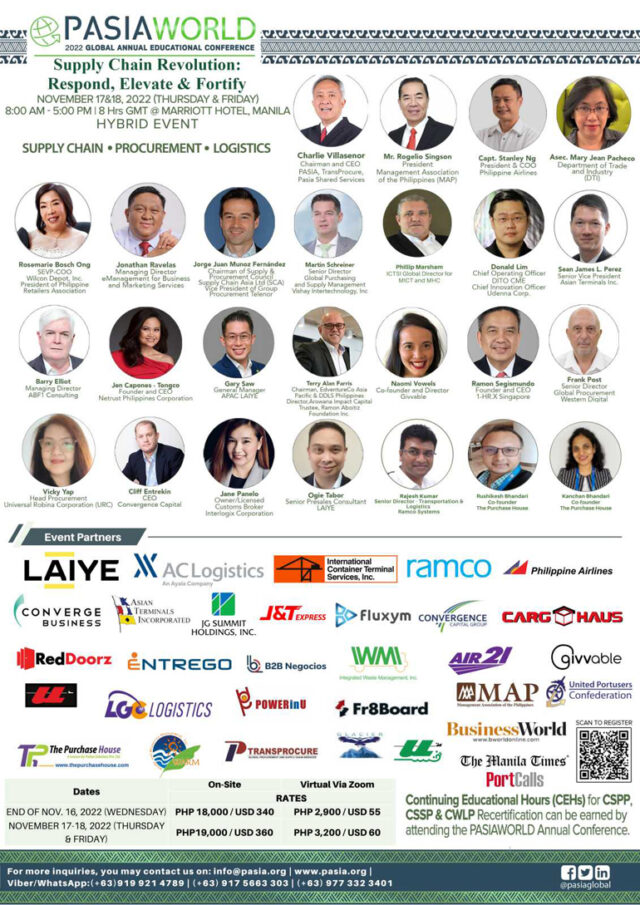
This year’s edition of the PASIAWORLD Conference, organized by the Procurement and Supply Institute of Asia (PASIA) will be held this Nov. 17 and 18 at Marriott Hotel, Manila, with sourcing, supply chain, and logistics professionals from some of the largest Asia-Pacific brands expected in attendance.
The two-day event will be highlighted by insights and best practices by industry experts, presentations of case studies through plenary discussion and panel discussions, as well as invaluable networking opportunities.
In line with this year’s theme, “Supply Chain Revolution: Respond, Elevate, & Fortify Conference 2022,” the event will include relevant themes that will elevate and fortify individuals, functional teams, and organizations amidst the prevailing disruption and changes that are the present business reality.
Targeting key decision makers, influencers, and global leaders, the conference guarantees an unparalleled opportunity to learn from local and global industry thought leaders, to network with like-minded individuals from top and emerging companies, and to hear of best-in-class business practices. It is expected to benefit business leaders in the fields of distribution, supply, production, and manufacturing in all sectors.
Resource speakers have prepared relevant, engaging topics that are curated based on the latest trends, challenges, and best practices in procurement and supply chain management, as well as all other functional disciplines.
This year’s conference, the first face-to-face since the pandemic, includes a C-level “Supply Chain is Everything” all leaders roundtable, promising insights and lessons from seasoned international and local senior leaders.
Keynote speakers are Rogelio “Babes” Lazo Singson, the new President of the prestigious Management Association of the Philippines (MAP) for Day 1, and Rosemarie Ong, SEVP-COO of Wilcon Depot, Inc., for Day 2.
Credible, seasoned, and esteemed leaders and professionals promise to complete the lineup of plenary and panel discussion speakers.
PASIA, which celebrates its 20th anniversary in the industry, is the premier professional institute for procurement and supply chain management in Asia, operating globally. It enables and empowers organizations to manage resources, risks, and costs and to streamline overall business operations. PASIA provides added value by educating and certifying professionals to apply world standards to their procurement and supply operations, which are key contributory processes to business growth and success.
To learn more about the PASIAWORLD Conference 2022, visit www.pasia.org.
Spotlight is BusinessWorld’s sponsored section that allows advertisers to amplify their brand and connect with BusinessWorld’s audience by enabling them to publish their stories directly on the BusinessWorld Web site. For more information, send an email to online@bworldonline.com.
Businesses requiring a service vehicle or delivery truck have a great chance of getting one by joining the #GoDreamer Raffle Promo by Global Dominion Financing, Inc. (GDFI), where the financing company is giving away one L300 in line with its 20th anniversary in March 2023.
The #GoDreamer Raffle Promo is open to all Filipinos aged 21 to 65 years old, whether they have an existing business or not. An existing business owner can absolutely use the prize as an additional unit for his operations.
GDFI, known for its Sangla ORCR (car & truck refinancing, car & truck collateral loan, prenda ORCR) product, aims to reach more entrepreneurs to offer its financial product, which is essential in mobilizing business operations across the country.
The financing company has more than 70 branches located nationwide, and is set to open more, potentially beyond 100 in 2023.
Before joining the promo, interested individuals are advised to first view and share GDFI’s announcement about the promo on its Facebook page.
After carefully reading the mechanics and sharing the post on GDFI’s Facebook page, one can easily join the raffle promo by registering on gdfi.com.ph.
For almost two decades now, GDFI has been one of the leading financial service providers to various sectors including car owners, business owners, and executives, offering secured cash loans and financial services.
“It’s not easy to launch, more so to expand a business. And we, at Global Dominion Financing, feel the need to support Filipino entrepreneurs through our loan products and even beyond,” said GDFI Deputy Chief Operating Officer (DCOO) Maria Carmela Laarni Felicidario.
“This raffle promo is a form of showing our commitment to businesses, to support their expansion goals and dreams. Their success is absolutely our success too!” Ms. Felicidario added.
Spotlight is BusinessWorld’s sponsored section that allows advertisers to amplify their brand and connect with BusinessWorld’s audience by enabling them to publish their stories directly on the BusinessWorld Web site. For more information, send an email to online@bworldonline.com.
A boat is seen on Pasig River, July 31, 2022. — PHILIPPINE STAR/ MIGUEL DE GUZMAN
FOREIGN INVESTMENT pledges declined 22.4% in the third quarter as investors fretted over a looming global economic slowdown, soaring inflation and the ongoing Russia-Ukraine war.
Data from the Philippine Statistics Authority (PSA) showed total approved foreign investments dropped to P13.05 billion in the July to September period, from P16.82 billion in the same period a year ago.
This was the smallest quarterly amount since the P8.981-billion investment pledges approved in the first quarter of this year.
For the first nine months of 2022, approved foreign investment pledges rose 15.6% to P68.28 billion.
Japanese investments accounted for 34.5% or P4.5 billion of the total approved foreign investments, followed by South Korea which made up 15.5% (P2.02 billion), and Singapore with 12.6% (P1.64 billion).
According to the PSA, the third-quarter investments were approved by four investment promotion agencies (IPAs) namely the Board of Investments (BoI), Clark Development Corp., (CDC), Philippine Economic Zone Authority (PEZA), and Subic Bay Metropolitan Authority (SBMA).
The PEZA accounted for 70.9% or P9.25 billion of total investments in the July to September period, followed by BoI with 16.5% or P2.16 billion and the CDC with 10.5% or P1.36 billion. The SBMA approved P276.13 million worth of investments.
No foreign investments were approved by other IPAs such as the Authority of the Freeport Area of Bataan (AFAB), BoI-Bangsamoro Autonomous Region in Muslim Mindanao (BoI-BARMM), Cagayan Economic Zone Authority (CEZA), Poro Point Management Corp. (PPMC), and Tourism Infrastructure Economic Zone Authority (TIEZA).
PSA data showed the manufacturing received the biggest share of approved foreign investments, accounting for 55.2% or P7.20 billion. Administrative and support service activities made up 25.9% (P3.38 billion), while real estate activities accounted for 10.3% (P1.35 billion).
Half or P6.6 billion of the approved investments will go to Calabarzon (Cavite, Laguna, Batangas, Rizal, and Quezon), while Central Luzon will receive 23% or P3.02 billion, and National Capital Region with P2.24 billion or 17.1%.
Once materialized, these projects are expected to generate 17,994 jobs.
The approved investments of foreign and Filipino nationals in the third quarter surged 58% year on year to P159.18 billion. Of the total, Filipino nationals accounted for P146.13 billion or 91.8%.
Sought for comment, Trade Undersecretary Ana Carolina P. Sanchez told BusinessWorld in a Viber message that the drop in approved foreign investments may be due to worries over a global economic slowdown.
“This is still partly a result of the global recession pushed by increasing inflation and interest rates, and the rising energy prices from Russia-Ukraine war,” Ms. Sanchez said.
Headline inflation accelerated to 6.9% in September, from 6.3% in August as prices of food and utilities continued to rise. As of end-September, inflation averaged 5.1%, still below the Bangko Sentral ng Pilipinas’ (BSP) 5.6% forecast for the full year.
The economy expanded 7.6% year on year in the third quarter.
“A combination of geopolitical factors — the Ukraine War, volatile energy prices, high US interest rates, and overall global economic uncertainty — and wait-and-see attitude on the policies of the new administration probably accounts for the dip in foreign investments this year compared to last year,” Foundation for Economic Freedom President Calixto V. Chikiamco said in a Viber message.
Tereso O. Panga, PEZA officer-in-charge and deputy director general for policy and planning, said in a Viber message that the agency expects to approve several big-ticket items in its next few meetings.
“We remain bullish that we will achieve our 6% to 7% growth target for 2022 given the high GDP growth forecast for the Philippines, making it one of the best performing economies in the region, and the aggressive support of President Ferdinand R. Marcos, Jr. and Trade Secretary Alfredo E. Pascual to promote the Philippines as the smart investment choice in the region and the ecozones in terms of attracting strategic, high-tech and high-value investments,” Mr. Panga said.
Rizal Commercial Banking Corp. Chief Economist Michael L. Ricafort said that investments could possibly increase in the last quarter.
“Foreign investments into the country could pick up in the coming months as the new administration already started since June 30, 2022 especially in view of the investment commitments from the recent visits to Indonesia, Singapore, and the US,” Mr. Ricafort said. — Revin Mikhael D. Ochave
















 After carefully reading the mechanics and sharing the post on GDFI’s Facebook page, one can easily join the raffle promo by registering on