Home Blog Page 5408

Philippine labor groups, employers to discuss workers’ rights with ILO

REUTERS

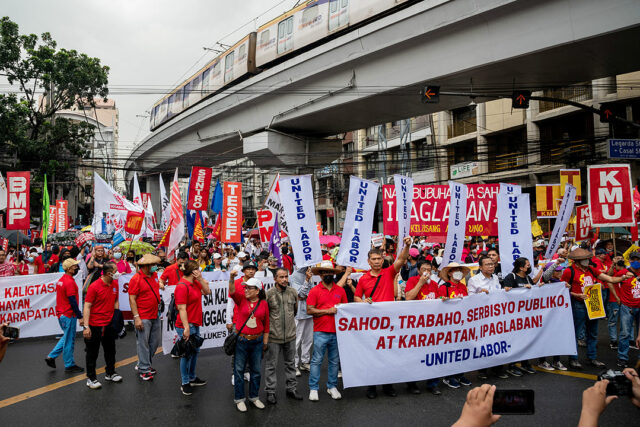
PHILIPPINE labor groups and employers are set to meet with a team from the International Labour Organization (ILO) in Manila this week to discuss cases of harassment and violence against trade unions.

In a statement last week, the Leaders Forum said it would push the rule of law and justice at the three-day meeting that will start on Jan. 23.

“Respect for labor rights as guaranteed by the Philippine Constitution, national labor laws and ILO conventions is indispensable for investments and economic growth,” it said.

ILO Bureau of Worker’s Activities Director Maria Helena André has said the Philippine government should uphold the law since rights violations would deter investments and economic activity.

The ILO high-level tripartite mission to the Philippines will look into the killings of trade unionists and other violations of workers’ rights.

The Leaders Forum includes the  Employers Confederation of the Philippines, Philippine Chamber of Commerce and Industry, Trade Union Congress of the Philippines and the Federation of Free Workers.

Justice Secretary Jesus Crispin C. Remulla has said the state does not sanction attacks, harassment or intimidation of activists and unionists.

He said an inter-agency task force on extralegal killings had investigated at least 17,000 police officers.

The Philippines has accepted 200 recommendations from member-states of the United Nations Human Rights Council, including investigating extralegal killings and protecting journalists and activists.

The UN Human Rights Committee has said the Philippines should comply with international human rights mechanisms.

Human rights abuses continued in the first six months of President Ferdinand R. Marcos, Jr.’s rule, Human Rights Watch said this month.

The Philippine Commission on Human Rights has said the government of ex-President Rodrigo R. Duterte had encouraged a culture of impunity by hindering independent inquiries and failing to prosecute erring cops involved in the government’s anti-illegal drug campaign.

Meanwhile, Jose “Sonny” G. Matula, a labor lawyer and president of the Federation of Free Workers, said government agents did not do enough to ensure the prosecution of 17 police officers in the murder of an activist.

This was after government prosecutors dismissed the murder complaint for lack of evidence.

“We are disappointed with the dismissal,” he said in a Viber message. “It appears that the authorities did not help the private complainant in gathering enough evidence.”

Mr. Matula said labor groups would bring up the murder of nine activists during a series of police raids in March 2021 with the ILO. — John Victor D. Ordoñez

Marcos claims PHL tagged as part of Asia’s ‘VIP Club’ in WEF

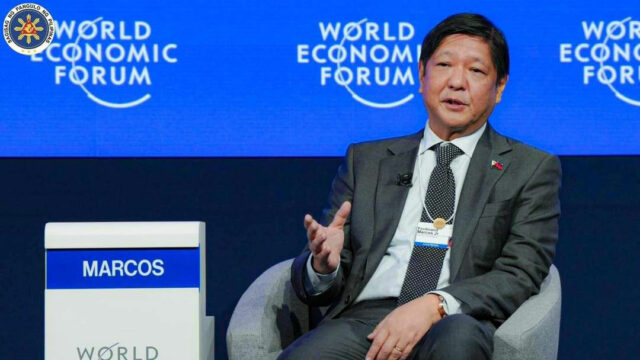
PRESIDENT R. Marcos, Jr. in World Economic Forum (WEF) — OPS PHOTO

PRESIDENT Ferdinand R. Marcos, Jr. at the weekend touted that global business and political leaders have tagged the Philippines as part of a so-called VIP Clubof Asia due to its economic performance, which the government hopes would translate to more foreign investments. 

The Philippines’ participation in the World Economic Forum (WEF) in Davos, Switzerland last week served as an excellent platform to showcase the Philippine economys strong performance,Mr. Marcos was quoted as saying in a press release by the Presidential Communications Office (PCO). 

Its good that we came here (in Davos, Switzerland) because by coming here, we have been included in what they call the VIP Club,he said in Filipino. The VIP Club is composed of Vietnam, Indonesia, and the Philippines. 

They said these countries have the best economy in Asia.” 

Think tank Ibon Foundation, however, expressed dismay at the Palaces bullish claims about the Philippine economy, saying facts show that last year was a tough one for poor and middle-class Filipinos. 

The Philippines faces growth risks from elevated inflation, rising borrowing costs and a global recession. The World Bank expects the economy to slow to 5.4% this year from an estimated 7.2% last year. 

The government has lowered its growth target this year to 6% to 7% from 6.5%-7.5%. Inflation hit 8.1% in December, the fastest since November 2008. 

The economic managers have failed to meet their growth targets for five years now with only eleventh-hour estimates coming anywhere close,IBON said. If their usual overestimates are any guide and generously ignoring how wildly growth was in 2020 it is more likely that growth this year will be around 5% or even less.” 

IBON maintained that the relatively rapid growth last year is a misleading indicator of the economys trajectory,noting that it was just a rebound from reopening and there was a statistical boost from being measured against the low base of an economy pressed down by lockdowns.”  

Leonardo A. Lanzona, who teaches economics at the Ateneo, also noted that the WEF organized by a foundation advocating for public-private cooperation — “is perceived as an elitist group.”  

“The WEF is a collection of super rich entities formed to avoid taxes. In the face of prevailing gut problems, persistent inequality and rising poverty, the active participation of the Philippine government only crystallizes the anti-poor character of the policies advocated by this administration,Mr. Lanzona said in a Facebook Messenger chat.

The poor farmer has more to contribute to the countrys development than all the tycoons who were part of this delegation,he said.  

The President met with global leaders at the Davos conference, with several foreign investors expressing intent to explore business opportunities in the Philippines,the PCO said in the media release.  

Earlier, the Palace said Mr. Marcos had secured commitments from at least two foreign companies during his Switzerland trip.   

But investment analysts were unimpressed, saying the supposed commitments were insignificant and could be had without a foreign trip.

Mr. Marcos met with WEF Founder and Chairman Emeritus Klaus Schwab and discussed partnerships and collaboration to help the Philippines sustain equitable and inclusive growth and provide a better quality of life for Filipinos,the PCO said in the Sunday release.  

It added that the Philippine leader also had the opportunity to exchange views with World Trade Organization Director-General Ngozi Okonjo-Iweala, World Bank Managing Director for Operations Axel Van Trotsenburg, International Monetary Fund Managing Director Kristalina Georgieva, and former United Kingdom Prime Minister Tony Blair.

Mr. Marcos, 65, arrived in Switzerland on Jan. 15 and returned to the Philippines on Saturday.

In his arrival speech, the President said his WEF engagement gave the Philippines a chance to inform various sectors that the country is leading economic recovery and performance not only in the Asia-Pacific but also in the whole world. 

Mr. Marcosclaim has been backed by House legislator Jose Maria Clemente S. Salceda, who said in a Sunday statement that absolutely there will be no recession for the Philippines in 2023.”  

We will be in positive growth territory regardless of what happens for the rest of the world,he claimed. We have removed restrictions on so many key sectors public services, the retail trade sector, the energy sector that the country will offset global recessionary forces.”  

Last week, the Palace said New York-based investment firm Morgan Stanley & Co. LLC would set up an office in Manila to support the governments development agenda. 

It added that Emirati logistics company DP World, which is already operating in the Philippines, seeks to set up an industrial park in Clarkfield, Pampanga province north of the Philippine capital.

Terry L. Ridon, a public investment analyst, told BusinessWorld at the time that Morgan Stanleys commitment does not constitute a commitment to undertake foreign direct investment in the Philippines.  

DP World, the logistics company, is already well-established in the country, operating ports in Manila and Batangas province,he added. Kyle Aristophere T. Atienza 

Lawmaker calls for rationalization of air transport by expanding Clark flights 

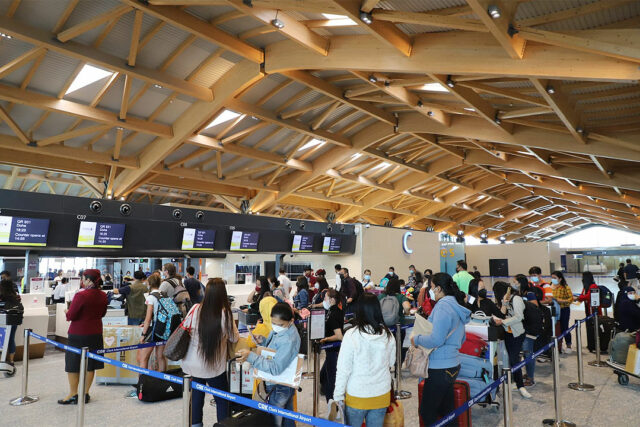
Clark International Airport
STOCK PHOTO | Image by BCDA.GOV.PH

A LAWMAKER called on transport authorities to maximize the recently upgraded Clark International Airport as an alternative facility to the main gateway in Manila, which is being pushed for privatization in the aftermath of the Jan. 1 air traffic fiasco that affected more than 65,000 passengers.     

House Minority Leader Marcelino C. Libanan said 50% of all flights in and out of the congested Ninoy Aquino International Airport (NAIA) could be transferred to the privately-managed Clark airport, which has a new terminal building that can accommodate up to eight million passengers annually.    

The Clark airport, located within a former American military air base in Pampanga, is about 115 kilometers north of NAIA.   

Mr. Libanan noted that Clark is more accessible now to and from the capital with the construction of toll roads.  

He added that privatizing NAIA would only be a temporary solution to the congestion problem.   

NAIAs problem is lack of land for expansion. No new parallel runway can be built there because the area around the airport is already highly urbanized,he said in a statement on Sunday.   

On Sunday, flights at the NAIA were briefly suspended for the replacement of a blowing/cooling fan for its second uninterruptible power supply, according to the Civil Aviation Authority of the Philippines (CAAP).   

Nine flights for departure were affected while 38 waited for clearance delivery after a short outage as part of maintenance activity, CAAP said. Beatriz Marie D. Cruz 

Davao WTE project still up for NEDA approval, full funding 

DAVAOCITY.GOV.PH

DAVAO CITYS proposed waste-to-energy (WTE) project is still up for final approval by the national government and has yet to secure the full funding needed to set up the facility, according to a local council member.   

Councilor Temujin TekB. Ocampo, chair of the city councils environment committee, said the WTE plan has already been endorsed by the Department of Energy and Department of Environment and Natural Resources (DENR) and is awaiting the green light from the National Economic and Development Authoritys (NEDA) green light. 

The ball right now is still with NEDA,he said at a media forum last week.   

We are still waiting to be approved in NEDA and the Department of Environment and Natural Resources (DENR) will just comply,he added.   

In March last year, former city mayor and now Vice President Sara Duterte-Carpio reported that DENR has agreed to allocate P740 million for the P3.5 billion government counterpart fund needed to supplement the P2-billion grant provided by the Japan International Cooperation Agency (JICA).  

The city government has already purchased a 10-hectare lot for the project, which is now being reassessed for wider use by the Metro Davao area composed of six cities and nine towns within Davao region.   

Under the original design, the WTE has a capacity for about 600 metric tons of waste and produce up to 12 megawatts of energy.   

Mr. Ocampo said the city government sees the WTE, planned in partnership with its sister city Kitakyushi in Japan more than three years ago, as the best waste management option.  

The citys existing sanitary landfill is expected to reach full capacity this year.   

Environmental groups, however, continue to oppose the project and have recently urged JICA to withdraw its funding support.   

The groups made the call during a forum held earlier this month. Among those in attendance were the Global Alliance for Incinerator Alternatives (GAIA) Asia Pacific, Ecowaste Coalition, Interfacing Development Interventions for Sustainability (IDIS)-Davao, Ecoteneo, Masipag Mindanao, Panalipdan Youth-Davao, and Saligan-Mindanaw.   

Farmers and residents also joined the meeting.       

Gary S. Villocino of Masipag, a network of farmers in Davao, said the WTE facility poses a threat to public health as well as valuable agricultural landthat could be used to cultivate resources for the community.  

Mark T. Peñalver of IDIS-Davao said incineration is not a renewable or sustainable energy source, and harms the environment.   

It produces more greenhouse gasses than coal. So not only is incineration a bad choice for the environment, but its also not a wise choice from a climate perspective,Mr. Peñalver said in a statement.  

The groups also reiterated their push to improve waste management starting at the household and community levels. Maya M. Padillo 

Public hospitals, specialists vouch for DoH officials accused of mishandling cancer funds 

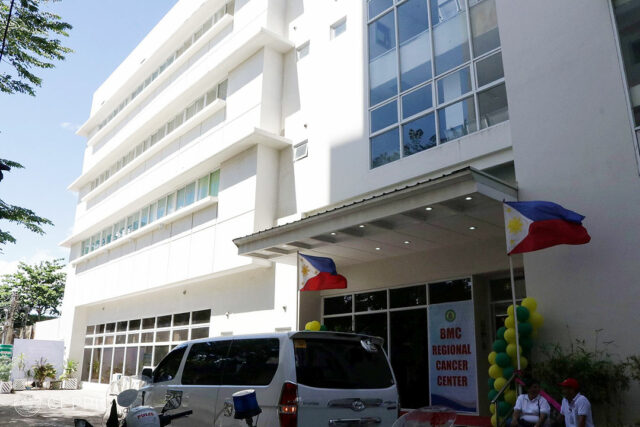
BICOL Cancer Center — BMC.DOH.GOV.PH

GOVERNMENT-run medical facilities with cancer specialty services have vouched for Department of Health (DoH) officials who have been accused of mishandling public funds for cancer patients.   

In a joint statement, 20 public hospitals said cancer funds amounting to more than P809 million have been allocated to them and have been used efficiently.  

The fund continues to be used for procurement of cancer medicines for our patients,they said.  

The hospitals include Jose Reyes Medical Center, East Avenue Medical Center, Philippine Childrens Medical Center, Baguio General Hospital and Medical Center, Mariano Marcos Memorial Hospital and Medical Center, Region 1 Medical Center, Cagayan Valley Medical Center, D Paulino J. Garcia Memorial Research and Medical Center, Batangas Medical Center, and Bicol Medical Center.  

Other signatories are the Bicol Regional Hospital and Medical Center, Western Visayas Medical Center, Corazon Locsin Montelibano Memorial Regional Hospital, Vicente Sotto Memorial Medical Center, Eastern Visayas Regional Medical Center, Zamboanga City Medical Center, Northern Mindanao Medical Center, Southern Philippines Medical Center, Davao Regional Medical Center, and Cotabato Regional and Medical Center.  

Clarito Carlo, Jr., a medical officer at the DoH, filed a complaint last week before the Office of the Ombudsman against several members of the department over alleged mismanagement of funds for the Cancer and Supportive-Palliative Medicines Access Program (CSPMAP).  

In his complaint, Mr. Carlo accused the officials of grave misconduct, malversation of public funds, and violating the countrys anti-graft law for the sub-allotment of CSPMAP funds to only 19 of the 31 access sites, which he said was highly disadvantageous to the government and a grave disservice to many CSPMAP-enrolled patients.”  

In a separate statement, several non ex-officio members of the DoH-led National Integrated Cancer Control Council assured all stakeholders that the P786-M fund in question is all accounted for.” 

The decision to sub-allot/transfer the funds to the hospitals was discussed and agreed upon by the Council due to the exigency of providing medicines to patients and to prevent and address gaps in patient treatment,they said. 

The signatories include Samuel D. Ang of the Surgical Oncology Society of the Philippines, Mae Concepcion J. Dolendo of the Philippine Society of Pediatric Oncology, Rachel Martie B. Rosario of the Philippine Society of Hospice and Palliative Medicine, and Corazon A. Ngelangel of the Philippine Cancer Society. Kyle Aristophere T. Atienza 

UP-MSI researchers push for wastewater-based COVID-19 monitoring after Davao study 

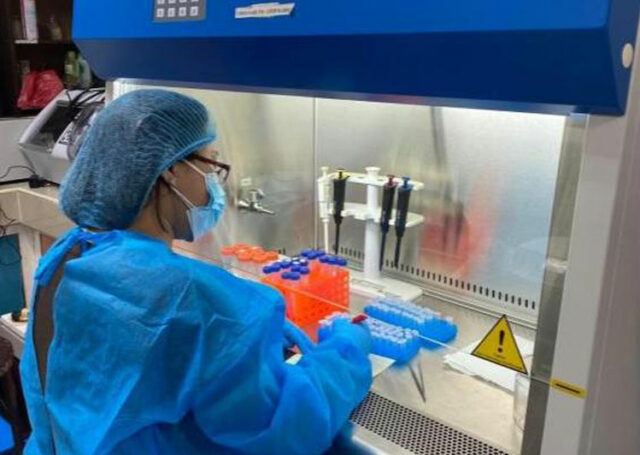
WBE laboratory — UP-DANN DEL MUNDO

RESEARCHERS FROM the University of the Philippines-Marine Science Institute (UP-MSI) called on government to adopt a wastewater-based monitoring of coronavirus disease 2019 (COVID-19) nationwide, saying this method allows for more localized surveillance and targeted mitigation measures. 

Detecting RNA in wastewater could help local government units forecast what barangays are at risk and may need closer monitoring, rather than a blanket lockdown,said Caroline Marie B. Jaraula, a UP-MSI professor who was among those that conducted a study on wastewater-based epidemiology (WBE) in Davao City.   

The presence of viral RNA or ribonucleic acid is an indicator of COVID-19.

We should consider this as science-based tools to determine which barangay is more susceptible,she said during a presentation of the study on Jan. 19 via a Zoom conference. 

Another member of the research team, Dann Marie N. Del Mundo of UP Mindanao, said WBE provides an effective and faster analysis of community-level COVID-19 infection using less resources. 

Clinical monitoring, such as RT-PCR testing, and contact tracing are limited in the early detection or prediction of community outbreaks and can be logistically demanding and expensive when applied to a large population, Ms. Del Mundo said.  

The researchers also stressed that WBE can be used as a tool for wider monitoring and making policies on public health.   

The team, with funding from the Department of Science and Technology, have expanded their work into other areas through the Integrated Wastewater-Based Epidemiology and Data Analytics for Community-Level Pathogen Surveillance and Genetic Tracking (iWAS) Project.  

Shyrill Mae F. Mariano, research assistant at UP-MSI, also highlighted that their work point to the critical need to improve wastewater management in Davao City, citing the presence of bacteriological and pharmaceutical indicators of untreated wastewater within the Davao River basin.  

During the conception of the USAID (United States Agency for International Development) Peer Peoples Project, Davao City still didnt have this municipal sewerage treatment,she said.However, in October 2022 the city government of Davao announced that it will be launching a septage management program this 2023 to address the rising coliform levels in the city.” 

The city government, in partnership with the Davao City Water District (DCWD), announced last year that it will be launching the Davao City Septage Management Program in 2023. Maya M. Padillo 

Labor group says SC ruling favoring Lazada riders a victory for security of tenure  

PHILSTAR FILE PHOTO

A LABOR group on Sunday said a Supreme Court (SC) decision in favor of delivery riders who were dismissed by Lazada E-Services Philippines, Inc. upholds the right of security of tenure. 

“In this historic case, the SC Second Division has once again put flesh and blood to the constitutional provision of protection to labor and upholds the fundamental right of workers to a regular job,” the Federation of Free Workers (FFW) said in a statement. 

The ruling, signed Sept. 21 last year and made public on Jan. 19, stems from a case filed by five riders in 2017 before the National Labor Relations Commission (NLRC) after the company stopped giving them delivery assignments. 

The High Court reversed the decisions of the NLRC and the Court of Appeals, which ruled that there was no employer-employee relationship between the riders and Lazada. 

In a statement on Friday, the SC said it ordered the e-commerce platform to reinstate the riders as they were not “independent contractors” since their work did not require a special skill or talent.  

Lazada was also ordered to pay the riders their full back wages from the time of dismissal up to the time of actual reinstatement.  

“When the status of the employment is in dispute, the employer bears the burden to prove that the workers are independent contractors rather than regular employees,” SC Senior Associate Justice Marvic M.V.F Leonen said in the ruling. 

“The SC made it clear that the protection to labor and the guarantee of the right security of tenure are not mere embellishments in a parchment that can be ignored like wallpapers on the wall. They are fundamental rights that should be enjoyed by workers in real life,” the FFW said.  

The decision can be appealed before the SC en banc. John Victor D. Ordoñez

SEC partners with universities for internship program 

THE SECURITIES and Exchange Commission (SEC) has partnered with four academic institutions San Beda University-Manila, Manuel L. Quezon University, La Consolacion College-Pasig, and Polytechnic University of the Philippines for its internship program.  

In a press release, the regulator said the program will train undergraduate and law students on company registration and regulation, capital markets, enforcement, and investor protection, among others.  

The SEC Internship Program seeks to provide students with direct practical experience at the SEC while honing their skills in relation to their respective academic backgrounds,the regulator said. 

Applicants for the internship program must be enrolled in an undergraduate or law degree program. 

Their program of study must also require them to undergo an internship during the semester they are enrolled therein. The commission will not accept voluntary internships for the purpose of getting work experience,the SEC said.   

Under the agreement, partner schools can send interns to the commission and also allows SEC to participate in university activities such as job fairs, seminars, and forums, among others, the SEC said. Justine Irish DP. Tabile 

US Justice dep’t found more classified items in Biden home

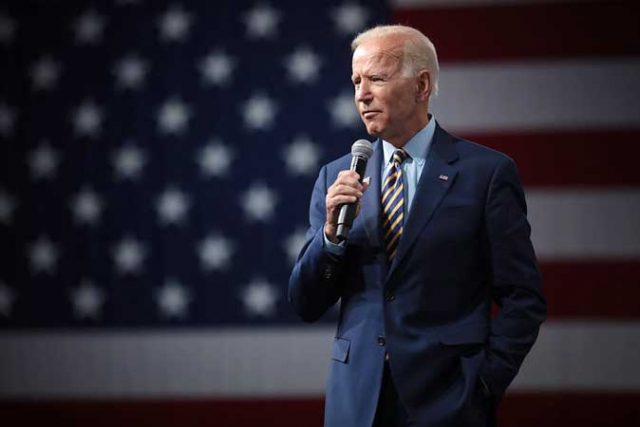
US President Joseph R. Biden, Jr. — Image via Gage Skidmore/CC BY-SA 2.0/Flickr

WASHINGTON — A new search of President Joseph R. Biden’s home in Wilmington, Delaware on Friday by the US Justice Department found six more items, including documents with classification markings, a lawyer for the president said in a statement Saturday night.

Some of the classified documents and “surrounding materials” dated from Mr. Biden’s tenure in the US Senate, where he represented Delaware from 1973 to 2009, according to his lawyer, Bob Bauer. Other documents were from his tenure as vice president in the Obama administration, from 2009 through 2017, Mr. Bauer said.

The Department of Justice (DoJ), which conducted a search that lasted over 12 hours, also took some notes that Mr. Biden had personally handwritten as vice president, according to the lawyer.

The president offered access “to his home to allow DoJ to conduct a search of the entire premises for potential vice-presidential records and potential classified material,” Mr. Bauer said.

Neither Biden nor his wife were present during the search, the attorney said. Mr. Biden is in Rehoboth Beach, Delaware, for the weekend.

Justice Department investigators coordinated the search with Mr. Biden’s lawyers ahead of time, Mr. Bauer said, and the president’s personal and White House lawyers were present at the time.

Other classified government records were discovered this month at Mr. Biden’s Wilmington residence, and in November at a private office he maintained at a Washington, D.C., think tank after ending his tenure as vice president in the Obama administration in 2017.

On Saturday, Mr. Bauer did not make clear in his statement where in the Wilmington home the documents were found. The previous classified documents were found in the home’s garage and in a nearby storage space.

The search shows federal investigators are swiftly moving forward with the probe into classified documents found in Mr. Biden’s possession. This month, US Attorney General Merrick Garland named a special counsel to probe the matter.

Special counsel Robert Hur, who was appointed during the process, is investigating how the president and his team handled Obama-era classified documents that were recently found in Mr. Biden’s private possession.

Mr. Biden’s lawyers found all the documents discovered before Friday’s search by the DoJ, according to the White House. The latest search was the first time federal law enforcement authorities have conducted a search for government documents at Mr. Biden’s private addresses, according to information released publicly.

Republicans have compared the investigation to the ongoing probe into how former President Donald Trump handled classified documents after his presidency. The White House has noted that Mr. Biden’s team has cooperated with authorities in their probe and had turned over those documents. Mr. Trump resisted doing so until an FBI search in August at his Florida resort.

The search escalates the legal and political stakes for the president, who has insisted that the previous discovery of classified material at his home and former office would eventually be deemed inconsequential.

Mr. Biden said on Thursday he has “no regrets” about not publicly disclosing before the midterm elections the discovery of classified documents at his former office and he believed the matter will be resolved.

“There is no there, there,” Mr. Biden told reporters during a trip to California on Thursday.

Since the discovery of Mr. Biden’s documents, Mr. Trump has complained that Justice Department investigators were treating his successor differently.

“When is the F.B.I. going to raid the many homes of Joe Biden, perhaps even the White House?” Mr. Trump said in a social media post earlier this month. — Reuters

New Zealand chooses Hipkins to replace Ardern

CHRIS HIPKINS speaks to members of the media outside New Zealand’s parliament in Wellington, New Zealand, Jan. 21. — REUTERS

WELLINGTON — New Zealand’s ruling Labor Party chose former COVID minister Chris Hipkins on Sunday to replace the charismatic Jacinda Ardern as its new leader, and become the next prime minister of the country.

Mr. Hipkins, 44, was the only nomination for the job and his confirmation at a party meeting on Sunday, known as the Labor caucus, was largely a formality.

His appointment to the top job followed the surprise resignation on Thursday by Ms. Ardern, who said she had “no more in the tank” to lead the country.

“This is the biggest privilege and biggest responsibility of my life,” Mr. Hipkins said at a news conference announcing his appointment. “I am energized and excited by the challenge that lies ahead.”

Mr. Hipkins immediately acknowledged the leadership of Ardern, who he called one of New Zealand’s greatest prime ministers and an inspiration to women and girls everywhere.

“She gave voice to those often overlooked in times of challenge and purposefully went about doing politics differently,” Mr. Hipkins said.

But some of the hate Ardern faced during her term is a reminder that “we’ve got a way to go to ensure women in leadership receive the same respect as their male counterparts,” he added.

Known as “Chippy,” Hipkins built a reputation for competence in tackling COVID-19 and was a troubleshooter for Ardern when other cabinet ministers were struggling.

First elected to parliament in 2008, he became a household name fronting the government’s response to the pandemic. He was appointed health minister in July 2020 before becoming the COVID response minister at the end of the year.

Mr. Hipkins named Carmel Sepuloni as deputy prime minister, New Zealand’s first deputy prime minister of Pacific origin.

Ms. Sepuloni, 46, is of Samoan, Tongan and New Zealand European decent and lives in Auckland. She holds a number of portfolios, including social development and employment and arts, culture and heritage.

Mr. Hipkins said the rest of his team would be announced later.

TOUGH ROAD
Mr. Hipkins said he has seen the media focus on Ms. Ardern’s personal life, and wants to keep his two young children and his family out of the limelight.

He said a year ago his wife and he decided to live separately. “She’s still my best friend but we have made that decision in the best interest of our family.”

Local polls have shown Mr. Hipkins was the most popular potential candidate among voters. While Ms. Ardern was popular early in her five-and-a-half-year tenure, her ratings have slid on a backlash to strict COVID curbs, rising living costs and mortgage rates, and concerns about crime.

Mr. Hipkins has a tough road ahead with Labor trailing the opposition in opinion polls and the country expected to fall into recession next quarter before a general election on Oct. 14.

Mr. Hipkins acknowledged that he was taking on the job at a challenging time, and said his government will focus on “bread and butter issues”.

“Over the coming week the cabinet will be making decisions on reining in some programs and projects that aren’t essential right now. We will be focused on middle- and low-income New Zealanders and the small businesses that are (finding) it tough to get by,” he said.

The economy is in sound shape, he said.

“Our books and our economy are in a better shape than many around the world and we are absolutely resolved to help the New Zealanders through these tough economic times,” he said.

Before Mr. Hipkins becomes prime minister, Ms. Ardern will tender her resignation to King Charles’ representative in New Zealand, Governor General Cindy Kiro. Ms. Kiro is to appoint Mr. Hipkins to the role and he will be sworn in. Mr. Hipkins said he will be sworn in on Wednesday. — Reuters

German finance minister warns against quick decoupling from China

FREEPIK

BERLIN — Germany must reduce its dependence on China gradually as decoupling from the Chinese market would costs jobs in Europe’s biggest economy, Finance Minister Christian Lindner was quoted as saying on Sunday.

Germany is working on a new China strategy that takes a more sober view of relations and aims to reduce dependence on Asia’s economic superpower, which has been the country’s top trading partner since 2016.

“Decoupling our economy from the Chinese market would not be in the interest of jobs in Germany,” Mr. Lindner was quoted as saying by the Welt am Sonntag newspaper.

He said that gradually other world regions and markets would have to become more important for German business over the coming years and decades, Welt am Sonntag reported.

“The political conditions must be improved for this,” Mr. Lindner said. — Reuters

In Mexico, a reporter published a story. The next day he was dead

THE MEXICAN FLAG flutters during the National Flag Day event in Iguala, Guerrero State, Mexico, Feb. 24, 2021. — REUTERS

MEXICO CITY — Just after sunset on Thursday, Feb. 10th, two men in a white Dodge Ram pickup pulled up in front of Heber Lopez Vasquez’s small radio studio in southern Mexico. One man got out, walked inside and shot the 42-year-old journalist dead. Mr. Lopez’s 12-year-old son Oscar, the only person with him, hid, Mr. Lopez’s brother told Reuters.

Mr. Lopez was one of 13 Mexican journalists killed in 2022, according to the Committee to Protect Journalists (CPJ), a New York-based rights group. It was the deadliest year on record for journalists in Mexico, now the most dangerous country for reporters in the world outside the war in Ukraine, where CPJ says 15 reporters were killed last year.

A day earlier, Mr. Lopez — who ran two online news sites in the southern Oaxaca state — had published a story on Facebook accusing local politician Arminda Espinosa Cartas of corruption related to her re-election efforts.

As he lay dead, a nearby patrol car responded to an emergency call, intercepted the pickup and arrested the two men. One of them, it later emerged, was the brother of Espinosa, the politician in Mr. Lopez’s story.

Ms. Espinosa has not been charged in connection with Mr. Lopez’s killing. She did not respond to multiple requests for comment and Reuters could not find any previous comment she made about her role in corruption or on Mr. Lopez’s story.

Her brother and the other man remain detained but have yet to be tried. Their lawyer did not respond to multiple requests for comment.

“I already stopped covering drug trafficking and corruption and Heber’s death still scares me,” said Hiram Moreno, a veteran Oaxacan journalist who was shot three times in 2019, sustaining injuries in the leg and back, after writing about drug deals by local crime groups. His assailant was never identified. “You cannot count on the government. Self-censorship is the only thing that will keep you safe.”

It is a pattern of fear and intimidation playing out across Mexico, as years of violence and impunity have created what academics call “silence zones” where killing and corruption go unchecked and undocumented.

“In silence zones people don’t get access to basic information to conduct their lives,” said Jan-Albert Hootsen, CPJ’s Mexico representative. “They don’t know who to vote for because there are no corruption investigations. They don’t know which areas are violent, what they can say and not say, so they stay silent.”

President Andres Manuel Lopez Obrador’s spokesman did not respond to a request for comment about attacks on the media.

Since the start of Mexico’s drug war in 2006, 133 reporters have been killed for motives related to their work, CPJ determined, and another 13 for undetermined reasons. In that time Mexico has registered over 360,000 homicides.

Aggression against journalists has spread in recent years to previously less hostile areas — such as Oaxaca and Chiapas — threatening to turn more parts of Mexico into information dead zones, say rights groups like Reporters Without Borders and 10 local journalists.

Mr. Lopez was the second journalist since mid-2021 to be murdered in Salina Cruz, a Pacific port in Oaxaca. It nestles in the Isthmus of Tehuantepec, a skinny stretch of land connecting the Gulf of Mexico and the Pacific that has become a landing spot for precursor chemicals to make fentanyl and meth, according to three security analysts and a DEA source.

Mr. Lopez’s last story, one of several he wrote about Ms. Espinosa, covered the politician’s alleged efforts to get a company constructing a breakwater in Salina Cruz’s port to threaten workers to cast their vote for her reelection or else be fired.

The infrastructure was a part of the Interoceanic Corridor — one of Mr. Lopez Obrador’s flagship development projects in southern Mexico.

Jose Ignacio Martinez, a crime reporter in the isthmus, and nine of Mr. Lopez’s fellow journalists say since his murder they are more afraid to publish stories delving into the corridor project, drug trafficking and state collusion with organized crime.

One outlet Reuters spoke to, which asked not to be named for fear of reprisals, said it had done an investigation on the corridor, but did not feel safe to publish after Mr. Lopez’s death.

President Lopez Obrador’s spokesman did not respond to a request for comment about corruption accusations related to the corridor.  

THE MECHANISM
In 2012 the government established the Mechanism for the Protection of Human Rights Defenders and Journalists.

Known simply as the Mechanism, the body provides journalists with protections such as panic buttons, surveillance equipment, home police watch, armed guards and relocation. Since 2017, nine Mechanism-protected reporters have been murdered, CPJ found.

Journalists and activists may request protection from the Mechanism, which evaluates their case along with a group of human rights defenders, journalists and representatives of nonprofits, as well as officials from various government agencies that make up a governing board. Not all those who request protection receive it, based on the analysis.

At present there are 1,600 people enrolled in the Mechanism, including 500 journalists.

One of those killed was Gustavo Sanchez, a journalist shot at close range in June 2021 by two motorcycle-riding hitmen. Mr. Sanchez, who had written critical articles about politicians and criminal groups, enrolled in the Mechanism for a third time after surviving an assassination attempt in 2020. Protection never arrived.

Oaxaca’s prosecutor at the time said Mr. Sanchez’s coverage of local elections would be a primary line of investigation into his murder. No one has been charged in the case.

Mr. Sanchez’s killing triggered Mexico’s human rights commission to produce a 100-page investigation into authorities’ failings. Evidence “revealed omissions, delays, negligence and breach of duties by at least 15 public servants,” said the report.

Enrique Irazoque, head of the Interior Ministry’s department for the Defense of Human Rights, said the Mechanism accepted the findings, but highlighted the role local authorities played in the protection lag.

Fifteen people within government and civil society told Reuters the Mechanism is under-resourced given the scope of the problem. Mr. Irazoque agreed, though he noted its staff of 40 increased last year to a staff of 70. Its 2023 budget increased to around $28.8 million from $20 million in 2022.

In addition to the shortage of funding, Mr. Irazoque said that local authorities, state governments and courts need to do more, but there was a lack of political will.

“The Mechanism is absorbing all the problems, but the issues are not federal, they are local,” he said in an interview with Reuters.

More convictions are what Mr. Irazoque believes are most needed, saying the lack of legal repercussions for public officials encourages corruption.

Impunity for journalist killings hovers around 89%, a 2021 report from the Interior Ministry, which oversees the Mechanism, showed. Local public servants were the biggest source of violence against journalists, ahead of organized crime, the report found.

“You would think the biggest enemy would be armed groups and organized crime,” said journalist Patricia Mayorga, who fled Mexico after investigating corruption. “But really it’s the ties between those groups and the state officials that are the problem.”

Many Mexican journalists killed worked for small, independent, digital outlets that sometimes only published on Facebook, noted Mr. Irazoque, saying their stories dug deep into local political issues.

Mexico’s National Association of Mayors (ANAC) and its National Conference of Governors (CONAGO) did not respond to requests for comment about the role of state and local governments in journalist killings or allegations of corrupt ties to crime groups.

President Lopez Obrador frequently pillories the press, calling out reporters critical of his administration and holding a weekly segment in his daily news conference dedicated to the “lies of the week.” He condemns the murders, while accusing adversaries of talking up the violence to discredit him.

Mr. Irazoque says he has no evidence the president’s verbal attacks have led to violence against journalists. Mr. Lopez Obrador’s spokesman did not respond to a request for comment.

“What type of life is this?,” journalist Rodolfo Montes said, eyeing security footage from inside his home where the Mechanism, in which he first enrolled in 2017, had installed cameras with eyes on the garage, street and entryway.

Years earlier, a cartel rolled a bullet under the door as a threat, and he has been on edge ever since. An entire archive box of threats spread over a decade sat in the corner. Looking down at his phone after a cartel threatened his 24-year-old daughter just a few days before, he said, “I’m living, but I’m dead, you know?” — Reuters