Home Blog Page 4173

National security: Should business worry?

PHILIPPINE STAR/KRIZ JOHN ROSALES

The Philippines continuously faces threats from both internal and external sources. The evolving trends and issues on security, such as territorial expansionism, volatile geopolitical competition and conflicts, the pandemic, internal threats to peace, terrorism, and natural and man-made calamities, continue to challenge the country. They can potentially affect our national defense and can pose an adverse impact to national development.

A holistic approach is needed for defense and security that extends beyond managing traditional military threats. The priority plans and programs to mitigate these issues were discussed by the Senior Undersecretary of the Department of National Defense (DND) Irineo C. Espino during the Sept. 20 Management Association of the Philippines (MAP) General Membership Meeting at the Ceremonial Hall of the Marriott Grand Ballroom.

He affirmed the overall thrust that “the Defense department is guided by its vision to guarantee the country’s security, territorial integrity, and sovereignty; continue to be a reliable partner in national development, and a strategy-player in the Asia-Pacific region.”

He added that the DND has a multi-faceted role of not only addressing defense issues but is also committed to ensuring the well-being and development of the nation and the Filipino people. A whole-of-nation approach is needed to carry out this mandate.

Mr. Espino likewise said that the major concern of the business sector is the peace and order in the country or the internal threats to peace. Insurgents attempt to derail operations of businesses, but the Defense Undersecretary assures that the insurgency in the country will be cleared before the year ends. This will ease the worries of existing businesses and startups — and hopefully pave the way for their growth.

The intent of the DND is to focus on external threats and come up with a capable defense posture to protect the country. The armed forces give priority to the commands that address external threats and most of these are directed to China.

The DND coordinates with the United States (US) government for joint maritime activities. According to Mr. Espino, China’s continued aggressive actions in territorial and maritime disputes, such as the West Philippine Sea, will remain a priority concern due to its implications to the country’s sovereignty, sovereign rights, and jurisdiction. Joint activities with our foreign counterparts are ongoing to provide solutions to address this problem. Equipment from other countries were also being procured, such as naval vessels and aircrafts, mostly donated by the US to the Philippine Air Force.

The Philippines needs to upgrade its weaponry through modernization. However, the challenge in upgrading the defense capability in the country is the financial cost. The support of the President alone is not enough to fund all the expenses needed to produce equipment. The DND specifies a requirement for suppliers to include in their packages: training, maintenance, and technology exchange. The DND likewise aims to produce this equipment in the future.

Aside from the hardware, the DND will also undertake re-educating and re-skilling of its personnel for competency enhancement. The modernization shift pushes the DND to opt for optimal deterrence and sustainability as it aims for an ambitious goal of achieving a modern, self-reliant, and combat-ready defense force.

Mr. Espino gave an update on the Reserve Officers’ Training Corps (ROTC), saying that it will be brought back to schools as a form of military training. This will be an orientation for emergency purposes for young people to be combat-ready. Aside from this, other expertise will be utilized, such as medical and other services.

The DND will also continue its engagement with security partners for joint development of technology and industries, and capacity-building through military training to improve the country’s security and contribute to global stability. The department will improve coordination with both the National Government and local governments for disaster risk reduction as well as maximize its resource generation through the utilization of defense potential.

The DND gave the reassurance that no war is being anticipated, yet, should a war arise, the DND’s plan to protect its people is in place. The Philippines can expect support from other countries, such as the US, Australia, Japan, and Korea, and continuously engages in bilateral talks with them to strengthen these alliances.

As to the preparation for natural calamities, Mr. Espino said that there are preparations for the use of food stamps in strategic areas in the country, including transportation and funding. Other government agencies are prepared for any disasters that may occur while local government units (LGUs) will be the first respondents to report their requirements for immediate response on disaster resiliency.

The DND calls for engagement and collaboration with the private sector to facilitate investor confidence in securing sensitive sites and communities.

A partnership between DND and MAP can help in establishing a well-secured Philippines, not only for the security and protection of businesses but for all the Filipino people to live comfortably on their own land. Trade and investments from foreign countries are crucial in the economic growth of the Philippines, but an assurance of security should always be prioritized.

In reciprocity, the MAP offered its assistance, especially in management expertise, to help the DND carry out its strategic shift from internal defense to external focus.

The DND shared its vision for a better country for the Filipino people. The department can play a vital role in the country’s overall national security thrust to support Philippine development. As Mr. Espino said, “under the ambit of the DND’s core values of patriotism, professionalism, and good governance, the department shall be able to fully and successfully transform into a modern, responsive, effective, and future-oriented defense force capable of attaining its mandate.”


Benedicta “Dick” Du-Baladad is president of the MAP and the founding partner and CEO of Du-Baladad and Associates or BDB Law.

map@map.org.ph

dick.du-baladad@bdblaw.com.ph

In Bali, ‘sea-sun-sand’ tourists threaten ancient rainforest

A MAN carries a surfboard in Nusa Dua, Bali, Indonesia, Nov. 17, 2022. — REUTERS

BULELENG, Indonesia — Deep inside his tribe’s sacred rainforest on the Indonesian holiday island of Bali, Indigenous guide Putu Willy Suputra looks on in disbelief as a group of tourists video themselves mimicking monkeys by swinging on a long, woody vine.

Mr. Suputra is a member of the 20,000-strong Adat Dalem Tamblingan Indigenous community who have lived in northern Bali since the 9th century and want rights to curb tourism and protect their rainforest and lake.

“These types of things really hurt me,” the 27-year-old said. “That liana will definitely die.”

“If we go into this forest, it is enough to walk, see, hear and leave a footprint, but we don’t need to do anything extra — like picking something or swinging from a tree,” he added.

“Most people are (only) thinking about the four S’s — sea, sun, sand and self … They don’t care about the culture of the (Balinese) people.”

From Venice to Bhutan, prized vacation destinations are seeking to limit tourism to protect locals and cultural sites, but without scaring off too many job-creating visitors with exorbitant taxes, hiking fees and other charges.

Bali, one of thousands of islands in Indonesia, is welcoming back visitors after COVID-19 restrictions, but critics fear the culture, traditions and rights of the predominantly Hindu island are under threat from mass tourism.

Bali has targeted 4.5 million international visitors for 2023 — more than its estimated 4.4 million residents — in a rebound from almost none during pandemic lockdowns. Before COVID, Bali had about 6.2 million visitors in 2019.

Tourism is putting huge pressure on the island’s limited infrastructure and has led to problems including soaring land prices, large developments, traffic jams clogging narrow streets and trash on once-pristine beaches.

The Alas Mertajati Forest and Lake Tamblingan are a near three-hour drive from the spas, yoga retreats, beach resorts and Bintang beer T-shirts of southern Bali, which has been Indonesia’s main tourist magnet for decades and made popular by the bestselling memoir Eat, Pray, Love.

The handful of tourists who make it to mountainous Buleleng regency usually sleep at homestays and go trekking or cycling, visit the ancient temples or simply take in the slow pace of rural life among coffee and clove plantations.

‘SUPPORTING ACTORS’ IN MASS TOURISM
Indonesia has in the last two years considered huge hikes in ticket prices to some of its most popular tourism sites, such as the Komodo national park which is home to the famous dragons — the world’s largest lizards — and the Borobudur Buddhist temple.

The plans spurred protests by tourism workers who feared for their jobs and were eventually scaled back.

Putu Ardana, a village elder in the Adat Dalem Tamblingan community, said Indigenous peoples should be able to decide what type of tourists can visit sacred areas. He said the emphasis should be on research, education and culture.

“Tourism is just a bonus. If we conserve our tradition, culture or farms (and) we do what we do best — people who like seeing our culture will come,” the 67-year-old said.

“What makes me sad is the actors of tourism in (southern Bali) are not actually Balinese, they’re people from Jakarta, investors from abroad … We Balinese are just supporting actors,” he added, with tears in his eyes.

The community wants government recognition of their “customary rights” to manage the forest and lake as ancestral lands dating back centuries.

“It is a race against time — the faster we can get recognition for the customary forest and lake, the sooner we can implement all the things needed to conserve it,” Mr. Ardana said.

In 2016, Indonesia announced that it would return customary lands to Indigenous peoples. To date, the country has recognized about 153,000 hectares (378,071 acres) for 108 communities, the government says.

President Joko Widodo vowed to return 12.7 million hectares of such land to Indigenous people, but progress has been slow. Land rights activists said the recognition process is cumbersome and prone to political interference.

A spokesman for Indonesia’s ministry of environment and forestry declined to comment.

Mr. Sumarsono, the head of the Bali natural resources conservation agency, said the Adat Dalem Tamblingan could apply to the central government for customary rights for the forest and lake. To date, this has not happened, he said.

Before this, however, the Adat Dalem Tamblingan need official recognition as an Indigenous group from both the local and central governments. An application was filed in 2019 but little progress has been made despite repeated requests, community members said.

The forest and lake have previously been designated as conservation areas, under which tourism must give priority to nature, for instance by banning permanent buildings and by limiting visits, Mr. Sumarsono said.

“In principle, it is not for mass tourism,” he added.

TOURISM A THREAT TO NATURE
A landmark global deal to protect nature agreed in Montreal late last year enshrined respect for the rights of Indigenous peoples as a key element for conservation.

Tourism can lead to the destruction of natural habitats, particularly forests and often land where Indigenous groups reside, said Danny Marks, assistant professor of environmental politics and policy at Dublin City University.

Developers often clear forests and mangroves and drain wetlands to make way for hotels, resorts and malls in Bali — and golf courses and train lines in nations such as Vietnam and Mexico, he added.

Governments have also displaced Indigenous communities to designate land as national parks or protected areas. Indigenous peoples are sometimes then branded as illegal settlers who can be arrested, Mr. Marks said.

“If tourism wants to ensure nobody is left behind, tourist operators and companies need to work directly with Indigenous communities, businesses, and NGOs — and governments should grant formal rights to their ancestral lands,” he said.

Rakhmat Hidayat, a regional manager at nonprofit think-tank WRI Indonesia, recommended “eco-educational tourism” for Indigenous peoples.

Such tourism can teach visitors about local culture, forest plants and ecosystems, offer tree adoption, and help develop forest-related products like honey or crafts.

“The community benefits economically while still being able to live in harmony with their traditional culture,” Mr. Hidayat said.

CRYSTAL-CLEAR WATERS
Shrouded in mountain mist, Lake Tamblingan, which supplies fresh water to villages and resorts across Bali, is believed by the Adat Dalem Tamblingan people to have medicinal and life-giving properties.

Village elders often swap stories of dragons appearing from the crystal-clear waters, or giant fish the size of boats that once caused a shocked, local fisherman to faint.

The surrounding 1,339-hectare Alas Mertajati Forest was mapped by local youths as part of community attempts to re-connect young people with their rainforest and gain customary rights.

Like his ancestors, nature is a huge part of guide Suputra’s identity, and he sees the Indigenous fight for rights as important for all of Bali. But he fears the holy rainforest will be harmed by ever more outsiders.

“I feel at peace in the forest. I can look deep into myself. (But) one day I will have a child or a grandchild, and I worry that it will be changed,” he added. — Thomson Reuters Foundation

Knight Frank: Manila office occupancy cost 5th cheapest in Asia-Pacific

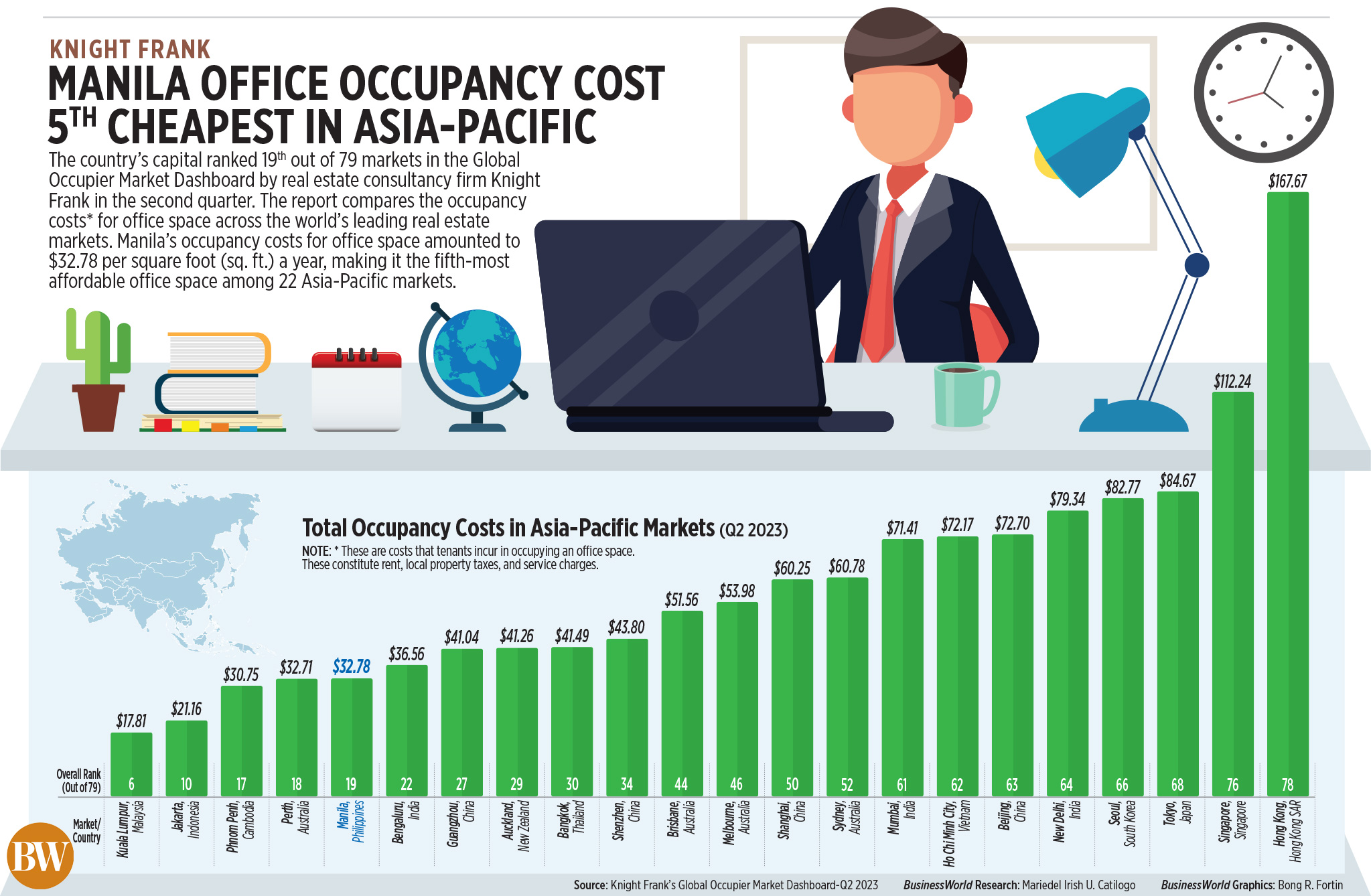
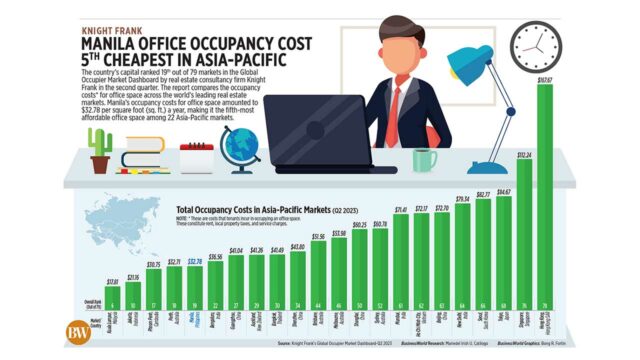
The country’s capital ranked 19th out of 79 markets in the Global Occupier Market Dashboard by real estate consultancy firm Knight Frank in the second quarter. The report compares the occupancy costs* for office space across the world’s leading real estate markets. Manila’s occupancy costs for office space amounted to $32.78 per square foot (sq. ft.) a year, making it the fifth-most affordable office space among 22 Asia-Pacific markets.

Knight Frank: Manila office occupancy cost 5<sup>th</sup> cheapest in Asia-Pacific

Actor Michael Caine says he is retiring aged 90

MICHAEL CAINE and Glenda Jackson star in 2023’s The Great Escaper. —IMDB.COM

LONDON — British actor and two-time Oscar winner Michael Caine has said he will retire from acting, aged 90, following the release of his latest film.

“I keep saying I’m going to retire. Well I am now,” Mr. Caine told BBC radio in an interview broadcast on Saturday.

“I’ve figured I’ve had a picture where I’ve played the lead and had incredible reviews… What am I going to do that will beat this?”

Mr. Caine stars in The Great Escaper opposite Glenda Jackson, who died in June shortly after completing her part in the film. The film is based on the true story of a World War II veteran who escapes from a care home to attend D-Day anniversary celebrations in France.

“The only parts I’m liable to get now are 90-year-old men. Or maybe 85,” Mr. Caine told the BBC. “So, I thought, I might as well leave with all this.”

Mr. Caine won Oscars for the 1986 film Hannah and Her Sisters and The Cider House Rules in 1999, both of them as best supporting actor. He also starred in movies such as Alfie, Get Carter, and Educating Rita. — Reuters

BTr partially awards T-bills as rates go up

STOCK PHOTO | Image by RJ Joquico from Unsplash

THE BUREAU of the Treasury (BTr) partially awarded the Treasury bills (T-bills) it auctioned off on Monday at higher rates as investors expect the Philippine central bank to resume its tightening cycle next month.

The government raised just P11.947 billion via the T-bills it auctioned off on Monday, short of the P15-billion program, even as total bids reached P19.371 billion, above the amount on offer.

Broken down, the Treasury borrowed only P3.637 billion via the 91-day T-bills, below the P5-billion offer, even as tenders for the tenor reached P5.137 billion. The three-month paper was quoted at an average rate of 5.99%, 18.4 basis points (bps) higher than the 5.806% seen last week. Accepted rates ranged from 5.85% to 6.10%

The government raised just P3.31 billion from the 182-day securities, short of the P5-billion program, despite bids for the tenor reaching P6.52 billion. The average rate for the six-month T-bill was at 6.207%, up by 9.2 bps from 6.115% quoted for last week, with accepted rates at 6.125% to 6.25%.

Meanwhile, the BTr made a full P5-billion award of the 364-day debt papers as demand for the tenor reached P7.714 billion. The average rate of the one-year T-bill rose by 8.3 bps to 6.388% from the 6.305% quoted for last week’s partial award. Accepted yields were from 6.325% to 6.438%.

At the secondary market before Monday’s auction, the 91-, 182- and 364-day T-bills were quoted at 5.8711%, 6.1458%, and 6.3085%, respectively, based on PHP Bloomberg Valuation Service (BVAL) Reference Rates data provided by the Treasury.

T-bill rates rose due to weak demand as market players expect the Bangko Sentral ng Pilipinas (BSP) to raise borrowing costs at their Nov. 16 policy meeting, a trader said via phone call.

The government made a partial award of its T-bill offer as it rejected bids that were too high, Rizal Commercial Banking Corp. Chief Economist Michael L. Ricafort said in a Viber message.

“T-bill auction yields are already unusually higher than the comparable short-term PHP BVAL yields as of Oct. 13,” Mr. Ricafort said.

“Auction yields were higher after the latest signals from local monetary authorities on a possible 25-bp policy rate hike that cannot be ruled out in November 2023,” he added.

The central bank is open to raising its policy rate by 25 bps during their meeting next month after inflation picked up for a second month in a row in September, BSP Governor Eli M. Remolona, Jr. said last week.

Mr. Remolona said he “would not rule out” a 25-bp increase at the Monetary Board’s Nov. 16 meeting, adding there is still room for monetary tightening as the economy remains strong.

The Monetary Board has kept the policy rate at a near 16-year high of 6.25% at its last four meetings. It raised borrowing costs by 425 bps from May 2022 to March 2023 to help bring down inflation.

Headline inflation quickened for a second straight month to 6.1% in September from 5.3% in August. This brought the nine-month inflation average to 6.6%, still higher than the BSP’s 5.8% forecast and 2-4% target for the year.

On Tuesday, the BTr will offer P30 billion in reissued seven-year Treasury bonds (T-bonds) with a remaining life of six years and nine months.

The Treasury wants to raise P150 billion from the domestic market this month, or P60 billion via T-bills and P90 billion via T-bonds.

The government borrows from local and foreign sources to help fund its budget deficit, which is capped at 6.1% of gross domestic product this year. — AMCS

Harbor Star says creation of new unit cleared by SEC

LISTED Harbor Star Shipping Services, Inc. said on Monday the Securities and Exchange Commission (SEC) had approved the incorporation of Kaibuok Star Shipyard, Inc. (KSSI).

In a stock exchange disclosure, Harbor Star said the SEC had authorized the creation of KSSI with an authorized capital stock of 55 million common shares at P1 each or P55 million which have been fully subscribed and paid up.

The company has subscribed to 30% of the issued and outstanding capital stock for P16.5 million, it said, adding that the 70% equity or P38 million was subscribed by Malaysian company Kaibuok Shipyard (M) Sdn. Bhd.

KSSI will build, construct, fabricate, repair, own, manage, operate, maintain, buy, sell, and deal with ships, vessels, boats and marine structures of every kind and nature, Harbor Star said.

The company said the unit’s business would include “graving docks, drydocks, floating docks, various land, and other structures and other conveniences for building, repairing, or docking of ships and other vessels for building and repairing marine and other land structures.”

Harbor Star is mainly engaged in harbor assistance, lighterage, towing, ship salvage, marine construction, repair and maintenance works, and other marine services. It has operations in 11 base ports in the country and services about 8,086 ships as of last year.

At the local bourse on Monday, shares in the company fell by 10 centavos or 1.25% to end at P0.79 each. — Ashley Erika O. Jose

Energizing growth: Lessons from UAE, France, and other countries

(Part 2 of a series)

DUBAI, UAE — This is my first time setting foot in the Middle East. I am going to Nice, France for the Tholos Forum 2023. My sponsor booked me at Emirates Air so the route is Manila-Dubai-Nice and back.

From several videos and photos I had seen, Dubai is very bright at night, very developed and rich. I see this at the airport. Our plane landed at 4:30 a.m. and there are bright lights all around. The United Arab Emirates’ (UAE) power generation in 1985 was only 12.2 terawatt-hours (TWH) while Philippines’ was 22.8 TWH. By 2005, the UAE overtook the Philippines with 60.7 TWH while ours was 56.6 TWH. The UAE, along with Saudi Arabia, Qatar, and other Middle East countries, optimized their oil and gas reserves and kept exporting. They did not follow the climate lobby of “keep fossil fuels on the ground” and they are correct, world demand for fossil fuels will never decline.

SENSITIVITY OF GDP GROWTH FROM POWER GENERATION GROWTH
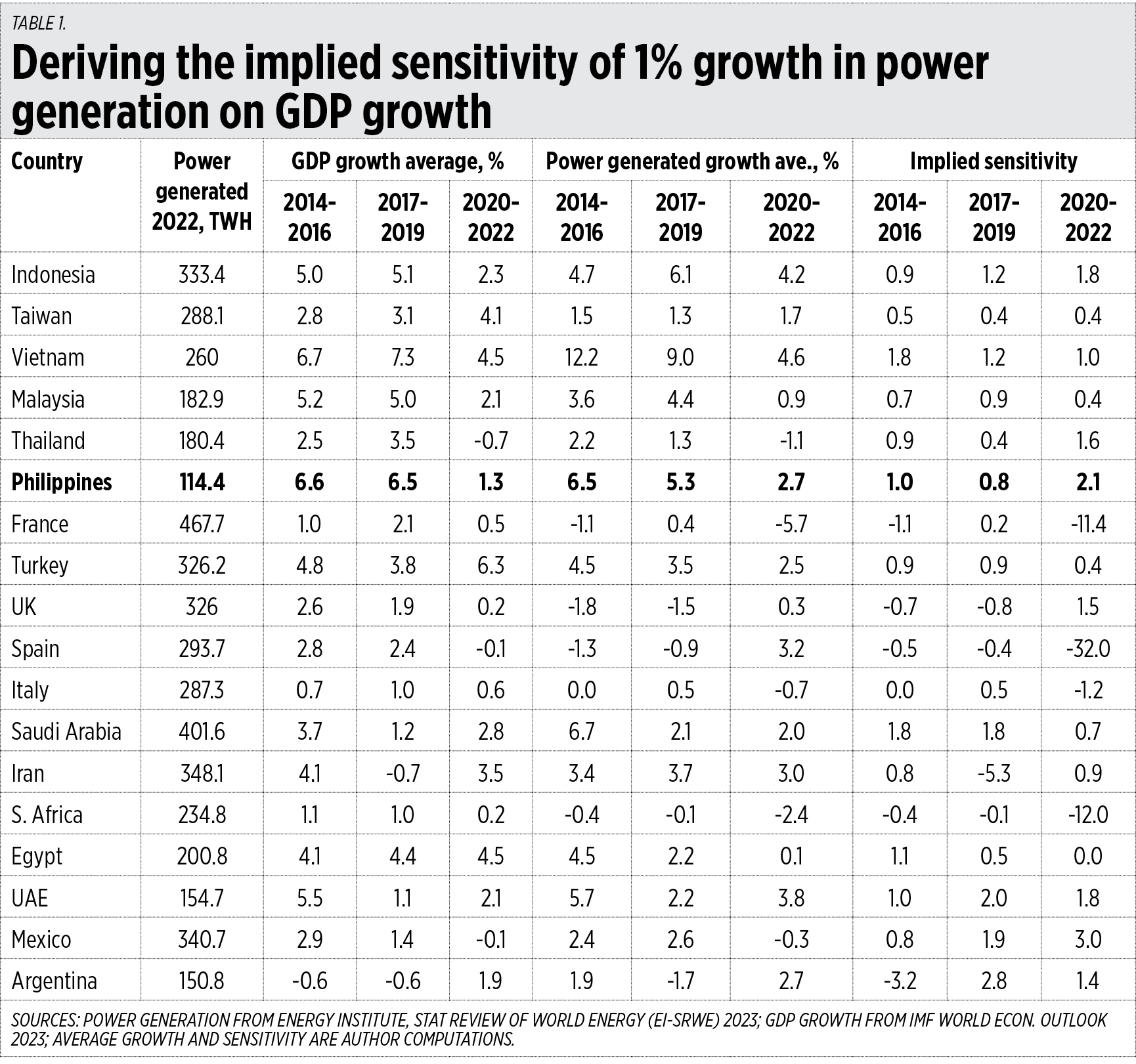
The UAE is also a good example of a country rapidly expanding its power generation which in turn prods more economic activities and higher GDP growth. In Table 1, I attempted to derive a “sensitivity” or responsiveness of 1% growth in power generation and its potential effect in GDP growth. I excluded countries with more than 500 terawatt-hours (TWH) in power generation in 2022 — China, India, South Korea, Japan, the US, Canada, Brazil, Germany — because they seem to be outliers.

For several countries, a 1% increase in power generation contributes to a 1%+ increase in GDP growth. Clear cases are Indonesia, Vietnam, the Philippines, Saudi Arabia, the UAE, Mexico, and Argentina. This does not hold for richer Asians, like Taiwan and Malaysia, and the Europeans as their power generation growth has slowed down in recent years.

There are many factors for a country’s fast or slow growth and power generation is just one of them — but it is a major contributor because most business and human activities require energy, especially from fossil fuels (land, sea, and air transportation; power generation, etc.).

The result shows that for many developing countries, there is a positive correlation between fast growth in power generation and fast GDP growth (see Table 1).

PANDESAL FORUM WITH ERC CHAIR
Last Friday, Oct. 13, I attended a special Pandesal Forum at Kamuning Bakery in Quezon City for columnists and editors. The lone guest was Energy Regulatory Commission (ERC) Chairperson and CEO Monalisa Dimalanta, and the moderator was Wilson Flores.

Ms. Dimalanta gave her usual clear and non-ambiguous explanation of issues related to electricity pricing, power security, grid stability, generation competition, distribution regulation, rural electrification, and related topics. For me the major takeaways from her talk were the following:

1. Power generation and supply are competitive; power transmission is a monopoly and easier to monitor; distribution is a geographical monopoly but there are many distributors (121 electric cooperatives or ECs and about 20 private corporate distribution utilities or DUs) and they make regulation more time consuming and complicated. I suggested that ultimately all ECs should become corporations with lots of mergers, with fewer DUs nationwide. She agreed.

2. The National Grid Corp. of the Philippines (better known as the NGCP) indeed has many delayed or uncompleted projects that until now contribute to yellow or red alerts and even occasional rotating blackouts. Penalizing it might help, but penalties do not really contribute to grid stability — the fines just go to the national treasury and not to the affected consumers. There is a need to address bureaucratic bottlenecks and the Energy Virtual One-Stop Shop law is a big help on this.

FRANCE AMBASSADOR VISITS DBM
My trip to France may not have been possible due to limited time between when the invite was sent to me and the trip itself. Good thing that my friend wrote to the France Ambassador to the Philippines, Her Excellency Marie Fontanel, and her office considered my case positively.

Last Friday, Ambassador Fontanel paid a courtesy visit to Department of Budget and Management (DBM) Secretary Amenah Pangandaman and other DBM officials. Their discussion covered diplomatic, trade and investment relations between the Philippines and France, especially on defense, agriculture, and infrastructure, among others. Good discussion between intelligent officials.

I hope that France will greatly help the Philippines develop our nuclear energy generation.

THOLOS FORUM, PANEL ON CLIMATE
The Tholos Forum 2023 is a three-day conference running from Oct. 16 to 18. On Day 3, a panel, “Climate is the key to global free market innovation and acceleration,” will feature Grover Norquist of the Americans for Tax Reforms (ATR) as one of the speakers. It will be moderated by Rod Richardson of the Grace Richardson Fund. I hope nuclear energy, including small modular reactors (SMR) and micro modular reactors (MMR), will be tackled.

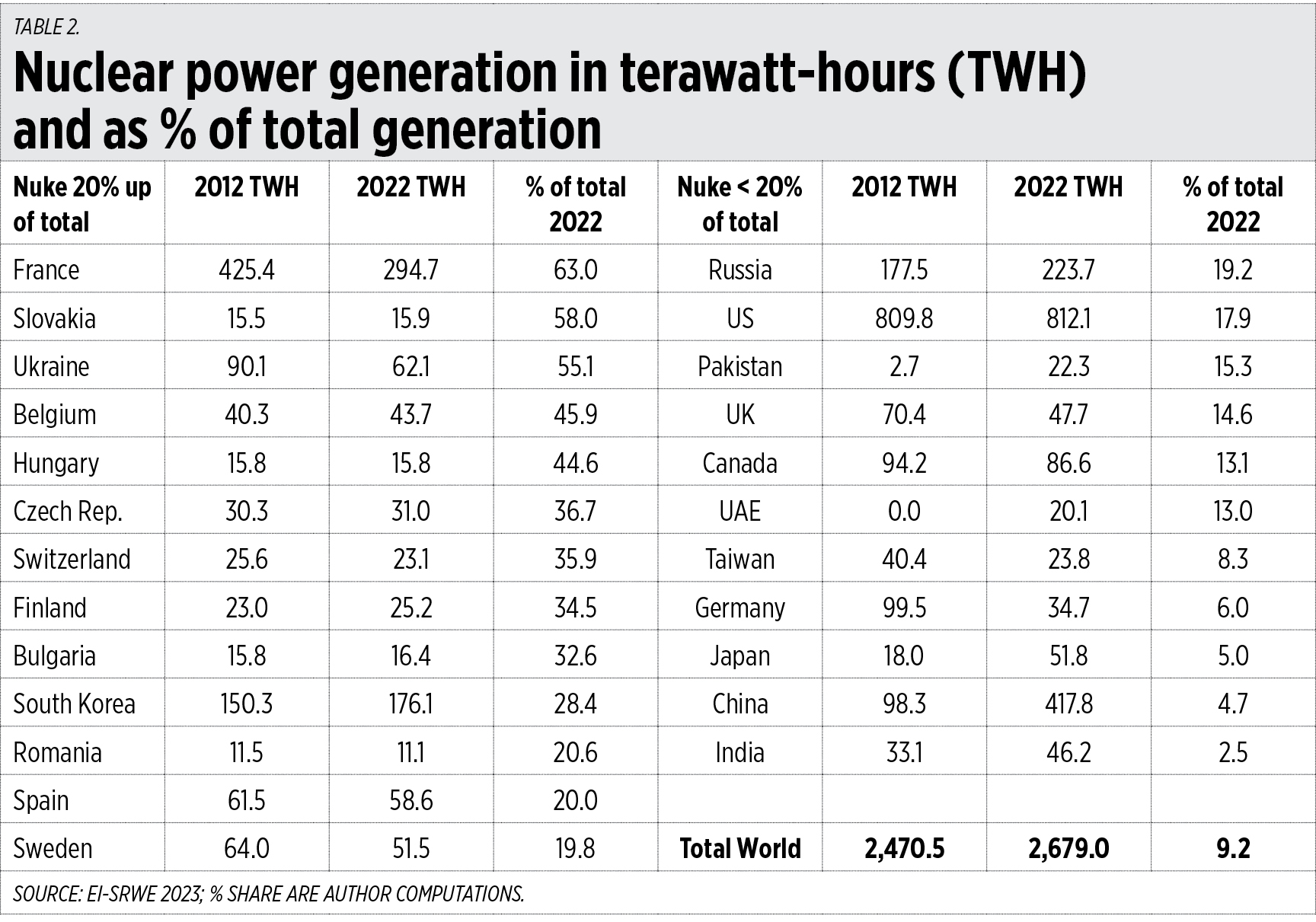
The Philippines need to go into nuclear energy production because previous government policies have killed new “greenfield” coal power plants and allow only “brownfield” coal plants, but space will be limited. Meanwhile, the government and the climate lobby are pushing hard for intermittent and unreliable wind-solar power generation. Table 2 lists countries that the Philippines can use as inspiration for nuclear development, especially France and the UAE.

There is no climate crisis or climate emergency. There is only the natural climate cycle of warming-cooling-warming-cooling in multiple-year, even multiple-century cycles, ever since planet Earth was born some 4.6 billion years ago. What we do have is persistent economic deprivation for many people, and we need more energy production, both from conventional thermal plants and conventional renewables like hydro and geothermal, to help remedy this. Plus nuclear. Consumer freedom and choice should prevail when it comes to what type of energy source they will get based on their needs.


Bienvenido S. Oplas, Jr. is the president of Bienvenido S. Oplas, Jr. Research Consultancy Services, and Minimal Government Thinkers.

minimalgovernment@gmail.com

Interior design students renovate social service hall for children’s home

A TEAM of interior design students have renovated and refurbished the social service hall of Asilo de San Vicente de Paul, a centuries-old nonprofit children’s home in Paco, Manila.

The makeover project of the Interior Design Program students of the De La Salle-College of Saint Benilde (DLS-CSB) is dubbed Kandili, which stands for “to care for and provide support.”

“Social services play an essential role in addressing the challenges faced by individuals and families in difficult circumstances,” the students said in a press release from DLS-CSB. “It aims to protect the vulnerable and marginalized by offering assistance and resources to empower them and be self-sufficient.”

Students used a color scheme of vibrant palettes for the social service hall “to foster calmness, optimism, and productivity.”

The consultation area was converted into cubicles with partitions to give privacy during sessions.

The center was also refurbished with custom and modular furniture pieces to maximize the space. Energy-efficient lighting options were installed, along with strategically placed ceiling fans. Indoor plants were also placed around the center.

Students worked on the project, from research and conceptualization to the actual implementation. To raise funds, they conducted various events such as merchandise sales, movie block screenings, and raffle draws.

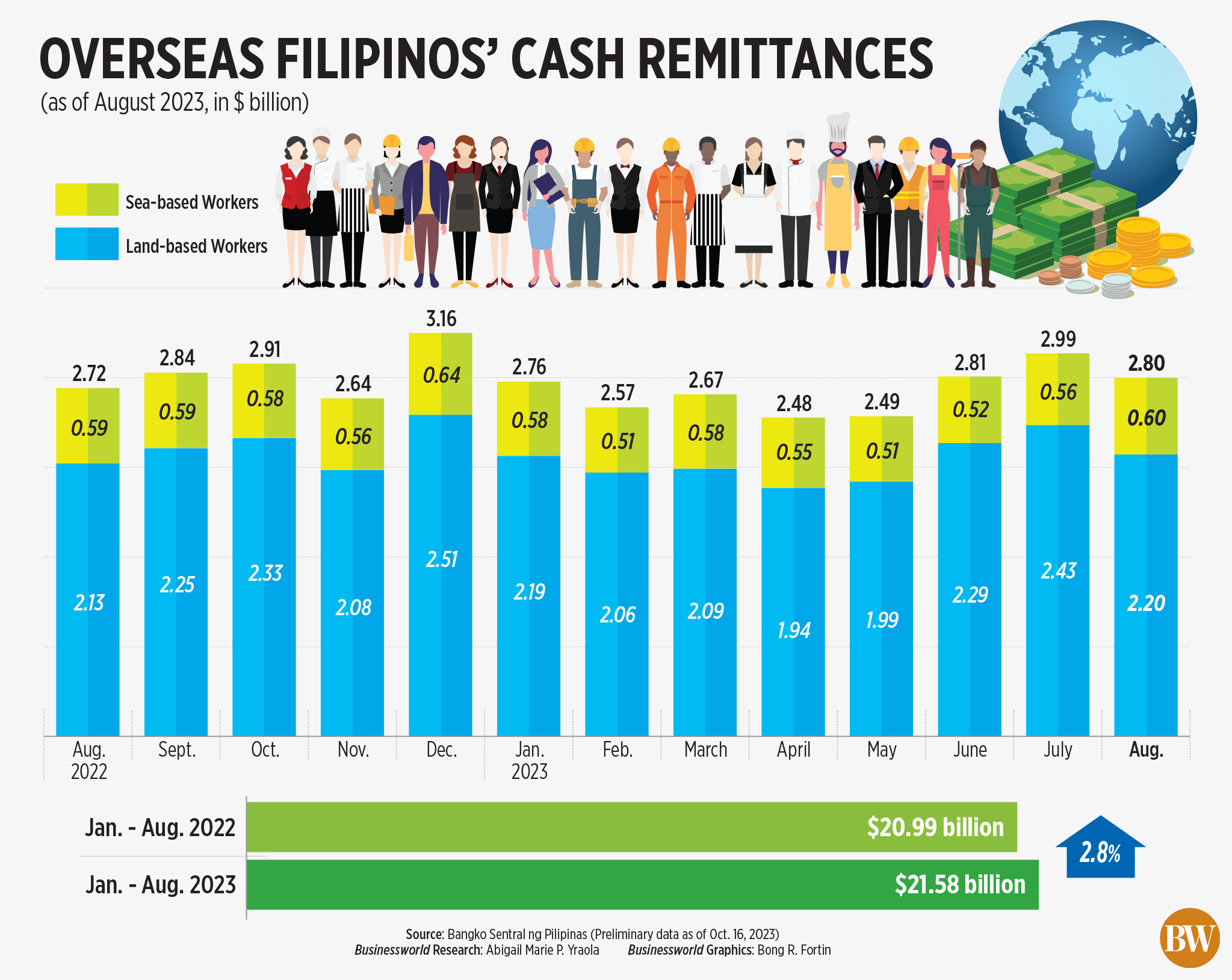
Overseas Filipinos’ Cash Remittances

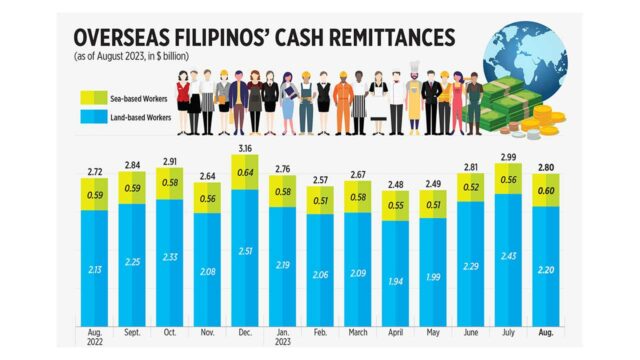
MONEY SENT HOME by overseas Filipino workers (OFWs) increased by 2.7% year on year in August, the fastest pace since May, data from the Bangko Sentral ng Pilipinas (BSP) showed. Read the full story.

Overseas Filipinos’ Cash Remittances

Entertainment News (10/17/23)


The Italian Film Festival returns

THIS year, the Italian Film Festival in Manila delves deeper into Italian culture, life, and art and will run from Oct. 21 to 24 at the Cineplex, Cinema 3 of the Venice Grand Canal Mall in McKinley Hill, Taguig City. It will feature six recent films: Diabolik where love and crime mix in a series of adventures by Antonio and Marco Manetti; Leonora Addio by Paolo Taviani which tells of the adventure of the urn of ashes of Pirandello and its journey from Rome to Agrigento; Il Colibrì (The Hummingbird) by Francesca Archibugi which follows a man from the 1970s to the near future and the myriad relationships on his path; Il Ritorno Di Casanova by Gabriele Salvatores follows the famous Venetian libertine as he has trouble facing the fact that he’s over 60; Settembre by Giulia Steigerwalt is set on a September day when three people realize that the life they find themselves in is not the one they had dreamed of; Diabolik Ginko All’attacco by Antonio Manetti and Marco Manetti continues the story of Diabolik as the film follows his escape from Inspector Ginko’s latest trap. One film will be screened on opening night on Oct. 21; on Oct. 22 and 23, two films will be featured at 6:30 and 8:30p.m.; and the last film will be shown on Oct. 24 to close the Italian Film Festival. All screenings will be available to the public (on a first-come, first-served basis) and are free of charge. The Italian Film Festival is organized by the Philippine-Italian Association under the auspices of the Embassy of Italy in the Philippines.


Music gaming app features ABS-CBN artists

NEWLY launched rhythm gaming app SuperStar Philippines is bringing the music of many ABS-CBN artists to Filipinos’ phones through an upbeat mobile game. The likes of Daniel Padilla, Janella Salvador, Belle Mariano, Maymay Entrata, Jayda, Angela Ken, BINI, BGYO, and Nameless Kids are now part of the app, which comes from US-based company Dalcomsoft in partnership with ABS-CBN Music. The rhythm game itself allows players to tap along to songs such as like Daniel Padilla’s “Simpleng Tulad Mo,” Ms. Mariano’s “Sigurado,” Ms. Entrata’s “Amakabogera,” BGYO’s “Tumitigil ang Mundo,” and BINI’s “Lagi.” They are now part of the SuperStar Series that features over 450 artists in its roster and is known for its success in South Korea, Japan, and the United States with over 75 million downloads worldwide. SuperStar Philippines is free to download on the App Store and Google Play.


Aegis to stage a Christmas concert

THE AEGIS, known for its powerhouse tunes, will have its first ever holiday concert, AEGIS: The Christmas Bonus Concert. The show will take place at The Theatre at Solaire in Parañaque City on Dec. 20. It aims to capture the spirit of the holiday season as the OPM (original Pilipino music) stars serenade their fans with Christmas-themed songs as well as their familiar hits, backed by an orchestra and rendered with intricate arrangements that elevate the experience of listening to Aegis live. Tickets are now available at all TicketWorld outlets nationwide and their official website.


Alden Richards, Julia Montes team up in romantic movie    

THE FIRST-TIME big-screen tandem of Alden Richards and Julia Montes is Five Breakups and A Romance, directed by Irene Villamor (known for her work in Meet Me in St. Gallen, Sid and Aya, and Camp Sawi). The very first collaboration between GMA Pictures, Cornerstone Studios, MYRIAD Corp., and Axinite Digicinema, the film also marks the first time the two leads are paired together for the big screen. Five Breakups and A Romance is a modern love story between the carefree Lance (Richards) and the career-driven Justine (Montes), who must find the ideal midpoint between love and career. The movie opens on Oct. 18 in cinemas nationwide.


Film tackles online shopping scam

SHOPPING for second-hand items online becomes a terrifying and life-threatening situation in the upcoming Korean action thriller Target, starring K-Drama’s Shin Hae-Sun, along with Kang Tae-Oh and Kim Sung-Kyun. Soo-hyun’s (Hae-Sun) life falls apart when she is targeted by a killer after buying a used washing machine online. Bent on saving costs due to skyrocketing prices of goods, Soo-hyun falls for a deal when a seller posted a second-hand washing machine online at a very cheap, irresistible price only to find out that she’s been scammed since the item is not working. She tracks the seller and warns everyone online about being scammed but soon finds out that this is no ordinary scammer. The film, directed by Park Hee-kon, opens on Oct. 18 in local cinemas.

Security Bank opens two new branches in Cagayan, Parañaque

BW FILE PHOTO

SECURITY BANK Corp. opened two new branches in Cagayan and Parañaque City last month to expand its presence nationwide.

The bank’s branch in Aparri, Northern Cagayan was opened on Sept. 14, while the one in Pargal, Parañaque City was inaugurated on Sept. 18, Security Bank said in a statement on Monday.

These brought Security Bank’s nationwide branch total to 319.

“These branch openings are proof of our commitment to invest in what matters to our customers. Our focus on customer-centricity set us apart for 72 years and counting,” Security Bank Executive Vice-President and Branch Banking Group Head Leslie Y. Cham was quoted as saying.

The two branches are located in commercial hubs, Security Bank said. The Aparri branch is within Novo Mall, while the Parañaque office is located in Aseana City.

“We choose locations where we do not yet have a market presence but see potential to serve new customers and to increase our market share,” Security Bank said in a message when asked for more details.

“We are making forward-thinking investments in digital transformation, employee experience, and branch banking expansion to boost our BetterBanking promise and deliver meaningful impact to stakeholders,” it added.

The two new branches have automated teller and cash deposit machines, spaces for their preferred clients, and self-service counters.

“They also feature the upgraded Mosaic Voyager tellering and lobby management system to speed up key transactions such as signature verification, as well as manage branch lobby traffic efficiently,” the bank added. — M.J.B. Poliarco

Philippine Seven’s Paterno leads global convenience stores group

BW FILE PHOTO

LISTED retailer Philippine Seven Corp. announced that its top official has been elected as the chair of the National Association of Convenience Stores (NACS) in the United States.

In a statement on Monday, the company said Jose Victor P. Paterno, its president and chief executive officer, is now chairman of the NACS, which is based in Alexandria, Virginia and represents 350,000 stores globally.

The NACS is a global trade association seeking to advance convenience and fuel retailing. It is led by a 30-member board of directors, which includes 7-Eleven US. 

The election took place during the NACS board meeting on Oct. 3 on the sidelines of the annual NACS trade show in Atlanta, Georgia.

The company said Mr. Paterno is the second non-US retailer to assume the post as well as the first one from Asia.

His advocacies for NACS include building an industry-wide technology platform that would allow retailers big and small to participate in growing digital ad spending from fast-moving consumer goods manufacturers. 

Mr. Paterno said he is “deeply honored and humbled” to take on the role, calling it a “tremendous privilege” to represent the company and the broader convenience store industry.

“I take pride in what we’ve been able to accomplish in the Philippines with technology and market share, and am excited to take things to the next level in collaboration with some of the best retail and tech minds I’ve met at NACS and its partners,” he said. 

Philippine Seven currently oversees 3,600 7-Eleven stores operating across the country, of which 54% are operating under franchise agreements.

On Monday, its shares at the local bourse fell P1 or 1.25% to close at P79 apiece. — Revin Mikhael D. Ochave

ADVERTISEMENT
ADVERTISEMENT