Home Blog Page 4174

The climate crisis is a health crisis, especially in Asia-Pacific

MARKUS SPISKE-UNSPLASH

CLIMATE CHANGE has disastrous health impacts.

As a medical humanitarian organization, Doctors Without Borders/Médecins Sans Frontières (MSF) is already seeing these impacts on the people we treat in over 70 countries around the world.

This year, powerful Cyclone Mocha hit Myanmar and Bangladesh and destroyed not only communities, but refugee camps. In years past, we have seen strong typhoons such as Haiyan in 2013, which laid waste to central Philippines and caused widespread flooding in Indonesia which have submerged homes and destroyed properties.

But it is not just cyclones and super typhoons. July 2023 was recorded as the planet’s hottest month in 174 years, resulting in Canadian wildfires, major heatwaves in France, Spain, Germany, Poland, and Italy, and marine heatwaves along coastlines from Florida to Australia.

In short, these weather events are happening all over the globe with greater frequency and impact.

While these are the most obvious, climate change has other impacts on health, particularly on disease. Doctors Without Borders is responding to high levels of vector-borne, food-borne, and water-borne diseases in our projects which is worrying, as this is projected to increase as the climate crisis accelerates. It is predicted that there will be 15 million more cases of malaria yearly, with 30,000 deaths linked to that, in addition to what we are already seeing now. One billion more people are expected to be exposed to dengue, not only in the Asia-Pacific, where it is much more prevalent, but across the world. European Union officials recently warned that there is a growing risk of mosquito-borne viral diseases such as dengue and chikungunya in Europe due to climate change. We have seen cholera outbreaks in at least 30 countries. While this is due to multiple factors, climate change is most definitely one of them.

Climate change is also linked to food insecurity and malnutrition. With extreme weather events such as heat waves and increased rainfall come droughts and floods that impact farming and fishing communities, affecting everything from the yield of crops grown, to the animals that till the soil, to the number of fish caught in nets.

It does not end there. Other impacts of climate change include the spread of non-communicable diseases; forced displacement and migration; and the emergence of conflicts, among others.

And all of these are expected to intensify over time — unless we take urgent action.

Humanitarian organizations like Doctors Without Borders are already seeing these impacts and treating patients in the most vulnerable communities. But we can only do so much. We are seeing huge needs everywhere we go, from the Asia-Pacific region to the Middle East, and the African nations. Countries with limited resources are enduring the worst of the devastation brought by the climate crisis. Our Rohingya patients in Cox’s Bazar, Bangladesh — who have endured decades of persecution and are already burdened by being contained in the world’s largest refugee camps — are repeatedly threatened by floodings and cyclones that come their way. Our patients in the island nation of Kiribati face climate and environmental changes that threaten their livelihoods and exacerbate their disease risks.

We have been sounding the alarm. We see these huge needs brought about by the climate crisis, and we fear that these needs are outstripping our capacity to respond.

We need the countries most responsible for this global warming of 1.2 degrees above pre-industrial levels to help those who are most affected, to take responsibility, and to provide financial and technical support to those most vulnerable. Governments of the most affected countries, including in the Asia-Pacific region, must not only compel the top polluters to help them mitigate and manage the impacts of climate change, but also put in place policies and affirmative climate actions in addressing and reversing the impact of these issues.

Already we are seeing commitments from world leaders. At their recent meeting, G20 nations have committed to a greener and more climate-resilient health system. The Association of Southeast Asian Nations (ASEAN) — which has five of the world’s 20 most at-risk countries located in the region — has announced an ambitious strategy to work towards carbon neutrality. The COP28 agenda in November has an increased focus on health, relief and disaster response.

This is an important and critically urgent moment. These commitments are ambitious, but member states of these regional blocs must see them through and take real action. Today, we are dangerously off track and urgent action needs to be taken now.

The climate crisis requires a whole-of-society approach. People and organizations must also understand that our own behaviors are a part of the problem. We need to respond together, in solidarity with all, for the health of all.


Born in the Philippines, educated in the US and the UK, Dr. Maria Guevara is the current International Medical Secretary for Doctors Without Borders/Médecins Sans Frontières. She is also a SAFE STEPS First Aid Ambassador for a collaborative pan-Asia program to promote awareness and increase knowledge of first aid skills across the region. Her special interests are Global Health, Response in Emergencies and Planetary Health.

Ortigas Land gives preview of Maple at Verdánt Towers units

ORTIGAS LAND unveiled the completed mock-up units of Maple at Verdánt Towers, giving some clients an exclusive tour last month.

Maple at Verdánt Towers is Ortigas Land’s first residential tower within Ortigas East.

Set for completion by the fourth quarter of 2024, the 42-storey tower will have 692 units. Maple offers studio, one-bedroom, and two-bedroom units, with the option of bi-level units with private gardens or a townhouse unit.

During the one-day tour, clients were able to view Maple’s ninth floor, and actual corner one-bedroom, inner one-bedroom, and studio units.

Maple’s amenities include an outdoor pool, fitness facilities, a lounge, and play areas, green open spaces, and bicycle-friendly roads.

Interested clients may drop by the Maple at Verdánt Towers model units at the Ortigas East Showroom located in the ground floor of Tiendesitas, Pasig City. The Ortigas East Showroom is open for viewing from 10 a.m. to 9 p.m. every Monday to Thursday, and 10 a.m. to 10 p.m. every Friday to Sunday.

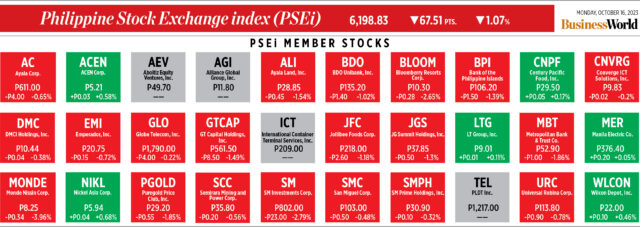
How PSEi member stocks performed — October 16, 2023

Here’s a quick glance at how PSEi stocks fared on Monday, October 16, 2023.


PSEi falls to 6,100 level amid war in Middle East

REUTERS

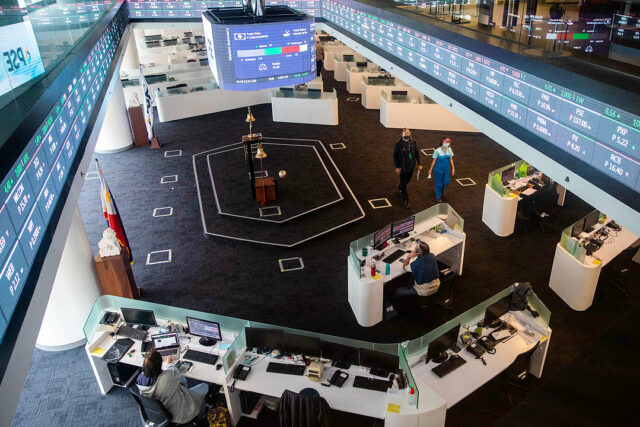
THE MAIN INDEX fell to the 6,100 level on Monday as investors stayed cautious amid the conflict in the Middle East that has affected global oil prices.

The Philippine Stock Exchange index (PSEi) slumped by 67.51 points or 1.07% to close at 6,198.83 on Monday, while the broader all shares index fell by 24.67 points or 0.72% to end at 3,359.90.

“Investors continued to stay on the sidelines as cautious sentiments prevailed today. This apprehension stemmed from the escalating Israel-Hamas conflict, with many market participants expressing concerns about its potential to spread to other Arab nations in turmoil,” AB Capital Securities, Inc. Vice-President Jovis L. Vistan said in a Viber message on Monday.

“The ongoing geopolitical unease exerted upward pressure on oil prices over the weekend, with both benchmark crude oil prices surging by nearly 6% on Friday. This substantial one-day increase marked their most significant percentage gains since April,” Mr. Vistan added.

Shares declined as investors continued to monitor developments in the Middle East, Regina Capital Development Corp. Head of Sales Luis A. Limlingan likewise said in a Viber message.

Crude oil hovered above $90 a barrel while equities were weak and the safe-haven dollar was firm on Monday as investors nervously watched whether escalating violence in Gaza would cause the conflict to spread beyond Israel and Hamas, Reuters reported.

Brent crude futures reached a new recent high of $91.20 on Monday before easing back slightly to $90.84, following Friday’s 5.7% surge.

The Philippines’ Department of Foreign Affairs placed Gaza under crisis warning Alert Level 4 over the weekend, making evacuation mandatory for all Filipinos in the area.

Almost all sectoral indices dropped on Monday. Holding firms declined by 91.12 points or 1.53% to 5,854.26; financials went down by 21.94 points or 1.21% to 1,789.08; industrials decreased by 78.48 points or 0.88% to 8,765.80; property dropped by 12.90 points or 0.48% to 2,625.25; and services lost 7.31 points or 0.47% to end at 1,524.02.

Meanwhile, mining and oil climbed by 31.93 points or 0.29% to 11,037.40.

Value turnover went down to P3.76 billion on Monday with 815.38 million shares changing hands from the P5.32 billion with 1.09 billion issues recorded on Friday.

Decliners outnumbered advancers, 116 versus 64, while 35 shares closed unchanged.

Net foreign selling stood at P369.15 million on Monday versus the P81.53 million in net buying seen on Friday.

For this week, Mr. Vistan placed the PSEi’s support at 6,160 and resistance at 6,350, while Mercantile Securities Corp. Head Trader Jeff Radley C. See put support between 6,087 and 6,157. — S.J. Talavera with Reuters

Peso inches higher vs dollar as oil prices ease after Friday’s surge

BW FILE PHOTO

THE PESO appreciated slightly against the dollar on Monday as oil prices eased slightly following Friday’s surge amid the ongoing war in the Middle East.

The local currency closed at P56.78 versus the dollar on Monday, strengthening by 3.1 centavos from Friday’s P56.811 finish, data from the Bankers Association of the Philippines’ website showed.

The local unit opened Monday’s session at P56.82 per dollar. Its intraday best was at its close of P56.78, while its weakest showing was at P56.88 against the greenback.

Dollars traded went down to $859.5 million on Monday from the $922.12 million on Friday.

“The peso appreciated in line with the decline in global oil prices amid concerns on global economic activity stemming from the ongoing Israel-Hamas conflict,” a trader said in an e-mail.

European stock indexes fell on Monday but oil prices pulled back on recent gains, as cautious markets watched for signs of escalation which could determine the financial fallout from the Israel-Hamas war, Reuters reported.

Oil prices rose last week as investors priced in the chance of escalation in the world’s top oil-producing region, while US Treasuries and gold prices rose as traders bought safe-haven assets.

Traders are waiting to see if the conflict draws in other countries, which would drive up oil prices further and deal a fresh blow to the global economy. They are keeping a particular eye on Iran, which said on Sunday that its armed forces would not engage militarily with Israel so long as Israel does not attack it, its interests or its citizens.

Oil prices eased after surging last week. Brent futures were last down 59 cents or 0.65% at $90.30 per barrel. US West Texas Intermediate crude fell by 0.7% or 59 cents to $87.06 a barrel.

The US dollar index slipped slightly, down 0.1% on the day at 106.47.

Top US officials warned on Sunday that the war could escalate into a wider conflict across the Middle East. US Secretary of State Antony Blinken arrived in Israel on Thursday and has also been to Qatar, Jordan, Bahrain, United Arab Emirates, Saudi Arabia and Egypt in a bid to limit the spread of the conflict.

For Tuesday, the trader said the peso could continue to rise against the dollar ahead of a likely softer US retail sales report.

The trader sees the peso moving between P56.65 and P56.85 per dollar on Tuesday. — with Reuters

Maharlika, OFW protections seen topping President’s Saudi agenda

REUTERS/AHMED YOSRI

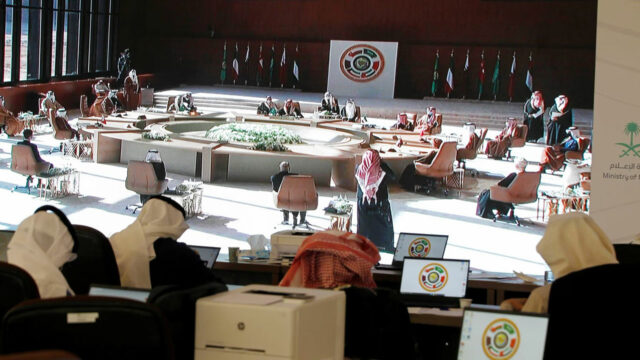
PRESIDENT Ferdinand R. Marcos, Jr. is expected to promote the newly established sovereign wealth fund and discuss protections for overseas Filipino workers (OFWS) during his visit to Saudi Arabia for the inaugural summit between Southeast Asian and Gulf leaders.

Mr. Marcos, who will fly to Riyadh on Oct. 19, is expected to hold a bilateral meeting with the Saudi government and businesses, Foreign Affairs Assistant Secretary Daniel R. Espiritu said at a Palace briefing on Monday.

“Of course, part of the discussion could be the presentation of the Maharlika Fund to the Kingdom of Saudi Arabia and its businesses, the protection of our nationals abroad especially in terms of labor reforms being proposed for the Kingdom of Saudi Arabia, and Arab assistance to develop the Bangsamoro Autonomous Region,” he said.

The investment fund has been provided seed capital by state-owned banks and the central bank.

Mr. Espiritu said Mr. Marcos is also expected to hold a bilateral meeting with Bahrain to discuss the 40th year of the two countries’ diplomatic relationship.

The Association of Southeast Asian Nations (ASEAN) and the Gulf Cooperation Council (GCC) will hold their first-ever summit on Oct. 20, over a decade after the first ministerial meetings between the two organizations in Bahrain in 2009.

“It’s very important because the GCC is composed of highly developed Arab economies, and at the same time, they are petrochemical powerhouses, as well as hub and logistics economies,” Mr. Espiritu said. “Now, they can help ASEAN in addressing energy and food security.”

He noted that Qatar is one of the world’s largest producers of fertilizer. “They can fill up the slack or the deficit on the ASEAN side.”

Mr. Espiritu said the Gulf countries could also help ASEAN nations with supply chain issues “since most of these hub economies are advanced in terms of operations of supply chains and ports and shipping and connectivity.”

He said dealings with Gulf countries could “indirectly” stabilize fuel prices “because the basic root of the high energy prices are shortages and instability in the region.”

“If the two regional organizations can cooperate on that… we can assure ASEAN of continued and consistent volume of supply throughout the year,” he added. 

The meeting with the Gulf countries coincides with the Gaza war between Israel and Hamas, the Palestinian group in control of the Gaza strip, which has made the region a flashpoint once more after an apparent warming of relations between Israel and moderate Gulf governments.

Mr. Marcos has condemned the Hamas attacks on southern Israel, defending Israel’s right to self-defense.

Mr. Espiritu said, “current developments in the Middle East” are expected to be raised in the ASEAN-GCC Summit, but “these countries are not exactly directly involved in the conflict, so probably the discussion will dwell on generalities.”

Mr. Marcos’ visit to Saudi Arabia will be his ninth foreign trip this year, and the 15th since he assumed office in June 2022.

He has visited China, Switzerland, Japan, the US, the UK, Indonesia, Malaysia, and Singapore this year.

He is set to fly to the US again in November for the Asia-Pacific Economic Cooperation Economic Leaders’ Meeting, and to the United Arab Emirates in December for the United Nations Climate Change Conference.

Mr. Marcos spent over P392.3 million last year on his foreign trips. His office is seeking P1.408 billion to fund foreign travel next year. — Kyle Aristophere T. Atienza

‘Smart and green’ infra being readied to serve offshore wind industry

STOCK PHOTO | Image by Insung Yoon from Unsplash

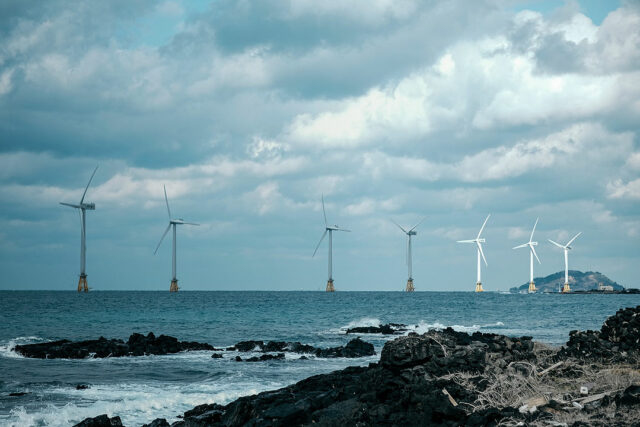
THE Department of Energy (DoE) said the nascent offshore wind industry will be served by “smart and green” infrastructure to link the wind turbines to the power grid.

Energy Assistant Secretary Mylene C. Capongcol said in a Viber message on Monday that the department is developing the system “that will define the grid interconnection support” for offshore wind (OSW) projects in aid of the renewable energy (RE) transition.

She made the remarks in response to Senator Sherwin T. Gatchalian’s call for the government to hasten the development of transmission facilities for OSW projects.

“The country would be better positioned to attract RE investment if transmission facilities are readily available for these RE facilities, particularly for OSW farms,” Mr. Gatchalian said in a statement on Sunday.

To date, the DoE has awarded 79 OSW service contracts this year with a potential capacity of 61.931 gigawatts. All are currently under development.

The DoE has said it is studying upgrades to ports that will serve offshore wind projects, with technical assistance from the Asian Development Bank (ADB).

Nine such ports have been identified, including Currimao, Ilocos Norte; Iloilo City; Bacolod City; Batangas City, Port Irene, Sta. Ana, Cagayan, as well as sites in Camarines Sur and Mindoro.

“These are areas with the highest wind potential and also the areas where there is a clustering of the offshore wind energy service contracts,” Energy Undersecretary Giovanni Carlo J. Bacordo told BusinessWorld.

Mr. Bacordo said the feasibility study on such works will be completed by April or May.

“(With the) feasibility study, I’m expecting that ADB will identify what ports are ideal for marshaling, manufacturing, operations and maintenance,” he said. “I expect also that this will also include the budget that is needed for an identified port to be repurposed.”

Marshaling ports serve as staging grounds to assemble wind turbines, which Mr. Bacardo said will require the most investment.

Philippine National Oil Co. (PNOC) President Oliver B. Butalid has said the company plans to redevelop its 19.2-hectare property in Mabini, Batangas into an integration port to serve OSW projects.

“PNOC manifested its intention to repurpose its existing port for offshore wind, so we look at this move by the PNOC president as a catalyst… (to) sending a strong signal to the private sector that the government is serious in its offshore wind efforts,” Mr. Bacordo said.

“There’s going to be a heavy capital requirement for the repurposing of existing ports. The (private sector) has to be convinced that there will be returns on their investment and that the government will serve as a partner,” he said.

Mr. Bacordo said that the port in Currimao will need about P4.8 billion to be repurposed into an OSW port meeting international standards.

“We’re hoping for the private sector to come in for a PPP (public-private partnership) project on these identified ports so that the other ports may also be developed as marshaling ports,” he said.

Asked whether there will be construction of new ports, he said: “As per advice from the experts, it is cheaper and faster to repurpose existing ports rather than to build a port from scratch.”

Mr. Bacordo said that the DoE is closely collaborating with the Department of Transportation and the Philippine Ports Authority on the project.

“I am expecting that by the period 2028 to 2030, we’ll be seeing a lot of public works projects — we’re expecting a lot of activities related to offshore wind like already the deployment of offshore wind turbines in the areas of the highest wind potential,” Mr. Bacordo said. — Sheldeen Joy Talavera

Multiple ASF, avian influenza vaccines undergoing testing

REUTERS

THE Department of Agriculture (DA) said on Monday that it has received applications from various companies seeking to introduce African Swine Fever (ASF) and Avian Influenza (AI) vaccines onto the Philippine market.

Agriculture Undersecretary Deogracias Victor B. Savellano told reporters that the vaccines are still undergoing trials.

“(They are still under) testing; once approved and we are okay with all the protocols, then we will recommend the vaccines for purchase,” Mr. Savellano added.

He said that the DA has received five bird flu vaccines for evaluation.

He added that the DA aims to seek approval for testing and use of AI vaccines from the President, who is also the Secretary of Agriculture.

“AI vaccines have been around for a long time now but there is no approved protocol for its testing, approval, and use,” Mr. Savellano said.

He added that four suppliers have expressed interest in bringing ASF vaccines to the Philippines, with two currently being tested.

“They are in various stages of trials at our Veterinary Laboratory Division of the Bureau of Animal Industry,” he said.

He added that until the approval of vaccines, the DA is prescribing heightened biosecurity measures to slow the spread of AI and ASF.

“For both the AI and ASF vaccines, we want to do it fast, but we want to do it safely also. This is a balancing act, but we are streamlining the process to expedite trials, approvals and eventual use,” he added.

The DA has said that it is aiming to increase livestock production by five times by 2028.

Separately, Pork Producers Federation of the Philippines Chairman Nicanor M. Briones said in a statement that vaccine testing has only been conducted on starter hogs and not sows and breeders, which are “the ones that produce pigs.”

Mr. Briones added that it would take billions more for the hog industry to recover from the effects of the ASF virus.

The House of Representatives said earlier that it would re-allocate about P1.5 billion towards ASF vaccines. — Adrian H. Halili

Awards body names PHL top cruise ship destination in Asia

NCL.COM

THE PHILIPPINES was named Asia’s Best Cruise Destination 2023 by the World Cruise Awards, the Department of Tourism (DoT) said on Monday.

In a statement, the department said: “This… is a big win for Philippine tourism as it reflects a resounding global preference for our island destinations,” Tourism Secretary Christina G. Frasco said.

The Philippines was named the winner on Sunday in Dubai. Other candidates were India, Japan, Singapore, South Korea, Sri Lanka, Taiwan, Thailand, and Vietnam.

The Philippines is projected to receive 128 port calls this year across 33 destinations, which are expected to bring in more than 101,000 passengers and 50,000 crew.

The cruise ships calling at Philippine ports are the Seabourn Cruise Line’s Seabourn Encore; Silver Cruises’ Silver Shadow and Silver Whisper; MSC Cruises’ MSC Poesia; The Cunard Line’s Queen Elizabeth; Norwegian Cruise Line’s Norwegian Jewel; Coral Expeditions Australia’s Coral Adventurer, Regent Seven Seas Cruises’ MS Seven Seas Explorer, Windstar Cruises’ MS Star Breeze;  AIDA Cruises’ AIDAbella, and various vessels from Blue Dream Cruise and Oceania Cruises.

“Our archipelago of 7,641 islands offers a wide array of cruise experiences, from exploring picturesque coastlines and coral reefs to immersing in local culture and traditions,” Ms. Frasco said.

She added that the department will continue to promote lesser-known destinations to expand the cruise tourism portfolio.

“We are grateful that the country’s potential to offer exceptional cruise experiences is now acknowledged on a global scale,” she said. — Justine Irish D. Tabile

NGCP asked to submit ECCs, contracts ahead of review

BW FILE PHOTO

THE Energy Regulatory Commission (ERC) has asked the National Grid Corp. of the Philippines (NGCP) to submit environmental clearances and project contracts to support the grid operator’s application for the fifth regulatory period.

“The Commission has conducted an initial review of the instant Application and has identified additional documents that are required in the Commission’s evaluation of the subject Application and complete review process,” the ERC said in an order dated Oct. 13.

The fifth regulatory period covers 2023-2027. The last transmission reset completed by the ERC was for the five-year regulatory period covering 2010 to 2015.

The ERC said the required documents should cover 2016 up to “the latest available data unless a different period is provided in the matrix.”

This includes environmental compliance certificate (ECC) for all projects where an ECC is required; pre-manufacturing and pre-importation requirements; and performance evaluations for personnel safety.

The ERC is also requiring copies of contracts for projects entered into between 2016 and 2023; a list of upcoming projects; value-added tax returns for 2018 to 2022; and details of all NGCP projects such as engineering design and approved budget estimates, among others.

The NGCP has 10 days from receipt of the order to submit the documents via electronic filing and within five days from the date of acknowledgment to submit pleadings through personal service, registered e-mail, or ordinary mail.

The NGCP filed an application dated March 29 seeking approval from the ERC of its maximum annual revenue for the 5th regulatory period in accordance with the promulgated Resolution No. 08, series of 2022, or the Amended Rules for Setting Transmission Wheeling Rates.

According to the ERC, failure to comply with the order is subject to administrative sanctions in the form of fines and penalties authorized by the Electric Power Industry Reform Act of 2001.

Asked to comment, NGCP Spokesperson Cynthia P. Alabanza said in a Viber message that the company is currently studying the order and preparing to comply.

“We received the Order on Oct. 13, Friday, after hours at 9:55 p.m. Unfortunately, while the Order gave us 10 days to comply, our receipt of the Order on Friday after the end of office hours means that 2 compliance days have already lapsed,” she said.

ERC Chairperson and Chief Executive Officer Monalisa C. Dimalanta said last week that the commission is targeting to complete its review of the 4th regulatory period within the year and the 5th regulatory period by the second quarter next year.

“It has been full of challenges every step of the way. But we are determined to complete this by year end, so we can proceed to the 5th RP evaluation,” Ms. Dimalanta said. — Sheldeen Joy Talavera

PRA values Manila Bay reclamation property investments at nearly P23 trillion

PHILIPPINE STAR/EDD GUMBAN

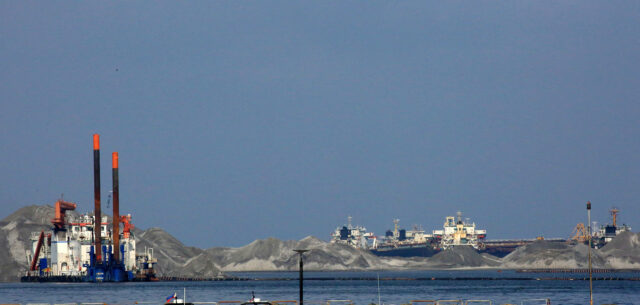
RECLAMATION projects around Manila Bay will attract investments in vertical property development worth P23 trillion, with an additional P1.95 trillion expected in low-rise “horizontal” development, the Philippine Reclamation Authority (PRA) told a Congressional panel on Monday.

In addition, reclamation costs have been estimated at P650 billion.

“The 14 approved projects from Navotas to Cavite province have a total area of 5,503 hectares (ha) which is 2.8% of Manila Bay,” PRA assistant general manager Joseph John Literal told the House ways and means committee.

The reclamation development phase will generate fees for the PRA worth P25 billion, extraction fees worth P30 billion. The valuation of the raw land assets was estimated at P734.71 billion, Mr. Literal said.

Horizontal development from Manila Bay reclamation projects would generate fees of P19 billion, with real property taxes estimated at P4.8 million per hectare. The saleable land asserts are valued at P2.20 billion.

“Reclamation projects offer immense economic opportunities, and hence, offer opportunities to expand fiscal space,” House ways and means panel chairman and Albay Rep. Jose Ma. Clemente S. Salceda said.

Eight reclamation projects are currently awaiting approval, Mr. Literal said.

President Ferdinand R. Marcos, Jr. in August suspended all reclamation projects around Manila Bay.

“A suspension is not tantamount to the abandonment of the projects and may be an opportunity for us to rethink the costs and benefits of reclamation projects,” Mr. Salceda said.

Mr. Literal cited Jurong in Singapore as an example of how reclamation can become “a platform for economic growth,” making Singapore the eighth largest exporter of chemicals by 2019.

He also cited the SM Mall of Asia complex, and the Cultural Center of the Philippines-Financial Center Area complex, which were reclaimed in the 1990s and the 1960s and 70s, respectively.

“Through the decades, these reclamation projects have survived typhoons and floods — proving the stability, safety and reliability of reclamation,” he told the panel.

A 2014 study conducted by University of Illinois professor Kelvin Rodolfo on the geological hazards of the Manila Bay reclamation projects showed that the capital region’s coastal areas are sinking by nine centimeters every year.

International environmental group Oceana has urged the government to permanently halt reclamation projects along Manila Bay, citing ecological damage.

“They put in peril food security, violate our constitutional right to a healthy, balanced, safe and resilient environment and the right of artisanal fisherfolk and coastal communities to access their fishing grounds and livelihoods,” the group said in August.

It takes 30 years to complete a reclamation project, Mr. Literal said, with four years needed to develop raw land through reclamation, three years for horizontal development, and 23 years for vertical development. — Beatriz Marie D. Cruz

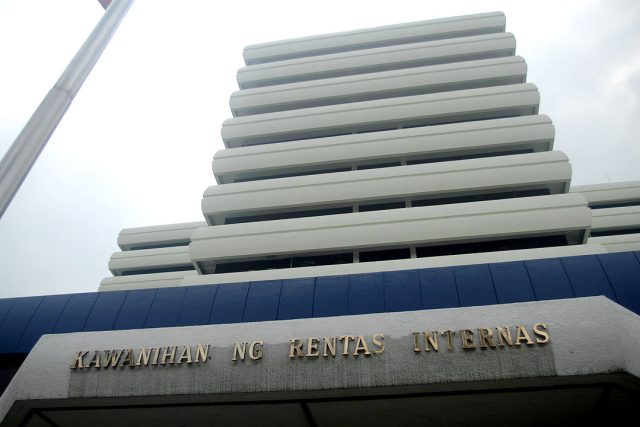
BIR seizes P604M worth of perfume, other scented products

THE Bureau of Internal Revenue (BIR) seized over 390,000 bottles of perfume and eau de toilette valued at P604.3 million in foregone excise tax.

In a statement on Monday, the BIR said it inspected over 400 factories, warehouses and stores from Sept. 27 to 28.

“Big or small, every business has to comply with excise tax regulations,” BIR Commissioner Romeo D. Lumagui, Jr. said.

According to the BIR, manufacturers, producers, or brand owners availing of the services of a toll manufacturer, subcontractor, or import-dealer of perfume and eau de toilette must file an application in writing for a permit to engage in such business with the BIR Commissioner through a duly authorized representative.

The persons or entities engaged in such business must also secure permits from the Excise Taxpayers Regulatory Division. They must also secure a permit to operate for excise tax purposes.

“The manufacturer, importer, owner, or person having possession of the excisable articles can be made liable for lack of permit to operate, failure to file certain information returns, and/or unlawful possession or removal of articles subject to excise tax without payment of the tax under the National Internal Revenue Code, as amended,” it added.

In August, the BIR said that it was losing as much as P370 billion in revenue due to “ghost receipts.”

The BIR expects to collect P2.64 trillion this year, of which P336 billion will come from excise taxes.

It collects about 70% of government revenue. — Luisa Maria Jacinta C. Jocson

ADVERTISEMENT
ADVERTISEMENT