Home Blog Page 4172

Etiqa expects double-digit increase in premiums

ETIQA LIFE & General Assurance Philippines, Inc. (Etiqa Philippines) expects its premiums to grow by low double-digits this year and next amid increased demand for medical services, its top official said.

“We’re still actually very bullish as far as our premium growth is concerned…. So, we are expecting to continue with that momentum and growth up until the end of the year and by next year,” Etiqa Philippines President and Chief Executive Officer Rico T. Bautista said in an interview on the sidelines of an event last week.

The company also sees high double-digit growth for its new business annual premium equivalent (NBAPE), Mr. Bautista added.

“We’re actually positive both on premium and new business APEs as compared to the industry, because the industry is actually negative on the premium side, but we are positive,” he said.

More individuals are availing of medical services, which Etiqa Philippines is mostly focused on, Mr. Bautista said.

“That’s what we are monitoring in terms of the progress of the claims of people,” he said.

Premium growth is also unlikely be affected by high inflation, although its income could take a hit, Mr. Bautista said.

Etiqa Philippines booked a premium income of P1.57 billion in the first quarter this year, with an NBAPE of P411.19 million, data from the Insurance Commission showed.

The company recorded a net loss of P30.95 million in the period.

LIFE INSURERS
Meanwhile, life insurers could see steady year-on-year premium growth, said Mr. Bautista, who is also the president of industry group Philippine Life Insurance Association, Inc. (PLIA).

“Overall, it would still be on the cautious side, meaning to say we would be traversing on a breakeven versus last year… But it’s not yet a very positive high growth perspective,” he said.

Companies’ performances have remained mixed, Mr. Bautista said.

“So, for PLIA, it will be a mix. There will be companies that will continue to grow, but there are also companies who are challenged in terms of their performance,” he added.

The life insurance sector saw its premium income fall by 2.25% to P149.47 billion in the second quarter, data from the industry regulator showed. — A.M.C. Sy

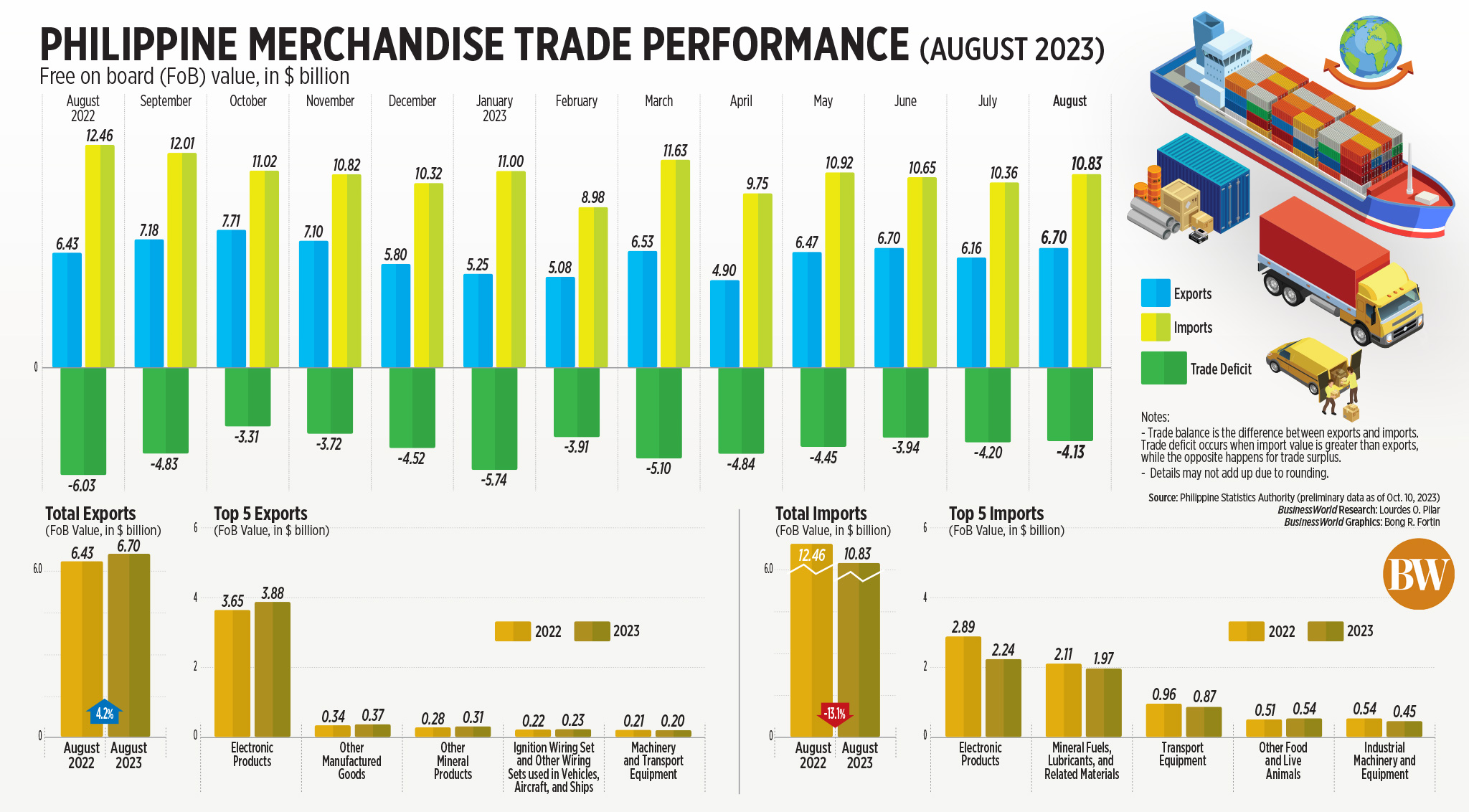
Philippine Merchandise Trade Performance (August 2023)

THE PHILIPPINES’ trade-in-goods deficit for August narrowed to its lowest level in two months, as an increase in exports offset the continued decline in imports. Read the full story.

Philippine Merchandise Trade Performance (August 2023)

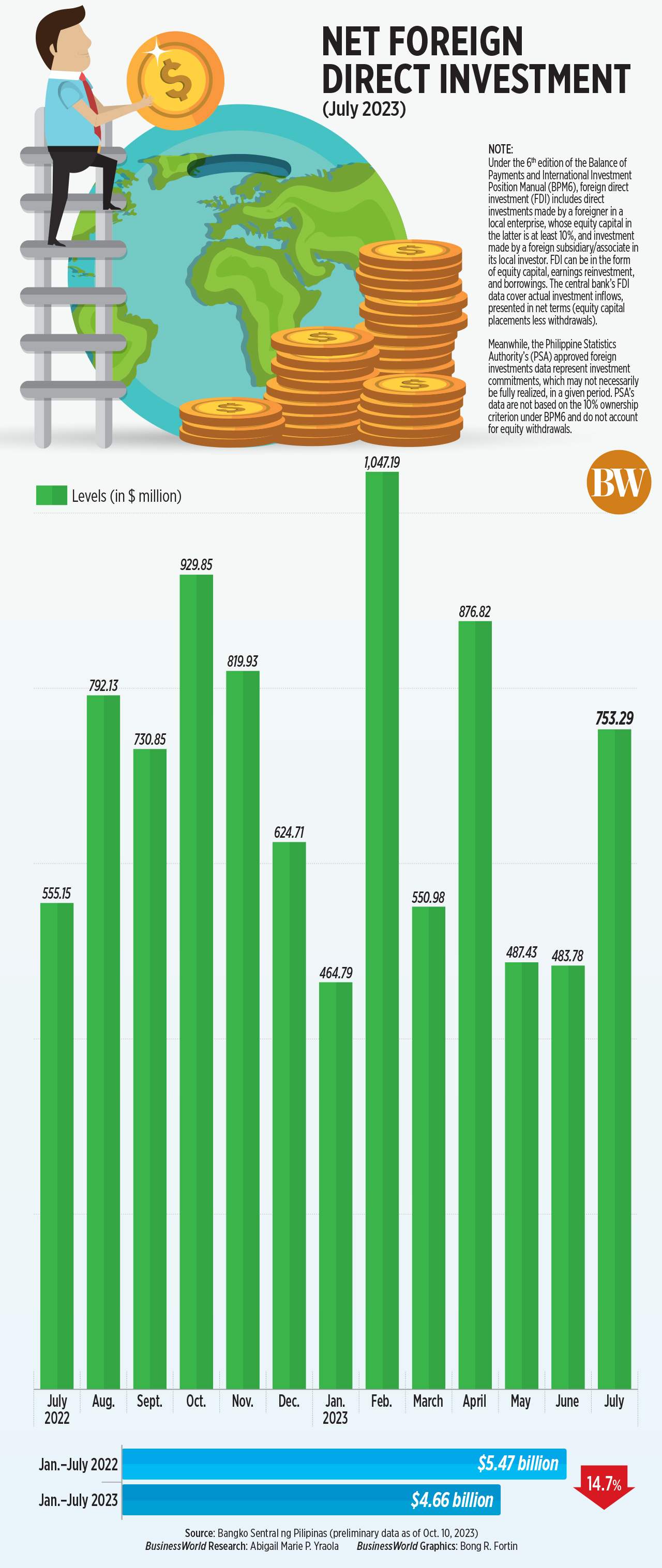
Net Foreign Direct Investment

NET INFLOWS of foreign direct investments (FDI) rose to its highest level in three months in July, amid improved investor sentiment. Read the full story.

Net Foreign Direct Investment

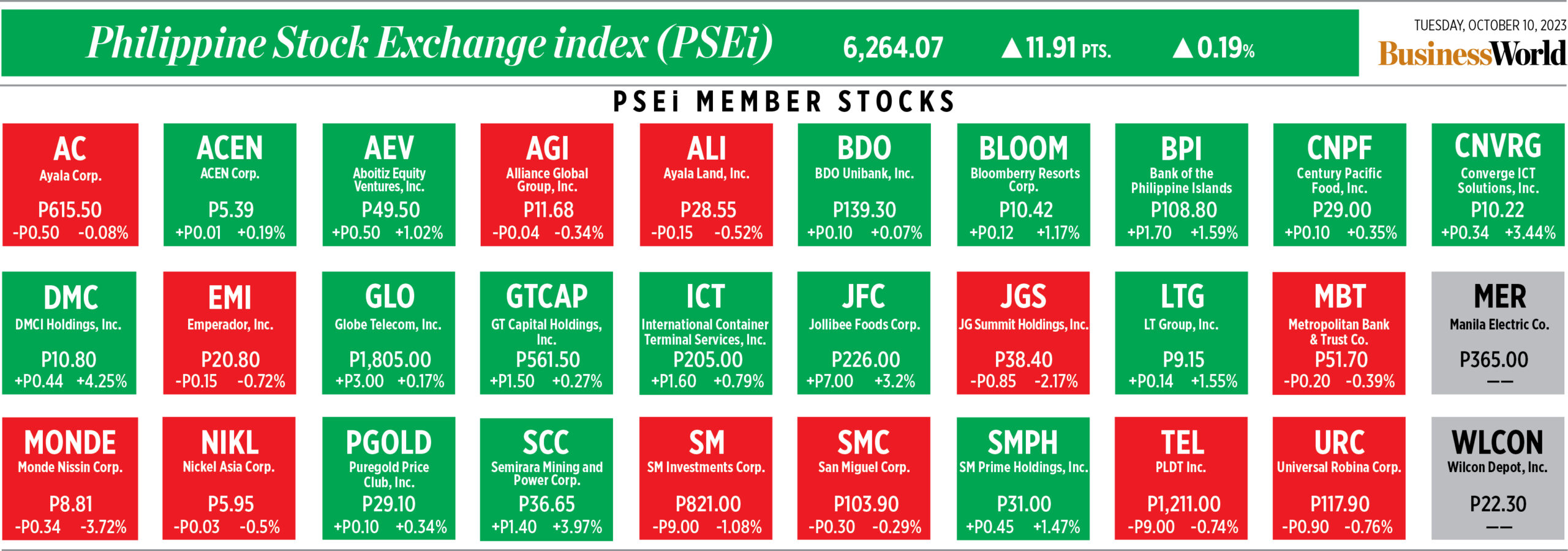
How PSEi member stocks performed — October 10, 2023

Here’s a quick glance at how PSEi stocks fared on Tuesday, October 10, 2023.


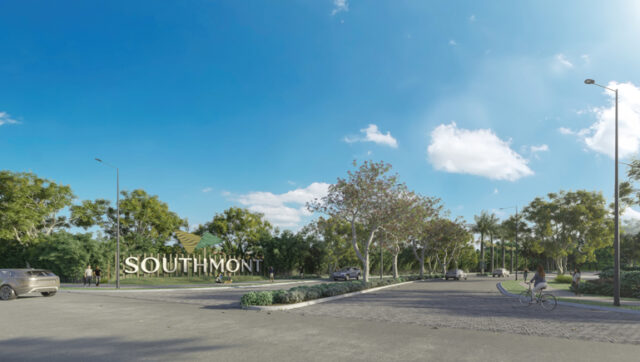
800-hectare Southmont estate by Ayala Land and Cathay Land to rise in Silang, Cavite

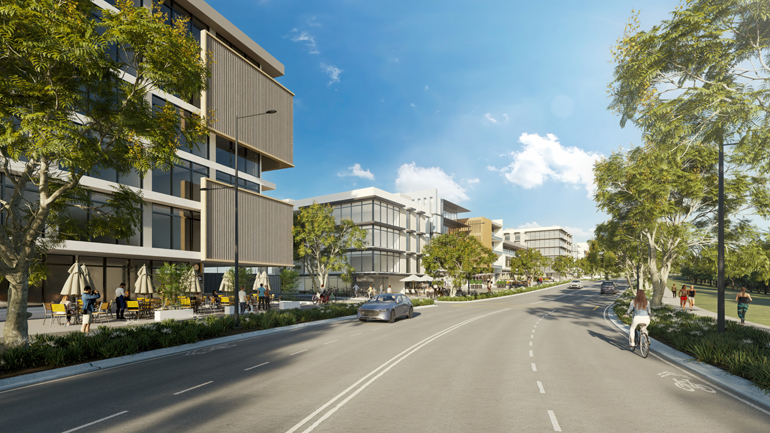
Southmont is designed to be a highly-connected estate with its access points in Metro Manila and Southern Luzon and its facilities that intend to enhance the living experience within the community.

Encompassing the features of urban and nature, plus the proximity and connectivity to Metro Manila, Silang, Cavite can be an ideal place for home seekers looking to live beyond but not far off the capital. Such conveniences offered in Silang, Cavite can be experienced in Southmont, an 800-hectare masterplanned estate developed from the collaboration between Ayala Land and Cathay Land.

Highly-connected estate

Proximity to the capital has always been an edge for the South. And with recent improvements in connectivity between the regions, further economic growth is anticipated across the provinces South of Metro Manila.

The province of Cavite is a major beneficiary of of the proximity to Metro Manila, which is further enhanced with the completion of major road infrastructure projects such as the Cavite-Laguna Expressway (CALAX) and the ongoing construction of LRT-1 Cavite Extension, among others.  The enhanced connectivity is creating more opportunities in Cavite, particularly attracting interest in real estate developments.

Located along the Cavite growth corridor, Southmont is highly accessible with major thoroughfares enveloping the estate, such as CALAX, Sta. Rosa-Tagaytay Road, and the upcoming Cavite-Tagaytay-Batangas Expressway (CTBEX). Southmont’s connectivity goes beyond unparalleled access points, it also fosters connectivity within the estate by offering facilities designed to enhance the community’s living experience.

Diverse offerings

Held onsite last Sept. 27, 2023, this groundbreaking milestone was led by Cong. Roy Loyola, 5th district representative of Cavite; Silang Mayor Kevin Anarna; Cathay Land President Jeffrey Ng; Ayala Corp. Chairman Jaime Augusto Zobel de Ayala; and Ayala Land President and CEO Meean Dy.

Southmont will rise amidst an elevated, vast rolling terrain with scenic views of landscapes, including the legendary Mt. Makiling. It will be made up of diverse developments, such as residences, retail and commercial, recreational facilities, and institutions.

Homeseekers can choose among an array of properties for their future home as Ayala Land will bring residential subdivision offerings of its different brands to Southmont. Ayala Land Premier, Alveo, Avida, and Amaia will create new homes in the estate, such as lots, house and lots, and townhouses. These residential spaces will be home to over 30,000 residents once at full development. Currently, Southmont offers residential developments Hillside Ridge and Verdea from Alveo Land, and Lanewood Hills by Ayala Land Premier. 

Elevated Lifestyle

Southmont brings several conveniences to future residents with several commercial and leisure spaces such as restaurants, retail stores, and grocery shops, as well as open-spaced community parks — all finely placed across the development.

Future residents of Southmont can get several conveniences from commercial and leisure spaces in the estate, which are also open for those traveling to and around Cavite. Diverse offerings to dine and shop include restaurants, retail stores, and grocery shops, among others. Southmont will also comprise connected open spaces with community parks, for residents and visitors.

The estate will also house a modern sports center designed with a similar ambiance to a country club, which can accommodate athletes, enthusiasts, and families looking for recreation, as well as host sporting events. More spaces will also be allotted for getting active with the dedicated bike and jogging trails within the estate.

Aside from spaces for living and leisure, Southmont will be built with key institutions, including a 500-seater church, which will also have an Events Center for different celebrations and occasions. In addition, residents will have a nearby school at the estate with Chiang Kai Shek in Southmont.

Such a variety of establishments that will emerge in Southmont could elevate the living experience for its future residents, as well as present opportunities for investors.

While already surrounded by nature, Southmont is designed with further greenery with the cultivation of climate-resilient plants and endemic tree species for landscaping.

Southmont’s resiliency is also thought of for the development, as it includes detention ponds and allows areas for rainwater percolations. Programs for waste reduction and storm water management will also be implemented in the place.

And as the establishments are connected within the estate, developers also ensure that Southmont will have good mobility as people wander around the area. Pedestrians are kept in mind with the presence of waiting sheds outside every development. There are also bike racks in various points and electric shuttles roaming within the estate.

Residents and travelers to Southmont can also conveniently move inside and beyond the place through its own transport terminal, which is strategically situated for better mobility within the estate and to nearby cities and destinations.

With means for mobility in and out of the development, connectivity is further maintained among the people, establishments, and other places beyond Southmont.


Spotlight is BusinessWorld’s sponsored section that allows advertisers to amplify their brand and connect with BusinessWorld’s audience by enabling them to publish their stories directly on the BusinessWorld website. For more information, send an email to online@bworldonline.com.

Join us on Viber at https://bit.ly/3hv6bLA to get more updates and subscribe to BusinessWorld’s titles and get exclusive content through www.bworld-x.com.

Shares inch up on bargain hunting, trade data

PHILIPPINE STAR/KRIZ JOHN ROSALES

PHILIPPINE SHARES edged higher on Tuesday on bargain hunting and as the country’s trade deficit narrowed in August.

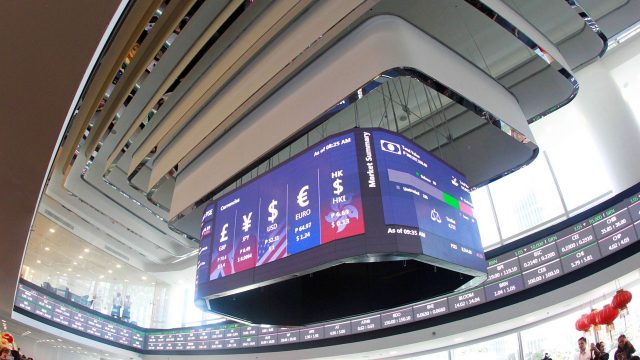
The Philippine Stock Exchange index went up by 11.91 points or 0.19% to end at 6,264.07 on Tuesday, while the broader all shares index rose by 6.22 points or 0.18% to 3,386.27.

“Stocks staged a modest rebound as investors engaged in bargain-hunting. This effectively countered the prevailing bearish sentiments linked to the Israel conflict,” AB Capital Securities, Inc. Vice-President Jovis L. Vistan said in a Viber message.

Investor sentiment was “boosted by the narrower trade deficit recorded in August,” Philstocks Financial, Inc. Research Analyst Claire T. Alviar said in a Viber message.

“Many investors, however, remained on the sidelines, with the net market value turnover posting at P4.17 billion,” Ms. Alviar said.

Value turnover went down to P4.54 billion on Tuesday with 688.96 million shares changing hands from the P5.71 billion with 771.49 million shares seen on Monday.

The Philippines’ trade-in-goods deficit shrank by 31.5% in August to $4.13 billion from the $6.03-billion gap in the same period last year, preliminary data from the Philippine Statistics Authority released on Tuesday showed.

The value of merchandise exports rose by 4.2% year on year to $6.70 billion in August.

Meanwhile, the value of imported goods declined by 13.1% year on year to $10.83 billion.

On the other hand, global stocks snapped higher on Tuesday, in line with a retreat in bond yields after US Federal Reserve officials signaled the recent yield surge could justify caution on interest rates, while oil eased, but violence in the Middle East made for nervy trading, Reuters reported.

The MSCI All-World index rose for a fifth day, up 0.5%, after having hit five-month lows last week, thanks in part to a 1.4% rise in Europe’s STOXX 600.

But investors were closely watching military clashes between Israel and the Palestinian Islamist group Hamas, after the latter unleashed a surprise assault at the weekend in which hundreds were killed and many abducted.

The Israeli military has since said it called up an unprecedented 300,000 reservists and was imposing a total blockade on the Gaza Strip, raising expectations of a possible ground assault.

At home, the majority of the sectoral indices rose on Tuesday. Mining and oil climbed by 133.42 points or 1.21% to 11,074.08; property went up by 15.08 points or 0.58% to 2,616.11; financials increased by 10.12 points or 0.55% to 1,818.99; and services gained 7.96 points or 0.52% to end at 1,520.11.

Meanwhile, holdings firms fell by 25.02 points or 0.42% to 5,934.34 and industrials declined by 3.71 points or 0.04% to 8,907.88.

Advancers outnumbered decliners, 96 versus 77, while 50 shares closed unchanged.

Net foreign selling went down to P275.32 million on Tuesday from P2.98 billion on Monday. — SJT with Reuters

Peso up vs dollar on dovish Fed comments

THE PESO rebounded against the dollar on Tuesday due to dovish hints from US Federal Reserve officials.

The local currency closed at P56.82 versus the dollar on Tuesday, strengthening by 13 centavos from Monday’s P56.95 finish, data from the Bankers Association of the Philippines’ website showed.

The local unit opened Tuesday’s session at P56.90 per dollar. Its intraday best was at P56.82, while its weakest showing was at P56.92.

Dollars traded went down to $1.05 billion on Tuesday from $1.25 billion on Monday.

“The peso strengthened amid dovish signals by some Fed officials who urged caution over further US policy rate hikes,” a trader said in an e-mail.

Top-ranking Fed officials indicated that rising yields on long-term US Treasury bonds, which directly influence financing costs for households and businesses, could steer the Fed from further increases in its short-term policy rate, Reuters reported

The Fed kept its target rate unchanged at the 5.25% to 5.5% range at its Sept. 19-20 meeting.

It has hiked rates by a cumulative 525 basis points since it began its tightening cycle in March last year.

The Federal Open Market Committee will next meet from Oct. 31 to Nov. 1 to review policy. 

The dollar’s weakness boosted the peso, Rizal Commercial Banking Corp. Chief Economist Michael L. Ricafort added in a Viber message.

The dollar was steady on Tuesday and below recent highs as comments by US Federal Reserve officials dampened rate hike expectations, although investors kept an eye on the conflict between Israel and the Palestinian Islamist group Hamas, Reuters reported.

The dollar index, which tracks the greenback against six peers, was last up less than 0.1% at 106.05. It remained below last week’s 11-month high of 107.34 and traded at roughly the same position as a week earlier.

For Wednesday, the trader and Mr. Ricafort see the peso moving between P56.70 and P56.90 per dollar. — with Reuters

Retail-farmgate divergence may trigger pork price caps

PORK meat products are sold at the Murphy Market in Cubao, Quezon City, Feb. 11, 2021. — PHILIPPINE STAR/ MICHAEL VARCAS

THE Department of Agriculture (DA) said price controls on pork are under consideration in the event that the price difference at the retail and farmgate levels continues to widen.

“That’s what we have to look at, after rice. The problem is… why it is higher in the markets,” DA Spokesperson and Assistant Secretary Arnel V. de Mesa told reporters on Tuesday, referring to the retail-farmgate divergence.

He added that the DA may consider price caps on pork if retail prices continue to rise, or if any “manipulation” is found.

The DA projects the supply of domestic pork to decline to a deficit equivalent to 10 days’ demand at the height of the yearend holidays.

“There might be a need to import during the last quarter where demand is much higher,” he added.

Mr. De Mesa said there is a need to balance local production with imports.

“It is still a priority of our government to strengthen local production; this is the only way to ensure that there is a balance and avoid an increase in prices,” he said.

“We need to consider the welfare of our producers and at the same time that of the consumers, as well,” he added.

The Philippines imported about 59.13 million kilograms of pork in the eight months to August, according to the Bureau of Animal Industry.

“When the imported pork meat comes in, they will keep (supply and demand) in balance,” he said.

Mr. De Mesa said the pork surplus will be equivalent to 10 days’ demand at the end of the third quarter.

He said that African Swine Fever (ASF) is still affecting the supply of pork.

“There are about 19 provinces with active cases of ASF,” he added.

He said the disease remains present in 98 barangays, though the outbreak has subsided to a level where case numbers are nowhere near their peaks.

On Monday, Oriental Mindoro province detected its first case of ASF. — Adrian H. Halili

Australia’s Fortescue declares interest in PHL hydrogen energy investment

FORTESCUE

AUSTRALIA’s Fortescue Metals Group Ltd. has expressed interest in investing in the Philippines’ hydrogen energy industry, the Department of Trade and Industry (DTI) said.

In a statement, the DTI said Trade Secretary Alfredo E. Pascual encouraged Fortescue to partner with Philippine companies with geothermal projects as a starting point.

“With a conducive business environment in place … Fortescue … can also partner with companies with existing projects such as geothermal, while also considering hydrogen as an energy option for the longer term,” Mr. Pascual said.

The DTI said that during Mr. Pascual’s meeting with the Australian company on Monday, Fortescue said it will explore “prospective investment opportunities in the Philippines.”

“They highlighted interest in utilizing hydrogen, particularly for transport given the proven technology in this area. They also said that they look forward to partnering with experts and local partners in their potential investment in the country,” the DTI said.

Yesterday, the DTI said that Australian companies have expressed interest in a public-private partnership for a 40-megawatt thorium-fueled simple-high-temperature gas-cooled reactor.

In a Viber message, Mr. Pascual said that the project in which Australia’s Southern Infrastructure Pty Ltd. and Kaizen ANZ Pty Ltd. expressed interest in carries potential advantage against uranium-based nuclear reactors.

“Thorium reactors have some potential advantages such as greater abundance of thorium in the Earth’s crust, reduced nuclear waste production, and enhanced inherent safety features,” Mr. Pascual said.

“While not renewable, the energy from nuclear power plants is considered clean. Thorium reactors represent a promising alternative for nuclear energy generation,” he added.

On Tuesday, Mr. Pascual and Foreign Affairs Secretary Enrique A. Manalo attended the sixth Philippines-Australia Ministerial Meeting (PAMM) in Adelaide.

In a joint statement, the trade and foreign affairs ministers of both countries welcomed the elevation of the Philippines-Australia bilateral relationship to a strategic partnership.

“The Ministers and Secretaries reinforced our countries’ commitment to striving for a region that is open, stable and prosperous. They reaffirmed our shared interests in preserving peace in the Indo-Pacific and recognized the stability of the region is anchored in respect for sovereignty and agreed rules and norms, and commitment to upholding international law,” the joint statement read.

Australian Foreign Minister Penny Wong said at the PAMM Joint Media Conference that Australia shares a special connection with the Philippines through its long friendship, deep partnership and 77 years of diplomatic relations.

“We are really pleased with what we are doing together, the practical steps we are taking and the importance of this relationship both bilaterally and also for the region we share,” she said.

Mr. Manalo said PAMM underscores the commitment of both countries to deepen existing and explore new areas of cooperation as strategic partners.

“As strategic partners, we are determined to seek alignment as we pursue cooperation across various sectors including defense, security, law and justice, trade and investment, development, people-to-people, and matters of regional significance,” he said.

He also added that the Philippines is now recognizing the growing importance of cybersecurity and looks forward to advancing cooperation with Australia.

Donald Edward Farrel, Australia’s Minister for Trade and Tourism, said there is more to explore in expanding the two-way trade between the Philippines and Australia.

“The Philippines is an extremely important economic partner to Australia. It is one of the fastest growing economies in this part of the world and the region,” Mr. Farrel said.

“We can do better, with less than 10 billion Australian dollars worth of two-way trade, the Philippines is our 17th largest trading partner,” he added.

He said that this could be further improved through the business mission Australia plans to send next year and the establishment of an Australian investment deal team in Manila.

“These efforts will make an important contribution to ensuring that we can expand our trade and investment connections,” he said.

Mr. Pascual said that the countries will work together to enhance collaboration in areas of mutual interests such as agriculture, education, critical minerals and clean energy.

“There is a lot of room for doing these enhancements. The Philippines is committed to work with Australia in finding mutually beneficial gains as we move forward to our strategic partnership,” he said. — Justine Irish D. Tabile


Fitch Ratings downgrades PHL growth forecast to 4.8%

REUTERS

FITCH RATINGS said it downgraded its gross domestic product (GDP) growth forecast for the Philippines to 4.8% this year from the 6.8% issued in May.

“We have revised down our forecast for 2023 growth to 4.8% from 6% at the time of the Outlook revision in May 2023,” Fitch Ratings said in a brief dated Oct. 9.

If borne out, the growth indicator would come in well below the government’s 6-7% growth target for the year.

“Headwinds to growth include high interest rates, the weak external sector as well as adverse weather conditions,” Fitch Ratings said in a follow-up e-mail.

However, it noted that these obstacles to growth are “temporary.”

According to Fitch Ratings, growth is expected to accelerate to 6.2% next year and further to 6.3% in 2025. These are both below the government’s 6.5-8% targets for 2024 to 2028.

“We forecast real GDP growth of above 6% over the medium term, considerably stronger than the ‘BBB’ median of 3%, after a record outturn of 7.6% in 2022, reflecting normalization of activity after the pandemic and the government’s investment program,” it added.

The Philippine economy grew 4.3% in the second quarter, the weakest reading for the indicator in over two years. Third-quarter GDP data will be released on Nov. 9.

Meanwhile, Fitch Ratings expects the National Government’s (NG) outstanding debt as a share to GDP to decline to 53.7% this year, 53.1% in 2024, and 52.3% in 2025.

It said this was due to “strong nominal growth and narrowing fiscal deficits.”

The government is hoping to reduce the debt-to-GDP ratio to below 60% by 2025.

At the end of June, the NG’s debt-to-GDP ratio stood at 61%, still above the 60% threshold considered by multilateral lenders to be manageable for developing economies.

It cited risks that could hamper the reduction of the debt-to-GDP ratio, including slowing fiscal consolidation in order to support growth.

Meanwhile, Fitch Ratings also noted that inflation will continue to remain a cause for concern.

“Inflation has fallen to more comfortable levels in many places, although El Niño is a risk, particularly for sovereigns that have food as a large weight in the consumer price index (CPI), such as India, the Philippines and Thailand,” it added.

Headline inflation accelerated to 6.1% in September. This marked the 18th straight month that inflation exceeded the central bank’s 2-4% target.

In the nine months to September, inflation averaged 6.6%, still above the central bank’s revised 5.8% full-year forecast. — Luisa Maria Jacinta C. Jocson

Green energy Round 2 winners given more time to submit post-auction requirements

THE Department of Energy (DoE) said it provided another deadline extension to winners of the second Green Energy Auction (GEA-2) program to submit their post-auction requirements.

In an advisory, winners were given until Nov. 13 to comply with the requirements. The DoE had originally set the deadline at Sept. 10, and then extended it to Oct. 10.

It said work suspensions due to inclement weather and holidays were partly behind the latest extension, though it was also responding “to the findings in the focus group discussion where the participants in GEA 1 found the timelines to be too strict,” Energy Undersecretary Felix William B. Fuentebella, the official who signed the advisory, said in a Viber message.

The DoE said it will issue the certificates of award to post-auction qualified winning bidders on or before Dec. 13.

Winning bidders that fail to submit post-auction requirements before Oct. 25 are required to extend the validity of their bid bond from Oct. 31 to Nov. 31, the DoE said. Proof of bond extension must be submitted not later than Oct. 27.

“Failure to submit such proof of bid bond validity extension within the prescribed timeline shall result in the post-auction disqualification of the bid and the corresponding forfeiture of the bid bond,” the DoE said.

GEA-2 was conducted on July 3, after which the DoE issued notices of award for 105 winning bids, covering projects generating 3,440 megawatts (MW), well below the 11,600-MW capacity on offer.

The project timelines are between 2024 and 2026.

The GEA program aims to promote renewable energy (RE) as a primary source of energy through competitive selection.

The DoE said that it will also help the government reach its goal of increasing the RE share of the energy mix to 35% by 2030 and 50% by 2040. — Sheldeen Joy Talavera

PCCI urges education system to stay up to speed on tech developments

PHILIPPINE STAR/EDD GUMBAN

THE Philippine Chamber of Commerce and Industry (PCCI) said the education system must keep up to date on technological developments that will raise businesses competitiveness when their students enter the workforce. 

“Our educational system should be able to keep up with the rapid advances in technology and innovation for us to create a future of skilled and technology-savvy workforce,” PCCI President George T. Barcelon said in a statement.

He cited the need to review and upgrade the Philippines’ competencies and skill sets to stay regionally competitive.

He said this will be one of the discussions in the upcoming 49th Philippine Business Conference and Expo (PBC&E) on Oct. 25- 26.

PBC&E Chairman Felino A. Palafox, Jr., said education plays a key role in making work opportunities fair, alleviating poverty and enhancing communities.

“Education is a long-term investment for the growth and prosperity of the country. There is an unmistakable correlation between access to quality education and economic and social progress,” he added.

The PCCI said that the Philippines has been slipping behind its Southeast Asian neighbors in reading, writing and arithmetic, citing a 2019 survey conducted by the Southeast Asian Ministers of Education Organization and the United Nations Children’s Fund.

It said that the educational disparities were further exacerbated by school closures during the pandemic as the abrupt shift to online learning disrupted access to education.

“The biggest obstacles stem from the inability to adapt to online learning owing to a lack of resources, as well as access to digital equipment and internet connectivity, particularly in remote regions,” the PCCI said. 

“Given this, institutions and businesses must redesign, rethink, and invest in present and future workforce education and training,” it added.

Mr. Barcelon said that PCCI believes in the value of education in improving the Philippine economy.

“(We) are working hard and continuously collaborating with the government and other private organizations to assist the Philippines in meeting the changing demands of the labor market,” he added.

The PBC&E session, which will discuss the ways the public and private sectors can contribute to shaping the future of earning and learning in the country on education, will be led by Senator Sherwin T. Gatchalian. — Justine Irish D. Tabile