Home Blog Page 28

Dawn blast at old Baguio bus terminal injures 14

BAGUIO CITY — Fourteen people were hurt after a blast rocked the former Philippine Rabbit bus line terminal sinkhole area along Magsaysay Avenue early morning on Monday.

Police said the explosion occurred around 3 a.m., hitting individuals who were in the vicinity. All 14 victims were rushed to nearby hospitals for treatment.

Authorities arrested a suspect believed to be behind the blast, later on identified as a small-scale miner from Itogon town in Benguet.

Police investigators told Baguio City Mayor Benjamin B. Magalong that the suspect allegedly lobbed an improvised explosive to get back at bystanders who mauled him after harassing people in the vicinity.

The area has been cordoned off as police continued their probe. — Artemio A. Dumlao

Ilocos farmers seek bigger subsidies as costs surge

BAGUIO CITY — Farmers in the Ilocos Region are urging local governments to tap tobacco excise tax funds to cushion the impact of rising fuel and fertilizer costs, which they say are making farming increasingly unsustainable.

The group Solidarity of Peasants Against Exploitation (STOP Exploitation) said diesel prices surged from P57.60 per liter in January to P152.45 as of April 8, sharply increasing irrigation expenses and forcing some farmers to cut losses.

The farmers’ group spokesperson Julie Balangue said many farmers are now harvesting crops early as low farmgate prices fail to keep pace with rising production costs, further squeezing already thin incomes.

Data from the farmers group showed irrigation costs for tobacco, rice, corn, and garlic have jumped significantly, with daily irrigation expenses now exceeding the region’s average daily farm income, raising concerns over long-term viability.

They warned that persistently high fuel and fertilizer prices could discourage planting in the next cropping season, posing risks to food supply and rural livelihoods.

The call for subsidies comes as disputes over tobacco pricing and grading continue following the opening of the flue-cured Virginia tobacco trading season in Northern Luzon.

STOP Exploitation challenged claims by the National Tobacco Administration (NTA) that issues at trading centers have been resolved, saying flaws in the grading system still depress farmgate prices.

While NTA Administrator Belinda S. Sanchez said efforts are underway to ease tensions and increase local procurement amid a potential oversupply, farmer groups remain skeptical. — Artemio A. Dumlao

PSEi falls as US-Iran talks end without peace deal

REUTERS

PHILIPPINE SHARES ended in the red on Monday, halting a three-day climb as sentiment soured again after talks between the United States and Iran ended over the weekend without a deal to end the war.

The benchmark Philippine Stock Exchange index (PSEi) fell by 0.72% or 44.16 points to close at 6,054.05, while the broader all shares index went down by 0.64% or 22.01 points to end at 3,386.52.

The PSEi slipped to the 5,900 level on Monday, logging an intraday low of 5,970.75, but managed to recoup its losses to finish at the session’s high.

“The market pulled back as worries over the war in the Middle East resurfaced. This comes as the US and Iran failed to reach a deal in their meeting last weekend followed by President Trump ordering the US Navy to blockade the Strait of Hormuz,” Philstocks Financial, Inc. Research Manager Japhet Louis O. Tantiangco said in a Viber message.

“Philippine equities closed in the red as renewed geopolitical tensions in the Middle East dampened investor sentiment. Concerns escalated after Donald J. Trump threatened Iran with a blockade of the Strait of Hormuz, reigniting fears of supply disruptions and a spike in global oil prices,” Regina Capital Development Corp. Head of Sales Luis A. Limlingan said in a Viber message. “Crude has already surged above $100 per barrel following the announcement, raising inflation risks and weighing on risk assets globally.”

Brent crude futures rose $6.67 or 7% to $101.87 a barrel by 0630 GMT after settling 0.75% lower on Friday. US West Texas Intermediate was up $7.26 or 7.5% at $103.83 a barrel following a 1.33% loss in the previous session, Reuters reported.

President Donald J. Trump said on Sunday the US Navy would start blockading the Strait of Hormuz, raising the stakes after marathon talks with Iran failed to reach a deal to end the war and jeopardizing a fragile two-week ceasefire.

Back home, most sectoral indices closed lower on Monday. Financials slid by 2.34% or 45.16 points to 1,880.09; property sank by 1.53% or 31.34 points to 2,007.98; mining and oil dropped by 0.96% or 173.88 points to 17,840.29; industrials retreated by 0.85% or 75.32 points to 8,711.94; and holding firms went down by 0.35% or 16.77 points to 4,711.03.

Meanwhile, services jumped by 1.01% or 28.54 points to 2,834.67.

Decliners outnumbered advancers, 121 to 82, while 69 names closed unchanged.

“Only four index members closed the day with gains led by Aboitiz Equity Ventures, Inc., climbing 4.03% to P31. JG Summit Holdings, Inc. was the worst index performer, dropping 5.23% to P27.20,” Mr. Tantiangco said.

Value turnover increased to P7.8 billion on Monday with 789.08 million shares traded from the P6.91 billion with 638.57 million issues that changed hands on Friday.

Net foreign selling was at P216.89 million versus the P1.5 million in net buying recorded on Friday. — Alexandria Grace C. Magno with Reuters

DEPDev wary of deficit impact if supplemental budget passes

ARSENIO M. BALISACAN — PHILIPPINE STAR/KRIZ JOHN ROSALES

By Kaela Patricia B. Gabriel

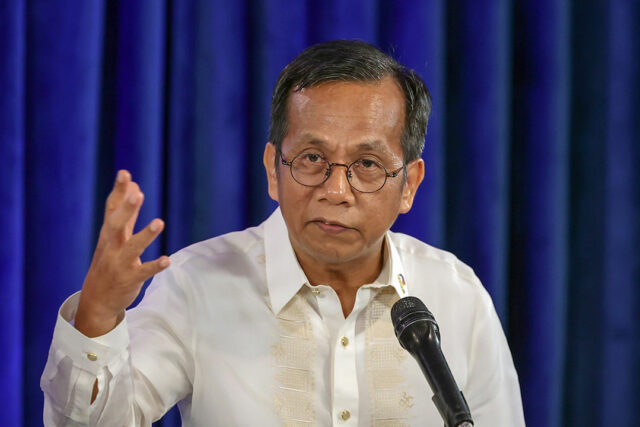
THE Department of Economy, Planning, and Development  (DEPDev) said it is weighing a possible request to Congress for a supplemental budget to support the programs addressing the oil crisis, though it cautioned about the possible impact of such a budget on the deficit.

At a Senate hearing on Monday, Economy Secretary Arsenio M. Balisacan said the government has sufficient funds to support oil-crisis measures until June, but added that a crisis that runs for six months could require budget realignment.

“The disadvantage is the deficit will surely increase. I am emphasizing that because unfortunately unlike when COVID hit us, we had a very good fiscal picture. Deficit was low, debt was low, but this time we don’t have that luxury,” Mr. Balisacan said.

Mr. Balisacan noted that the continued rise of fuel prices would cause inflation to exceed the 2%-4% target band for 2026.

He added that credit agencies have been watching how the Philippines handles the crisis, noting that one of the agencies has downgraded the Philippines due to elevated fiscal risks brought about by the Persian Gulf war.

According to Mr. Balisacan, P238 billion in funds to support emergency measures have been identified by the Department of Budget and Management, with P125.2 billion already released as of April 1.

Out of the released funds, P20 billion supported the Department of Energy’s (DoE) emergency oil purchase.

“My preference is that we work around the 2026 GAA (General Appropriations Act). We need to cut back on capital outlays if necessary just to fund what’s most needed for the crisis,” Mr. Balisacan said.

Aside from the supplemental budget, Mr. Balisacan also recommended revisiting the oil deregulation law, easing the biofuels import ban, building strategic fuel reserves, using lower-grade fuel, diversifying energy resources by tapping nuclear energy, and lifting the coal moratorium.

In 2020, the Philippines imposed a moratorium which restricted the processing of applications for coal-fired power plants to promote the transition towards renewable energy.

“We are in a transition but I think that even Japan, Germany, and Italy (are) revisiting their renewable energy transition, delaying it a bit, so that they can respond to the challenges of the global situation” Mr. Balisacan said.

In the same hearing, Energy Secretary Sharon S. Garin reported the gasoline reserve as equivalent to 54.38 days of consumption. The diesel reserve is projected to last 48.90 days, kerosene 104.73 days, jet fuel 67.65 days, fuel oil 45.96 days, and liquefied petroleum gas 36.27 days.

Agri dep’t considering P10 per kilo subsidy for users of gov’t fishports

PHILIPPINE STAR/ MICHAEL VARCAS

THE Department of Agriculture (DA) said it is studying a proposal to grant P10 subsidy per kilo of catch landed at government fishports, citing the need to assist municipal fisherfolk and commercial operators deal with rising fuel costs.

In a Senate hearing on Monday, Agriculture Secretary Francisco P. Tiu Laurel, Jr. said the proposal is still awaiting funding.

“If it can be funded, commercial fishers, and even municipal fishers with larger boats, will receive P10 for every kilo they unload at government fish ports. But that needs to be funded,” he said.

Mr. Laurel said the proposal will require consultation with economic managers to determine how to fund the scheme.

“A decision may come as early as next week,” he added.

The energy crisis has reduced the frequency of voyages, threatening to squeeze the supply of fish, a leading source of protein for poorer households.

“Our fishing sector will definitely grind to a halt as fuel now accounts for 70% to 80% of production costs, from 40% to 50% (previously),” Mr. Laurel said.

He added that most fishing operations, big or small, need to sell their catch at around P150 per kilo at landing or face losses.

Meanwhile, Mr. Laurel told reporters separately that the DA is “considering all options,” including increasing imports of key agricultural commodities, including fish, to help consumers deal with rising food prices.

“If fuel prices are still like this (going forward), fishing operations will be disrupted. We might open up  imports of galunggong (round scad) and other fish just to maintain supply,” he said.

He added that the possible increase in fish imports should not affect aquaculture.

The DA earlier approved imports of 250,000 metric tons of fish, which will begin in August, to plug potential supply gaps and stabilize prices. — Vonn Andrei E. Villamiel

AmCham says WFH scheme reassuring for ecozone locators

REUTERS

THE American Chamber of Commerce of the Philippines (AmCham) said that allowing economic zone locators to make work-from-home (WFH) arrangements will help sustain confidence among foreign investors about continuity of operations during the energy emergency.

AmCham Executive Director Ebb Hinchliffe said expanded WFH arrangements for registered business enterprises (RBEs) in ecozones “provides much-needed operational flexibility and helps sustain confidence among US and other foreign investors across a wide range of industries.”

The Fiscal Incentives Review Board approved last week a resolution that allows RBEs to implement WFH arrangements without affecting their fiscal and non-fiscal incentives amid the national energy emergency.

The measure will be in effect for one year from March 24 unless the state of national energy emergency is extended or lifted by President Ferdinand R. Marcos, Jr.

Although it allows up to 90% WFH arrangements, the resolution allowed investment promotion agencies to set a lower threshold, based on operational needs and specific circumstances, provided it does not fall below 50% of the total workforce.

“Business needs and operating models vary significantly across sectors — including manufacturing, logistics, services, and knowledge-based industries. In this context, policies that enable flexibility, rather than impose one-size-fits-all mandates, are critical,” Mr. Hinchliffe said.

“Empowering firms to determine the most appropriate work arrangements based on their operational realities supports continuity, productivity, and long-term competitiveness,” he added.

He said information technology-business process management, shared services, and other digitally-enabled industries are well-positioned to maximize remote work arrangements, which is why the broader framework should remain inclusive and adaptable to all RBEs.

“Moving forward, AmCham looks to continued policy clarity and consistency, including early guidance on the duration of these measures and any transition arrangements,” he said.

“Ongoing dialogue between government and the private sector will be essential to ensure effective, transparent, and predictable implementation,” he added.

Peter Lee U, an associate professor and dean of the School of Economics of the University of Asia and the Pacific, said that the measure will “help reduce demand for oil through reduced commuting.”

“As long as the companies can decide who needs to be onsite to preserve some minimum level of productivity, it seems like a good idea,” he said via Viber. — Justine Irish D. Tabile

PEZA expects Batangas project to help chip industry climb value chain

BW FILE PHOTO

THE Philippine Economic Zone Authority (PEZA) said it approved a P30-million investment by Optispac Philippines, Inc. in a facility in Batangas.

In a social media post on Monday, PEZA registered Optispac as an economic zone export enterprise. It intends to locate within the Lima Technology Center-Special Economic Zone in Lipa City.

The company’s investment will cover machinery, equipment, and working capital.

Optispac projects export operations to scale from 100,000 units in its first year of operation to over 375,000 units annually by the fourth year.

PEZA Director General Tereso O. Panga said the project aligns with the Philippine push to advance to high-tech manufacturing.

“Enterprises like Optispac play a crucial role in moving the Philippines up the global technology ladder,” he noted.

The company’s advanced hermetic packaging and liquid-cooled technologies will significantly bolster the semiconductor and electronics (S&E) value chain, Mr. Panga added.

“By producing sophisticated electronic packaging solutions right here in our ecozones, they provide essential components that allow our existing locators to innovate and compete more effectively at a global level,” he said.

The government is seeking to elevate the S&E industry from the assembly, test, and packaging to advanced packaging, integrated circuit design, and front-end manufacturing.

The Philippine Semiconductor and Electronics Industry Roadmap sets a target for electronic exports of $110 billion by 2030.

The export goal will be met through a five-year plan to train 128,000 semiconductor professionals, according to the roadmap, which was announced last year.

The Philippine Statistics Authority reported that electronic exports grew 17% to $46 billion in 2025, while semiconductor exports rose 18.7% to $34.62 billion. — Beatriz Marie D. Cruz

PHL debt-to-GDP to continue declining — AMRO

REUTERS/THOMAS WHITE/ILLUSTRATION

PHILIPPINE DEBT as a proportion of gross domestic product (GDP) is expected to steadily decline through 2030, according to the ASEAN+3 Macroeconomic Research Office (AMRO).

In its 2026 Fiscal Policy Report, AMRO said that it expects debt ratios to gradually stabilize or decline across most ASEAN+3 economies, excluding China and South Korea.

“In both economies, debt ratios are expected to continue rising at a pace similar to that observed over the past five years, reflecting persistently high primary deficits and, in China’s case, the continuation of the hidden debt-swap program through 2028,” it said.

“By contrast, the debt ratio is projected to decline in Indonesia, Japan, Laos, Malaysia and the Philippines,” it added, while pointing out that moderate increases are expected in other member economies.

For 2026, AMRO estimates the Philippine debt-to-GDP ratio to slightly decrease to 62.8% from 63.2% in 2025.

Last year, most ASEAN+3 economies recorded higher debt ratios except Japan, Laos, and Vietnam, where debt ratios continued to fall.

“Most member economies recorded a higher debt ratio in 2025 after showing signs of stabilization in previous years,” AMRO said. 

“In several other economies, the upward trend persisted, with increases observed in China, South Korea, Myanmar, the Philippines, and Thailand,” it added.

According to the report, the Philippine debt-to-GDP ratio increased to 63.2% in 2025 from 60.7% in 2024.

“Primary deficits and higher effective interest rates were the main drivers of rising debt ratios, while real GDP growth and inflation exerted downward contributions,” it said.

The Philippine economy expanded by a weaker-than-expected 4.4% in 2025, the weakest reading since the 9.5% contraction in 2020, while the National Government’s budget deficit widened by 4.68% in 2025 to P1.58 trillion, exceeding the P1.56 trillion ceiling set for the year.

Meanwhile, AMRO said that it expects gross financing needs to remain elevated throughout 2030.

“Looking ahead, despite the government debt-to-GDP ratio stabilizing or declining, higher principal repayments on maturing debt across various tenors are expected to keep gross financing needs elevated over the medium term in most member economies,” it said.

“In addition, the interest burden is projected to remain high, reflecting the legacy effects of accumulated public debt,” it added.

For 2026, AMRO projects Philippine gross financing needs at 8.8% of GDP, lower than the 10.1% posted last year.

The report also flagged persistent near-term economic uncertainty that could weigh on growth and inflation.

“Elevated global energy prices, reflecting geopolitical developments in the Middle East, and the potential disruption to energy supply pose risks to both growth and inflation across the region,” AMRO said.

For 2026, AMRO expects Philippine GDP to expand by 5.3%, within the government’s 5-6% target for the year.

“Additional risks include financial market volatility and weaker-than-expected growth in major economies, which could compound external and domestic headwinds,” it said.

“Should downside risks materialize, fiscal policy should remain agile and flexible to mitigate adverse impacts and support economic stability — in close coordination with monetary policy,” it added.

AMRO said that fiscal measures implemented by member economies to mitigate the impact of the COVID-19 pandemic and to curb high inflation thereafter resulted in a narrowed fiscal space compared to pre-pandemic levels.

“Sustaining efforts to rebuild fiscal buffers therefore remains critical to ensure that authorities retain sufficient capacity to respond decisively to emerging shocks, while continuing to support the structural transformation to strengthen resilience,” it said. — Justine Irish D. Tabile

Farmers say imports being readied for tariff reductions are already cheap

REUTERS

FARMERS said on Monday that key agricultural imports being considered for tariff cuts are already cheap and need no further price advantages.

Rosendo O. So, chairperson of the Samahang Industriya ng Agrikultura, said pork, for instance, is already cheap due to lower production and fuel costs in the source countries.

“For pork from Brazil… export prices are only around $1.60 to $2.50 per kilo. That’s how low they are. Their fuel prices are also lower,” he said at a briefing.

Elias Jose M. Inciong, chairman of the United Broiler Raisers Association, said there is no reason to reduce tariffs on chicken as farmgate prices remain depressed.

“We do not see any reason to reduce tariffs further because chicken prices are currently low. Our survey last Friday showed a liveweight price of P82 per kilo against the industry’s breakeven range of P100 to P110, so producers are incurring losses,” he said.

Mr. Inciong added that demand for chicken remains weak as “household spending has been absorbed by fuel expenses, reducing consumers’ propensity to consume.”

In a letter addressed to President Ferdinand R. Marcos, Jr., 17 industry officials, including Mr. So and Mr. Inciong, urged the government to reject any proposal to cut tariffs on agricultural imports.

“Tariff reductions on imported pork, chicken, and corn at this time, whatever the percentage may be, would be a stab in the back for the agriculture sector and our national economy,” they said.

They warned that lowering tariffs would undermine domestic production and further increase reliance on imports.

“Increasing our dependence on food imports will further expose the country to the volatile and fragile global supply that it cannot control,” according to the letter.

The groups instead called for stronger support for domestic producers.

“Now more than ever, supporting local production will reduce external dependence, ensure baseline food availability, protect rural livelihoods, and support jobs in allied sectors,” they said. — Vonn Andrei E. Villamiel

Beyond buildings: Inside the SEC’s REIT rule reforms

The Real Estate Investment Trust (REIT) market welcomed 2026 with a new stage of development with the issuance of Securities and Exchange Commission (SEC) Memorandum Circular No. 1, Series of 2026, amending the Implementing Rules and Regulations (IRR) of the REIT Act of 2009, or RA 9856. After the regulatory improvements introduced in 2020 which triggered the establishment of the first few REITs in the Philippines, the SEC once again seeks to establish a more robust framework to encourage investment in the REIT market.

The revised rules broadened asset eligibility and ownership structures and introduced reinvestment flexibility for sponsors, with the aim of positioning REITs as a more effective capital-raising platform for both real estate and infrastructure-related investments.

BROADER SCOPE OF INCOME-GENERATING REAL ESTATE
Under the old REIT rules, income-generating real estate was primarily associated with traditional rental properties such as office buildings, malls, and other commercial developments. While the earlier IRR did not expressly disqualify other asset types, the SEC emphasized that income-generating real estate must be physical and tangible in nature and even opined that investments in real estate mortgages are not allowable REIT investments.

The new rules adopted a significantly broader approach. Income-generating real estate now includes assets that produce recurring and predictable cash flows, regardless of whether such income arises from leases or other passive revenue sources. Qualifying assets also include infrastructure and alternative real estate such as toll roads, railways, airports and air navigation facilities, ports, ICT infrastructure, energy infrastructure assets, data centers, parking lots, buildings, malls, warehouses or storage facilities, immovable fixtures, machinery, facilities, and structures, as well as real rights over properties (e.g., usufruct, easements and registered leases). It excluded, however, real properties held primarily for sale or disposition and assets whose income is derived mainly from their sale rather than their continuing use or operation.

This progressive approach deviates from the traditional rental properties and aligns Philippine REITs more closely with neighboring regions and opens the door for infrastructure-backed and hybrid REIT structures.

EXPANDED OWNERSHIP STRUCTURES
Previously, the allowable investments in real estate assumed direct ownership of REIT assets through leasehold or freehold, offering limited guidance on the use of special purpose vehicles (SPVs) or joint ventures. As a result, potential market players became reluctant to set REITs, considering that the public will, in effect, own at least one-third of the income-generating real estate of the REIT.

The amended rules allowed REITs to own income-generating assets directly or indirectly, through unlisted SPVs or incorporated joint ventures, provided the REIT owns at least two-thirds of the outstanding and voting capital stock of the asset-holding entity. Compared with the old regime, this expanded the options for internal asset ownership structure while ensuring that REIT investors retain meaningful control.

However, it appears that the transfer of property to the unlisted SPV or incorporated joint venture does not enjoy the same tax incentives as transfers of property to a REIT, particularly on the 50% reduction in DST and all applicable registration and annotation fees. Nonetheless, dividends declared by the unlisted SPV or incorporated joint venture which are received by the REIT are considered allowable deductions to the taxable net income of the SPV or incorporated joint venture. Note that the requirement of distribution of at least 90% of distributable income also extends to such SPVs or incorporated joint ventures that are wholly or partially owned by a REIT. Failure to do so shall be a violation of the REIT’s dividend distribution obligation.

LONGER REINVESTMENT PERIOD FOR SPONSORS
One of the most practical changes involves the reinvestment requirement for REIT sponsors. Under the 2020 rules, sponsors were required to reinvest listing proceeds within one year.

The amendment extends the reinvestment period to two years and, at the same time, allows reinvestment through equity investments, loans, debt instruments, or debt repayment related to Philippine real estate or infrastructure projects. This change gives sponsors greater capital planning flexibility while preserving the policy objective of channelling REIT proceeds back into the Philippine capital market.

PUBLIC OWNERSHIP AND GOVERNANCE STANDARDS
The amended rules further defined a public shareholder as one who owns less than 10% of the REIT’s outstanding shares and does not exercise substantial influence over management or operations. Ownership of 10% or more — directly or indirectly — creates a presumption of substantial influence. This clarification strengthens investor protection and prevents the dilution of public ownership through affiliated or indirect holdings.

MINIMUM PUBLIC OWNERSHIP COMPLIANCE
In practice, asset infusions by sponsors could inadvertently trigger MPO breaches, especially in the execution of property-for-shares exchanges. During public consultation, the draft circular sought to allow temporary MPO breaches when sponsors inject income-generating assets in exchange for REIT shares, subject to regulatory approval, full disclosure, and a clear plan to restore compliance.

However, this proposed measure did not materialize in the issued circular, resulting in a status quo. Thus, the public float requirement for REITs of one-third of the outstanding common stock must, at all times, be complied with.

In which case, sponsors or their affiliates seeking to infuse property in exchange for shares of the REIT may resort to preparatory steps to ensure compliance with the MPO, considering the value of the property to be infused. This may include the declaration of REIT shares as property dividends by the sponsor to public shareholders, resulting in an increase of public shareholding. The transaction will be subject to DST and final taxes if the recipient is an individual. It may also sell a portion of its REIT shares to increase public float through open trading or pre-arranged sales (block sales) prior to infusion. However, the proceeds of the sale will be subject to reinvestment rules as discussed above, and the transaction will be subject to stock transaction tax, PSE fees, SRC fees, SCCP fees, and commissions to brokers.

The investors and the REIT will ultimately have to conduct a cost-benefit analysis to determine the most cost-efficient approach to the intended structure.

DIVIDEND SAFEGUARDS
The statutory requirement for REITs to distribute at least 90% of distributable income annually remains unchanged and further extended to asset-holding SPVs and incorporated joint ventures. In both cases, the dividends distributed shall be allowed as an additional deduction to the taxable net income of the REIT, SPV, and incorporated joint venture.

TAX AND STRUCTURING IMPLICATIONS
While the circular does not specifically discuss the tax implications of the reforms, the regulatory changes have meaningful tax and structuring implications. The expanded asset definition and formal recognition of SPVs support more tax-efficient structuring in terms of infrastructure and mixed-use assets as well as managing fund flow within the group.

At the same time, the dividend requirement limits the ability to retain earnings at the subsidiary level, requiring careful planning to balance cash flow management, tax timing, and dividend compliance. The extended reinvestment period also allows sponsors to better align taxable events with project timelines and funding needs.

OUTLOOK OF REITS IN THE PHILIPPINES
The expanded eligibility of assets and structuring options make this an opportune moment for developers, infrastructure operators, and sponsors to explore launching a REIT or streamline existing REIT structures. A detailed feasibility and structuring analysis at this stage can position potential and existing market players to take advantage of the new REIT regulatory landscape.

Let’s Talk Tax is a weekly newspaper column of P&A Grant Thornton that aims to keep the public informed of various developments in taxation. This article is not intended to be a substitute for competent professional advice.


Johanne D. Abdulrahman is a manager from the Tax Advisory & Compliance practice area of P&A Grant Thornton, the Philippine member firm of Grant Thornton International Ltd.

pagrantthornton@ph.gt.com

Cignal collides with Creamline in PVL race to All-Filipino finals

CIGNAL SUPER SPIKERS — FACEBOOK.COM/PREMIERVOLLEYBALLLEAGUE

Games on Tuesday
(MOA Arena)
4 p.m. – Farm Fresh vs PLDT
6:30 p.m. – Cignal vs Creamline

CIGNAL and Creamline try to ride the crest of their crucial semifinal victories and get ahead in the ultra-competitive race to the finals as they collide on Tuesday in the PVL All-Filipino Conference at the MOA Arena.

The Super Spikers and the Cool Smashers both jumpstarted their bids with victories over the Farm Fresh Foxies, 23-25, 25-14, 25-11, 25-12, and the PLDT High Speed Hitters, 22-25, 27-25, 19-25, 28-26, 15-10, respectively, on Saturday at the same Pasay venue.

They face off at 6:30 p.m. with the winner sealing at least a playoff for a finals seat while inching closer to the best-of-three finale unfurling on April 21 at the Smart Araneta Coliseum.

The Manny V. Pangilinan franchise is expected to rely anew on the high-scoring pair of Erika Santos and Vanie Gandler in sealing the club’s third finals appearance and a shot at a breakthrough crown.

“We see all our semifinal matches as must-win games,” said Ms. Santos, who unloaded 21 points last time out.

For Creamline, a 10-time league champion, it is shooting for a return trip to the finals since last making it two years ago.

Bernadeth Pons, who spewed 28 points including crucial ones in the last two sets, vowed to go all out on this one.

“We promise to give our best in the next game,” she said.

Meanwhile, PLDT and Farm Fresh aim to bounce back from their defeats and stay in the hunt as they collide at 4 p.m. — Joey Villar

McIlroy holds nerve to defend Masters title, adds to his growing legacy

RORY MCILROY — REUTERS/PETTER ARVIDSON/BILDBYRÅN

AUGUSTA, Georgia — Rory McIlroy waited 17 years for his first Green Jacket and then on Sunday did what only three golfers before him had managed by winning a second Masters in a row.

The world number two, who let a record six-shot advantage slide on Saturday, capped a closing one-under-par 71 with a bogey that left him at 12 under on the week and one shot clear of Scottie Scheffler.

When his winning putt dropped, the Northern Irishman looked to the clear blue Georgia skies and let out a jubilant roar before hugging caddie Harry Diamond, while cheers of “Rory! Rory!” bounced off Augusta National’s towering pine trees.

“I just can’t believe I waited 17 years to get one Green Jacket and then I get two in a row,” said McIlroy. “I think all of my perseverance at this golf tournament over the years has started to pay off.”

With the win, the 36-year-old joins Jack Nicklaus (1965, 1965), Nick Faldo (1989, 1990) and Tiger Woods (2001, 2002) as the only players to successfully defend their Masters title.

‘STILL HAVE THINGS I WANT TO ACHIEVE’
McIlroy, who joked earlier last week that Augusta National felt like his home course given he took multiple day trips on his private jet in recent weeks to prepare, is still hungry for more after joining Lee Trevino, Faldo and Phil Mickelson as players with six major championships.

“I don’t want to put a number on it, but I feel like this win is just — I don’t want to say a stop on the journey, but yeah, it’s just a part of the journey,” said McIlroy. “I still have things I want to achieve.”

Scheffler, a four-time major champion who had won two of the last four Masters, started the day four shots back but nearly got to within one of McIlroy at 17. Putting for a third straight birdie, his ball stopped agonizingly just beside the hole.

Scheffler, who went out three pairings ahead of McIlroy, carded a 68 that left him alone in second while becoming the first player in the last 82 years to play the final two rounds bogey-free at the Masters.

“I always felt like I was a couple shots out of it, but I was ahead of those guys, so I felt like if I could make a few birdies and post a score I’d be in a good spot but just wasn’t able to make enough birdies on the back,” he said.

ANOTHER MASTERS MISS FOR ROSE
LIV Golf’s Tyrrell Hatton (66), birthday boy Russell Henley (68), 2025 Masters runner-up Justin Rose (70) and overnight co-leader Cameron Young (73) finished in a share of third place.

Rose, who lost to McIlroy in a playoff last year for his third runner-up finish, had a one-shot lead through 10 holes before watching it disappear after a bogey-bogey start to Amen Corner.

“Chance that got away obviously,” said Rose, who was the only player in the field with four rounds under par this week.

“You know, I was by no means kind of free and clear and was nowhere kind of close to having the job done, but I was right in position.”

McIlroy, up by one, sensed the opportunity and put his foot on the gas as he stuffed his tee shot at the par-three 12th to seven feet for a birdie moments before Rose three-putted from 30 feet at the 13th where he had an eagle look.

From there, McIlroy mostly spared himself the topsy-turvy finish he had to endure in the final round last year as he rolled in an 11-foot birdie to go three clear moments after Scheffler got to within two after a birdie on the 15th.

MCILROY BOGEYS 18TH AFTER ERRANT TEE SHOT
With victory in sight, McIlroy caught a break at the 15th where his third shot was just enough to avoid the water guarding the green. He delivered a pressure-packed up and down from behind the green at 16 and then bogeyed the last after an errant tee shot and leaving his second shot in a bunker.

McIlroy struggled with his putting early on and fell two shots behind Young after a costly double bogey at the par-three fourth, where he missed the green off the tee and then three-putted from nine feet.

He made bogey two holes later after missing another par-three green but made two birdies before the turn to stay firmly in the mix going into the second nine where the tournament hung in the balance.

“I just had to hang in there,” said McIlroy. “Having a six-shot lead going into the weekend, it would have been a bitter pill to swallow if I wasn’t able to get myself over the finish line.” — Reuters

ADVERTISEMENT
ADVERTISEMENT