Home Blog Page 2739

Philippines expresses ‘displeasure’ with China over Saturday’s collision

PHILIPPINE STAR/ MIGUEL DE GUZMAN

By Kyle Aristophere T. Atienza and John Victor D. Ordoñez, Reporters

THE PHILIPPINES on Monday said it had expressed its displeasure with China after another collision of their vessels that it said didn’t help in efforts to cool tensions in the South China Sea.

“We have made the necessary approaches to China in terms of contacting them through various means to express our complaint and displeasure at what happened,” Foreign Affairs Secretary Enrique A. Manalo told reporters at the presidential palace.

Mr. Enrique said the Philippine side had raised its concern over the fact that the Philippine Coast Guard (PCG) vessel that was hit by a Chinese vessel thrice near Sabina Shoal at the weekend was just practicing innocent passage.

He said the Chinese side, in response, “accused us, as usual, of doing this and that.” “We’re contemplating, at the moment, possible approaches to this issue,” Mr. Manalo said when asked whether Manila would lodge another diplomatic protest against Beijing.

“I think, maybe, in the coming days or weeks, we’ll probably have a better picture of where we’re headed for this.”

Mr. Manalo said the incident “doesn’t help the situation” in the South China Sea, one of the world’s most important waterways that China claims almost in its entirety.

A Philippine task force handling sea disputes with Beijing on Saturday accused a Chinese vessel of “deliberately” ramming the Philippines’ largest coast guard vessel named BRP Teresa Magbanua thrice near Sabina Shoal.

The Chinese Coast Guard vessel caused significant damage to BRP Teresa Magbanua and endangered the lives of its personnel, the task force said.

The Chinese side made a similar claim, with Coast Guard spokesperson Liu Dejun saying the smaller PCG vessel had “deliberately” collided with their ship.

“China exercises indisputable sovereignty” over the shoal, he said on Chinese state broadcaster CCTV, condemning what he called “unprofessional and dangerous” conduct of the Philippine ship.

The 97-meter-long BRP Teresa Magbanua has been near Sabina Shoal since mid-April, as Manila has accused Beijing of dumping dead corals at the atoll to alter its elevation.

Sabina lies 140 kilometers off the Philippine westernmost island of Palawan and is part of the Spratly Islands.

Sabina has been a staging ground for Philippine resupply missions to Second Thomas Shoal, where Manila grounded a Navy vessel in 1999 to serve as an outpost for a handful of Filipino troops.

Manila and Beijing came up with a resupply deal in July after a June 17 standoff in which Chinese forces threatened, using bladed weapons, Filipino troops delivering supplies to the Navy outpost.

The Philippine side said the Saturday collision was the fifth incident of Chinese harassment at sea in August.

The Philippine Department of Foreign Affairs (DFA) last month said the government of President Ferdinand R. Marcos, Jr. had filed 173 diplomatic protests against China from July 1, 2022 to Aug. 12, 2024, 40 of which were lodged this year.

‘UNPROVOKED AGGRESSION’
Meanwhile, think tank Stratbase ADR said joint patrols, escorts to resupply missions and external defense capacity-building efforts with like-minded partners would help the Philippines exercise its “sovereignty, territorial integrity and economic rights” within its exclusive economic zone.

“The Philippines, as a maritime nation supported by friends and partners, will not back down in the face of this aggression,” Stratbase President Victor Andres C. Mahit said in a statement.

“The institute underpins the importance of reinforcing alliances and elevating partnerships through joint patrols and exercises to respond to threats posed by antagonistic states like China,” he added.

The think tank described Saturday’s incident as “an act of desperation” on China’s part that violated international law.

The Chinese Embassy in Manila did not immediately reply to a Viber message seeking comment.

The United States, New Zealand, and Australian embassies have expressed concern over the incident, urging China to follow international law.

Last month, the US and French navies held war games in the Philippine Sea to advance their interoperability “in support of a free and open Indo-Pacific,” according to the US 7th Fleet.

Manilla, Washington, Ottawa and Canberra held their first joint military exercises in the South China Sea on Aug. 7 and 8 amid Beijing’s increased military buildup in the waterway.

“Chinese behavior, including repeated incursions of its vessels into Philippine territory, unprovoked aggression and the propagation of disinformation are clear violations of international law,” Mr. Manhit said.

Also on Monday, the DFA urged the Senate to ratify a United Nations (UN) agreement on the conservation of marine life and resources beyond a nation’s jurisdiction amid recent sea scuffles with China.

In his speech at a symposium in Makati on the UN agreement on Marine Biological Diversity of Areas Beyond National Jurisdictions (BBNJ), Mr. Manalo said his agency was working with the Senate to refine the country’s laws on marine resources.

“To achieve the goal of conservation and sustainable use of marine biological diversity, the international community must continue to strengthen international cooperation and coordination, especially through the BBNJ agreement,” he said, based on a copy of his speech sent to reporters via WhatsApp.

The UN agreement entails international cooperation in promoting environmental impact assessments and capacity-building in the transfer of marine technology.

The Philippines signed the treaty at the 78th United Nations General Assembly (UNGA) in New York in September last year.

Congress has approved a bill that seeks to set up Philippine sea lanes and another establishing maritime zones to assert the country’s territorial claim over the South China Sea.

The Senate last month passed another bill that tasks the government to draft a plan to manage marine and coastal resources to cut land and sea-based pollution and overfishing.

“The agreement embodies our collective response and responsibility towards ensuring the health and productivity of our oceans for generations to come,” Mr. Manalo said.

DepEd may go back to one-hour subjects to ease load

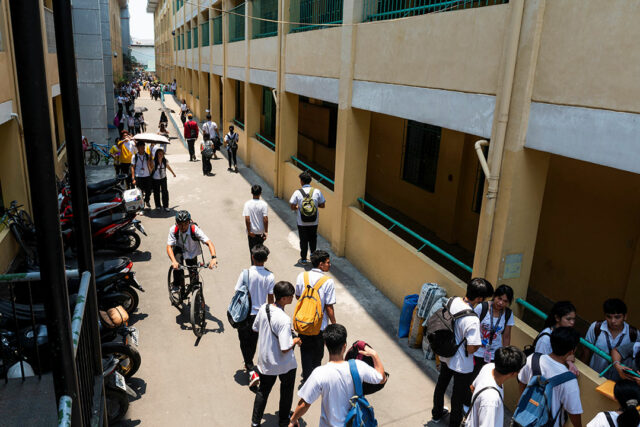
Students walk inside the campus of a high school in Quezon City, April 18, 2024. — REUTERS

By Kenneth Christiane L. Basilio, Reporter

THE PHILIPPINES’ Department of Education (DepEd) plans to order schools nationwide to revert to the one-hour duration of subjects under a new curriculum to ease teachers’ workload, according to its chief.

DepEd took notice of teachers’ plight under the Matatag curriculum, which shortened the time for each subject to 45 minutes, Education Secretary Juan Edgardo “Sonny” M. Angara told a budget hearing at the House of Representatives on Monday.

He said they are close to finalizing an order that he would issue soon. “We are preparing a department order to inject flexibility, meaning we’ll go back to six one-hour subjects,” Mr. Angara said in mixed English and Filipino.

“Our thought process behind the Matatag curriculum is that the 45-minute lessons maximize learning time… for students,” he said. “We listened to the situation on the ground, and some teachers, as well as some schools, are struggling.”

Vice-President and ex-Education Secretary Sara Duterte-Carpio introduced in August 2023 the new curriculum, which seeks to streamline learners’ education by focusing on reading, literacy and numeracy in the first three schooling years of a student.

Party-list Rep. France L. Castro said the curriculum is “problematic” because teachers are forced to congest their teaching hours to 45 minutes per class to meet their teaching load.

“Our high school teachers have seven to eight [teaching] loads… so it’s really necessary to review this immediately,” she said in Filipino at the hearing.

An April 2024 DepEd order said teachers should spend six hours of their workday to classroom teaching, with the remaining two hours constrained to tasks such as curriculum planning and learners’ assessment.

Going back to the one-hour subject duration is a step in the right direction toward better education quality, Ferdinand Pol L. Martin, who teaches education at the University of the Philippines, said by telephone.

“Forty-five minutes is sometimes too short,” he said in Filipino. “Often, you have routines and ceremonies [before you start your teaching] and you run out of time, leaving you with just 30 minutes.”

“Other teachers go overtime as well, so there’s really nothing left for you. One hour is just right,” he added.

The Education department is also preparing for the 2025 Program for International Student Assessment (PISA) by strengthening science learning and improving computer literacy, Mr. Angara said.

The upcoming PISA survey is a “particular challenge” for the Philippine education system due to the lack of science teachers, made worse by the country’s poor performance in previous assessments.

“The President is particularly concerned about the next PISA exam,” he told congressmen.

“This is in March 2025 next year, just a few months from now, so we have formed a PISA technical working group within the department to organize test materials and [conduct] school infrastructure assessments,” he added.

Filipino students were among the world’s weakest in math, reading and science, according to the 2022 PISA. The Philippines ranked 77th out of 81 countries and performed worse than the global average in all categories.

DepEd is looking at digitizing its “PISA-focused science program” in online learning platform Khan Academy this month, according to the Education chief.

“From October to December, we will hold learning sessions for 1.6 million 15-year-old public school learners,” he said.

DepEd would keep holding “intensive learning sessions” until the day of the survey, he added.

Exploratory talks between PHL, Maoists ‘ongoing’

THE PHILIPPINE GOVERNMENT and the local Maoist movement were still in exploratory talks for the resumption of their peace negotiations, a presidential peace adviser said on Monday.

The exploratory talks between the government and the Communist Party of the Philippines’ political wing were still “ongoing” as seen in a November mission statement by the two camps, Presidential Adviser on Peace, Reconciliation and Unity Secretary Carlito G. Galvez Jr. said at a Palace briefing.

Mr. Galvez was referring to a joint communique signed by the two camps in November last year to signify their openness to peace negotiations amid “serious socioeconomic and environmental issues” as well as foreign security threats facing the country.

The Cabinet official said there are three processes under a peace negotiation, including coming up with a vision statement and a framework agreement.

“Then number three is the final peace agreement,’’ he added.

In their joint communique, the National Democratic Front of the Philippines (NDFP) and the Philippine government recognized the “need to unite as a nation in order to urgently address these challenges and resolve the reasons for the armed conflict,” citing socioeconomic and environmental issues as well as foreign aggression.

It was signed by the Special Assistant to the President Secretary Antonio Ernesto “Anton” F. Lagdameo, Jr. on behalf of the Philippine government with Mr. Galvez and former Armed Forces of the Philippines Chief of Staff General Emmanuel Bautista as witnesses. 

NDFP’s National Executive Council member Luis G. Jalandoni, Negotiating Panel interim chairperson Julieta de Lima, and member Coni Ledesma signed the agreement.

The communique acknowledges Mr. Bautista for initiating informal talks in the past years with the late NDFP chief political consultant Jose Maria C. Sison, founder of the 55-year-old Maoist insurgency.

Earlier in the day, President Ferdinand R. Marcos, Jr. on Monday vowed to implement all signed peace agreements with various rebel groups including those covering the country’s south.

“You can depend on this Administration to implement all signed peace agreements for the security, the inclusive progress, and stability not only in Mindanao but throughout the country,” he said in a speech marking the 28th anniversary of the 1996 Final Peace Agreement with the Moro National Liberation Front (MNLF).

He said peace processes with former revolutionary organizations including the Moro Islamic Liberation Front, Cordillera Bodong Administration-Cordillera People’s Liberation Army, and a communist-inspired partisan group were in “the advanced stages of implementation.”

He also cited the implementation of a transformation program that seeks to uplift the socio-economic conditions of MNLF combatants, their families, and communities.

The 1996 agreement is the government’s main policy framework in implementing a 1976 pact between the Philippine state and MNLF for the establishment of an autonomous region for Muslims in Mindanao.

The 1970s pact has two phases: the integration of MNLF members into the Philippine military and police, and the implementation of individual and community-level interventions to deliver peace dividends, according to Mr. Marcos’ office.

The Office of the Presidential Adviser on Peace, Reconciliation and Unity engages with two primary MNLF groups: the faction led by founding Chairman Nur Misuari; and the group led by BARMM Minister of Labor and Employment Datu Muslimin Sema.

Meanwhile, Mr. Marcos called on the MNLF and other stakeholders to ensure a peaceful and credible conduct of the Bangsamoro region’s first parliament elections next year.

“The forthcoming election is an important reminder not only of the democracy that empowers us to mold our destinies but also of the visionaries who paved the way for the freedom that we all relish today,” he said.

Replacing the Autonomous Region in Muslim Mindanao, BARMM was inaugurated in 2019 following a peace negotiation between Moro separatists and the Philippine government in 2014 that paved the way for an organic law in 2018.

The first-ever parliament elections in the region was originally set for May 2022 but was postponed due to the coronavirus pandemic and the failure to come up with an electoral code. — Kyle Aristophere T. Atienza

Deal boosts PHL arbitration role

PHILIPPINE STAR/MICHAEL VARCAS

THE PHILIPPINE Dispute Resolution Center, Inc. (PDRC) and the Hague-based Permanent Court of Arbitration (PCA) have agreed to boost cooperation on the peaceful resolution of global disputes amid tensions between Manila and China in the South China Sea.

In a statement on Monday, the PDRC said it had signed an agreement with the international court on Aug. 28 to hold arbitration meetings and hearings in the organization’s facilities in Taguig City.

At the event, Philippine Ambassador to the Netherlands Jonathan E. Malaya said the partnership would raise the Philippines’ “profile as an advocate of a rules-base order.”

“The signing of the PDRC-PCA Cooperation Agreement raises the international reputation of the Philippines as a preferred arbitral forum and promotes the use of arbitral institutions located in the country,” he said at the signing ceremony at the PDRC’s headquarters in Taguig City, based on the statement.

The organization, which is composed of lawyers, former members of the judiciary, doctors, among others, is engaged in promoting the use of arbitration and mediation in settling disputes in the maritime, banking, finance, securities and intellectual property industries. — John Victor D. Ordoñez

Enforcement of law vs scams urged

A PHILIPPINE senator on Monday urged the government to immediately enforce a recently signed law imposing tougher penalties on financial scammers and providing aid to human trafficking victims after authorities rescued more than 160 foreign nationals at an illegal offshore gaming hub in Cebu at the weekend.

In a statement, Senator Ana Theresia N. Hontiveros-Baraquel cited a provision in the Anti-Financial Account Scamming Act (AFASA), which was signed into law in July, that would liquidate assets seized in cases of economic sabotage to be used as aid for human trafficking victims.

“AFASA also has a provision that allows the use of seized assets for victim protection. It is time we set the law in motion,” she said.

“Our hearings have strongly established that these POGOs are run by organized and syndicated criminal groups in complicit with some public officials.”

Under the AFASA law, individuals found guilty of economic sabotage face life imprisonment and a fine of at least P1 million but not more than P5 million. Those found guilty of fraud face jail time of as many as 12 years and a fine of not more than P1 million. — John Victor D. Ordoñez

5,000 cops deployed amid Enteng

PHILIPPINE STAR/EDD GUMBAN

THE PHILIPPINE National Police (PNP) on Monday said it deployed over 5,000 police officers for rescue and manning of evacuation centers amid tropical storm Enteng (International name: Yagi).

“Our PNP chief has also ordered that the respective regional directors activate our Regional Disaster Incidence Management Task Groups to make sure that we follow management protocols for humanitarian assistance and disaster response (HADR),” PNP Spokesperson and Acting Public Information Office Chief Police Col. Jean S. Fajardo, said in mixed English and Filipino in an online briefing.

“So far, the focus of HADR is on region 5, 4-A (Cavite, Laguna, Batangas, Rizal, and Quezon), and the National Capital Region where the affected areas are so far,” she added.

The PNP leads the Law and Order Response Cluster, which is among the 11 response clusters activated by the National Disaster Risk Reduction and Management Council (NDRRMC) on Sunday evening.

According to the country’s disaster agency, at least three people died due to the typhoon. — Chloe Mari A. Hufana

DHSUD placed on red alert

BAGUIO CITY — Regional offices of the Department of Human Settlements and Urban Development (DHSUD) were placed on red alert for possible emergency responses as the agency’s pro-active measure due to the would-be effects of Tropical Storm Enteng (Yagi).

DHSUD Secretary Jose Rizalino L. Acuzar directed Undersecretary for Disaster Response and for Administrative and Finance Services Randy Escolango to issue a memorandum to ensure readiness of the regional offices in Regions 1, 2, 3, 4A, 4B, 5, 6, 7, 8, Cordillera Administrative Region (CAR) and the National Capital Region (NCR).

A memorandum was issued on Sunday by Undersecretary Escolango instructing the Regional Directors of the different regions to be on alert. This was prompted by the National Disaster Risk Reduction and Management Council’s Memorandum No. 192 s. 2024, which called for activation and or placing on standby of response clusters due to Enteng.    

The DHSUD is the head of the shelter cluster of the NDRRMC.   

To ensure timely and proper actions, the regional directors were also directed to submit daily situational report, the Memorandum further added. — Artemio A. Dumlao

Gov’t workers’ pay hike delayed

A CONGRESSMAN on Monday said the Marcos administration has yet to fulfill its promise of salary increases for government employees.

President Ferdinand R. Marcos, Jr. issued an Executive Order (EO) in 2023 adjusting the salaries of government employees, which Party-list Rep. France L. Castro said was supposed to take effect in January this year.

“Why is it that there’s already an Executive Order and implementing rules and regulations, yet the salary increase still hasn’t been given?” she said in a statement. “Our… government employees have long been waiting for a substantial adjustment to their salaries, which is crucial for coping with the rising cost of living due to inflation.”

The EO will be implemented in four tranches, beginning in 2024 and up until 2027.

Budget Secretary Amenah F. Pangandaman in a statement last month assured that the first tranche of the pay hike will take effect this year.

It will cost the government about P36 billion this year to implement the first tranche of the pay boost, according to the same Department of Budget and Management statement. — Kenneth Christiane L. Basilio

Comelec to build P8-B Pasay office

THE COMMISSION on Elections (Comelec) reported plans to build an office building, worth P8.2 billion, in Pasay City in 2028.

Comelec Chairman George Erwin M. Garcia said the agency has been renting various spaces, including several floors at the Palacio del Gobernador in Intramuros, Manila City, for 84 years.

“This is a symbol of the desire of the Comelec to become an independent constitutional body and prove that the Commission’s honor, dignity, and independence is there,” he said in Filipino during a groundbreaking ceremony on Monday.

“The building is only a symbol but, in our hearts, thoughts, and feelings, that is honest service to the people.”

The polls chief said the budget for the new building was approved in 2019. He added they aim to finish the construction within 3 to 4 years from 2025.

The foundation of the building will be finished in 5 to 6 months. — Chloe Mari A. Hufana

4 Dawlah men surrender

COTABATO CITY — Four more members of a local terrorist group in Maguindanao del Sur, all experts in fabrication of home-made bombs, surrendered on Saturday, Aug. 31, and promised to thrive in peace once reintegrated into mainstream society.

The four members of the Dawlah Islamiya first turned in an M14 rifle, an M16 rifle, a gauge 12 combat shotgun, a bolt-action Barrett sniper rifle and improvised explosive devices. They also renounced their membership of the group before the Army’s 92nd Infantry Battalion and local executives. The local terror group has a reputation for fomenting hatred for non-Muslims.

Major Gen. Antonio G. Nafarrete, commander of the Army’s 6th Infantry Division, told reporters on Monday that the four terrorists agreed to return to the fold of law through the joint efforts of local government units in Maguindanao del Sur and officials of the 92nd Infantry Battalion led by Lt. Col. Christian V. Cabading.

As of Saturday, 728 members of the allies Dawlah Islamiya and the Bangsamoro Islamic Freedom Fighters and 397 New People’s Army guerillas have surrendered since 2017. — John Felix M. Unson

Ilocos Norte records lowest poverty rate

BAGUIO CITY — Ilocos Norte has the lowest poverty incidence rate among families, at 0.3%, and among the population, at 0.5%, the lowest poverty incidences in the provincial category recorded throughout the country for 2023, the Philippine Statistics Authority (PSA) reported.

Ilocos Norte governor Matthew M. Manotoc said attributed this to Ilokanos’ resilience.

Employment and livelihood-opportunity projects and programs being implemented by the provincial government, like the “Mataginaginayon a Progreso,” “Agri ka Dito,” “Naruay a Pangedan Job Fairs,” and “IN na Kabuhayan Livelihood Program,” among others, are some of the initiatives undertaken to support the people, especially those in the marginalized sector in fighting against poverty.

While Mr. Manotoc takes pride in this achievement, he assured he will remain relentless in ensuring that the poverty statistics reflect the reality of the everyday lives of Ilokanos.

Mr. Manotoc vowed he will continuously work with various private and public sectors, national government agencies, and local and international businesses to meet the increasing demands of the people, fight poverty, and provide the best quality of life every Ilokano family deserves. — Artemio A. Dumlao

September 3 classes suspended amid Tropical Storm Enteng and Southwest Monsoon

PHILIPPINE STAR/MIGUEL DE GUZMAN

The Philippine government has suspended classes for public schools and government offices in the National Capital Region (NCR) and Region IV-A (CALABARZON) because of Tropical Storm Enteng and the Southwest Monsoon. 

In light of Malacañang’s announcement, cities in NCR have also suspended classes for private schools. 

Metro Manila: 

CALABARZON provinces have also posted their announcements on social media. 

CALABARZON 

  • Batangas – All levels (modular distance learning to be implemented) 

Here is a list of other municipalities and cities who have announced class suspensions due to the unfavorable weather conditions brough about by Tropical Storm Enteng: 

MIMAROPA 

Cagayan Valley Region 

Central Luzon 

  • Hagonoy, Bulacan – All levels (suggested to utilize Alternative Delivery Mode (ADM))  

Bicol Region 

Cordillera Administrative Region 

  • Baguio City – Preschool to high school (public and private) 

Ilocos Region 

  • Pangasinan – All levels (public and private) 
  • Ilocos Sur – All levels (public and private) 

According to the Philippine Atmospheric, Geophysical, and Astronomical Services Administrations (PAGASA), Enteng continues to move towards north northwestward over Isabela as of 8 PM.Almira Louise S. Martinez