Home Blog Page 2025

LTFRB: Cause of our traffic congestion

FREEPIK

The mission statement of the Land Transportation Franchising and Regulatory Board (LTFRB) states that LTFRB ensures that the commuting public has adequate, safe, convenient, environment-friendly, and dependable public land transportation services at reasonable rates through the implementation of land-based transportation policies, programs, and projects responsive to an investment-led and demand-driven industry.

In essence, the LTFRB determines the demand for public transport and then issues the necessary franchises to public transport operators who will then supply the necessary vehicles to meet the transport needs of the commuting public.

The issuance of franchises should therefore be determined by the number of public vehicles needed to meet the public demand for transport. Since the population of the Philippines has been growing, we would expect that the number of franchises issued by the LTFRB would also grow.


Unfortunately, as shown in the accompanying table, the LTFRB declared moratoriums on the issuance of franchises.
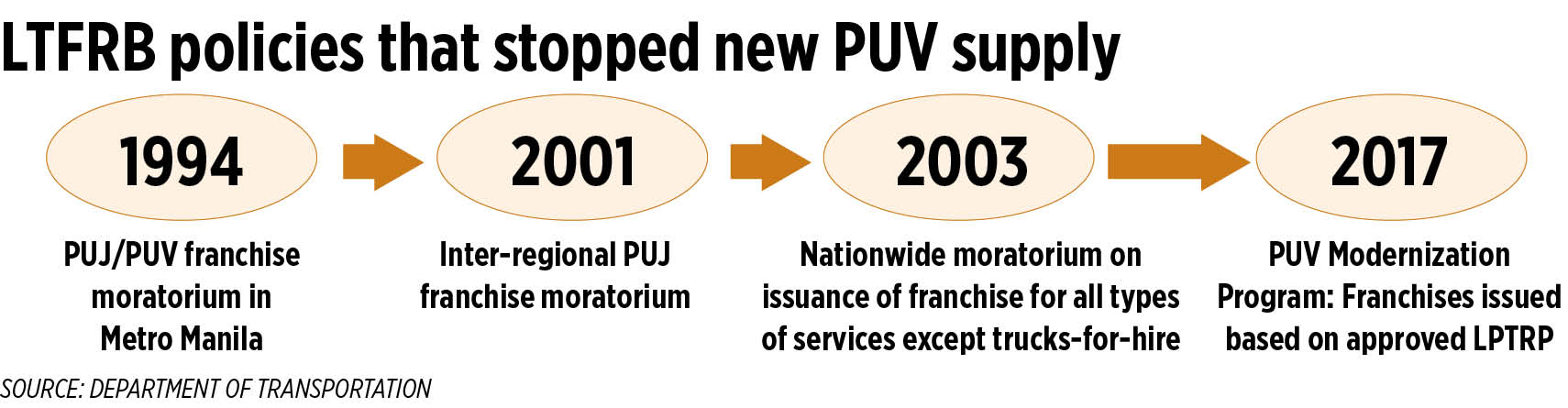
 

The net results of these policies has been a reduction in the service provided by the public utility jeepneys (PUJs) and buses (PUBs) in Metro Manila.The number of trips of the PUJs declined by 50% from 193,221 in 2013 to 95,659 in 2023 while the trips by the PUBs declined by 42% from 36,551 to 21,107.
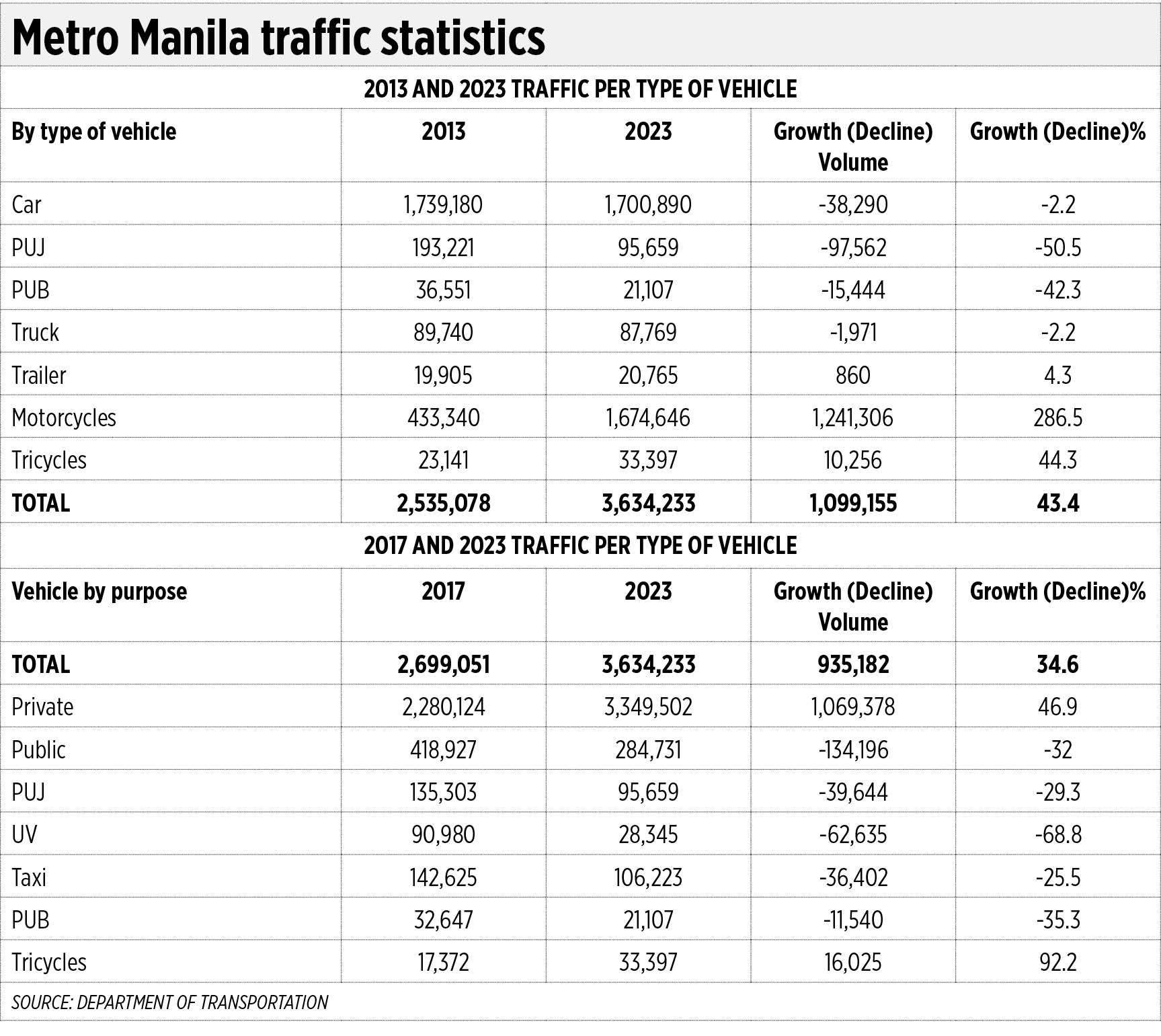
Over-all trips by private vehicles increased from 2,280,124 trips in 2017 to 3,349,502 in 2023 or a 47% increase while trips by public vehicles declined from 418,927 in 2017 to 284,731 in 2023 or a 32% decrease. As private vehicles occupy the same space as jeepneys but carry only one or two passengers as opposed to eight to 10 passengers for a jeepney, the result is severe traffic congestion, all as a result of the catastrophic decisions of the LTFRB.

The most plausible explanation for the adverse actions of the LTFRB is “regulatory capture.” Regulatory capture occurs when the regulator, in this case the LTFRB, is captured by those organizations it is supposed to regulate, in this case the jeepney, bus, and motorcycle operators.

As a captured agency, the LTFRB serves the interest of the operators rather than the public, in this case, the commuters. Clearly by decreasing the franchises and so the public vehicles on the road, the LTFRB serves the interest of the operators since their vehicles will now be filled to overflowing with passengers, some hanging on for dear life. On the other hand, commuters want more franchises so there will be enough vehicles to meet their transport needs.

Lacking adequate public transport, some of our hapless commuters were forced to buy, usually on installment, motorcycles if they had to have any hope of reaching their destination on time. Thus, the trips by motorcycles increased from 433,340 in 2013 to 1,674,646 in 2023 for a staggering increase of 286%.

Despite this response from the commuting public, there is still the problem of commuters who could not afford to buy motorcycles. This was of no concern to LTFRB but was of great concern to the city mayors of Metro Manila.

They decided to provide the public service that the LTFRB appallingly neglected to provide. The cities of Caloocan, Malabon, Manila, Pasig, Taguig, and Valenzuela started operating public bus services.

In the case of Pasig, the Pasig Bus Service was started in 2015 to provide free shuttle services from Pasig City Hall to key drop-off points in the city of Pasig. Pasig City bought its own buses and hired its own drivers.

In the case of Quezon City, the Quezon City Bus Service was started in 2020 and has now 100 buses serving eight routes with the Quezon City Hall as hub. However, instead of providing the service itself, Quezon City subcontracted the operation to Philtranco, Genesis, and Saulog. The rides are also free.

The city governments had to offer the rides for free since they do not have franchises from the LTFRB. Without the franchise, they cannot operate as a regular bus service. This arrangement has created problems. In addition to the issue of sustainability, the city government is also accused of unfair competition by the private operators.

We argue that instead of trying to be operators regulated by the LTFRB, the city governments should lobby for legislation devolving the regulatory function of LTFRB to the local government units.

At present, the issuance of franchises for tricycle operators has already been devolved to the local governments. And they have handled this responsibility quite well.

Take the case of Siquijor town in Siquijor Province, a popular tourist destination where the principal means of public transportation is now by tricycles. The Sangguniang Bayan regulates the operation of tricycles and has organized their operation efficiently and effectively.

By the way, few are aware that the 60,000 motorcycle taxi drivers are now allowed to operate only because of a pilot test approved by Congress in June 2019, which is valid only until June of this year. And so, Congress has proposed a law regulating these motorcycles drivers. We suggest that under this proposed law, these motorcycle franchises be regulated by the local government units as with the tricycle franchises.

We suggest further that the present PD on LTFRB be amended so that the regulation of public land transport be devolved to the provincial, city, and municipal governments with the LTFRB regulating only the national public transport systems.

We make this proposal for the following reasons:

1.) Given their interest and information on the needs for public transport in their community, the LGUs are in the best position to be the regulator for local public transport franchises rather than the LTFRB.

2.) Given that the regulatory powers will be diffused from one centralized agency to numerous LGUs, regulatory capture will be avoided; and,

3.) The LGUs can be held accountable when traffic congestion occurs in their locality. At present the critical role of the LTFRB in our present traffic congestion is not even realized by both our government officials and the commuting public.


Dr. Victor S. Limlingan is a retired professor of AIM and a fellow of the Foundation for Economic Freedom. He is presently chairman of Cristina Research Foundation, a public policy adviser and Regina Capital Development Corp., a member of the Philippine Stock Exchange.

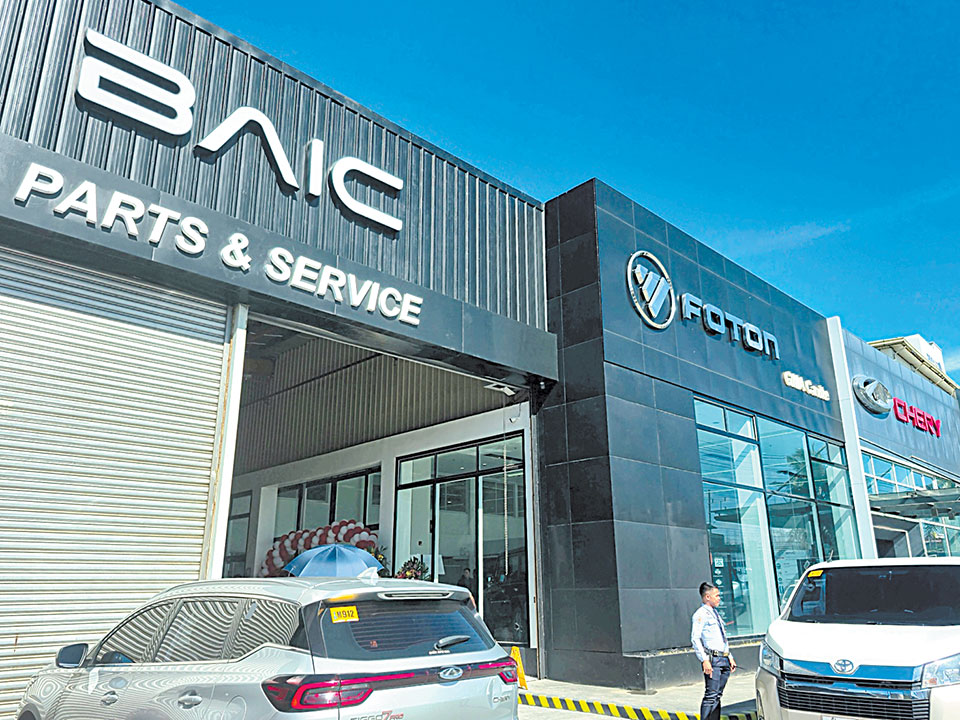
BAIC opens Cavite dealership

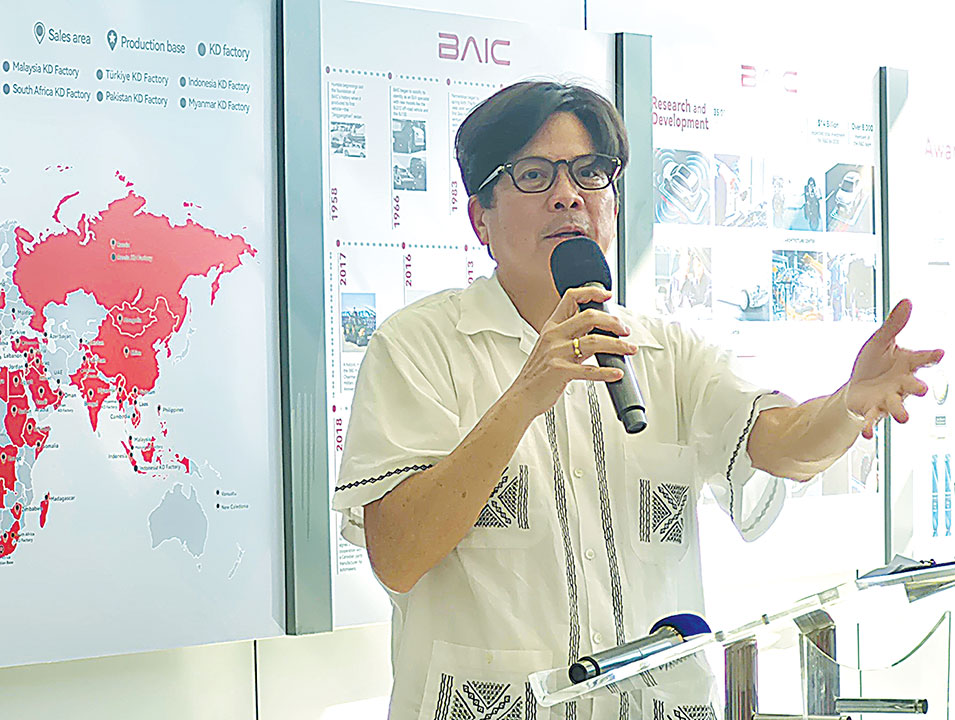
BAIC GMA is interconnected with dealerships of Foton and Chery, both of which are also distributed by the United Asia Automotive Group, Inc. (UAAGI). — PHOTO BY HAZEL NICOLE CARREON

By Hazel Nicole Carreon

BEIJING AUTOMOTIVE Industry Holding Company, Ltd. (BAIC) celebrated the grand opening of its newest dealership in General Mariano Alvarez (GMA), Cavite, marking the continued expansion of its presence in the Southern Luzon region, and the pursuit of its goal to bring a diverse range of vehicles closer to Caviteños.

Operated by Frontier Automotive Marilao Corp. (FAMC), BAIC GMA boasts a modern showroom showcasing the brand’s latest models. Furthermore, the dealership features a fully equipped service center staffed by expert technicians, ensuring that customers receive top-notch after-sales support.

The new outlet is FAMC’s first BAIC dealership. “It’s a great time to start the new year with a new brand. We want to sell more and more of these products that we can enjoy at very competitive prices,” said FAMC Dealer Principal Willy Chiongbian II in his speech at the opening ceremony.

Founded in 1958, BAIC has been a dominant player in the Chinese automotive market. It has formed joint ventures with major international car brands like Mercedes-Benz and Hyundai, giving BAIC access to technology, expertise, and an established distribution network. Now, the brand is strategically targeting emerging markets in Asia, Africa, and Latin America.

In the Philippines, BAIC vehicles have been distributed by the United Asia Automotive Group, Inc. (UAAGI) since 2024. The brand aims to cater to the growing demand for SUVs and crossovers in the local market, introducing various options such as the B40 Ragnar off-road SUV, B60 Beaumont hybrid full-size SUV, B30e Dune hybrid off-road SUV, B80 Wagon premium SUV, X55 subcompact crossover, and X7 Grandeza compact crossover.

“We have such a robust product portfolio with very competitive products, and we have very good pricing for the segments in which we are participating in. With the opening of this dealership, we are certain to make it big here in GMA,” BAIC Philippines General Manager and Brand Head Christopher Yu stated.

Every purchase of any BAIC model comes with a 150,000km/five-year vehicle warranty (whichever comes first). BAIC Philippines continues to strengthen its foothold in the local market through strategic dealership expansion and a focus on customer satisfaction. With the opening of BAIC GMA, the brand now has 15 dealerships nationwide, solidifying its commitment to providing high-quality vehicles and excellent service.

BAIC GMA is located at Block 23 Lot 2, Governor’s Drive, Barangay Gavino Maderan, GMA, Cavite. The showroom is open from Monday to Saturday, 8:30 a.m. to 5:30 p.m., while the service center is open from Monday to Sunday.

For more information, visit baic.ph.

Wildflour Hospitality weighs IPO

PHILSTAR FILE PHOTO

PREMIUM casual restaurant operator Wildflour Hospitality Group said an initial public offering (IPO) is a “big possibility” in the near future as the company pursues nationwide expansion.

“It is something that we are talking about. It’s really a big possibility for us in the near future,” Wildflour President and Chief Executive Officer Ana Lorenzana de Ocampo told reporters on the sidelines of an event in Taguig City last week.

“I can’t say yet because it’s still being discussed. But definitely, we are looking at an IPO,” she added.

In February last year, Wildflour announced that it secured a $15-million investment from Singapore-based private equity firm KV Asia Capital to support its expansion plans.

“Our partnership with KV Asia raises the ceiling for us to be able to do these things,” Ms. De Ocampo said.

The Philippine Stock Exchange is targeting six IPOs this year.

According to Ms. De Ocampo, Wildflour is opening 12 to 14 outlets across all its brands. The company currently operates 27 outlets.

She said new stores will open in SM North EDSA, Trinoma, Cebu, Alabang, Makati, and Baguio.

Ms. De Ocampo expects a strong financial year for Wildflour in 2025, noting that the company had a “good start.”

“I’m hoping that the trajectory really goes upward as we go into the year. We wouldn’t be building all these restaurants if we didn’t feel confident about the market,” she said.

“We’re very happy with how the restaurants are performing. I’m hopeful that 2025 will be a good year for us,” she added.

Ms. De Ocampo also acknowledged challenges in retaining manpower and mitigating the effects of inflation.

“It’s very easy to hire people, but training and retaining them are challenging for us,” she said. 

“On inflation, the cost of all our ingredients is rising, which affects many aspects — our menu mix, the prices of menu items, construction costs, and more. It’s really a domino effect. Manpower and inflation are our biggest challenges,” she added.

Wildflour’s portfolio includes various brands, such as Wildflour Restaurant, George & Onnie’s Filipino Restaurant, Wildflour Italian, Pink’s, Farmacy Ice Cream and Soda Fountain, Little Flour Café, Pizza Sisters, Kei Maki, and Antica Osteria. — Revin Mikhael D. Ochave

Paris Fashion Week: Pastel and shoulders at Chanel, petticoats for Dior, and Germanier’s colorful beads

CHANEL.COM

PARIS — Chanel assembled a sprawling runway set in the form of its trademark interlocking C logo for its spring summer 2025 catwalk show, held last Tuesday at the Grand Palais in central Paris.

Models paraded a pastel-colored lineup of glittering dresses and tailored jackets along the white carpet of the sloping set, many emphasizing the shoulders, which were bulked up. (Watch the show here: https://www.chanel.com/us/haute-couture/spring-summer-2025/ )

There were trim jackets with round, broadened shoulders, sheer dresses with piles of feathers, loosened sleeves and flouncy skirts.

At the end of the show, the clapping audience hesitated a moment, seeming to mark the customary pause reserved for a designer’s bow, before standing up and heading out into the blustery weather.

Chanel has been without a creative director since the abrupt departure of Virginie Viard halfway through last year, with her task left to in-house design teams. The privately owned fashion house said in December Matthieu Blazy would succeed her in the role.

The choice of Mr. Blazy, who joins from Kering-owned Bottega Veneta later this year and is credited with helping boost that label’s recent success, signals a new approach for Chanel, famous for tweed jackets and No. 5 perfume.

The haute couture fashion shows in Paris ran through Jan. 30 and featured some of the industry’s best-known labels

DIOR
Dior creative director Maria Grazia Chiuri kicked off the Paris Haute Couture fashion shows on Monday last week with a lineup of hooped petticoats and corsets in sheer, airy fabrics. (Watch the show here: https://www.youtube.com/watch?v=YfTathfqqvc)

Models marched down the runway in low heels parading ruffled and lacy looks, some with voluminous skirts, decorated with tufts of fabrics, sequins or ribbons that streamed behind.

Ms. Chiuri drew on the house’s original La Cigale silhouette from the early 1950s, known for a tightly cinched waist, as well as the looser Trapeze line from the late 1950s, throwing fitted jackets over short, puffy skirts and decorating tulle with embroidery.

Models wore their hair slicked back, in a mohawk-like style, with a row of feather-tipped spikes that added a punk flair to the look.

The LVMH-owned fashion house held the show in a temporary structure in the gardens of the Rodin Museum where the set was decorated by colorful artwork by Rithika Merchant. The artist’s fantastical creatures and tropical vegetation added to the otherworldly flavor of the catwalk presentation.

GERMANIER
Kevin Germanier showed a lineup of short, skin-hugging dresses in brightly colored beadwork for his namesake label’s catwalk outing on Thursday, closing the week of spring/summer 2025 haute couture shows in Paris. (See the show here: https://www.youtube.com/watch?v=S8LwBFxXu5I)

Models marched down the concrete runway, tassels swinging and bead-covered boots clicking. One garment appeared to be decorated with colored felt pens that fanned out in all directions while piles of ruffles added volume to knit dresses.

Mr. Germanier said he used second-hand garments and leftovers from workshops in countries including Brazil and India.

“My client is not just a celebrity, it’s literally a woman who just loves fashion and she wants to go to have tea with her friends looking fabulous,” he said, backstage after the show.

The Swiss designer has dressed celebrities including Taylor Swift, and made costumes for performers at the closing ceremony of the Paris Olympic Games last summer. — Reuters

Reflections on a just transition

VECTEEZY/ PIXFINITYSTUDIO

The Conference of Parties (CoP29) or the climate summit wrapped up in Baku, Azerbaijan in November 2024 with two clear outcomes: having a new target for climate finance to developing countries and laying down initial rules for bilateral and global carbon trading. These are not the ambitious and desired outcomes that climate activists have been hoping for, especially in the light of calls for a “just transition,” but at least the negotiations did not completely collapse.

The Intergovernmental Panel on Climate Change (IPCC) defines just transition as “a set of principles, processes and practices that aim to ensure that no people, workers, places, sectors, countries or regions are left behind in the transition from a high carbon to a low carbon economy.”

One emerging concern is that this transition requires the quick, deep, and massive transition in energy sources, access, and distribution. To deliver this transition to “clean energy,” massive amounts of minerals and raw materials are required, including nickel, cobalt, aluminum, lithium, and other rare earth minerals.

Which creates a dilemma. If we require more minerals to achieve the clean energy transition and pursue a “just transition,” would this mean we are going to open more mines? What if the mineral extractions would result in more deforestation, displacement of communities, or environmental harm?

In response, the extractives industry and some mining countries have touted their intent to expand “responsible mining” to reconcile the demand for more of these “transition minerals” with the triple-bottom lines of profit, people, and planet.

While it is true that transition minerals are needed for renewable energy systems, a large part of the demand for transition minerals is expected to be utilized for electric vehicles, and not necessarily for solar or wind energies.

In Germany, for instance, around 60% of raw material consumption is expected to go to the transport sector. A study by Power Shift investigated the metal requirements in the production of battery-powered cars by Volkswagen. It found out that the batteries alone could require around eight times more aluminum and nickel in 2030 than the entire planned expansion of wind power plants in Germany.

The questions then are: Who will benefit from mining transition minerals? Are they going to be used for solar or wind energies to power our cities and countryside, or are they going to mainly serve the shift to electric vehicles? Are they going to be utilized for the Philippines’ own industrialization, or are they going to be used mainly by rich countries’ energy transition?

More importantly, who will shoulder the costs — environmental, social, and health — of mining? Are there enough safeguards to prevent deforestation, water depletion, and noise and air pollution? Who will bear the impacts of loss of biodiversity, toxic mine accidents, and disasters? How about lost livelihoods by the affected communities?

Responsible mining claims that the jobs generated by mining companies justify acceptance for mining. However, government data from the Mines and Geosciences Bureau show that in 2023, the mining industry’s contribution to total employment is only at 0.45%, while its contribution to GDP is only 0.70% (at current prices).

To fully respond to the challenges of a just transition and towards a clean energy transition, the Marcos Jr. administration must consider the following recommendations:

1.) Enactment of an updated mining law. The Philippine Mining Act of 1995 remains inadequate to address climate change and disaster risk reduction (DRR).

2.) Expansion of the cost-benefit analysis of mining and other extractives projects.

3.) Additional and proper enforcement of no-go zones and protected areas, particularly prime agricultural lands, and primary forests.

4.) A science-based policy that ensures no sacrifice zones are added to the already many vulnerable and high-risk areas susceptible to climate change impacts.

5.) Defining and strengthening the recycling and reuse systems of various industries.

6.) Formulation and adoption of a circular economy framework.

While we can recognize that minerals and metals do have roles and contributions to make in the path to industrialization, mining must not create more sacrifice zones nor deepen the suffering of people and planet to satisfy the increasing needs of already richer countries.


Rhoda Viajar is the media/communications consultant of Alyansa Tigil Mina (ATM). She keeps busy by doodling, tending to her 94-year-old father, and spending time with family.

Treasury bills, bonds may fetch lower rates on BSP easing hopes

BW FILE PHOTO

RATES of the Treasury bills (T-bills) and Treasury bonds (T-bonds) to be auctioned off this week may continue to move lower on expectations of further monetary easing by the Bangko Sentral ng Pilipinas (BSP) after Philippine economic growth fell below the government’s target in 2024.

The Bureau of the Treasury (BTr) will auction off P22 billion in T-bills on Monday, or P7 billion each in 91- and 182-day papers and P8 billion in 364-day papers.

On Tuesday, the government will offer P30 billion in reissued seven-year T-bonds with a remaining life of five years and five months.

T-bill and T-bond auction yields could mirror the week-on-week decline in secondary market rates as softer-than-expected Philippine gross domestic product (GDP) growth last year could support further policy easing by the BSP, Rizal Commercial Banking Corp. Chief Economist Michael L. Ricafort said in a Viber message.

At the secondary market on Friday, the 91-, 182-, and 364-day T-bills went down by 3.36 basis points (bps), 5.02 bps, and 13.49 bps week on week to end at 5.2786%, 5.5219% and 5.7118%, respectively, based on PHP Bloomberg Valuation Service Reference Rates data as of Jan. 31 published on the Philippine Dealing System’s website.

Meanwhile, the seven-year bond went down by 7.37 bps week on week to yield 6.0831%, while the rate of the five-year debt, the tenor closest to the remaining life of the T-bonds to be offered on Tuesday, dropped by 9.59 bps to end at 5.9872%.

Philippine GDP expanded by 5.6% in 2024, missing the government’s 6%-6.5% full-year growth target but slightly faster than 5.5% in 2023.

BSP Governor Eli M. Remolona, Jr. on Friday said that a rate cut is “on the table” at the Monetary’s Board’s Feb. 13 policy meeting, with economic growth “a little bit below capacity.”

“If the [output] gap is widening, if it becomes more negative, then it would call for more easing,” Mr. Remolona said.

On Saturday, the BSP chief said the Philippine central bank may cut benchmark rates by 50 bps this year in a gradual manner as “policy insurance” against risks.

Mr. Remolona said the reductions could be implemented in increments of 25 bps each in the first and second half of the year.

The Monetary Board has slashed benchmark borrowing costs by 75 bps since kicking off its easing cycle in August last year, bringing the policy rate to 5.75%.

Meanwhile, a trader said in an e-mail that the reissued bonds on offer on Tuesday could fetch rates ranging from 5.90% to 5.975% before the release of January Philippine inflation data on Wednesday (Feb. 5).

“Higher fuel and some major food items due to weather disturbances are expected to pressure the print,” the trader said.

A BusinessWorld poll of 16 analysts yielded a median estimate of 2.8% for the January consumer price index.

If realized, this would be a tad slower than 2.9% in December and match the 2.8% print in the same month a year ago. This would also be within the BSP’s 2.5%-3.3% forecast for the month.

Alessandra P. Araullo, chief investment officer at ATRAM Trust Corp., said in a Viber message that the T-bonds could be quoted at 5.95% to 6.05%, depending on the market’s appetite for longer tenors.

Last week, the BTr raised P27.6 billion from its auction of T-bills, higher than the initial P22-billion plan, as total bids reached P91.06 billion, more than four times as much as the amount on offer.

The oversubscription led the Treasury to double the accepted non-competitive bids for the three- and six-month debt to P5.6 billion each for the third straight T-bill auction.

Broken down, the Treasury borrowed P9.8 billion via the 91-day T-bills, higher than the programmed P7 billion, as tenders for the tenor reached P32.25 billion. The three-month paper was quoted at an average rate of 5.113%, falling by 42.3 bps from the previous auction, with accepted rates ranging from 5.098% to 5.128%.

The government also made a P9.8-billion award of the 182-day securities, above the P7-billion program, as bids stood at P26.65 billion. The average rate of the six-month T-bill stood at 5.488%, dropping by 13.5 bps, with the BTr only accepting bids with this yield.

Lastly, the Treasury raised P8 billion as planned via the 364-day debt papers as demand for the tenor totaled P32.16 billion. The average rate of the one-year debt decreased by 5.1 bps to 5.724%, with bids accepted having rates of 5.69% to 5.728%.

Meanwhile, the reissued bonds to be offered on Tuesday were last auctioned off on Jan. 7, where the government raised P30 billion as planned for an average rate of 6.06%, below the 6.375% coupon rate.

The Treasury is looking to raise P203 billion from the domestic market this month, or P88 billion from T-bills and P115 billion from T-bonds.

The government borrows from local and foreign sources to help fund its budget deficit, which is capped at P1.54 trillion or 5.3% of gross domestic product this year. — A.M.C. Sy

Isuzu PHL leads truck sales for 25 years straight

Isuzu Philippines Corp. President Tetsuya Fujita poses with some key truck models of the brand. — PHOTO FROM ISUZU PHILIPPINES CORP.

ISUZU PHILIPPINES CORP. (IPC) notched a historic milestone, maintaining its position as the leading truck brand in the Philippines for 25 consecutive years. In a release, IPC said this reflects an “unwavering commitment to quality, reliability, and customer satisfaction.” In 2024, IPC sold a total of 4,591 trucks, cornering 41% of the market, and achieving a “triple crown” by dominating all three major truck categories: light-duty, medium-duty, and heavy-duty trucks.

The company reported that the Isuzu N-Series truck remains the best-selling light-duty truck model in the country for an unprecedented 26 straight years. A total of 2,812 units were sold in 2024, capturing 43% of the Category III market share. “The enduring popularity of the N Series can be attributed to its fuel efficiency, durability, versatility, and advanced safety features, making it the preferred choice for businesses across industries such as retail, logistics, and construction,” the company said.

The N Series uses Isuzu’s globally renowned Blue Power Euro 4 technology, ensuring low emissions, fuel efficiency, and compliance with environmental regulations. Various body configurations such as dropside, aluminum van, refrigerated van, and fire truck – cater to diverse business needs. It has a rigid chassis frame with crash safety cabin design for enhanced driver and cargo protection, and gets ergonomic cabin design, adjustable seating, and modern dashboard features for better driving experience and reduced fatigue during long hauls. Meanwhile, Isuzu N-Series Smoother runs on a so-called Automatic Manual Transmission (AMT), making it more comfortable for drivers to operate the truck.

“The Isuzu N-Series continues to be the top choice for Filipino businesses due to its unmatched combination of durability, fuel efficiency, and adaptability to various business applications,” said IPC President Tetsuya Fujita. “We are proud that our light-duty trucks have remained a staple in the industry, providing dependable solutions that help businesses grow and thrive.”

The company’s success extends beyond light-duty trucks. In the Category IV (medium-duty trucks and buses) segment, IPC sold 1,534 units, achieving a 40% market share. Medium-duty trucks, such as the popular Isuzu F-Series, cater to logistics, cold chain, and industrial hauling needs, which have seen significant growth in recent years.

In the Category V (heavy-duty trucks) segment, Isuzu sold 245 units, securing 33.2% market share, further cementing its reputation as the go-to brand for large-scale logistics and infrastructure projects. Isuzu heavy-duty trucks, known for their powerful performance, high payload capacity, and robust chassis, provide businesses with the capability to transport heavy loads efficiently.

IPC attributes its market dominance not only to its exceptional truck models but also to its industry-leading after-sales services and customer support, collectively known as the “Isuzu Advantage.” This comprehensive support system includes a 48-strong nationwide dealership network; comprehensive parts inventory (with a 6,000sqm parts warehouse facility); Isuzu Mobile Medic Trucks which can reach remote areas to provide emergency repairs and maintenance services on site; expert Japanese truck engineers who are deployed to “assist businesses in customizing their trucks according to specific operational requirements, offering tailored solutions that enhance efficiency;” specialized driver and mechanic training programs, and high-quality body applications by authorized builders.

Added Mr. Fujita, “Our commitment goes beyond selling trucks. We are dedicated to being a reliable partner for our customers by offering comprehensive after-sales support that ensures their trucks remain in optimal condition throughout their lifespan. We will continue to provide our customers with exceptional service, ensuring that Isuzu remains their ‘Responsible Partner’ for years to come.”

For more information, visit www.isuzuphil.com or follow Isuzu Philippines on Facebook.

Down to Earth touts regenerative farming

PHILIPPINE STAR/EDD GUMBAN

By Adrian H. Halili, Reporter

SPECIALTY vegetables and herb growers Down to Earth said it is seeking to enhance agricultural practices through regenerative farming methods.

“Regenerative agriculture is a growing practice that centers mostly on soil building,” Nicolo Aberasturi, founder and owner of Down to Earth, told BusinessWorld.

Mr. Aberasturi added that his practice focuses on using ruminant animals to boost soil health.

“We use ruminant animals to cycle the supposed to be weeds or grass in the farm.,” he said. “You are actually adding, building up your soil.”

He added that grass or weeds that are normally growing in farms would be fed to animals like pigs or cattle, while their manure fertilizes the soil.

Regenerative agriculture is also a means of improving water quality and biodiversity.

“Even (organic farming) can destroy the structure of the soil even if there are no chemicals used,” he said.

“Every time you damage the soil, you deplete the soil structure and the quality of the minerals in the soil that plants need,” he added.

The effects of soil degradation in the Philippines have led to loss of productive topsoil through water erosion, declining soil fertility due to over-cultivation, and reduced vegetation cover due to illegal logging, according to the Bureau of Soils and Water Management.

Mr. Aberasturi said that crops grown using regenerative practices are “more complete in minerals.”

He added the Down to Earth mainly focuses on the growing of specialty vegetables, herbs, and edible flowers, targeting hotels and restaurant owners serving farm to table cuisine.

Down to Earth also sells grass fed beef and other meats from its farms in Tanauan, Batangas, and Dahilayan, Bukidnon. It also operates a physical store in Mandaluyong.

He said that the business also does small-scale bottling and canning.

“Let’s say, we have an excess of tomatoes, what we do is that we make them into sauce or sun dry them. This is so that the excess is not wasted, and we sell them already bottled,” he said.

Additionally, Mr. Aberasturi said that Down to Earth also trains farmers on regenerative farming methods.

“We are seeing a window of opportunity, and we want to share the technology to other small farms that are just starting,” he said.

He added that repurposing excess harvest for animal feed will reduce post-harvest losses.

“If they have the technology, the excess vegetables we see or read about in the news that are rotting (can be used as) animal feed instead,” he said.

SEC files complaint against Seataoo

BW FILE PHOTO

THE SECURITIES and Exchange Commission (SEC) has filed a criminal complaint against New Seataoo Corp. and Seataoo Information Technology One Person Corp. (Seataoo OPC) for soliciting investments without the required license.

The complaint, which also covers the entities’ officers, was filed before the Department of Justice on Jan. 16, the corporate regulator said in an e-mailed statement over the weekend.

The SEC said that Seataoo Group was found offering securities in the form of investment contracts through a “dropshipping e-commerce platform” scheme.

Investors are encouraged to become online sellers on the group’s platform, with a requirement to deposit money for order processing.

The group promises returns of 7% to 12% on the invested amount. It also offers an affiliate program where existing investors or online sellers earn a 3% referral commission.

“This scheme affirms that the deposited funds are, in reality, investments, as they are not limited to transactional payments directly tied to specific purchases. In fact, complainants are demanding the return of their investments plus profits,” the SEC said.

“This mandatory funding of individual accounts required of Seataoo’s members and online sellers is a device used by Seataoo to mask its offer and sale of unregistered securities, thereby obtaining investments from the public without securing the requisite license from the commission,” it added.

In June last year, the SEC revoked the certificates of registration of New Seataoo Corp. and Seataoo Information Technology OPC for violating the Revised Corporation Code, the Securities Regulation Code, and the Financial Products and Services Consumer Protection Act, among others.

In December, the commission en banc denied the appeal filed by New Seataoo Corp. and Seataoo Information Technology OPC against the revocation order for lack of merit.

BusinessWorld sought comment from Seataoo via e-mail but has yet to receive a response as of the deadline. — Revin Mikhael D. Ochave

Style (02/03/25)


There’s a new sneaker in town

THE sneaker game in the Philippines just got a new player with SJ Lifestyle, a brand born from the Cortina family’s 70-year heritage of crafting premium footwear. SJ seamlessly blends timeless craftsmanship with modern innovation to deliver stylish, sustainable and affordable sneakers that make every step count. SJ Lifestyle, a Belgian brand, is challenging the market by proving that feature-packed sneakers made with high-quality materials do not have to come with a hefty price tag. With prices ranging from P2,500 to P5,000, SJ offers affordable sneakers that feature trendy designs and superior comfort that easily get you through the day pain-free. The cherry on top? These shoes are made with recycled materials. Not only do these sneakers look good, but they are also environmentally friendly. The Belgian sneaker brand has launched its latest “Athleisure” collection, featuring three versatile models, all engineered with lightweight and high energy return midsole technology. The collection also features recycled footbeds, linings, and laces. The collection includes the “Ibiza” sneakers for men and women. It has an elevated midsole for extra height and shock absorption. The “SJ Reflect” for men and women are heavy on features and were engineered for a variety of uses, from a chill stroll through the city, exploring nature, or going on a trail run, while keeping your feet steady with enhanced grip and heel support. These sneakers also show off reflective details for visibility at night and insoles made from 100% recycled materials. Finally, the “Trail” sneakers for men and women are engineered for diverse terrains. These soft, trail-inspired sneakers blend outstanding performance with a fashionable edge. Featuring a curved midsole providing a 60% energy return, an ultra-breathable jacquard upper and linings made from recycled materials. Shop the shoe collections on Shopee, Lazada, Zalora, and the official SJ Lifestyle Online Store www.sjlifestyle.ph. It also has a brick-and-mortar store at the Festival Mall, Alabang. Plans are underway to expand to more locations across Metro Manila in 2025, starting with SM North EDSA this February.


Viña Romero now at Rustan’s

CONTEMPORARY FILIPINO fashion designer Viña Romero introduces her newest collection, Palagi (“Always”), exclusively at Rustan’s. Known for weaving her personal journey into her work, Ms. Romero continues to redefine timeless design through her latest collection. The collection showcases signature elements that define Ms. Romero’s craftsmanship. Pintucks, patchwork, pleats, and playful tailored ribbons make their mark across both menswear and womenswear. The thoughtful incorporation of traditional techniques, particularly with the barong, is paired with unexpected design elements and contemporary color palettes. The Palagi collection is now exclusively available at Rustan’s.


Fendi Peekaboo gets new look

FENDI’S iconic Peekaboo line introduces the Peekaboo Soft Small bag. Unveiled on the Women’s Spring/Summer 2025 runway, this latest iteration embodies softness and versatility. Taking inspiration from the Peekaboo Soft bag, the Small size stays true to its codes and unparalleled softness. In fact, the bag maintains the original features of the Medium and Large sizes: the soft construction, lightweight design, and sumptuous high-quality calf leather. Its wearability is enhanced with a new cross-body functionality, thanks to an adjustable strap extension that can be added to the handle. In this way, the Peekaboo Soft Small offers shoulder, crossbody, and handle wear, designed for day-to-evening wear. The Peekaboo Soft Small comes in a range of colors in leather, spanning from timeless neutrals like dove and black to vibrant spring-inspired hues like matcha green. The bag is also available in a seasonal version adorned with 468 fringes. More luxurious versions are crafted in exotic croco dégradé. The bag was pre-launched in selected Fendi boutiques worldwide and at fendi.com on Jan. 9.

The Marquis de Sade’s Guide to Cancel Culture

PICRYL

IN THEOLOGY, being condemned to perdition may sound a lot like going to hell, but it’s much worse than spending eternity amid fire and brimstone. Those who believe in the survival of the soul after death shudder at the gravity of perdition: the total dissolution of one’s existence even in spiritual form. In our increasingly soulless secular age, there’s an attempt at a similar punishment: We call it cancellation.

The concept derives from television — that which befalls series and shows with bad ratings, yanked by broadcast networks, never to be seen again. Its first use in popular culture in that sense may have been in the lyrics of “Your Love Is Cancelled,” by the disco-funk group Chic (“Well I saw it on TV ‘bout someone like me…”). The song is from 1981, but cancellation as we know it really got going this century. Today, it’s a pile-on of blaming and shaming in our social media public squares that often leads to the target’s commercial or career oblivion. The courts can also get involved to mete out justice. The vitriol makes it much more hellish than old-fashioned consumer boycotts.

Some of the most spectacular examples involve fans turning against their idols. The most recent is graphic novel icon Neil Gaiman, who has received massive condemnation after lurid stories emerged alleging sexual assault and harassment on his part. He has denied the allegations and there are no criminal charges filed against him. Nevertheless, the furor has convinced publishers to avoid or drop Gaiman, who has become a multimillionaire from his oeuvre of close to 50 novels and comic books. HarperCollins and W.W. Norton, which have successfully published his books before, said they have no plans with the British author. In late January, Dark Horse Comics announced it wouldn’t release the last volume of its illustrated version of his 2005 fantasy novel Anansi Boys.

On Friday, Variety reported that Netflix, Inc.’s adaptation of The Sandman, based on Gaiman’s bestselling comic books, will end after the second season later this year.

Does such collective vengeance result in permanent perdition? The history of one offender may hold some lessons.

If any literary figure should be up for perpetual cancellation, it’s Donatien Alphonse François de Sade — the Marquis de Sade, pornographer, philosopher, poisoner, prisoner, the prophet of sexual excess and cruelty, the inspiration for the word “sadism.”

It’s not as if no one tried to erase the French nobleman from memory before. Beset by episode after episode of his violent sexual exploits and blasphemous outbursts, his status-conscious mother-in-law had him thrown into prison for more than 12 years, including a dramatic turn in the infamous Bastille just before it was stormed by the mobs of the French Revolution on July 14, 1789. He was condemned to be executed twice — the first time for sodomy and for poisoning prostitutes he’d hired for orgies in Marseille (the women fell ill after ingesting pastilles probably laced with the aphrodisiac Spanish fly). But he and an accomplice fled to Italy and were burned in effigy instead. When he was out of the Bastille, the chaos of the French Revolution saved him in the nick of time from the nick of the guillotine. Ironically, one of the charges was for being a political moderate in the reign of terror of Maximilien Robespierre, whose overthrow the same day, 9 Thermidor (July 27, 1794) likely saved Sade’s life.

Sade was a byword for excess and violence even before he began publishing his books, which he didn’t really get to until the 1790s. Justine and Juliette are companion novels (their subtitles are The Misfortunes of Virtue and Vice Amply Rewarded, respectively). The title characters are sisters with opposite views of morality on whom Sade then proceeds to inflict a series of lurid and humiliating assaults till they both end up in nunneries. Juliette so scandalized Napoleon Bonaparte that, in 1801, he ordered Sade consigned to the insane asylum of Charenton for the rest of his life. Sade’s final wish was to be buried in a corner of what remained of his estate. As he wrote in his last will and testament: “My grave, once covered over, shall then have acorns strewn over it, in order that the spot become green again, and the copse grown back thick over it, so that any trace of my grave will disappear from the face of the earth, just as I trust the memory of me will fade from the minds of everyone.”

His relatives disassociated themselves from Sade but he hasn’t been forgotten. Justine and Juliette were put on the index of books forbidden to Catholics but were somehow taken off the banned list in 1835, two decades after his death. The German psychiatrist Richard von Krafft-Ebing coined the word “sadism” in 1886 to describe sexual gratification resulting from the inflicting of pain and humiliation. The beginning of the 20th century saw the reemergence of the manuscript of The 120 Days of Sodom, or the School of Libertinage, which Sade wrote secretly and hid in the Bastille and believed was destroyed when the prison-fortress was demolished. Its unrelenting litany of sex crimes and murders was first published in 1904. It was the basis of poet and film director Pier Paolo Pasolini’s Salò o le 120 giornate di Sodoma. The movie isn’t set in the last days of the reign of Louis XIV, as Sade conceived it, but during the final throes of Benito Mussolini’s Republic of Salò.

Simone de Beauvoir wrote a defense of the marquis in 1951 entitled “Must We Burn Sade?” One academic in 2022 said it was consistent with the feminism of the French social critic’s magisterial The Second Sex: “In his writings is revealed sexuality’s potential to subvert patriarchal norms and mystifications, and perhaps, in the end, even gender itself.” Meanwhile, therapists have prescribed S&M for people suffering from sexual trauma — the S standing for sadism. In 2022 The novelist Pierre Guyotat — whose own novels were once banned in France — said that “Sade, that extraordinary hero, is in a way, the French Shakespeare.” And if not the Bard of Avon, then a homebody? In 1998, Francine du Plessix Gray published At Home with the Marquis de Sade: A Life, a fictional account of the two women who defined him — his maleficent mother-in-law and her daughter, his devoted and enabling wife (who endured Sade’s affair with her younger sister, a canoness*).

This extended afterlife for a convicted pornographer hasn’t gone undenounced. In 1981, feminist writer Andrea Dworkin hectored Sade devotees, declaring that “the power of the pornographer is the power of the rapist/batterer is the power of the man.” But death — and his own final wishes — haven’t obliterated him. His books continue to circulate; and every decade or so, a new Sadean fervor wells up. For some “canceled” people, you can still separate the inspirational artist from the failure of a human being (though I will always cringe a little before I dance to Michael Jackson). But Sade’s life was at the heart of his art — and his life was despicable. Ick.

Generations of haters haven’t been able to dislodge him from our cultural imagination — or bookshelves or movies, though it’s been a quarter century since the last major motion picture about him. Even Sade’s real family has come around to their forebear’s infamy: One descendant began marketing a line of champagnes bearing his name in the late 1980s. It’s a caution to those of us who feel that outrage that’s expressed publicly and vociferously enough can pulverize a reputation forever. Perhaps it can send an author or celebrity to limbo. But that’s not perdition — and is no guarantee that the target won’t return as Sade has, again and again.

There is one thing that can be done. When I told my colleagues I was writing a column about the Marquis de Sade, there was one almost universal response: sniggering. I smiled back. As Thomas More said, “The devil, that proud spirit, cannot endure to be mocked.” Sade’s a joke. Laugh his ghost out of the room.

What should go without saying — but I’ll type anyway — is the prerequisite for the cancelled who are hoping for Sade-style resurrection: You’ve got to be dead first. n

BLOOMBERG OPINION

*A woman who chose to live with nuns but did not take permanent vows of poverty and could leave the religious community if she chose.

BSP securities’ rates mixed as demand slips

BW FILE PHOTO

YIELDS on the Bangko Sentral ng Pilipinas’ (BSP) short-term securities ended mixed on Friday as the two-month bills went undersubscribed.

The central bank securities fetched bids amounting to P185.96 billion on Friday, higher than the P170-billion offer but slightly below the P186.394 billion in tenders for the P200 billion auctioned off a week prior.

Broken down, tenders for the 28-day BSP bills reached P88.323 billion, above the P70-billion offer and the P74.195 billion in bids for the P100 billion auctioned off the previous week.

Banks asked for yields ranging from 5.7% to 5.839%, narrower than the 5.64% to 5.9% band seen a week earlier. This caused the average rate of the one-month securities to inch down by 0.19 basis point (bp) to 5.8119% from 5.8138% previously.

Meanwhile, bids for the 56-day bills amounted to P97.637 billion, lower than the P100-billion offering and the P112.199 billion in tenders for the same volume auctioned off the week prior. The BSP awarded all the submitted bids.

Accepted rates for the two-month tenor were from 5.73% to 5.9%, higher than the 5.65% to 5.875% margin seen a week prior. With this, the average rate of the securities rose by 1.81 bps to 5.8048% from 5.7867% logged in the prior auction.

The central bank increased last week’s total offering of BSP bills (BSPB) compared to the volume put up for auction previously, BSP Deputy Governor Francisco G. Dakila, Jr. said in a statement.

“Total tenders received fell slightly to P185.96 billion (from P186.394 billion) and resulted in bid-to-cover ratios of 1.26 times for the 28-day BSPB and 0.98 times for the 56-day BSPB. The BSP fully awarded its offering for the 28-day BSPB and accepted the P97.637-billion worth of total tenders for the 56-day BSPB.”

The central bank uses the BSP securities and its term deposit facility to mop up excess liquidity in the financial system and to better guide market rates.

The BSP bills were calibrated to not overlap with the Treasury bill and term deposit tenors also being offered weekly.

Data from the central bank showed that around 50% of its market operations are done through the short-term BSP bills.

Short-term instruments offer more stability and predictability, the BSP earlier said. These are also considered “high-quality liquid assets” and grants more flexibility for banks versus term deposits, which are not tradable. — Luisa Maria Jacinta C. Jocson