Home Blog Page 1448

Senate ratifies bills on right-of-way sites and nuclear regulatory body

BW FILE PHOTO

THE Philippine Senate on Wednesday ratified bicameral conference reports on measures that will hasten infrastructure projects by facilitating easier acquisition of right-of-way sites and create a nuclear energy regulatory body before it adjourned sine die.

The report, which reconciled Senate Bill No. 2821 and House Bill No. 6571, sought to amend Republic Act No. 10752, the Right-of-Way Act, to make the acquisition of right-of-way sites easier for infrastructure projects designed for public use.

“There were problems in the acquisition of the right-of-way. It was a recurring problem for infra projects which eventually caused delays in its accomplishment resulting in economic losses to the government,” Senator Mark A. Villar, who formerly sat as secretary of Public Works and Highways, said in his sponsorship address.

The Accelerated and Reformed Right-Of-Way Act is expected to also “expedite the process of right-of-way acquisition and provide just compensation to private property owners,” he said.

The measure was among the priority bills identified by the Legislative-Executive Development Advisory Council for the 19th Congress.

Also on Wednesday, the chamber approved the bicameral conference report on the Philippine National Nuclear Energy Safety Act. The report, which reconciled Senate Bill No. 2490 and House Bill No. 9293, will create an independent government body that regulates all sources of ionizing radiation, including nuclear and radioactive materials and radiation devices.

“This bill is clear in separating the agencies that promote and regulate nuclear energy. When I say atomic energy, this includes for medical purposes, agriculture, etc.,” Senator Alan Peter S. Cayetano said in a separate address.

The measure also imposes a legal framework for the safe use of nuclear energy in the country.

Moreover, the Senate ratified a proposed act that would strengthen the fiscal autonomy of the judicial branch of government.

This would allow the Supreme Court or the Chief Justice to realign their budget and create a Judiciary Trust Fund. — Adrian H. Halili

Gov’t sends generators to Siquijor

BW FILE PHOTO

PRESIDENT Ferdinand R. Marcos, Jr. on Wednesday said the government is deploying emergency generators to Siquijor to ease a power crisis that has left parts of the island with electricity for as little as two hours a day as he criticized private power provider Siquijor Island Power Corp. (SIPCOR) for failing to meet its obligations.

To immediately restore a reliable supply, the administration has ordered the transfer of two large generator sets from Palawan to Siquijor, following improvements in the power situation in the Central Visayan province.

The sets are expected to arrive within 24 hours, which will stabilize electricity across the island once operational. The President, however, stressed this is only a stopgap measure.

“The assessment is that SIPCOR has to live up to their commitments,” Mr. Marcos told reporters in Siquijor during the inspection of the SIPCOR power plant, according to a transcript from the Presidential Palace.

The inspection followed the declaration of a state of calamity on the island due to power outages.

“There are many shortcomings. We have to repair damage that has been caused by the collapse of the power supply, and that is the schedule we have given ourselves — six months.”

The President guaranteed there would be a long-term solution to the power shortage in the island province in six months.

“No more of these piecemeal, stopgap measures that we’ve been forced to implement. The government will do its part. SIPCOR must do theirs,” he added in Filipino.

SIPCOR is a subsidiary of the Villar Group’s Prime Asset Ventures, led by former Senate President and richest man in the country, Manuel B. Villar, Jr.

Head of public relations at Prime Asset Ventures, Inc., Mavic Chavez Ching, did not immediately respond to a Viber chat seeking comment.

Siquijor, long known for its mystical charm, has in recent years emerged as a rising tourist destination. Mr. Marcos warned that the continued power disruptions could derail its economic momentum.

“The people who are the victims of this situation are ordinary people of Siquijor, and they cannot go about their business,” he added. “We are losing — they are losing that opportunity to develop due to the electricity shortage.”

Calls have grown among Siquijor residents for the government to consider other electricity suppliers.

The president said, “everything is on the table” as long as it leads to the best long-term outcome.

The Department of Energy, in coordination with local officials, is expected to lead the planning and negotiations for long-term reforms in Siquijor’s power infrastructure.

SIPCOR on Tuesday said it is working to fully restore electricity in the province. It has so far completed maintenance on one of its service units, providing an increase of 7,550 kilowatts to its capacity. — Chloe Mari A. Hufana

DFA, DHSUD chiefs get CA nod

THE COMMISSION on Appointments (CA) on Wednesday confirmed the appointment of Foreign Affairs (DFA) Secretary Ma. Theresa P. Lazaro, who will assume office on July 31.

“She possesses the gravitas, wisdom, and commitment that the post demands. I therefore respectfully urge this Commission to confirm her appointment as Secretary of Foreign Affairs of the Republic of the Philippines,” Senator Jose “Jinggoy” P. Estrada said in a sponsorship speech.

Ms. Lazaro will replace current Foreign Affairs Secretary Enrique A. Manalo, who was re-assigned as the Philippine Permanent Representative to the United Nations.

The constitutional body also approved the appointment of Housing (DHSUD) Secretary Jose Ramon P. Aliling, who will succeed Jose Rizalino L. Acuzar after he was reassigned as presidential adviser for the Pasig River development.

Both secretaries were recently appointed by President Ferdinand R. Marcos, Jr. following a sweeping review of his Cabinet members.

The CA had also confirmed the appointment of 118 generals and flag officers of the Armed Forces of the Philippines. — Adrian H. Halili

Gov’t to conclude PrimeWater probe

BW FILE PHOTO

THE Presidential Palace on Wednesday said the investigation into the Villar-owned Prime Water Infrastructure Corp. for alleged poor services and high cost will most likely conclude next week.

In a briefing, Palace Press Offices Clarissa A. Castro said the probe of the water company will most likely wrap up next week after President Ferdinand R. Marcos, Jr. last April 30 ordered the investigation.

“I don’t want to preempt anything, but most probably… I don’t want to say ‘by next week,’ but it’s just around the corner,” she said in Filipino.

Ms. Castro added that PrimeWater has pledged to repair pump stations in Bulacan to help ensure a sufficient water supply for schools affected by service disruptions in the province.

Water supply in schools is expected to resume following the completion of repairs, which are scheduled to begin on June 13, just days ahead of the start of classes next week.

Mr. Marcos has directed the Local Water Utilities Administration (LWUA) to investigate and address the water supply shortage affecting several schools in Bulacan, which he personally inspected last Monday.

During his visit to Tibagan Elementary School in San Miguel, Bulacan, the President observed that the school’s comfort rooms needed rehabilitation. However, efforts to improve the facilities have been hampered by an ongoing water supply problem in the area.

The private company oversees and operates water services for over 500,000 households across more than 100 districts nationwide. — Chloe Mari A. Hufana

More NAIA officers to be deployed

REUTERS

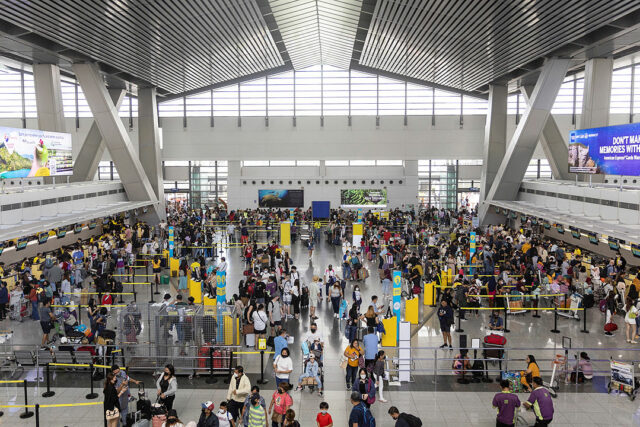
THE Department of Transportation (DoTr) together with Manila International Airport Authority (MIAA) and the Bureau of Immigration (BI) have signed a memorandum of agreement (MoA) on Wednesday to ensure shorter lines at the immigration counters at the country’s main gateway.

“Based on our assessment the long queues at the immigration counters were because of the lack of immigration personnel due to budget constraints, this is the reason why we came up with this agreement,” Transportation Undersecretary Giovanni Z. Lopez said in a media briefing on Wednesday.

Under the agreement, the Transportation department will authorize the allocation and disbursement of the immigration service charge for the BI when additional immigration officers were asked to perform overtime duties not covered by the 2025 general appropriations budget.

MIAA General Manager Eric Jose C. Ines.  did not disclose the amount needed to be extended to the Immigration bureau by MIAA for the program.

“We are still calculating the amount, there is a computation in the agreement but that is a ballpark figure and that is about P5 million monthly,” Mr. Ines said, adding that a technical working group will be formed to also determine the total number of personnel to implement the program.

The Transportation department also said that the deal signed with BI and MIAA will also ensure enough immigration personnel at peak hours, especially with the anticipated travel demand. — Ashley Erika O. Jose

8 Mpox patients in BARMM recover

COTABATO CITY — All of the eight individuals in the Bangsamoro region afflicted with monkeypox have recovered, regional health officials announced on Wednesday.

Employees of the Ministry of Health-Bangsamoro Autonomous Region in Muslim Mindanao (MoH-BARMM) are closely observing 37 others suspected of having contracted the viral disease and whose blood samples had been sent to the Research Institute for Tropical Medicine for examination.

The MoH-BARMM had provided each of the eight monkeypox patients with food rations, vitamin supplements and other essential supplies while in isolation, according to local executives.

BARMM’s health minister, the physician-ophthalmologist Kadil M. Sinolinding, Jr., told reporters in Cotabato City on Wednesday that they will intensify their information campaign on the prevention of monkeypox.

Reporters of radio stations in Cotabato City and editors of regional weekly newspapers have committed to helping the MoH-BARMM educate Central Mindanao residents on how to avoid getting infected with monkeypox.

The MoH-BARMM, the office of Bangsamoro Chief Minister Abdulrauf A. Macacua, and the region’s transportation and communications minister Paisalin P. Tago, together overseeing the regional government’s anti-monkeypox measures being implemented airports and seaports in the autonomous region. — John Felix M. Unson

Cotabato airport facilities under rehab 

COTABATO CITY — The Islamic prayer room in the Cotabato Airport in Datu Odin Sinsuat, Maguindanao del Norte is being rehabilitated for Muslim travelers to have a place for worship rites while waiting for their flights, officials reported on Wednesday.

Ranking officials of the Bangsamoro Airport Authority (BAA) and Bangsamoro Transportation and Communications Minister Paisalin P. Tago told reporters that they are also improving the comfort rooms in the airport.

The Cotabato Airport is only about eight kilometers south of Cotabato City, where the Bangsamoro regional capitol is located.

“This is part of an effort to ensure the convenience of plane passengers while they are at the pre-departure area of the Cotabato Airport,” Mr. Tago said.

BAA employees said government accounting procedures had caused a slight delay in the procurement of supplies for the project, but did not hamper its implementation.

Mr. Tago said the improvement of the Cotabato Airport prayer room and the restroom in the facility is a joint initiative of the BAA, the Ministry of Transportation and Communications-Bangsamoro Autonomous Region in Muslim Mindanao (MoTC-BARMM), and BARMM Chief Minister Abdulrauf A. Macacua.

The project is being supported by the team of the Civil Aviation Authority of the Philippines (CAAP) assigned to the Cotabato Airport, according to BAA officials.

Functions and powers of CAAP are not devolved to the BARMM government, but the agency and the MoTC-BARMM are coordinating cohesively in overseeing the operation of the Cotabato Airport. — John Felix M. Unson

Action on frozen meat ban in Abra pushed

BAGUIO CITY — The League of Municipalities of the Philippines (LMP) is pushing for a decisive action to enforce a ban on frozen meat products within Bangued, Abra.

An early intervention signaling his strong commitment to public health and agricultural products protection in the Cordillera, LMP National President Joseph Sto. Niño B. Bernos called on authorities to be on their toes against the illegal entry of frozen meat products that is detrimental to local production.

Abra province has maintained strict restrictions on the entry of live swine, raw meat, and all forms of frozen or processed pork since 2019.

This measure was implemented as a crucial defense against the spread of African Swine Fever (ASF), a highly contagious and devastating disease for pig populations.

Despite the existing ban, incidents of frozen meat confiscation indicate ongoing challenges in its full enforcement.

Mr. Bernos emphasized that rigorous adherence to the policy is paramount to safeguard the health and well-being of residents not only in Bangued but across the entire province. — Artemio A. Dumlao

Peso sinks to six-week low as US-China deal boosts dollar

BW FILE PHOTO

THE PESO sank to a six-week low on Wednesday as the dollar got a boost after the United States and China reached a deal to extend their tariff truce.

The local unit closed at P55.885 per dollar, weakening by 5.5 centavos from its P55.83 finish on Tuesday, Bankers Association of the Philippines data showed.

This was the peso’s worst close in six weeks or since it finished at P56.145 against the greenback on April 29.

The peso opened Wednesday’s session slightly stronger than Tuesday’s close at P55.80 against the dollar. Its worst showing was at P55.90, while its intraday best was at P55.78 versus the greenback.

Dollars exchanged went down to $1.15 billion on Wednesday from $1.23 billion on Tuesday.

“The dollar-peso ended higher after the US and China agreed to a framework deescalating trade tensions. But the pair was capped on caution ahead of the US CPI (consumer price index) release,” a trader said in a phone interview.

“Talks between the US and China extended into their second day in London, with a Treasury official saying the teams were trying to iron out technical details,” Rizal Commercial Banking Corp. Chief Economist Michael L. Ricafort said in a Viber message.

Philippine financial markets are closed on June 12 (Thursday) for the Independence Day holiday.

Stock markets and the dollar gave a guarded welcome on Wednesday to the latest signs of progress in trade talks between the United States and China, while waiting for more detail of what was decided and whether it would stick for long, Reuters reported.

Bond investors were also hunkered down for a reading on US inflation that could show the early impact of tariffs on prices, and a Treasury auction that will test demand for the country’s debt.

In London, negotiators from Washington and Beijing said they had “agreed a framework on trade” that would be taken back to their leaders.

US Commerce Secretary Howard Lutnick said the implementation plan should result in restrictions on rare earths and magnets being resolved, but again offered no specifics.

Investors in US stocks, who have been badly burned by trade turmoil before, remained cautious, with S&P 500 futures and Nasdaq futures both down 0.2%.

Asian and European shares were slightly more positive, with MSCI’s broadest index of Asia-Pacific shares outside Japan up 0.6% and the STOXX benchmark for major European shares gaining 0.14%.

The reaction in currency markets was equally muted, with the dollar strengthening slightly against the Japanese yen to trade at 145.05. The euro edged down 0.1% to $1.1422, nudging the dollar index up to 99.091.

Data on US consumer prices for May might also show some initial upward pressure from tariffs, though analysts assume it will take a few months to fully show in the series.

Median forecasts are for the headline consumer price index to rise 0.2% and the core 0.3%, which would nudge the annual rates up to 2.5% and 2.9%, respectively.

Anything higher would be a setback to hopes for more rate cuts from the US Federal Reserve and could see bonds sell-off. Markets imply little chance the Fed will ease at its meeting next week or in July, but have priced around a 60% chance of a move in September. — A.M.C. Sy with Reuters

Stocks rebound as US, China agree to extend truce

REUTERS

PHILIPPINE SHARES booked a modest rebound on Wednesday after the United States and China reached a deal to continue their tariff truce.

The main Philippine Stock Exchange index (PSEi) rose by 0.53% or 33.65 points to close at 6,381.32, while the broader all shares index went up by 0.47% or 17.69 points to 3,776.19.

Philippine financial markets are closed on Thursday (June 12) for the Independence Day holiday.

“The local market ended higher following the positive cues from Wall Street. Investors cheered the consensus reached by the US and China in their trade talks in London,” Philstocks Financial Inc. Research Manager Japhet Louis O. Tantiangco said in a Viber message.

“The PSEi corrected higher after the US and China agreed to a preliminary plan to ease trade tensions, and also after US stock markets gained further to near record highs recently,” Rizal Commercial Banking Corp. Chief Economist Michael L. Ricafort likewise said in a Viber message.

US and Chinese officials said on Tuesday they had agreed on a framework to get their trade truce back on track and remove China’s export restrictions on rare earths while offering little sign of a durable resolution to longstanding trade tensions, Reuters reported.

At the end of two days of intense negotiations in London, US Commerce Secretary Howard Lutnick told reporters the framework deal puts “meat on the bones” of an agreement reached last month in Geneva to ease bilateral retaliatory tariffs that had reached crushing triple-digit levels.

Mr. Lutnick said the agreement reached in London would remove restrictions on Chinese exports of rare earth minerals and magnets and some of the recent US export restrictions “in a balanced way,” but did not provide details after the talks concluded around midnight London time.

On Tuesday, the S&P 500 climbed 0.55% to end the session at 6,038.81 points. The Nasdaq gained 0.63% to 19,714.99 points, while the Dow Jones Industrial Average rose 0.25% to 42,866.87 points.

Back home, all sectoral indices closed higher on Wednesday. Industrials climbed by 0.96% or 85.68 points to 8,971.66; holding firms went up by 0.9% or 49.69 points to 5,515.68; property increased by 0.87% or 19.61 points to 2,261.41; services rose by 0.72% or 15.93 points to 2,227.29; mining and oil ascended by 0.53% or 50.06 points to 9,475.57; and financials edged up by 0.03% or 0.75 point to 2,331.54.

“JG Summit Holdings, Inc. was the day’s top index gainer, climbing 4.27% to P19.04. Universal Robina Corp. was at the bottom, falling 3.31% to P83.15,” Mr. Tantiangco said.

Value turnover decreased to P7.14 billion on Wednesday with 897.37 million shares exchanged from the P9.39 billion with 1.45 billion issues traded on Tuesday.

Advancers outnumbered decliners, 104 versus 91, while 44 names were unchanged.

Net foreign selling went down to P30.21 million on Wednesday from P525.73 million. — Revin Mikhael D. Ochave with Reuters

Offshore wind auction to offer capacity of 3,300 MW

REUTERS

By Sheldeen Joy Talavera, Reporter

THE Department of Energy (DoE) said it opened up for stakeholder comment on the rules for fifth round of the green energy auction (GEA-5), which will offer 3,300 megawatts (MW) of capacity.

In a statement on Wednesday, the DoE said this round will focus on fixed-bottom offshore wind technology, with installation targeted for between 2028 and 2030.

“By prioritizing fixed-bottom offshore wind for GEA-5, we are investing in a technology that is ready to deliver,” Energy Secretary Raphael P.M. Lotilla said. “This allows us to set a strong and credible foundation for the country’s offshore wind sector, one that can deliver first power by 2028.”

The DoE said it opted for fixed-bottom as the focus of GEA-5 due to its “established global track record, cost-efficiency, and scalability.”

“This approach positions the DoE to expedite the near-term deployment of offshore wind, supporting large-scale and reliable renewable energy generation aligned with the country’s energy security and climate objectives,” the DoE said.

It said floating offshore wind technology remains in the early stages of development, pending which the Philippines must exploit “a critical window for proactive planning and capacity-building.”

Energy Undersecretary Rowena Cristina L. Guevara said the DoE remains open to floating offshore wind technology.

“As global experience grows and the technology matures, the DoE will reassess its inclusion in future auction rounds. For now, our focus is to build momentum with fixed-bottom projects that can succeed under current technical, regulatory, and infrastructure conditions,” she said.

The DoE is inviting offshore wind developers, port operators, transmission companies, and other parties to review the GEA-5 terms of reference and submit inputs, comments, or clarifications on or before June 18.

GEA-5 is expected to facilitate market access for offshore wind developers, ensuring long-term demand for their generation capacities.

The DoE expects offshore wind to play a key role in achieving the Philippine target of increasing renewable energy’s share in the power mix to 35% by 2030 and 50% by 2040.

PPPs expected to take off after RoW bill becomes law

A MAN WORKS at a construction site in Navotas City. — PHILIPPINE STAR/RYAN BALDEMOR

THE new Right-of-Way (RoW) bill, when signed into law, is expected to help fast-track public-private partnerships (PPPs), according to the Federation of Filipino Chinese Chambers of Commerce and Industry, Inc. (FFCCCII). 

“The FFCCCII lauds the historic passage of the Right-of-Way bill, a transformative legislative achievement that will accelerate the Philippines’ infrastructure renaissance,” FFCCCII President Victor Lim said in a statement on Wednesday.

“By dismantling bureaucratic bottlenecks that have stalled critical projects for years, this law empowers our nation to finally bridge its infrastructure gap and fuel equitable progress,” he added.

He said that the bill’s final reading approval at the Senate reflects the government’s priorities of job creation, enhancing logistics, and improving the quality of life.

“The FFCCCII particularly welcomes its potential to fast-track PPPs, enabling timely delivery of airports, seaports, and industrial corridors that will elevate our global competitiveness,” he added.

Senators on Monday approved Senate Bill No. 2821, the Accelerated and Reformed Right-of-Way Act, which aims to facilitate easier acquisition of right-of-way in infrastructure construction.

It seeks to amend the Republic Act No. 10752, also known as the Right-of-Way Act.

The FFCCCII said “costly delays in land acquisition, legal disputes, and procedural gridlock” have hindered the completion of infrastructure projects.

The bill “cuts through these obstacles with clarity, efficiency, and fairness, ensuring public and private projects can advance without sacrificing due process or just compensation,” Mr. Lim said.

“We extend our deepest gratitude to policymakers for their courage in passing this long-stalled measure. As we move forward, we urge vigilant execution to balance swift implementation with transparency, protecting stakeholders’ rights while safeguarding the greater public interest,” he added. — Justine Irish D. Tabile

ADVERTISEMENT
ADVERTISEMENT