Home Blog Page 1232

Escudero and Romualdez keep post as Senate President and Speaker

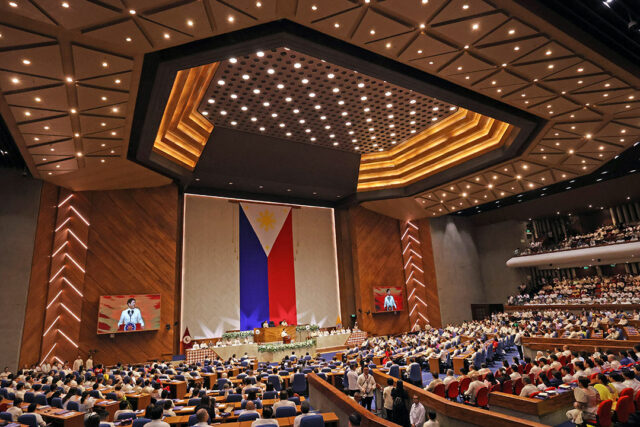
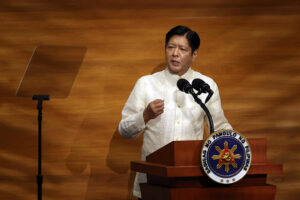
PRESIDENT Ferdinand R. Marcos, Jr., joined by re-elected Senate President Francis G. Escudero and Speaker Ferdinand Martin G. Romualdez, delivered his fourth State of the Nation Address in the House of Representatives on Monday. — PRESIDENTIAL COMMUNICATIONS OFFICE

By Kenneth Christiane L. Basilio and Adrian H. Halili, Reporters

SENATOR Francis “Chiz” G. Escudero and Leyte Rep. Ferdinand Martin G. Romualdez have both been re-elected by their chambers as Senate President and Speaker of the House, respectively, during the opening of the first regular session of the 20th Congress on Monday.

During a Senate plenary session, a supermajority of 19 out of 24 Senators voted in favor of Mr. Escudero to be the Senate President, marking his second term as the Senate’s top official. He first assumed the post in May last year, following the resignation of his predecessor Senator Juan Miguel F. Zubiri.

In his speech before the Senate floor, Mr. Escudero said that the Senate must prioritize legislation that will lower the cost of goods, create more jobs, reform the education and healthcare systems, mitigate climate change, and strengthen national defense.

“The Filipino people look to the Senate to come up with solutions that will improve their lives, address their needs, and bring their aspirations within reach,” he added.

Mr. Escudero said that the legislative body must not “bow to a mob” amid criticism on the Senate’s delay of Vice-President Sara Duterte-Carpio’s impeachment proceedings.

“We should not and cannot bow to a mob. We will not be cowed by the shrillest of voices. We will stand up for what is right, what is just, and what is consistent with the Rule of Law and our Constitution,” he added.

Last week, the Supreme Court (SC) ruled that the impeachment of Ms. Duterte was unconstitutional for violating the one-year ban on the filing of more than one complaint against an impeachable official and the right to due process. Any subsequent impeachment complaint against her may only be filed by Feb. 6, next year.

Senator Jose P. Ejercito Estrada also retained his position as Senate President pro tempore, while Senator Emmanuel Joel J. Villanueva was elected as the chairman of the Senate Committee on Rules and majority leader.

Senator Vicente C. Sotto III will serve as the Senate’s minority leader after garnering only five votes when the chamber voted for the Senate chief. The runner-up in the Senate Presidential race automatically assumes the role of minority leader, with their voters comprising the new minority.

Joining Mr. Sotto are Senators Ana Theresia N. Hontiveros-Baraquel, Panfilo M. Lacson, Lorna Regina Bautista Legarda, and Mr. Zubiri.

Meanwhile, re-elected Speaker Romualdez, who ran unopposed, retained the top House post after clinching 269 votes. Thirty-four lawmakers abstained.

“I will be here not just to preside, but to protect,” Mr. Romualdez told the House floor after taking his oath as House Speaker.

The Speaker post holds significant clout and is typically occupied by an ally of the sitting president. It wields political influence and sway on 314 lawmakers representing congressional districts and sectors in the legislative chamber, where tax measures and the yearly national budget originate.

Mr. Romualdez’s election might reinforce the chamber’s legislative alignment with President Ferdinand R. Marcos, Jr.’s administration, signaling continued support for its policy priorities, said Anthony Lawrence A. Borja, an associate political science professor at De La Salle University.

“Such an alignment however, can be seen by some as a mark of Romualdez’s hold over Marcos, Jr.,” he said in a Facebook Messenger chat.

The House Speaker would likely focus on whipping votes for the approval of social welfare and economic bills in the chambers to help bolster public support for Mr. Marcos, he added.

“This is directed at affecting the everyday life of beneficiaries for the sake of bolstering support for the current administration in the context of a longer lag time that economic policies are usually tied with,” said Mr. Borja.

Ederson DT. Tapia, a political science professor at the University of Makati, said he expects Mr. Romualdez to hold the speakership throughout the 20th Congress, even if Mr. Marcos’ political clout wanes.

“While he has maintained close coordination with the palace, he has also managed to lead with stability in the house,” he said in a Facebook Messenger chat. “I am of the belief that a majority of the members of the house would continue to support him and his leadership style.”

Also on Monday, the House floor elected Ilocos Norte Rep. and presidential son Ferdinand Alexander A. Marcos III as majority leader, an influential post within the chamber that heads the committee overseeing the legislative agenda.

The younger Mr. Marcos’ election as majority floor leader would help strengthen ties between the Executive branch and the House, and help thrust reforms forward, Mr. Romualdez said in a statement.

“His promotion to majority leader signals the House supermajority’s confidence in his ability to deliver results and infuse new energy into institutional reforms,” he said.

On the other hand, Party-list Rep. Marcelino C. Libanan said in a separate statement that he also retained his leadership of the House minority bloc after receiving the support of 29 other congressmen that abstained from voting for Mr. Romualdez’s speakership bid.

Meanwhile, Davao City Rep. Isidro T. Ungab did not vote for Mr. Romualdez as House Speaker, as he and three Duterte lawmakers chose to remain independent of the chamber’s majority and minority blocs.

In a separate statement, Mr. Ungab said that he and Davao City Reps. Paolo Z. Duterte, Omar Vincent S. Duterte and Party-list Rep. Harold James T. Duterte chose to “forge an independent path” in the chamber to govern above what they described as partisan politics.

“Our choice to become independent members demonstrates our commitment to principled governance and our intent to serve our country and constituents free from partisan considerations,” they said in the statement.
Resolution on the sense of the Senate mulled after SC ruling on VP impeachment

BW FILE PHOTO

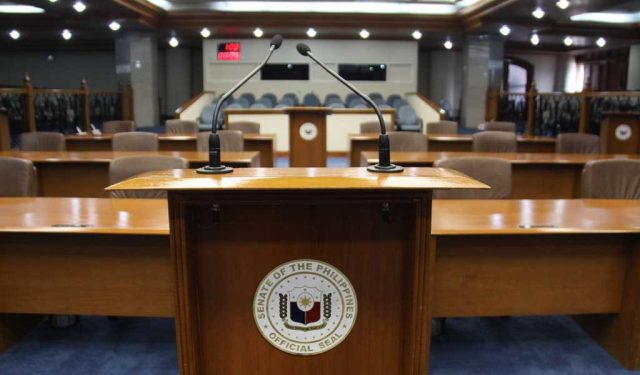
A RESOLUTION expressing the sense of the Senate on the Supreme Court (SC) ruling that junked the impeachment proceedings against Vice-President (VP) Sara Duterte-Carpio, is being considered in the chamber, a senator said on Monday.

Senator Risa Hontiveros-Baraquel said the ruling may have implications for impeachment proceedings, particularly the definition of what it means to “initiate” an impeachment case, as well as the Senate as a separate and co-equal branch of the government.

“What happens to the principle of separate and co-equal branches of government and the respect we have for one another? What happens to the rights of citizens to hold each of us, who work for the government, accountable?” she said in mixed English and Filipino in a media briefing.

“So, there are ongoing efforts to strike a balance, such as a resolution on the sense of the Senate, among other measures.”

Ms. Hontiveros said there are no talks yet whether a motion for reconsideration will be filed, but she said she expects to discuss how they will proceed with the trial of Ms. Duterte after the High Court’s recent ruling.

“The Senate Impeachment Trial Court is in session. The trial is ongoing — that is my presumption.”

“I am counting on the initial announcement of the presiding officer that we will sit as an impeachment court on July 29,” she said.

“Our top-of-mind concern is the recently issued decision of the Supreme Court. So we also need to agree on how we will proceed following this important development.”

House lawmakers on Sunday said that they will file a motion for reconsideration before the SC, noting factual errors in the court’s timeline and contrary to their official records.

“I hope that issue will be resolved as soon as possible, because I understand that this impeachment trial is still pending,” she added.

‘UNFAIR’ RULING
Meanwhile, three Senators on Monday called on the Supreme Court to reconsider its recent ruling, which they described as “unfair.”

“Congress, acting in good faith and following prevailing jurisprudence, followed the law in initiating and transmitting the complaint,” Senators Hontiveros, Francis Pancratius “Kiko” N. Pangilinan, and Paolo Benigno “Bam” A. Aquino IV said in a joint statement.

They added that to retroactively apply a new definition of what it means to “initiate” an impeachment case, after the fact, would be like “changing the rules in the middle of the game.”

“It is unfair,” they said.

The High Court deemed the impeachment proceeding against Ms. Duterte as unconstitutional for its violation of the one-year ban on the filing of more than one complaint and the right to due process. The filing of any impeachment complaints against her must be filed by Feb. 6, next year.

“We call on our fellow citizens, on every institution that still believes in accountability, and on the Supreme Court itself: harmonize the seemingly conflicting provisions of the Constitution on Judicial review and the exclusive powers of Congress,” the senators said.

In contrary, Senator Maria Imelda R. Marcos called on her fellow senators to respect the Court’s ruling on the impeachment case of her ally.

“Respect and honor the decision of the Supreme Court. To my fellow senators — let’s get to work. Let’s take care of the welfare of the people,” Ms. Marcos told a separate news briefing.

Ms. Duterte, who is widely seen as a potential presidential contender in 2028, was impeached last February with the backing of more than 200 lawmakers — exceeding the one-third threshold required to transmit the charges to the Senate.

She faces accusations of secret fund misuse, unexplained wealth, destabilization and plotting the assassination of President Ferdinand R. Marcos, Jr., his family, and the Speaker. She has denied all allegations. — Adrian H. Halili

Analysts: Marcos should pursue FOI reforms to cement government transparency

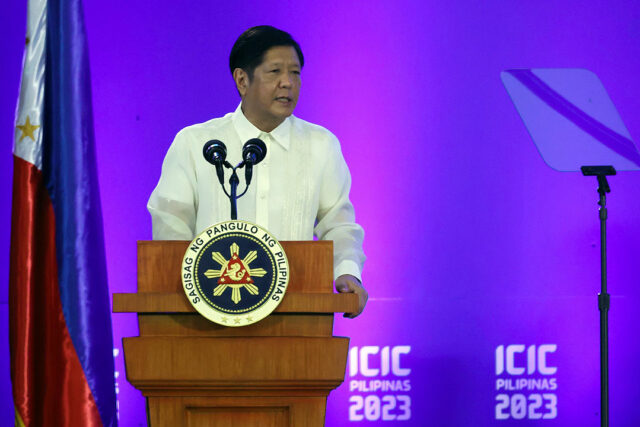
PRESIDENT Ferdinand R. Marcos, Jr. at the 14th Edition of the International Conference of Information Commissioners (ICIC) held in Manila on June 19, 2023. — PHILIPPINE STAR/KRIZ JOHN ROSALES

By Kenneth Christiane L. Basilio, Reporter

PRESIDENT Ferdinand R. Marcos, Jr. should enact the long-awaited Freedom of Information (FOI) bill to stay true to his government’s commitment to transparency and accountability, and as he seeks to cement his legacy in the second half of his term, political analysts said at the weekend.

The Philippine leader should declare the measure as a priority of his administration to help push the bill forward in Congress, which for decades has remained lukewarm to the proposal, they added.

“If Mr. Marcos is really serious and sincere with his pronouncements about promoting transparency and accountability in the government and combating fake news, he should prioritize and certify as urgent the passage of an FOI law in the 20th Congress,” Arjan P. Aguirre, who teaches political science at the Ateneo de Manila University, said in a Facebook Messenger chat.

The 1987 Constitution upholds the right to access information but needs an enabling law for it to be enforced.

Proposals to establish an FOI regime have been filed as early as 1992 but have repeatedly failed to pass largely due to lack of prioritization by lawmakers.

Certifying the FOI bill as part of the Marcos administration’s legislative priorities would be a “game-changer” for his government as it would send a signal that he’s willing to engage with stakeholders transparently, said Patrick C. Acupan, convener of transparency group FOI Youth Initiative.

An FOI law would also help rebuild public trust in the government, he added.

“The persistent lack of transparency has real, everyday consequences for the people,” Mr. Acupan said. “We are left in the dark about how decisions are made, how public money is spent, and who benefits. This undermines our ability to assert our rights and demand accountability.”

He said that Filipinos are not content with simply knowing what government programs are being funded, as they seek full clarity on how decisions are made, and state resources are allocated.

“It’s one thing to publish an amount allocated for social amelioration. But that alone won’t tell us who received the funds, how they were selected, who were excluded and why, how the list of beneficiaries is validated,” he said.

Any FOI measures should clearly define the scope of accessible government data and specify exceptions, Mr. Acupan said, citing a proposal by transparency advocacy group Right to Know, Right Now Coalition.

There should also be an independent government body to oversee FOI requests and operations, helping insulate it from political interference, he added.

Mr. Aguirre, meanwhile, said an FOI law should be accompanied by other measures that could strengthen the country’s democratic institutions, as he urged for action on an anti-political dynasty bill and proposals that could help reform the party-list system.

Lawmakers should also look at streamlining and strengthening government institutions handling graft and corruption accusations to further boost public trust in the state, Anthony Lawrence A. Borja, an associate political science professor at the De La Salle University said.

“This is to ensure that heads would roll in the near future because in the absence of well-publicized manifestations of justice, institutions would remain empty in the eyes of those who distrust them,” he said in a Facebook chat.

Mr. Aguirre said that the government too should institutionalize a “Truth Commission” that would oversee the investigation into ex-President Rodrigo R. Duterte’s anti-drug campaign to help further build public trust in the government.

The tough-talking former Philippine president was arrested in Manila in March and was flown to The Hague under an arrest warrant issued by the International Criminal Court, where he now remains in custody. He is facing crimes against humanity charges before the tribunal over his administration’s deadly war on drugs, which human rights groups estimate claimed tens of thousands of lives.

Philippines to continue tariff talks with US online

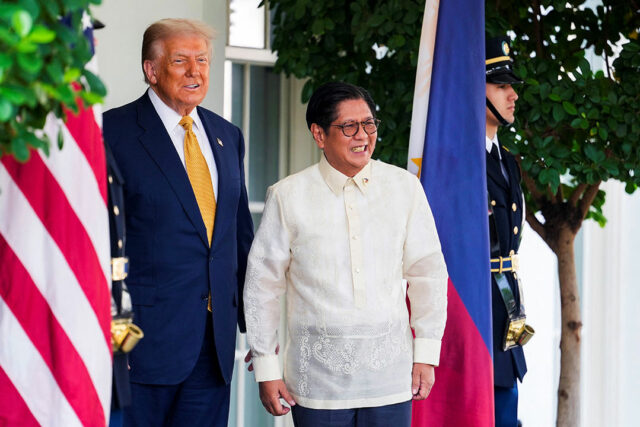
US PRESIDENT Donald J. Trump welcomes Philippine President Ferdinand R. Marcos, Jr. at the White House in Washington, DC, US, July 22. — REUTERS/KENT NISHIMURA

THE PHILIPPINES will not be sending a delegation to the US but will continue negotiations online to further reduce the 19% tariff imposed on Philippine exports, as Washington’s Aug. 1 deadline approaches, the Special Assistant to the President for Investment and Economic Affairs said on Monday.

“We stay in Asia, but you know, it’s through electronic communication,” Secretary Frederick D. Go told reporters on the sidelines of President Ferdinand R. Marcos, Jr.’s fourth State of the Nation Address (SONA).

The US last week lowered its “reciprocal” tariffs against Philippine exports following a meeting between Mr. Marcos and American President Donald J. Trump at the White House. The new rate is still higher than the initial 17% rate announced during “Liberation Day” last April.

Meanwhile, Trade Secretary Ma. Cristina A. Roque said that the Philippines is still hoping for a lower tariff than the 19% imposed by the United States, as it looks to finalize negotiations before the Aug. 1 deadline.

“If we can go lowest that we can go that would be best,” Ms. Roque told BusinessWorld. “Of course, we are trying to do everything we can to put (the tariffs) down, but in the end it’s really the US who will decide.”

“But I can’t really discuss much because we signed a (non-disclosure agreement) and we’re just really waiting for the negotiations to finish by Aug. 1,” she added.

Ms. Roque said that the Trade department is still studying which US industries will be imposed with zero tariffs.

“For us, we just have to really give what we can give, because there are some industries that we cannot give to,” she added.

Ms. Roque earlier said Manila will not compromise sensitive sectors such as rice, sugar, pork, chicken, corn, and fisheries in the ongoing negotiations, which are still under review.

The updated tariff rate puts the Philippines at a similar position to Indonesia and marginally ahead of Vietnam, which faces a 20% rate. Singapore maintains a preferential 10% rate. — Chloe Mari A. Hufana and Adrian H. Halili

Civil society role in budget pushed

PHILIPPINE STAR /KJ ROSALES

CONGRESS should let civil society groups have a greater say in the national budget process, a coalition of non-government organizations said on Monday.

Allowing civil groups to sit in on House and Senate budget hearings would ensure that the perspectives of marginalized sectors would be taken into consideration in crafting the annual spending plan, helping align public funds to the nation’s needs, a coalition of more than 100 organizations said in a joint statement published on Social Watch Philippines’ Facebook page.

“Despite the Constitutional mandate for people’s participation in governance, the current budget process remains largely exclusive, with civil society participation often relegated to token consultations,” they said.

Lawmakers should consider making bicameral conference committee discussions on the national budget more transparent by streaming its meetings via popular social media websites, while also providing a matrix outlining the changes made by the joint congressional panel. 

Most bicameral conference committee meetings, where senators and congressmen reconcile conflicting provisions of their bills, are held behind closed doors. Lawmakers have previously signified their willingness to hold bicameral conference committee meetings open to the public.

Budget proceedings last year were criticized after the bicameral panel increased unprogrammed funds fourfold to more than P500 billion, aside from blank line-items, fueling concerns that the budget was tweaked after Congress ratified it. — Kenneth Christiane L. Basilio

Palace names acting Ombudsman

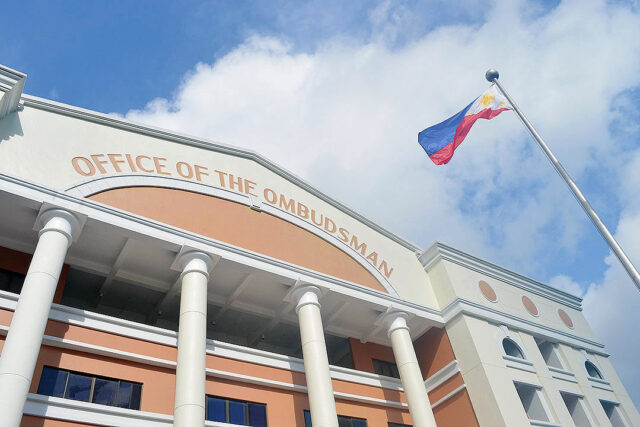
OFFICE OF THE OMBUDSMAN PHILIPPINES FACEBOOK PAGE

MALACAÑANG on Monday confirmed the appointment of Special Prosecutor Justice Mariflor P. Punzalan-Castillo, as officer-in-charge of the Office of the Ombudsman.

Executive Secretary Lucas P. Bersamin told Palace reporters in a Viber group chat that she will act as the Ombudsman following the expiration of Ombudsman Samuel R. Martires’ seven-year term on July 27.

According to Mr. Bersamin, there is no shortlist yet from the Judicial Bar and Council (JBC).

“Interviews of the aspirants by the JBC are yet to begin after the SONA (State of the Nation Address),” he added, noting President Ferdinand R. Marcos, Jr.’s speech on July 28.

Ms. Punzalan-Castillo was also a Court of Appeals Justice, appointed by Mr. Marcos in November 2023.

The President’s pick for the position comes as he delivered his midterm SONA in the House of Representatives, outlining his legislative agenda for the remainder of his six-year term. — Chloe Mari A. Hufana

PHL tourism up 8% in first half

PHILIPPINE STAR/RUDY SANTOS

THE Bureau of Immigration (BI) on Monday said tourism in the Philippines rose by almost 8% in the first half of 2025, compared to the same period last year.

In a statement, Commissioner Joel Anthony M. Viado said the bureau processed over 7.84 million arrivals from January to June 2025, compared to over 7.27 million in the first half of 2024.

Travelers from the US topped the list of arrivals (753,544), followed by those from South Korea (745,623), Japan (256,776), China (229,915), and Australia (188,082).

“This steady growth is proof that the Philippines remains a top destination in the region,” Mr. Viado said.

The government will continue to improve its programs to attract more visitors to the country, the BI noted. — Chloe Mari A. Hufana

NHA grants payment moratorium

PHILIPPINE STAR/ MIGUEL DE GUZMAN

THE National Housing Authority (NHA) has granted a one-month moratorium on amortization and lease payments, providing relief for housing beneficiaries affected by recent storms and the southwest monsoon.

Under NHA Memorandum Circular No. 2025-141, amortization and lease payments will be suspended from Aug. 1 to 31. This moratorium applies to all housing beneficiaries nationwide, the agency said in a statement.

Delinquency interest or penalties will not be imposed during the 30-day period, NHA said.

The agency will resume its collection of amortization and lease payments, as well as the addition of delinquency and other interest charges, on Sept. 1.

Any payments made during the moratorium will be applied following the existing hierarchy of payments, NHA added.

According to the NHA, the moratorium seeks to provide relief to beneficiaries affected by the southwest monsoon (Habagat), as well as storms Wipha (local name: Crising), Francisco (Dante), and Co-may (Emong).

The brief suspension would allow NHA beneficiaries to focus on rebuilding their homes and lives without the burden of payment obligations, NHA General Manager Joeben A. Tai said.

“The moratorium aims to offer relief for families residing in NHA project sites, many of whom are still recovering from the physical and economic aftermath of the typhoons,” according to the agency.

The NHA, an attached agency of the Department of Human Settlements and Urban Development (DHSUD), is mandated to address the housing needs of the lowest 30% of income earners.

Other housing agencies, such as the Social Housing Finance Corp. and the National Home Mortgage Finance Corporation, each imposed a month-long payment moratorium for its beneficiaries.

More than 600,000 families are expected to benefit from the payments moratorium implemented by DHSUD’s attached agencies. — Beatriz Marie D. Cruz

DBM OKs SUCs’ staffing guide

THE Department of Budget and Management (DBM) has approved the guidelines and policies for implementing Phase II of the revised staffing standards for state universities and colleges (SUCs).

In a statement on Monday, the DBM said it greenlit the issuance of National Budget Circular No. 598, which seeks to improve the performance and reach of public higher education institutions to make government services more responsive and inclusive.

“We are strengthening the standards for hiring personnel in our State Universities and Colleges. We are following President Bongbong Marcos’ directive to ensure that there is an adequate and appropriate workforce for research and development, as well as support for our students,” Budget Secretary Amenah. F. Pangandaman said.

Issued on July 15, the circular provides the guidelines and policies for the implementation of the second phase of the Revised Organization and Staffing Standards for SUCs.

“Phase II now strengthens the institutional capacity of SUCs in research, extension, and auxiliary services, recognizing their increasingly important role in national development, innovation, and community engagement,” the DBM said. — Aubrey Rose A. Inosante

New SSS branch opens in Sta. Rosa

Top executives from SSS and Robinsons Land Corporation, together with local government officials, inaugurated the new SSS Sta. Rosa Branch at Robinsons Sta. Rosa.

THE Social Security System (SSS) has launched a new branch in Sta. Rosa, Laguna to cater to residents of nearby cities Cabuyao, Calamba, Biñan, San Pedro, and Carmona.

The branch, located at the Robinsons Land Corporations (RLC) Lingkod Pinoy Center in Robinsons Sta. Rosa, can cater to around 1,500 walk-in members and process over 7,000 transactions daily. It is open from Mondays to Fridays, 8 a.m. to 5 p.m.

Services include the processing of Death, Disability and Funeral Claims, Pension Loan Program, annual confirmation of pensioner, UMID ID capture and releasing, submission and release of E-1 and E-4 and releasing of Educational and Calamity Loan Checks.

Employers may also avail services involving posting, contribution payments, loan payments, data amendments and request assistance.

The inauguration was led by SSS President and Chief Executive Officer Robert Joseph M. De Claro, alongside top SSS executives and local government leaders represented by Sta. Rosa Mayor Arlene B. Arcillas and Laguna Vice-Governor Atty. JM Carait III.

Representing Robinsons Land Corporation were Vice-President for Operations and Marketing Joel Lumanlan and External Affairs Director Irving Wu.

Robinsons’ Lingkod Center also houses other government agencies, such as the Philippine Health Insurance Corp., Pag-IBIG, Land Transportation Office, Philippine Postal Corp., Professional Regulation Commission, and the Government Service Insurance System. — CAT

Marcos vows overtime and overload pay for teachers this schoolyear

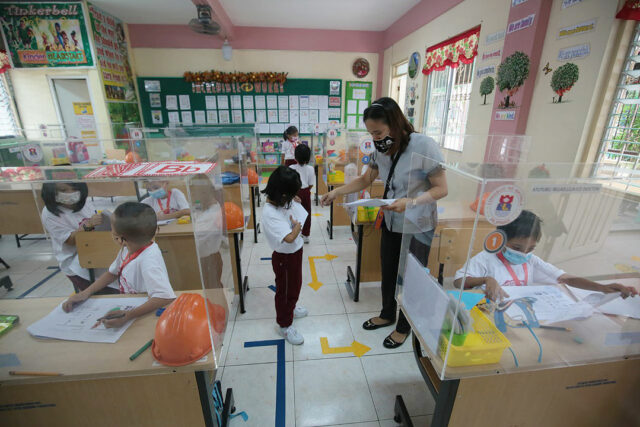
A TEACHER assists students at a school in Manila where face-to-face classes resumed on Feb. 9, 2022. — PHILIPPINE STAR/MICHAEL VARCAS 
PRESIDENT Ferdinand R. Marcos, Jr., joined by re-elected Senate President Francis G. Escudero and Speaker Ferdinand Martin G. Romualdez, delivered his fourth State of the Nation Address in the House of Representatives on Monday. — PRESIDENTIAL COMMUNICATIONS OFFICE

by Almira Louise S. Martinez, Reporter

Philippine President Ferdinand R. Marcos, Jr., during his fourth State of the Nation Address, underscored the importance of teachers and vowed to compensate public school teachers for their excess hours and additional workload this school year.

Ang pinakamahalaga sa sistema ng edukasyon ay ang ating mga mahal na guro [Our beloved teachers are the most important part of the education system],” Mr. Marcos said.

In 2024, Mr. Marcos already spoke about prioritizing teachers’ wellbeing and, in line with this, the Department of Education (DepEd) issued Memorandum No. 053, s. 2024, wherein teachers are only required to teach for six hours per day.

In cases of overtime, teachers may only claim pay for up to two extra hours daily.

“At ngayong school year na ito, makakatanggap na kayo ng kabayaran para sa inyong teaching overload at para sa inyong overtime [This school year, you will receive compensation for your teaching overload and overtime],” Mr. Marcos said.

In addition to overtime and overload pay, the Education department on Monday said it doubled the teaching supplies allowance to P10,000, along with the first-ever medical allowance for teachers.

“Teachers in private schools will now receive a ₱24,000 salary subsidy, a ₱6,000 increase,” the DepEd said in its press release.

Source: DepEd

Mula sa simula, malinaw ang layunin natin na makinig, ayusin ang kailangang ayusin, at itayo ang mga kulang [From the beginning, it was clear that our goal was to listen, fix what needs to be fixed, and build what we’re lacking],” Education Secretary Juan Edgardo “Sonny” M. Angara said in a press release.

“This is the result of listening to our teachers, parents, and actual students in schools,” Mr. Angara said in Filipino.


Reduced paperwork

To highlight the government’s support in easing the daily burden of teaching professionals, unnecessary paperwork has been removed from their responsibilities.

Hindi tayo tumitigil maghanap ng mga paraan upang pagaanin kahit paano ang inyong pasanin sa araw-araw [We have not stopped in finding ways to ease the burden you carry each day],” Mr. Marcos said.

Tinanggal na natin ang halos isandaang dokumentong kailangan niyong atupagin noon na wala namang kinalaman sa inyong pagtuturo [We have removed nearly a hundred documents you used to deal with that had nothing to do with your actual teaching],” he added.

PHILSTAR FILE PHOTO

In June, the Department of Education (DepEd) trimmed down 57% of the paperwork requirements for public school teachers to create more time for classroom teaching.

Under DepEd Order No. 06, s. 2025, the number of forms required from teachers was reduced from 174 to five regularly accomplished forms.

Meanwhile, 31 forms for teacher ancillary tasks and 39 forms for teaching-related assignments can still be completed depending on the “agreed designations of teachers by virtue of their rationalized workload.”

Mr. Marcos also noted that the remaining documents will be processed digitally on the government-issued laptops.

“We’re going to make the remaining paperwork digital so you can work on it online with your new laptops,” he said in Filipino.


Skepticism from teachers

Despite these pledges, some educators remain unconvinced.

“The OT (overtime) pay boasted by President Marcos today, although included in the Department of Education (DepEd) Order, seems unrealistic because there are no funding,” Alliance of Concerned Teachers – NCR Union President Ruby Bernardo said in Filipino on a Facebook message.

“Thank you pa rin ang OT ni teacher [Teachers still only receive a “thank you” for their OT],” she added.

Aside from the overtime compensation, Ms. Bernardo also expressed concern over the continued failure to respond to teachers’ calls for a salary increase.

“No mention of salary increase for teachers and government employees, wage hike for workers in the private sector in BBM’s 4th SONA,” she said.

On June 30, House Bill 203, which seeks to adjust the entry-level salary of public school teachers, was refiled in the House of Representatives. It aims to increase the salary of teachers from Salary Grade 11, or around P30,000, to P50,000.

“Mahiya kayo”: Marcos condemns corruption in flood control projects

PHILIPPINE STAR/MIGUEL DE GUZMAN
PRESIDENT FERDINAND R. MARCOS, JR. — PHILIPPINE STAR/KJ ROSALES

by Edg Adrian A. Eva, Reporter

Philippine President Ferdinand R. Marcos Jr. on Monday lambasted the conspirators behind graft-ridden flood control projects, saying they should be ashamed for pocketing public funds while Filipinos lost their homes, and warned that they would face legal charges.

“Sa mga nakikipagsabwatan upang kunin ang pondo ng bayan at nakawin ang kinabukasan ng ating mamamayan—mahiya naman kayo sa inyong kapwa Pilipino [To those who conspired in seizing the nation’s funds and steal the future of our people—have the decency to feel ashamed before your fellow Filipinos],” Mr. Marcos said during the fourth State of the Nation Address (SONA) at the House of Representatives in Quezon City.

Mr. Marcos admitted that many of these flood control projects are flawed, substandard, or even ghost projects. These findings came after his inspection of areas affected by the recent tropical cyclones Crising, Dante, and Emong.

“Huwag na po tayong magkunwari. Alam naman ng madla na may raket sa mga proyekto [Let’s stop pretending. The public knows there are shady dealings behind these projects],” Mr. Marcos said.

To prevent the corrupt practice from happening again, the chief executive ordered the immediate submission of a list of all flood control projects from all regions of the country that were completed in the last three years.

Once the lists have been received, the Regional Project Monitoring Committee, a multi-sectoral body that oversees government development projects, will examine the projects and flag anomalies such as unfinished and ghost projects.

Mr. Marcos added that the audit and performance review of the flood projects will be made publicly available for transparency.

“Sa mga susunod na buwan, makakasuhan ang lahat ng lalabas na may sala mula sa imbestigasyon, pati na ang mga kasabwat na kontratista sa buong bansa [In the coming months, everyone found guilty through the investigation—including accomplice contractors across the country—will face charges.],” Mr. Marcos said.

SENATE.GOV.PH

A day before Mr. Marcos’ fourth SONA, Senator Panfilo “Ping” M. Lacson flagged the government’s flood control projects, alleging that roughly ₱1 trillion of the nearly ₱2 trillion allocated since 2011 may have been lost to corruption.

Other senators—Juan Miguel F. Zubiri and Joseph Victor G. Ejercito—likewise criticized the program for lacking an integrated flood master plan. Senator Paolo Benigno “Bam” A. Aquino IV has urged the Senate to initiate an investigation into the government’s flood control efforts.


A warning to lawmakers?

Filipino lawyer and Senior Research Fellow at the Ateneo Policy Center Michael Henry Ll. Yusingco said Mr. Marcos’ remarks appeared to address lawmakers profiteering from flood control projects.

“This warning seems to be directly addressed to lawmakers, specifically dynastic lawmakers who profit from these flood control projects,” Mr. Yusingco told BusinessWorld via Messenger.

“But to stay true to his commitment to prosecute everyone behind the corruption, the President must appoint the right person as the new Ombudsman—someone who will not be afraid to go after political dynasties, someone who has the wherewithal to overcome partisan politics,” he added.

If the President appoints someone who does not meet these standards, the SONA is just an empty threat, and Gen Z and Millennial voters will make him pay in 2028, he added.

ADVERTISEMENT
ADVERTISEMENT