Home Blog Page 7938

Sign of the times: Intensifying taxpayers’ use of e-signatures

The Philippines is celebrating its 123rd year of independence. We have been enjoying our freedom for over a century and much has changed since then. For the business sector, changes have been directed towards intensifying the use of technology. Can we now say that we are moving towards freedom from the old way of doing business?

It seems that the government is indeed trying to veer away from the manual way of doing things. Even the Bureau of Internal Revenue (BIR) is keen on going digital. This year, the agency issued several regulations on the use of electronic signatures. Citing the Ease of Doing Business and the Electronic Commerce Act of 2000, the BIR issued Revenue Memorandum Circular (RMC) 29-2021 and RMC 46-2021 to address taxpayers’ concerns on the filing of BIR forms as they work from the comfort of their homes due to lockdowns after the onset of the COVID-19 pandemic.

An e-signature refers to any distinctive mark, characteristic, and/or sound in electronic form, representing the identity of a person and attached to or logically associated with the form/certificate or any methodology or procedure employed or adopted by a person and executed or adopted by such person with the intention of authenticating or approving an electronic data message or document. For purposes of RMC 29-2021, an e-signature includes digital and other methods of signing electronic documents.

RMC 29-2021 was issued to lay down the guidelines for the use of e-signatures on certain BIR forms/certificates. Pursuant to the RMC, withholding agents or their duly authorized representatives are given the option to use e-signatures for the following BIR forms/certificates:

1. BIR Form 2304 — Certificate of Income Payment not Subject to Withholding Tax (Excluding Compensation Income);

2. BIR Form 2306 — Certificate of Final Tax Withheld at Source;

3. BIR Form 2307 — Certificate of Creditable Tax Withheld at Source; and

4. BIR Form 2316 — Certificate of Compensation Payment/Tax Withheld.

In addition to the above-mentioned forms/certificates, RMC 46-2021 was issued which allows taxpayers to use electronic or digital signatures in the filing of Annual Income Tax Return (AITR). The e-signature or digital signature shall be deemed equivalent to the actual signature or “wet signature” for filing purposes.

On a related note, RMC 29-2021 cited the legal basis for the recognition of the e-signature under Section 8 of the E-commerce Act. Under this provision, an electronic signature on the electronic document is deemed equivalent to the signature of a person on a written document if that signature is proved by showing that a prescribed procedure, not alterable by the parties interested in the electronic document, existed under which —

(a) A method is used to identify the party sought to be bound and to indicate said party’s access to the electronic document necessary for his consent or approval through the electronic signature;

(b) The method is reliable and appropriate for the purpose for which the electronic document was generated or communicated, in light of all circumstances, including any relevant agreement;

(c) It is necessary for the party sought to be bound, in or order to proceed further with the transaction, to have executed or provided the electronic signature; and

(d) The other party is authorized and enabled to verify the electronic signature and to make the decision to proceed with the transaction authenticated by the same.

The above provisions put the taxpayers on the lookout regarding their internal procedures in attaching e-signatures or in performing similar methods on documents they intend to submit or file before the BIR. Taxpayers should ensure the credibility of all “e-signed” documents. Control and monitoring procedures must be installed to guarantee the integrity of each e-signed document and to make it easier to prove or disprove whether a particular document or correspondence was electronically signed legitimately by the authorized signatory.

The BIR issuances on e-signatures are much appreciated, and many are looking forward to subsequent issuances which would allow e-signatures to be used for other types of BIR forms and letter-correspondences with the BIR, particularly in correspondence on tax assessments or in tax refund cases. Certainly, taxpayers would not want their position or claim to be denied just because their e-signatures are not considered valid.

Under RMC 29-2021, an electronic signature includes “any” methodology or procedure employed or adopted by a person and executed or adopted by such a person with the intention of authenticating or approving an electronic data message or electronic document. As it continues to conduct dialogues with stakeholders, perhaps the BIR can expound on the coverage of “any” methodology or procedure in a bid to provide more clarity to taxpayers. This is not to limit the applicability of the law, but to serve as a guide to those who intend to maximize the use of technology in their transactions with the BIR.

I hope subsequent issuances make further clarifications to ease the apprehension of taxpayers in using e-signatures or similar methods, as filings and transmittals to the BIR are very crucial. We hope that the BIR eventually goes fully digital and maximizes the use of technology to break free from traditional procedures and to efficiently and effectively serve taxpayers.

Let’s Talk Tax is a weekly newspaper column of P&A Grant Thornton that aims to keep the public informed of various developments in taxation. This article is not intended to be a substitute for competent professional advice.


Gemmalu Molleno-Placido is a manager of the Tax Advisory & Compliance division of P&A Grant Thornton, the Philippine member firm of Grant Thornton International Ltd.


pagrantthornton@ph.gt.com

Poor Filipinos may get vaccinated soon, says Department of Health

THE GOVERNMENT will soon start vaccinating poor Filipinos against the coronavirus depending on available supplies, health authorities said on Monday.

Health Undersecretary Maria Rosario S. Vergeire said the World Health Organization had also allowed the use of vaccines obtained under a global initiative for equal access for the country’s poor population.

“This will be allowed depending on the supply,” she told an online news briefing in mixed English and Filipino.

Local governments with excess vaccine supply may vaccinate this group as early as now, Ms. Vergeire said.

Vaccines under the global initiative were originally allotted for health workers, senior citizens and seriously ill people.

Under the guidelines, local government units will coordinate with the Department of Social Welfare and Development for the list of poor Filipinos.

Additional poor populations identified and validated by local governments will be eligible for vaccination.

The government is vaccinating health frontliners, senior citizens, seriously ill people and economic frontliners.

About 6.8 million coronavirus vaccines had been given out as of June 13, according to the presidential palace.

Of the total, more than five million were first doses, while the rest were second doses, presidential spokesman Herminio “Harry” L. Roque, Jr. told a televised news briefing on Monday.

Mr. Roque said about 964,781 health workers and 471,425 senior citizens had been fully vaccinated.

About 412,246 seriously ill people and 7,020 essential workers had also completed their coronavirus shots.

Mr. Roque said the country has received about 12.7 million coronavirus vaccines.

The government last week took delivery of about 100,000 doses of Sputnik V shots from Russia and about 2.2 million doses of the vaccine made by Pfizer, Inc.

The country seeks to inoculate as many as 70 million Filipinos before the end of the year to attain herd immunity. It seeks to inoculate nine million people in the National Capital Region by late November. 

Meanwhile, Senator Panfilo M. Lacson pushed for a vaccine passport system that would allow easier entry of vaccinated people, especially returning migrant Filipino workers and foreign investors.

The senator said many returning migrants and foreign investors were reluctant to come here because of tight protocols. Returning overseas Filipino workers (OFW) might be required to be tested and then stay at home for 10 days, he said.

“Most of the time, OFWs return to the country because of an emergency. But if you are an OFW and you are required to be quarantined for 10 days, how many days of your leave will go to waste? I don’t think that makes sense,” he told the ABS-CBN News Channel.

“Our tourism sector and investment will suffer,” Mr. Lacson said. “If a potential investor who would like to come here learns of the requirements that include a swab test and staying at a quarantine facility not of his or her choice, would he or she still come?”

He asked an inter-agency task force to fine-tune protocols and ensure that these are in sync with other countries.

The government earlier cut the quarantine requirements for fully vaccinated foreign travelers to seven days.

This applies to foreigners who got vaccinated in the Philippines. Returning Filipinos who got vaccinated overseas must still undergo a 10-day quarantine at a facility and four days at home, Mr. Roque said earlier.

A person is considered fully vaccinated two or more weeks after completing his dose. — Vann Marlo M. Villegas and Kyle Aristophere T. Atienza

Rights group asks ICC to order Duterte arrest for ‘crimes vs humanity’

A HUMAN rights group has asked the International Criminal Court (ICC) in the Netherlands to order the arrest of President Rodrigo R. Duterte for alleged crimes against humanity in connection with deadly war on drugs.

In a supplementary pleading, members of Rise Up for life and for Rights asked the tribunal to detain the tough-talking leader pending his trial and investigation of the country’s human rights situation.

“The complainants stress the urgent need to open an investigation into crimes against humanity in the Philippines, and for the court thereafter to issue a warrant of arrest against respondent President Rodrigo R. Duterte,” they said.

The group also said the Justice department’s review of extrajudicial killings was neither comprehensive nor transparent. The public does not have access to its reports, it pointed out.

Justice Secretary Menardo I. Guevarra declined to comment. “All matters pertaining to the ICC are handled solely by the Department of Foreign Affairs (DFA),” he told reporters in a Viber group message.

“We respect the opinion of people who are critical of what we are seriously trying to do.”

The agency had received 52 case records from police and 107 cases from the Philippine Drug Enforcement Agency for its review, according to Mr. Guevarra’s recorded statement released by DFA on Sunday night.

Mr. Guevarra on Monday said he recorded the statement last week “for use by the DFA in the diplomatic community.”

“It was meant to be an update on the work of the review panel and on the status of the United Nations-Philippines joint program on technical cooperation on human rights,” he added. — Bianca Angelica D. Añago

Judge withdraws from senator’s drug case

OFFICE OF SEN. LEILA DE LIMA/RELEASE

A MUNTINLUPA judge has withdrawn from the drug trafficking case against one of President Rodrigo R. Duterte’s staunchest critics.

In a four-page order, Judge Liezel A. Aquiatan granted Senator Leila M. de Lima’s plea for inhibition even if it was “unfounded and totally unfair.”

Ms. De Lima sought the magistrate’s inhibition in May, accusing her of committing “blatant errors” in handling her case.

The lawmaker said Ms. Aquiatan had validated inadmissible evidence presented by government prosecutors, cherry-picked parts of the testimonies by witnesses, disregarded the testimonies of defense witnesses and added “her own versions of the narrative which were never even testified on by the incredible witnesses she chose to believe.”

Ms. Aquiatan in February junked one of Ms. De Lima’s drug cases but rejected her plea to dismiss a second case, citing evidence of the senator’s guilt. Another Muntinlupa court is hearing a third case. — Bianca Angelica D. Añago

Trade chief backs partial reopening of gyms sans safety certification 

PHILSTAR

TRADE Secretary Ramon M. Lopez is proposing a partial reopening of gyms that do not have a safety seal certification.

In a briefing on Monday, Mr. Lopez said he will request the government’s task force against the coronavirus to allow the operation of gyms at 20% capacity before they receive safety seal certifications.

Gyms and other indoor non-contact sports venues with certification are now allowed to operate up to 30% capacity in Metro Manila and neighboring regions.

Establishments that have been checked to be compliant with health safety protocols are given stickers displayed at entry points.

Mr. Lopez said his proposal will allow those waiting for inspection by the local government to resume business even at minimal capacity.

“Hopefully, this will encourage consumer confidence,” Mr. Lopez said.

Once the gyms have been certified, they will be able to reopen at 30% capacity. Establishments with safety seals, including restaurants, are allowed to increase their capacities by 10 percentage points.

Over a hundred applications for safety seals assessed by the Trade department have been denied due to non-compliance with health safety protocols, while another hundred have been approved. About 600 are still pending, Mr. Lopez said on Friday.

Safety seal inspection and certifications are divided among different government agencies. The Trade department covers various retail and repair services shops. — Jenina P. Ibañez

Davao city mayor rebuffs vice president’s unsolicited advice

DAVAO CIO

PRESIDENTIAL daughter and Davao City Mayor Sara Duterte-Carpio has asked Vice President Maria Leonor G. Robredo to refrain from giving advice “if she knows nothing about what is happening on the ground.”

Ms. Robredo, in her weekly Sunday radio program, said the Davao City government could learn from Cebu City’s handling of a coronavirus surge, which involved the active participation of the private sector and the medical community.

Ms. Carpio, in a statement released late Sunday, said the vice president “should not attack the medical community of Davao City as being inactive when they have been silently suffering and working tirelessly to help save lives since March of last year.”

She also said the private sector has been “very helpful and has tremendously contributed” to the pandemic response in the city.

“She (vice president) should open her eyes to the surge of cases in localities all around the world and she might be able to say that a surge in cases where 85% of the cases are asymptomatic is primarily identified by aggressive testing, coupled with tracing and isolation/quarantining,” the mayor said.

Several parts in the central and southern Philippines, mostly urban areas, have in recent weeks seen a sudden increase in coronavirus cases.

Ms. Carpio also told Ms. Robredo to refrain from “involving the COVID-19 (coronavirus disease 2019) surge in Davao City in her attempt at politicking.”

The mayor said there will be a proper time to attack her leadership as a local official if the vice president “dares to run for President.”

Ms. Carpio has previously denied intent to vie for the country’s top post in next year’s elections as banners urging her to run have been cropping up in various parts of the country.

In a statement on Monday, the vice president’s spokesperson, Ibarra M. Guttierez, said Ms. Robredo was not politicking and simply offering assistance as she has done in Cebu, Palawan, and Tuguegarao City. — Kyle Aristophere T. Atienza

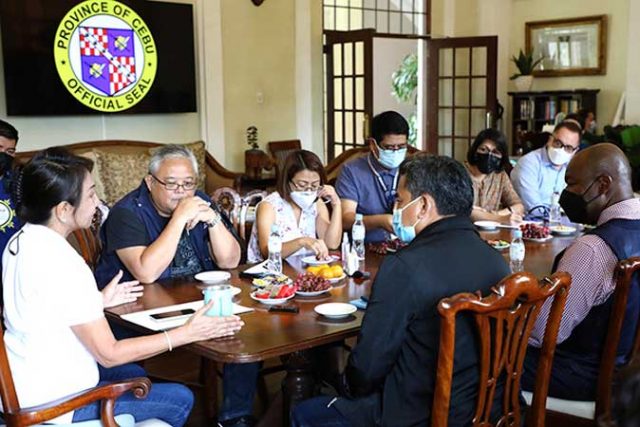
Cebu ordered to follow national quarantine rules as international airport arrivals resume   

CEBUPIO

PRESIDENT Rodrigo R. Duterte has ordered the provincial government of Cebu to abide by the pandemic task force’s quarantine rules for returning Filipinos, according to the presidential palace.  

“The President has decided that the IATF (Inter-Agency Task Force) protocols must be implemented by the Cebu Province,” Presidential Spokesperson Herminio “Harry” L. Roque said, citing Executive Secretary Salvador C. Medialdea.  

Mr. Medialdea last month issued an order directing the diversion of international flights bound for Mactan Cebu International Airport to Manila from May 29 to June 5 after the Cebu government insisted on applying its own quarantine protocols.   

The order was extended until June 12. As of June 13 evening, the provincial government said it was keeping its own rules as international flight arrivals have resumed.   

“The last extension was just a preparation for full implementation of that decision,” Mr. Roque told a televised news briefing.  

He said the President considered the Health department’s “critique and has decided that Cebu Province must abide with the IATF arrival protocols.”  

An executive order from Cebu Governor Gwendolyn F. Garcia and an ordinance passed by the provincial board requires returning Filipinos and other residents to stay in a hotel for a period of two to three days after being swabbed for coronavirus testing upon arrival. Those with a negative result can go home where they will continue to be on quarantine for four days, then undergo another test from their local government.   

Under the national policy, all arriving international passengers must undergo a 10-day quarantine and swabbing on the seventh day from arrival.  

The President recently met with Ms. Garcia, a political ally, to address the supposed clash of executive powers.  

Ms. Garcia has been invited by Senate President Vicente C. Sotto III to attend a virtual Senate hearing on Tuesday that will tackle the provincial government’s quarantine protocols, according to a report by the state news agency. — Kyle Aristophere T. Atienza 

Community pantry organizer among 10 Rotary awardees

ANA PATRICIA NON
ANA PATRICIA NON

THE 26-YEAR OLD lady who set up a small bamboo cart for a give-and-take community sharing project amid the pandemic is among the 11 awardees of the 2020-2021 Rotary Golden Wheel Awards.

Ana Patricia Non, whose community pantry concept has been replicated nationwide, “best exemplify the Rotary spirit of ‘Service Above Self’,” said the Rotary Club of Rotary International District 3780 in a statement on Monday.

Ms. Non and Ferdinand Constantino are honored under the Growing Local Economies category. The other awardees are: Dr. Edith Tria, Josephine Barbin and lawyer Dorothea Gancayco, for Supporting Education category; Dr. John Michael Lao and Fr. Arthur Opiniano, for Fighting Disease category; Fr. Steve Tynan and Barangay Tanod Melodina Maximo, for Promoting Peace; Clarita Orlain, for Protecting the Environment; and midwife Leila Rebadomia, Saving Mothers and Children.

The award is presented by the Quezon City government and the Rotary Club of Rotary International District 3780.

NGO pushes for mining-free Marinduque   

VARIOUS groups led by the Marinduque Council for Environmental Concerns, Inc. (MACEC) asked the National Economic and Development Authority’s (NEDA) regional office to deny all mining applications in the province.   

MACEC Executive Secretary Elizabeth E. Manggol said the group is worried that Executive Order No. 130 which lifted the ban on new mining agreements,  signed by President Rodrigo R. Duterte on April 14, will result in new applications in Marinduque and all over the Philippines.   

“We know better. We have learned the hard lessons of environmental destruction and danger to health caused by Marcopper Mining Corp.’s activities in the island,” Ms. Manggol said in a statement on Monday.   

MACEC said 41 resolutions and statements from the Marinduque provincial and other local government units, academe, and civil society groups have asked to deny with finality the mineral production sharing agreement (MPSA) applications of Marcopper Mining and 38 other mining applications.   

In 1996, the drainage tunnels of Marcopper’s open-pit mines broke and caused toxic mine tailings to spill into Boac River.   

The groups also requested to remove Marinduque in the mining tenement area and declare it as a mining-free zone.

Yoly Esguerra, Partnership Mission for People’s Initiatives (PMPI) national coordinator, said Marinduque should be identified as a mine-free zone since it is a small island ecosystem.   

“We urge the Department of Environment and Natural Resources (DENR) to heed the voice of the people. It will be a shame for the DENR, if another mining contract is permitted given the volume of resolutions and statements from the different communities and the local government units of the province of Marinduque,” Ms. Esguerra said. — Revin Mikhael D. Ochave   

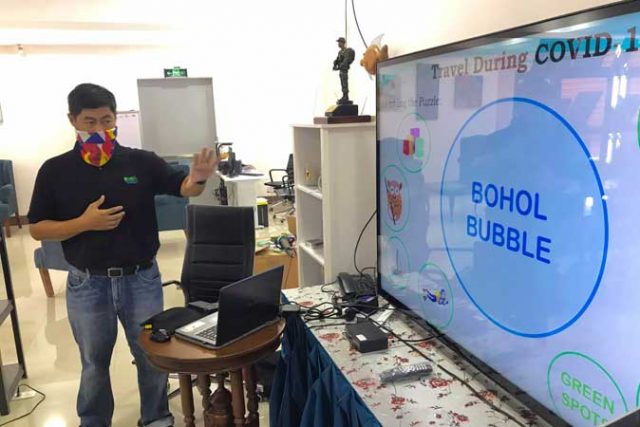
DoT secures vaccines for 5,000 Bohol tourism workers

THE DEPARTMENT of Tourism (DoT) announced Monday that additional doses of coronavirus vaccines will be delivered to Bohol as early as this week to inoculate 5,000 of the province’s tourism workers.

“I am delighted to bring the good news that vaccine czars Sec. Carlito Galvez and Sec. Vince Dizon have approved our request for additional vaccines for Bohol.

With this, the industry’s frontliners can start preparing for a bigger reopening of tourism in the coming days,” Tourism Secretary Bernadette Romulo-Puyat told Bohol’s industry stakeholders in a virtual meeting.

The delivery will consist of 10,000 doses of the Russian Gamalea Sputnik V vaccine brand.

“With these vaccines, we are assured that frontliners from accredited hotel and resort staff, transport operators, tour site and restaurant facilities will have an added protection against COVID-19 (coronavirus disease 2019),” she said.

The DoT, citing data from the provincial government, said  more than 200,000 workers have been affected by the temporary closure of establishments due to the pandemic.

Bohol Governor Arthur C. Yap said workers of accredited establishments with certificates for health safety standard compliance will get priority for vaccination.

“Bohol draws its income from remittances abroad and the services sector, and both sources have been impacted during this crisis.

The promise of more vaccines arriving sooner than later is indeed great news so we can protect not only our residents but assure visitors that we are taking measures to assure their safety as well,” Mr. Yap said. — MSJ

Muntinlupa residents ask human rights agency to probe BuCor wall 

RESIDENTS of Muntinlupa are set to ask the Commission on Human Rights (CHR) to probe the “inhumane building” of a wall by the Bureau of Corrections (BuCor), which has blocked their access to the main road.

The affected residents of Southville, along with local groups Kalipunan ng mga Mamamayan na Pinagkaisa sa New Bilibid Prison, Inc. and Alyansa ng Mamamayan sa Southville 3, will submit a letter to the CHR containing testimonies of how the “wall continues to violate the rights of the local population.”

“Aside from being an inconvenience, it cost the jobs and livelihood of informal workers, (public utility vehicles) and tricycle drivers, and disrupted the delivery of services in the barangay,” they said in a statement on Monday.

The Insular Prison Road, which is part of the national penitentiary property, serves the primary access to around 8,000 families or 40,000 residents of Southville 3, a government social housing project.

BuCor built the wall in March this year, which it said should have already been up 15 years ago.

Local government officials have likewise called for the removal of the wall.

Justice Secretary Menardo I. Guevarra said he will review the letter once submitted, but noted that alternative solutions were already recommended during previous discussions with BuCor. — Bianca Angelica D. Añago

Fiduciary Duty of Loyalty: Conflict-of-interest situations for directors, trustees, or officers

DAMIR KOPEZHANOV-UNSPLASH

Principle 2 of the Corporate Governance (CG) Code for Publicly Listed Companies (PLCs) provides that: “The fiduciary roles, responsibilities and accountabilities of the Board as provided under the law, the company’s articles and by-laws, and other legal pronouncements and guidelines should be clearly made known to all directors as well as to shareholders and other stakeholders.”

In turn, Recommendation 2.1 provides that “The Board members should act on a fully informed basis, in good faith, with due diligence and care, and in the best interests of the company and all shareholders.” The Explanation recognizes that there are two key elements of the fiduciary duty of members of the Board: the duty of care and the duty of loyalty; and that the “duty of loyalty is of central importance in that the board member should act in the interest of the company and all its shareholders, and not those of the controlling company of the group or any other stakeholder.”

The language of the Explanation to Recommendation 2.1 is quite peculiar since by limiting the application of the duty of loyalty to “shareholders” and by stating that board members should act in the interests of the company and all its shareholders and not those of “any other stakeholder,” it seems to conclude that no fiduciary duty is owed at all to the identified stakeholders of the company. The focus on the concept of duty of loyalty should limit itself to the fact that in conflict-of-interests situations, directors or trustees should chose to pursue the best interests of the company and the stakeholders to whom they owe fiduciary duty, and not their personal interests.

In realm of good CG, matters pertaining to the duty of loyalty cover primarily “related party transactions,” covered under Recommendation 2.7, thus: “The Board should have the overall responsibility in ensuring that there is a group-wide policy and system governing related party transactions (RPTs) and other unusual or infrequently occurring transactions, particularly those which pass certain thresholds of materiality. The policy should include the appropriate review and approval of material or significant RPTs, which guarantee fairness and transparency of the transactions. The policy should encompass all entities within the group, taking into account their size, structure, risk profile and complexity of operations.”

The Explanation to Recommendation 2.7 recognizes that ensuring the integrity of RPT is an important fiduciary duty of the director. It mandates the Board to formally adopt and implement an RPT Policy and provides for the contents thereof.

Section 31 of the RCCP now embodies the concept of “self-dealings” and “related party transactions,” which can be summarized as follows:

GENERAL RULE: Every contract of a corporation with any of its directors, trustees, or officers, or their spouses and relatives within the fourth civil degree of consanguinity or affinity, shall be voidable at the option of the corporation (i.e., acting through its Board of Directors);

EXCEPTION: Such contract shall be valid and binding on the corporation (i.e., corporation, acting through its Board of Directors, shall have no option to seek the annulment of such contract), when the following conditions are present:

(a) The presence of the interested director or trustee in the Board meeting in which the contract was approved was not necessary to constitute a quorum for such meeting;

(b) The vote of the interested director or trustee in such Board meeting was not necessary for the approval of the contract; and,

(c) The contract is fair and reasonable under the circumstances;

(d) In the Case of a Corporation Vested with Public Interest: Material RPT shall be approved by:

(i) At least two-thirds of the entire membership of the Board;

(ii) With at least a majority of the Independent Directors voting to approve the Material RPT;

(e) In the Case of an Officer: The contract has been previously authorized by the Board.

IF ANY OF THE CONDITIONS (1), (2) OR (4) ARE NOT PRESENT: In the case of a contract with a director or trustee, such contract may be ratified by a vote of shareholders representing at least two-thirds of the outstanding capital stock or of at least two-thirds of the members in a meeting called for the purpose; PROVIDED THAT:

(1) Full disclosure of the adverse interest of the directors or trustees involved is made at such meeting; and,

(2) The contract is fair and reasonable under the circumstances.

While the language of Section 31 of the RCCP clearly implies that the interested director or trustee may actually participate in the meeting involving a self-dealing transaction and actually vote thereat, Section 52 thereof expressly provides that “A director or trustee who has a potential interest in any related party transaction must recuse from voting on the approval of the related party transaction without prejudice to compliance with the requirements of Section 31 of this Code.”

Since Section 52 does not provide for any penalties when an interested director or trustee fails to recuse himself from participating in RPTs, the question must be: If an interested director or trustees does not recuse himself in participating in the meeting and voting on a self-dealing or related party transaction, does that make him criminally liable under Section 170 of the RCCP? Our position, as discussed below, is that violation of the prohibition under Section 52 does not make the offending director or trustee criminally liable under Section 170 of the RCCP. Nevertheless, the same may be the subject of administrative sanctions of the Securities and Exchange Commission (SEC) pursuant to Section 158 thereof.

In April 2019, the SEC issued Memorandum Circular No. 10-2019 (Rules on Material RPTs for PLCs), which has the following salient features:

• Recognized that RPTs are not inherently reprehensible, and that in fact “transactions between and among related parties may create financial, commercial and economic benefits to individual institution and to the entire group where said institutions belong.”

• Defines covered “Material RPTs” as those amounting to 10% or higher of a PLC’s Total Assets based on its latest audited financial statements, over a 12-month period with the same related party; and that if the reporting PLC is a parent company, the Total Assets shall pertain to its total consolidated assets.

• Obliges the PLC’s Board of Directors to adopt and submit to the SEC a Material RPT Policy, signed by the Board Chairman and the Compliance Officer.

• Obliges the filing with the SEC an Advisement Report on Material RPTs (signed by the Corporate Secretary or authorized representative) within three calendar days after the execution date of the transactions.

• Mandates disclosing in the Integrated Annual CG Report filed with the SEC (submitted annually every May 30) a summary of Material RPTs entered into during the reporting year.

Memorandum Circular No. 10-2019 indicates clearly that SEC is not gun-shy at all in activating its administrative sanction powers under Section 158 of the RCCP as it imposed specified basic and daily/monthly penalties for (a) Non-filing or late filing of or incomplete/incorrect signature in the Material RPT Policy; and, (b) Non-filing or late filing of or incomplete/incorrect Material RPT Advisement Report. In addition, the memorandum circular provides:

Continued non-payment of the assessed fine and/or failure to comply with the requirement within a period of 15 days after notice and hearing, shall be a sufficient ground for the Commission to take other appropriate action or remedies available under Section 158 of the RCCP.

Further, the commission of a fourth offense for the same violation is a ground for the suspension/revocation of the erring company’s registration or secondary license, which shall be made after notice and hearing, in accordance with the abovementioned procedures.

This is without prejudice to administrative penalties that may be imposed by the Commission pursuant to the provisions of the RCCP, the Securities Regulation Code, and other related laws.

With the imposition of basic penalty and daily/monthly penalties for the defined offenses, we do not understand the saving clause in the afore-quoted last paragraph that holds “This is without prejudice to administrative penalties that may be imposed by the Commission pursuant to the provisions of the Revised Corporation Code.”

This article reflects the personal opinion of the author and does not reflect the official stand of the Management Association of the Philippines or the MAP.


Attorney Cesar L. Villanueva is Chair of  MAP Corporate Governance Committee, trustee of the Institute of Corporate Directors, former Chair of Governance Commission for GOCCs (August 2011 to June 2016), Dean of the Ateneo Law School (April 2004 to September 2011), author of the book The Law and Practice in Philippine Corporate Governance and the National Book Board Award-winning Profession, and founding partner of the Villanueva Gabionza & Dy Law Offices.

map@map.org.ph

cvillanueva@vgslaw.com

http://map.org.ph

ADVERTISEMENT
ADVERTISEMENT