Home Blog Page 756

PHL stocks rebound as players pick up blue chips

BW FILE PHOTO

PHILIPPINE STOCKS rebounded on Tuesday as players picked up cheap shares of blue chips following the market’s recent weakness.

The bellwether Philippine Stock Exchange index (PSEi) rose by 0.66% or 38.98 points to close at 5,867.04, while the broader all shares index increased by 0.28% or 9.98 points to 3,558.88.

“The index bounced back from oversold levels following [Monday’s] market meltdown as investors pick up blue chips that have been sold down to multi-year lows,” AP Securities, Inc. Research Head Alfred Benjamin R. Garcia said in a Viber message.

“The benchmark stock index rebounded modestly on the back of bargain hunting and net foreign buying. Monday’s plunge brought many blue chips to compelling valuations, making them attractive to both opportunistic traders and long-term investors,” China Bank Capital Corp. Managing Director Juan Paolo E. Colet said.

However, uncertainty on the political and economic fronts continues to weigh on sentiment, he said.

Regina Capital Development Corp. Head of Sales Luis A. Limlingan said the PSEi’s rise on Tuesday was likely a technical rebound following its drop to a near seven-month low on Monday amid heavy selling pressure.

“[The] market continues to await the release of inflation and GDP (gross domestic product) figures, along with corporate earnings reports, to confirm its next direction,” he said.

The Philippine Statistics Authority will release October inflation data on Nov. 5 (Wednesday) and third-quarter GDP data on Nov. 7 (Friday).

A BusinessWorld poll of 17 analysts yielded a median estimate of 1.8% for October headline inflation. This would be faster than the 1.7% clip in September but within the Bangko Sentral ng Pilipinas’ (BSP) 1.4-2.2% forecast. It would also mark the eighth month in a row that inflation was below the BSP’s 2-4% annual target.

Meanwhile, Philippine GDP likely grew by 5.3% in the third quarter, based on the median forecast of 18 economists and analysts separately polled by BusinessWorld. This is slower than the 5.5% expansion in the second quarter and is below the government’s 5.5%-6.5% full-year goal.

Sectoral indices ended mixed on Tuesday. Financials climbed by 2.08% or 39.60 points to 1,936.18; property increased by 1.94% or 41.21 points to 2,164.36; and services rose by 0.12% or 2.81 points to 2,268.06.

Meanwhile, industrials declined by 1.23% or 108.43 points to 8,648.65; mining and oil shed 1.2% or 150.41 points to 12,337.88; and holding firms decreased by 0.06% or 3.16 points to 4,751.63.

Market breadth was positive as advancers outnumbered decliners, 108 to 83, while 57 names were unchanged.

Value turnover went down to P6.37 billion on Tuesday with 538.81 million shares traded from the P9.80 billion with 801.95 million issues exchanged on Monday.

Net foreign buying was at P339.79 million, a reversal of the P1.33 billion in net selling recorded on Monday. — Sheldeen Joy Talavera

Floor price for live hogs set at P210 per kilo

STOCK PHOTO | Image by Barbara Barbosa from Pexels

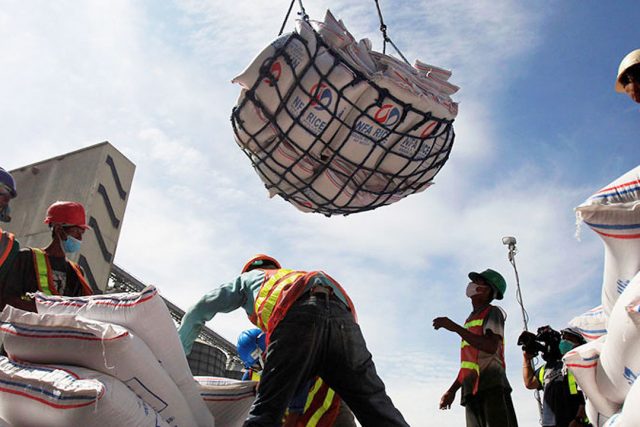
THE Department of Agriculture (DA) said it reached agreement with the pork industry to set a minimum farmgate price of P210 per kilogram for hogs on a liveweight basis.

The floor price is designed to arrest a steep drop in the live weight price to around P150 to P180 per kilo, which represents little more than breakeven cost, industry officials said.

The Samahang Industriya ng Agrikultura (SINAG), the National Federation of Hog Farmers, Inc., and the Pork Producers Federation of the Philippines represented the hog industry in talks with the DA.

The DA said it will also recommend restoring the pork import tariff to 40% from the current 25% under Executive Order 62, citing excessive imports.

Low import duties have encouraged excess imports which have “flooded the market, squeezed local producers, and endangered both our food security and farmers’ livelihoods,” Mr. Laurel was quoted as saying in a statement.

Jayson H. Cainglet, executive director of SINAG, told BusinessWorld via Viber that the influx of cheaper imported pork has not shown up in market prices.

Tutal hindi naman nagre-reflect ang tariff sa market price, ibalik na lang sa original. Binubulsa lang ng importers ang difference. Hindi nakikinabang ang consumers at producers (Since the low tariffs are not reflected in market prices, we might as well restore the original tariff. Importers are capturing the profits if tariffs are low but prices remain the same. Consumers and producers are not benefiting,” Mr. Cainglet said.

The DA added that it plans to reinstate a maximum suggested retail price for pork, which would be set at a level that balances “profitability across the supply chain and consumer protection.”

The DA will also issue an order reclassifying pork jowls, currently considered offal, to subject them to higher tariffs. Demand for pork jowls, a popular cut used in Korean barbecue (samgyupsal), has risen among meat processors. — Vonn Andrei E. Villamiel

Rice imports expected to resume by mid-Jan.

REUTERS

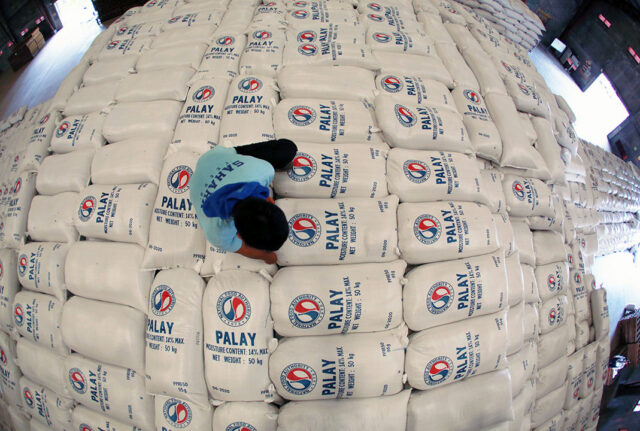
THE Department of Agriculture (DA) said on Tuesday that rice imports could resume in mid-January as prices stabilize following a four-month import ban.

DA Spokesman Arnel V. de Mesa said the executive order extending the import ban until December has yet to be released but confirmed it will be issued soon.

“We were informed that the executive order will be released,” he told a Palace briefing.

Imports will be allowed starting mid-January, running into mid-February, allowing rice inventories to build up before the next harvest.

“By January, we definitely need imports because there will be no additional harvest,” he said. “That’s why the ban is only until December.”

He added that the government will reassess conditions later in the year to determine whether another import freeze will be necessary. 

“It’s possible that we may reimpose a ban if harvests remain strong, to protect farmgate prices,” he added.

The DA over the weekend announced that the suspension of rice imports will remain in place until year’s end to help stabilize the farmgate price of palay, or unmilled rice.

The Philippines is the world’s largest rice importer, according to the US Department of Agriculture (USDA). The USDA trimmed its 2025 rice import forecast for the Philippines to 4.9 million metric tons (MMT) from 5.4 MMT previously following the government’s import freeze.

As of August, before the freeze took effect, imports amounted to 2.58 MMT of rice, down from 4.81 MMT imported in 2024.

Agriculture Secretary Francisco P. Tiu Laurel, Jr. said on Sunday that the executive order signed by President Ferdinand R. Marcos, Jr. that would formalize the extended import ban was initially expected to be released on Monday, Nov. 3.

The Marcos administration first implemented the import ban on Sept. 1 to stem the decline in prices of the staple grain ahead of the wet-season harvest.

While prices initially recovered following the suspension, they began to ease again as the original Oct. 31 expiry date approached.

The next lean period, Mr. De Mesa noted, will fall between July and August, ahead of the September harvest.

“We are now able to plan these cycles better — when to impose an import ban and when to allow imports — to protect both farmers and consumers and to ensure price stability,” he added.

Raul Q. Montemayor, national manager of the Federation of Free Farmers, said the import ban has not significantly propped up farmgate prices.

“Palay prices fell to P15.60 per kilo in September from P17.11 a month before, despite the start of the import ban,” he said via Viber.

“While there are reports of slight increases, prices remain low compared to previous periods,” he said, estimating the cost of production at about P14.50 per kilo.

Mr. Montemayor added that most of the palay harvest has been brought in, meaning any price increases driven by the ban would likely benefit traders rather than farmers.

He also warned that the government must closely monitor rice inventory levels through the rest of the year.

“Between October and December — excluding September, because for some reason they allowed 340,000 tons to come in despite the ban — we will forego about 1 million tons of imports, volume that would have been added to supply if there was no ban,” he said.

“The next harvest will be in March-May, so whatever stocks are carried over from 2025 plus imports that will come in if the ban is lifted say in January should be enough for at least three months consumption.” — Chloe Mari A. Hufana

Rice inventory up 3.2% in Oct. as NFA holdings rise sharply

PHILIPPINE STAR/MIGUEL DE GUZMAN

THE national rice inventory rose to 2.35 million metric tons (MMT) as of Oct. 1, up 3.2% year on year, the Philippine Statistics Authority (PSA) reported.

Of the total stock, 40.5% was held by commercial traders, 40.4% by households, and 19% by the National Food Authority (NFA).

Stock held by the NFA more than doubled to 447,900 MT in October from 172,640 MT a year earlier.

Rice held by commercial establishments amounted to 954,910 MMT, down 21.1%.

Rice held by households rose 6% year on year to 952,090 MT.

Month on month, the national rice inventory rose 13.6%, the PSA said.

“In comparison to September 2025, increments were noted in the rice stocks from the households by 17.8% and from the commercial sector by 17.1%. Meanwhile, rice stocks (held by) NFA depositories decreased by 0.2%,” a PSA report said.

The PSA also reported a 6.3% increase in corn inventory to 846,810 MT.

Corn held by the commercial sector accounted for 78.1% of the total, with the remainder held by households.

Month on month, the corn inventory rose 52.5%. — Vonn Andrei E. Villamiel

Palace optimistic about turnaround after infra scandal dents investor confidence 

A view of the central business district of Makati City on July 10. — PHILIPPINE STAR/RYAN BALDEMOR

THE GOVERNMENT is confident in a rebound following the infrastructure corruption scandal and a weak peso, with the economy being propped up by the business process outsourcing (BPO) and tourism industries and migrant worker remittances, the Palace spokesman said.

Press Officer Clarissa A. Castro said at a briefing:

“We remain confident that our government can overcome this, mainly because of the continued support from our BPOs, overseas Filipino workers and the tourism sector,” she said. 

Economic growth likely slowed to 5.3% last quarter as soft government spending, typhoons, and a corruption scandal weighed on growth momentum, according to a median estimate of 18 economists in a BusinessWorld poll.

The Philippine Statistics Authority will release third-quarter gross domestic product data on Nov. 7.

The heavy July rains caused many flood control projects to fail or exposed them as substandard, prompting the President to crack down on public works corruption in his State of the Nation Address.

Legislators and other government officials were allegedly colluding to steal billions of pesos in infrastructure funds.

The President has since ordered cost-cutting across all government agencies, with reductions as large as 50%.

The business community has called for the most egregious offenders to be made an example of after the scandal affected stock prices, with the peso dipping to a record low on Oct. 28.

Share prices fell 1.71% or 101.62 points to 5,828.06 on Monday, a seven-month low, with investors concerned the slowdown in public spending will cause the economy to lose momentum. The broader all-shares index slipped 1.23% to 3,548.90.

Analysts have expressed concerns about government underspending, with only P1.46 trillion of the P1.6 trillion in funding disbursed during the quarter.

Inflation is expected to rise slightly to around 1.8% in October from 1.7% in September, still within the Bangko Sentral ng Pilipinas’ forecast range of 1.4% to 2.2% and below its 2-4% target band. — Chloe Mari A. Hufana

ARTA, Ombudsman in deal to clear case backlog

THE Anti-Red Tape Authority (ARTA) and the Office of the Ombudsman said they signed an agreement to expedite the investigation of red-tape violations and alleged corruption.

The memorandum of agreement (MoA), signed during the Ease of Doing Business Convention on Tuesday, seeks to ensure “the rendering of assistance by the ARTA to the Ombudsman in the investigation of alleged red-tape related infractions and corruption by public officials and public servants.”

Under the agreement, the Ombudsman will incorporate ARTA findings in its investigation process, ARTA Director General Ernesto V. Perez said.

In a speech, Ombudsman Jesus Crispin C. Remulla said: “We will see (the impact of the collaboration) in the next few months, the next few days, as we get all the information about the corruption that happened during the flood control mess, ” he said.

Around 30 cases linked to the Department of Public Works and Highways (DPWH) are under preliminary investigation, with more expected to come, Mr. Remulla said.

“The DPWH is a problem in itself right now. And we are getting all the information. We’re processing the data,” he said. 

Mr. Remulla also flagged the Bureau of Internal Revenue and Bureau of Customs as the source of the most severe problems.

“The bigger problems come with the revenue streams of government,” he said in his speech. “Everybody knows they’re corrupt but no one’s done anything about it. We will do something about it.” — Beatriz Marie D. Cruz

Nickel mining industry in Caraga singled out for damaging environment, livelihoods — report

BW FILE PHOTO

MINING in northeastern Mindanao’s Caraga region has increased the local community’s vulnerability to the climate crisis, damaged livelihoods, and increased food insecurity, according to an international climate and human rights group.

In a news report released on Tuesday, Climate Rights International (CRI) warned of the industry’s impact as global demand grows for electric vehicle batteries, which use nickel as a key raw material.

“Nickel mining and related pollution have damaged the environment and threatened the rights of communities in multiple ways, including by destroying livelihoods, driving food insecurity, polluting water resources, threatening health, and impacting education,” CRI found.

BusinessWorld approached the Chamber of Mines of the Philippines for comment, but the chamber said it is still studying the report.

The Philippines is the world’s second-largest producer of nickel and the leading exporter of raw nickel ore. The United Nations trade database indicates that the Philippines exported nearly 45 million metric tons of nickel last year, valued at over $1.04 billion.

CRI’s report was the result of field research in mining-affected communities in the Caraga Region this year, including interviews with residents in Surigao del Sur and Dinagat Islands.

Caraga accounts for over half of the Philippines’ total metallic mineral output in terms by value, according to the Mines and Geosciences Bureau (MGB).

Twenty-six active mines operate in the region, including 23 specializing in nickel.

At a forum on Tuesday, CRI researcher and report author Krista Shennum said residents of mining communities have reported respiratory and skin problems, with their drinking water polluted by runoff.

CRI also found that fisherfolk in Dinagat Island and Surigao del Sur that fish stocks have been depleted due to mining activity, with farmers reporting that their rice fields have been left flooded and polluted, resulting in elevated food insecurity.

“Residents in Tubajon on Dinagat Island described how the loss of forests and mangroves due to mining operations and mining-related pollution makes their communities more exposed to storm surges, high winds, and flooding during extreme weather events like Super Typhoon Odette in 2021,” according to the report.

The researchers also reported instances of harassment, intimidation, and even killing of those opposed to mining activities.

According to a 2024 report by human rights group Global Witness, the Philippines remains Asia’s most dangerous country for environmental workers.

“Some individuals in the Caraga Region and across the Philippines who have challenged mining companies have faced lawsuits that they believe are intended to silence their activism,” the report found.

CRI quoted Tubajon, Dinagat Mayor Fely Pedrablanca as saying that mining companies have threatened to sue the local government over its opposition to mining activities and for publicly disclosing information about their tax payments.

With the shift toward clean energy, global demand for nickel is expected to rise in the coming decades. According to CRI, a scenario that assumes compliance with Paris Agreement goals produced an estimate of 60% nickel consumption growth by 2040.

Philippines nickel ore production rose 19.3% year on year by value, according to the MGB.

Most of the nickel mined in the Philippines is shipped overseas as raw ore of processing, with more than 90% of exports going to China. Exports to Indonesia also rose by more than 4,000% between 2023 and 2024 as Indonesian smelters faced shortages of nickel ore.

CRI is urging the government to freeze approvals for new nickel mines and review existing sites’ environmental compliance. — Vonn Andrei E. Villamiel

Review process for local PPP projects amended

PPP.GOV.PH

THE Public-Private Partnership (PPP) Center has issued a resolution revising the approval process for PPP projects overseen by local governments, the Department of Economy, Planning and Development (DEPDev) said.

In a social media post on Tuesday, DEPDev said the PPP Governing Board released this resolution on Oct. 27, introducing amended procedures and timelines, as well as forms and templates, for local PPP projects, to take effect on Nov. 26.

The new procedures bring the approval process in line with Republic Act No. 11966, or the PPP Code of the Philippines and its Implementing Rules and Regulations, DEPDev said.

The government is currently overhauling the oversight process for infrastructure projects managed by the Department of Public Works and Highways (DPWH) following a corruption scandal originating in irregular flood control contracts.

The resolutions cover PPP projects implemented by local government units and state universities and colleges.

The new procedure requires Investment Coordination Committee clearance of proposed Government Undertakings and availability payments using government funds for local PPP projects.

“Review and approval of proposed changes in the approved parameters, terms, and conditions for Local Solicited PPP projects (are required) prior to submission of bids,” it said.

The resolution also requires the determination of a reasonable rate of return in case of single complying solicited bids.

The PPP Center has reported that the PPP project pipeline now consists of 229 projects valued at P2.77 trillion, as of Sept. 3. — Aubrey Rose A. Inosante

Rice seed program granted P1.67 billion in extra funding

BW FILE PHOTO

THE Department of Budget and Management (DBM) said it approved the release of nearly P1.67 billion in additional funding to support the government’s rice seed program.

In a statement on Tuesday, the DBM said the extra funds will cover the purchase, delivery, and distribution of inbred certified seeds ahead of the 2026 dry season.

The release will also fund the procurement of vehicles and farm machinery.

The Philippine Rice Research Institute (PhilRice) aims to develop, propagate, distribute, and promote high-quality inbred rice seed to strengthen seed growers’ cooperatives.

“That’s why we approved the release of an additional P1.665 billion in funding for the program — to ensure the continued livelihood of our farmers and a sufficient supply of rice from the regions,” Budget Secretary Amenah F. Pangandaman said.

The DBM said about P4 billion was appropriated for PhilRice under the 2025 General Appropriations Act, that includes acquisition, delivery, and distribution of 2.5 million bags (at 20 kilos per bag) of inbred certified seed for the wet season, which started in March 2025.

This was released through a Special Allotment Release Order on May 14. — Aubrey Rose A. Inosante

Threshold to participate in retail market access program lowered to 100 kilowatts

PHILSTAR FILE PHOTO

MORE medium-sized enterprises and institutions are expected to exercise the option to select a preferred electricity supplier next year after the Energy Regulatory Commission (ERC) lowered the required threshold to join the retail market.

In a statement on Tuesday, the ERC said it approved the lowering of the threshold to 100 kilowatts (kW) of average monthly peak demand to be eligible for the Retail Competition and Open Access (RCOA) and the Retail Aggregation Program (RAP). The previous threshold had been 500 kW.

The ruling complies with the Electric Power Industry Reform Act (EPIRA) and fulfills its mandate to foster competition, drive efficiency, and empower electricity consumers.

ERC Chairman and Chief Executive Officer Francis Saturnino C. Juan said more end-users will be able to access better prices, improved service quality and innovation.

“Lowering the contestability threshold to 100 kW and implementing it in a deliberate and orderly fashion marks a significant advancement in unlocking the full potential of open access and consumer choice in the Philippines,” Mr. Juan said.

“This move underscores our commitment to fostering a fair, competitive, and transparent electricity market that delivers enduring benefits to consumers,” he added.

RCOA is a customer-choice program which gives qualified customers the power to choose their energy supplier, while RAP allows multiple electricity consumers to combine to meet the required consumption threshold.

Over 2,300 customers have signed up for RCOA while 73 groups have aggregated to join RAP, representing a combined demand of nearly 31 megawatts.

The ERC said it has taken a phased and coordinated approach to ensure market readiness and operational stability.

With the new threshold set to take effect on June 26 next year, the ERC said the transition period will allow distribution utilities and retail metering service providers time to procure and install metering equipment.

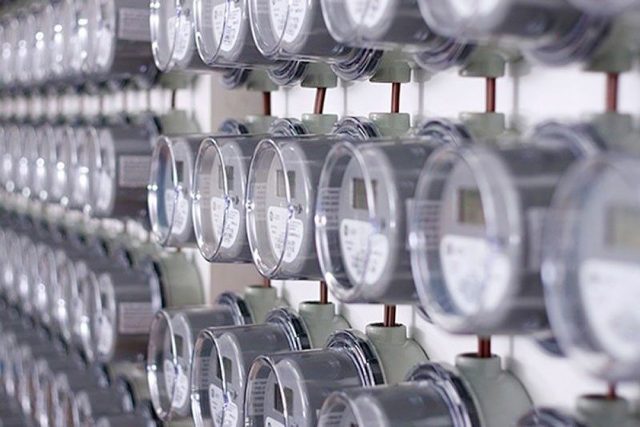
The ERC has also issued rules governing the implementation of advanced metering infrastructure (AMI) by distribution utilities and authorized entities, which will guide the rollout of smart metering systems.

AMI, which integrates smart meters, communication platforms, and data management systems, enables two-way information flow between consumers and utilities. This provides real-time data on electricity consumption, automated billing, outage detection, and remote service management.

According to the ERC, the rules reflect technological advancements, global best practices, and evolving consumer and market needs, while ensuring data privacy and cybersecurity.

“The new AMI Rules mark a milestone in the digital transformation of the power distribution sector. By enabling real-time data exchange and empowering both utilities and consumers, we are laying the foundation for a smarter, more secure, and inclusive energy future,” Mr. Juan said. — Sheldeen Joy Talavera

Alex Eala ends 2025 WTA Tour at Top 50, sees fruitful 2026

WTA NO. 50 ALEX EALA — WTATENNIS.COM

CRACKING the world’s Top 50 is just the beginning for Alexandra “Alex” Eala.

The Filipina tennis wunderkind vowed a stronger fight next season in a bid to win her first Grand Slam, climb upper in the Women’s Tennis Association (WTA) rankings and capture more pro titles after reaching 50th place at the end of the 2025 WTA Tour.

“This marks the beginning of what I hope to be a long, happy and fruitful career on tour. Thank you everybody. See you in 2026,” Ms. Eala penned on social media.

Ms. Eala, only 20 years young, became the first Filipina in history to barge into the world’s Top 50 tennis players — thanks to a stellar run around the world marked by her first WTA title in Mexico and a first-ever Grand Slam main draw for any Filipina ever at the US Open.

The lefty ace ruled the WTA 125 Guadalajara Open and stunned world No. 15 Clara Tauson of Denmark in Round 1 of the US Open in New York. Before that, she scored gigantic wins against five-time major winner Iga Swiatek (world No.2) of Poland, 2017 French Open champion Jelena Ostapenko (No. 25) of Latvia and 2025 Australian Open champion Madison Keys (No. 5) of the United States.

She started the year at No. 158 before scaling more than 100 rungs to reach the pinnacle of Philippine tennis with 1143 points, qualifying to all main draws of WTA 1000 and majors such as the US Open, French Open and Wimbledon. The only Slam main draw left for Ms. Eala is the Australian Open, where she’s also seeded early next year.

Having played in China, Japan, Brazil, England, Canada, Portugal, Spain, Slovakia, Singapore, India and Australia as well, Ms. Eala also had her share of agonies and defeats. And that’s what only made her historic year worthwhile for a huge stepping stone to a bigger goal next year.

“My season comes to an end. I have no words to describe what 2025 has brought me. My dreams have truly come alive,” added Ms. Eala.

“It’s such a privilege to look back at this year and relive these amazing moments through memory. All that’s happened this season and the emotions that come with it is a love letter to my family, friends, team, every supporter across my journey in tennis, and of course, baby Alex.”

But first things first for Ms. Eala before thinking 2026 as she’s set for a sweet Philippine team homecoming to play in the 33rd Southeast Asian Games next month in December.

With her first pro title already in the books and a glittering Top-50 ranking, Ms. Eala will be out in Bangkok for her first gold medal after winning three bronze mints in the 2022 Hanoi games. Ms. Eala skipped the Cambodia edition in 2023.

From there, a first-ever home game is on the horizon when the Philippine Sports Commission (PSC) and the Philippine Tennis Association (PHILTA) host a WTA Tour leg early next year to be called Manila or Philippine Open. — John Bryan Ulanday

UP Fighting Maroons eye payback vs UST

UAAP

Games on Wednesday
(Mall of Asia Arena)
7:30 a.m. – UE vs ADMU (16U)
9:30 a.m. – UST vs UPIS (16U)
Noon – UE vs ADMU (Women)
2 p.m. – UE vs ADMU (Men)
4:30 p.m. – UST vs UP (Men)
7 p.m. – UST vs UP (Women)

REIGNING champion University of the Philippines (UP) wants payback on University of Santo Tomas (UST) to firm up grip of the coveted second seed in the UAAP Season 88 men’s basketball tournament on Wednesday at the Mall of Asia Arena.

Game time is at 4:30 p.m. with the Fighting Maroons, clinging behind leader National University (NU) (8-2) at 6-3, eyeing enough separation from rival De La Salle University (6-4) and Santo Tomas (5-4) for the desired Top Two laced by a twice-to-beat incentives in the Final Four.

In the first game at 2 p.m., Ateneo de Manila University (4-5) shoots for an end to a costly five-game slump that bumped it out of the Final Four picture against the winless University of the East (0-9), which will welcome back Wello Lingolingo from a four-game suspension.

But all eyes are on the Fighting Maroons, who got decked by the Growling Tigers, 87-67, in the opening day.

That lopsided affair was held at the Tigers’ lair at the Quadricentennial Pavilion Arena in España and with a neutral ground this time around, the dribblers from Diliman are hopeful for a different result especially on the crest of winning four of its last six games after a flat 0-2 start.

A stark contrast it is for Santo Tomas, in the middle of a three-game skid after a blazing 5-1 start for a tie with NU on top in the first round.

“They’re very competitive also as a team. For us naman, we will always focus on ourselves first and what needs to be improved on and definitely, every team naman, kung paano naman paghandaan, we’ll treat UST the same,” said coach Goldwin Monteverde, banking on Harold Alarcon, Francis Nnoruka, Rey Remogat and Gani Stevens to lead the way.

The Growling Tigers, led by super import Collins Akowe, are well aware of their struggle with no wins to show in the second round but admitted there’s no panicking in a bid to prove their resilience to stay in the Top Four. — John Bryan Ulanday

ADVERTISEMENT
ADVERTISEMENT