Home Blog Page 740

BSP launches open finance pilot for PERA

BW FILE PHOTO

THE BANGKO SENTRAL ng Pilipinas (BSP) has launched a pilot program that will use open finance to boost access to the Personal Equity and Retirement Account (PERA) and encourage more Filipinos to save.

The central bank on July 29 launched the Open Finance for PERA Pilot, which leverages the regulator’s Open Finance framework that allows for secure sharing of customers’ financial data across institutions.

“By making PERA the starting point for open finance, we make it part of a seamless digital ecosystem, making saving and investment simpler for everyone,” BSP Governor Eli M. Remolona, Jr. said “At the same time, we give open finance a jumpstart from concept to practice. This is more than innovation; this is financial health.”

Through the initiative, Filipinos can open PERA accounts by logging into their selected provider’s platform and consenting to bank or e-wallet know your customer data sharing, which the BSP said eliminates the need for manual forms or ID verification.

“The BSP sees open finance as a means to expand financial choice and convenience… The pilot will soon allow users to open accounts directly via participating apps, making PERA more accessible and user-friendly,” the central bank added.

The launch was attended by BSP officials, Monetary Board members, as well as representatives from participating financial institutions and PERA Administrators. The participating institutions will enable their customers to open PERA accounts, while the PERA Administrators will manage the investments.

The participating financial institutions are Land Bank of the Philippines; Maya Philippines, Inc.; Metropolitan Bank & Trust Corp.; Philippine National Bank; Rizal Commercial Banking Corp.; Union Bank of the Philippines, Inc.; and G-Xchange, Inc.

Meanwhile, the PERA Administrators are ATRAM Trust Corp.; BDO Unibank, Inc.; and BPI Wealth – A Trust Corp.

Launched in 2016, PERA is a voluntary fund scheme meant to supplement retirement benefits from the Government Service Insurance System or the Social Security System, as well as private employers.

Contributors aged 18 and above who have a tax identification number are allowed to open a PERA account. Self-employed and locally employed contributors can make an annual contribution of P200,000, while overseas Filipino workers can invest up to P400,000.

The PERA Law also offers various incentives to contributors, such as tax exemptions on earnings from PERA investments, a 5% income tax credit on contributions that can be used for paying income tax liabilities, and a tax-free distribution on qualified withdrawal of PERA investments.

Accumulated PERA contributions climbed by 24% year on year to P491.4 million at end-2024 from P396.3 million in 2023, data from the BSP showed.

The total number of PERA contributors likewise rose by 6.4% to 5,912 at 2024’s close from 5,555 a year prior. — Katherine K. Chan

Metro Manila condo vacancy may drop in 2026

METRO MANILA’S residential market continues to experience dampened take-up for mid-income condominium projects (priced from P3.2 million to P12 million per unit). This has prompted major property developers to aggressively offer attractive and innovative ready-for-occupancy (RFO) promos to encourage more buyers to acquire units in the capital.

Hefty discounts on spot cash payments, extended payment terms, free appliances, and other concessions are indeed enticing more investors to purchase vertical units. These promotions appear to be effective, with Colliers recording improved take-up across nearly all condominium price segments in Metro Manila.

We are now seeing a more pronounced influx of luxury developments — high-end projects dominating both supply, through new launches, and demand, as evidenced by positive net take-up for luxury to ultra-luxury units priced at P100 million and above.

Developers have become more prudent with their launches within and outside Metro Manila, capitalizing on a consumer base flush with cash and actively seeking capital value appreciation opportunities even beyond the capital.

DEMAND AND RENTS REMAIN SOFT
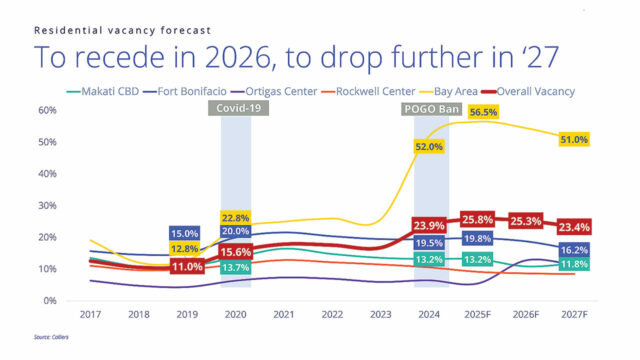
Weak demand for units for rent and for sale has resulted in elevated vacancy levels across Metro Manila, particularly in the Bay Area, which continues to suffer from the effects of the Philippine offshore gaming operator (POGO) exodus. More established central business districts (CBDs) continue to outperform their peripheral counterparts.

We forecast a marginal rental correction of 1.5% in 2025, followed by a recovery in 2026 as vacancy begins to ease. We also expect sustained demand, particularly from expatriates seeking larger units and more open spaces.

VACANCY TO EASE IN 2026 AND 2027
Colliers expects vacancy levels to begin declining in 2026 as condominium completions slow and demand picks up, especially in key CBDs. This trend will likely continue through 2027, driven in part by fewer unit turnovers and stabilizing take-up in major business districts.

We project a more stable vacancy rate in Metro Manila over the next 24 to 26 months, as the worst impact of the POGO exodus on the condominium market has likely passed.

CUT-THROAT RFO BATTLE TO CONTINUE
As of the second quarter (Q2), the remaining condominium inventory in Metro Manila stands at 81,000 units, 30,600 of which are RFO. Colliers recommends that developers with significant RFO inventory offer more attractive and curated promos. We have seen select developers offer up to 40% discounts on total contract prices (TCPs) for spot cash payments, early move-in packages, rent-to-own options, and even gift certificates of up to P150,000 ($2,700).

Meanwhile, tenants and buyers should watch for areas offering larger discounts on lease rates and prices. In our view, RFO units in the Bay Area and other fringe locations are likely to be offered at steeper discounts due to slower demand and elevated vacancies caused by the POGO exit.

DEVELOPERS CORNER LUXURY DEMAND
The substantial volume of unsold inventory in the mid-income segment (P3.6 million to P12 million) is prompting developers to pivot toward high-end developments. In 2024, Colliers recorded that the upscale to ultra-luxury segments (P12 million and above) accounted for 41% of total condominium launches in Metro Manila. Several developers have recently launched new luxury projects both within and beyond the capital. These include Ayala Land Premier’s Laurean Residences in Makati, Cebu Landmasters’ The Wave in Cebu, and SM Prime’s Signature series, which will be located across several provinces.

Colliers expects demand for luxury projects to remain strong, with take-up driven primarily by expatriates, international visitors, and sustained interest from affluent buyers. Developers should emphasize upscale amenities, premium concierge services, and strong capital appreciation potential — key considerations for discerning investors and end-users.


Joey Roi Bondoc is the director and head of Research of Colliers Philippines.

joey.bondoc@colliers.com

Too many em dashes? Weird words like ‘delves’? Spotting text written by ChatGPT is still more art than science

PEOPLE ARE NOW routinely using chatbots to write computer code, summarize articles and books, or solicit advice. But these chatbots are also employed to quickly generate text from scratch, with some users passing off the words as their own.

This has, not surprisingly, created headaches for teachers tasked with evaluating their students’ written work. It’s also created issues for people seeking advice on forums like Reddit, or consulting product reviews before making a purchase.

Over the past few years, researchers have been exploring whether it’s even possible to distinguish human writing from artificial intelligence (AI)-generated text. But the best strategies to distinguish between the two may come from the chatbots themselves.

TOO GOOD TO BE HUMAN?
Several recent studies have highlighted just how difficult it is to determine whether text was generated by a human or a chatbot.

Research participants recruited for a 2021 online study, for example, were unable to distinguish between human- and ChatGPT-generated stories, news articles, and recipes.

Language experts fare no better. In a 2023 study, editorial board members for top linguistics journals were unable to determine which article abstracts had been written by humans and which were generated by ChatGPT. And a 2024 study found that 94% of undergraduate exams written by ChatGPT went undetected by graders at a British university.

Clearly, humans aren’t very good at this.

A commonly held belief is that rare or unusual words can serve as “tells” regarding authorship, just as a poker player might somehow give away that they hold a winning hand.

Researchers have, in fact, documented a dramatic increase in relatively uncommon words, such as “delves” or “crucial,” in articles published in scientific journals over the past couple of years. This suggests that unusual terms could serve as tells that generative AI has been used. It also implies that some researchers are actively using bots to write or edit parts of their submissions to academic journals. Whether this practice reflects wrongdoing is up for debate.

In another study, researchers asked people about characteristics they associate with chatbot-generated text. Many participants pointed to the excessive use of em dashes — an elongated dash used to set off text or serve as a break in thought — as one marker of computer-generated output. But even in this study, the participants’ rate of AI detection was only marginally better than chance.

Given such poor performance, why do so many people believe that em dashes are a clear tell for chatbots? Perhaps it’s because this form of punctuation is primarily employed by experienced writers. In other words, people may believe that writing that is “too good” must be artificially generated.

But if people can’t intuitively tell the difference, perhaps there are other methods for determining human versus artificial authorship.

STYLOMETRY TO THE RESCUE?
Some answers may be found in the field of stylometry, in which researchers employ statistical methods to detect variations in the writing styles of authors.

I’m a cognitive scientist who authored a book on the history of stylometric techniques. In it, I document how researchers developed methods to establish authorship in contested cases, or to determine who may have written anonymous texts.

One tool for determining authorship was proposed by the Australian scholar John Burrows. He developed Burrows’ Delta, a computerized technique that examines the relative frequency of common words, as opposed to rare ones, that appear in different texts.

It may seem counterintuitive to think that someone’s use of words like “the,” “and,” or “to” can determine authorship, but the technique has been impressively effective.

Burrows’ Delta, for example, was used to establish that Ruth Plumly Thompson, L. Frank Baum’s successor, was the author of a disputed book in the Wizard of Oz series. It was also used to determine that love letters attributed to Confederate Gen. George Pickett were actually the inventions of his widow, LaSalle Corbell Pickett.

A major drawback of Burrows’ Delta and similar techniques is that they require a fairly large amount of text to reliably distinguish between authors. A 2016 study found that at least 1,000 words from each author may be required. A relatively short student essay, therefore, wouldn’t provide enough input for a statistical technique to work its attribution magic.

More recent work has made use of what are known as BERT language models, which are trained on large amounts of human- and chatbot-generated text. The models learn the patterns that are common in each type of writing, and they can be much more discriminating than people: The best ones are between 80% and 98% accurate.

However, these machine-learning models are “black boxes” — that is, we don’t really know which features of texts are responsible for their impressive abilities. Researchers are actively trying to find ways to make sense of them, but for now, it isn’t clear whether the models are detecting specific, reliable signals that humans can look for on their own.

A MOVING TARGET
Another challenge for identifying bot-generated text is that the models themselves are constantly changing — sometimes in major ways.

Early in 2025, for example, users began to express concerns that ChatGPT had become overly obsequious, with mundane queries deemed “amazing” or “fantastic.” OpenAI addressed the issue by rolling back some changes it had made.

Of course, the writing style of a human author may change over time as well, but it typically does so more gradually.

At some point, I wondered what the bots had to say for themselves. I asked ChatGPT-4o: “How can I tell if some prose was generated by ChatGPT? Does it have any ‘tells,’ such as characteristic word choice or punctuation?”

The bot admitted that distinguishing human from nonhuman prose “can be tricky.” Nevertheless, it did provide me with a 10-item list, replete with examples.

These included the use of hedges — words like “often” and “generally” — as well as redundancy, an overreliance on lists, and a “polished, neutral tone.” It did mention “predictable vocabulary,” which included certain adjectives such as “significant” and “notable,” along with academic terms like “implication” and “complexity.” However, though it noted that these features of chatbot-generated text are common, it concluded that “none are definitive on their own.”

Chatbots are known to hallucinate, or make factual errors.

But when it comes to talking about themselves, they appear to be surprisingly perceptive.


Roger J. Kreuz is an associate dean and professor of psychology at the University of Memphis.

The heroic role of gas plants in cheaper electricity

A number of non-truthful statements against gas plants especially liquefied natural gas (LNG) came out recently. These include that: a.) gas plants are responsible for recent higher Meralco electricity prices; and, b.) gas plant costs are driving up electricity prices globally and cause more hardship to households.

I said “non-truthful” because there are numbers and facts that disprove the above narratives. I compared the electricity rates from July 2022 — the start of President Ferdinand R. Marcos, Jr.’s administration — to July 2025, the last billing period. Here we go.

Meralco’s total electricity rates collected increased from P9.75 per kilowatt-hour (kWh) in July 2022 to P12.64/kWh. This increase was due mainly to: a.) a lower distribution refund rate, and, b.) a higher generation charge from pass-through of higher Malampaya prices and the Energy Regulatory Commission (ERC) denial or inaction on requests to adjust charges due to Change in Circumstance (CIC) claims.

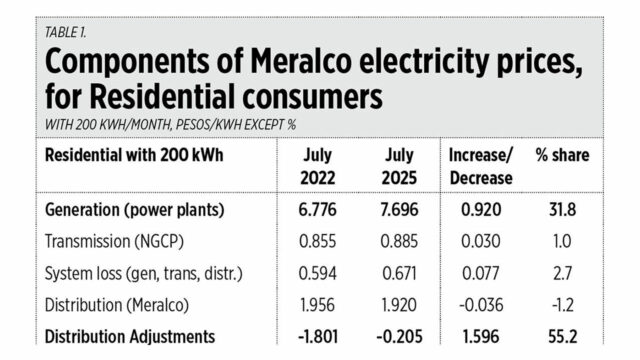
The LNG plants in Batangas — jointly owned by Aboitiz Power (AP), Meralco Power Gen (MGEN) and San Miguel Global Power (SMGP), the Excellent Energy Resources, Inc. (EERI) and South Premier Power Corp. (SPPC or the Ilijan plant) — have nothing to do with the higher prices this year. And there was even a decline in the Meralco distribution charge from 2022 to 2025 by nearly 4 centavos/ kWh (see Table 1).

Here are the numbers for the two reasons for the increase that I mentioned.

On (a.): in July 2022, Meralco residential customers got a refund of P1.80/kWh in the distribution charge due to distribution rate true-up. The total refund of P48.2 billion was completed in May 2023. In July 2025, the distribution refund rate covering the latest true-up was lowered by the ERC to P0.205/kWh. So there was an “increase” of P1.596/kWh in distribution adjustments which constitutes 55% of the P2.89/kWh increase over three years.

On (b): the generation costs of First Gas Sta. Rita and First Gas San Lorenzo, both owned by FirstGen (not affiliated with Meralco), increased by P1.988/kWh and P2.806/kWh, respectively, over the same period. Both power plants account for about 30% of the generation supply.

The ERC denial of, or inaction on, requests for price adjustment based on CIC claims forced the power suppliers — SPPC, Sual Power Inc. (SPI), and ACEN — to terminate their fixed price Power Supply Agreements (PSAs) with a total contracted capacity of 1,310 megawatts. Meralco was then forced to enter into emergency PSAs, which were more expensive by about P1.32/kWh than the PSAs that were terminated.

I asked Meralco for more data on the PSA between it and EERI. They replied that the generation cost of the EERI gas plant under the PSA with Meralco would have been lower if the ERC had acted on Meralco’s PSA applications filed in 2021. After conducting a competitive selection process (CSP) in 2021, Meralco and its counterparty suppliers (EERI and Masinloc Power) asked for ERC approval of the two resulting PSAs totaling 1,800 MW — but the ERC did not act for two years. So the power suppliers terminated the two PSAs in March 2023 after the lapse of the long-stop date. Meralco then conducted another CSP in 2024, a period of higher inflation (the Philippine inflation rate was 6% in 2023 and 3.2% in 2024). The offered prices of the 2024 winning power suppliers were P2+ per kWh higher than the winners of the 2021 CSP.

So the PSAs of the Meralco “sister companies” — EERI and SPPC/Ilijan — with a combined capacity of 2,400 MW, are not the main drivers of the increase in the total rate. Rather, these PSAs helped augment the supply in the grid to avert power supply shortages and bring down the cost of electricity.

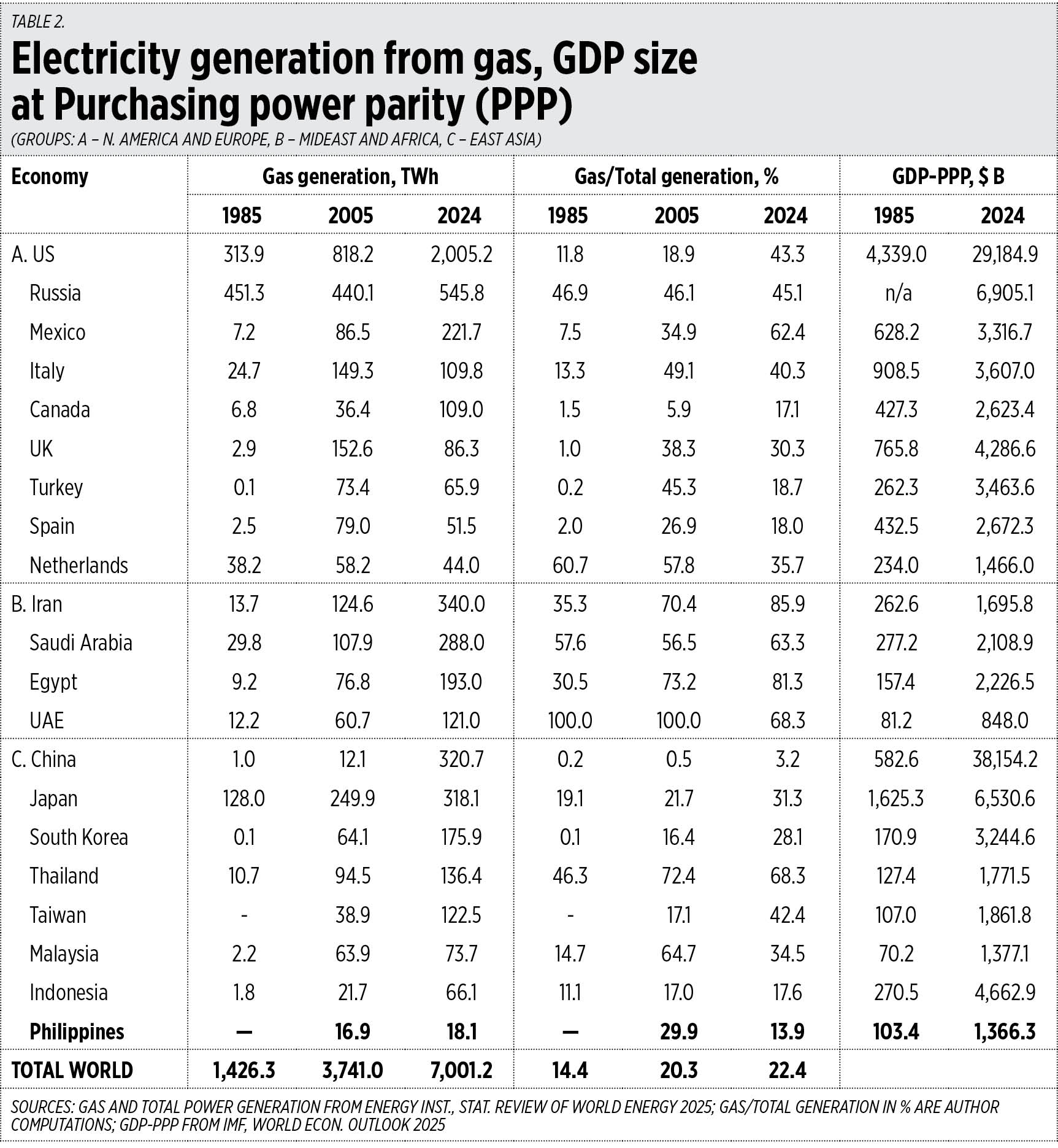
Blaming gas plants for driving up electricity prices globally and causing more hardship to households is an idea that I find far out. Many countries, both industrialized and industrializing, are using more gas power. From 1985 to 2024, the expansion in gas power generation in terawatt-hours (TWh) among selected countries was as follows: the USA, from 314 TWh to 2,005 TWh; Mexico from 7 TWh to 222 TWh; Canada from 7 TWh to 109 TWh; Iran from 14 TWh to 340 TWh; Egypt from 9 TWh to 193 TWh. In East Asia the increase was as follows: China from 1 TWh to 321 TWh; South Korea from 0.1 TWh (or 100,000 MWh) to 176 TWh; and, Malaysia from 2 TWh to 74 TWh. Globally it increased from 1,426 TWh to 7,001 TWh.

The share of gas to total power generation for many countries has been rising. Looking at the numbers from 1985 to 2024, the USA’s gas share rose from 12% to 43%, Mexico’s from 7.5% to 62%, the UK’s from 1% to 30%, South Korea’s from 0.1% to 28%, and Taiwan’s from zero to 42%. There has been  a significant expansion in GDP size of many countries as they used more hydrocarbons like gas to produce electricity over the past four decades (see Table 2).

The Philippines’ gas generation of only 18 TWh in 2024 was equivalent to only seven weeks of gas generation in Thailand, five weeks in South Korea, three weeks in Japan and China, and only three days in the US. It is so small and yet some climate-obsessed activists want to discontinue the expansion of our gas power capacity.

The Philippines should have expanded its gas power generation by four times (4X) to be at the level of Malaysia, or 7.6 times to be at the level of Thailand in 2024. The climate activists should turn their anti-gas noise and drama on the USA, Russia, Iran, Saudi Arabia, China, Japan, and Korea. It is very likely that these countries will laugh at these activists.

I hope that AP, MGEN, and SMGP will continue their LNG partnership and further expand the Philippines’ gas capacity. More power from stable, dependable sources means there is less threat of blackouts and lower prices of electricity.


Bienvenido S. Oplas, Jr. is the president of Bienvenido S. Oplas, Jr. Research Consultancy Services, and Minimal Government Thinkers. He is an international fellow of the Tholos Foundation.

minimalgovernment@gmail.com

SMPC Q2 earnings down 33% as coal, power prices ease

SEMIRARAMINING.COM

SEMIRARA MINING and Power Corp. (SMPC) saw its second-quarter (Q2) attributable net income decline by 33% to P4.1 billion as coal and electricity prices continued to normalize.

For the three months ended June, SMPC’s revenues dipped by 18.4% to P18.17 billion due to lower selling prices in the coal segment and weaker spot market prices in the power segment, according to its financial statement released on Monday.

Broken down, coal and power revenues decreased by 20% to P10.27 billion and 6% to P6.47 billion, respectively.

The average selling price for Semirara coal went down by 20% to P2,223 per metric ton (MT) due to “the combined effect of stabilizing global market indices and a higher proportion of lower-quality and non-commercial grade coal shipments.”

During the period, the average Newcastle Index fell by 26% to $100.50, while the Indonesian Coal Index 4 went down by 16% to $46.40.

SMPC’s coal production increased by 8% to 5.6 million MT, driven by improved access to coal seams at the Narra mine.

The company, however, reported flattish shipments at 4.6 million MT, as increased own-plant sales offset lower foreign shipments.

In the power segment, average spot electricity prices on the Luzon-Visayas grid declined by 42% to P4.04 per kilowatt-hour due to large supply margins brought about by additional power capacity, fewer outages, and a modest increase in demand.

The company reported a 17% increase in power sales to 1,435 gigawatt-hours, fueled by stronger plant availability and higher average capacity.

Of the total energy sold, 56% was sold to the spot market, while the remaining 44% was covered by bilateral contracts.

As of end-June, the company had committed 38% of its 840-megawatt (MW) total dependable capacity. After accounting for internal power usage, about 435.6 MW was left that could be sold to the spot market.

“While energy prices eased, we ramped up coal production and boosted power generation. By keeping our costs under control and operating more efficiently, we were able to cushion the impact of weaker prices,” SMPC President, Chief Operating Officer and Chief Sustainability Officer Maria Cristina C. Gotianun said in a media release.

For the first six months ended June, SMPC’s earnings decreased by 33.1% to P8.42 billion due to the continued stabilization of coal and spot electricity prices, and the recognition of an equity net loss from its cement associate.

Revenues sank by 14.4% to P31.33 billion, driven by softer coal index benchmarks and weaker electricity spot prices, cushioned by improved power segment generation.

“Looking ahead, we expect prices to remain relatively stable. Our focus is on ramping up coal production toward our 18 million metric ton target and optimizing our generation mix to maximize contracted capacity,” Ms. Gotianun said.

SMPC is the only vertically integrated power generator in the country that runs on its own fuel. The company supplies fuel to power plants, cement factories, and other industrial facilities across the Philippines. It also exports coal to China, South Korea, Brunei, and other nearby markets.

At the local bourse on Monday, shares in the company declined by 1.52% to close at P32.45 apiece. — Sheldeen Joy Talavera

Peso surges to P57 level on renewed Fed cut hopes

BW FILE PHOTO

THE PESO rebounded sharply against the dollar on Monday to return to the P57 level after weaker-than-expected US jobs data revived hopes of a September rate cut by the US Federal Reserve.

The local unit closed at P57.29 per dollar, surging by 85.5 centavos from its P58.145 finish on Friday, Bankers Association of the Philippines data showed.

The peso opened Monday’s session stronger at P57.75 against the dollar, which was already its worst showing. Its intraday best was its closing level of P57.29 against the greenback.

Dollars traded fell to $1.69 billion on Monday from $2.54 billion on Friday.

“The dollar-peso closed lower on back of a weak dollar following low nonfarm payrolls data last Friday, strengthening bets of Fed cuts,” a trader said in a phone interview.

Data on Friday showed US employment growth undershot expectations in July while the nonfarm payrolls count for the prior two months was revised down by a massive 258,000 jobs, suggesting a sharp deterioration in labor market conditions, Reuters reported.

Markets are now pricing an almost 90% chance the Fed will ease rates next month owing to the weaker-than-expected jobs data, with just under 60 basis points worth of cuts expected by December, implying two quarter-point cuts and a 40% chance of a third.

The peso gained ground on expectations that Philippine headline inflation eased in July, Rizal Commercial Banking Corp. Chief Economist Michael L. Ricafort said in a Viber message.

The Philippine Statistics Authority is scheduled to release July inflation data on Tuesday (Aug. 5). A BusinessWorld poll of 17 analysts yielded a median estimate of 1.2% for the July consumer price index (CPI), within the central bank’s 0.5%-to-1.3% projection.

If met, the July CPI print would be slower than the 1.4% in June and the 4.4% clip in the same month a year ago.

This would also be the slowest in nearly six years or since the 0.6% print posted in October 2019.

For Tuesday, the first trader sees the peso moving between P57 and P57.50 per dollar, while Mr. Ricafort expects it to range from P57.10 to P57.40. — Aaron Michael C. Sy with Reuters

Retail group says tech shift won’t end Filipinos’ love for malls

PHILIPPINE STAR/KJ ROSALES

THE PHILIPPINE Retailers Association (PRA) said the rise of artificial intelligence (AI) in retail will not lead to the decline of brick-and-mortar stores, countering fears that smarter online shopping could drive Filipinos away from malls.

“They say that people won’t come to malls anymore [because of AI], but Filipinos as a whole are still very social creatures. We’re all social citizens, and we go to malls to truly interact with one another,” PRA President Alice T. Liu told reporters on the sidelines of an event on Thursday last week.

“Although some purchases may shift online, we believe malls will continue to be places where people will still congregate.”

PRA Chairman Roberto S. Claudio noted that AI will only drive growth in the country’s retail sector.

“Over the last five years, retail has been growing by 10% to 15%, and that’s without the use of AI,” Mr. Claudio said. “So next year, as [retailers] adopt AI, I think growth will be even greater — higher than 10% to 15% — depending on how well they use AI.”

Ms. Liu noted AI’s potential to create new positions and roles in the industry, citing the need for upskilling and investment in data management.

“There will be jobs that will be replaced by AI, but there will also be new roles and positions created that will give others opportunities to grow in this field,” she said.

“We are hoping that companies will invest in cleaning up their data, getting their data architecture ready for AI implementation, and at the same time, building a workforce that is more comfortable with using AI,” Ms. Liu added.

The Metro Manila retail sector is expected to deliver about 300,000 square meters of new retail space between this year and 2030, according to real estate consultancy firm JLL Philippines. — Beatriz Marie D. Cruz

Entertainment News (08/05/25)


Clara Benin to hold a two-night concert

FOLLOWING the sold-out success of her 2023 concert at the Music Museum, Clara Benin returns to the stage with a celebration of the records that shaped her artistic journey. Born On A Rainy Night: Celebrating 10 Years of Human Eyes and Riverchild is a two-night concert happening on Oct. 3 and 4 at the Manila Metropolitan Theater. Presented by minsan studio, the special show reimagines Ms. Benin’s early work with a 30-piece orchestra, under the musical direction and arrangement of Ria Villena-Osorio. It draws from her 2015 debut album Human Eyes and EP Riverchild. Tickets are now available via www.minsan.studio.


Dolly de Leon joins Apple TV+ series

FILIPINO actress Dolly de Leon is joining the cast of the Apple TV+ series Maximum Pleasure Guaranteed. The CreaZion Studios artist will star alongside Tatiana Maslany. The half-hour darkly comedic thriller is created, written, and executive produced by David J. Rosen. It follows a newly divorced mom (played by Ms. Maslany) who spirals into a world of blackmail, murder, and youth soccer. Ms. De Leon takes on a series regular role as Detective Sofia Gonzalez.


Science museum opens in Iloilo City

SCIENCE XPdition has opened in Iloilo City at Festive Walk Iloilo as the province’s first science museum inside a mall. Featuring over 40 immersive exhibits across 10 themed labs, the attraction brings science to life through play and discovery. Designed for learners of all ages, it blends education and entertainment, offering a new kind of learning destination for Western Visayas.


Rico Blanco drops new song

OPM icon Rico Blanco is back with “Paalam,” a simple ballad on goodbyes. Equal parts love song and meditation on loss, “Paalam” contemplates the emotional weight of parting, inspired by a former bandmate’s departure in the 1990s. The song evolved over time and took deeper shape with kundiman arrangements and intricate orchestral builds following the recent passing of Mr. Blanco’s brother. It is out now on all digital music streaming platforms.


Glico Philippines, SM Cinema renew cookie partnership

THE biscuit brand Pocky will continue to be offered in 78 SM Cinemas nationwide. This follows the renewal of a partnership between confectionery manufacturer Glico and SM Cinema, signifying their second year of collaboration. The agreement stipulates that Pocky will continue to be the exclusive biscuit brand sold at the mall cinema’s Snack Bars across the country.


It All Started In May releases 2nd single

A MONTH after their debut with the single “O’ Kay Tamis,” OPM band It All Started In May has dropped their second single, “Pasado.” This release is about admiring someone from afar and wondering if they’re out of your league, set to a lighthearted melody. “Pasado” is now available on all streaming platforms.


GMA Network celebrates FPJ’s birth month

GMA Network is paying tribute to the legendary action star Fernando Poe, Jr. (FPJ) on his birth month, with an action-packed lineup of his timeless classics. “FPJ sa GMA” includes an Aug. 10 airing of Ang Maestro (1981) featuring Pacquito Diaz. The action continues on Aug. 17 with Iyo ang Tondo, Kanya ang Cavite (1986), where FPJ teams up with another action icon, Ramon Revilla, Sr., in a story of territorial pride and brotherhood. On Aug. 24, the lighthearted Pakners (2003) sees FPJ share the screen with billiards legend Efren “Bata” Reyes. Capping off the month on Aug. 31 is Ang Lalaki… Ang Alamat… Ang Baril (1978) with Marianne dela Riva. These classic FPJ films air every Sunday afternoon at 3:15 p.m. on GMA Network.


Eraserheads performs at Electric Fun Music Festival

THE ERASERHEADS is set to headline the Electric Fun Music Festival on Oct. 18 at the SMDC Festival Grounds, Aseana City, Parañaque. It has announced that its two-hour set featuring fan favorites and deep cuts will also include a performance of its new song, “Get This Love Thing Down.” Tickets are available via PalawanPay and SM Tickets. VIP and SVIP tickets will include access to the band’s soundcheck prior to the show.


Filipino podcasters on Spotify go visual

THE NUMBER of Filipino creators publishing video podcasts on Spotify has grown by nearly four times in the past year, according to the platform. It has also seen more Filipino creators embracing video to bring their shows to life, with over half of the Philippines’ top 20 podcasts now offering video content on Spotify. Examples include Sam YG and DJ Chacha’s long-running podcast Lecheng Pag-ibig ’To, and duo Ashley Rivera and Hershey Neri’s comedy show Chicks 2 Go.


Comedy icon Roderick Paulate in Mudrasta

THE family-comedy Mudrasta, starring comedy icon Roderick Paulate, is hitting screens nationwide on Aug. 20. He stars alongside a big cast that includes Tonton Gutierrez, Elmo Magalona, Carmi Martin, Awra Briguela, Arkin Magalona, Ruby Ruiz, Joel Saracho, Sunshine Teodoro, Debbie Garcia, Odette Khan, and Celia Rodriguez. The story follows Victor “Beki” Labrador (Mr. Paulate) as he reconnects with a past love, Enrique Santillanes (Mr. Gutierrez). After Enrique’s passing, Beki inherits half of his estate and a stake in the family business, provided he lives with Enrique’s orphaned children (Elmo and Arkin Magalona) and their grandmother (Celia Rodriguez). The film was produced by CreaZion Studios and directed by Julius Ruslin Alfonso.


Korean spy thriller Tempest on Disney+

THE international spy thriller Tempest is coming to the Disney+ streaming platform on Sept. 10. It centers on an assassination attempt made on a presidential candidate and a multinational conspiracy. Tempest stars Gianna Jun and Gang Dongwon in the lead roles, with Korean-American actor John Cho supporting. Other cast members are Lee Misook, Park Haejoon, Christopher Gorham, Michael Gaston, and Spencer Garrett. Tempest is directed by Kim Heewon and co-directed by Korea’s leading martial arts director Heo Myeonghaeng.


Bravecto 365 offers year-long protection from fleas

PET PROTECTION brand Bravecto has released Bravecto 365, offered by veterinarians nationwide, which keeps dogs safe from fleas for a full year. Unlike other protections, it does not require monthly administration, and is effective with just one dose. It comes in an injectable suspension. It protects dogs six months and older from ticks and fleas. It is now available in vet clinics nationwide.

Humans are…

THE AUTHOR, in his Squid Games outfit, in South Korea with news reporters. — PHOTO PROVIDED BY THE AUTHOR

These words are now unforgettable for the millions of Squid Game fans all over the world. Squid Game has become the highest-viewed K-drama on Netflix. I was never a K-drama fan until Squid Game premiered in 2021. Twenty-two episodes and four years later, I now own a Player 045 tracksuit, a pink soldier costume, and toys from the series. I eventually saw myself on Korean National News the night after the series’ fan event at Seoul Plaza last June.

But I’m not just fanboying here. As an assistant professor of strategic human resources, I have been using this series that all Gen Z can relate to in my lessons. In fact, I love this K-drama so much that I play Squid Game-themed slides and music and wear my 045 tracksuit on my first class meeting every term.

Now, you might be wondering how such a series can be relevant to strategic human resources, and what it can teach us daily.

All of the 456 contestants in seasons 1 and 2 had massive debt. They saw the games as a way to change their predicament — but at the cost of the lives of the other 455 players. We might not think it, but we, too, can be like those contestants as we strive to climb the corporate ladder. We can kill each other’s dreams, reputation, good vibes, and motivation through our words, actions, and intentions. We can always say “It’s nothing personal; it’s just pure business.” But our words, deeds, or actions, small as they may seem to us, can have a ripple effect on others, especially if the person you undermine in the workplace has been going through a lot of stress and mess. We often get caught up in the hustle and bustle of the daily grind, and sometimes become callous towards other people’s feelings. If this is the prevalent culture, attrition will skyrocket.

According to a study by Merritt (2024), the attrition rate increased globally in 2024 by 20%. This means that job-hopping has become the norm. The International Labor Organization (2024) also reported that employee tenure is decreasing annually. Organizations look at employees as numbers, just like in Squid Game, where each player is labeled with a number. And if a player dies, guards in pink jumpsuits pick up the dead body and put it in a black coffin made pretty by a pink bow. Management can see exit interviews as a cumbersome, laborious effort or as rant sessions, and take everything that the exiting employees say with a pinch of salt. For firms that see off-the-charts attrition rates as an unavoidable trend, top management should look at the flip side — the high costs of hiring and training these people.

Being nice to everyone in the workplace doesn’t cost anything. Being Mr. or Ms. Congeniality at the office may not win you a promotion, and may even make you the favorite topic at the office water station. But at least what you are doing is right, will not require much effort, and will preserve your mental health. Ultimately, you are the player most likely to win the 4.56B won because you are the colleague who exudes good vibes and makes the workplace a better place for everyone else.

When we are all caught up in the organization’s hustle culture, we might end up neglecting the needs of the people we work with because of our focus on the people we work for. The surviving-over-thriving workplace culture must end; otherwise, we will be no different from the 455 players in the Squid Game. Our protagonist, player 456, came back in Season 2 to end the game.

(Spoiler ahead. — Ed.)

But in Season 3, we saw a jaw-dropping ending in which Cate Blanchett is recruiting a player at a random alley in LA. The ending screams that the games will not end as long as influential people take advantage of the plight of needy people.

So, my dear reader, ask yourself: Does your workplace reflect the games? Are you just another player with a story, and will you let someone with more power and resources kill your dreams just so you can get by?


Alvin Neil A. Gutierrez is an assistant professor of the Department of Management and Organization of the Ramon V. Del Rosario College of Business. He teaches Strategic Human Resources to undergraduate students. He appeared on the South Korean cable TV network MBN News.

alvin.gutierrez@dlsu.edu.ph

SEC alerts public on 10 crypto platforms

BW FILE PHOTO

THE Securities and Exchange Commission (SEC) has issued an advisory on ten cryptocurrency platforms that it said are operating without the necessary registration.

In an advisory released Aug. 4, the SEC flagged crypto platforms OKX, Bybit, Mexc, Kucoin, Bitget, Phemex, Coinex, Bitmart, Poloniex, and Kraken.

The commission said the platforms offer crypto-asset services to Philippine residents without the required registration or authorization mandated under SEC Memorandum Circular (MC) No. 4 and MC No. 5, which took effect on July 5.

“These rules apply to any person or entity that offers, promotes, or facilitates access to crypto-asset trading venues or intermediation services such as buying, selling, and derivatives trading of crypto-assets,” the corporate regulator said.

“The SEC has identified other platforms that are similarly situated — that is, they continue to offer or market crypto-asset services to the Philippine public without the required registration or license,” it added.

According to the SEC, Filipino investors are at risk of total loss of funds, no legal recourse, and exposure to fraud, market manipulation, and identity theft.

The commission added that unregistered crypto-asset platforms may be exploited for money laundering and terrorist financing.

“However, unregistered platforms often operate without effective anti-money laundering systems, and are not subject to monitoring by Philippine regulators. This creates serious vulnerabilities that have been repeatedly flagged by the Financial Action Task Force,” the SEC said.

“Continued public access to such platforms may expose the country to cross-border illicit finance and reputational risks, including concerns related to gray-listing,” it added.

Meanwhile, the SEC said it will take legal and regulatory actions against violators, which may include the issuance of cease-and-desist orders and requests to block access to websites and applications.

The commission may also file criminal complaints; coordinate with global platforms such as Google, Apple, Meta, and TikTok to remove active unauthorized marketing activities; and take other appropriate enforcement actions as deemed necessary. — Revin Mikhael D. Ochave

Visa, RCBC partner to boost cross-border payments with Visa Direct

VISA PHILIPPINES

PAYMENTS TECHNOLOGY company Visa has partnered with Rizal Commercial Banking Corp. (RCBC) to bring its real-time digital payment platform called Visa Direct to more consumers in the Philippines.

Visa Direct is a push payment platform that enables real-time payments and money transfers directly to eligible cards, bank accounts, and wallets.

The company said the partnership aims to boost outbound cross-border payment solutions for Filipinos amid a globalized economy.

“Digital cross-border payments and remittances are crucial in supporting the Philippine economy — and Visa Direct underscores Visa’s commitment to fast, secure, and convenient money movement platforms to connect Filipinos to more opportunities beyond borders,” Visa Country Manager Jeffrey V. Navarro said in a statement on Monday. “In partnering with RCBC with this innovation, we hope to bridge outbound cross-border payment gaps and help widen financial inclusion. We look to working with other partners as well in helping transform remittances for Filipino consumers and businesses here and across the world.”

He added that Visa and RCBC are also looking to integrate additional features under the partnership, including fraud detection mechanisms and multi-currency wallets.

“RCBC continues to lead innovation in banking and digital payments, and this partnership with Visa outlines our steadfast commitment to convenience, speed, security and flexibility for our customers,” RCBC President and Chief Executive Officer Reginaldo B. Cariaso said.

“Visa Direct strengthens our push for inclusive, tech-enabled banking by making global money transfers faster and more accessible. This is a vital step in expanding digital financial services for every Filipino,” RCBC Executive Vice-President and Chief Innovation and Inclusion Officer Angelito “Lito” M. Villanueva added.

Visa Direct is active in 190 countries and territories, sends money to 8.5 billion endpoints, and supports 160 currencies.

Mr. Navarro previously said Visa Philippines wants to boost outbound transactions through the platform as it can help the cost of sending money offshore and can make sending money abroad as easy and convenient as person-to-person payments done via e-wallets or mobile banking apps.

He added that the platform can be tapped by micro, small, and medium enterprises looking to expand their businesses globally and those procuring goods and services abroad, as well as students abroad who need allowance and money for tuition and expats living in the Philippines sending money to their countries of origin.

Visa said on Monday that the partnership will also help overseas Filipinos who now prefer to send remittances digitally amid the growing adoption of online payments.

The share of online payments in monthly retail transactions in the Philippines stood at 57.4% in terms of volume and 59% in value terms in 2024, the latest Bangko Sentral ng Pilipinas (BSP) data showed. These are up from 52.8% and 55.3%, respectively, in 2023.

BSP Governor Eli M. Remolona, Jr. earlier said the increases reflect the continued shift towards online payment channels amid Filipinos’ growing trust in digital financial services.

The BSP is targeting to achieve a 60-70% share of digital payments over total retail payments volume by 2028, in line with the Philippine Development Plan. — Katherine K. Chan

Aboitiz group targets early 2027 for LIMA expansion

ABOITIZ CONSTRUCTION, INC.

ABOITIZ CONSTRUCTION, Inc., the Aboitiz group’s construction arm, said it expects to complete the fourth phase of its LIMA Estate expansion in Batangas within 18 months.

The 100-hectare (ha) expansion includes site development, set for completion in 16 months, and the construction of a flyover, expected to be finished within 18 months.

“This project is a testament to our commitment to delivering quality structures while contributing to the economic progress in the region,” Ramez Sidhom, chief operating officer of Aboitiz Construction, said in a statement on Monday.

“By helping the expansion of LIMA Estate, we are not only supporting business growth but also creating more opportunities for local communities,” he said.

Located in Malvar and Lipa, Batangas, LIMA Estate is a mixed-use development spanning over 1,000 ha, with more than 250 locators and 75,000 employees.

The expansion aligns with the company’s Great Transformation 2025 strategy, it said, which seeks to integrate advanced technologies into site development processes to ensure efficiency and high-quality execution.

To date, Aboitiz Construction has completed 217.5 ha of land development projects within LIMA Estate.

Its latest completion — the land development for Meadow Village — is one of the components of Aboitiz Land’s The Villages at LIMA Estate.

Aboitiz Construction is also leading the design and construction of a food manufacturing facility for Big E Food Corp., known for its Lemon Square pastries.

The development, slated for completion at LIMA Estate this year, includes a production plant, an operations and maintenance building, and other ancillary structures.

“The strong collaboration among Aboitiz Construction, Aboitiz InfraCapital Economic Estates, and Aboitiz Land reflects the strength of our integrated approach — one that delivers end-to-end solutions for locators and accelerates infrastructure development,” said Rafael Fernandez de Mesa, head of Aboitiz InfraCapital Economic Estates and president and chief executive officer of Aboitiz Land.

“This synergy allows us to fast-track projects, improve operational efficiency, and ultimately create an environment where businesses can thrive and communities can flourish.”

On Monday, shares of Aboitiz Equity Ventures declined by 2.54% or 80 centavos to close at P30.70 apiece. — Beatriz Marie D. Cruz