Home Blog Page 739

Viva Communications, Inc. and WEBTOON Productions seal first-look development and production deal to bring more hit stories to Viva One

Valerie Salvador del Rosario, President and COO for Studio Viva, Inc.; and Ryan Benitez, Development Executive, APAC, and Creator Manager, International Operations and Strategy for WEBTOON Productions

Viva Communications, Inc., one of the Philippines’ leading entertainment powerhouses; and WEBTOON Productions, the fan-driven studio and IP business from WEBTOON Entertainment, Inc., have signed a significant three-year first-look development and production partnership to bring more beloved and popular Wattpad stories to life as adaptations on Viva One.

Viva One, which has an extensive base of over four million subscribers across 90 countries, becomes the ultimate destination for these beloved adaptations. Building on their longstanding collaboration, this new deal further cements Viva’s reputation as the home of faithful and acclaimed adaptations-based titles from Wattpad.

One of these is the wildly popular and trending Ang Mutya ng Section E, which have successfully expanded their fandoms throughout the globe, making it a global phenomenon. As part of this new partnership, fans can expect more upcoming Wattpad adaptations on Viva One.

Filipino audiences have long embraced compelling stories that originated on Wattpad, from the early successes of Diary ng Panget and Talk Back and You’re Dead to fan-favorite adaptations such as Ex With Benefits, This Time, Your Place or Mine?, and Girlfriend for Hire. More recently, Viva has also successfully transitioned Wattpad hits into binge-worthy series, including the University Series: The Rain in Espana, Safe Skies, Archer, Chasing in the Wild and Avenues of the Diamond and Seducing Drake Palma — all available for streaming exclusively on Viva One.

Building on the global success of Ang Mutya ng Section E, we’re incredibly excited to officially partner with Viva, said Ryan Benitez, Development Executive, APAC, and Creator Manager, International Operations and Strategy for WEBTOON Productions. “This collaboration opens the door to bringing more best-selling and beloved Filipino Wattpad stories to the screen — for fans in the Philippines and wherever Viva One is available. It marks a new chapter for our creators, and we’re thrilled to see where this journey takes us!

“This collaboration reflects our unwavering dedication to showcasing Filipino storytelling and expanding its reach to a global audience,” said Vic del Rosario, Jr., chairman and CEO of Viva Communications, Inc. and a pioneer in the Philippine entertainment industry. “By collaborating with WEBTOON Productions, we are continuing to tap into stories that deeply resonate with Filipino readers and viewers, both locally and globally. We are thrilled to bring even more of these stories to Viva One.”

Ito pong partnership ng Wattpad at Viva, it just means it will open more doors and opportunities for our Filipino literary artists. Na yung mga sinulat po nila can come to life audio-visually,” said Valerie Salvador del Rosario, president and COO of Studio Viva, Inc.

The deal was negotiated between Ms. Salvador del Rosario; and Daryl Kho, Business Development, Southeast Asia for WEBTOON Productions.

With this strengthened partnership, Viva and WEBTOON Productions reaffirm their dedication to delivering powerful and engaging content that capture hearts and imaginations across the globe. Stay tuned as more must-watch adaptations make their way exclusively to Viva One.

About WEBTOON Productions

WEBTOON Productions brings together technology, a diverse new generation of creators, and passionate global fandoms to create data-backed, audience-driven TV shows, films, and books. Leveraging incredible stories and insights from WEBTOON and Wattpad, WEBTOON Productions has pioneered a bold, global, fan-first approach to entertainment. WEBTOON Productions has worked with Netflix, Sony Pictures Television, The Jim Henson Company, Vertigo Entertainment, Constantin Film, Penguin Random House, and many other leaders in entertainment and publishing.


Spotlight is BusinessWorld’s sponsored section that allows advertisers to amplify their brand and connect with BusinessWorld’s audience by publishing their stories on the BusinessWorld Web site. For more information, send an email to online@bworldonline.com.

Join us on Viber at https://bit.ly/3hv6bLA to get more updates and subscribe to BusinessWorld’s titles and get exclusive content through www.bworld-x.com.

Imported brandy drives 13.7% income growth for Keepers

LUCIO L. CO-LED liquor distributor The Keepers Holdings, Inc. reported a 13.7% increase in its net income for the first half to P1.62 billion from P1.43 billion a year ago, driven by higher sales of imported brandy.

Consolidated revenue rose by 17% to P9.04 billion from P7.72 billion in the same period last year, Keepers said in a regulatory filing on Tuesday.

Keepers said the higher revenue was driven by a 22% growth in the volume of cases sold, led by the Alfonso imported brandy.

Operating expenses increased by 22% to P692.5 million from P567.45 million a year earlier.

In July, Keepers announced its entry into the premium local spirits market through the acquisition of a 50% stake in Cervia Global Trading, Inc. for P40 million. The acquisition also positions the company for growth in international markets.

Cervia Global is the company behind Sula, which manufactures flavored liqueur in coconut, dark chocolate, and coffee flavors using locally grown ingredients.

The company’s board had also previously approved the incorporation of a subsidiary to establish a chain of retail outlets for alcoholic beverages and related products.

Keepers has brought various international brands of spirits, wines, and specialty beverages into the Philippines. These brands include Johnnie Walker, Chivas Regal, Glenfiddich, Suntory, Jinro, Jose Cuervo, Jim Beam, Penfolds, Red Bull, and many others.

Keepers shares rose by 3.19%, or eight centavos, to P2.59 per share on Tuesday. — Revin Mikhael D. Ochave

MB-approved foreign borrowings jump by 25% in the second quarter

FILE PHOTO: U.S. one dollar banknotes are seen in front of displayed stock graph in this illustration taken February 8, 2021. — REUTERS/DADO RUVIC/ILLUSTRATION/FILE PHOTO

THE Monetary Board’s (MB) approved government foreign borrowings rose by 25.38% year on year in the second quarter, the Bangko Sentral ng Pilipinas (BSP) said.

Approved public-sector foreign borrowings jumped to $4.89 billion in the three months through June from $3.9 billion in the same period a year ago, the central bank said in a statement late on Monday.

Broken down, the approvals consisted of eight project loans amounting to $4.14 billion and three program loans worth $0.75 billion.

“The approved foreign borrowings have medium- to long-term maturities,” the BSP said.

“The loans are meant to fund projects and programs on road and rail transport, flood control management, climate resilience, health services, and civil service modernization,” it added.

Under the Constitution, the Monetary Board is required to approve any foreign loan agreements entered into by the National Government (NG).

The BSP must also approve in principle any foreign borrowing proposals by the NG, government agencies and government financial institutions before actual negotiations.

The Monetary Board must submit a report of its decision on these applications for loans within thirty days from the end of every quarter of the calendar year.

The central bank said these approvals are in line with its task of “ensuring that the country’s foreign debt remains manageable.”

Latest BSP data showed outstanding external debt rose by 14% to $146.74 billion at the end of March. This brought the external debt as a percentage of gross domestic product (GDP) to 31.5% from 29.8% in the fourth quarter.

The BSP’s external debt data cover borrowings of Philippine residents from nonresident creditors, regardless of sector, maturity, creditor type, debt instruments or currency denomination.

Latest Treasury data showed the NG’s gross borrowings surged by 78.16% year on year to P263.99 billion in June. This came as gross external debt soared to P96.41 billion during the month.

From this year until 2027, the National Government plans to source at least 80% of its borrowing program from domestic sources and 20% from foreign lenders. — Luisa Maria Jacinta C. Jocson

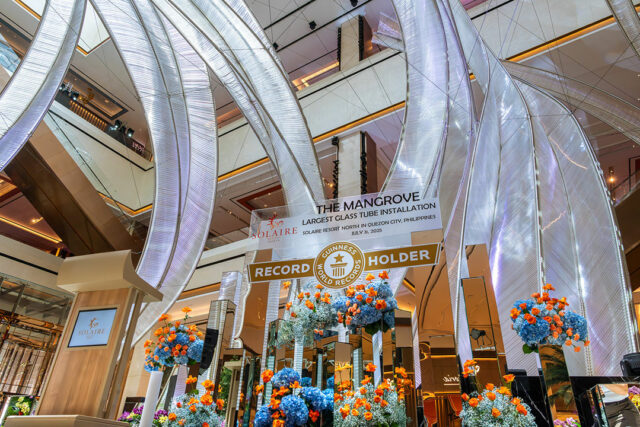
Solaire North’s giant glass tube installation earns Guinness World Record

THE END of July saw Solaire Resort North in Quezon City mount a formal ceremony naming The Mangrove — an artwork by American glass sculptor Nikolas Weinstein, located at its lobby atrium — as the largest glass tube installation in the world, as per Guinness World Records.

The monumental glass installation took over four years of meticulous planning, engineering, and craftsmanship to make.

“When we first imagined this property, we set our sights high. Not just on growth, but on transformation. We didn’t want to simply build another resort. We wanted to create something that would stand out for its creativity, elegance, and meaning,” said Gregory Hawkins, president and chief operating officer for Bloomberry Resorts Corp., at the ceremony.

He explained that The Mangrove is at the heart of their vision, reflecting with Solaire Resort North stands for. It is meant to be “a breathtaking symbol of strength, growth, and resilience.”

RECORD NUMBERS
Emi Saito, the official adjudicator of Guinness World Records, said at the event that they measured the structure in the presence of two witnesses, as well as reviewed it based on a full report.

“The minimum requirement was an added height, width, and depth longer than 60 meters,” she explained. “It also has to be in a public space.”

The Mangrove stands at 25.396 meters in height, 19.166 meters in width, and 24.198 meters in depth.

It is made up of 16,000 glass tubes supported by steel bars. The materials used in crafting the sculpture include glass, stainless steel, cable, silicone, and acrylic.

Located at the hotel and casino’s main atrium, the sculptor Mr. Weinstein worked with Samantha Drummond and her Habitus Design Group so that the lobby would evoke Philippine mangrove forests.

For visitors to Solaire Resort North, the tubes appear to gently twist and turn as if in movement, reaching up through the three-story atrium towards the skylight.

For Mr. Weinstein, the “difficult” and “frustrating” process of putting it all together was part of the challenge.

“We were really interested in making it something where you can kind of move through it, above it, and around it,” he said in a video message played at the ceremony.

He added that it became that huge “not because that was the intention.”

“It was sort of like, ‘here’s a big space, what do you want to do with it?’” he said.

The Mangrove can be found in Solaire Resort North, located on 1 Solaire Way in Vertis North, Quezon City. — Brontë H. Lacsamana

Following the footsteps of Vietnam

STOCK PHOTO | Image by Georgios Domouchtsidis from Unsplash

(Part 3)

Both the Philippines and Vietnam will become upper middle-income countries in the next two years. The $64 question is which of the two will fall into the so-called middle-income trap.

In development literature, the “middle-income trap” is a term employed to describe a situation in which a country that has achieved a certain level of income (say upper-middle which today is roughly close to $5,000 per capita) fails to progress to high-income (about $16,000 per capita) and remains stuck at that level for a prolonged period. This phenomenon happens when a country grows rapidly after escaping poverty, but growth decelerates before it can become a high-income economy. The economy loses competitive advantage in labor-intensive industries, but fails to develop innovation, achieve productivity increase, and the value-added sectors that are predominant in high-income economies.

Leading causes for economies to fall into this trap are loss of cost advantage, weak innovation, poor institutions, inequality and social exclusion, and underdeveloped capital markets.

The loss of cost advantage in most cases is the steep rise in wages, making labor-intensive exports less competitive. This problem is usually aggravated by a misplaced population control program that leads very early to the ageing of the population before the country becomes rich. The example usually cited is Thailand, the first country to grow old before becoming rich. To a certain extent China is also already suffering from this syndrome as its population ages rapidly because of the one-child program that it implemented strictly (and sometimes brutally) in the last century. China’s leaders today are frantically trying to increase the birth rate but to no avail.

Malaysia is an example of a possible candidate for falling into the middle-income trap because of a slow shift to high tech and innovation, despite having a strong manufacturing base. Then there is Brazil, a typical South American economy that reached upper middle-income status decades ago but got stuck there because of great disparity in income, weak infrastructure, and overdependence on commodity exports. South Africa is a good example of an economy that got stuck at the middle-income level because of racial discrimination, poor quality of education, and inadequate infrastructure. Mexico suffers from low productivity, weak rule of law, and an over-reliance on the US market.

In contrast, countries that escaped the “middle-income trap” during our generation are South Korea, Taiwan, Singapore, and Ireland. South Korea reached high-income status by investing heavily in quality education, the upgrading of export, and R&D in technology. Taiwan became high-income through technological innovation and a strong industrial policy. Singapore excelled in good governance, converted itself into a financial hub, and focused on human resource development. Ireland integrated itself into the European Union, attracted large volumes of FDIs, and developed a pool of highly skilled technical and knowledge-based workers.

Whether or not Vietnam could fall into the middle-income trap has recently been raised with the publication of an article in the Financial Times (June 13) entitled “Does Vietnam have an Economic Plan B?” It may follow in the footsteps of Mexico that became overly dependent on the US market. As the FT article observes, “Vietnam’s recent economic success — with GDP growth at 7% in 2024 — has been driven primarily by exports to the US and surging investments from companies fleeing China…. As a result, the south-east Asian country is one of the world’s most trade-dependent countries, with the US accounting for nearly a third of its total exports… Now it’s ‘China plus one’ success has backfired as the US president takes issue with trading partners who have large surpluses with the US. Vietnam has the third largest, after China and Mexico.”

There are now calls for Vietnam not only to diversify its trade partnerships, but also to build its domestic market as an engine of growth (like the Philippines has done) and to make it more resilient to external shocks.

In this regard, the Philippines appears to have an advantage during times of global crises, such as those that occurred during the East Asian financial crisis in 1997 to 2000, the Great Recession from 2008 to 2012, and the COVID-19 pandemic. The stronger reliance that the Philippine economy has on its domestic market and its very low export to GDP ratio of less than 30% (compared to close to 100% of Vietnam) shields it from slowdowns in the global economy (which we shall surely experience during this current year).

It is clear that US President Donald Trump’s actions have served as a wake-up call for how vulnerable Vietnam is to external shocks. There is a great possibility that the export-led growth model will soon run its course and throw a monkey wrench in Vietnam’s plan to become a developed country 20 years from today. Already, the World Bank downgraded its growth forecast for Vietnam this year, from 6.8% to 5.8%.

Meanwhile, there is a high probability that the Philippines will grow faster in GDP in the next two to three years.

Even if the Trump Government imposes a similar 20% tariff on exports of both economies, the adverse effect on the Philippines will be less because of our very low export to GDP ratio. It is also providential that some 20% of our GDP comes from exports of services, not goods. The foreign remittances from our OFWs and the earnings of our BPO-IT sector total close to $80 billion which are equivalent to the total agribusiness exports of Vietnam.

It is too late for the Philippines to replicate the success story of Vietnam in the export of manufactured goods. We missed the boat when, early in our development efforts, we followed the inward-looking, protectionist, and import-substitution route to industrialization. If at all, we can still have a strong manufacturing sector based on our huge domestic market. We can still build a significant industrial sector based on steel manufacturing, cement and other construction materials, food manufacturing, chemicals, and even ship building.

We should have no illusions, however, that we can still be a major exporter of manufactured goods. Our competitive advantage will be in the service sector, such as the export of manpower (especially in health, hospitality, and construction workers to the Middle East). As we continue to improve our infrastructure, we can build a strong tourism sector which is labor-intensive. Our greatest lesson from Vietnam, as described in the first two articles of this series, is in agribusiness.

The question of which of the two countries will fall into the middle-income trap will be decided by demographics. Will Vietnam grow old before becoming rich as in the case of Thailand? As the FT article reports, there are ongoing reforms in Vietnam that are meant to address demographic issues as the country’s working age is projected to shrink. In fact, the Government recently lifted its long-standing two-child policy. This move, however, is futile as has been the experiences of all East Asian countries that have tried to reverse their decline in fertility rate, starting with Singapore in the last century and the extreme cases of Japan, South Korea, Taiwan, and even China.

A quick comparison of the demographic profiles of the Philippines and Vietnam shows that the Philippines is in a better position to avoid rapid population decline. As of 2025, the total population of the Philippines is 118.4 million while that that of Vietnam is 100.2 million. The median ages are 25.7 and 33.5 of the Philippines and Vietnam, respectively. The Philippine population is still growing at 1.3% annually compared to 0.8% of Vietnam. Some international data still show the Philippine fertility rate at 2.5 children per fertile woman and that of Vietnam at 1.9 in 2025. The Philippine Statistics Authority, however, reports the fertility rate of the Philippines as equal to that of Vietnam at 1.9.

Given the predominantly Christian culture of the Philippines and its constitutional ban against abortion, it is highly likely that the Philippines will continue to enjoy a demographic dividend for many more decades to come. As long as the Philippines can succeed in following the footsteps of Vietnam in attaining higher agricultural growth, the Philippines has a greater chance of avoiding the middle-income trap and reaching high-income status by 2045.

(Read parts 1 and 2 of this series at https://tinyurl.com/2xwz9pjw and https://tinyurl.com/25yzzdfy.)


Bernardo M. Villegas has a Ph.D. in Economics from Harvard, is professor emeritus at the University of Asia and the Pacific, and a visiting professor at the IESE Business School in Barcelona, Spain. He was a member of the 1986 Constitutional Commission.

bernardo.villegas@uap.asia

ACEN posts Q2 loss amid Vietnam project woes

ACENRENEWABLES.COM

AYALA-LED ACEN Corp. posted an attributable net loss of P1.19 billion for the second quarter, reversing the P3.57-billion net income recorded last year, citing a large impairment from its wind farms in Vietnam.

Revenues declined by 15.8% to P7.95 billion, while costs and expenses slightly fell by 0.3% to P5.95 billion, according to the company’s financial report released on Tuesday.

ACEN President and Chief Executive Officer Eric T. Francia cited macro and sectoral headwinds this year as challenges the company continues to face in its energy transition.

“The company’s underlying health and long-term prospects remain robust, and we have been leveraging opportunities to increase contracted capacities and expand investments in energy storage,” he said in a statement.

For the six months ending June, the company’s attributable net income dropped by 87.8% to P763 million, mainly because of a P2.7-billion impairment tied to its Lac Hoa and Hoa Dong wind farms in Vietnam.

“Excluding this one-off booking and the P1.35-billion valuation gain in 2024, net income fell 24% over the same period, impacted by depressed WESM (Wholesale Electricity Spot Market) prices and increased depreciation effects,” the company said.

ACEN said the wind project experienced extended delays in construction due to COVID-19-related restrictions and has been operating under a provisional tariff since reaching commercial operations in the first quarter of 2024.

In June, the project companies and state-owned electric utility Vietnam Electricity (EVN) agreed on a final tariff that was lower than the project’s original investment, impacting both past and future sales.

Nevertheless, core attributable earnings before interest, taxes, depreciation, and amortization (EBITDA), which excludes all non-recurring items, remained flat at P10.5 billion year over year.

“This reflects the company’s underlying financial resilience, underpinned by fresh generation from new plants that began operating in 2025,” the company said.

Despite lower generation from the Philippines and Australia, ACEN’s total attributable renewables output for the first half increased by 9% to 3,228 gigawatt-hours.

“Our teams are actively addressing the various challenges encountered during the quarter, with a relentless focus on execution. We expect to operationalize ACEN’s capacity at a more calibrated pace, ensuring that margins remain optimal at all levels,” said ACEN Chief Financial Officer and Chief Strategy Officer Jonathan Back.

ACEN, the listed energy platform of the Ayala group, boasts a total of 7 gigawatts (GW) of attributable renewable energy capacity across operational, under-construction, and committed projects.

The company’s portfolio spans the Philippines, Australia, Vietnam, India, Indonesia, Laos, and the United States. ACEN is targeting to expand its capacity to 20 GW by 2030. — Sheldeen Joy Talavera

Nascent bets on sodium-ion for safer, longer-lasting car batteries

NASCENT

By Edg Adrian A. Eva, Reporter

NASCENT Technologies Corp. is developing a sodium-ion-based starter battery that is lighter, longer-lasting and more environmentally friendly than traditional lead-acid car batteries.

“It’s built as a drop-in replacement for existing chemistries, so it’s intended for cars and trucks,” Joshua S. Santiago, Jr., Nascent research and development scientist and business development manager, told BusinessWorld via Zoom. “Unlike lead-acid, it doesn’t need maintenance and is much lighter.”

NOVA battery, the company’s flagship product, aims to address issues tied to lead-acid batteries such as short cycle life, overheating and the use of toxic materials. The product is expected to benefit fleet operators, particularly trucks, vans and traditional jeepneys.

Mr. Santiago noted that while sodium-ion batteries are more expensive, long-term costs would be lower due to abundant material and future competition among manufacturers.

Nascent started lab testing and prototype evaluations of the NOVA battery in the first quarter. Field testing with 200 to 300 fleet vehicles is planned by year-end, said Nascent co-founder and Chief Technology Officer Joey D. Ocon.

“Hopefully, the data becomes clearer on how much better the technology is relative to lead-acid,” he said in the same Zoom call. “But so far, based on our data, the technology is way better in terms of lifetime and total cost of ownership.”

The startup plans to begin commercial production in 2026 through partnerships with fleet operators, vehicle manufacturers and local government units. Nascent aims to capture $4.5 million of the estimated $500-million local starter battery market within one to two years, targeting 100,000 units for fleet vehicles, two- and three-wheelers and early adopters.

The NOVA battery can deliver 2,000 to 3,000 charge cycles — equivalent to three to five years of use — compared with just 300 to 500 cycles for conventional lead-acid batteries, according to Nascent.

The sodium-ion battery also stores more energy and performs safely at high temperatures.

“For thermal stability, sodium-ion is intrinsically safer,” Maricor Divinagracia-Luzadas, Nascent chief operating officer and head of the company’s electrochemistry division, said in the Zoom call. “Our cells show no risk of thermal runaway. It still maintains good performance even at higher temperatures, making them ideal for tropical climates like in the Philippines.”

Ms. Luzadas cited the sustainability advantage of sodium-ion technology, noting that it avoids harmful materials commonly used in lithium-ion batteries such as lithium, cobalt and nickel.

“They’re widely available in many parts of the world. The only thing lacking is the chemical industry infrastructure that converts those raw materials into battery-grade materials,” she added.

She said sodium-ion batteries are not meant to replace existing technologies entirely but to complement them amid surging global demand.

“We know that each battery chemistry has its strengths,” she said. “And as the energy transition accelerates, we’ll need more options to meet different demands.”

Nascent also plans to expand NOVA’s applications beyond vehicles. Potential uses include power storage for cell towers, information technology systems, off-grid installations, rural electrification, residential solar energy systems and electric vehicles.

Fintech FinQuest Philippines rolls out SME loan-matching platform

FINANCIAL TECHNOLOGY (fintech) company FinQuest Philippines has launched a loan-matching platform for small and medium enterprises (SMEs) and financial institutions to help the former get access to financing.

The platform will connect SMEs with banks and other financial firms and will act as a marketplace for borrowers and lenders, it said in a statement on Tuesday.

This will allow for streamlined applications and access to multiple financier options, it said.

“Our mission is simple: to empower SMEs and business borrowers with faster access to financing, while helping formal financial institutions reduce origination costs and administrative burden… In a digital world where trust is paramount, I bring to this endeavor my lifelong commitment to financial stability, integrity, and inclusive growth,” said FinQuest Philippines Founder and Chief Executive Officer Jose Carmelo C. Nograles.

SMEs will need to submit only one loan application via FinQuest.ph, which the platform will distribute to its network of partner banks and other financial institutions.

The fintech company said its platform’s automated workflows can help reduce loan processing and approval times.

Borrowers can also compare lenders’ rates and repayment schedules via the platform.

Meanwhile, financial institutions get “curated applicant profiles, reduced origination costs, and a pipeline of vetted leads” through the platform.

“FinQuest is transparent and direct in its role as merely a technological marketplace platform, a space that aims to bring together SMEs and financial institutions. The company itself does not engage in any kind of lending activities, as mandated by its registration with the Securities and Exchange Commission,” it said.

“Additionally, its cybersecurity measures are compliant with the mandates of the Bangko Sentral ng Pilipinas as it anonymizes personal data until loan applications are finalized and deletes applicant data post-acceptance as parts of its procedures in protecting its users and their information.” — A.M.C. Sy

Arts & Culture (08/06/25)


Shoe exhibit opens at Yuchengco Museum

AVANT-GARDE footwear designer and art provocateur Joel Wijangco unveiled his latest exhibit at the Yuchengco Museum, blurring the line between fashion, sculpture, and social commentary. The exhibit showcases over 25 handcrafted shoes, each one acting as a sculptural narrative. From Bo-ho (Body Horror), a twisted stiletto exploring body dysmorphia, to Palengkera No. 1, inspired by the fishwife Amazons of Malabon’s wet markets, Mr. Wijangco’s work straddles art, fashion, and emotional archaeology. Blending surrealism, pop culture, Filipino folklore, and personal memory, Mr. Wijangco’s work playfully looks into identity, memory, and the absurdities of beauty. The exhibit at Yuchengco Museum, G/F RCBC Plaza, Ayala Ave. Corner Gil Puyat Ave., Makati City, is ongoing until Oct. 15. Admission is free.


Zarzuela the focus on Instituto Cervantes in Aug.

TO BE screened on Aug. 7, 3 p.m., at the Intramuros branch of Instituto Cervantes is a production by Teatro de la Zarzuela of the classic La del manojo de rosas by Pablo Sorozábal. This is part of a month-long cultural program highlighting the shared legacy of zarzuela in the Philippines, presented by the Instituto Cervantes, the Embassy of Spain, and the University of Santo Tomas (UST). From Aug. 1 to 28, the cultural celebration, entitled Zarzuela Viva, will feature weekly zarzuela screenings, a zarzuela workshop, and a zarzuela recital. Up next will be a screening of Alfredo Sanzol’s production of El barberillo de Lavapiés by Francisco Asenjo Barbieri, on Aug. 14, and a screening of El sobre verde by Jacinto Guerrero on Aug. 28. These last two screenings will take place at 3 p.m. at the Central Laboratory Auditorium of the University of Santo Tomas. From Aug. 18 to 22, a four-day Zarzuela Workshop will be conducted by Spanish pianist Ramón Grau from Teatro de La Zarzuela in Madrid, at the Conservatory of Music of UST. On Aug. 26, the zarzuela workshop participants and Mr. Grau will present a concert, Zarzuela-Sarswela, at the Education Auditorium, UST. This event is open to public, but they should register early through this link: https://forms.office.com/e/gqQYWUHzSb. For more information about Zarzuela Viva, visit Instituto Cervantes’ website at www.manila.cervantes.es, or follow it on Facebook at https://www.facebook.com/InstitutoCervantesManila/.


New group presents Sopranong Kalbo

A NEW theater company, Teatro Meron, presents Rolando Tinio’s translation of Eugene Ionesco’s Sopranong Kalbo (The Bald Soprano), a classic of the Theater of the Absurd. Directed by Ron Capinding, it will have performances on Aug. 8 to 10 at the Rizal Minitheater of the Ateneo de Manila University in Quezon City. It stars Joel Macabenta, Miren Alvarez-Fabregas, Joseph dela Cruz, Pickles Leonidas, Goldie Soon, and Yam Yuzon. Tickets come in different categories, priced from P700 to P800 and are available at Ticket2Me.


Areté presents translation of Joaquin’s Portrait of the Artist

ARETÉ ATENEO is producing a Filipino translation of Nick Joaquin’s classic A Portrait of the Artist as Filipino, entitled Quomodo Desolata Es? The translation was written by Jerry Respeto and Guelan Varela-Luarca who is also the director. The play is set in Intramuros just before World War II and follows two sisters as they see the world change around them. It stars Gan Pangilinan, Delphine Buencamino, Omar Uddin, Vino Mabalat, and John Sanchez. There will be performances from Aug. 8 to 17 at the Hyundai Hall, Areté, Ateneo de Manila University in Quezon City. Tickets range in price from P999 to P1,499 and are available via Helixpay.


Gene Paul Martin, Is Jumalon shows at MO_Space

STARTING Aug. 9, visual artists Gene Paul Martin and Is Jumalon will have solo exhibitions at MO_Space. At the main gallery is Mr. Martin’s Godhead, where his paintings are dense islands of color and abstraction. At Gallery 2 is Ms. Jumalon’s A Garden in the Chest, where she explores invented landscapes as spaces of retreat and recognition, creating images as places of personal refuge and geographies of commonality. Both exhibits run until Sept. 7 at MO_Space in Bonifacio Global City, Taguig.


Fundraising shows before play goes to theater fest

THE Cultural Center of the Philippines (CCP) and BOGT Philippines present fundraising performances of 13th of September on Aug. 10, before the show is brought to Monaco to represent the Philippines at the Mondial du Théâtre. BOGT Philippines has said that the critically acclaimed production has received its third invitation to an international theater festival, this after joining the festivals in Canada (2019) and Germany (2021, 2022). The 18th Mondial du Théâtre in Monaco will run from Aug. 20-27. The fundraising send-off performances (to help cover essential expenses for the delegation) will be on Aug. 10, 3 and 7 p.m., at the Tanghalang Ignacio Gimenez, Cultural Center of the Philippines, Pasay City. The tickets cost P1,000 and P800 and are available on Ticketworld.com. The 13th of September is an adaptation by three-time Palanca awardee Eljay Castro Deldoc from Lanie Robertson’s The Insanity of Mary Girard, about a woman who is committed to an asylum by her husband after she becomes pregnant by another man. It is directed by Riki Benedicto and star Andoy Ranay as Mary Girard, together with Lao Rodriguez and Drew Espenocilla.


Side Show: The Musical ongoing at Power Mac

ONGOING until Aug. 17 at Circuit Makati’s Power Mac Center Spotlight is the Sandbox Collective’s production of Side Show: The Musical, which revolves around the life of conjoined twins and their fellow “freaks” who live in a carnival in 1930s America. The cast features Jon Santos, Tanya Manalang, Molly Langley, and Marvin Ong. Tickets are available through Ticket2me.


Raco Ruiz mounts 4th exhibit at Secret Fresh

VISUAL ARTIST Raco Ruiz has his fourth solo exhibit, NO WORRYS, running until Aug. 8 at Secret Fresh Gallery, Ronac Art Center, Ortigas Ave., San Juan City. Known for his signature blend of pop culture and personal storytelling, Mr. Raco is introducing a new series anchored by his original character, Razzl the Clown, now joined by a dopamine-dependent dalmatian named Dopa.


Saturday Group holds 57th anniversary exhibit

ARTISTS collective Saturday Group has marked their 57th anniversary with a major exhibit, 57, at Gallery Big at Shangri-La Plaza mall in Mandaluyong City. It is running until Aug. 9. The Saturday Group members who are part of the show include Ronnie Bercero, Franklin Caña, Daisy Carlos, Salvador Ching, Buds Convocar, Nida Cranbourne, Jonathan Dangue, Anna De Leon, Robert Deniega, Ysa Gernale, Maryrose Gisbert, Amado Hidalgo, Celeste Lecaroz, Francis Nacion, Roel Obemio, Carlo Ongchangco, Anthony Palo, Tessie Picaña, Omi Reyes, Joy Rojas, Eman Santos, Aner Sebastian, Sheila Tiangco, Magoo Valencia, Lydia Velasco, Joseph Villamar, Jik Villanueva, Migs Villanueva, Gene Artango-Villasper, Inna Nanep-Vitasa, Chewy Yap, and Melissa Yeung Yap.


Dance students critique Martial Law in performance

THE DANCE production Alimuom sa Takip-Silim, based on research-driven choreography, will highlight the social injustices of the Martial Law era. The four-act drama will be staged beginning Aug. 15. It is presented by Unfolding Productions, a group of young artists from the dance program of the De La Salle-College of Saint Benilde (DLS-CSB). The public can see the production on Aug. 15 at 4 p.m. and Aug. 16 at 1 p.m. It will be staged at the 5th Floor Theater of the Benilde Design + Arts Campus, 950 Pablo Ocampo St., Malate, Manila.


Ayala Museum hosts Ambeth Ocampo lecture on WWII

THE Filipinas Heritage Library, in partnership with Purefoods Deli, presents “Cultural Casualties of World War II,” a lecture by historian and scholar Dr. Ambeth R. Ocampo. The 1945 Battle for Manila left deep scars not only on its people but also on the city’s cultural fabric. Historic sites and structures were reduced to rubble. Irreplaceable works of art, rare books, manuscripts, and invaluable records of the past were lost forever. In this lecture, Mr. Ocampo explores the cultural cost of war, examining both tangible and intangible losses. These include those captured in the poignant postwar paintings of National Artist Fernando Amorsolo. The lecture will be held on Aug. 16, 1:30-3:30 p.m., at the Ayala Museum, Makati Ave., Makati. This is one of The Roderick Hall Memorial Lectures 2025. Tickets range in price from P150 for students to P300 for regular tickets. They come with free one-day access to the Filipinas Heritage Library valid until Sept. 16.


Richard Arimado exhibits at Galerie Joaquin

RICHARD ARIMADO has used his stylized, rotund figures and vibrant palette, to focus on scenes of communal life in his paintings. Titled Chronicles, his latest exhibition presents scenic vignettes of rural life that feel less like fixed images and more like living memory. Chronicles is on view at Galerie Joaquin until Aug. 17. The gallery is located at the R3 Level of Power Plant Mall, Rockwell Center, Makati.


Anchored on national interest: Philippine foreign policy in these changing, challenging times

FACEBOOK.COM/COASTGUARDPH

If there was any confusion on what exactly independent Philippine foreign policy means to this administration, President Ferdinand Marcos, Jr. spelled it out clearly in last week’s State of the Nation Address.

“Then as now, our policy remains the same — the Philippines is a friend to all and an enemy to none,” he said.

This guiding principle states that the Philippines will not be drawn into conflict, but neither will it shy away from defending its sovereignty. The President reiterated this despite persistent — and intensifying — threats in the West Philippine Sea, and even in cyberspace, in the battle for the minds and hearts of the public.

The Philippines responds to these threats by speaking out against incursions, filing diplomatic protests, and by nurturing friendships with many nations that share our values and our commitment to the rule of law.

On this last point, much progress has been achieved in the past three years. Indeed, we are now more vigilant, more capable, and more determined to defend ourselves because of the continued strengthening of the Armed Forces of the Philippines. Our defense capabilities are being enhanced with the steady acquisition of arms, warships, and other defense equipment — aligned with the goals of modernization and a comprehensive approach to the protection of the archipelago.

We have an increasing number of allies ready to stand with us in times of urgent need. The Philippines is now backed by strengthened security alliances and growing confidence drawn from deeper international partnerships, with like-minded countries.

At a high-level forum hosted by the Stratbase Institute last month, Foreign Affairs Secretary Ma. Theresa Lazaro said the Philippines is pursuing multilateral and bilateral engagements that bolster the country’s position and broaden its capacities.

“We now have several visiting forces agreements, 11 bilateral maritime dialogues, such as with Australia, one of the most important maritime partners, a trilateral maritime dialogue, and a growing number of countries that join our multilateral maritime cooperation activities. All of this demonstrates that the Philippines does not stand alone and can rely on its partners in order to maintain regional peace and security,” she said during the event that marked the 9th anniversary of the arbitral decision largely favoring the Philippines in the dispute with China over the West Philippine Sea.

In the same event, ambassadors and representatives from 26 like-minded nations expressed their support for the Philippines and the rules-based international order.

Recent high-level engagements further illustrate the Philippines’ strategy of diversified diplomacy. Last month, President Marcos Jr.’s official visit to Washington DC showed our foreign policy in action and marked a significant milestone in the evolving Philippine-US relationship. He was the first leader in the region to be invited to the White House under President Donald Trump’s second term. This signals the importance Washington places on its relationship with the Philippines.

Amid rising aggression in the West Philippine Sea and the broader South China Sea, US officials’ pronouncements send a strong message to deter hostile actions. Beyond defense and security, President Marcos Jr.’s visit demonstrated the depth and breadth of the Philippines’ comprehensive relationship with the United States, marked by announcements of stronger partnerships in other key areas.

Following his visit to Washington, President Marcos Jr. embarked on a five-day state visit to India, reinforcing the Philippines’ commitment to building a diversified and multilateral network of partnerships. The visit is expected to advance cooperation not only in maritime security and defense, but also other key areas such as trade, pharmaceuticals, digital innovation, agriculture, and tourism.

The Philippines is also gearing up to assume the ASEAN Chairmanship in 2026, a pivotal role that will allow it to lead efforts on regional cooperation, promote collective responses to cross-border challenges, and strengthen ASEAN’s engagement with its dialogue partners.

In parallel, the country is campaigning for a non-permanent seat on the United Nations Security Council in 2026. As Foreign Affairs Secretary Lazaro noted in a post-SONA briefing, winning this seat would be a major diplomatic milestone — demonstrating the Philippines’ readiness to contribute to global peace, security, and multilateral governance.

Under the term of President Marcos Jr., the Philippines has been manifesting the essence of a truly independent foreign policy. We focus on the needs and interests of Filipinos, and base our decisions on what is most beneficial for our people and our nation. In this case, we assert our integrity and territorial rights, as backed by international law. We protect the interests of our fisherfolk rightfully earning their living in our Exclusive Economic Zone. We resist any advances by other powers that try to twist the narrative.

We cannot do this on our own. We are fortunate to have allies in numerous countries who equally believe that the rule of law must prevail. Because of this affinity, they are able to share with us their expertise in terms of beefing up our defense capabilities.

The geopolitical environment around the Philippines is becoming increasingly complex. We bank on the support of our strategic partners while keeping our national interest — and nobody else’s — at the core of our pursuits.


Victor Andres “Dindo” C. Manhit is the president of the Stratbase ADR Institute.

Wilcon Q2 income falls 19% on weaker sales

PHILSTAR FILE PHOTO

WILCON DEPOT, INC. (Wilcon) saw its second-quarter (Q2) net income fall by 18.72% to P626 million on lower sales.

For the second quarter, the company’s combined revenue decreased by 2% to P8.80 billion from P8.98 billion recorded in the same period a year ago.

“While some of the impact of the measures we’ve implemented will be spread out up to next year, we are already seeing improvements especially in trucking. If sales growth rates continue to trend upward and we are able to control increases in some expense items, we are expecting to reverse the net income decline in the first half,” Wilcon President and Chief Executive Officer Lorraine Belo-Cincochan said in a stock exchange disclosure on Tuesday.

For the first half, the company’s net income went down by 23.18% to P1.16 billion from P1.51 billion recorded in the same period in 2024.

Wilcon recorded gross revenue of P17.30 billion for the six months ending June, down by 0.69% from P17.42 billion in the same period a year ago.

“We are already seeing an upward trend in our sales and our same-store sales growth (SSSG) is already in positive territory in June. It was mainly during the long holidays in April and May that foot traffic was affected, as expected,” Ms. Belo-Cincochan said.

For the April-to-June period, Wilcon saw its total expenses rise by 1.03% to P7.87 billion from P7.79 billion incurred in the same period last year.

The company attributed the drop in its income to weaker same-store sales and rising expenses, noting that the opening of new stores also contributed to higher costs during the period.

At the stock exchange on Tuesday, shares in the company gained four centavos, or 0.41%, to end at P9.85 apiece. — Ashley Erika O. Jose

GoTyme Bank, TikTok Shop launch tailored loans for PHL microenterprises

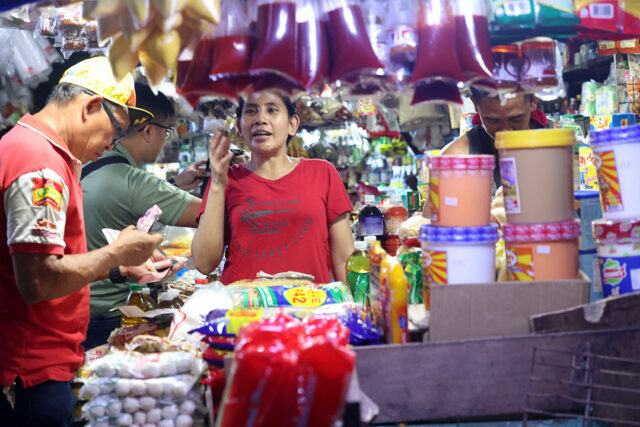
People buy food items at a market in Quezon City, Nov. 22, 2024. — PHILIPPINE STAR/MIGUEL DE GUZMAN

GOTYME BANK has partnered with TikTok Shop to roll out customizable business loans for micro, small and medium enterprises (MSMEs) operating on the e-commerce platform, aiming to close funding gaps that traditional banks often overlook.

“Traditional lending is not built for MSMEs,” GoTyme Bank Co-Chief Executive Officer and Chief Commercial Officer Albert Raymund O. Tinio said at the launch event last month. “And that’s the gap we want to address through a partnership that reimagines how MSMEs access capital.”

The tie-up will let pre-qualified TikTok Shop sellers apply for flexible, fast-releasing loans. The loan amount, interest rate and repayment terms will be based on a seller’s transaction history on the platform.

“For TikTok Shop, it’s about deepening support for the seller community, not just helping them sell, but helping them succeed,” Mr. Tinio said.

“For GoTyme Bank, it’s about making financial services more inclusive and absolutely more beautiful. And for our valued sellers, it’s about gaining access to the kind of capital that helps you move faster, prepare smarter and take advantage of growth rates when it’s right in front of you.”

The loan is designed with MSMEs in mind, featuring a simplified application process that requires only a valid ID and business document. No collateral is required, and loan approval and disbursement can be completed in as little as three days.

Interest rates range from 1.5% to 2.5%, with repayment terms of three to 12 months. Payments can be made via InstaPay or QRPH.

Mr. Tinio said the loan product was developed to address common challenges in traditional MSME lending, including lengthy application processes, excessive documentation, high rejection rates, rigid repayment terms, slow disbursement and confusing fee structures.

“For decades, the default option of business owners in need of funding has been to approach traditional lenders like banks and other financial institutions,” he said. “But the reality is, traditional lending wasn’t built with small businesses in mind, much less digital-first entrepreneurs who operate online, create content and fulfill orders through platforms like TikTok Shop.”

GoTyme Bank President and CEO Nathaniel D. Clarke said the bank seeks to reach 20% of TikTok Shop’s seller base by year-end.

“It’s not a fixed number that we actually go for,” he told reporters. “Obviously, we’ll scale it up depending on how our performance goes. But as much as possible, we’re going to get as many merchants to be able to have the product also by the end of the year.”

Since the pilot launch, 16 merchants have availed themselves of the loan product, he added. — Aaron Michael C. Sy