Home Blog Page 6011

Local shares extend rally on improved profits
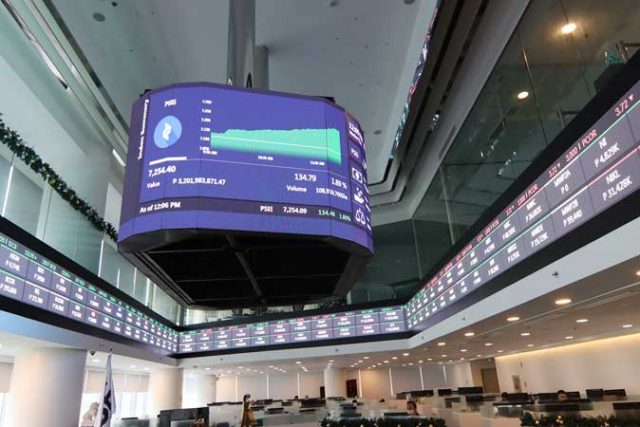
BW FILE PHOTO

PHILIPPINE SHARES extended their rally to a seventh straight day on Tuesday amid better earnings from listed companies and higher remittances from overseas Filipino workers (OFW) and as foreign funds shifted to the local market amid fears of a slowdown in China.

The Philippine Stock Exchange index (PSEi) went up by 112.80 points or 1.67% to close at 6,850.64 on Tuesday, while the broader all shares index increased by 44.21 points or 1.23% to 3,625.08.

“For the seventh straight day, the local bourse rallied by 112.80 points or 1.67% to 6,850.64 as positive sentiment continues amid an improving economic environment, especially with the good earnings performance of the companies despite high inflation during the second quarter,” Philstocks Financial, Inc. Research Analyst Claire T. Alviar said in a Viber message.

“Also, higher OFW cash remittances in June boosted the sentiment as well… There’s conviction in market participation as the net market value turnover has improved…,” Ms. Alviar said.

Cash remittances sent through banks stood at $2.75 billion in June, up 4.4% year on year, Bangko Sentral ng Pilipinas data released on Monday showed.

For the first six months of 2022, cash remittances rose by 2.9% to $15.35 billion. The central bank expects remittances to grow by 4% this year.

“Philippine stocks continued their upward momentum as funds look for alternatives after the weaker view of China. Recently, economic reports have critiqued China and the unexpected cut in its benchmark rates,” Regina Capi-tal Development Corp. Head of Sales Luis A. Limlingan said in a Viber message.

China’s central bank cut key lending rates in a surprise move on Monday to revive demand as data showed the economy unexpectedly slowing in July, with factory and retail activity squeezed by Beijing’s zero-COVID policy and a prop-erty crisis, Reuters reported.

The grim set of figures indicate the world’s second largest economy is struggling to shake off the June quarter’s hit to growth from strict coronavirus disease 2019 (COVID-19) restrictions, prompting some economists to down-grade their projections.

Back home, all sectoral indices closed higher on Tuesday. Financials went up by 43.59 points or 2.78% to 1,610.19; holding firms climbed by 127.34 points or 1.95% to 6,639.74; property jumped by 43.89 points or 1.43% to 3,096.84; services gained 16.72 points or 0.96% to end at 1,757.25; industrials increased by 92.52 points or 0.93% to 9,990.11; and mining and oil rose by 98.93 points or 0.83% to 11,919.94.

Value turnover rose to P8.89 billion on Tuesday with 967.13 million shares changing hands from P5.49 billion on Monday with 1.03 billion issues seen the previous trading day.

Advancers outnumbered decliners, 111 versus 91, while 35 names closed unchanged.

Net foreign buying went up to P1.27 billion on Tuesday from the P360.11 million seen the previous trading day. — JIDT with Reuters
Renaming of Ilocos university after dictator opposed

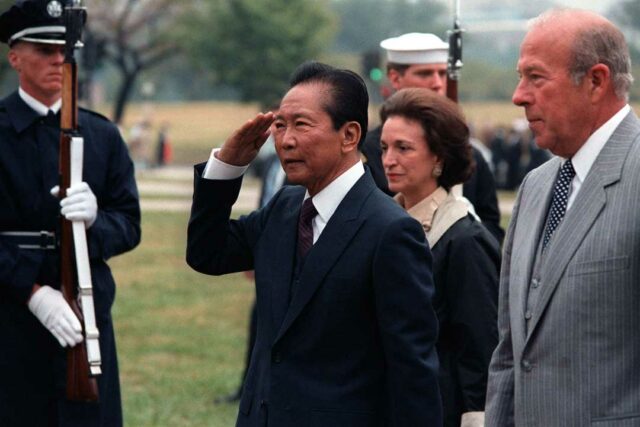
A group of martial victims and political prisoners on Tuesday opposed a bill that seeks to rename an Ilocos Norte university after the late dictator Ferdinand E. Marcos, Sr.

“This is a brazen attempt to deodorize the stink of the dictator… whose blood-soaked regime violated the rights of thousands of Filipinos and plundered the nation’s coffers,” the Samahan ng Ex-Detainees Laban sa Detensyon at Arresto (SELDA) said in a statement.

His rule led to rampant poverty, soaring basic commodity prices and lack of access to basic social services, it added.

Last month, Ilocos Norte Rep. Angelo M. Barba filed a bill that seeks to rename Mariano Marcos State University in Batac, Ilocos Norte to Ferdinand E. Marcos State University.

Mr. Barba, who is the late president’s nephew, said the bill is based on “a generation that has honored the father and is now ready to honor the son, similar to how a father passes the torch to his son.”

He was referring to now President Ferdinand R. Marcos, Jr., the son of the dictator who won the May 9 election by a landslide.

“We cannot expect the youth to develop nationalism and respect for human rights if we keep on naming public institutions — especially schools and universities — after founders of political dynasties and corrupt government of-ficials, let alone after a dictator who infamously perpetrated massive plunder and committed countless grave human rights violations,” SELDA said.

Party-list Rep. Raoul A. Manuel also opposed the bill during a House of Representatives committee hearing on Tuesday.

He cited laws such as the Human Rights Victims Reparation and Recognition Act of 2013, which acknowledged human rights violations during Mr. Marcos’ two-decade rule.

Last month, human rights groups protested before Marcos Jr.’s first address to Congress, seeking accountability for human rights violations during his father’s regime.

“Marcos Jr. cannot claim that he is innocent and is off the hook from being liable for the violations inflicted upon us by his father’s bloody regime,” SELDA earlier said in a statement.

More than 70,000 people were jailed, about 34,000 were tortured and more than 3,000 people died under martial rule, according to Amnesty International. — John Victor D. Ordoñez

House panel approves postponement of village, youth council elections to Dec. 2023

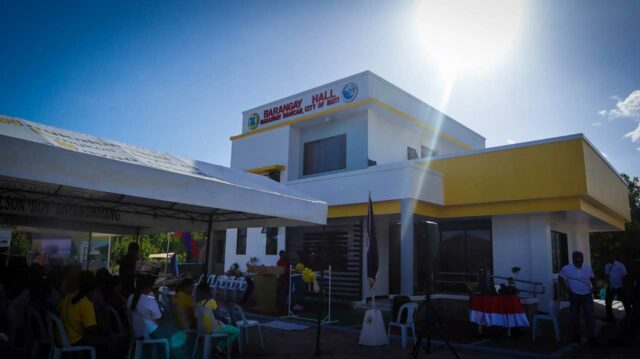
A BARANGAY hall in Mati City. -- DAVAOORIENTAL.GOV.PH

A HOUSE of Representatives committee on Tuesday voted to postpone the village and youth council elections by a year to December 2023.

The House Committee on Suffrage and Electoral Reforms, chaired by Mountain Province Rep. Maximo V. Dalog, Jr., approved a still unnumbered substitute bill setting the barangay and Sangguniang Kabataan (SK) elections to Dec. 5, 2023.

Several bills were filed on the postponement, mostly citing the benefit of saving about P8 billion that had been allocated for the nationwide electoral exercise and realigning this fund for pandemic-recovery measures.

The Commission on Elections (Comelec) had been carrying out preparations for the supposed voting in December this year.

Comelec Chairman George Erwin M. Garcia told the committee that they will need a new law to provide accurate direction on whether or not they will continue with other preliminary activities such as ballot printing.

“We at the Comelec will just abide by the mandate of the Congress and the Executive as far as postponing the election is concerned,” Mr. Garcia said.

“We were given P8.449 billion as the budget for the barangay and SK elections,” he said. “As of today, we have spent only P800,000 of that money.”

Mr. Garcia also pointed out that the postponement would actually cost an additional P5 billion as it would mean resuming voter registration, printing more ballots, and tapping more election workers.

Members of the committee voted 12-2 in favor of postponement.

Only ACT-Teacher Party-list Rep. France L. Castro and Kabataan Party-list Rep. Raoul Danniel A. Manuel voted against the measure.

Elections for youth leaders and barangay officials — considered as frontline government workers as they cover the smallest political unit — was supposedly set in May 2021 but was postponed due to the coronavirus pandemic. Incumbent officials were elected in 2018, which was also a postponement from the supposed 2016 voting.

Under the law, barangay and SK elections should be held every three years.

Poll watchdogs National Citizens’ Movement for Free Elections (NAMFREL) and Kontra Daya, among other groups oppose the postponement citing that it would be a violation of the right of suffrage. — Matthew Carl L. Montecillo

P1.4B released for free EDSA bus rides until yearend

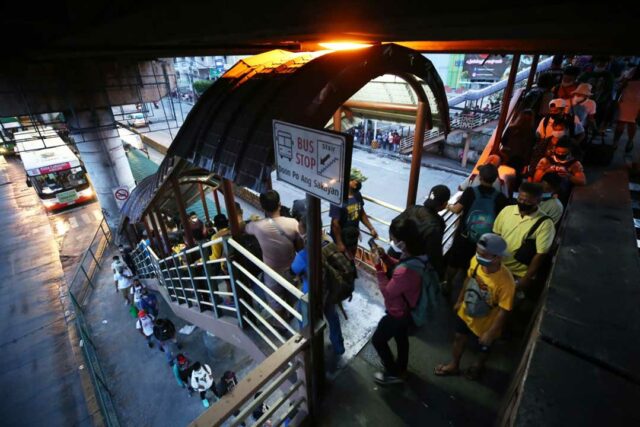
COMMUTERS form a long line that snakes along a pedestrian overpass in EDSA for free bus rides on July 18. -- PHILSTAR/MIGUEL DE GUZMAN

A P1.4-BILLION fund has been released for the extension of the free bus ride program along EDSA, a main thoroughfare in the capital region Metro Manila, until December, the Department of Budget and Management announced on Tuesday.

In a statement, the department said Budget Secretary Amenah F. Pangandaman approved the Special Allotment Release Order and Notice of Cash Allocation for the extension of service contracts of public utility vehicles covering September 1 to December 31.

President Ferdinand R. Marcos, Jr. promised last month to extend the free ride program, with the Department of Transportation worrying then about funding source as the program was set to end by end-July.

Under service contracting, most of the P1.4-billion allotment will be utilized as performance-based payouts to drivers and operators, as opposed to the traditional boundary system used by private companies.

Performance is dependent upon the number of passengers they service in a day, most of whom are students and members of the labor force along the EDSA bus carousel route.

“The release of additional funds is to support President Marcos’ intention to extend the Libreng Sakay (free ride) of the Department of Transportation and the Land Transportation Franchising and Regulatory Board until December,” Ms. Pangandaman said in Filipino.

She said an estimated 50 million commuters are seen to benefit from the program.

An increase in public transportation passengers are expected starting Aug. 22 as schools reopen for face-to-face classes.

The free ride program will also support the livelihood of drivers of about 628 bus units, the budget chief said.

“This is a big help in the livelihood of our drivers in the EDSA Busway who until now are still recovering from the effects of the pandemic, and the rising prices of gasoline,” Ms. Pangandaman said.

Year-to-date, net increases in oil prices stood at P17.55 per liter for gasoline, P30.15 per liter for diesel, and P24.75 per liter for kerosene, based on data from the Department of Energy. — Diego Gabriel C. Robles

US donates P1.6-M supplies for Palawan disaster preparedness

US donation Palawan -- US EMBASSY PHOTO RELEASE

THE UNITED States government has donated P1.6 million worth of supplies to the provincial government of Palawan to support disaster relief preparedness, its embassy in the Philippines said in a statement released on Tuesday.

The supplies include tents and other items for shelter, medical, and logistical capacity during emergency situations prompted by calamities.

Palawan in the west-central part of the Philippines, which is historically not in the usual path of strong typhoons that hit the country, was among the most affected areas when tropical cyclone Odette (international name: Rai) struck in December last year.

“The supplies we received will surely be of great help to our continued disaster readiness efforts,” Palawan Governor Victorino Dennis M. Socrates said in a statement.

“We are beyond grateful for this donation.”

The US Embassy’s Civil Affairs Team (CAT) turned over the supplies to the Palawan provincial government during a ceremony last week.

“The local government of Palawan, the Philippine Coast Guard, and the Armed Forces of the Philippines have been reliable partners in ensuring that our activities and projects are well-coordinated and executed to their full potential, and that members of the US Embassy CAT are properly welcomed and taken care of throughout our stay in the province,” US Army Captain Arthur Kim said.

The CAT has a longstanding collaboration with the Palawan local government, military, and coast guard in educational outreach activities, first responder training, medical and dental programs, and COVID-19 response.

“We must continue to be adaptive and diligent in ensuring that the Philippines and US partnership remains steadfast and unwavering in the face of global political, economic, and health-related challenges,” Mr. Kim said. — Alyssa Nicole O. Tan

QC school did not inform DepEd of intent to close

Colegio de San Lorenzo -- FACEBOOK PAGE

THE COLEGIO de San Lorenzo in Quezon City did not inform the Department of Education regarding its decision to permanently close, the agency’s spokesperson said on Tuesday.

“They did not formally inform the DepEd of their intent to close,” DepEd spokesperson Michael T. Poa said in a statement.

The school announced its decision on Monday, citing financial challenges amid the pandemic.

Up until Aug. 12, the school was still collecting enrollment and other fees, based on announcements on its official Facebook page.

State-run broadcast network PTV4 reported on Tuesday about angry parents and teachers who were not allowed entry at the school to get academic records, which are needed to apply in other schools.

“While students have already enrolled for the upcoming school year 2022-2023, it would be difficult for (us) to continue operating due to the low turnout of enrollees this year. In connection with this development, we will initiate full refunds of fees paid (i.e. tuition, uniform expenses, book expenses) and assist all students for their transfer to other schools and educational institutions by timely releasing their records and credentials for such purpose,” Colegio de San Lorenzo said in a statement.

This is a voluntary closure, Mr. Poa of DepED said.

He said the agency will only issue an acknowledgement of closure “once we are assured that the transfer credentials of the affected students are processed and released by the school.”

He said DepEd will help in finding schools that are willing to absorb the affected learners.

“Our primary concern is the learners. There is already a private school in Quezon City that got in touch with DepEd and informed us that they are willing to absorb students, particularly Grades 11 and 12 at the same tuition rate as that of Colegio de San Lorenzo,” he said. “We hope that more schools would do the same.” — Kyle Aristophere T. Atienza

Plebiscite for Calaca cityhood set Sept. 3

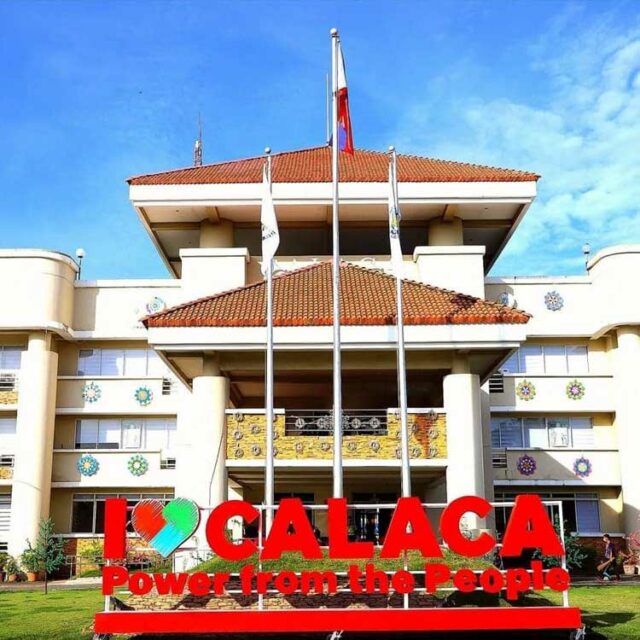
Calaca Municipal hall -- CALACA GOVERNMENT FACEBOOK PAGE

VOTING for the approval of a law converting Calaca town in Batangas into a city is set on Sept. 3, the local government announced on Tuesday.

The Commission on Elections also issued an advisory Tuesday announcing the start of ballot printing for the plebiscite, which was streamed live on its Facebook page and Youtube channel.

The law on Calaca’s cityhood, contained in Republic Act 11544, was signed by former President Rodrigo R. Duterte on May 26.

Calaca, located about 100 kilometers south of the capital Manila, is classified as a first-class municipality with a population of 87,361 as of 2020. It is home to the ecozone Phoenix Petroterminals & Industrial Park.

In a statement, local officials said the town is “more than ready to become a full-fledged city” as it conducts an information campaign for the ratification of the cityhood law.

The information dissemination, they said, highlights the benefits of becoming a city such as higher allocation from national funds and fiscal authority on income generation, among others.

Gabriela, Bayan Muna condemn indictment of religious group members

TWO progressive groups on Tuesday denounced the indictment of members of the Rural Missionaries of the Philippines (RMP) for alleged terrorist financing.

“There is clearly no let-up on the attacks against RMP and progressive organizations even under President Ferdinand R. Marcos, Jr.’s regime,” Gabriela Party-list Rep. Arlene D. Brosas said in a statement.

Bayan Muna Executive Vice-President Carlos Isagani T. Zarate said the indictment shows the “continuing weaponization of existing laws and processes against activists and human rights defenders.”

The Department of Justice on Monday said government prosecutors indicted 16 members of the church-based group for allegedly financing activities of the Communist Party of the Philippines and its armed wing, the New People’s Army. The agency noted the charges were based on testimonies of former rebels. — John Victor D. Ordoñez

Active ASF cases confined to five regions

DA.GOV.PH

ACTIVE African Swine Fever (ASF) cases are now confined to just five regions from 14 previously, the Bureau of Animal Industry (BAI) announced on Tuesday.

As of Aug. 4, the remaining ASF-active cases are in the Cordillera Administrative Region, Central Luzon, Eastern Visayas, Zamboanga Peninsula, and SOCCSKSARGEN.

“The Department of Agriculture is also full blast (implementing) the repopulation program for recovery and expansion,” National Livestock Program Director Ruth S. Miclat-Sonaco said during a briefing on Tuesday.

“It’s a prerequisite that ASF should be controlled in (each) area first. I believe we are doing well as far as ASF control is concerned,” she added.

The Philippines recorded the first case of ASF in the country in 2019, and ensuing outbreaks in various areas had significantly affected the hog industry. — Luisa Maria Jacinta C. Jocson

Taiwan accuses China of ‘tricks’ with military footage of islands

REUTERS

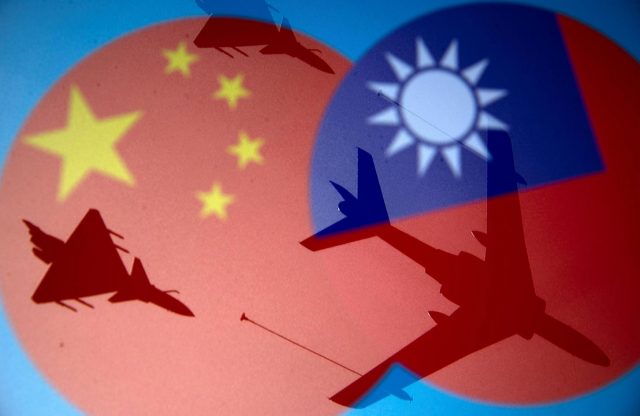
TAIPEI — Taiwan accused China of exaggeration on Tuesday after the Chinese military published footage of the strategically located Penghu islands, where there is a major Taiwanese air base, saying it was not true Chinese forces had come near the islands.

China, which claims Taiwan as its territory, has carried out military exercises around the island this month after a visit by US House of Representatives Speaker Nancy Pelosi, who was followed by five US lawmakers on Sunday and Monday.

The Chinese military unit responsible for the area adjacent to Taiwan, the People’s Liberation Army’s Eastern Theatre Command, released on Monday video of the Penghu islands, apparently taken by a Chinese air force aircraft.

Taiwan Air Force Vice Chief of Staff for Operations Tung Pei-lun told reporters in Taipei that this was Chinese information warfare, though he said he had no comment on who had taken the video.

“China used the exaggerated tricks of cognitive warfare to show how close it was to Penghu — which is not true,” Tung said.

Taiwan’s Defense Ministry on Monday, in an update of Chinese air force activity near Taiwan, showed on a map that the closest Chinese aircraft to Penghu that day were four J-16 fighters.

The fighters crossed the Taiwan Strait median line — normally an unofficial barrier between the two sides — but stayed closer to the Chinese coast than Penghu, the map showed.

Tung said that Taiwan had a real-time “grasp” of what was going on in the skies, and that Chinese aircraft have been operating to the north and southwest of Taiwan and across the median line.

Penghu, a summer tourist destination for its beaches, is close to Taiwan’s southwestern coast, unlike the Taiwan-controlled Kinmen and Matsu islands, which are right next to the Chinese coast.

Taiwan’s armed forces are well-equipped but dwarfed by China’s. The island’s president, Tsai Ing-wen, has been overseeing a modernization program and has made increasing defense spending a priority.

Defense Ministry spokesman Sun Li-fang said next year’s proposed defense budget had been submitted to the Cabinet for approval.

It is based on the “assessment of the enemy threat,” military development needs, and Taiwan’s overall financial resources, he said, without giving details. — Reuters

Indonesia at ‘pinnacle of global leadership’ — Jokowi

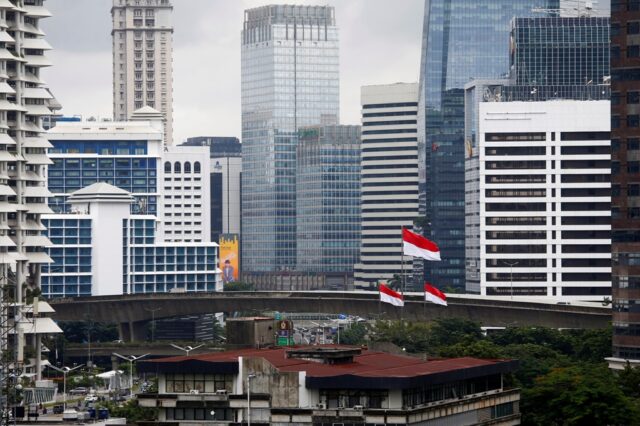
INDONESIAN national flags fly at a business district in Jakarta, Indonesia, Feb. 5, 2021. — REUTERS

JAKARTA — Indonesian President Joko Widodo on Tuesday hailed his country’s growing stature on the global stage and reiterated calls for the Southeast Asian nation to be a “bridge of peace” between Russia and Ukraine.

“In 2022, we hold the presidency of the G20, an international forum made up of the world’s largest economies. Next year, we will assume the chairmanship of ASEAN,” he said in an annual state of the nation speech a day before Indonesia celebrates 77 years of independence.

“It indicates that we [are at the] pinnacle of global leadership,” he added.

As head of the G20 this year Jokowi, as the president is known, has taken an increasingly active role in foreign affairs.

In late June he travelled to Kyiv and Moscow to meet with his Ukrainian and Russian counterparts, Volodymyr Zelensky and Vladimir Putin, as part of diplomatic efforts to find a peaceful solution to the war and ease the global food crisis. He was the first Asian leader to do so.

Indonesia, he said, “has been accepted as a diplomatic bridge” between the two nations.

In the televised national address Jokowi also noted the country’s economic fundamentals remain strong amid a volatile global economy, with inflation at 4.9% and economic growth reaching 5.4% in the second quarter of 2022.

As the pandemic eases, relatively low case numbers this year have allowed Jokowi to refocus on his priorities, including economic growth and infrastructure development in Southeast Asia’s largest economy.

The parliament passed legislation earlier this year on relocating the country’s capital to Indonesian Borneo, a cornerstone of the president’s agenda.

Jokowi, who donned a traditional outfit from Bangka Belitung islands off Sumatra, the color of which his private secretary said represented a “green future,” was elected in 2014 and will finish his second and final term in 2024. — Reuters

Singapore’s next PM signals rich may have to pay more taxes

A VIEW of the city skyline in Singapore, Dec. 31, 2020 — REUTERS

Singapore’s next prime minister signaled that the wealthy may face more taxes as the government seeks more inclusive growth in the city-state and looks for ways to shield the most vulnerable groups from the impact of high inflation.

While the country’s income inequality based on the Gini coefficient has been narrowing, the government probably needs to “lean some more in the direction of more inclusive growth,” Lawrence Wong, 49, the country’s deputy prime minister, said in an interview with Bloomberg News Editor-in-Chief John Micklethwait on Monday. He was referring to an index developed by Italian statistician Corrado Gini in 1912.

“Everybody pays some form of taxes but certainly the ones with greater means — the rich and the higher-income — will have to pay more,” Mr. Wong, who’s also the finance minister, said, reiterating a message he has communicated before. “It’s not only done through the taxation system, but we also can do it through transfers and spending and make sure that spending is targeted at the lower-income and those with greater needs.”

His comments follow an assurance from Prime Minister Lee Hsien Loong last week that the government is prepared to do more to help lower-income households deal with price gains hovering at a 14-year high. The city-state, which earlier raised taxes on its wealthiest 1% and imposed other levies, needs more cash to sustain its inflation fight given an expected budget shortfall of $3 billion, or 0.5% of gross domestic product, this fiscal year.

Inflation is expected to peak by the end of the year before easing, Mr. Wong said, adding that the government will provide more assistance should prices rise further. The country’s consumer prices rose 6.7% in June, the quickest pace since mid-2008, while the core measure gained 4.4%.

“But the big uncertainty is what is the extent of the easing and where will the new inflation rate stabilize at,” said Mr. Wong, who expects inflation to settle at a higher rate especially considering the geopolitical environment, supply issues, and spending on the green economy transition. “We have to prepare for that new equilibrium where inflation is concerned.”

Singapore’s central bank has already tightened monetary policy four times since last year to tame inflation, while the government has targeted measures, including unveiling a S$1.5-billion ($1.1 billion) package in June, at the most vulnerable to blunt the impact of supply-driven price shocks.

Mr. Wong said the government intends to stick with its plan to raise the consumption tax next year to 8% from 7%, while clarifying that there are built-in buffers to protect the lower-income households from the increase.

“That’s the system we have but we’re continuing to see how it can be enhanced, how it can be improved and how can it be fit for purpose, increasingly in a world that’s going to be more uncertain and where there will be more forces that will stretch incomes and wealth apart,” Mr. Wong said.

In the same interview, Mr. Wong talked about rising geopolitical risks and the importance of a multilateral rules-based trading system to support global growth.

GROWTH RISKS

Mr. Wong was named the leader of the so-called fourth generation, or 4G, team in mid-April, making him the heir-apparent to Lee. The economy he’s poised to inherit is grappling with slowing growth on top of elevated prices.

“It’s not just an inflation risk and, in fact, the growth risks are starting to increase as well for next year and that’s what we’re watching carefully, too,” the deputy prime minister said.

Singapore last week trimmed its full-year economic growth projection to a range of 3%-4% from 3%-5% seen previously, citing significant downside risks to the global economy including the war in Ukraine and financial instability owing to tighter monetary policies in advanced economies.  — Bloomberg