Home Blog Page 6001

Manila slips in financial center ranking

Manila slid five spots to 100th out of 119 global financial centers in the 31st edition of the biannual Global Financial Centers Index (GFCI) that assesses the competitiveness of financial centers around the world. The country’s total GFCI rating also went down by a point to 546. A separate assessment on financial technology (fintech) ranked the Philippine capital at 77th out of 113 financial centers in terms of how respondents perceive the competitive environment and fintech offerings. Manila fell two spots from 75th place in September last year.

Manila slips in financial center ranking

PSEi drops on higher oil prices, China lockdown

STOCKS slid on Tuesday amid volatile global oil prices on lockdowns in China due to a surge in coronavirus disease 2019 (COVID-19) cases.

The benchmark Philippine Stock Exchange index (PSEi) shed 40.81 points or 0.58% to close at 6,980.02 on Tuesday, while the broader all shares went down by 10.41 points or 0.28% to 3,712.39.

“The PSEi declined today to among one-month lows after global oil prices went up from two-week lows. The lockdowns in China could slow down economic recovery prospects and valuations, as more aggressive rate hikes by the Fed (US Federal Reserve) and global central banks are deliberate efforts to slow down the economy to better rein in or curb elevated inflation,” Rizal Commercial Banking Corp. Chief Economist Michael L. Ricafort said in a text message.

“Philippine shares slid into the red as concerns about a global economic slowdown amid COVID-19 outbreaks in China sent interest rates lower,” Regina Capital Development Corp. Head of Sales Luis A. Limlingan said in a Viber message.

“Investor sentiment was dampened by inflation fears amid the newly implemented increase in fuel prices, and concerns over China’s COVID-19 stricken economy and its knock-on effects on the local economy. Adding to the worries is the growing warnings over a possible rise in COVID-19 cases in the country in the succeeding months,” Philstocks Financial, Inc. Senior Research Analyst Japhet Louis O. Tantiangco added in a Viber message.

On Tuesday, Brent crude futures were up 59 cents or 0.58% at $102.91 a barrel after rising to $103.93 earlier in the session, while US West Texas Intermediate contracts were up 34 cents or 0.35% at $98.88 per barrel.

The lockdown in Shanghai and the spread of cases in other big cities like Beijing is weighing on the growth outlook for the world’s second-largest economy and investment sentiment, Reuters reported.

The majority of sectoral indices ended in the red on Tuesday except for property, which gained 28.47 points or 0.88% to 3,241.02 and industrials, which went up by 48.64 points or 0.51% to 9,412.55.

Meanwhile, holding firms fell by 99.01 points or 1.49% to 6,547.19; financials declined by 21.22 points or 1.27% to 1,649.22; services lost 13.11 points or 0.67% to 1,941.77; and mining and oil dropped by 67.60 points or 0.56% to 11,941.73.

The MidCap index retreated by 0.85 point or 0.07% to 1,151.61 and the Dividend Yield index dropped by 9.71 points or 0.59% to close at 1,647.88.

Value turnover decreased to P4.11 billion with 549.51 million shares changing hands on Tuesday from the P4.52 billion with 650.10 million issues seen on Monday.

Advancers narrowly outnumbered decliners, 94 versus 91, while 48 names closed unchanged.

Net foreign selling dropped to P312.19 million on Tuesday from P370.58 million the previous trading day.

For the remainder of the week, RCBC’s Mr. Ricafort placed the PSEi’s immediate support at the 6,800 to 6,900 levels. — Luisa Maria Jacinta C. Jocson with Reuters

Peso up as BSP chief says June hike possible

BW FILE PHOTO

THE PESO strengthened versus the greenback on Tuesday after the central bank raised the possibility of a rate hike within the first half.

The local unit closed at P52.25 per dollar on Tuesday, appreciating by 16 centavos from its P52.41 finish on Monday, based on Bankers Association of the Philippines data.

The peso opened Tuesday’s session at P52.35 against the dollar. Its weakest showing was at P52.37, while its intraday best was at P52.13 versus the greenback.

Dollars exchanged climbed to $1.498 billion on Tuesday from $726 million on Monday.

A trader in a Viber message attributed the peso’s strength to hawkish signals from the Philippine central bank that departed from previous statements that they would only start increasing interest rates in the second half of the year.

Bangko Sentral ng Pilipinas (BSP) Governor Benjamin E. Diokno said in an interview with Bloomberg Television that the central bank may consider raising benchmark interest rates at its June 23 meeting.

Policy makers may wait for another cycle after the May 19 meeting if the economy grew around 6%-7% in the first quarter, he said.

The BSP chief previously said the central bank may begin rate hikes in the second half of this year, and that an increase to 2.5%-2.75% as part of a normalization process is “reasonable.”

“We can afford to wait as to what will be the move of the Fed in the next two meetings,” Mr. Diokno said during Monday’s interview. “Right now, there is no evidence of second-round effects on the demand side.”

Meanwhile, Rizal Commercial Banking Corp. Chief Economist Michael L. Ricafort said the peso appreciated as global oil prices eased on Monday.

World oil prices dropped by about 4% on Monday, with benchmarks reaching their lowest in two weeks due to growing concerns on the impact of the prolonged lockdown in China to demand, Reuters reported.

The decline in fuel prices was also attributed to worries over the impact of rate hikes by the US Federal Reserve on growth.

The Federal Open Market Committee will have its next policy review on May 3-4. Fed Chairman Jerome H. Powell has hinted they are will consider a 50-basis-point hike at that meeting following the quarter percentage point increase in March.

For Wednesday, Mr. Ricafort gave a forecast range of P52.15 to P52.35, while the trader expects the local unit to move within P52.25 to P52.45 per dollar. — L.W.T. Noble with Reuters

TUCP seeking P480 hike in Calabarzon minimum wage

TUCP FB PAGE

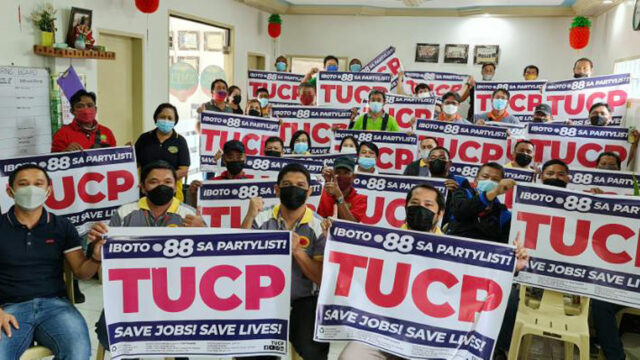
THE Trade Union Congress of the Philippines (TUCP) on Tuesday filed a petition for a P480 increase in the daily minimum wage in the Calabarzon region, more than two weeks after it refiled a wage hike petition in the National Capital Region.

In a statement, the TUCP said the purchasing power of P303-P400, the daily minimum wage in the provinces near Metro Manila, has been eroded by inflation to about P268-P353, depending on the province.

The Calabarzon region consists of Cavite, Laguna, Batangas, Rizal and Quezon provinces, which lie to the south and east of Metro Manila.

The TUCP said that the impact of the last minimum wage increases in the region, in 2018, “has long dissipated.”

“How can workers and their families cope with skyrocketing prices of food and commodities with such ridiculously low wages?” it added.

The TUCP said the take-home pay of a minimum wage earner in the region is currently between P279 and P371 per day after deductions. “Minimum wages have been below poverty thresholds in Calabarzon, and the gaps have been widening.”

It said current take home pay levels imply that families of minimum wage workers can spend P11-P14 per meal. “Clearly, the amounts cannot provide for the recommended nutritional requirements for a family of five, not by any stretch of the imagination.”

Calabarzon is a key industrial region, “hosting the highest concentration of manufacturing activity with automotive assemblers predominantly located in Laguna, semiconductors, high-tech industries and electronics in Cavite and Batangas, and garments manufacturers in Rizal,” according to a study published by Oxford Business Group.

The region accounted for 14.5% of the country’s economic output in 2020.

The TUCP on April 5 refiled its petition for a P470 increase in the minimum wage for Metro Manila, after the wage board dismissed an earlier filing due to jurisdiction issues.

The TUCP also filed a P440 minimum wage hike petition in the Bicol region.

The organization noted that Bicol’s last wage board decision was in August 2018. Wage boards typically start hearing new petitions on the anniversary of the last board action.

“After three years and eight months since (the wage order was issued), the measly P20 increase has long dissipated.” — Kyle Aristophere T. Atienza

Duterte signs electric vehicle measure into law

Image via Ivan Radic/CC BY 2.0

PRESIDENT Rodrigo R. Duterte has signed into law a measure regulating and developing the Philippines’ electric vehicle (EV) industry, including quotas for their adoption by various industries, the Palace said in a statement.

Republic Act No. 11697 was signed on April 15 and outlines the regulatory framework for the manufacturing and adoption of electric vehicles. Its main policy aim is to promote the industry as a “feasible mode of transportation to reduce dependence on fossil fuels.”

Industries such as cargo logistics, food delivery companies, tour agencies, hotels, power utilities, and water utilities have been set a 5% EV quota for their vehicle fleets, whether owned or leased, on a timetable to be determined by an industry roadmap.

The law governs “the manufacture, assembly, importation, construction, installation, maintenance, trade and utilization, research and development, and regulation of electric vehicles.”

The roadmap will feature an annual work plan to “accelerate the development, commercialization, and utilization of EVs” and recognizes preferential parking slots for EVs and charging stations in dedicated spaces as key to their adoption.

According to the law, establishments with 20 or more designated parking slots should dedicate 5% of their space for the use of EVs and provide charging points.

The law sets manufacturing standards for “EVs, batteries, and facilities, including recycling facilities, parts and components, and charging stations and related equipment.”

The Department of Energy has been designated as the agency to lead the EV adoption campaign and the rollout of charging stations. — Kyle Aristophere T. Atienza

Japanese model maker Tamiya expected to invest P2 billion in expanding Cebu facility

TAMIYA

TAMIYA, Inc., a Japanese manufacturer of plastic scale models and radio-control products for hobbyists, confirmed plans to invest P2 billion in an expansion of its Cebu operation this year, the Department of Trade and Industry (DTI) said.

In a statement on Tuesday, the DTI said Tamiya Chairman and President Shunsaku Tamiya confirmed the company’s widely reported decision to set up a new facility at the Cebu Light Industrial Park, which is targeted to start operations by September 2023. The facility will add to the company’s current operation in Cebu.

Previous reports had estimated the planned investment at P1.5 billion.

The DTI said the decision to invest was reported by Commercial Counselor Dita Angara-Mathay of the Philippine Trade and Investment Center in Tokyo.

“The new plant and building (will be) 22,579 and 30,765 square meters (sq.m.) respectively, which will generate 300 additional jobs and increase output by 5% over three years and overall capacity by 20%,” the DTI said.

According to the DTI, Tamiya’s annual production for export is valued at $30 million, of which 80% is produced in the Philippines.  

“While Tamiya’s sizeable overseas regional operations span the United States (California) and Europe (Germany), Tamiya has only one production facility outside of Japan. The company’s factory in the Philippines, specifically in Mactan, Cebu is housed inside a 40,000 sq.m. facility with over 1,200 workers engaged in model assembly,” the DTI said.  

Trade Secretary Ramon M. Lopez said Tamiya’s planned investment showcases the quality and efficiency of Filipino workers.  

“The fact that Tamiya has been operating in the country for about 30 years and is now moving forward with expansion plans despite the challenges of the pandemic, is testament to the enabling environment that President Rodrigo R. Duterte together with his economic managers have set up for foreign direct investors,” Mr. Lopez said. — Revin Mikhael D. Ochave

Anakpawis party-list presses for price controls on oil products

PHILSTAR FILE PHOTO

A PARTY-LIST organization said on Tuesday that the government needs to impose price controls on oil products to aid agricultural workers, adding that fisherfolk are losing their livelihoods because of expensive fuel.

“There have been significant numbers of our fisherfolk seeking different occupations which they perceive as more sustainable sources of income than fishing,” Anakpawis National Vice-President Ariel B. Casilao said in a statement.

“This trend of labor out-migration in the fishing sector should compel the government to immediately impose price controls on oil products to encourage our fisherfolk to return to their livelihood,” he added.

Anakpawis estimated that the latest oil price hike of about P4 per liter means that fisherfolk consuming an average of 12 liters per trip will need to spend P876, up from P840 last week when diesel was still at P70 per liter.

Mr. Casilao noted that Republic Act 7581 or the Price Act, authorizes the imposition of “automatic price controls against illegal manipulation, including profiteering or the sale or offering for sale of any basic necessity or prime commodity at a price grossly in excess of its true worth.”

“Any increase in the cost of production furthers the plight of our ailing rural sectors. Production costs are constantly rising yet income continues to drop drastically,” he said.

“We demand that the government immediately impose measures to correct these fraudulent practices of oil companies in price manipulation and overpricing,” he added. — Alyssa Nicole O. Tan

Foreign visitor arrivals hit 313,050 since reopening of borders

PHILSTAR

THE PHILIPPINES has admitted more than 300,000 foreign visitors since reopening its borders on Feb. 10, according to the Department of Tourism.

“From Feb. 10 to April 25, we surpassed the 300,000 mark. We received about 313,050 international arrivals,” Tourism Secretary Bernadette Romulo-Puyat said in a Laging Handa briefing on Tuesday. 

According to Ms. Puyat, the leading country of origin for such visitors was the US, followed by Canada and South Korea.

“In terms of pre-pandemic levels with regard to international tourist arrivals, we are still far off because in 2019, we received 8.26 million tourists. But we are happy with the current levels,” Ms. Puyat said.    

“We are happy that we are slowly getting back to normal. But we still really have to follow minimum health and safety protocols,” she added.  

On Feb. 10, the Philippines started admitting nationals who do not require a visa to enter the Philippines. Starting April 1, borders were opened to all nationalities. 

Recently, the World Travel and Tourism Council (WTTC) estimated that the Philippine tourism industry contributed $41 billion to the economy in 2021, up 129.5% from 2020 levels.  

“Our expert analysis shows that the economy has turned a corner and is firmly on the road to recovery,” WTTC President and Chief Executive Officer Julia Simpson said in a recent briefing. — Revin Mikhael D. Ochave

Gov’t urged to crack down on quarries, other works around Masungi reserve

MASUNGI GEORESERVE FOUNDATION, HANDOUT

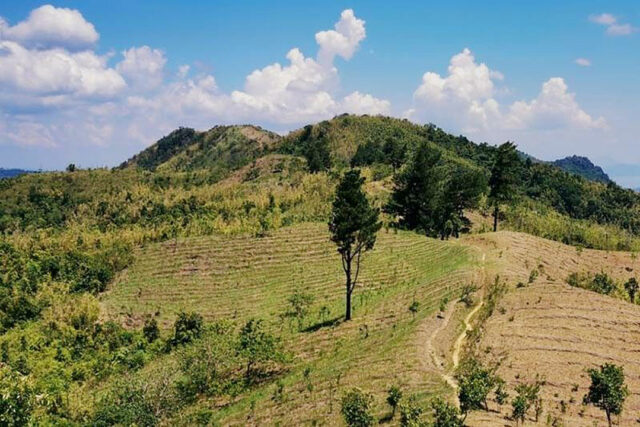
THE GOVERNMENT needs to cancel quarrying agreements and halt illegal construction around the Masungi Georeserve in Baras, Rizal, and focus on conserving the area, civil society organizations said.

Over 30 heads of environmental organizations and educational institutions signed a joint statement seeking an end to such activity at Masungi and the Upper Marikina Watershed, which they said risks degrading the environment around the portion of the Sierra Madre range to the east of Metro Manila.

“The conservation project, spanning 2,700 hectares of severely degraded and abused watershed areas around the Masungi limestone, seeks to stop illegal activities such as land grabbing, quarrying, and illegal construction, and rewild the landscape crucial to Metro Manila’s disaster and water resilience,” according to the joint statement.

Apart from being a conservation area and park, the Masungi project also aims to protect the Upper Marikina Watershed.

The joint statement urged the Department of Environment and Natural Resources (DENR) to immediately cancel Mineral Production Sharing Agreements (MPSA) in force within the Upper Marikina Watershed.

The group cited Republic Act No. 11038 or the Expanded National Integrated Protected Area Systems Act, which bans mineral exploration, mining, and quarrying inside protected areas.

“We believe these are more than enough grounds to merit the expeditious cancellation of the said MPSAs. We condemn the reported moves of certain officials to approve similarly harmful and contradictory activities inside the protected area, such as the construction and operation of certain swimming pool resorts that disrupt and divert waterways inside the critical watershed,” according to the statement.

“It is ironic and disheartening that instead of canceling the quarrying agreements and removing illegal permanent structures, there are now threats of removing the award-winning reforestation work of the Masungi Georeserve Foundation in the area,” it added.

The group said that studies estimate the remaining forest cover of the Upper Marikina Watershed at 11% as of 2021.

“This dire situation could significantly worsen the extent of flooding in low-lying reaches of the Upper Marikina Watershed, including the cities and communities of Metro Manila and Rizal Province,” according to the statement.

Among the signatories are environmental lawyer Antonio A. Oposa,  former Puerto Princesa Mayor Edward S. Hagedorn, Manila Observatory Executive Director Jose Ramon T. Villarin, Wild Bird Club President Michael C. Lu, and United Nations Environment Programme Goodwill Ambassador Antoinette F. Taus, among others.

In a separate statement, Presidential Communications Office Secretary Martin M. Andanar also urged the DENR to look into environmental degradation in the area.

“Safeguarding the environment and natural resources is an important component in our sustainable development,” he said.

“We therefore express concern on reports of alleged development activities, which include resort expansion, in the Marikina Watershed. We urge the Anti-Illegal Logging Task Force to look into the matter and file the necessary charges against violators of environmental laws,” he added. — Luisa Maria Jacinta C. Jocson

Risks to PHL children from online activity seen as elevated

THE children of the Philippines are considered to be at significant risk of exposure to online threats, according to a study conducted by cybersecurity firm Surfshark.

Surfshark found that the risk profile of children in the Philippines was near the bottom of the countries studied. Thai children were considered most at risk. Turkey was behind the Philippines at third.

The study rated countries on a scale of “very low” risk (a 0-20 score) to “very high” (80-100).

Japan was found to be the most secure.

Children in the Philippines “don’t have the skills to deal with cyberbullying or other common cyber threats,” the company said.

Surfshark’s study found that 6 out of 10 children aged 8-12 are exposed to cyber risks. One in two children encounter cyberbullying, and one in three experience phishing or hacking.

“The number of cybercrimes against children steadily grew each year by 5-9% but sharply spiked by 144% in 2020, after roughly 1 billion school children worldwide were relocated online for remote learning,” Surfshark said.

Surfshark found that low and lower-middle-income countries had better online safety education than more developed countries. Saudi Arabia and Uruguay, for example, had virtually non-existent online safety education.

Children in the Asia-Pacific, meanwhile, had the strongest online risk management skills, Surfshark said.

“Through this study, we can see that educating children about cyberthreats plays a massive role in them knowing how to deal with any problems that may arise online,” Cybershark Information Security Officer and Cybersecurity Expert Aleksandr Valentij said. “There is no one-size-fits-all approach to discussing online safety with your children. Instead, you must discover ways to converse with them and assist them in understanding what to do.”

More generally, losses in the Philippines during the pandemic from bank fraud, such as unauthorized withdrawals or illegal transfers, amounted to P1 billion, the Bankers Association of the Philippines (BAP) said.

Cybersecurity company Kasperky general manager for Southeast Asia Yeo Siang Tiong has said that the government and private sector should start working on cybersecurity awareness.

He added that users should be aware that cyberattacks can occur via social media and messaging apps, and should know how to respond. — Tobias Jared Tomas

ASEAN-Canada FTA negotiations expected to conclude during next Presidential term

REUTERS

THE Department of Trade and Industry (DTI) said the conclusion of negotiations with Canada for a free trade agreement (FTA) with the Association of Southeast Asian Nations (ASEAN) is expected to come some time after the Duterte administration steps down on June 30.

“In terms of timing, the process may take time and therefore is not expected to be completed before June 30 this year,” Trade Secretary Ramon M. Lopez said in a Viber message to BusinessWorld, in response to queries about the trade deal, known as ACANFTA.

The Tariff Commission (TC) issued a notice on April 25, announcing that it will hold a public consultation regarding Philippine participation in the ACANFTA negotiations, covering products under Chapters 1 to 97 of the ASEAN Harmonized Tariff Nomenclature (AHTN) 2017.

The TC said the scheduled public consultation will be held on May 5, in accordance with Republic Act No. 10863 or the Customs Modernization and Tariff Act.

According to Mr. Lopez, ACANFTA is expected to be “mutually beneficial.”

“The ACANFTA will be our window through ASEAN to have an FTA with Canada. This will mean more goods that can have better trade flows mutually beneficial to strengthen trade relations with Canada,” Mr. Lopez said.

Mr. Lopez would not say which goods the Philippines is pushing for inclusion in free trade talks.

“The goods to be included are yet to be negotiated between ASEAN and Canada. We will definitely include products that will benefit us,” Mr. Lopez said.

In November, Mr. Lopez and his counterpart trade ministers from the ACANFTA countries launched trade talks.

The DTI has said that a joint feasibility study done in 2018 indicated that the Philippines is projected to realize a 2.63% gain in gross domestic product (GDP), equivalent to $7.4 billion, after joining ACANFTA.

The study also suggested that ASEAN GDP will increase by 1.6% or $39.4 billion as a result of ACANFTA.

According to the DTI, Canada was the Philippines’ 18th largest trading partner in 2020, with trade valued at  $925.7 million. Canada was the Philippines’ 19th largest export market, with shipments valued at $400 million, and the 22nd largest source of imports at $525.6 million.

According to the Canadian embassy website, Canada-Philippines bilateral merchandise trade was $2.7 billion in 2021, up from $2.1 billion in 2020.

The embassy said Canadian merchandise exports to the Philippines included meat, mineral ores, wood, cereals, and precious stones and metals while top imports were electronics, machinery, and scientific and precision instruments. — Revin Mikhael D. Ochave

Seven more Filipinos get COVID in Shanghai

REUTERS

SEVEN more Filipinos in Shanghai, China tested positive for the coronavirus, according to the Philippine consul general. 

Seventeen Filipinos there have been infected with the virus, 14 of whom were active cases. Three of the migrant workers had been discharged from isolation facilities in Shanghai, Consul General Josel Ignacio told ABS-CBN TeleRadyo on Tuesday. 

New coronavirus disease 2019 (COVID-19) cases in Shanghai fell for the third straight day to the lowest in three weeks as China’s anti-pandemic focus shifts to Beijing, where daily infections have hit a record. 

New infections in Shanghai dropped by 12.7% to 16,980, while cases with symptoms declined by about a third to 1,661. Fifty-two patients have died, according to Chinese government data released on Tuesday. 

That raised the total infections to 522,000 since March 1 in the city of 25 million people. 

Shanghai is struggling to defeat China’s worst outbreak in two years despite weeks of lockdowns. 

Under its zero-COVID strategy, China imposed lockdowns, mass testing and travel restrictions to contain infections. 

Mr. Ignacio reiterated that the Philippine government would provide food assistance to Filipinos affected by the lockdown. The Overseas Workers Welfare Administration will also give $200 to infected Filipinos. 

The Philippines might experience another surge in coronavirus infections by May or June, similar to what other countries are experiencing now, OCTA Research Group fellow Fredegusto P. David told a virtual town meeting on Monday. 

The Philippines on Monday started giving out second booster shots against the coronavirus to seriously ill people. 

Among those eligible for the shots are people with weak immune systems, those living with HIV, cancer, transplant and bedridden patients, and the terminally ill, the Department of Health (DoH) said in a statement. 

Only 12.9 million of 67.2 million fully vaccinated Filipinos have received booster shots, said Teodoro J. Herbosa, an adviser at the National Task Force Against COVID-19. 

He also said a COVID-19 outbreak could happen among unvaccinated Filipinos. “If we ever do get an outbreak, it will be in areas where vaccination rates are below 50%,” Mr. Herbosa said.   

OCTA President Ranjit S. Rye, citing a poll they conducted on March 5 to 10, said 77% of Filipinos were willing to get their booster shots, while 23% were unsure. 

He added that 53% of those who were unsure felt that booster shots are safe, while 35% thought these are not needed. 

OCTA Research interviewed 1,200 adults face-to-face for the nationwide poll. 

Only certain areas in the capital region were ready to roll out the second booster shots, the Health department said on Monday. 

Members of the vulnerable sector should get a vaccine brand that is different from their earlier shots for more protection, according to Nina Gloriani, who heads the government’s vaccine expert panel. 

The second booster vaccine should be injected three months after the first, the Health department said earlier. 

Rontgene M. Solante, a member of the government’s vaccine expert panel, told the town hall meeting economic frontliners should get their first booster shots to ensure that economic recovery was not derailed. 

First booster shots would protect one from infection and lessen the chance of transmission, he said. 

“If COVID-19 cases go up, we might be placed under a lockdown again and our economy will be derailed again,” he added. 

Based on DoH guidelines, economic frontliners include private sector workers required to physically report for work, employees in government agencies and informal sector workers and self-employed people who work outside. They also include people who work in private households. 

At the same meeting, presidential adviser for entrepreneurship Jose Ma. A. Concepcion III said Filipinos should take their booster shots to prevent lockdowns, which would stall the recovery momentum of businesses.   

“We don’t want to go back to Alert Level 3,” he said. “That would really destroy the renewed enthusiasm of entrepreneurs as they see their lives and businesses coming back. You don’t want to break that momentum.” 

The private sector is working on how to entice more Filipinos to get their COVID-19 booster shots, he separately said in a mobile phone message. 

“It is challenging with the current environment. But we are working on it,” he added.   

He also said private companies are conducting information drives to inform people that COVID-19 vaccines are safe. — Norman P. Aquino