Home Blog Page 5967

How to take your high-performing SME into the Success Stage

JCOMP-FREEPIK

In the book Five Stages of Small Business Growth, researchers Neil C. Churchill and Virginia L. Lewis go in-depth into the growth framework that all small-to-medium enterprises (SMEs) normally go through. It describes the common scenarios and challenges companies face at each stage, and what steps they can take to move on to the next phase.

The Survival Stage is the second phase of this framework. In this stage, an SME has grown past the phase of merely existing in their industry. It has customers and the ability to consistently deliver goods and services. The company structure is still basic, with the owner still making most decisions despite having a business manager. System development, or the use of technology and automation in the company, is minimal.

Once an SME generates enough revenue to break even and grow in size, it’s on its way to the third stage: Success Stage.

In the Success Stage, the SME has generated above-average revenue to upgrade their current assets, such as tools and equipment. Its workforce is also growing significantly, with more managers taking over minor business decisions. At this point, SME owners have the luxury of deciding whether to expand, maintain the company’s stable profits, or disengage from the company while keeping the business more or less at the status quo.

HOW TO ADVANCE FROM SURVIVAL TO SUCCESS
Advancing towards the Success Stage seems either like a tremendous task or a lucky break, especially when you are an SME owner on the survival stage for a while. The key is to look at aspects of the business to focus and improve on, eventually setting you apart from competitors.

Here’s two business aspects that are crucial for SMEs to focus on:

• Delivering great customer service

While a company’s goal is to earn profit, its purpose is to get and keep customers, according to Harvard Business School Professor Theodore Levitt in his book, The Marketing Imagination. You essentially depend on your customers for a living, and building success means understanding customers and appreciating what they want.

Great service can satisfy your customers. But without consistency, they won’t become loyal customers — which is what SMEs should aspire for. When customers consistently get what they expect, they repeat transactions and give good feedback. With online reviews being such an important deciding factor for consumers nowadays, a bad review can be detrimental to your sales and reputation.

Consistently excellent service is key to keeping current customers attracting new ones. When customers become voluntary ambassadors of your brand, you know you’re doing things right.

• Finding good investors

The right investor won’t just be a reliable source of funds for your business, but will also provide guidance and business expertise whenever you need it.

Consider your business goal and how an investor would make them easier to achieve. Would you need solely financing, business expertise, or a mix of both? Decide where and how much your investor will be involved in your business, since that will affect your decisions and direction in the long run.

So, what should you look for in a potential business investor? First, their funding capacity: their ability to fund and the diversity of their portfolio. Diverse, recent investments show you how strong an investor’s financial game is. When they have numerous, diverse investments, it means they’re not solely dependent on you to make bank. A quick Google search can let you know the deals your potential investor has done, how many investments they make yearly, and what they specialize in when it comes to investing.

Second is the investor’s assets and resources. The right investor can help you manage your capital, infrastructure, and more. As industry experts, they can offer connections, expertise, and guidance on crucial business decisions. According to Crack the Funding Code by Judy Robinett, the survival rate for most tech companies is at 20%; but up to 80% of those who undergo mentoring programs can survive.

Lastly, you want investors who recognize your business value and its potential in the future, and who are genuinely invested in your vision for the long haul. Pick recognized stable investors who are ready to invest in your business for the next five years or more.

Choosing the right investor is finding a good balance in their ability to fund, their assets and resources, and a genuine belief in your business potential. Ultimately, the right investor will drive you in the right direction and offer you the tools you need to succeed.

The idea of taking your business to the Success Stage can be a long road, fraught with factors that are sometimes out of your control as a business owner. However, by taking small steps to build a strong network of repeat customers and an even stronger source of funding to keep improving your business, you can slowly but surely make your way up from survival mode to the success you’ve always wanted.

(This article reflects the personal opinion of the author and does not reflect the official stand of the Management Association of the Philippines or MAP.)


Benedict S. Carandang is member of the MAP, and is vice-president for External Relations of First Circle. First Circle is a multi-awarded finance company that offers select high-performing SMEs free funding to grow their business to 10 times their current potential. Under First Circle’s Growth Partners Program, SMEs can have a zero-interest, always-available funding line for the next five years that is equivalent to 10% of their annual sales. In addition, SMEs can have exclusive access to current and future First Circle products, such as B2B payments, Corporate Cards, FX and cross-border remittances, and a B2B marketplace. Qualified SMEs will also have a dedicated business consultant to help them along their journey to the Success Stage — all in exchange for a 25% passive stake in their business. This article is co-written with Ian Benetua, a regular contributor to First Circle’s Resource Center.
map@map.org.ph

benedict@firstcircle.ph

Power supply-demand in elections, nuclear energy, and transmission issues

The Presidential and local elections next week generate not only political heat and drama but also climate and energy drama from some sectors that are warning of “power outages during elections amid coal plant shutdowns.”

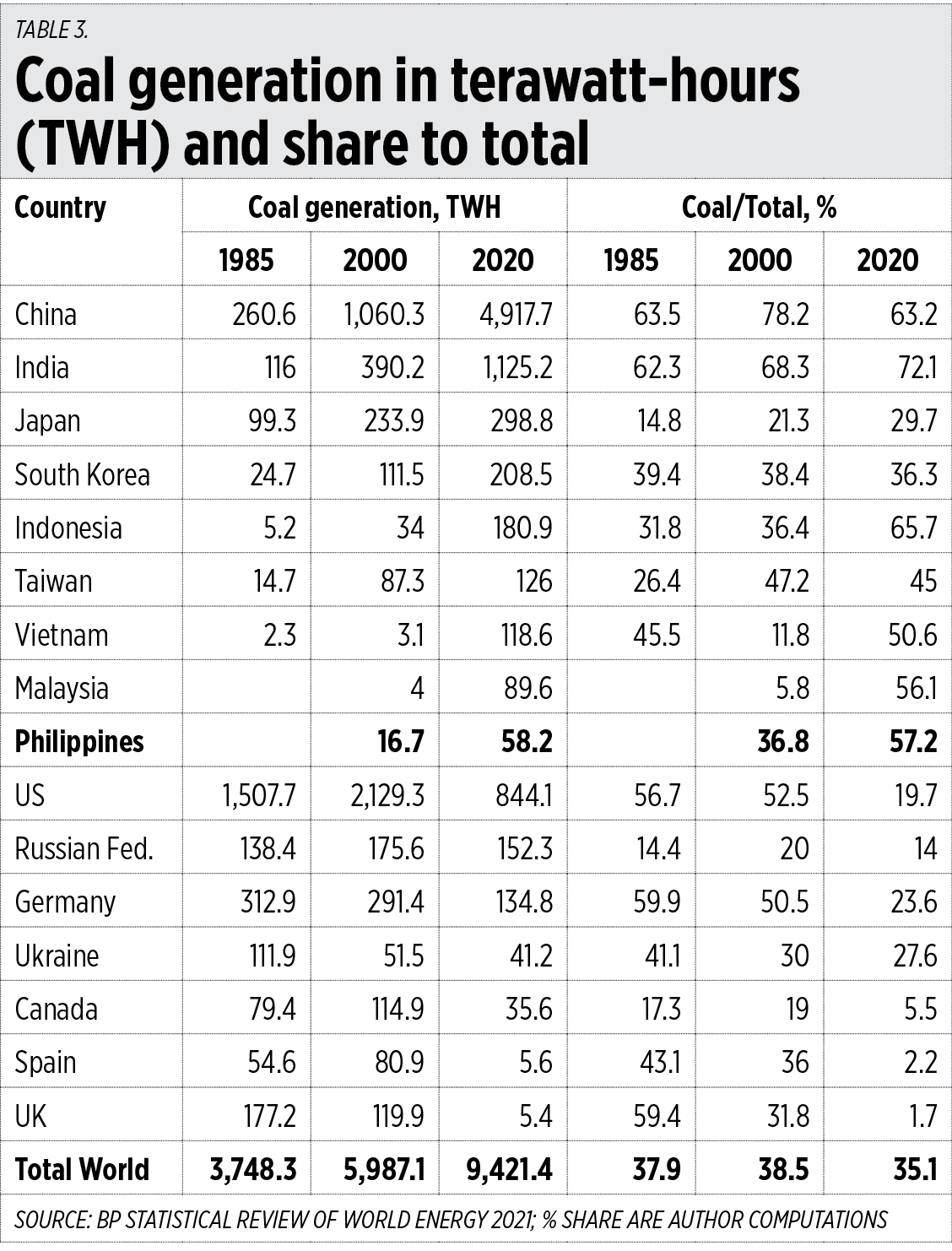
Blackouts during elections because of coal-plant shutdowns — this is nice scare mongering to attract public attention. This is part of the overall plan to endlessly demonize coal power plants (which contributed 57% of total power generation in the Philippines in 2020) so that the agenda of pushing intermittent renewables plus gas will be hastened.

Last Friday, April 29, I attended the media briefing of the Independent Electricity Market Operator of the Philippines (IEMOP) and among the topics discussed was the power supply-demand projection for the second and third quarters of 2022, more specifically on election week.

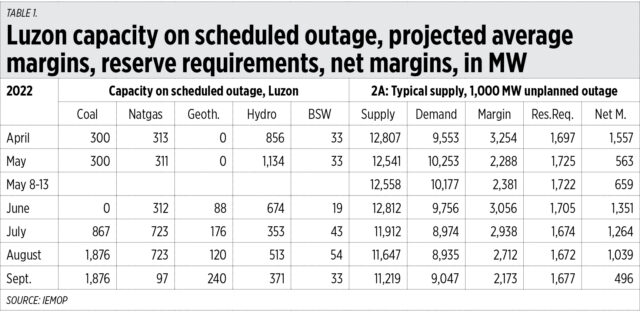
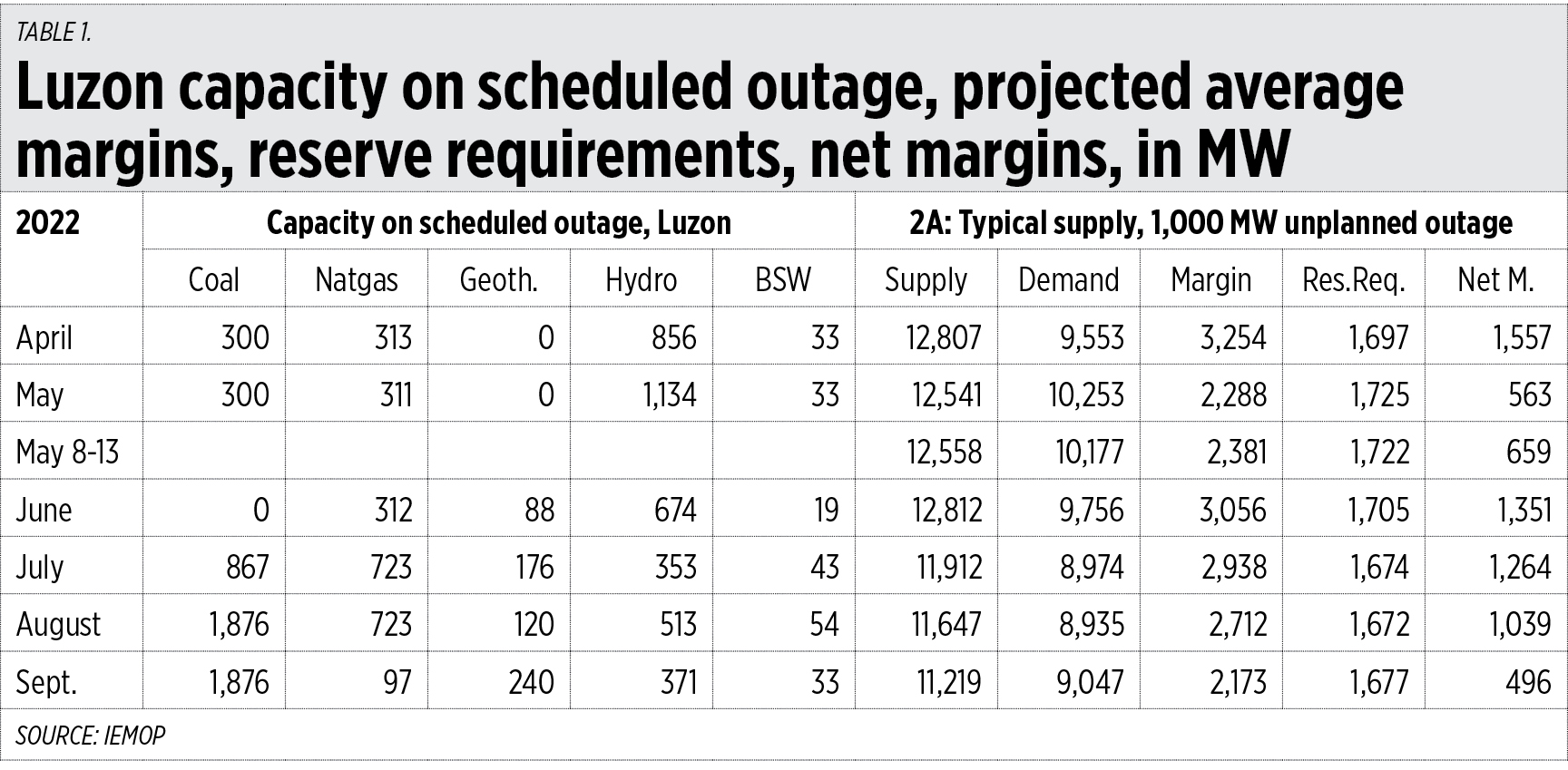
IEMOP noted that during election day in 2019, peak power supply in the Luzon grid was 10,706 MW and peak demand that day was 8,962 MW, for a comfortable margin of 1,744 MW. And during election day in 2016, peak supply in the Luzon grid was 10,329 MW while peak demand that day was 7,721 MW, thus there was a wide margin of 2,608 MW.

The market operator listed the scheduled (maintenance) shutdowns until September, and made four supply-demand projections under four assumptions. For purposes of brevity, I will show only the most pessimistic assumption or scenario: Typical monthly offers with no additional capacities, and 1,000 MW in unplanned outage. The result for next week is a comfortable margin of 2,381 MW, minus the reserve requirement 1,722 MW and still having a net margin of 659 MW (Table 1).

So there. The assumptions are tilted towards the pessimistic scenario to widen the buffer for reserves. And still there are no blackouts foreseen. The public should be wary of scare mongering to further demonize coal, invite blackout economics, and push climate and business agendas.

INTERCONNECTIONS
Related to stabilizing power supply in the country, the Philippine Independent Power Producers Association, Inc. (PIPPA) was reported in some news outlets as urging the National Grid Corp. of the Philippines (NGCP) to hasten the greater interconnection of power supply and demand areas via providing more sufficient transmission lines and assets.

PIPPA said there are 1,000+ MW of stranded capacity in Bataan and Quezon due to transmission line limitations; another 1,000+ MW of power surplus in Mindanao that cannot be exported to the Visayas and Luzon; and hundreds of MW of mostly renewables stranded capacity in Cebu, Negros, and Panay as the inter-island transmission lines are not fully operational or remain not expanded. Good reminders, PIPPA.

NUCLEAR POWER
Last Saturday, April 30, I gave a talk — “If Leni wins, or if BBM wins, how will their policies affect our lives and businesses?” — for personnel and officers of China Bank Savings (CBS). I thanked Jo Fernandez for the invitation. My presentation was mostly quantitative, which complemented the bank’s prior session on non-partisan voter education, on what to expect and do during election day itself.

While my talk was mostly about economics, I devoted two slides comparing the energy policies of Vice-President Leni Robredo, Bongbong Marcos, Jr. (BBM), and Isko Moreno. All of them are in favor of more renewables, and while Robredo and Moreno are either non-supportive of or oppose nuclear power, Marcos is explicitly supportive of developing nuclear power.

In a previous column, I noted that the BBM-Sara team is engaged in deception and dishonesty in promoting the “golden age” of Ferdinand Marcos’ Martial Law years and the “good economic management” of the current administration (see https://www.bworldonline.com/opinion/2022/03/21/437319/a-campaign-of-disinformation/, March 21). But I must give credit to BBM for supporting nuclear power development in the country.

Nuclear power has the highest energy density of all energy sources, hundreds or thousand times higher than fossil fuels coal-gas-oil, and much higher than geothermal and hydro, more so intermittent renewables solar-wind.

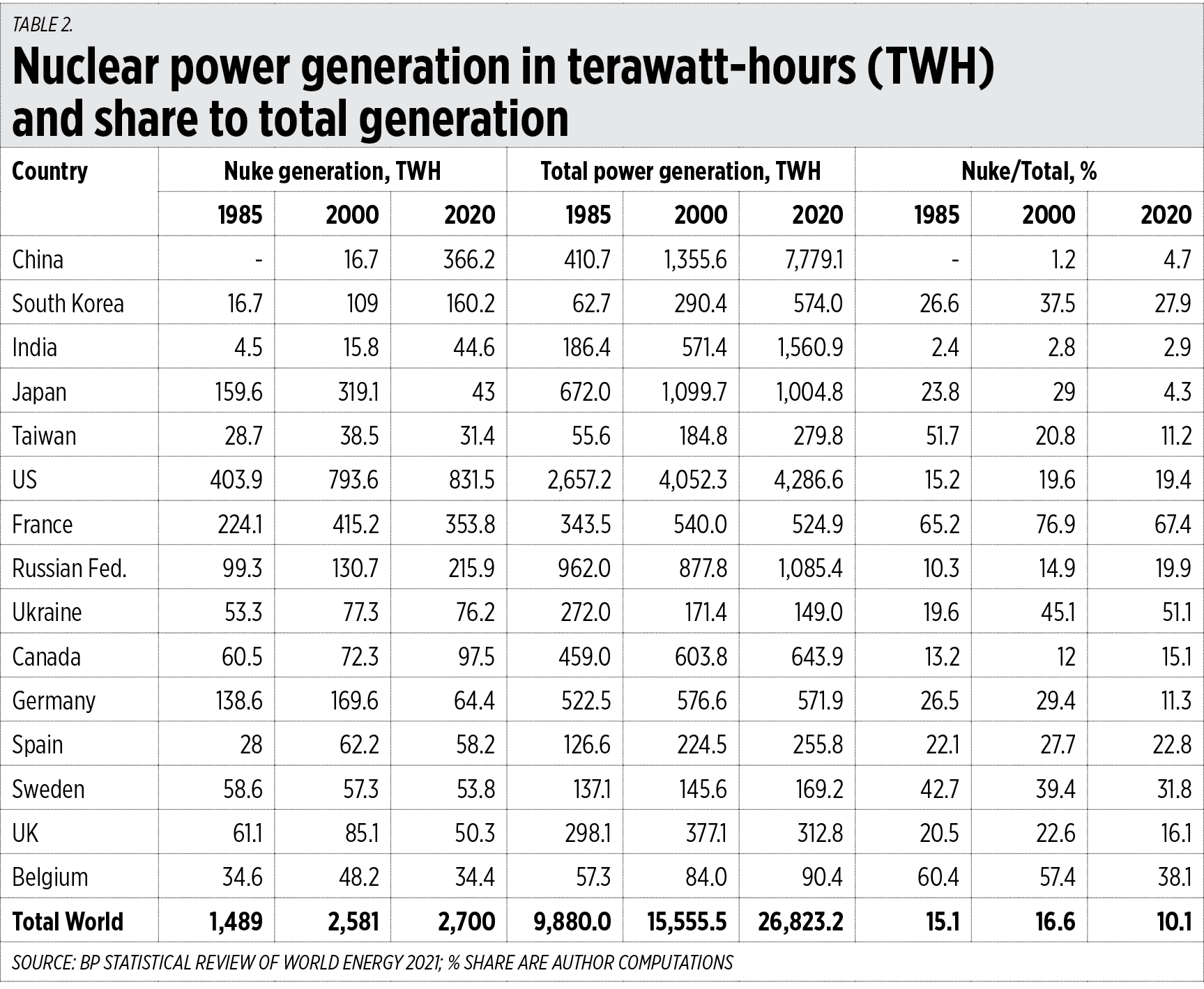
If the Bataan Nuclear Power Plant (BNPP), a huge 620-MW plant, was allowed to operate in 1984 or 1985, the Philippines and South Korea would have been “nuke classmates.” In 2020, our total power generation from all sources was 101 TWH (terawatt-hour) — comparable to Korea’s 103 TWH from nuke power alone in 1999.

I showed a table on comparative nuclear power generation in my talk at CBS. I expanded it here in Table 2 to show their share to total generation. France, Belgium, Sweden, and Taiwan were the most nuclear-intensive users in the 1980s. France was 77% reliant on nuclear power in 2000 and 67% in 2020. France is the biggest electricity exporter in the European Union and seems to have no recorded nuclear accident, which is the main concern of many anti-nuke groups.

The next administration should seriously consider developing nuclear power, at least small modular reactors (SMRs) that can be put up and dispatched in big island-provinces like Bohol, Mindoro, Masbate, and Palawan.

And back to coal. The United Kingdom and Germany were 60% coal power-reliant until 1985. By 2020, it was down to 24% in Germany and only 2% in the UK. Big and poor countries China and India reach up to 78% coal use and this is one of the major contributors to their having lifted hundreds of millions of their people from poverty — by having cheap, stable, dispatchable energy for businesses and households.

There is no “man-made” climate crisis that necessitates demonizing and abandoning fossil fuels. There is only natural or “nature-made” climate change, a warming-cooling cycle that characterized our planet’s climate since 4.6 billion years ago. Thus, the government should not distort our power supply-demand dynamics via more politics and energy rationing. Government should not impose more carbon taxes or oil taxes. We should have cheap, competitively priced, stable, and dispatchable on-demand energy.


Bienvenido S. Oplas, Jr. is the president of Minimal Government Thinkers.

minimalgovernment@gmail.com

Sanctions haven’t made clear what counts as ‘Russian oil’

WIRESTOCK-FREEPIK

EUROPEAN UNION sanctions on Russian oil are inching closer, with Germany, the bloc’s biggest economy, saying that it won’t oppose an embargo. But what is actually considered “Russian oil”?

Putting restrictions on Russian crude is one thing. Trying to stop the sale of Russian refined products is much more complicated, in part because it’s not clear what can, or should be, included.

For crude, it is (relatively) straightforward. Sanctions should be applied to crude pumped out of oil fields in Russia, from which the government derives revenue in the form of export duties and mineral extraction tax.

The one area of uncertainty is CPC Blend crude, which is shipped from a terminal on Russia’s Black Sea coast — close to, but entirely separate from, the country’s main export port in the region at Novorossiysk. The blend contains some molecules of Russian origin, and purchasers have been named and shamed by organizations tracking shipments of “Russian” crude.

But the situation isn’t that simple. At the export terminal, CPC Blend comprises approximately 90% crude from Kazakhstan and 10% that comes from fields in the Russian sector of the Caspian Sea, which are operated by the Russian oil company Lukoil PJSC.

While it might be technically feasible for the Russian molecules to be separated prior to export, as the US Treasury initially suggested in its guidance on Russian oil sanctions, this isn’t going to happen. The Russian operators of the export terminal aren’t going to segregate molecules from Russian oil fields just to make it easier for buyers to avoid them. That would appear to make it a candidate for sanctions.

But the CPC pipeline carries about 80% of Kazakhstan’s crude exports, and there are no realistic alternatives for more than a small fraction of that volume. So, the choice is clear: Ban CPC exports and cripple the economy of Kazakhstan, while inflicting little pain on Russia. Or, accept that Moscow will continue to export a small amount of crude via the CPC system.

The US Treasury updated its guidance in mid-March, noting that CPC crude “is marketed and loaded with a certificate of origin verifying that the crude is of Kazakh origin” and that “US persons may reasonably rely upon a certificate of origin.”

So Russian crude will continue to leak onto the market, just as supplies do now from Iran and Venezuela, with some countries willing to keep buying despite sanctions. Steps could be taken to limit and gradually reduce those flows over time, by granting waivers to buyers who demonstrate that they are reducing their purchases of Russian crude. This was done with considerable success during the Obama-era sanctions on Iranian oil. Yes, there will be some smuggling and blending of Russian crude with other grades in shady ship-to-ship transfers, but no system is going to be perfect.

Refined products are even more complicated.

Fuels produced in Russian refineries are an easy target. The US ban on imports is already hitting Russian refineries that have few other outlets for selling fuel oil and vacuum gas oil and no way to avoid making them. The build-up of unsold product has forced them to cut throughput as they run out of storage space.

But what about, for example, diesel fuel produced in an Indian refinery that has started to import Russian crude alongside deliveries from traditional suppliers in the Middle East? How should those refined products be classified? Moscow won’t see tax receipts from the diesel sales — it has already collected them from the original crude cargo. But if such sales are permitted, there’s no economic incentive for Indian refiners to stop buying Russian crude. And their purchases have soared since Moscow’s invasion of Ukraine.

The cost of shipping crude from western Russia to India and China is much greater than making deliveries to Europe, necessitating steep discounts to offset higher shipping costs and many more vessels, with voyages to Asia taking at least four times as long as trips to Europe.

Oil market dynamics, where diesel fuel is already in short supply and prices have risen to record highs, may make it very difficult to sanction products refined from Russian crude outside of Russia. Maybe that’s just something we have to live with, as the screws are tightened on Russia’s crude flows. Sanctions aren’t a failure even if they only reduce, rather than halt, Russia’s oil exports.

BLOOMBERG OPINION

Initiative Philippines launches relief effort for Ukraine

The culturally-driven agency organizes local donation drive in support of Ukraine children

Initiative, the culturally-driven global communications agency within Mediabrands, has launched a 200 for 2M donation drive for Ukraine, in particular children of Ukraine who are affected by the ongoing conflict.

“Through this simple collective effort we hope to help give Ukrainian children a chance to start their lives again,” says Melody Laogan, Initiative Managing Partner. Co-Managing Partner Paul Atienza adds, “We want to illuminate the way and be a force of positive change in the industry with this humble effort.”

In observance of Women’s Month in March, Initiative Philippines helped to shine a spotlight on women who took a heroic stand through their own individual efforts to help put an end to the conflict and instill peace in Ukraine.

This April, Initiative puts the spotlight on the children who have been most at risk; wrenched from the comfort and security of their homes and rendered totally defenseless by this conflict. To date, an estimated 3.6 million people have now fled the violence in Ukraine, half of this number are estimated to be children; many of whom now exposed to sub-zero temperatures, injury, hunger, and trauma.

The plight of the children of Ukraine moved Initiative Philippines to create 200 for 2M, a campaign to raise donations for Save the Children, the chosen charity. Armed with the agency’s promise of Cultural Velocity, Nori Villaruel, Initiative’s resident strategist, says, “With the Filipinos culture of pakikipagkapwa and sudden rise of usage of online banking apps and e-wallets, we thought that giving at least PHP 200 can already help at least 2 million Ukrainian children.”

The agency’s relief efforts are posted organically in its employees’ social media accounts, together with key LED sites donated by select OOH media partners, Summit Media, Kaddish Advertising, and City Advertising Ventures, as a way to help in the cause. With the agency also seeking help from its client partners, the donations as of April 27, 2022 have reached over PHP 35,000.

For those who wish to donate, you may do so here:
GCash: 0917-815-5509 (Melody Laogan)
BDO Account Number: 011290034115 (Melody Laogan)


Spotlight is BusinessWorld’s sponsored section that allows advertisers to amplify their brand and connect with BusinessWorld’s audience by enabling them to publish their stories directly on the BusinessWorld Web site. For more information, send an email to online@bworldonline.com.

Join us on Viber to get more updates from BusinessWorld: https://bit.ly/3hv6bLA.

Pope defends media freedom, pays tribute to killed reporters

REUTERS

VATICAN CITY — Pope Francis on Sunday paid tribute to journalists who have died or been jailed in the line of duty, defending a free press and praising those in the media who courageously report on “humanity’s wounds”.

Speaking to thousands of people in St. Peter’s Square for his weekly address and blessing, Pope Francis noted that May 3 will be the United Nations World Press Freedom Day.

“I render homage to journalists who pay in person for this right,” he said, citing statistics that 47 journalists were killed and more than 350 jailed last year.

He did give the source of the statistics. UNESCO, the U.N. organization that sponsors World Press Freedom Day, said earlier this year that 55 journalists and media workers were killed in 2021.

“A special thanks to those who, with courage, keep us informed about humanity’s wounds,” the pope said.

Last month Francis honored journalists killed covering the Russia-Ukraine war, saying he hoped God would reward them for serving the common good.

The New York-based Committee to Protect Journalists says it has confirmed that at least seven journalists have died while covering the war in Ukraine and is investigating whether others were killed because of their work.

Reporters Without Borders, which is based in Paris, says it has documented a number of attacks directly targeting journalists wearing “Press” arm bands in Ukraine. — Reuters

Group chat births Filipino NFT movement

The avatar of Alfred Someros, co-founder of Bored Punks of Society, a Filipino NFT (non-fungible token) movement.

In early September 2021, college students Alfred Someros and Karl Ruelan were playing Mobile Legends and communicating with fellow gamers through their Crypto Discussions channel on Discord. 

From conversations about online gaming, their online community shifted to conversations on non-fungible tokens (NFTs) and the cryptocurrency market. The same community was the beginning of their online educational movement in the digital world.    

Mr. Someros, a sports science student with a background in organizational management, and Mr. Ruelan, a mechanical engineering student at the University of the Philippines-Diliman, began their research and enriched their knowledge on financial literacy, the beginnings and developments of NFTs, and the cryptocurrency market.    

The weeknights of online gaming led to their first unofficial podcast on NFTs through Discord with 30 to 50 listeners.    

The online community grew to become the Bored Punks of Society, a Filipino NFT movement focusing on educating investors on the fundamentals of the digital world. They have financial advisers in their team to share their expertise in financial literacy with their online community.   

According to the Bored Punks of Society website, the group’s objective is “to educate and welcome people to the beauty of cryptocurrencies, metaverse, and investing through our weekly community discussions, unlimited reliable resources, and educational podcasts with certified financial advisors, Bored Punk educators, and influential people in the space.”    

“Our focus is to educate people…,” said Bored Punks’ lead director Mr. Ruelan in English and Filipino, during a presentation at the Brasserie on 3 at Conrad Manila in March. “We saw a chance to help people who are interested in the world of crypto. Many get into it blindly without proper knowledge, so they lose [money]. We want to help them explore.”    

Mr. Someros, Bored Punks’ chief marketing officer, said, “We wanted to help other Filipinos learn about NFTs and how casual gamers can actually go on a much deeper level and engage others to earn a respectable living. From what is still considered a ‘gray area’ for us Filipinos, we want to help create more success stories for others by breaking it down for the everyday person.”    

During their online discussions, Messrs. Someros and Reulan would host sessions with avatars.  

When participants expressed interested in owning an avatar to identify as a member of the community, the Bored Punks of Society offered its first 7,640 Avatar-based NFTs for approximately P2,500 each on the OpenSea marketplace. The NFTs sold for 25 matic (a cryptocurrency) each, and sold out a month after their release. They were also able to resell their NFTs for over P510,000.    

The earnings from the initial sale were used as seed money to further build their online community, a website, and invest in equipment for their podcast. 

WHAT IS AN NFT?
NFTs are one-of-a-kind digital assets (which may be a drawing, meme, animated GIF, video, etc.) purchased online through cryptocurrency. Its record of ownership is stored in a digital ledger called a blockchain.    

To create NFTs, artists make limited copies by “minting” them on various NFT platforms including SuperRare, Nifty Gateway, Rarible, and Foundation.   

According to research by Finder.com published in November 2021, 32% of Filipino internet users currently own an NFT. In an online survey of over 28,000 people across 20 countries to compare NFT ownership, Finder.com recorded that the Philippines takes the top spot for NFT adoption.   

“However, while 32% of the 1,507 Filipino Internet users surveyed said they currently own NFTs, an additional 9.5% said they plan to acquire some. This means NFT adoption in the Philippines could soon hit 41.5%,” said Finder.com.  

NFTs seem to attract older people, according to its survey: “People ages 65 and over are the most likely to have NFTs in the Philippines (40.7%). At the other end of the spectrum are people ages 18 to 24 (22.4%).”  

Still, most people do not know about NFTs.   

“While NFT adoption is forecast to increase around the world in future, a large number of people still don’t know what NFTs are,” said the Finder.com report. “Japan has the highest percentage of people who said they don’t know what NFTs are (90%), followed by Germany (83%) and the United Kingdom (79%). On the other end of the spectrum, the Philippines recorded the lowest percentage at 49%, followed by Nigeria (52%) and Thailand (53%).”   

HOW TO GET STARTED
Messrs. Someros and Reulan demonstrated the basic steps to enter the NFT market:  

First, one needs to download the app of a cryptocurrency wallet (in their case the Metamask wallet). Then, the user has to create a new wallet (equivalent to an account) with a password, and a unique recovery phrase of 12 words (which are to be encoded to secure the wallet). The user will need cryptocurrencies which can be purchased using a credit card through Coinbase, Kraken, eToro, and even PayPal.    

Once the user has secured a wallet address, they can browse through various marketplaces such as Rarible, Foundation, and OpenSea.   

Mr. Someros, however, emphasized that the NFT environment is a double-edged sword.  

“Be careful where you put your money at, always buy with a burner wallet (an extra wallet. Not one with all your assets), and always check the roadmap, project’s community, and its legitimacy,” Mr. Someros said.  

Since it started the online movement in September of last year, the group now reaches 20,000 members through its Bored Punks Podcast.    

The group’s podcast airs on Saturday, 8 p.m., through Facebook, Apple Music, and Spotify.    

“We were quite surprised by the number of people that wanted to learn about cryptocurrency or blockchain and [who have been] supporting the project ever since,” Mr. Someros said in a subsequent conversation via Messenger chat in April.   

Messrs. Someros and Reulan are currently finalizing the Bored Punks DNA with an updated version of their roadmap for the group.  

“[It is] mainly focused on maximizing education, physical-digital adaptation, and technological innovation on blockchain that can further sustain, onboard, and educate our fellow kababayan,” he said.    

For more information, visit Bored Punks of Society at boredpunksofsociety.com, and their official social media pages on FacebookInstagram, and Twitter — Michelle Anne P. Soliman 

‘Surprise’ urban Malaysia floods drive pleas for climate action

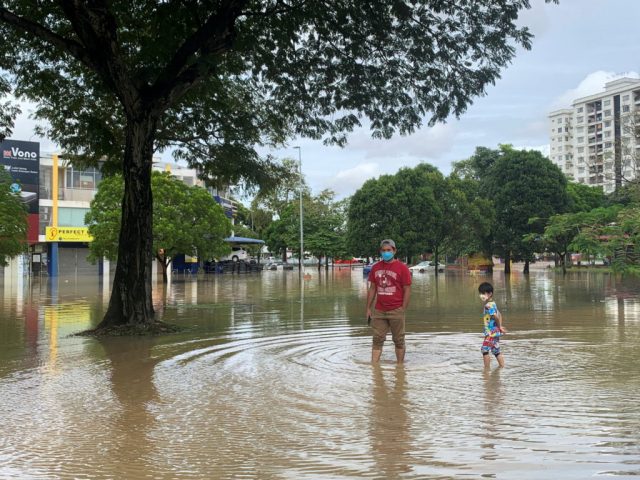
A man and his child stand in flood water in Shah Alam, Selangor state, Malaysia, December 19, 2021. — REUTERS/Rozanna Latiff

KUALA LUMPUR — The damaged furniture and mud-caked walls left by floodwaters have now been replaced or cleaned in Elizabeth Chong’s family home, but lost forever are old photos and documents that gave a precious glimpse into her ancestors’ lives. 

On the street in Malaysia’s capital Kuala Lumpur where Chong’s family have lived for almost a century residents have coped with regular flooding for decades — but nothing prepared them for the devastation caused by rising waters late last year. 

Ms. Chong, who lives in a two-storey house with her disabled aunt and retired mother, was among more than 120,000 people displaced by heavy rains and severe flooding in mid-December and early January across Malaysia. 

“We knew that it was raining constantly and we expected a flood — but not to that extent,” the 22-year-old told the Thomson Reuters Foundation. 

“The doors burst open. Water came in like crazy. All of a sudden it was chest high,” said Ms. Chong, an administrator for a pharmaceutical company and a part-time student. 

Disasters in 2021 from extreme weather and natural phenomena such as earthquakes resulted in a global economic loss of $270 billion, according to a March report by the Swiss Re Institute. 

Floods alone accounted for 31% of those losses, it noted. 

Like many Southeast Asian nations, Malaysia suffers regular flooding during its annual monsoon season but such widespread destruction rarely occurs in the richest states, including the capital and neighboring Selangor. 

Urban areas across the region — already struggling to cope with booming populations, rapid urbanization and crumbling infrastructure — now face heightened threats from climate change-driven storms, heatwaves, floods, and forest fires. 

Malaysia’s recent floods — some in areas once considered immune to such damage — caused nearly $1.5 billion in losses and were described by government officials as a “once-every-100-years” weather event. 

But victims say the country’s response to the floods was often slow and inadequate, and green groups are now calling on the government to introduce laws to cut climate changing emissions and boost emergency response and adaptation efforts. 

“Floods occur every year somewhere, at some time in the country,” said Salleh Mohd Nor, a former president and senior advisor at the Malaysian Nature Society. 

“To say that this (flood) is one-in-100-years is something I doubt … with climate change the rains will be more frequent and torrential,” he added. 

WAITING FOR RESCUE
The last time deep floodwaters entered Ms. Chong’s terraced house — which sits near a river and in the shadow of a huge mall and fancy hotels — was in 2000. One of her earliest memories is of falling into floodwaters as an infant. 

Renovations to the house over the years have included adding an additional floor, raising the structure by 2 feet (0.6 meters), and installing a flood barrier. 

Authorities also completed construction of a key drainage and road tunnel in 2007, to guard against flash floods in the capital and help ease traffic congestion. 

But after more than three days of near-constant rain in late December, floodwaters rose in about three hours from a trickle in Ms. Chong’s home to touching the ceiling of the ground floor. 

She and her family were forced to seek safety on the dry upper floor where, in darkness after the electricity was cut, she began frantically calling emergency services on her mobile phone. Nobody answered. 

As trapped neighbors shouted questions and instructions to each other through windows, Ms. Chong phoned her local fire station and was told to call the national government helpline. 

A quick Google search showed that it only operated from 9 a.m. to 6 p.m., she said. 

Fire crews eventually used a boat to rescue Ms. Chong’s family from the balcony, dropping them off on higher ground — and in the rain — without additional help, she added. 

They temporarily moved in with family that lived elsewhere in the city, and the next day she returned home with her mother to salvage some belongings. 

“This house had a lot of photos,” Ms. Chong said. “Historical, valued things from my grandparent’s time were all ruined.” 

VANISHED FORESTS
Malaysia was once entirely covered in trees but nearly half have now vanished, according to green group WWF. 

The country has lost nearly a fifth of its primary forest since 2002, though deforestation rates have fallen in recent years, according to monitoring service Global Forest Watch (GFW). 

Analysts say forest losses may be contributing to the worsening floods, with many of the hardest-hit states also showing the highest deforestation rates, according to GFW data. 

As news reports emerged of rivers and flooded areas awash with logs, opposition politicians called on the government of Pahang state, east of Kuala Lumpur, to check on illegal and uncontrolled logging. 

Damien Thanam Divean, vice president of non-governmental organization PEKA Malaysia, said clear-cutting of forests, to plant crops such as palm oil and durian fruit, had reduced the ability of land to absorb water, worsening floods. 

He called for a change in the national constitution to put forest management under federal control, with funds allocated to states to promote conservation efforts. 

Malaysia’s Environment Ministry and Prime Minister’s Office did not respond to a request for comment. 

Still, it is difficult to prove that deforestation upstream caused any specific flooding event, said John-Rob Pool, the implementation manager for Cities4Forests, led by the World Resources Institute, a US-based think-tank. 

During heavy rains, however, forests and fallen vegetation slow runoff, allowing more water to enter the soil and reducing the amount flowing downstream. 

That means, “restoring forests is an absolute no-regret strategy” whether for biodiversity protection or lowering flood risk, Mr. Pool said. 

Typically, seasonal floods happen more along the eastern coast of the Malaysian peninsula, said Renard Siew, a climate change advisor at think-tank the Centre for Governance and Political Studies — so the floods in December came as a shock to many urban residents. 

They “never thought the time would come when they would actually have to evacuate from their homes for safety,” he said. “That took them by surprise.” 

Climate change played a role in the severity of the rains and floods, he said, but other factors also contributed to the damage, from garbage-clogged city drains to construction on formerly green areas. 

He urged Malaysia’s government to better protect forests and mangroves, plant more urban trees and introduce a climate change act to help ministries and authorities work better together. 

“We saw in December that things were not as coordinated as they should be,” he said. 

SLOW RECOVERY
Kuala Lumpur resident Ms. Chong’s salary barely covers the household bills and her flood-hit family received no clean-up or financial help from the federal government, she said. 

But local charities, non-government organizations and others stepped in to help — including Ms. Chong’s employer which set up a fund to replace damaged items while friends chipped in with plates, cups and a rice cooker. 

The house is now clean of mud but still needs major repairs on the electrics and toilets — and Ms. Chong’s wheelchair-bound aunt now lives in temporary accommodation provided by a non-government organization. 

Ms. Chong blames the loss of trees — and a lack of investment in flood prevention infrastructure — for her family’s losses. 

“One of the reasons why it floods so much is because they cut down too many trees or burn down trees to make way for developments and palm oil plantations,” she said. — Michael Taylor/Thomson Reuters Foundation

AG&P: Helping build stronger Philippine industry

AG&P Industrial Division, a manufacturing, Engineering, Procurement, Construction, Installation and Commissioning (EPCIC) and Operations & Maintenance (O&M) leader, is pursuing projects that would help the Philippines bounce back strongly from the pandemic, usher in a greener economy and help fortify energy security in the country.

On the other hand, AG&P Energy Division develops owns and operates the downstream LNG / Natural Gas (NG) platform, including LNG regasification terminals, LNG-to-power integrated solutions, City Gas Distribution (CGD) and LNG bunkering which allows it to provide clean energy directly to its clientele.

Combined, AG&P is building infrastructure for sustainable growth of the Philippine economy and beyond.

Leading the industrial growth

In recent years, AG&P has been developing domestic infrastructure that will strengthen the industrial capability of the country as well as provide large-scale employment. “AG&P has a state-of-the-art manufacturing facility in the Philippines, which is a mini-city by itself wherein modules of various sizes (some thousands of tons) are ready for assembly at their clients’ project site. In the last three years, we have employed 8,000 people. Prior, we have sent over 12,000 people overseas and hired 11,000 domestically at our facility and are one of the largest employers in Batangas,” said Mr. Alex Gamboa, President, AG&P Industrial.

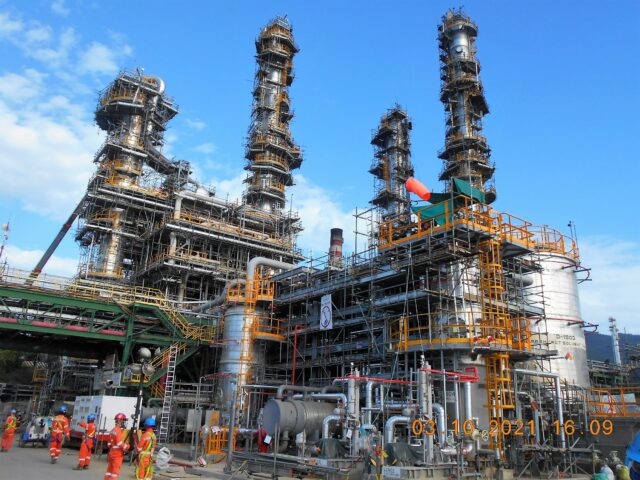
AG&P completed the expansion of the fully-integrated petrochemical complex of JG Summit, building the first fully-integrated petrochemical plant in the country; constructed major structures and mechanical components at Masinloc power plant; Petron lube blending plant; and the Shell North Mindanao import facility; the upgrade of the smelting facility of Glencore; and the modification of the Shell Malampaya offshore gas platform.

In addition, AG&P has delivered 30 modules to date from the Philippines to Thailand for its Sriracha Refinery under the Thai Oil Clean Fuel Project. Upon completion of this project, Sriracha’s refining capacity for high-value fuel products will increase from 275,000 to 400,000 barrels per day, while ensuring compliance to the new global fuel quality and emission standards.

AG&P has recently been engaged by Cemex Holding Philippines Inc.’s subsidiary – Solid Cement Corporation for its Solid K4 Expansion Project. A $235-million initiative, it involves the construction of a new integrated production line at Solid Cement’s plant in Antipolo, Rizal to increase annual capacity of blended cement by 1.5 million tons to 3.4 million tons. The target completion is by first quarter of 2024.

“We share CEMEX’s view on the growth of the construction industry and future need for increased cement production capacity to help develop and upgrade the country’s infrastructure for the Philippine economy to expand further,” said Mr. Gamboa.

Leading the energy transition

AG&P is proud to lead the global energy transition to cleaner fuels through their subsidiary GAS Entec, an energy advisory and technology firm, headquartered in Singapore with engineering offices in South Korea. The firm designs and builds cutting-edge floating and onshore LNG infrastructure powered by its proprietary plug-and-play products and advanced LNG technical solutions – bringing innovation to downstream LNG infrastructure and enabling the introduction and accelerated adoption of LNG to gas-starved demand centers. In the Philippines, AG&P is building the first Philippines LNG (PHLNG) Import Terminal of the country.

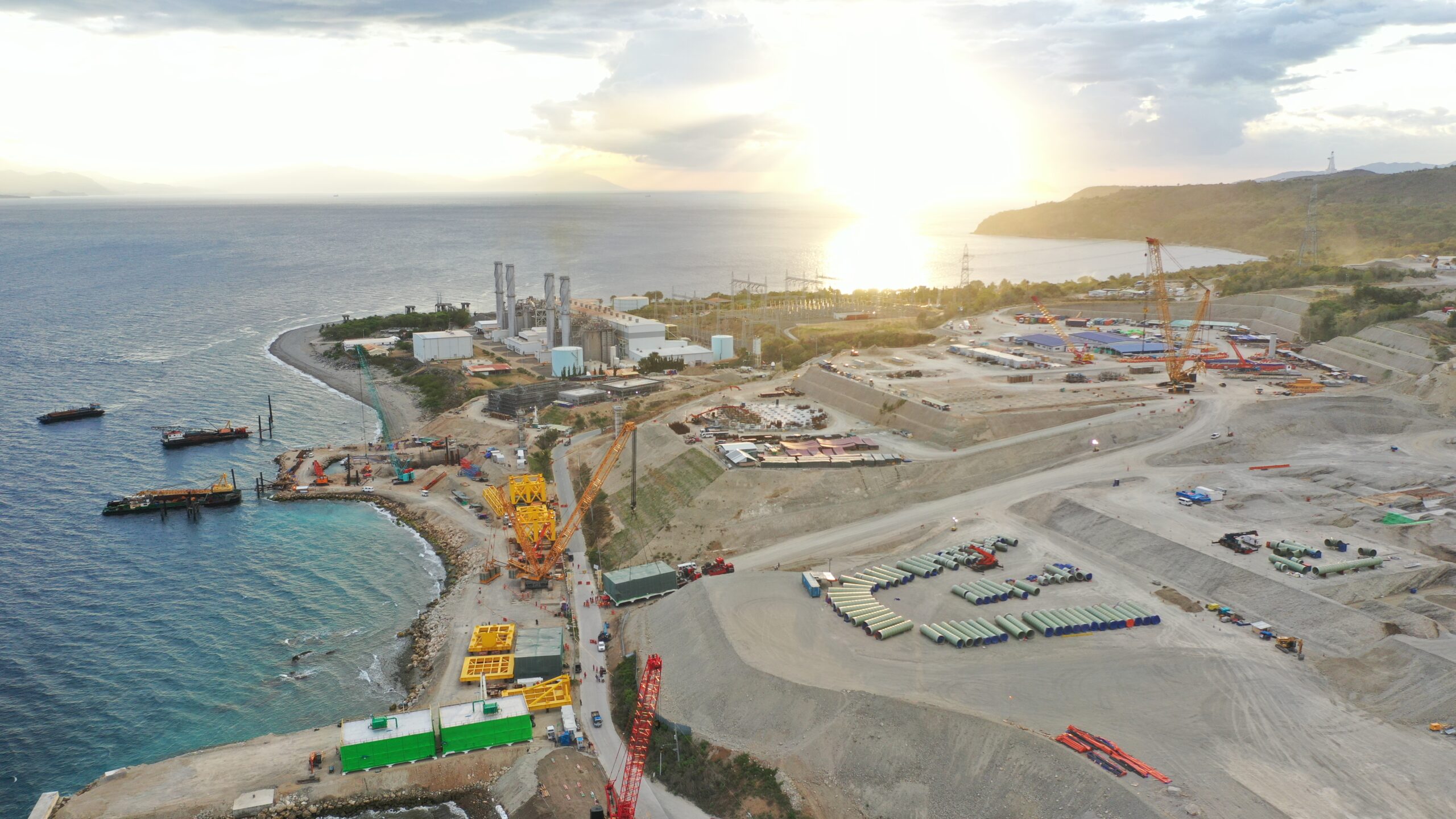
The Philippines LNG (PHLNG) Import Terminal in Ilijan, Batangas.

AG&P is spending PHP22 billion to complete the country’s first LNG import terminal, called PHLNG, within the second half of 2022 in Batangas. The PHLNG Import Terminal will initially have an annual capacity of 3 million tons of LNG.

“The Philippines LNG (PHLNG) Import Terminal in Batangas represents our contribution to enhancing energy security for the Philippines, specifically the Luzon grid,” said Mr. Gamboa.

He said the PHLNG is also envisaged to help Filipinos gain more experience and skills in the LNG industry that would help them get employed overseas, particularly in AG&P projects abroad. He said plans are afoot to link with universities and government agencies to realize this goal.

According to Mr. Gamboa, AG&P is also bidding for several projects in the energy transition and renewable energy space that when combined will generate several thousands of Megawatts needed in the future to sustain the growth of the economy; some light industry projects in the food and electronics sector; the manufacture of construction materials to reduce dependence on imports; and projects overseas that will increase production at its manufacturing facilities.

“We believe in the potential of the Philippines and the Filipinos. We are definitely interested in projects in the country that will leverage the experience and expertise we have gained abroad in building industrial infrastructure over the decades. We are also undertaking projects overseas that will use our facilities here, provide jobs for Filipinos and help increase dollar reserves for the country,” he said.


Spotlight is BusinessWorld’s sponsored section that allows advertisers to amplify their brand and connect with BusinessWorld’s audience by enabling them to publish their stories directly on the BusinessWorld Web site. For more information, send an email to online@bworldonline.com.

Join us on Viber to get more updates from BusinessWorld: https://bit.ly/3hv6bLA.

China COVID hard line eats into everything from Teslas to tacos

REUTERS

SHANGHAI — When Tesla’s Shanghai plant and other auto factories were shut over the last two months by emergency measures to control China’s biggest coronavirus disease 2019 (COVID-19) outbreak, the burning question was how quickly they could restart to meet surging demand. 

But with the Shanghai lockdown grinding into its fourth week, and similar measures imposed in dozens of smaller cities, the world’s largest boom market for electric cars has gone bust. 

Other companies from luxury goods makers to fast-food restaurants have also offered a first read on the lost sales and shaken confidence of recent weeks, even as Beijing rolls out measures to help COVID-hit industries and stimulate demand. 

Joey Wat, chief executive officer of Yum China, which owns KFC and Taco Bell, said in a letter to investors that April sales had been “significantly impacted” by COVID controls. In response, the company simplified its menu, streamlined staffing and promoted bulk orders for locked-down communities, she said. 

The pressing question now is: how and when will Chinese consumers start buying everything from Teslas to tacos again? 

In China’s once-hot electric vehicle (EV) market, the recent turmoil is a stark example of a one-two economic punch, first to supply and then to demand, from Beijing’s hardline implementation of COVID controls across the world’s second-largest economy. 

Before Shanghai was locked down in early April to contain a COVID-19 outbreak, sales of EVs had been booming. Tesla’s sales in China had jumped 56% in the first quarter, while sales for EVs from its larger rival in China, BYD, had quintupled. Then came the lockdowns. 

Showrooms, stores and malls in Shanghai were shut and its 25 million residents were unable to shop online for much beyond food and daily necessities due to delivery bottlenecks. Analysts at Nomura estimated in mid-April that 45 cities in China, representing 40% of its GDP, were under full or partial lockdowns, with the economy at a growing risk of recession. 

The China Passenger Car Association estimated retail deliveries of passenger cars in China were 39% lower in the first three weeks of April from a year earlier. 

COVID control measures cut into shipments, car dealers held back from promoting new models, and sales tumbled in China’s richest markets of Shanghai and Guangdong, the association said. 

One dealer of a premium German car brand in Jiangsu province, which borders Shanghai, told Reuters sales plunged by one-third to half in April, citing lockdowns and trucking bottlenecks that made it difficult to deliver orders. 

He was even more worried about the impact on consumer spending power, he said, declining to give his name as he was not permitted to speak to the media. 

“It could be worse than the first wave of COVID in 2020, when the economic recovery was quick and strong. Nowadays there are more uncertainties in the economy, and the stock and property markets are not doing well,” he said. 

DOWNWARD SPIRAL 

“Much will depend on how fast these restrictions can be lifted but the coming weeks may be difficult,” Helen de Tissot, chief financial officer at French spirits maker Pernod Ricard, told Reuters on Thursday. 

Kering, which owns luxury brands including Gucci and Saint Laurent, said a “significant chunk” of its stores had been shuttered in April. 

“It’s very difficult to predict what will happen after the lockdown,” said Jean-Marc Duplaix, Kering’s chief financial officer. 

Apple also warned at its latest results over COVID-hit demand in China. 

City authorities from Beijing to Shenzhen are trying to stimulate some demand by giving out millions of dollars worth of shopping vouchers to encourage residents to spend. 

On Friday, Guangdong, a manufacturing powerhouse with an economy larger than South Korea’s, rolled out its own incentives to try to restart sales of EVs and plug-in hybrids. 

These include subsidies of up to 8,000 yuan ($1,200) for a select range of what China classes as “new energy vehicles”, including from Volkswagen and BYD. Tesla, second in EV sales in China, was excluded from the subsidy program. 

The US automaker did not respond to a request for comment. 

Chongqing, another major auto manufacturing hub, in March said it would offer cash of up to 2,000 yuan ($300) for shoppers who exchange old cars for new models and set aside another $3 million for other measures to spur sales. 

While noting such measures, Credit Suisse analysts still said they believe COVID control measures have put both online and offline consumption on a downward spiral. 

“We see the consumer sector as being at major risk if the prolonged pandemic and further tightening continue across China,” they said in an April 19 research note. — Reuters

Summit Natural Drinking Water fuels Filipino athletes’ #ThirstforGold in the 31st SEAGAMES

Empowering our heroes Hidilyn Diaz, EJ Obiena and Filipinas (Philippine Women’s National Football Team) with the right hydration and right minerals in their journey to summit!

Summit Natural Drinking Water showcases, once again, its unwavering commitment to supporting Filipino athletes thrive, this time in their bid to bring honor to the country in the 31st Hanoi Southeast Asian (SEA) Games this May 12 to 23, 2022.

As the official bottled water partner of the Philippine Olympic Committee, Summit is one with our athletes in their journey to aspire, perspire, and inspire fellow Filipinos. The Philippines’ first Olympic gold medalist Hidilyn Diaz, Asian pole vault record-holder EJ Obiena, and now, Filipinas, the Philippine National Women’s Football Team are all set to have their hydration levels covered by Summit with the right minerals, allowing them to remain focused on their goals and deliver at peak performance.

Even before Hidilyn and EJ entered the pantheon of Filipino sports icons, Summit has been there to support their respective journeys.

HIDILYN’S JOURNEY TO SUMMIT

Hidilyn Diaz has been making a name for herself since 2008, when she was selected as a wildcard entry for the Beijing Games, becoming the first-ever Filipina to compete in weightlifting. 2016, the year when Hidilyn Diaz, ended the country’s 20-year Olympic medal drought by winning silver at the women’s 53-kg category in weightlifting. Summit is honored to have witnessed that win at the Rio Olympics. To show their love and support for Diaz, they officially made her one of their ambassadors in the year 2018. The goal is not only for Hidilyn to promote the brand but also to back her up in terms of training and hydration as Summit believes in her persistence, motivation, and capacity in achieving a Gold. True enough, in 2019, Diaz won her first SEA Games Gold medal after topping the 55-kg division. With a committed sponsor by her side, Hidilyn powered through challenges en route to her historic win in the Tokyo Games that ended the country’s 93-year hunt for an Olympic gold medal. With back-to-back milestones from various competitions, she proved that she has always had a #ThirstforGold.

To commemorate Hidilyn’s success story, Summit Natural Drinking Water is launching Summit Labels featuring Hidilyn Diaz in 350ml, 500ml and 1L formats and Sports Bottles in 500ml format, which you can now get in leading stores nationwide.

EJ’S JOURNEY TO SUMMIT

Meanwhile, EJ Obiena joined Team Summit after rising in the pole-vaulting scene here and abroad. He most memorably competed in the Tokyo Olympics against the best, proving that one of the sport’s brightest stars is a Filipino.

The “Golden Boy” has been jumping since he was six years old. Since then, he has always remained active, joining the track teams throughout his years in school, from elementary to college, before competing internationally, starting at the 2019 SEA Games where he bagged the gold medal after clearing 5.45 meters on the bar. A year later he stands as the first Filipino athlete to qualify for Tokyo 2020, capping off as the fifth overall in his group during the qualifiers and 11th overall as he made the cut. Currently, EJ is a world record holder with 5.93m as his best performance and recently he has been winning gold in competitions across the globe.

EJ is also set to be carrying the Philippine flag in the opening ceremony of the upcoming SEA Games, making his participation even more remarkable. With EJ as the official flag bearer, he is not only representing Filipino athletes but giving pride and joy to all Filipinos around the world.

The two Filipino Olympians make room as Summit welcomes to its growing family the Philippine National Women’s Football Team, now known as Filipinas. The young, history-making squad secured a spot in the next year’s FIFA World Cup, becoming the first Philippine team to qualify for the grandest stage of the world’s biggest sport.

FILIPINAS’ JOURNEY TO SUMMIT

The Philippine Women’s National Football Team, also known as the “Filipinas” continue to break barriers as they continue to prove their #ThirstForGold. The Filipinas made a historic feat in the AFC Women’s Asian Cup in India earlier this year by reaching the semifinals and qualifying for the FIFA Women’s World Cup for the first time ever. Now they are embarking on the journey towards the 31st SEA Games by making sure that they are well prepared and well trained with the help of getting support and the right minerals from Summit.

With the support of Summit Natural Drinking Water, the Filipinas look to carry the momentum from their World Cup qualification onto the SEA Games next month. Meanwhile, Hidilyn and EJ are reigning gold medalists at the Games and are thirsty for more.

Show your support as our athletes #ThirstForGold at the SEA Games! Every purchase of Summit Natural Drinking Water bottle contributes to the training of our athletes taking them one step closer to their goals.

This year, Summit Natural Drinking water also partners with Liv3ly in promoting an active lifestyle and supporting Filipinos as they #ThirstForMore.

Liv3ly is a social fitness app with the goal of motivating users to move through engaging, experiences, gamification, and rewards. With the app, users can take on running challenges, track records, and compete with other users.

Download the Liv3ly app now in Appstore and Google Play to win exciting prizes from Summit! Stay tuned for Summit #ThirstForMore virtual run for more surprises!


Spotlight is BusinessWorld’s sponsored section that allows advertisers to amplify their brand and connect with BusinessWorld’s audience by enabling them to publish their stories directly on the BusinessWorld Web site. For more information, send an email to online@bworldonline.com.

Join us on Viber to get more updates from BusinessWorld: https://bit.ly/3hv6bLA.

Hope fizzles for Japan’s ‘revenge spending’ splurge as inflation looms

REUTERS

TOKYO — Japanese mother of three Maiko Takahashi was never one to pinch pennies or accept hand-me-downs for her children even though circumstances for her single-income family have always been fairly modest.

But times have changed. Nowadays, she has no trouble with used clothes and her pursuit of bargains and scrimping on the most trifling costs borders on the obsessive.

“I’ve started to pay close attention to tips on TV shows, like minimizing the number of times you open the fridge to save electricity,” said Ms. Takahashi, whose family of five lives in suburbs north of Tokyo.

“We’ve started to feel the pinch going about things the usual way so I’ve made adjustments.”

Ms. Takahashi’s behavior is mirrored by a growing number of consumers and underlines a worrying trend for Japan.

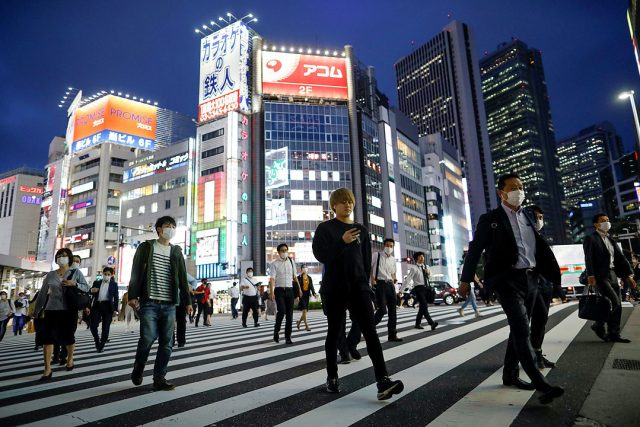
After lifting two years of on-and-off coronavirus curbs in March, the government was counting on what’s known as “revenge spending”, pent-up demand triggering a splurge that boosts consumption and a moribund economy, as has been seen in the United States, China and some other major economies.

But with energy, food and other living costs soaring — exacerbated in recent months by a sharp decline in the yen and the war in Ukraine — those hopes are fading fast.

Facing the prospect of struggling with rising prices, Japan’s famously thrifty consumers are tightening their belts even as they sit on the remains of an estimated 50 trillion yen ($383 billion) — equivalent to 9% of the economy — in “forced savings”, as the Bank of Japan calls it, accrued during the pandemic.

Some bigger companies have answered a government call to raise wages but the gains of some 2% will be swallowed up by higher prices of everything from flour, to diapers and beer, economists say.

In March, electricity prices in resources-poor Japan jumped 22% from the previous year — the most in more than four decades.

The government recently upgraded its assessment of the economy for the first time in four months, citing an expected recovery in spending, but added a caveat that the outlook was clouded.

“The chance of a ‘revenge spending’ burst is becoming smaller than we had expected,” a government official said in unusually candid remarks, noting that prospects were especially uncertain beyond the summer.

FINAL FEAST

With more than 90% of consumers saying in the latest government survey that they expected everyday goods to become more expensive over the next 12 months, economists say it is no surprise to see behavior like Ms. Takahashi’s.

In addition to accepting used uniforms for her son entering kindergarten, and venturing further in search of discounts, the stay-at-home-mum said she has switched to lower-cost private brands (PB) for mayonnaise, ketchup and other food.

She’s not alone. The share of so-called PB items for mayonnaise purchases nationwide rose to 22% in March from 18% a year earlier, according to market research firm Intage Inc. Supermarket giant Aeon Co. saw PB food sales jump 15% in the six months to February.

The “Golden Week” holiday, which began on Friday, is the first in three years without coronavirus disease 2019 (COVID-19) restrictions, and the economy should see a dramatic improvement in spending but that is likely to be the high point for consumption this year, said Daiwa Securities senior economist Toru Suehiro.

“The full-fledged impact of rising costs will emerge in the July–September quarter and later, so the Golden Week will probably be the last feast of the year,” he said.

The number of holiday travelers is expected to grow about 70% from last year, but still a third short of pre-pandemic levels, according to JTB Corp., Japan’s biggest travel agency.

The yen’s fall to two-decade lows would normally be a boon for in-bound travelers, but Japan, fearing COVID, has kept its borders closed to tourists. In 2019, almost 32 million foreign tourists contributed to the economy.

Meanwhile, the weak yen has caused pain for many companies by increasing input costs, making them just as cautious as consumers — and reluctant to raise wages.

“Prices keep rising and rising for items we can’t live without, while salaries are flat,” Ms. Takahashi said. “I’m constantly racking my brains over what I can skimp on next.” ($1 = 130.6400 yen) — Kantaro Komiya and Kentaro Sugiyama/Reuters

Russia’s Ukrainian quagmire providing tough lessons for China

REUTERS

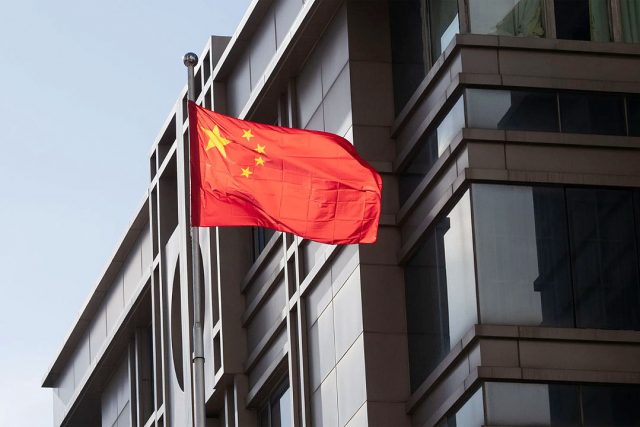
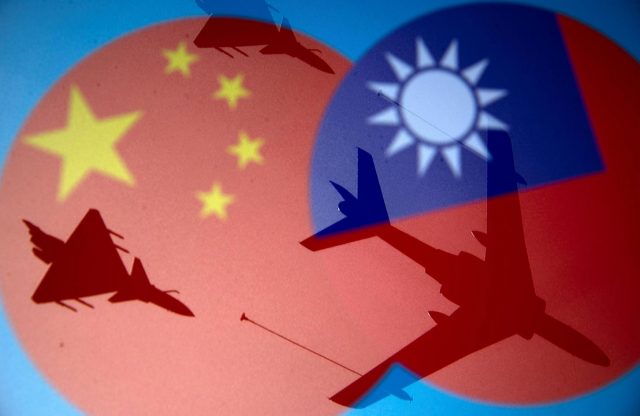
HONG KONG/BEIJING — From countering a Western “information war” during a Taiwan conflict to using “shock and awe” to swiftly subdue the island’s forces, Chinese strategists are soaking up lessons from Russia’s Ukrainian quagmire, diplomats, scholars and analysts say. 

Chinese military experts are discussing the conflict in private chat groups, offering their takes on Western involvement in Ukraine and Russia’s perceived failings, say two scholars and four Asian and Western diplomats who are in touch with Chinese strategists. 

Although their conclusions have yet to surface in official military journals or state media, Russia’s failure to quickly crush the Ukrainian military is a key topic — as are fears about how well China’s untested forces would perform. 

“Many Chinese experts are monitoring this war as if they are imagining how this would unfold if it happened between China and the West,” said Beijing-based security scholar Zhao Tong of the Carnegie Endowment for International Peace. 

Russia’s approach in the early stages of the war did not subdue Ukrainian forces, which emboldened the international community to intervene with intelligence sharing, military equipment and the economic isolation of Russia. 

“China probably should think about conducting a much stronger and much more comprehensive operation at the very beginning to shock and awe the Taiwanese forces to secure a major advantage,” Mr. Zhao said, referring to observations from Chinese strategists. 

They believe securing that advantage would “deter enemy forces from being willing to intervene,” he said. 

Singapore-based scholar Collin Koh said such an approach would create its own problems for China’s People’s Liberation Army. 

“If you are going to ‘shock and awe’ Taiwan with overwhelming force in the initial stages, there might be a lot of civilian casualties,” said Mr. Koh, of the S. Rajaratnam School of International Studies. That would make occupation difficult and harden international opposition. 

“The Chinese can’t have any illusions now that they will be welcomed as liberators in Taiwan and given supplies and assistance,” he said. 

Taiwan also has greater missile capabilities than Ukraine, allowing for pre-emptive strikes on a Chinese build-up or attacks on Chinese facilities after an invasion. 

Neither China’s defense ministry nor China’s Taiwan Affairs Office immediately responded to requests for comment. 

Russian forces invaded eastern Ukraine starting on Feb. 24, reducing towns and cities to rubble amid stiff resistance, losing thousands of troops as well as tanks, helicopters and aircraft. British officials estimated this week that 15,000 Russian troops have died; other sources suggest a higher number. 

More than 5 million people have fled after what Russia describes as a “special operation” to disarm Ukraine and protect it from fascists. Ukraine and Western governments say this a false pretext for an unprovoked war of aggression by President Vladimir Putin. 

INFORMATION WAR 

Chinese strategists also worry about how Russia is contending with indirect Western military assistance, a factor China would also face in a Taiwan scenario, say two scholars and four diplomats. 

Chinese experts are privately arguing about the need for Beijing to better compete in the so-called information war, which has complicated Russia’s position on the battlefield, Mr. Zhao said. 

Besides isolating Russia economically, Western diplomatic efforts — and reporting on atrocities in the war zone — have made it easier to provide aid for Ukraine and harder for Russia to find outside support. 

Mr. Zhao said that to Chinese strategists, one of the most important parts of the current conflict was how Western nations “are able to manipulate, from their perspective, international opinion and decisively change the international response to the war.” 

Some Chinese strategists believe that the control of information has created a much worse impression of Russian performance than is warranted. 

“There are a lot of discussions about how China needs to pay great attention to this information domain,” Mr. Zhao said. 

LOGISTICAL CHALLENGES 

Some analysts note that the Ukrainian campaign was under way long before Russian forces invaded in late February, with months of build-up on the Russian side of the border. Those efforts were easily tracked by private sector open-source intelligence firms and repeatedly highlighted by US and other governments. 

“Taiwan would present a far greater logistical challenge than Ukraine, and to ready an invasion force on that scale undetected would be incredibly difficult,” said Alexander Neill, who runs a strategic consultancy in Singapore. 

China’s military leaders also have for decades looked to Moscow for not just weapons but also structural and command doctrine. 

Russian and Chinese forces have staged increasingly intensive joint exercises in recent years, including large-scale combined arms operations in Russia in September 2020. 

Strategic assumptions from this collaboration, however, are being tested. In 2012 the PLA adopted units similar to Russian Battalion Tactical Groups (BTG) — supposedly swift, nimble and self-supporting units. But Russian BTGs have become bogged down in Ukraine and proven vulnerable to attack. 

Russia has also struggled to coordinate the involvement of several military districts in the Ukraine war. Chinese analysts worry a Chinese invasion across the Taiwan Strait — widely seen as a far greater military challenge — would face similar problems, as it requires smooth cooperation across its recently formed Southern, Eastern and Northern Theater Commands. 

Russia’s forces in Ukraine have had command breakdowns and low morale. Analysts say it’s unclear how Chinese troops — untested since they invaded northern Vietnam in 1979 — would perform in a modern conflict. 

“We’ve seen signs of alarming indiscipline from Russian troops, which is a reminder that there is so much we don’t know about how Chinese troops would perform under the pressures of war,” Mr. Neill said. “For all the political indoctrination, we just don’t know how resilient they would be.” — Greg Torode, Martin Quin Pollard and Yew Lun Tian/Reuters