
How PSEi member stocks performed — June 2, 2022
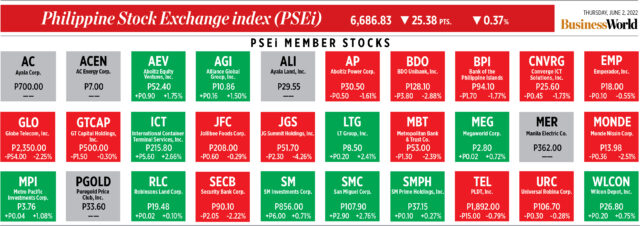
Here’s a quick glance at how PSEi stocks fared on Thursday, June 2, 2022.
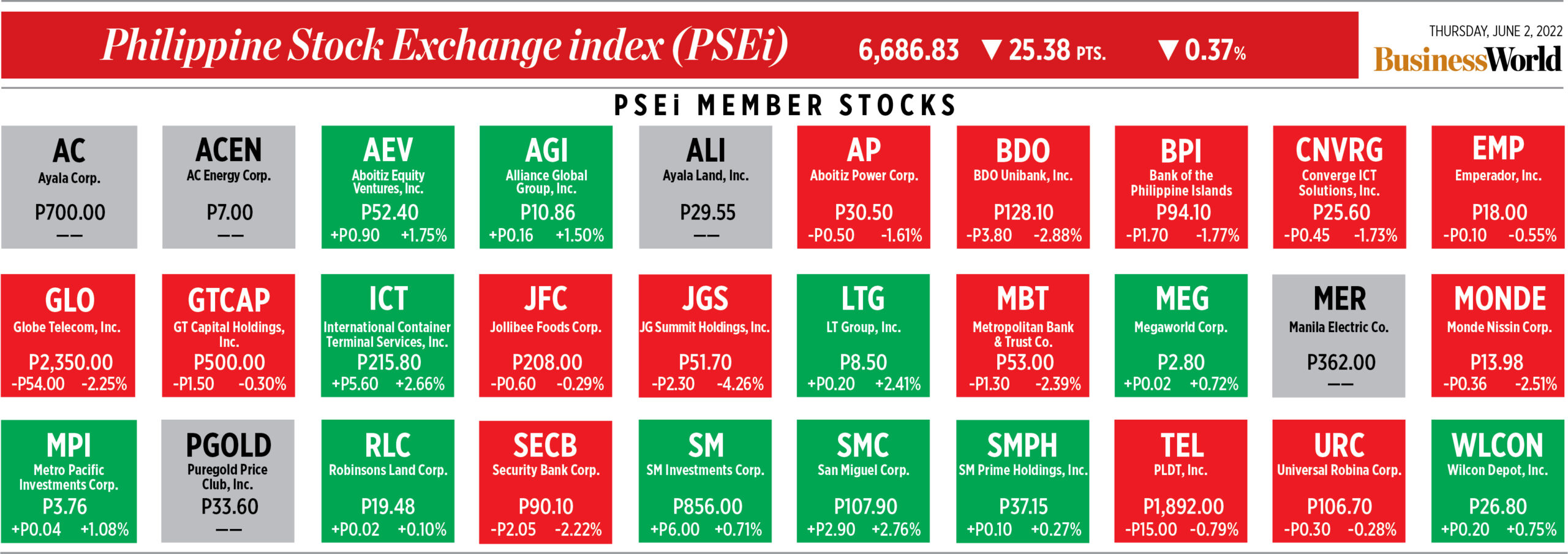

Here’s a quick glance at how PSEi stocks fared on Thursday, June 2, 2022.

THE PESO sank against the dollar on Thursday as the government’s outstanding debt ballooned to P12.76 trillion as of April and due to continued hawkish signals from US Federal Reserve officials.
The local unit closed at P52.80 on Thursday, shedding 32 centavos from its P52.48 finish on Wednesday, Bankers Association of the Philippines data showed.
The peso opened Thursday’s session slightly weaker at P52.47 against the dollar. Its weakest showing was at P52.80, which was also its close, while its intraday best was at P52.455 versus the greenback.
Dollars exchanged increased to $1.1 billion on Thursday from $724.22 million on Wednesday.
The peso weakened following the release of latest data on the National Government’s outstanding debt, Rizal Commercial Banking Corp. Chief Economist Michael L. Ricafort said in a Viber message.
The government’s outstanding debt was at P12.76 trillion at end-April, due to the net issuance of securities and a weaker peso, the Bureau of the Treasury (BTr) said on Thursday.
Preliminary data from the BTr showed outstanding debt climbed 16.1% from P10.99 trillion in the same month a year ago and by 0.7% from the March level of P12.68 trillion.
“The peso finally broke the P52.50-level today as the US Federal Reserve started its plan to unload its asset purchases this month and lingering Fed rate hike expectations,” a trader said in an e-mail on Thursday.
Stronger US economic data could also support continued aggressive monetary tightening from the Fed amid hawkish signals from Fed officials, Mr. Ricafort added.
The Fed began shrinking asset holdings built up during the pandemic on Wednesday. Traders expect it will raise rates by 50 basis points at meetings this month to make a dent in an inflation rate running more than three times its goal, Reuters reported.
San Francisco Federal Reserve Bank President Mary Daly said on Wednesday that the Fed should hike interest rates up to a level that no longer stimulates the economy.
“I see a couple of 50-basis-point hikes immediately in the next couple of meetings to get there. And then we need to look around and see what else is going on,” Ms. Daly said in a CNBC interview.
For Friday, the peso might rebound on profit taking after Thursday’s decline.
Mr. Ricafort expects the peso to move between P52.60 and P52.90 versus the dollar on Friday, while the trader expects a range of P52.65 to P52.85. — K.B. Ta-asan with Reuters
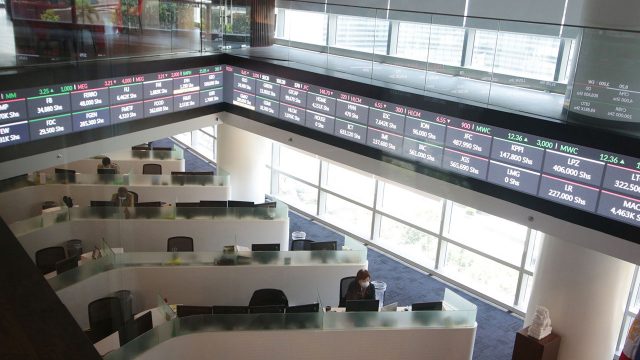
SHARES continued to decline on Thursday on concerns over rising inflation, which could cause further tightening by the US Federal Reserve, and as the Philippine Senate deferred the ratification of a key trade agreement.
The benchmark Philippine Stock Exchange index (PSEi) declined by 25.38 points or 0.37% to close at 6,686.83 on Thursday, while the broader all shares index went down by 7.99 points or 0.22% to 3,581.79.
“The local market dropped further this Thursday… as investors took cues from Wall Street’s decline overnight, driven by worries over the US economy amid the Federal Reserve’s monetary tightening. The Fed has already started with its plans to trim its balance sheet,” Philstocks Financial, Inc. Senior Research Analyst Japhet Louis O. Tantiangco said in a Viber message.
“Philippine shares traded in the red as global economic concerns continued to weigh on investor sentiment. The moves came after JPMorgan Chase & Co. chief executive Jamie Dimon cautioned that an economic “hurricane” caused by the Fed and the dragging Ukraine-Russia war is brewing,” Regina Capital Development Corp. Head of Sales Luis A. Limlingan said in a Viber message.
Mr. Dimon described the challenges facing the US economy akin to a “hurricane” down the road and urged the Fed to take forceful measures to avoid tipping the world’s biggest economy into a recession, Reuters reported.
Mr. Dimon’s comments come a day after US President Joseph R. Biden, Jr. met with Fed Chair Jerome Powell to discuss inflation, which is hovering at 40-year high.
The Fed is under pressure to decisively make a dent in an inflation rate that is running at more than three times its 2% goal and has caused a jump in the cost of living for Americans. It faces a difficult task in dampening demand enough to curb inflation while not causing a recession.
Meanwhile, Philstocks Financial’s Mr. Tantiangco added that the Senate’s deferred ratification of the Philippines’ membership in the Regional Comprehensive Economic Partnership (RCEP) caused negative sentiment.
Senators on Wednesday deferred the ratification of the RCEP, which was touted as the world’s biggest trade agreement since it represents 30% of global gross domestic product.
The majority of sectoral indices ended in the green, except for financials, which dropped by 31.39 points or 1.92% to 1,602.19, and industrials, which fell by 74.25 points or 0.80% to 9,139.53.
Meanwhile, mining and oil rose by 154.61 points or 1.28% to 12,188.47; services improved by 9.94 points or 0.53% to 1,860.49; holding firms rose by 10.27 points or 0.16% to 6,264.03; and property added 3.45 points or 0.11% to end at 3,059.11.
Decliners outnumbered advancers, 100 versus 73, while 53 names ended unchanged.
Value turnover decreased to P5.06 billion with 852.38 million shares changing hands from P5.98 billion with 659.26 million issues seen on Wednesday.
Net foreign selling went down to P318.61 million from the P552.88 million seen the previous trading day. — Luisa Maria Jacinta C. Jocson with Reuters
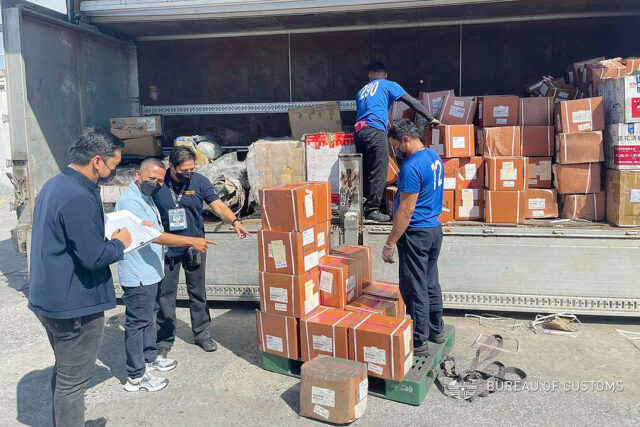
A FOOD Safety Regulatory Administration (FSRA) has been proposed that will maintain a registry of agricultural imports configures to deter smuggling.
Agriculture Secretary William D. Dar also called for strengthening border inspections to better implement the Food Safety Act.
The proposed FSRA will be tasked with enforcing the Food Safety Act, specifically to protect consumers from “trade malpractices and from substandard or hazardous products,” including smuggled agricultural goods.
“We could at least tighten institutional cooperation that allows data to be instantly accessible and the regulatory hierarchy to be defined and the procedures harmonized with those of institutions duly mandated to apprehend and sanction,” he added.
According to the law, large-scale agricultural smuggling is committed when at least P10 million worth of rice or at least P1 million worth of sugar, corn, pork, poultry, garlic, onion, carrots, fish, and cruciferous vegetables in either raw, processed, or preserved form is illegally brought into the country.
Agriculture Assistant Secretary Federico E. Laciste, Jr. has said that the Department of Agriculture (DA) estimates smuggled agri-fishery goods at P667.5 million between 2019 and 2022, of which P10 million was apprehended in 2019 and 2020.
The Bureau of Customs also conducted 542 seizure cases involving P1.99 billion worth of agricultural products since 2019.
Mr. Dar said that the department will implement other measures to counter the smuggling of agricultural goods, including the creation of a sub-task group on economic intelligence to track down smugglers, hoarders, price manipulators, and profiteers. It also plans to organize a trade office as the DA’s enforcement unit.
In 2021, the DA and the Subic Bay Metropolitan Authority signed a partnership for the establishment of the country’s first cold examination facility to implement full-scale inspections and control of goods entering via Subic Bay.
“The Food Safety Act provides for the participation of several national agencies. It would be great if DA can come into it with a more empowered role, even as we upgrade the processes of our own food safety regulatory agencies,” Mr. Dar added.
“We call upon everyone, particularly those who transact business as part of their functions at the DA regulatory agencies, to come forward if they have knowledge of any misconduct, especially of corruption, and present evidence so we can act on them with urgency,” he said. — Luisa Maria Jacinta C. Jocson

THE Financial Stability Coordination Council (FSCC) said it will move to preempt the disruptive effects of emerging systemic risks, especially those caused by any negative developments on the global scene.
In a statement on Thursday, FSCC Chairman and Bangko Sentral ng Pilipinas Governor Benjamin E. Diokno said: “The Council will always choose to be preemptive against possible systemic risks.”
The statement was released after the FSCC’s recent meeting.
“The global outlook has changed significantly downwards over the last six months, and yet our Q1 growth was a strong 8.3% year on year. This reflects the resilience of the local economy,” Mr. Diokno, who was nominated as Secretary of Finance in the incoming government, said.
The Philippines’ growth momentum “is expected to be sustained despite fluidity of markets worldwide,” the FSCC said.
The council cited the International Monetary Fund’s World Economic Outlook report for April, which estimated Philippine growth at 6.5% this year, an upgrade from its previous view of 6.3% released in January.
The estimate is below the government’s own target of 7%-9% growth for the year.
“The rest of the world is already feeling the pressure from rising fuel costs and the recent policy actions of the US Federal Reserve,” the FSCC said.
The Fed is under pressure to decisively curb inflation. Fifty-basis-point hikes at each of the Fed’s next two meetings in June and July were all signaled, Reuters reported.
Also represented on the FSCC are the Department of Finance, Insurance Commission, Philippine Deposit Insurance Corp., and the Securities and Exchange Commission. — Keisha B. Ta-asan

A SENIOR LEGISLATOR said public-private partnership (PPP) schemes for infrastructure require more attractive terms to ensure private-sector participation, and promised to reorganize the government’s offerings to help it pursue its public-works agenda in fiscally unfavorable conditions.
After a meeting with the incoming Public Works and Highways (DPWH) Secretary Manuel M. Bonoan, Albay Rep. Jose Ma. Clemente S. Salceda, who chairs the House Ways and Means Committee, said on Thursday that “PPPs stand a very strong chance of playing a major role again in this new administration.”
“We have ongoing fiscal constraints, but we also have ongoing public needs. Infrastructure and social services will always be good, and necessary investments. So, sourcing from outside the public sector will be very crucial,” he said.
Mr. Salceda said he is also in continuing discussions with SMC Tollways executives on how to develop the infrastructure and transport sector.
“I discussed with Secretary Bonoan today how I hope to help his department with sourcing the necessary fiscal space for infrastructure. It is absolutely crucial that we maintain infrastructure as a spending priority,” he said.
Mr. Salceda said the new administration’s budget should ensure productive spending that will produce multiplier effects and remain useful for longer periods of time.
He added that the growth of personnel spending in the budget must be contained.
“But we really need to expand fiscal space, either by collecting existing taxes better or by imposing new taxes,” he said, “because PPPs do entail the need for some fiscal space in the future.”
“Basically, a PPP is advancing public welfare but deferring public costs, but the costs will come,” he added.
Separately, the Move as One Coalition said on Thursday that active transport facilities on all road and bridge projects are urgently needed for pedestrians, cyclists and light mobility device users to lower the accident rate.
“We urge the government to incorporate active transport infrastructure in the P264 billion worth of DPWH (Department of Public Works and Highways) roads and bridges as required under the 2022 General Appropriations Act,” the coalition said in a statement.
Between 2019 and 2021, the Metro Manila Development Authority reported a total of 82 cyclist deaths and 4,588 injuries.
Congress has allocated P2 billion for such facilities via the Transportation department. It also included a requirement that at least 50% of road space be allocated for public transport, pedestrians, and cyclists.
Under the Local Government Support Fund Special, local governments can also use their P10.6 billion in funds to ensure better protection for bike lanes and pedestrian infrastructure, as well as improve public parks and eco-tourism parks.
“Cyclists who are the main breadwinners and who die on the road leave their families with a huge emotional and financial loss. Those who suffer injuries require surgery, physical therapy, and time to recuperate. Often, they cannot afford the medical expenses and lost income when they miss days at work,” it said.
“The Coalition believes that Filipino cyclists should arrive alive. We demand more than just thoughts and prayers from the government for the cyclists who have died on our unsafe roads,” it added. — Alyssa Nicole O. Tan

JOYRIDE Ecommerce Technologies Corp. (JoyRide), which operates a four-wheel transport network vehicle service, rejected allegations that it was charging fares beyond the approved fare structure set by the Land Transportation Franchising and Regulatory Board (LTFRB).
“JoyRide respectfully takes exception to the allegations in the LTFRB statement dated June 2, 2022 that ‘it was found that JoyRide was charging P1,000 representing one-way ride due to what is called ‘Priority Boarding Fee,’” JoyRide Senior Vice-President for Corporate Affairs Jose Emmanuel M. Eala said in a statement on Thursday.
Mr. Eala issued the statement in response to a press release issued by the transport regulator early Thursday, which was then revised in the afternoon to not single out JoyRide.
“So as not to single out JoyRide, in the new PR (press release), pinangalanan na lahat ng TNCs (transport network companies) na sinulatan ng warning versus excessive fares (all TNCs that were warned for overcharging were named),” LTFRB Executive Director Maria Kristina E. Cassion told reporters by Viber chat.
In its earlier statement, the LTFRB said that it had sent a letter to JoyRide, directing it “to submit their written explanation to the Board why their accreditation as TNC should not be suspended and/or revoked within 10 days from receipt of the show cause order.” The letter was dated May 24, 2022, the agency said.
In its revised news release in the afternoon, the agency said TNCs “have been exacting excessive fares beyond the fare structure for transport network vehicle service (TNVS) set by the Board under Memorandum Circular No. 2019-036.”
The transport regulator said the fares for the TNVS are supposed to be P40 at flag down for sedan-type TNVS, with additional charges of P15 per kilometer and P2 per minute waiting time.
Meanwhile, for premium AUV/SUVs, the flag down rate is P50 plus P18 per kilometer and P2 per minute of waiting time. Hatchback or sub-compact TNVS charge P30 at flag down, P13 per kilometer and P2 per minute waiting time.
“Based on an anonymous complaint submitted to the LTFRB, it was found that a TNC was charging as much as P1,000 representing one-way ride due to what is called ‘Priority Boarding Fee.’ The LTFRB is currently investigating the said complaint,” the regulator said.
“However, the agency saw it fit to write all TNCs warning them against the imposition of excessive fares contrary to current guidelines on TNVS fares. On May 24, 2022, the LTFRB wrote warning letters to E-pick Me Up, Ipara, JoyRide, My Taxi PH (Grab), and Cloud Panda, who are all accredited TNCs,” it added.
JoyRide’s Mr. Eala welcomed the reminder from the LTFRB with regard to the fare regulations.
“In this regard, JoyRide reiterates that its fare structure is 100% compliant with relevant LTFRB Memoranda and is fully reflected and disclosed in our app. JoyRide is cognizant of the need to be a responsible player in the 4-wheel ride-hailing space and is such, committed in (complying with) the regulations imposed by our regulator,” he said.
He also said that the company submitted on May 27 its clarification, stating that “JoyRide is compliant with the fare structure set by the LTFRB guidelines.”
“If the passenger were to book his/her ride through our app, in full transparency, it will compute a rate based on a base fare, distance, and time which follows the LTFRB guidelines,” Mr. Eala noted, citing the letter.
“Our clarification was subsequently acknowledged by the LTFRB through e-mail on May 30, 2022. No other communication or decision or any so-called findings were sent to JoyRide after that. As such, the allegations in the latest statement of the LTFRB dated June 2, 2022 shared to us by the media comes as a complete surprise to us.”
Mr. Eala said a priority fee is an “optional fee” that customers can freely add to the total fare upon booking.
“It is an industry practice in case a customer would like to tip or incentivize a driver-partner in advance.” — Arjay L. Balinbin

THE Department of Trade and Industry (DTI) said it introduced an improved version of its e-Presyo online price monitoring system.
Trade Secretary Ramon M. Lopez said during the virtual launch of the system on Thursday that e-Presyo 2.0 will provide real-time information on prices and inventory levels of basic necessities and prime commodities.
“This version of our online price monitoring system is a much better, upgraded version… This version is more efficient when it comes to data gathering and data management and in generating real-time and accurate reports,” Mr. Lopez said.
Mr. Lopez said the system was put together in collaboration with the United States Agency for International Development and University of the Philippines Public Administration Research and Extension Services Foundation, Inc.
According to the DTI, the system features a Price Monitor mobile application, which allows DTI personnel to look up suggested retail prices via mobile. The application also allows personnel to view their assigned stores for monitoring and report their data via the app.
The DTI said the system also allows participating stores to upload their products, prices, and inventory for sharing with consumers. This pricing information is accessible to consumers via the e-Presyo Consumer mobile app.
The Consumer app allows permits searches for the cheapest products or nearest stores. The app also lets consumers report overpricing by a store and to provide proof of the mispricing and location information.
Separately, Mr. Lopez said the supply of flour is adequate amid recent announcements by various restaurants that they are experiencing shortages.
“The flour itself is stocked with distributors and dealers. The supply is still there. The price will not immediately go up. It usually has a 30- to 60-day lag time before the price goes up, depending on the wheat that they use in producing the flour. The Philippines typically sources wheat from the US, Canada, Australia, and Argentina,” Mr. Lopez said. — Revin Mikhael D. Ochave

THE MARCOS family’s billions of pesos worth of unpaid estate tax is an election issue that Filipinos should move on from, according to a senator who is poised to lead the upper chamber.
“Let us move on,” Senator Juan Miguel F. Zubiri told the ABS-CBN Teleradyo on Thursday. “That is an election issue, and the election is over.”
The lawmaker, who was part of President-elect Ferdinand R. Marcos, Jr.’s senatorial slate in the election last month, earlier said Mr. Marcos had asked Congress to help him fight corruption.
He urged lawmakers to pass laws that would plug leakages and deter other anomalies in revenue-generating agencies such as the Internal Revenue and Customs bureaus.
In March, the Bureau of Internal Revenue said it sent in December a written demand to the Marcos family to settle their tax liabilities that have ballooned to more than P200 billion due to interests.
The Finance department earlier said the estate tax would be an additional source of state revenue amid surging global oil prices. Mr. Marcos has evaded questions from the media about the issue.
Critics and former government officials have urged the government to charge the Marcos family in court for failing to pay the estate tax.
Former Presidential Commission on Good Government (PCGG) Commissioner Ruben Carranza has said the son and namesake of the late dictator is aware of his family’s stolen wealth because he had been a key administrator of the Marcos estate since his father died in exile in the US in 1989.
He said Mr. Marcos was 40 years old when the PCGG discovered in 1998 the $2 million worth of assets deposited by his late father with Merrill Lynch Securities in New York in 1972 under the Panamanian corporation Arelma S.A.
Mr. Carranza said it was the son who answered questions about the contents of the dirty Swiss bank accounts.
Critics, including victims of the late dictator’s martial rule, worry that the government would never recover the ill-gotten assets once Marcos Jr. becomes president.
Meanwhile, Mr. Marcos will hold his presidential inauguration at the National Museum in Manila on June 3, his office said in a statement.
Members of the inaugural committee have inspected the area and found it to be a “suitable venue,” incoming Presidential Management Staff Secretary Zenaida Angping said.
“The National Museum of the Philippines building and its surrounding areas match our requirements for President-elect Marcos’ inauguration,” she said. “Preparations are already in full swing to ensure that it will be ready by then.”
The country’s main museum, formerly known as the Old Legislative Building, served as the venue for the inauguration of former Presidents Manuel L. Quezon in 1935, Jose P. Laurel in 1943 and Manuel Roxas in 1946.
The Marcos camp had considered two other venues for the inauguration — Fort Santiago which is a historical defense fortress in Manila built in the 1940s and Quirino Grandstand, named after the late President Elpidio G. Quirino.
Mr. Marcos’ father held his inauguration as the country’s 10th president at the grandstand in 1965.
The incoming president chose not to hold his inauguration there because it is surrounded by hospitals housing people infected with the coronavirus.
Congress on May 25 declared Mr. Marcos’ landslide victory in this year’s presidential election. It also proclaimed his running-mate Sara Z. Duterte-Carpio as the country’s next vice-president.
The tandem, who came from political clans, joined forces to secure the first landslide victory in four decades, although observers said it remains to be seen if they can stay united in the next six years.
Ms. Carpio, a top choice for president in polls conducted before the filing of candidacies, is the daughter of President Rodrigo R. Duterte, who had faced a probe by the International Criminal Court for his war on drugs that has killed thousands. — Kyle Aristophere T. Atienza

CHINA has rejected the Philippines’ protest against its yearly fishing ban in the South China Sea, saying the four-month moratorium is meant to protect marine resources in waters under its jurisdiction.
“China cannot accept the unwarranted accusation of the Philippine Foreign Ministry,” Chinese Foreign Ministry spokesman Zhao Lijian told a news briefing on Wednesday, according to a transcript posted on the agency’s website.
“The summer fishing moratorium in the South China Sea adopted by China is a normal measure of protecting marine biological resources in waters under China’s jurisdiction,” he said.
It is also a part of its obligations under international law including the United Nations Convention on the Law of the Sea, he added.
The South China Sea, a key global shipping route, is subject to overlapping territorial claims from China, Brunei, Malaysia, the Philippines, Taiwan and Vietnam.
The Philippines has released a diplomatic note admonishing the fishing moratorium that began on May 1 and is expected to last until Aug. 16.
The Department of Foreign Affairs (DFA) this week said the Philippines has “sovereignty, sovereign rights and jurisdiction” over the disputed areas. It cited a 2016 arbitral award by a United Nations (UN)-backed tribunal that voided China’s claim to more than 80% of the sea.
China has rejected the ruling, calling it null and void.
“We hope the Philippine side can view it in an objective and correct perspective, and earnestly fulfill the obligations as a littoral state of the South China Sea to jointly promote sustainable development of fishery in the South China Sea,” Mr. Zhao said.
The Philippines had been protesting China’s annual fishing ban over areas that extend “far beyond” its legitimate maritime entitlements under the 1982 UNCLOS.
“The declaration of a moratorium on fishing that extends to the West Philippine Sea has no basis in law and undermines the mutual trust, confidence and respect that should underpin bilateral relations, as affirmed most recently by President Rodrigo R. Duterte and President Xi Jinping during their telesummit on April 8,” DFA said.
The Philippines this week summoned a senior Chinese Embassy official as it accused Beijing of harassing a research vessel near the Second Thomas Shoal, which is part of the Philippines’ exclusive economic zone and continental shelf in the South China Sea.
The Philippines issued the summons on April 13 to protest the alleged bullying of RV Legend, which was conducting an authorized marine scientific research activity, by a Chinese vessel, Foreign Affairs Deputy Assistant Secretary Gonar B. Musor told reporters via WhatsApp. — Alyssa Nicole O. Tan

TWO officials of a company that allegedly sold overpriced medical supplies to the government were released from the Pasay City jail on Thursday after almost seven months.
The Senate sergeant-at-arms released Pharmally Pharmaceutical Corp. Director Linconn Ong and Corporate Secretary Mohit Dargani after Senate President Vicente C. Sotto III signed their release order on Wednesday evening, when Congress adjourned sine die, the Senate said in a statement.
At a hearing last year, the Senate blue ribbon committee asked the officials to submit documents on Pharmally’s dealings with the Budget department’s procurement service. They were cited in contempt and sent to jail after failing to produce the files.
“They have no one but themselves to blame for their continuing detention in the same manner that only their action, their compliance with just directives can pave the way for their release,” Senator Richard J. Gordon, Sr., who heads the committee, said earlier.
Mr. Gordon has presented a draft report on the body’s findings after its probe of multibillion coronavirus pandemic contracts. Only nine senators have signed the committee report, short of the 11 needed for it to be discussed in plenary.
“There is so much ballyhoo,” Mr. Gordon said in a statement. “Why create a blue ribbon committee if the Senate members will not vote?”
Senate Majority Leader Juan Miguel F. Zubiri and Senator Sherwin T. Gatchalian have said they would only sign the committee report if allegations against outgoing President Rodrigo R. Duterte were removed.
Mr. Gordon’s committee in a 113-page report said Mr. Duterte could be held accountable for siding with people involved in the deals.
It also endorsed charges against Health Secretary Francisco T. Duque III, Budget Director Warren Rex Liong, former Budget Undersecretary Lloyd Christopher Lao, former Duterte economic adviser Michael Yang and several Pharmally officials.
Senator Ana Theresia N. Hontiveros-Baraquel has said she would seek a reinvestigation in the next Congress if the report is not discussed in plenary. The body held 18 hearings over seven months. — Alyssa Nicole O. Tan

THE explosive and experienced Golden State Warriors will look to overcome the suffocating Boston Celtics defense when the teams meet what is expected to be a highly competitive National Basketball Association (NBA) Finals.
The Warriors, who are playing in their sixth Finals in eight years and who have won three titles over that span, have home court advantage and will be the more rested team after finishing off the Dallas Mavericks in five games in the previous round.
The “Dubs” could also be at full strength for Game One on Thursday. Gary Payton II, Otto Porter, Jr., and Andre Iguodala were full participants in practice on Tuesday after they all missed time with injuries this postseason.
But the team’s success will ultimately hinge on the performance of the sharpshooting “Splash Brothers” duo of Stephen Curry and Klay Thompson.
Curry has been outstanding during the first three rounds of the playoffs and Thompson, who missed two full seasons with leg injuries, is finding his three-point stroke at just the right time.
Thompson dropped a game-high 32 points to close out the Mavericks in an ominous sign for the Celtics.
The Jayson Tatum-led Celtics boasted the top-rated defense in the league this season and will have a big size advantage over the Warriors.
Defensive Player of the Year guard Marcus Smart and towering center Robert Williams will look to disrupt the Warriors pass-heavy offense every trip down the floor.
Warriors forward and defensive anchor Draymond Green said what is unique about the Celtics is the ability of Smart and Williams to cover for any lapses in coverage by their teammates.
“Robert Williams erases mistakes at the rim… and Marcus Smart covers up mistakes beneath the rim,” Green said.
“That makes for a great defense.”
But ultimately the tandem of Tatum and Jaylen Brown will need to outduel Curry and Thompson if the Celtics want to hang championship banner No. 18 at TD Garden.
Despite the franchise’s storied history in the league, nobody on this Celtics team has ever played in the Finals. But that inexperience does not worry Boston head coach Ime Udoka.
“I don’t think any of our guys are awed or intimidated by the moment at all,” Udoka said on Tuesday.
“We understand what it is. We know the opponent in front of us, and for us as always it’s been business as usual, going on the road, not fazed by that at all.”
Game One is on Thursday in San Francisco. — Reuters
