Home Blog Page 5824

BoC-Dadiangas sub-port reaches final stage of ISO-certification

THE BUREAU of Customs (BoC) on Thursday said the port of Davao’s sub-port of Dadiangas is already in the final stage of the External Quality Audit amid its bid to become the second ISO Certified sub-port in Mindanao.  

The sub-port under the supervision of the BoC-Davao office is located in General Santos City. 

“Sub-port of Dadiangas undergoes the second and final stage of the External Quality Audit on Sept. 21 by its external certifying body, Tüv-Süd where the said Port was recommended the ISO 9001:2015 Certification,” the BoC said in a press release.  

“During the process audit, auditors from TÜV SÜD, a leading certification body, assessed and reviewed the actual processes enrolled under the Quality Management System (QMS) of the sub-port,” it added.  

Dadiangasport collector, Orlando Orlino, gave assurance that all audit findings will be complied with within the set timeframe, as well as expressed support for the port of Davao’s Quality Management Unit, which is guiding the sub-port’s ISO team.  

If realized, the sub-port of Dadiangas will be the second ISO-certified sub-port in Mindanao after the subport of Iligan.  

Davao District Collector Erastus Sandino B. Austria said the BoC aims to strengthen its efforts aligned with the ISO 9001:2015 standards.  

The ISO 9001 are international standards that reflect an organization’s ability to consistently provide products and services acceptable to customers and regulators. Diego Gabriel C. Robles

DFA chief says a more sustainable global maritime sector must also improve seafarers’ welfare

DFA.GOV.PH

THE PHILIPPINESchief diplomat is looking towards a maritime sector that places more priority into sustainability and ensures inclusivity for women, according to a statement released by the Department of Foreign Affairs (DFA) on Thursday in time for the observance of World Maritime Day. 

In a speech commemorating the event, Foreign Affairs Secretary Enrique A. Manalo said achieving sustainability in the maritime industry entails enormous effort and a host of necessary actions in multiple areas of concern.”  

However, the worlds success in this regard should result in better conditions for seafarers all over the world,he added, especially for a maritime and seafaring nation like the Philippines.  

Mr. Manalo assured that the country continues to uphold its commitment to serve and protect the interests of over two million Filipino seafarers and maritime industry workers through policies and frameworks that protect their rights and welfare.  

Women in maritime will also be a recurring theme in our efforts in promoting and mainstreaming womens issues in the industry and to recognize their role in decision-making processes and skills development, and their significant contributions to the advancement of technologies and innovative solutions to address sustainability issues,he said.  

He also hopes to continue discussions on greener shipping, while affirming support for initiatives by the International Maritime Organization to harness technologies for digitalization and automation.  

World Maritime Day, established by the United Nations in 1978, aims to raise awareness about the importance of the shipping industry and its role and contribution to global commerce.  

This years theme “new technologies for greener shipping” is a call to action to support green transition for the maritime sector. Alyssa Nicole O. Tan

SSS opens assistance programs to Karding victims 

A RESIDENT near the Marikina River carried kitchen equipment as surrounding communities were ordered to flee when water reached critical levels on Sept. 25. — PHILIPPINE STAR/ WALTER BOLLOZOS

THE SOCIAL Security System (SSS), which covers private sector workers, announced on Thursday that it will extend financial assistance to its members and pensioners who were hit by Super Typhoon Karding, with international name Noru, which struck northern Philippines Sunday.   

SSS President and Chief Executive Officer Michael G. Regino said members can avail of the Loan Assistance Program (CLAP) while pensioners can tap the Three-Month Advance Pension.  

“In response to the devastation brought about by Super Typhoon Karding, we will offer these two programs in the areas to be declared under a state of calamity by the National Disaster Risk Reduction and Management Council,” Mr. Regino said.  

“We are finalizing the guidelines for these programs, and we shall release them through our website and social media channels once available,” he added.  

A loan equivalent to a member’s average 12 monthly salary credit or an amount applied for, whichever is lower, can be availed under the CLAP.  

Meanwhile, the computation for the Three-Month Advance Pension is based on the pensioner’s monthly rate.  

Super Typhoon Karding, the 11th typhoon to hit the country this year, was a category 3 typhoon that brought heavy rains and strong winds across Luzon in northern Philippines, leaving at least eight people dead, including five rescue workers. Five others have been reported missing.  

EVACUATION CENTERS
Meanwhile, Batangas Rep. Ralph G. Recto, sponsor of a bill seeking to establish a multipurpose gym in each town and city that will serve as an evacuation center, expressed optimism that the proposed measure will get priority in Congress.    

Mr. Recto, a former senator, said he has been pushing for the bill for seven years, but he is hopeful that it will move forward in the current Congress after the social welfare secretary and President Ferdinand R. Marcos, Jr. expressed support to the idea in the aftermath of typhoon Karding.   

Department of Social Welfare and Development Secretary Erwin T. Tulfo said during a briefing on Monday that it is time to designate an evacuation center for each municipality and city.   

Mr. Marcos replied that it was a good point.”  

Under the bill, the multipurpose gyms will be designed as disaster resilient structures with facilities for evacuation operations. Diego Gabriel C. Robles and Kyanna Angela Bulan 

Senator suggests provision of cash rather than equipment after DepEd laptop controversy 

SEN. ALAN PETER CAYETANO FACEBOOK PAGE

SENATOR Alan Peter S. Cayetano on Thursday suggested that beneficiaries of equipment and devices in government programs be given cash instead to purchase their own requirements, saying this could be less prone to corruption as he cited the controversy over the education departments procurement of allegedly overpriced laptops. 

Can we study if ‘KKB or kanya-kanyang bili’ is possible?he said in a statement, meaning a kind of buy-your-own scheme.   

This option will make the process simpler and faster, Mr. Cayetano said, as the government only needs to calculate and approve an amount to be given to beneficiaries.  

Beneficiaries will be required to submit a copy of their receipt along with a photograph of themselves with their newly purchased unit.  

The purpose of buying in bulk is to procure units at a cheaper price, but this is canceled out by some public officials who pocket public funds, the senator said.  

I would like you to look into and have a discussion about all of this,Mr. Cayetano told Budget Secretary Amenah F. Pangandaman whose nomination for appointment was confirmed by the upper chamber on Wednesday.  

The upper chamber has conducted four investigative hearings, in aid of legislation, on laptop purchases and scholarship fund disbursement by education agencies that were flagged by state auditors. Alyssa Nicole O. Tan 

NLEX shoots for back-to-back win in PBA Commissioner’s Cup

Frankie Lim — PHILIPPINE STAR FILE PHOTO
FRANKIE Lim won’t be making his long-awated coaching debut. — PHILIPPINE STAR FILE PHOTO

Games Today
(Smart Araneta Coliseum)
3 p.m. — NLEX vs Blackwater
5:45 p.m. — NorthPort vs Meralco

CHANGE in plans, balik-PBA Frankie Lim won’t be making his long-awaited coaching debut for NLEX today. But the goal stays the same for the Road Warriors: gun for back-to-back wins in the Commissioner’s Cup.

Chief deputy Adonis Tierra makes another pinch-hit job as Mr. Lim serves his pending suspension from his previous PBA stint in 2015 in the 3 p.m. duel with Blackwater (1-1) at the Smart Araneta Coliseum.

Mr. Lim was actually supposed to sit on the bench for the first time last Sunday versus Meralco but that game was called off due to Super Typhoon Karding. As such, the suspension carries over to their next game, per Commissioner Willie Marcial.

Mr. Tierra, who led the NLEX to a 96-90 win over its former mentor Yeng Guiao and Rain or Shine last Wednesday, said Mr. Lim’s imprint will already be on the way they play.

If they get the desired result, the Road Warriors will not only draw level with Bay Area Dragons (2-0) at the summit but also build momentum before Mr. Lim starts calling the shots on Oct. 8 against Phoenix.

Looking to throw a wrench on NLEX’s plans are the Bossing, who are back on track after opening the tournament with a 46-point beatdown from the Dragons. With Baser Amer, import Cameron Krutwig, and recent trade acquisitions Troy Rosario and Gab Banal providing the heroics, Blackwater secured a 97-85 bounceback verdict over the Fuel Masters Saturday.

“We really got embarrassed last game (versus Bay Area). That woke us up,” said Blackwater mentor Ariel Vanguardia. “But we’re still a work in progress in terms of chemistry.”

Meanwhile, Meralco opens its campaign in the mid-season tournament against NorthPort (1-1) in the 5:45 p.m. main match.

The Bolts brought in former NBA player Johnny O’Bryant to plug in the hole in the paint as they continue their chase for a franchise breakthrough after narrowly missing a finals stint in the last All-Filipino.

They shoot for a winning start against the Batang Pier’s new-look crew of holdovers Robert Bolick, Arwind Santos and Roi Sumang, second-time import Prince Ibeh and new arrivals Arvin Tolentino, Jeff Chan, Prince Caperal and Kent Salado.

This fresh combo has shown lots of promise in leading NorthPort past Phoenix, 92-89, and pushing the Dragons to the limit before conceding a close 105-104 loss on a Myles Powell buzzer-beating triple. — Olmin Leyba

Undermanned Letran battles age-old rival San Beda

NCAA/SYNERGY/GMA
FRAN Yu would have to steer the Knights wheel one more time. — NCAA/SYNERGY/GMA

Games Today
(Filoil EcoOil Centre)
12 p.m. — Mapua vs JRU
3 p.m. — Letran vs San Beda

FOR the past two games, Fran Yu has been manning Letran’s ship with aplomb.

But with two of the Knights’ vital cogs out due to suspension, Mr. Yu would have to steer the wheel one more time.

Mr. Yu would have to step up even more as a Letran team minus starters Brent Paraiso and Louie Sangalang tackles age-old bitter rival San Beda today in the NCAA Season 98 at the Filoil EcoOil Centre.

The scrappy skipper had a Herculean effort in their last two games, unleashing 15 points, five assists, four rebounds and three steals in a bruising 67-62 win over the Mapua Cardinals Tuesday and 12 points, nine boards, five dimes and six swipes in an 81-75 win over the College of St. Benilde Blazers a week ago.

A win for the three-peat-seeking Dominican school would catapult it back to the top alongside idle CSB and Lyceum of the Philippines University on identical 4-1 records.

For San Beda, which is currently in a logjam at No. 5 with San Sebastian and University of Perpetual Help on 2-2 slates, it would barge into the magic four with a win in their 3 p.m. showdown.

It might help the San Beda Lions a bit that the sharp-shooting Mr. Paraiso and the energetic, bulldozing Mr. Sangalang would serve their one-game suspension slapped by league commissioner Tonichi Pujante for their unsportsmanlike play last game.

Mr. Paraiso got the boot after he hit Mapua’s Adrian Nocum dangerously on the nape that resulted to a disqualifying foul while Mr. Sangalang was ejected due to two technical fouls for taunting.

Now it will be up to Mr. Yu to take charge again.

Mapua (1-4), a runner-up a season ago, aims to come out of a rut while Jose Rizal U (2-2) shoots for a third win in row as they square off at 12 p.m. — Joey Villar

UP Maroons’ Tamayo seen as favorite to win Most Valuable Player award

UP FIGHTING Maroons’ Carl Tamayo — THE UAAP

WITH an expected leap from his national team stint, Carl Tamayo looms as the favorite to win the Most Valuable Player (MVP) plum when University of the Philippines shoots for a successful title defense in the UAAP Season 85 firing off tomorrow.

Mr. Tamayo, fresh from consecutive international stints with Gilas Pilipinas, has been declared by coaches to be at the forefront of the UAAP MVP derby with La Salle’s Mike Phillips and reigning MVP Ange Kouame of Ateneo in the mix.

But as huge of a feat it would be for the versatile 6-foot-7 cager only in his second year, ensuring that the UAAP crown stays in Diliman remains his lone, ultimate goal over any possible individual recognition.

“The goal is just to win the championship all the time, that’s the only goal,” vowed Mr. Tamayo after being hailed as Season 84’s Rookie of the Year.

Mr. Tamayo last season took the UAAP by storm with averages of 13.0 points, 7.5 rebounds, 1.5 assists and 1.3 steals to win the ROY award and a Mythical Five citation as UP dethroned Ateneo for its first title in 36 years.

This year, those numbers are expected to only increase following a fruitful trip with Gilas in the 2022 FIBA Asia Cup and the fourth window of 2023 FIBA World Cup Asian Qualifiers, which he’s hoping to carry over to the UAAP.

Tamayo’s meteoric rise also led to some rumors that he might be the next rising star set for an overseas stint but for now, the Cebu native assured that he will play nowhere else but in Diliman.

“I’m just focusing on UP, trying to help the team to win the championship again. I’ll never close my door to play abroad. But for now, I’m here in UP, to play in UP,” he vowed as UP opens its campaign against La Salle tomorrow. — John Bryan Ulanday

New York Yankees slugger Aaron Judge matches AL record with 61st home run

AARON JUDGE — REUTERS

YANKEES slugger Aaron Judge tied the American League (AL) home run record when he socked his 61st of the season on Wednesday night in New York’s road game against the Toronto Blue Jays.

Mr. Judge hit a two-run shot against Blue Jays left-hander Tim Mayza in the seventh inning, giving the Yankees a 5-3 lead. The blast to left also scored Aaron Hicks, who led off the inning with a single.

He pulled level on the AL single-season homer list with Roger Maris, who hit 61 for the Yankees in 1961. The only other AL player ever to hit 60 in a season was Babe Ruth, who had 60 for the Yankees in 1927.

Roger Maris, Jr., the former slugger’s son, and Patty Judge, the current star’s mother, shared an embrace in the first row of the stands after No. 61 cleared the fence.

Mr. Judge said after the Yankees’ 8-3 win, “It’s an incredible honor, getting a chance to be associated with one of the Yankee greats, one of baseball’s greats, words can’t describe it.

“That’s one thing so special about the Yankees organization, is all the guys that came before us and kind of paved the way and played the game the right way, did things the right way, did a lot of great things in this game and getting a chance to be mentioned with those guys now is, I can’t even describe it, it’s an incredible honor that’s for sure.”

Mr. Judge, 30, had gone homerless in seven consecutive games since hitting his 60th against the Pittsburgh Pirates on Sept. 20. He finished the Wednesday game 1-for-4 with a walk.

Regarding the record-tying blast, Mr. Judge said, “When I hit it, I thought I got enough, but it’s been a couple of games since I did that, so you never really know if it was going to get out or, so, I tried to sprint around the bases a little bit then once it got over the fence, just relief that now we’re leading the game.

“Getting a chance to tie Roger Maris, you dream about that kind of stuff, it’s unreal.”

The all-time single-season record is 73, set by the San Francisco Giants’ Barry Bonds in 2001. Sammy Sosa topped 60 three times for the Chicago Cubs from 1998-2001, and Mark McGwire exceeded 60 for the St. Louis Cardinals in both 1998 and 1999.

The Yankees have seven regular-season games remaining after Wednesday. — Reuters

LeBron James firm buying a major league pickleball team

FOUR-TIME NBA champion LeBron James is getting into the pickleball business, as his firm LRMR Ventures headlines a new ownership group buying a team with Major League Pickleball (MLP).

The four-time NBA MVP is joined by fellow basketball greats Draymond Green and Kevin Love, as well as investment firm SC Holdings and others, the elite North American league said on Wednesday.

MLP founder Steve Kuhn said the investment would be instrumental in helping the league achieve its goal of reaching 40 million pickleball players by 2030.

Pickleball is a fast-paced paddle sport with similarities to tennis, though played on a much smaller court with a net using a perforated plastic ball.

MLP is expanding its league to 16 teams from 12 and is due to wrap up its 2022 season in Columbus, Ohio next month.

Mr. James’ business partner Maverick Carter told CNBC that the sport’s community and “capacity to be both fun and competitive” were motivating factors in the deal. — Reuters

Sendoff fit for a king

Longtime tennis habitues know injuries have been part and parcel of Roger Federer’s campaigns on the back end of his career. The last decade, in particular, is littered with long absences from competition off necessary surgeries and compelled convalescence. It’s why he failed to claim any Grand Slam titles after Wimbledon in 2012 and heading into the Australian Open in 2017. It’s also why the next year was his last great one, and why the remainder simply proved to be a stepping stone to retirement.

True, Federer wanted to extend his stay at the top of the sport. He could have chucked his racket in the closet at anytime during his hobbled years and still been assured of his spot as the greatest player tennis has ever produced. True, major championships do count in the assessment of many, and, in this regard, Rafael Nadal and Novak Djokovic — currently at 22 and 21 with more likely to come — trump his single score aggregate. Then again, there can be no doubting his status as the best of the best of all time.

Needless to say, the writing on the wall had already been clear to Federer for a long while before he formally hung up his sneakers. As he would explain, however, he used the prospect of returning to the court at 41 as motivation to recover from yet another bout with the scalpel. Even as he held out hope, he understood that he was done. And so he prepared for his valedictory, with, as things turned out, the Laver Cup serving as the perfect venue.

Considering his accomplishments, Federer arguably deserved a better exit. A fairy-tale ending would have had him winning his doubles match alongside noted rival and good friend Nadal. Instead, they lost a close one, and, ultimately, the team-based competition itself. That said, he is universally beloved for a reason, and the crowd — and, significantly, his peers — in London couldn’t care less what the scoreboard reflected. They gave him a sendoff fit for a king, capped by a prolonged standing ovation with not a dry eye in the house. Which was why he left with happy tears, his heart full and place in history secure.


Anthony L. Cuaycong has been writing Courtside since BusinessWorld introduced a Sports section in 1994. He is a consultant on strategic planning, operations and Human Resources management, corporate communications, and business development.

Delivering on business and consumer expectations

There was clear convergence among the three major international financial institutions (IFIs) in terms of the Philippines’ growth prospects for 2022. True, the International Monetary Fund (IMF) slightly downgraded its prognosis but both the World Bank and the Asian Development Bank (ADB) actually upscaled their forecasts. The three institutions were one in estimating that the Philippine economy will grow by 6.5% this year. The outlier is the Singapore-based ASEAN+3 Macroeconomic Research Office (AMRO) that topped the three IFIs’ common forecast, by elevating its April forecast of 6.5% to 6.9%.

Except for AMRO’s, the growth forecasts of the three intersect the Philippines’ official target of 6.5-7.5% at its tail.

It is quite interesting that despite the directions of their updates, they all collapsed into one single growth rate.

They have their own reasons. The IMF is worried that the potential recession in the United States and China could affect local conditions. Such global shocks could come from reduced external trade with both countries such that the country’s growth momentum in the first half of the year is likely to slow down. For the World Bank, the sentiment is very bullish because of accommodative fiscal policy that is expected to recover domestic demand. For the ADB, the easing of mobility restrictions is expected to motivate a rebound in domestic demand and business activities. Like the ADB, AMRO holds that the growth driver is the reopening of the economy. Infrastructure projects will be key to investment demand.

But what is happening on the ground?

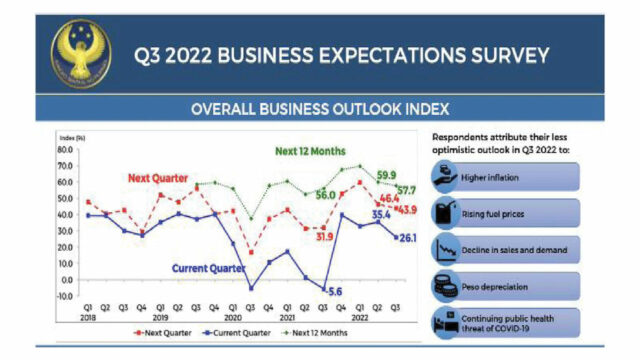
Based on the Bangko Sentral ng Pilipinas’ (BSP) Business Expectations Survey (BES) for the third quarter of 2022 conducted between July 6 to Aug. 15, overall business sentiment dropped for the same quarter, next quarter, and the next 12 months.
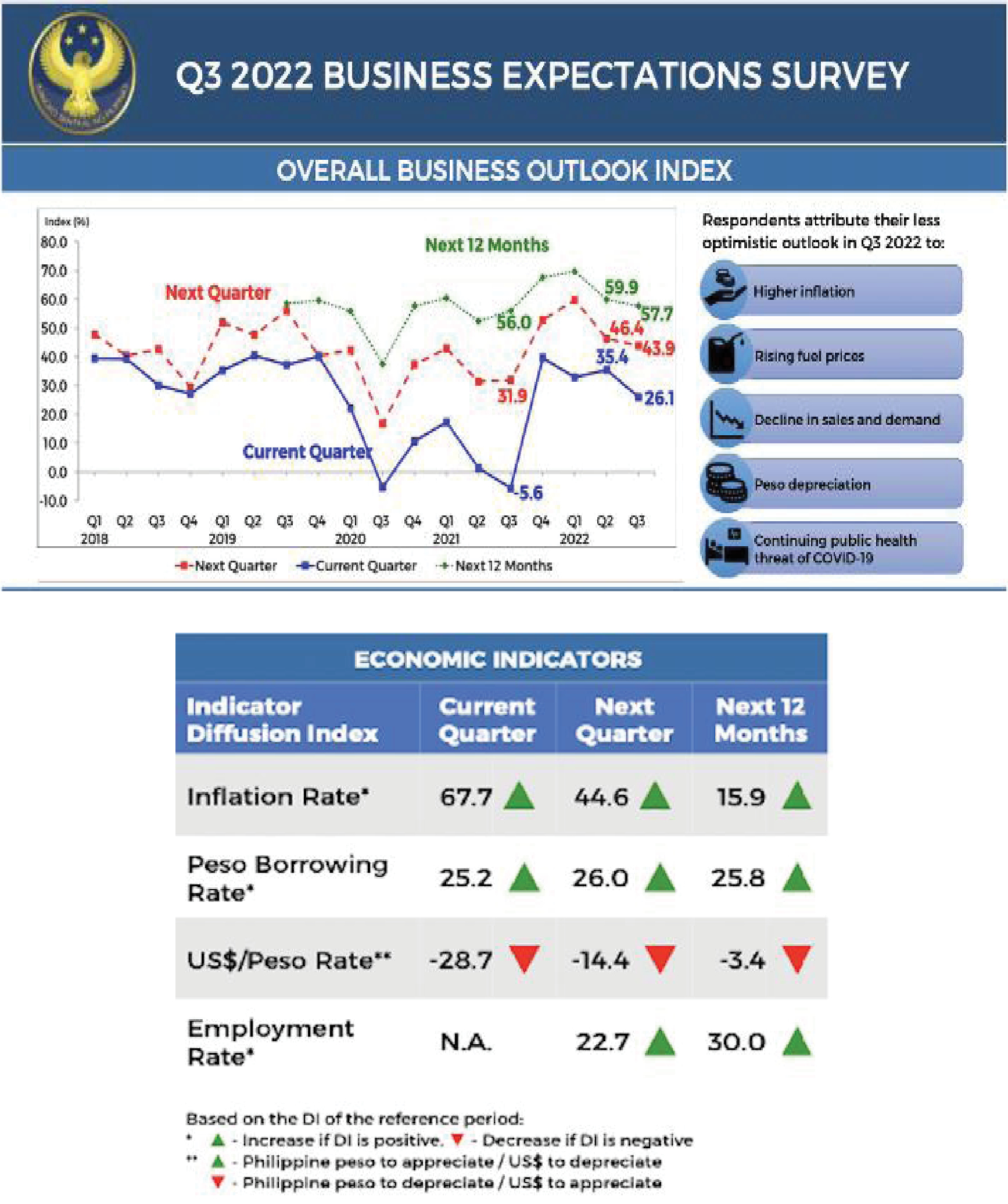
This quarterly survey has been reliable in terms of the representativeness of its sample as well as the reasonable correlation between business sentiment and actual economic growth. Loosely, the results may be considered good predictor of economic growth. If we take the BES as a proxy for gross capital formation in the national income accounts, it covers 25% of total gross domestic product (GDP). The BES is useful for planning purposes because the actual national income accounts are available only after more than two months from the subject quarter.

Respondent firms are drawn at random from the list of Top 7,000 corporations ranked based on total assets. The BSP represents in its regular survey results that BES provides “advance indication of the direction of change in overall business activity in the (Philippine) economy and in the various companies’ operations as well as in selected economic indicators.”

If the third quarter 2022 BES results point to the south, these may not be exactly positive for the Philippines’ actual GDP numbers. The respondents explained their less optimistic sentiment in terms of five factors: one, higher inflation of consumer goods, services, raw materials and production costs; two, rising fuel prices; three, decline in sales and demand; four, peso depreciation; and five, continuing public scare of COVID-19.

Less optimism or more pessimism appears to be the more prevailing sentiment across the global economies. This spirit is pervasive because of the risk of recession on account of an unprecedented rise in inflation and the subsequent monetary tightening by central banks all over the world. Undue rise in consumer prices destroys the public’s purchasing power and disincentivizes business from expanding the scale of their operations and hiring more workers. This is how poverty and inequality are birthed and intensified.

China, Croatia, France, Germany, Greece, Hungary, Mexico, South Korea, and the United States also reported less optimistic business sentiment for the same quarter. While business sentiment was more optimistic in Australia, Bulgaria, Israel, and the Netherlands, it turned pessimistic in Brazil, Canada, and Thailand and more pessimistic in New Zealand and the United Kingdom.

For the fourth quarter 2022, Philippine businessmen were less optimistic about the prospects of doing business. The reasons are basically of the same cut: rising prices of relevant commodities; lower demand/sales of construction materials and medicines; higher fuel prices; weaker peso and higher interest rates; and the usual decline in business due to the rainy season.

What about the business prospects for the next 12 months?

As the chart shows for the two more forward-looking periods of reckoning — next quarter and the next 12 months — business sentiment is expected to trend lower. If we invoke the correlation between business sentiment and actual GDP, the slowdown of real GDP from the first to the second quarter might continue in the third quarter of this year and for the next 12 months. Those factors behind the weak business sentiment are just too overriding. In fact, for the next 12 months, business respondents also added the burning issue of “shortage in (the) supply of food and raw materials” like fuel and construction materials.

On specific business operations, the sentiment is discouraging. Firms expect their financial condition and access to credit to be tighter, showing an actual decline. The BSP noted in its report that this specific finding was consistent with the second quarter Senior Bank Loan Officers Survey (SLOS) which indicated “an expectation of a net tightening of overall credit standards for loans to enterprises for the third quarter 2022.”

For the fourth quarter 2022, the employment outlook looks dim. A decline was reported even as the prospects for the next 12 months are more optimistic. Among the business constraints were stiff domestic competition and insufficient demand.

All told, business respondents expect a weak peso, and higher borrowing and inflation rates for the third quarter. Their inflation rate expectation of 5.6% for the whole year 2022 coincides with the latest BSP forecast. While the average exchange rate expectation of P55.2 for the year is weaker than the emerging P53.02 for the first nine months of the year, for business purposes, the prevailing exchange rate might be more relevant considering that their operations are forward-looking. It is likely that the last quarter of the year could see the peso averaging at least P57 to a dollar.

The other quarterly BSP survey covers the consumers as respondents. This is also an important survey because it gives us a glimpse of things to come from the consumption side of economic growth. Household consumption accounts for more than 70% of total GDP and therefore is the one big important driver of overall business activities. Consumer respondents are a random sample of some 5,000 households all over the Philippines.

The consumer outlook is based on three components namely, economic condition which captures their perception of the economic situation; family financial situation which covers the household income level, savings, debts, investment, and assets; and family income which includes primary income and receipts from other sources.

There is bad news and good news from our consumer expectations survey.
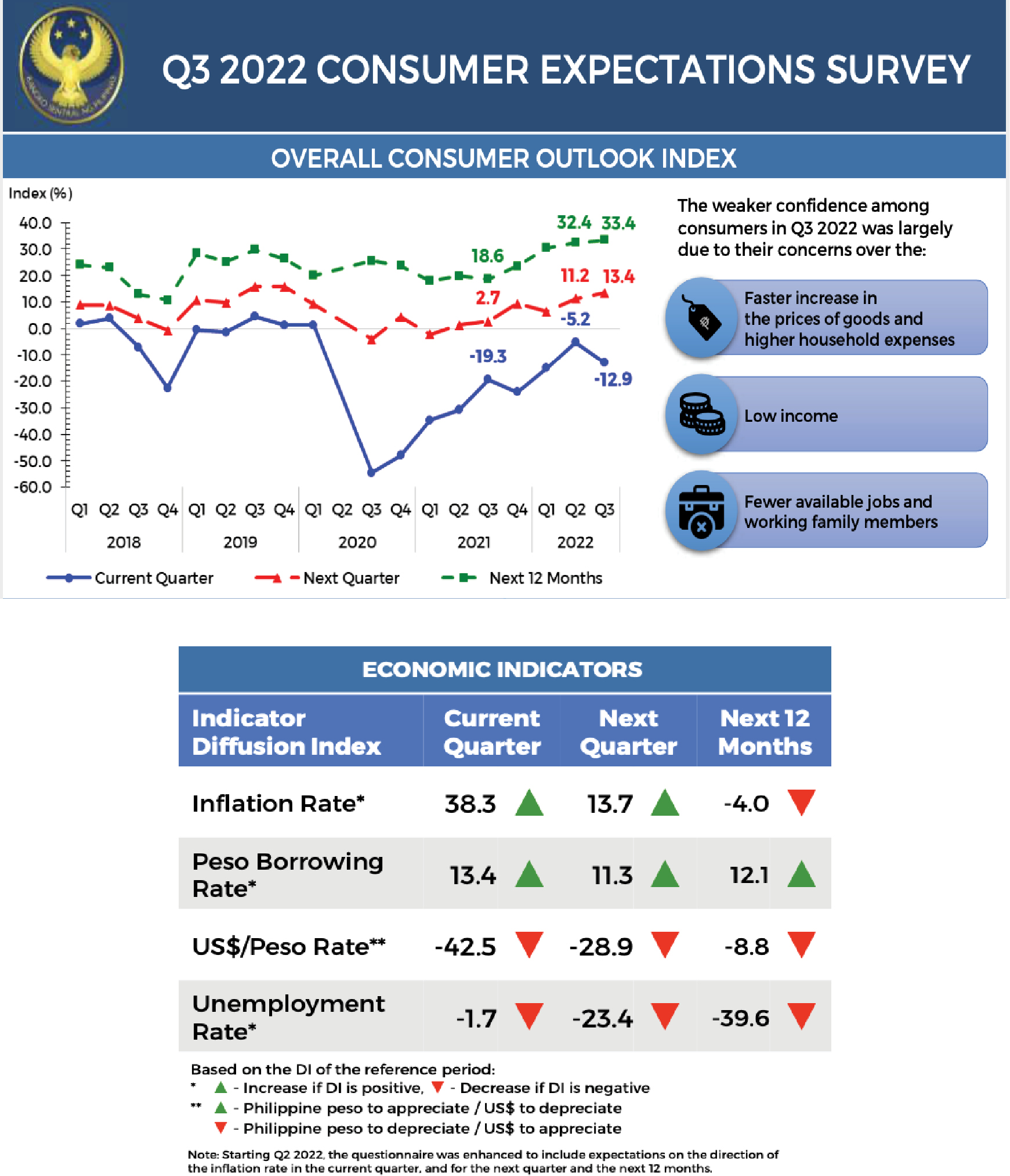
Bad news is the current quarter sentiment which turned more pessimistic as the index turned more negative, from -5.2 to -12.9. The reasons behind such pessimism are quite analogous with those of their business counterparts: higher inflation and household expenses; lower income; and limited job opportunities.

More countries also reported the prevailing negative sentiment for the third quarter particularly Australia, the Czech Republic, Finland, France, Italy, Japan, South Korea, Switzerland, and Taiwan.

The good news is that for the next quarter and 12 months, the consumer outlook index indicates more optimistic sentiment, being positive and rising. Consumer respondents point to more jobs, additional income, good governance, good public policies, and financial assistance.

It is also useful to know the consumers’ expectations about key economic indicators. For all the reckoning periods, they expect unemployment to decline — meaning, output growth could rise; interest rates to increase; and the peso-dollar rate to depreciate. As expected, households believe that inflation may rise this quarter and the next, breaching the official target of 2-4%. Inflation, however, is expected to ease in the next 12 months. This is consistent with the current BSP forecasts of 5.6% for this year and 4.1% next year although both are in excess of the target.

It will be a big challenge to deliver on this favorable household sentiment because the underlying assumptions require effective government policies, sufficient supply of goods and services, and stable health conditions. While IFIs could take the extra mile of encouraging their member countries to pursue sensible policy and structural reforms, it is our own political leaders and their economic managers who have the mandate to make things happen, and convert those conditional propositions of economic growth with price stability to reality.

True, Nobel laureate in Physics Niels Bohr was once quoted to have said “Prediction is very difficult, especially if it’s about the future.” For this very reason, it would be best for those in authority to take on Peter Drucker’s challenge that “the best way to predict your future is to create it.”


Diwa C. Guinigundo is the former deputy governor for the Monetary and Economics Sector, the Bangko Sentral ng Pilipinas (BSP). He served the BSP for 41 years. In 2001-2003, he was alternate executive director at the International Monetary Fund in Washington, DC. He is the senior pastor of the Fullness of Christ International Ministries in Mandaluyong.


On the Philippines’ ‘fake news’ problem

FREEPIK

Senator Jose Pimentel Ejercito, Jr., more widely known as Jinggoy Estrada, has filed a bill (Senate Bill No. 1296) that would amend the Cybercrime Prevention Act of 2012 (Republic Act 10175) to include “fake news” among the many offenses the Act penalizes.

The Estrada bill defines “fake news” as “misinformation and disinformation of stories (sic) which is (sic) presented as a (sic) fact, the veracity of which cannot be confirmed, with the purpose of distorting the truth and misleading its (sic) audience.”

The grammatical lapses of its “definition” are not the only infirmities of the latest bill criminalizing the dissemination of false information.

The use of the term “fake news,” is one. It was popularized by former US President Donald Trump and his minions in their tirades against the media. But the phrase is an oxymoron — a contradiction in terms.

If a piece of supposed information is false, it is not news; and if it is news, it is by definition accurate. For instance, if not verified, a newspaper account that claims that University of the Philippines students are being recruited by New People’s Army agents among the staff is not “fake news”; simply false information. But another report that the Department of Health has declared residents of the National Capital Region as once again at moderate risk of COVID-19 infection would be news if its accuracy has been established through interviews, documentation, and those other means available for journalists to confirm the truthfulness of their reports.

The “fake news” oxymoron has nevertheless been legitimized in public discourse among other reasons because it has been used in the US and elsewhere to attack the media as supposedly deliberate purveyors of false, misleading, or distorted information.

The media, whether old (print, television, radio, film) or new (online news sites, blogs, social media), do at times fall short of providing accurate and meaningful information on issues and events of public concern. In some instances, as we saw during the last campaign and election, they do so intentionally in behalf of advancing a pre-determined end such as convincing their audiences that they should support this or that candidate. But it is also true that many media practitioners exert every effort to get at the truth and to report it despite such difficulties as being barred from covering a public event or even being threatened with physical harm.

The problems with anti-“fake news” legislation is that of distinguishing between the first and the second, as well as between deliberate misinformation or disinformation and an error committed in good faith — information which turns out to be false but which the media practitioner thought was accurate.

It is in determining which is which that things become problematic. Under the provisions of RA 10175, and those of previously proposed anti-“fake news” bills, fabricating and spreading false information would be punishable with huge fines and even long prison sentences. Preventing the Act’s being unjustly used against journalists and other communication professionals will require both a complainant and an enforcing agency to establish, through documentation and consultation with experts among others, the truth or falsehood of, say, the claims of a blogger or an online news site.

Whether the alleged offense was deliberate or not is even more difficult to determine. But the Estrada bill’s definition of that dubious “fake news” phrase assumes bad faith in every case of misinformation or disinformation. That much is evident in its declaring that every such incident is “with the purpose of distorting the truth and misleading its (sic) audience.”

Already weaponized against free expression and press freedom, the 2012 Cybercrime Prevention Act would be even more repressive if “fake news” as defined by the Estrada bill were to be added to the list of offenses the Act penalizes.

That it is government — whether the Philippine National Police, the Department of Justice, the Office of the Press Secretary or any other agency — that will most likely claim that a report that puts it in a bad light is false is even more dangerous to free expression and press freedom.

Government and its instrumentalities have used RA 10175 in their attempt to silence not only critical reporting but even truthful coverage of government affairs. Adding the prerogative of prosecuting groups and individuals for supposedly generating and spreading false information to the vast powers of government will make the already difficult and even dangerous journalistic enterprise more uncertain, and will have a devastating impact on the people’s right to know what is going on in the government to whose officials they have delegated their sovereign powers. Any law penalizing the making and spreading of false information will, for the above reasons, more likely be part of the misinformation and disinformation problem rather than part of the solution.

Like the many attempts in this country to legislate it out of existence (the Estrada bill was preceded by two other similar attempts in Congress), manufacturing and spreading false information is neither new nor rare. Neither has its impact on human affairs ever been beneficial. More than a hundred years ago, for instance, many Americans’ support for the Spanish-American War of the late 19th century, which among other consequences led to the US occupation of the Philippines, was at least partly encouraged by the false claims of the William Randolph Hearst and Joseph Pulitzer tabloids then that Spain had blown up the battleship USS Maine while it was docked at Cuba’s Havana Harbor.

More recently, in 2003 a majority of the US population supported the invasion of Iraq on the basis of the disinformation that it had weapons of mass destruction and was protecting Osama bin-Laden’s Al-Qaeda terrorist group. That invasion cost over 100,000 civilian and military lives and led to the perennial instability and regression of what was previously one of the more developed countries in the Middle East.

But the problems of disinformation have since been multiplied by the trolls and keyboard armies funded by political and economic interests as well as by those well-meaning but untrained individuals who recklessly upload unverified information and who share them with innumerable others.

The resulting crisis in information has thus become a major factor in the further decline of citizen understanding of the issues and events around them, thereby contributing to the ascendancy in many countries of the authoritarianism that flourishes in mass ignorance.

The antidote to false information, however, is not the enactment of laws that will worsen rather than remedy the problem, but in educating the media audiences on how to distinguish between false and accurate information as well as on responsible Netizenship.

Some media organizations are themselves already so engaged. They fact-check themselves and each other, and provide their audiences information on how they can distinguish false accounts from the true, in addition to improving Netizen capacity to critically read social media and online blogs and news sites.

But the involvement of the educational system is even more vital in this crucial undertaking. Instead of focusing on restoring mandatory military training and appropriating millions in “confidential funds” to monitor the alleged terrorist infiltration of public schools, the Department of Education could more wisely spend its budget on improving its severely inadequate media literacy programs at the basic education level, which have been mostly limited to teaching students the use of video and still cameras. Unfortunately, that has never been, and still seems to be farthest from, the priorities of the Department.


Luis V. Teodoro is on Facebook and Twitter (@luisteodoro).

www.luisteodoro.com

ADVERTISEMENT
ADVERTISEMENT