Home Blog Page 5795

Helping hand came to ailing track and field legend Lydia de Vega-Mercado

AILING track legend Lydia de Vega-Mercado is not alone in her lonely battle with cancer.

Philippine Olympic Committee president Abraham “Bambol” Tolentino yesterday has joined the caravan of generous people who are providing assistance to the debilitated former Asian sprint queen, who is reportedly in critical condition due to Stage Four breast cancer.

The mayor from Tagaytay and PhilCycling chief yesterday said he will donate P100,000 from his personal money to help defray the cost of Ms. De Vega-Mercado’s growing medical expenses.

“We will give it straight to the hospital,” said Mr. Tolentino.

The much-needed helping hand came a day after Ms. De Vega-Mercado’s daughter, Stephanie De Keonigswarter, sounded the alarm and made the announcement on her Instagram and Facebook accounts of the sad plight of her ailing mother with  Stage Four breast cancer.

The Philippine Sports Commission (PSC) has also extended a helping hand upon the instruction of President Ferdinand Marcos, Jr.

“We were told by the President to extend the necessary assistance,” said PSC executive director and officer-in-charge Atty. Guillermo Iroy, Jr.

And there is fervent hope that more will come. — Joey Villar

When a CEO is in conflict with the HR manager

I’m the human resource (HR) manager of a small factory with 361 workers, including 249 workers from five separate manpower agencies and labor cooperatives. About 90% of these temporary workers have been with us for more than five years. I recommended to our chief executive officer (CEO) that we gradually convert their status to regular employees as they are doing jobs that are critical to our business. The CEO rejected my idea. How do I manage the situation? — Lonely Star.

Let the CEO who has the greater responsibility over the factory and its policies decide. After all, he’s being paid to make unpopular decisions as long as they redound to the overall advantage of the organization. You can’t go against it unless you leave your current employ for another company that is in syncs with your personal ethics and values. That means you may have to bear with the situation for few more months, maybe years.

While you’re at it, remain positive and pray that your concerns will be resolved sooner than later. Relax and reflect. And rediscover what you can do best next time to improve your success rate with the CEO.

In the meantime, take it in stride. Don’t let this situation affect your work. “The best way to take failure and rejection is to wallow in it,” says Bernie Brillstein in The Little Stuff Matters the Most (2004).

That includes the challenge of actively looking for a new job. Leaving the company is not disloyalty and there’s no reason to feel bad about it. If your ideas are not compatible with top management’s, then accept it. One caveat though: Keep your disagreement with the CEO secret. Don’t discuss it with your colleagues or workers in your department.

IMPERATIVES
It’s not enough that your opinion be founded on personal values and ethical standards. You must go beyond that. At the same time, it is unrealistic to set aside one’s beliefs for the sake of keeping your job. Your opinion will not lose its efficacy just because it was rejected by your boss.

Next time, if you find yourself in the position of having to make a similar recommendation, ensure that you gain the upper hand by taking the following steps:

One, find out what the prevailing best practices in the industry are. Conduct a survey with other organizations of similar size, staffing levels, and compensation policy. It may be a challenge to pry out pay and perks policies, which are basically confidential.

But not if you can settle for general information like the minimum or maximum ranges for certain key jobs. This means being upfront with the kind of information that you can truthfully provide to survey participants and make it easy for them to understand your goals.

Two, seek a legal opinion from at least two reputable lawyers. You can’t go wrong if your recommendation is backed by the opinions of labor-management attorneys. If you don’t have a budget for that, you can do research on Supreme Court decisions and analyze rulings involving excessive hiring of contractual workers.

The rulings apply the so-called four-point employment test. The four points are: the workers’ selection of engagement, payment of their salaries and benefits, employer’s power of control over production methods and the power of dismissal. Note that management can lose its case once employees prove only two out of these four points.

Related to this test is the law against labor-only contracting.

Last, prepare a cost-benefit analysis to support your proposals. What could the factory lose if your company perpetuates the hiring and firing cycle when engaging agency workers? Remember that the Supreme Court has ruled against a multinational company due to its overuse of temporary workers, and ordered it to pay millions in damages and penalties.

More than the money, what about the company’s reputation? What would it gain in the short term? How about the motivational level of these workers compared to the regulars? What about productivity losses? There are more issues at stake.

INNER COMPASS
The bottom line is: Don’t be afraid to make recommendations as you see fit, even if others think it’s wrong. Don’t be a person without an opinion. You need to do a lot of active listening. Ask questions to discover the rationale behind everything.

Don’t be a yes man or a yes woman. Be frank with everyone, including your boss. But do it professionally and respectfully. If you don’t agree with management policy, back your opinions up with evidence and conviction.

Use the inner compass that you rely on to tell you when things are not right. When the boss does things that raise red flags, make allowance for the possibility that he may change his mind should you present an unassailable argument.

Put your detailed proposal in writing, but keep it confidential. This will protect you from being blamed later on.


Consult with Rey Elbo on Facebook, LinkedIn or Twitter or send your questions to elbonomics@gmail.com or via https://reyelbo.consulting

ADB raises 2022 Philippine GDP growth forecast to 6.5%, inflation to 4.9%

THE ASIAN Development Bank (ADB) on Thursday said it had raised its growth forecast for the Philippines this year, but warned that a slowdown in global growth and a spike in commodity prices could threaten recovery. Read the full story.

ADB raises 2022 Philippine GDP growth forecast to 6.5%, inflation to 4.9%

What to See This Week (07/22/22)

Mason Thames in a scene in The Black Phone (2021)

The Black Phone

IN The Black Phone, a 13-year-old boy Finney (Mason Thames) is abducted by a sadistic killer and trapped in a soundproof basement where screaming is of little use. When a disconnected phone on the wall begins to ring, Finney discovers that he can hear the voices of the killer’s previous victims. And they are dead set on making sure that what happened to them doesn’t happen to Finney. The film also stars Ethan Hawke, Madeleine McGraw, Jeremy Davies, James Ransone, and E. Roger Mitchell. Fox 10 Phoenix’s Robert Daniels says that “This is a movie meant for kids to encounter, enjoy, and hail as a cult classic in 20 years.” The Black Phone (2022) received a score of 83% from the review aggregate site Rotten Tomatoes.

MTRCB Rating: R13

Ten actionable perspectives for healthcare leaders

HEALTH leaders are playing multi-dimensional chess — facing the classic problem of doing more with less, withstanding massive shocks like pandemics, all while planning their next moves in anticipation of the future.

To better understand how healthcare executives will be charting their course towards the future, KPMG surveyed 200 healthcare CEOs from Australia, Canada, China, Germany, the Netherlands, Saudi Arabia, the United Kingdom and the United States. All these leaders oversee medium-to-large hospitals, health systems and care provider networks that span privately and publicly funded systems.

No matter whether we are in a crisis situation or in steadier times, the future of healthcare will continue to involve complex challenges that will require holistic, forward-looking and flexible leadership. This article provides an overview of 10 perspectives for healthcare leaders to consider when trying to plan and build for the future.

The COVID cloud’s silver lining: How the pandemic has accelerated transformation in healthcare

While COVID-19 was not an anticipated crisis, its effects will be long-term. The pandemic will likely transform healthcare more so than any other sector, changing the way organizations deliver care, how their workforces go about providing services, the way supplies are procured, and the role that health leaders play in society.

Patience for patient-centricity: Investment and time are needed to give customers the experiences they deserve

“Patient or customer-centered care” is a phrase often used in the healthcare sector, but it’s less frequently delivered on. Service models have asked patients to navigate through the way systems are built rather than ecosystems that are built around patients themselves. Most healthcare executives agree that to better respond to patient needs and preferences, the sector should adopt a more “patient-centric” approach, with 79% of CEOs recognizing that patient/customer experience at their organizations “needed improvement.” When asked how their patients/customers would rate their organization’s ability to meet their needs, only 31% of CEOs rated their organizations as “excellent.”

Power to the people…soon: The evolving role of patients — from recipients of care to active participants

When it comes to non-episodic care, the reality is that most of the caregiving burden is borne by patients themselves. Around the clock, patients monitor their own health, assess their progress and reach out for intervention when necessary. Yet many providers do not empower or enlist patients to be a co-owner of those health outcomes. With patients who are more digitally literate than ever, technology offers an opportunity to take patients off the bench and turn them into active healthcare team members.

Blurring lines between care and the community: The case for moving care out of hospitals and closer to patients

Community-based care can be viewed as healthcare systems’ way of becoming more patient-centric, by shifting care where possible, closer to the people who need it. Moving the right care to the right setting, at the right time enables providers to intervene sooner when better outcomes are possible. This approach also allows for care to be delivered in a more cost-effective way (without expensive hospital infrastructure and overhead), and in a more readily accessible and convenient manner for patients.

Digital healthcare:  Not ‘if’ or ‘why,’ but ‘when’ and ‘how soon?’: Why digital is the inevitable solution but needs action today

The healthcare sector’s need to get up to speed digitally is obvious to patients, healthcare workers and leaders in many jurisdictions. With health records housed in paper folders with general practitioners, transmission of information between providers via fax machine, and appointment bookings conducted via telephone — for an industry reliant on sophisticated technologies for treatment, the case is clear that the front and back offices of healthcare are ripe for digital transformation.

The digital journey — from data and delivery to AI and robotics: Why health leaders need to walk before they can run in the digital journey

If digital is the inevitable future of healthcare, the question is ‘where to start on that path?’ As technologies emerge in all dimensions of healthcare — from the methods of treating patients to the platforms that can enable patient-provider interaction, health leaders should take decisive action by deciding on the investments to make today. Sensibly, many organizations have started with less sophisticated, more proven technologies. More than half of executives (59%) report that their organizations are using telemedicine, for example, making it the most-cited tech innovation in current use; its utility and benefits made only more obvious thanks to COVID-19.

Workforce worries won’t go away: The transition from optimizing ways of working to ensuring healthcare organizations have enough people to meet demand

Health leaders are addressing workforce challenges with approaches in the immediate term focused on optimizing their teams, while keeping their eyes on the horizon of talent supply shortages. Roughly two-thirds (67%) acknowledge that their organizations need to focus more of their attention on talent and resources. Fewer than half (43%) of executives believe they’re facing a talent shortage. Instead, the most concerning workforce issues keeping healthcare CEOs up at night are the ability to meet demand, the impact of new operating models upon staff, supporting workforce wellness, and recruiting new talent.

Choose your friends wisely: The dynamic ecosystem of players in healthcare delivery

With evidence growing that health outcomes are impacted by a wide spectrum of social determinants — not the least being housing, education, poverty and nutrition — the need for healthcare organizations to partner with groups that contribute to people’s lives and not solely to patients’ clinical outcomes is more apparent. Healthcare providers must look to adjacent sectors not only for their contributions to people’s health and wellness, but also as capabilities to be leveraged as they focus on their core competencies.

Enter the multifaceted leader: How the modern health leader will be best-equipped and measured

Traditionally, many healthcare organizations have been led by clinician leaders — doctors who rose through the ranks of their departments up to executive offices or by professionally trained administrators in more public systems. But as the nature of care has evolved from a provider-centric model towards a digitally enabled, customer-centric approach, so too has the profile of the CEO fit for the future of care. Data from the survey suggest the skillsets they possess, the priorities they focus on, and the ways they’re being measured for success are evolving.

The path forward -— Be the master of your own destiny: Health leaders recognize the challenge ahead; but it will take a frank assessment to start the journey

The 2021 Healthcare CEO Future Pulse demonstrates the case for transformation in healthcare is apparent. It’s also imminent. Emerging from the pandemic, health leaders’ agendas are full — with priorities to address delivery model reforms, digital enablement and workforce planning. Each of these requires leaders to make difficult decisions and convincing cases — to make investment, to guide their people through change, and to work with stakeholders to help make it happen.

KPMG firms aim to support health leaders in this journey together. We welcome the opportunity to work together to turn our collective dreams for the sector into the reality of tomorrow.

These are excerpts taken from KPMG International’s 2021 Healthcare CEO Future Pulse: 10 actionable perspectives for healthcare leaders


Suntrust’s parent firm changes name

LOCALLY LISTED Suntrust Resort Holdings, Inc. said its parent firm in Hong Kong is changing its corporate name to reflect the group’s focus on tourism-oriented ventures.

“SGHL’s (Suncity Group Holdings Ltd.) board believes that the new name can bring a new atmosphere to SGHL’s corporate image and identity, which will help SGHL better capture potential business opportunities and benefit the future development of the group,” the company said in a press release on Thursday.

Hong Kong’s SGHL proposed to change its name to LET Group Holdings Ltd., with “L” standing for leisure, “E” for entertainment, and “T” for taste, as part of the group’s strategic business plan and its future development direction focused on tourism-related business.

Suntrust said that the proposed name change is conditional upon SGHL shareholders’ approval at a general meeting and the approval of the Registrar of Companies in the Cayman Islands.

SGHL is principally engaged in the development and operation of an integrated resort in the Philippines through Suntrust and its subsidiaries. It is also involved in the operation of a hotel and gaming business in Russia through Summit Ascent Holdings Ltd. and its subsidiaries; property development in Japan; and management and operation of malls in China.

As part of its tourism-related business, Suntrust entered a co-development agreement with Westside City Resorts World, Inc. to continue Westside City’s development, construction, operation and management of casinos and related businesses.

On the stock market on Thursday, Suntrust’s shares ended unchanged at P1.01 apiece. — Justine Irish D. Tabile

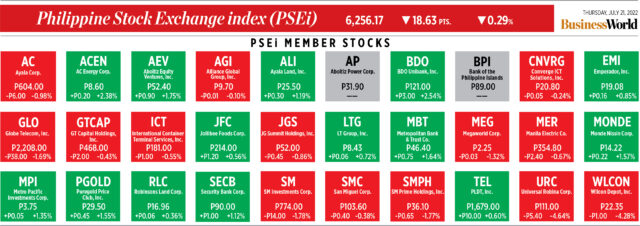
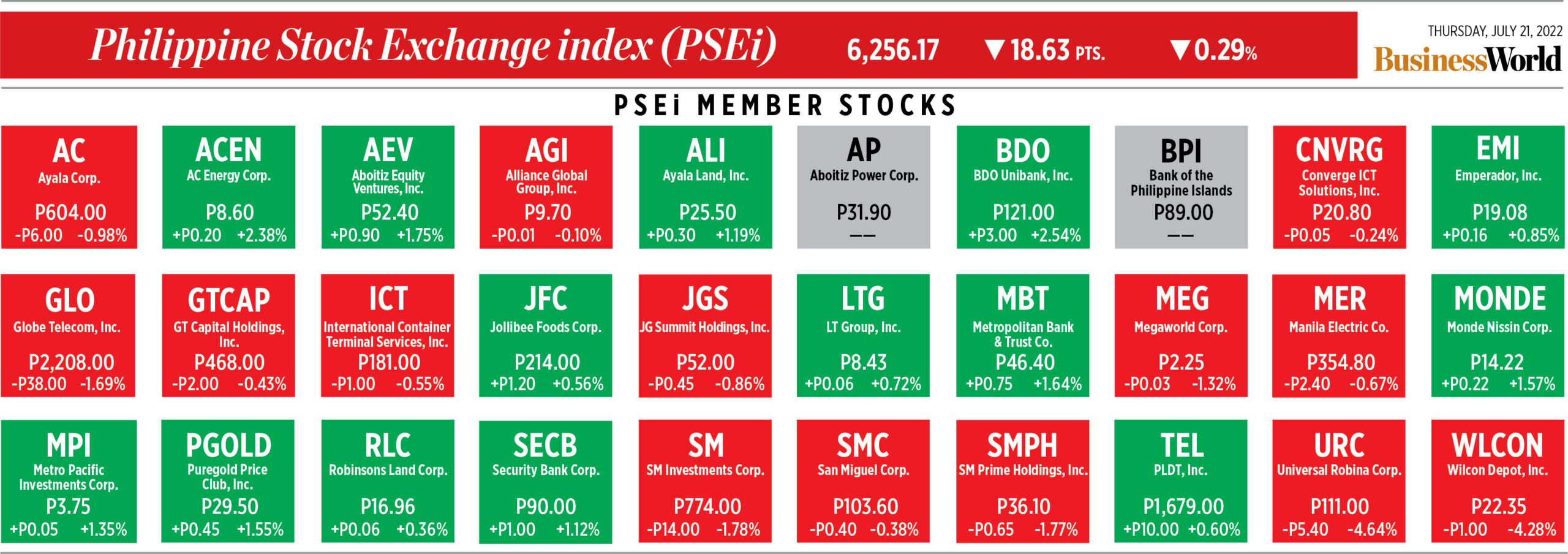
How PSEi member stocks performed — July 21, 2022

Here’s a quick glance at how PSEi stocks fared on Thursday, July 21, 2022.


Peso declines on recession fears, ECB

BW FILE PHOTO

THE PESO weakened further versus the dollar on Thursday on recession fears and ahead of the European Central Bank’s (ECB) policy meeting, where it is expected to raise rates for the first time in 11 years.

The local unit closed at P56.35 versus the greenback on Thursday, down by six centavos from its P56.29 finish on Wednesday, according to the Bankers Association of the Philippines. Year to date, this is 10.4% or P5.35 lower its close of P51 versus the dollar on Dec. 31, 2021.

The peso opened Thursday’s session at P56.34 against the dollar. Its weakest showing was at P56.43, while its intraday best was at P56.26 versus the greenback.

Dollars exchanged decreased to $647.45 million on Thursday from $710.05 million on Wednesday.

Rizal Commercial Banking Corp. Chief Economist Michael L. Ricafort said the peso ended weaker on gloomy global market sentiment amid signs of a recession in the United States.

“US existing home sales declined to 2-year lows. Microsoft is slowing hiring in some groups. Ford plans up to 8,000 job cuts to help fund investments in electric vehicles,” Mr. Ricafort added.

The peso also declined “amid the recent uptick in the benchmark 10-year US Treasury yield to among three-week highs at 3.05% and recent net increase in global crude oil prices near $100 per barrel, still among one-week highs,” he added.

Brent crude futures dropped by $2.36, or 2.2%, to $104.56 a barrel by 0816 GMT after slipping 0.4% in the previous session. US West Texas Intermediate crude futures fell by $2.49, or 2.5%, to $97.39 a barrel following a 1.9% drop on Wednesday.

Oil prices have been volatile as traders have had to square tighter global supply because of the loss of Russian barrels following the country’s invasion of Ukraine, with recessionary worries that could weaken energy demand, Reuters reported.

“The markets are also anticipating an interest rate hike by the European Central Bank,” Mr. Ricafort said.

The ECB is set to deliver its first rate hike in 11 years overnight against a difficult economic backdrop exacerbated by the war in Ukraine. The rate hike could also affect oil demand.

For Friday, Mr. Ricafort gave a forecast range of P56.20 to P56.40 against the dollar. — KBT with Reuters

Stock index drops further on coronavirus worries

BW FILE PHOTO

THE bellwether index slipped further on Thursday as rising coronavirus disease 2019 (COVID-19) cases in the country and latest balance of payments (BoP) data weighed on sentiment and ahead of meetings of key central banks.

The Philippine Stock Exchange index (PSEi) went down by 18.63 points or 0.29% to close at 6,256.17 on Wednesday, while the broader all shares index inched up by 0.33 point or 0.01% to 3,381.86.

“Shares on the Philippine Stock Exchange dipped, ahead of looming central bank meetings in Europe and Japan,” Globalinks Securities and Stocks, Inc. Head of Sales Trading Toby Allan C. Arce said in a Viber message.

“Resurfacing concerns over COVID-19 risks amid the detection of more cases in the country with Omicron sub-variants weighed on the market. Our year-to-date balance of payments deficit, which is already wider compared to the same period last year, also dampened sentiment,” Philstocks Financial, Inc. Senior Research Analyst Japhet Louis O. Tantiangco said in a Viber message.

The Philippines has logged 910 more infections involving more contagious subvariants of the Omicron coronavirus, the Health department said on Wednesday. Of the total, 816 were BA.5, 42 were BA.4, and 52 were BA.2.12.1 cases.

Meanwhile, the country’s BoP deficit widened to $1.57 billion in June from the $312-million deficit in the same month last year but slightly narrowed from the $1.61-billion gap in May.

In the first half of the year, the BoP deficit widened to $3.1 billion, from the $1.9-billion deficit in the same period in 2021.   

The majority of sectoral indices ended in the red on Thursday except for mining and oil, which went up by 217.86 points or 1.94% to 11,419.39, and financials, which increased by 18.65 points or 1.25% to 1,499.72.

Meanwhile, property went down by 20.84 points or 0.73% to close at 2,821.07; holding firms dropped by 40.18 points or 0.68% to 5,848.23; industrials decreased by 16.36 points or 0.17% to 9,412.47; and services lost 1.92 points or 0.11% to end Thursday’s session at 1,641.55.

Advancers outnumbered decliners, 107 versus 69, while 60 names closed unchanged.

Value turnover climbed to P6.09 billion on Thursday with 807.09 million shares changing hands from the P5.03 billion with 733.64 million issues seen the previous trading day.

Foreign buyers turned sellers anew, logging P92.85 million in net sales on Thursday from the P22.65 million in net buying seen the previous trading day.

“The market’s direction may likely be determined by the outcome of the European Central Bank’s meeting on Thursday to begin Europe’s rate-hike cycle. Markets are hedging bets on a hike of either 25 basis points or 50 basis points, with the latter perhaps able to support a euro that has slipped below $1 this month,” Globalinks Securities and Stocks’ Mr. Arce said.

He placed the PSEi’s support at 6,100 and resistance at 6,500, while Philstocks Financial’s Mr. Tantiangco placed support at the 6,000-6,150 range and resistance at 6,400. — Justine Irish D. Tabile

NAIA Q2 passenger traffic up sharply at 8.3M as pandemic restrictions ease

FACEBOOK.COM/NAIA TERMINAL-1

PASSENGER traffic at the Ninoy Aquino International Airport (NAIA) rose sharply in the second quarter following the easing of safety requirements for travelers, including quarantines and test results.

The Manila International Airport Authority (MIAA) said international passenger volume was up 129% from a quarter earlier, while domestic traffic was up 87%.

Domestic passenger traffic at the various NAIA terminals — arrivals as well as departures — topped 5.94 million in the second quarter, according to percentage changes derived from raw throughput data provided on the MIAA website for both periods.

International passenger traffic rose to more than 2.35 million in the three months to June.

In its financial report for the first quarter, the NAIA operator returned a net loss of P234 million, narrowing from a loss of P583 million a year earlier.

MIAA is required to remit 50% or more of its net income as dividends to the National Treasury.

“This is apart from the 20% National Government share in MIAA’s operating income based on actual collections, excluding income from utilities and terminal fees/passenger service charge, and the 30% corporate income tax, as well as the P100 share on passenger service charge and the contributions to National Civil Aviation Security Committee, which is P60 for every international passenger and P15 for every domestic passenger,” it said in its report.

Cebu Pacific, Philippine Airlines, and AirAsia Philippines continue to boost flight service on both domestic and international routes to take advantage of the increased demand for air travel resulting from the relaxation of pandemic-related restrictions.

On Feb. 10, the Philippines started accepting nationals that do not require visas to enter the country. Since April 1, borders have been opened to all nationals.

Foreign visitors have totaled 517,516 as of May 25 since the full reopening of borders with minimal quarantine requirements, according to the Department of Tourism.

The US was the top source of arrivals between Feb. 10 and May 25 with 104,589, followed by South Korea with 28,474 arrivals, and Canada 24,337. — Arjay L. Balinbin

Gov’t seeks bidders for Davao depot contracts for city’s bus system

DAVAO CITY GOVT.

THE GOVERNMENT has started soliciting bids for the design and construction contract for two depots of the Davao High Priority Bus System Project.

The deadline for the submission of bids for the Sasa Depot and the Sto. Nino Depot is Aug. 8, according to a bid bulletin from the Procurement Service office of the Department of Budget and Management, the procuring agent of the Transportation department.

The project, which is funded by the Asian Development Bank (ADB), is expected to improve public transport infrastructure and services in Davao City.

Open competitive bidding will be conducted in accordance with the ADB’s “Single-Stage: One-Envelope bidding procedure,” according to the Procurement Service. It is open to all bidders from eligible countries.

According to the ADB, this project has five depots located in Buhangin, Calinan, Sasa, Sto. Nino, and Toril.

The project also includes the development of three public transport terminals, a driving school, and improvement of bus routes.

The bus system will have 29 routes across a network of 672 kilometers, operating on over 580 kilometers of road, and traversing the entirety of Davao City.

The service will employ a combination of diesel and electric buses.

The project is expected to commence operations in August 2023.

The Transportation department said last year that the civil works component of the project will cost P19.71 billion, while the bus fleet, both diesel and electric, will cost P21.17 billion. — Arjay L. Balinbin

DENR’s Loyzaga promises priority action on climate change measures

DENR FACEBOOK PAGE

ENVIRONMENT Secretary Maria Antonia Y. Loyzaga said action to address the climate crisis will be one of the department’s areas of focus during her term.

The Department of Environment and Natural Resources (DENR) needs to act on the climate emergency “through science to approach national and local-scale impacts of climate change. We live in a multi-hazard environment, from industrial and what we call natural-technological hazards,” she said during the department’s turnover ceremony on Thursday.

“We need to continuously protect our indigenous species as part of our heritage and harness these resources for the benefit of our country,” she added.

The new DENR Secretary said that she is aiming to “emphasize the crucial role in the accounting of natural resources of the country.”

“We need to harness our expertise and make sure the capabilities of the different sectors and bureaus are in line and support each other. We want to invest in a scientific and risk-based approach,” she said.

“The role of the DENR cannot be minimized in terms of trying to support the economy of our country and the social and inclusive development of our nation,” she added.

In a separate statement, the DENR announced that it is collaborating with the Korean National Assembly to explore the use of a communications satellite to monitor and protect the environment.

“Korean technology will strengthen Philippines’ capabilities in the use of data generated through orbital satellites, which provide high resolution images of the terrain,” the DENR said in a statement.

DENR Director Al O. Orolfo said that satellite technology and high resolution images play a significant role in managing and protecting natural resources and the environment.

Apart from the satellite, there are two ongoing projects between the DENR and the Korea International Cooperation Agency.

These include the establishment of an Integrated Water Resources Management and Information System for the Pampanga River Basin Phase 2 and the enhancement of marine litter management in Manila Bay.

There are also potential collaborations with the Philippine Space Agency and Philippine Atmospheric, Geophysical and Astronomical Services Administration, according to the DENR. — Luisa Maria Jacinta C. Jocson