Home Blog Page 5572

Bill seeks creation of drug overdose info campaign, case tracking system

PHILSTAR FILE PHOTO

A BILL that will set up an information campaign and reporting system on drug overdose cases has been filed at the Senate.   

“Whether the drug overdose is accidental or intentional, I believe we can handle the side effects and the dangers to life that drug overdose can cause,Senator Manuel LitoM. Lapid, author of Senate Bill 1498, said in a mix of English and Filipino in a statement on Monday.  

Under the measure, the Department of Health (DoH) will be the lead agency of the program, which will include educational and intervention initiatives to reduce the rate of drug overdose.  

The department will also be mandated to publish regular reports on drug overdose trends, including information on emergency room utilization for treatment and costs.  

It is important that responsible government branches such as the DoH can provide important information like emergency services that can be carried out to those who experience drug overdose,Mr. Lapid said.  

The DoH will also be required to provide an annual advisory to municipal, city and provincial officials on the prevalence of drug overdose incidents in their respective areas, as well as best practices and strategies for addressing the issue.  

The proposed law also makes it illegal for anyone to knowingly withhold, fail to disclose, or falsify any information relating to an incident of drug overdose.   

“It is important for the public to see the data related to this, and what they can do if they or their loved ones experience drug overdose,the senator said.   

Providing correct information to our countrymen is a powerful weapon to protect us from the adverse effects of drug overdose.Alyssa Nicole O. Tan

How SMEs can manage fluctuating peso values better

BW FILE PHOTO

This year’s most harrowing economic trend, following the accelerated rate of inflation, is the depreciation of the Philippine peso against the US dollar. The local currency hit P50 to $1 dollar in July 2022 and continued to depreciate, eventually dropping to P59 in September and October before recovering this month to the P57 range.

The peso appreciation was a much-welcomed improvement by both consumers and the government, since it was buoyed by milder US inflation results in October, higher employment numbers, and continued growth in local gross domestic product (GDP). Remittances during the holiday period are also expected to improve peso values further.

The economic and political reasons for peso depreciation, however, still remain in place. Worldwide inflation, global tensions between Ukraine and Russia, our country’s overseas debt, and increased imports versus decreasing exports are issues that will linger until next year. With the foreign exchange rate changing every day due to these factors, the peso will continue to fluctuate. Should the peso depreciate in 2023, small and medium enterprises (SMEs) must be ready to manage its negative effects, and seize the rare opportunities it presents.

First, a depreciated peso means that locally sourced and made products and services are cheaper than imported ones. SMEs in the local manufacturing and sourcing sector can highlight this in their marketing activities to attract more customers, especially foreign buyers who can open the way for exporting. For the same reasons, the agriculture sector can also benefit from exporting their products, as the industry will receive more pesos per dollar. The tourism industry, meanwhile, can focus on marketing to international tourists, as Filipino goods and services are now even more affordable to foreign visitors.

Second, a depreciated peso makes importing supplies more expensive, reducing businesses’ purchasing power. A lot of SMEs are on the hook right now from cementing deals with suppliers back when the peso was at the P53-54 range against the US dollar. To better prepare for the future, SMEs must find local suppliers as an alternative to importing raw materials. Aside from lower production costs and less import taxes, diversifying suppliers can strengthen an SME’s supply chain by decreasing its susceptibility to geopolitical and economic shocks. Having a local supplier also makes it easier for SMEs to establish a good working relationship, which can help them negotiate better terms in the future.

Third, no matter what the current foreign exchange rate is, SMEs must aim to develop products and services that are at par with imported ones. Being more competitive in the global market is critical: aside from capturing a new market through exporting, businesses that trade in multiple countries, especially our ASEAN neighbors, are also less prone to the negative effects of peso depreciation. China is more resilient to trade tensions stemming from US issues; Japan’s biggest imports, meanwhile, are heavy on electronics, such as medical equipment and circuits — a good opportunity for our burgeoning electronics manufacturing industry.

Lastly, to prepare for further depreciation shocks, SMEs must improve their resilience — especially in terms of working capital. For some industries, it is simply inevitable to import goods and services as the Philippines is typhoon-prone and has a long way to go in improving local production efficiency. Thus, a minor drop in peso-to-dollar values can lead to a huge cash flow gap if, say, your company is forced to honor an importing contract that you made when peso values were more favorable.

Having a revolving credit line is an excellent way to ensure you always have working capital. Compared to the typical business loan, which provides a lump sum of capital upfront, revolving credit lines work the same way as a personal credit card — to be used only on an as-needed basis. Revolving credit lines provide SMEs an emergency fund of sorts by providing a credit limit that they can dip into whenever a business opportunity or cash flow gap arises, then letting you pay interest only on the portion of the credit line that you used. When opening a credit line, look for a provider that doesn’t charge anything for application. Their dedicated account managers are also a great help for business owners who need funding quickly, but do not have the time or skill to facilitate credit line withdrawal requests on their own.

There are many more ways SMEs can manage the effects of fluctuating peso values, but marketing to foreign clients, strengthening local supply chains, building export plans and taking care of working capital can already go a long way. These steps can protect SMEs from peso depreciation vulnerabilities, and even enable them to take advantage of global trade when the local economy is not in their favor.

This article reflects the personal opinion of the author and does not reflect the official stand of the Management Association of the Philippines or MAP.

Benedict S. Carandang is the vice-president for External Relations of First Circle, a fintech provider that helps SMEs grow through long-term partnership, flexible financing, and free tools to help them find government opportunities. This article is co-written with Kathryn Jose, a content marketing contributor for First Circle.

map@map.org.ph

benedict@firstcircle.ph

Elon Musk and the confessions of an Ayn Rand reader

DANIEL OBERHAUS-FLICKER

I’M FED UP reading about Elon Musk and Twitter. If you think about it, neither the spoiled-brat serial entrepreneur nor the spoiled-brat social network he bought matters a whit in a world where millions are fighting for sheer survival against evil imperialists, famine, or other disasters.

And yet I also confess to a voyeuristic reflex that does make me glance at headlines about Musk and Twitter, as I might rubberneck when passing a car wreck. Will they self-destruct in a meteoric flameout? Will they turn things around against all odds like action heroes staring down the apocalypse?

Upon reflection, I recognize this won’t-look/must-look cognitive dissonance. It goes back to a feeling I had when I was in my late teens and devouring Ayn Rand novels such as The Fountainhead and Atlas Shrugged.

The characters in those stories and the philosophy that animates them — pretentiously called “objectivism” — bear a superficial resemblance to people like Musk. That might explain why Tesla, Inc. founder Musk, Amazon.com, Inc. titan Jeff Bezos and quite a few other hard-driving — and almost invariably male — tech tycoons adulate Ayn Rand.

Rand’s protagonists, such as the architect Howard Roark in Fountainhead or the Capitalist Ubermensch John Galt in Atlas Shrugged, are cartoons of what Musk and his ilk aspire to be. They’re uncompromising, ultra-masculine, and hyper-individualistic visionaries. They’re in it for themselves, powered by an unapologetic egocentrism that rejects the serf morality of ordinary pencil pushers in their cubicle farms.

In this worldview, anybody who doesn’t grasp the single-minded genius of a Roark, Galt, Musk, or Bezos belongs by default to the antagonists in Rand’s novels. Those are the naysaying mediocrities and bureaucrats, the socialists and parasites, the unproductive and disingenuous slouches and “moochers,” the cowards and conformists.

Roark’s vision is aesthetic — an ideal of sleek and simple architectural lines that make the human spirit soar, but for that very reason can’t be appreciated by lesser mortals condemned to being spiritual pygmies. Musk’s vision is an almost eschatological iteration of Roark’s. His big idea is to prepare humanity’s escape from our home planet by colonizing Mars.

Once you get your mind around this brazenness, all sorts of things make an eccentric kind of sense. Musk co-founded one company, SpaceX, to build the rockets that will one day transport us to Mars, with the accompanying satellite communications (Starlink) we’ll need. He has another, The Boring Company, that drills tunnels, so that we can live and zip around under Mars’ surface to avoid the radiation. He runs another, Tesla, that will harness sunlight to move us around. To get our human cognition up to snuff for these adventures, Musk nurses Neuralink, which dabbles in brain implants.

Mars it is, then. It’s telling that Musk’s vision is named after a Roman god. I picture Roark and Galt (all of Rand’s heroes are atheists) high-fiving Musk as they climb into the pioneering SpaceX saucer with him to embark for that next frontier. Musk’s autism, which he acknowledges openly and humorously, makes his focus even more laser-like. I always assumed that Roark and Galt also had Asperger’s.

By now it should be clear why Roarks, Galts, or Musks capture the imaginations of teenage boys like the one I used to be, or the one still hiding inside me now. They’re paragons who rebel against — and burst — the limits of the humdrum and stultifying mainstream. They’re heroic, and romantic. We root for them. We fantasize about being them.

But as boys grow up, some also mature — even I, in my mere fifties, am feeling the beginnings of that process. Attempts to re-read Rand reveal her characters to be one-dimensional and flat. The boy’s imagination flared at their oratory; the middle-aged man inadvertently nods off during speechifying that goes on for pages of repetitive cliches.

With a crushing sense of disillusionment, the mature re-reader makes several observations. First, Rand was a mediocre writer. Second, her characters are actually boring. Third, the plots that wannabe Roarks and Galts such as Musk try to emulate are destined to meet a fate worse than failure: prosaic reality.

In that real world, Tesla turns into just another car company, which its first-generation employees eventually leave in disappointment. The Boring Company actually becomes boring. SpaceX seems self-indulgent. Neuralink is science fiction. As for Twitter, it’s just a site where media types like me curate their work while mobs of trolls and bots cast aspersions and spread conspiracy theories. Normal people needn’t waste time on it.

As for Musk, what initially looked like romantic intensity suddenly just looks sadomasochistic. Sure, Musk brags about how he sleeps on the office floors of his companies because he works so hard. And he demands that his co-visionaries do the same. So he fires half of Twitter’s employees, then writes e-mails to the rest, in the middle of the night, challenging them to be “hardcore” or get the heck off his spaceship.

Those employees aren’t Randian moochers. In their own ways, they may be just as talented and idealistic as Musk. But they also have families, lives, and bills to pay. They’ll be forgiven for rolling their eyes.

And so Rand’s lure over the teenager recedes, while the wisdom of older literature comes to the fore. Musk, Roark, and Galt start looking like yet more men succumbing to hubris and getting trapped in a desperate solipsism. How will they react?

When a kitsch architect messes with his genius construction, a public-housing project, Roark dynamites it. No poor family will ever live there. When Galt has enough of the moochers, he gathers all the country’s great inventors and creators and goes on strike in Galt’s gulch, somewhere in Colorado, until the outside world is a wasteland. Musk, too, may yet find his own way to blow up Twitter, or much more.

This isn’t the romantic heroism of creative genius yearning to soar free. It’s the sugar crash of narcissists wandering off on ego trips, throwing temper tantrums and storming out in rage quits. For the sake of nostalgia, I’ll keep Rand in my bookshelf and Musk in my peripheral vision. But there are more important things deserving my attention.

BLOOMBERG OPINION

Economic projections for 2023 and beyond

The BusinessWorld Economic Forum (BWEF) 2022 today, Nov. 29, has as its theme, “Forecast 2023: Opportunity in Uncertainty.” I want to contribute to the discussion on economic forecast and projections in relation to the recently concluded big annual conference, the UN Framework Convention on Climate Change (UNFCCC) 2022 or 27th Conference of Parties of UNFCCC (COP 27) in Egypt that ended on Nov. 19.

PROJECTIONS 2022 AND 2023
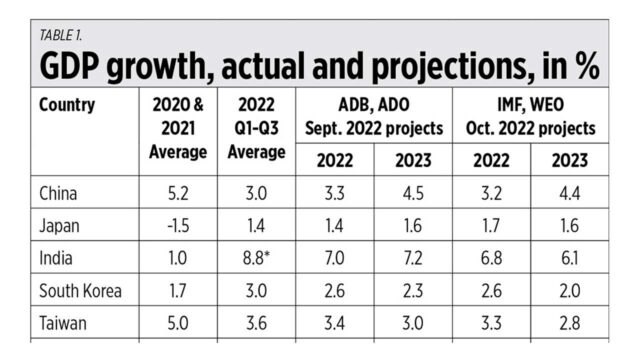
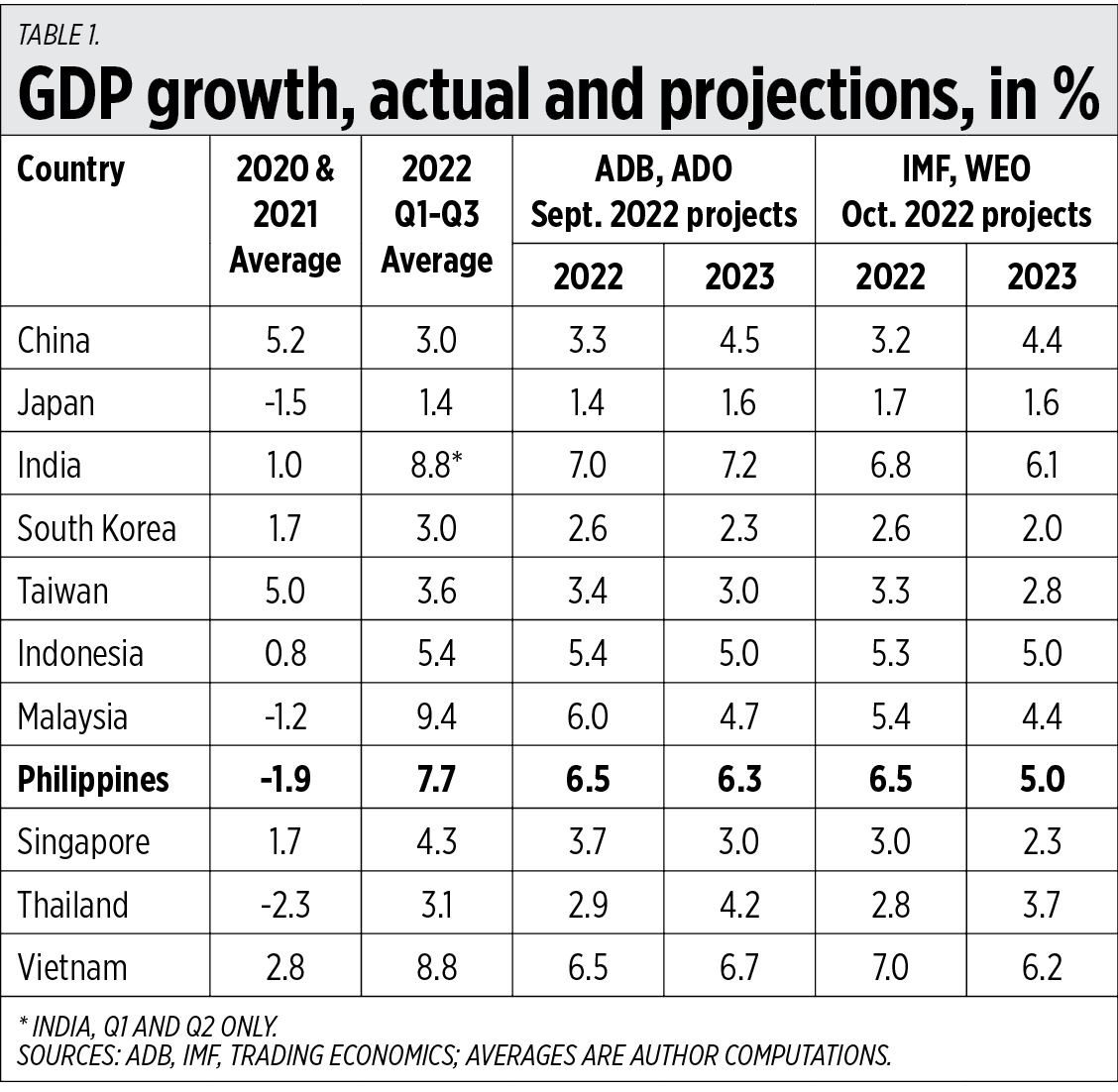
The Philippines had the deepest economic contraction in Asia in 2020 at -9.5%, followed by a mild recovery of 5.7% in 2021. This year, it is on the way to having the fourth fastest growth in East and South Asia at around 7.8%.

The multilaterals, especially the ADB through its Asian Development Outlook (ADO) September 2022 Update, and the IMF World Economic Outlook (WEO) October 2022 Update, have bad and low projections of only 6.5% Philippines growth this year, even if they knew that growth in quarters 1 and 2 (Q1, Q2) was already at 7.7%. When Q3 growth came out at 7.6%, it showed their projections as having archaic and ugly assumptions because they will now assume that Q4 growth will only be 2.9% — bad and unrealistic. My own projection for Q3, which I wrote in this column on Aug. 15, was 7-7.5% growth, and for Q4 is 7.5-8% growth.

This year will further cement the new trend that South East Asia and South Asia are the fastest growing regions in the world. Malaysia, the Philippines, Vietnam, and India will be the head of the pack (Table 1).
Finance Secretary Benjamin Diokno, as head of the economic team, is doing a good job in assuring the public and investors that important market-oriented reforms like the Public Service Act amendment, and the Foreign Investment and Retail Trade Liberalization Acts are in place, and no tax hikes will be done in major sectors like individual and corporate income, VAT, excise on energy products, even in so-called “sin products.”

These are good moves by Secretary Diokno. With the Philippine inflation rate already at 5.1% from January-October 2022 vs. 2% in 2020, and 3.9% in 2021, any tax hike on major sectors will have inflationary effects, especially if the tax hike is on energy products.

Last week, rumors about Secretary Diokno were published in at least two publications: “Biz Buzz: Cabinet member on way out?” (Philippine Daily Inquirer, Nov. 21) and “Mar, Gibo in play too? Salceda is top pick for DoF as Marcos grows weary of Diokno’s incompetence” (bilyonaryo.com, Nov. 21). A good quote from the President came out in the story “Marcos dismisses as ‘fake news’ report Diokno on way out at DoF” (BusinessWorld, Nov. 22), referring to BizBuzz and Bilyonaryo as dishonest and indulging in irresponsible reporting. The public should mark these two outlets.

PROJECTIONS MEDIUM- TO LONG-TERM
There is a trend that high and rising consumption of fossil fuels (FF) — oil, natural gas, and coal — leads to high and sustained growth. And declining consumption of FF leads to low and declining growth.
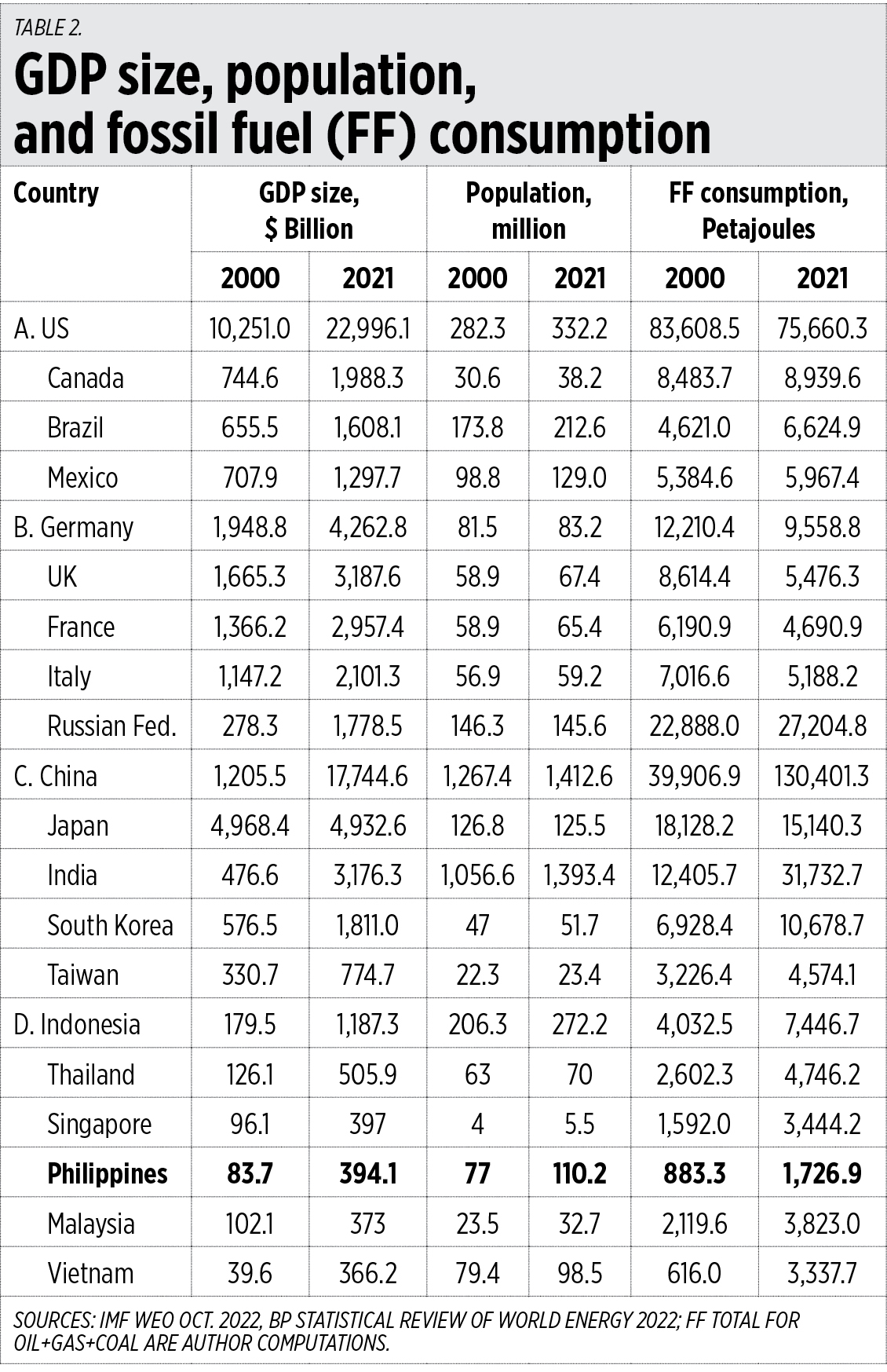
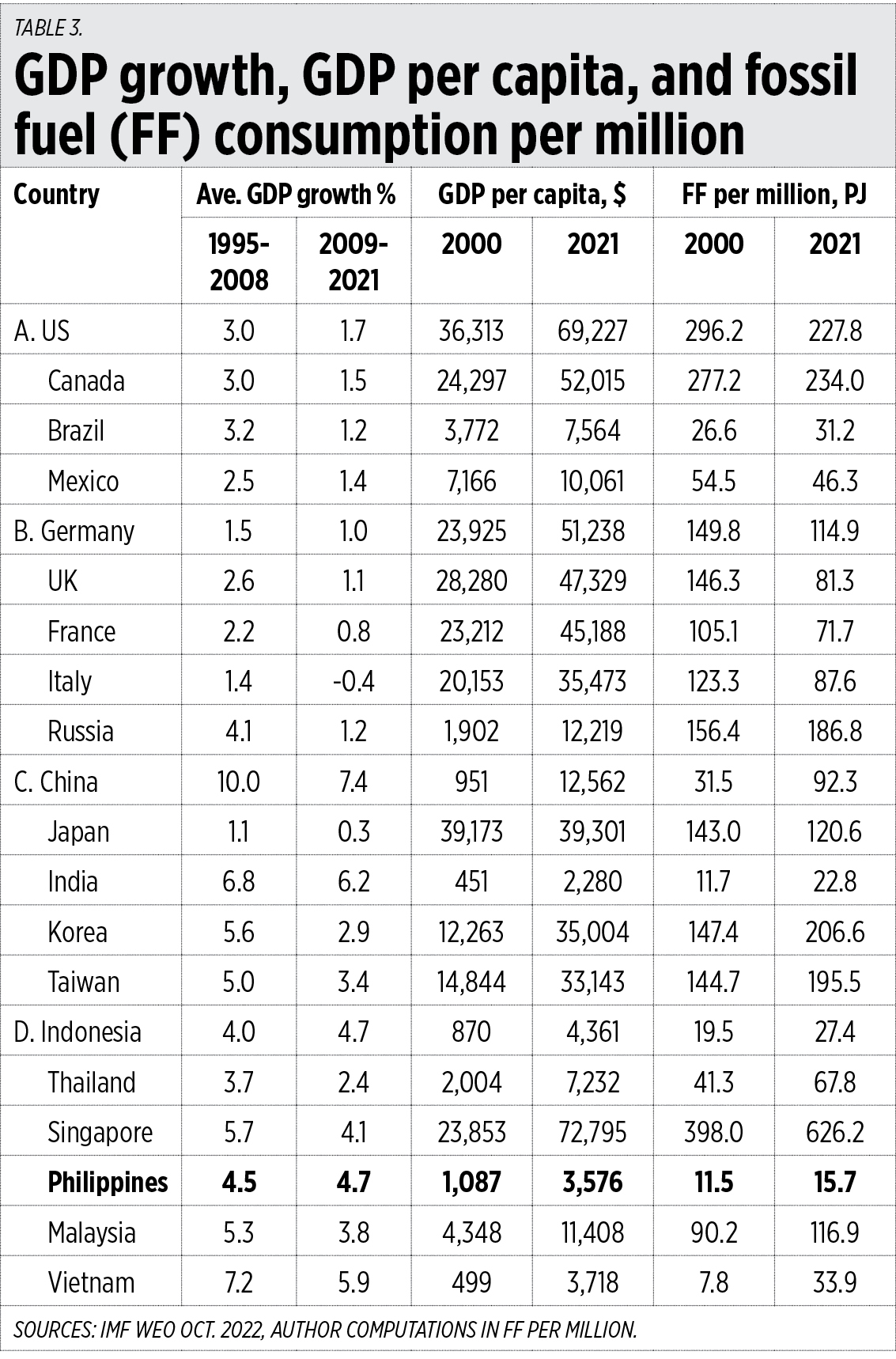
In two tables accompanying this piece, I chose the biggest economies and arranged them in group A for North and South America, group B for Europe, group C for Northeast and South Asia, and group D for the ASEAN-6.

Energy consumption is expressed in Petajoules (PJ). One PJ is equivalent to 23,885 tons of oil equivalent, or equivalent to 277.78 megawatt-hours (MWH) of electricity.

The G7 countries — the US, Canada, Germany, the UK, France, Italy, and Japan — have had high FF consumption historically, which partly explains their high GDP per capita. Russia and Asian countries like South Korea, Taiwan, and Singapore, also have high FF consumption both in total and PJ per million population (Tables 2 and 3).

From 2020 to 2021, there was big decline in FF consumption by G7 countries except Canada and this contributed to their low average growth of 1.7% or lower over the last decade. In contrast, the rest of Asia — especially China, India, and ASEAN-6 — have had rising FF use and this contributed to their high average growth of 2.4-7.4% in the last decade. Their per capita GDP has also expanded significantly.

The long-term economic projections would be a continuation of this trend: low, anemic growth of below 1.7% for G7 and other rich countries, and 2.5% and higher growth for developing countries in Asia.
PHILIPPINES ENERGY REFORMS
The Philippines and the rest of developing world should continue their sustained FF use if they wish to have cheap and reliable energy 24/7 that will power their growth and industrialization. The Philippines, in particular, had the lowest FF use in the ASEAN-6 in 2021, only half of Vietnam’s, one-fourth of Thailand’s, one-eighth of Malaysia’s, 1/13th of Taiwan’s and South Korea’s, and 1/40th of Singapore’s.

In the power sector, the Philippines should focus on more FF plants, with 24/7 reliable and dispatchable on-demand power. Big reforms are needed in the distribution sector too as many electric cooperatives in the provinces are so inefficient and wasteful — they charge high prices with frequent power fluctuations and brownouts, and they are protected by politics via the National Electrification Administration (NEA). If they cannot be efficient, their monopoly franchise areas should shrink and efficient corporate distribution utilities like Meralco should take over.

On energy bureaucracy, UP College of Business Administration Professor Emeritus Epictetus Patalinghug, made this observation and I say Amen to it:

“The EPIRA*-led restructuring of the energy sector created a more efficient private run generation sector, but slowly enlarged the energy sector bureaucracy: DoE, Napocor, PSALM, NEA, ERC, WESM, Transco**. The octopus has multiplied post-EPIRA with no evident reduction in the cost of electricity per kilowatt hour. System losses and management inefficiency among electric coops have not disappeared.”

* Electric Power Industry Reform Act

** Department of Energy, National Power Corp., Power Sector Assets and Liabilities Management Corp., National Electrification Administration, Energy Regulatory Commission, Wholesale Electricity Spot Market, National Transmission Corp.


Bienvenido S. Oplas, Jr. is the president of Minimal Government Thinkers.

minimalgovernment@gmail.com

Personalized SIM cards will take the Philippines’ digital transformation agenda to the next level

MANIK ROY- UNSPLASH

MORE than a month has passed since the signing of the SIM (Subscriber Identity Module) Registration Act into law, intended as an ambitious move to combat fraud by requiring Filipinos to register their identities with public telecommunications entities (PTEs).

The discourse has been understandably divided: companies in support argue that it is a critical step in combating criminal activity, significantly reducing spam and scam SMS messages. Those against it say the Act presents gaping holes in data security and enforcement, explaining that scammers can easily shift to other means to acquire peoples’ information.

Indeed, implementing the Act may pose challenges for business and society-at-large. However, it is a necessary step on the way to further digital maturity of the national economy.

FITTING WITHIN GLOBAL PRACTICE
Already, the number of SIM cards in the Philippines exceeds the population by 40% (vs. the excess globally of just 5%, according to Data Reportal) and is continuing to grow rapidly (+5% for 2021-2022). At the same time, Filipinos use mobile internet the most in the world (five hours and 47 minutes per day vs. the average global level of three hours and 43 minutes).

These factors alone are enough to make it clear that the rapid digitalization of society based on mobile technologies has enormous potential in the country. Without regulation and control, however, this potential can simply fall into the wrong hands and can become very dangerous.

After the pandemic, the number of cybercrimes increased by 703% in 2021 compared to 2020, and by 125% in nine months of this year compared to 2021, according to the Philippine National Police’s Anti-Cybercrime Group.

The Act fits within global practice, with the Philippines joining the vast majority of countries — 185 out of 245 — where SIM card registration is mandatory. The registration of SIM cards is intended to become a guarantee of a transparent, regulated and secure mobile environment. This environment, in turn, strengthens the foundations of the national digital ecosystem.

Obvious beneficiaries are fintech companies, which will employ new opportunities to strengthen scoring, e-KYC policy, cybersecurity, among others. Based on our experience in other countries, linking phone numbers to specific individuals has been a significant asset in all these areas and it is expected that the Philippines will not be an exception in how this new law will greatly reduce mobile scams and crimes related to the disposal of prepaid SIM cards.

The Act also looks promising when considering digital payments and e-commerce. Registered SIM cards can bolster the integration of payment channels with a smartphone, increasing the personalization of online shopping services such as the Buy Now, Pay Later segment. Nowadays, it is especially on the rise in the Philippines: the market is valued at $1.5 billion, and by 2028 it promises to grow to $10 billion.

ADDRESSING MAJOR CONCERNS
While minimizing the risks of digital fraud and deepening integration into fintech ecosystems, it is important to recognize the logistical problem of 160 million SIM cards already in the hands of Filipinos requiring official retroactive registration within 180 days to avoid deactivation.

For the consumer, there is no cause for concern as the registration procedure is free and can be done online through means the PTEs will establish, according to a section of the new law. The forthcoming Implementing Rules and Regulations (IRR) of the Act is expected to shed light.

Government agencies and PTEs are also expected to establish registration facilities in remote areas with limited telecommunications or internet access, which is hoped to pave the way for registration for the representatives of indigenous peoples and residents of remote rural areas.

Concerning the security of personal data of Filipinos, the Act addresses this salient point of contention by prohibiting disclosure of a subscriber’s personal information, except by decision of law enforcement and judicial authorities.

The National Privacy Commission (NPC), recognizing that implementing a SIM card registration system “will entail a massive collection of personal data,” said in an earlier statement that there is a “strong need to develop a technology-neutral approach and to future-proof the proposed legislation to achieve its intended purpose, in a manner that respects the rights and freedoms of the data subjects.” This recognition should further alleviate concerns.

We also share their call for mechanisms to be developed and implemented to prevent security risks and data breaches “that may arise from overcollection and improper or inadequate monitoring practices.”

In general, the Act will complement the Philippines’ digital transformation agenda and take it to the next level. The challenge, ultimately, is proper implementation and adoption — both subject to much-needed inter-sectoral deliberation.


Kirill Kalashnikov is the regional director for APAC at Robocash Group, which operates in the Philippines through consumer finance company Digido.

Germany breathes life into WC push in battling draw with Spain

SPAIN’S Sergio Busquets (5)fouls Germany’s Jamal Musiala  before being shown a yellow card. — REUTERS/KAI PFAFFENBACH TPX IMAGES OF THE DAY

Costa Rica shocks favored Japan with 1-0 victory

AL KHOR, Qatar — Germany gave themselves hope of avoiding another embarrassing early World Cup exit when they snatched a 1-1 draw with Spain on Sunday with Niclas Fuellkrug firing home an 83rd minute equalizer on only his third appearance for his country.

The result leaves the four-time world champions facing a must-win match against Costa Rica on Thursday, and also means Spain have yet to book their passage out of Group E. Japan and Costa Rica could yet qualify too.

Germany looked to be in severe danger of repeating their group stage failure of 2018 in Russia when Alvato Morata, eight minutes after coming on from the bench, handed Spain the lead by neatly flicking in a cross from Jordi Alba in the 62nd minute.

A defeat against Spain after Germany’s shock 2-1 opening loss to Japan would have left Hansi Flick’s men facing a huge challenge to get into the knockout phase.

But in the 83rd minute they battled back into contention as Leroy Sane took advantage of a poor defensive clearance to feed Jamal Musiala who turned between two Spain defenders, with the ball falling to Fuellkrug who fired high into the net.

The Werder Bremen forward, who won his first cap earlier this month after a string of goals in the Bundesliga, had replaced Thomas Mueller 13 minutes earlier as Germany desperately sought an equalizer.

“We knew what the situation was, what was at stake,” Flick told reporters, and he said Fuellkrug’s equalizer might prove to be a turning point for Germany in Qatar.

“Things start to happen when you start to win, so maybe this will give us a boost and give us the self confidence to get goals,” he said.

Spain coach Luis Enrique said he was left ruing his side’s failure to hold on to their lead. “But after two matches we are in the top of the classification of the death group and I think that we have to be positive,” he said.

The Spaniards had looked more relaxed from the start, cutting through Germany with their angled passing in the Al Bayt Stadium, about 50km (30 miles) north of Doha. Dani Olmo almost created an early breakthrough in the seventh minute but his shot was palmed onto the bar by Manuel Neuer.

Germany thought they had taken an unlikely lead in the 39th minute when defender Antonio Rudiger powered in a header from a Joshua Kimmich free kick, but the German celebrations were cut short as VAR quickly ruled that he was offside.

Spain goalkeeper Unai Simon was forced into his first save in the 56th minute when the 2010 champions got into trouble trying to play out of defence, allowing Kimmich to shoot from just inside the penalty area but Simon saved impressively.

Spain top the standings with four points and now need only a draw in their final Group E game against Japan to progress. A win would send them through to the knockout round in first place.

Germany, are bottom of the table on one point. They need to win against Costa Rica on Thursday and their hopes then depend on Japan losing. If Japan draw it would come down to goal difference or goals scored by Germany and Japan.

COSTA RICA STUNS JAPAN
Costa Rica’s Keysher Fuller scored in the 81st minute to give his team a 1-0 victory over favored Japan on Sunday in World Cup play at Al Rayyan, Qatar. The loss denied Japan a chance to move straight to the knockout stage.

Fuller’s score came on Costa Rica’s first shot on target in the match.

Costa Rica, which lost to Spain 7-0 in its Group E opener, now has an improbable chance to advance. With two matches down, Costa Rica and Japan have three points each. Spain also has three points and will meet Germany, which lost its opener to Japan, later Sunday.

Japan controlled the ball 57 percent of the match and had three shots on goal, all stopped by Costa Rica goalkeeper Keylor Navas. The Japanese also couldn’t take advantage of five corner kick opportunities.

MOROCCO 2, BELGIUM 0
Abdelhamid Sabiri scored in the 73rd minute and fellow substitute Zakaria Aboukhlal also tallied in second-half stoppage time to lift Morocco to victory in its Group F match.

Sabiri opened the scoring after curling in a free kick from near the corner flag that surprised Belgium goalkeeper Thibaut Courtois (two saves).

Aboukhlal provided insurance with a goal on the counterattack and Munir El-Kajoui made three saves for Morocco, which has four points — one more than Belgium.

The Belgians were unable to take advantage of any of their nine corner kicks.

CROATIA 4, CANADA 1
A quick-strike goal against Croatia did not hold up and Canada crashed out of the World Cup with a second straight setback in Group F.

Alphonso Davies’ leaping header gave Canada the lead in the second minute and marked the first goal scored by the men’s national team in World Cup history.

Croatia grabbed the lead with first-half goals by Andrej Kramaric in the 36th minute and Marko Livaja in the 44th.

Kramaric scored again in the 70th minute and Lovro Majer capped the Croatians’ win with a goal during second-half stoppage time. Croatia and Morocco lead Group F with four points. — Reuters

Cignal HD Spikers eye PVL finals vs Petro Gazz Angels

Tai Bierra-led Cignal HD Spikers — PVL

Games Tuesday
(Philsports Arena)
2:30 p.m. — Cignal vs Petro Gazz
5:30 p.m. — Creamline vs Chery Tiggo

FOR the first time in its young Premier Volleyball League (PVL) life, Cignal is on the cusp of a breakthrough finals appearance.

It is a chance that the HD Spikers are expected to pounce on as they shoot for nothing less than a victory against a dangerous Petro Gazz today in the PVL Reinforced Conference at the PhilSports Arena.

Cignal is expected to ride the crest of its giant-sized 23-25, 25-23, 28-26, 25-18 victory over top seed Creamline last Sunday at the Smart Araneta Coliseum that sent the former to its second straight win in the semis and closer to its first appearance in the championship round since joining the league a year back.

And the HD Spikers could formalize their entry to the best-of-three finale unfurling Thursday at the Big Dome with another triumph at the expense of the Angels in their 2:30 p.m. duel.

“I must admit that it was really a big win beating a strong team like Creamline,” said Cignal coach Shaq delos Santos. “But we still have to prepare, recover and avoid complacency against Petro Gazz.”

Truly, Petro Gazz was also coming off an equally huge triumph at the expense of Chery Tiggo, 25-15, 25-17, 25-13, also last Sunday.

“We just have to keep on improving for us to have a chance against Petro Gazz,” said Mr. Delos Santos.

Creamline, for its part, eyes to bounce back from its stinging defeat that dropped it to 1-1 as it squares off with Chery Tiggo, winless in two games, in the other match at 5:30 p.m.

A win by Cignal and a win by Creamline would seal a title duel while a win by Petro Gazz and a win by Creamline would result to a three-way logjam for the two finals berths.

A win by Cignal and a loss by Creamline would send the former straight to the finals and the latter in a three-way tie with Petro Gazz and Chery Tiggo for the last finals spot.

All ties will be resolved by FIVB tiebreakers. — Joey Villar

NCAA Season 98 Final Four unfolds today at FilOil Center

COLLEGE of St. Benilde Blazers top the Season 98 elimination. — NCAA/SYNERGY-GMA

Games Tuesday
(Filoil EcoOil Centre)
12 p.m. — CSB vs San Beda
3 p.m. — Letran vs LPU

COLLEGE St. Benilde (CSB) and Colegio San Juan de Letran set out to arrange a title showdown while San Beda and Lyceum of the Philippines University (LPU) go all out to spoil it as the NCAA Season 98 Final Four unfolds today (Nov. 29) at the Filoil EcoOil Centre.

The Blazers, who are playing their first Final Four game in two decades after ending up on top with a 14-4 record, battle the No. 4 Red Lions at 12 p.m. while the Knights, who wound up the second seed with a 13-5 mark, tackle the No. 3 Pirates at 3 p.m.

CSB and Letran earned the twice-to-beat incentive for finishing in the top two and would need just a win to advance to the best-of-three finals slated to open next week.

A deciding game, if necessary, is on Friday at the same venue.

After achieving their initial goal, CSB coach Charles Tiu said the next step is go all out to make the finals for a chance to snare the school’s second crown since its breakthrough title conquest 22 years ago.

“It’s great, we are happy, it’s one of our small goals,” said Mr. Tiu. “Hopefully we can go past the Final Four and really make a run for the championship.”

The Blazers are enjoying one of their best, if not their best, seasons to date after exceeding expectations owing to their deep bench headed by MVP frontrunner Will Gozum, Migz Oczon, Migz Corteza, Mark Sangco, Jimbo Pasturan and skipper JC Cullar.

But lacking the toughness, Mr. Tiu said it would be hard to get past the playoff round.

“Hopefully we mature and continue to grow as a team,” said Mr. Tiu.

For the Knights, they would have to find ways to recover their winning form after dropping their last elimination round game at the hands of the Jose Rizal Heavy Bombers, 87-71, last Wednesday.

While Letran would be the prohibitive favorite being the three-peat-seeking champion, it has ran into problems when it faced LPU as the two split their two elimination round matches.

The Pirates won the first meeting, 82-75, last Oct. 2 while the Knights rebounded with a 69-64 escape last Oct. 28.

“We know it’s going to be a do-or-die game for us but we’re prepared for it because we’ve treated all our games in the elimination as do-or-die,” said LPU mentor Gilbert Malabanan. — Joey Villar

Blu Boys give Team USA a scare

PHILIPPINES Blu Boys softball team — AMATEUR SOFTBALL ASSOCIATION OF THE PHILIPPINES

THE Blu Boys showed the other teams competing in the men’s softball World Cup in Auckland, New Zealand that they are there to compete.

Matched up against perennial champions United States in their very first game, the Cebuana Lhuillier-backed Blu Boys gave a real scare to the American team who could only eke out 1-0  victory.

Nicholas Mullins scored the lone run in the third inning off a wild pitch by top Filipino pitcher Leo Barredo that allowed the Americans to score the winning run.

ASAPHIL President Jean Henri Lhuillier was all praises for the Blu Boys for that performance,” before they left, I told them that I will be happy to see them lose as long as they give it their best and keep the games close, and that is exactly what they did. This for me was a morale booster for the team as they go up against defending champions Argentina in their second game,” said Mr. Lhuillier.

In other matches, Argentina also found a tough opponent in Cuba as the Argentinians could only come off with a close 3-1 win against the Cubans.

World No. 2 team Japan posted the most impressive victory with an 11-0 victory over South Africa while host New Zealand gave a reason to local fans with a 3-1 win over the Czech Republic. Canada won its opening game with close 3-2 win over Venezuela while Australia blanked Denmark 7-0.

WGM Frayna sets title-retention bid in PHL chess

RAFAEL REX FELISILDA-UNSPLASH

JANELLE Mae Frayna will try to cement her place as the one of the greatest, if not the greatest, Filipina woodpushers of all time as she sets in motion her title-retention bid in the Philippine National Women’s Chess Championship unfurling today at the PACE in Quezon City.

The country’s first and only Woman Grandmaster (WGM) has asserted her dominance of the event last year and is expected to rule again the nine-day tournament staking a cash pot amounting to P140,000 including P50,000 to the winner thanks to presentor Nova Wellness Center owned by Travis Vincent Chua.

Ms. Frayna was referring to the seasoned group of fellow Olympiad mainstays Jan Jodilyn Fronda, Bernadette Galas, Marie Antoinette San Diego and Shania Mae Mendoza.

The young movement will be composed of April Joy Claros, Ayana Usman, Bea Mendoza, Vic Glysen Derotas, Mary Joy Tan, Franchesca Largo, Ayana Usman and Kate Nicole Ordizo.

Tournament director is National Chess Federation of the Philippines CEO GM Jayson Gonzales while Reden Cruz is chief arbiter.

Apart from the money prize, the top performers here will get a chance to represent the country in international events like the Hangzhou Asian Games and the Asian Indoor Martial Arts Games in Thailand next year. — Joey Villar

PSC, Milo sign 2022 Batang Pinoy partnership

(L-R) Nestlé Philippines Inc. Assistant Vice President for Milo Sports Carlo Sampan, Beverages and Confectionary Business Executive Officer Veronica Vargas-Cruz, PSC Chairman Noli Eala and PSC Accounting Head Erik Jean Mayores formally signed partnership for the upcoming 2022 Batang Pinoy National Championships on Monday held at the Rizal Memorial Sports Complex, Manila.

BOUND by their mission to produce Filipino sports champions, the Philippine Sports Commission (PSC) and Nestlé Philippines, Inc. — Milo signed a Memorandum of Agreement (MOA) for the Batang Pinoy 2022 National Championships Nov. 28 at the Rizal Memorial Sports Complex, Manila.

PSC Chairman Jose Emmanuel “Noli” M. Eala and Nestlé Philippines Veronica V. Cruz represented their respective organizations. The Batang Pinoy Games, one of the PSC’s centerpiece grassroots sports programs will be held Dec. 17 to 21 in Ilocos Sur.

“For Batang Pinoy to once again work with Nestlé Philippines and Milo, is truly an honor, as well as a blessing for the Filipino youth. We hope that we can continue to interest Milo to be a strong partner for PSC, not only for Batang Pinoy but for our entire grassroots program,” said Eala during the signing ceremony.

Under the agreement, the partnership will continue until the end of 2022.

On the part of Milo, Ms. Cruz said that “Milo believes that sports is a great teacher. It is our privilege and honor to be sponsoring the Batang Pinoy and be its long-time partner. We are very excited that Batang Pinoy is happening again and we are one with you in igniting the Philippines to be active again and be energized.”

With the support of Milo and other private sector partners, the PSC aims to revive and further strengthen its grassroots programs from which rose world class athletes like Olympic gold medalist Hidilyn Diaz, Olympic Silver medalist Carlo Paalam, and World champions Caloy Yulo and Phillip Delarmino, among others.

Also present during the MOA signing were PSC Commissioner Olivia “Bong” Coo, PSC Accounting Chief Erik Jean Mayores, together with Joey Uy, Atty. DG Anastacio, and Carlo Sampan from Milo.

China braces for further economic drop

PEOPLE gather for a vigil and hold white sheets of paper in protest over coronavirus disease (COVID-19) restrictions, during a commemoration of the victims of a fire in Urumqi, as outbreaks of COVID-19 continue, in Beijing, China, Nov. 27. — REUTERS

CHINA’s economic activity slumped in November and could drop further in coming weeks as coronavirus disease 2019 (COVID-19) outbreaks spread across the country and protests against tighter virus restrictions escalate. 

Bloomberg’s aggregate index of eight early indicators showed a likely contraction in activity in November from an already subdued pace in October. With COVID-19 cases spreading rapidly in each of China’s provinces now and major cities like Guangzhou, Beijing and Zhengzhou imposing new restrictions to limit residents’ movements, the outlook remains grim.

Economists at Goldman Sachs Group Inc., Macquarie Group and Hang Seng Bank say chances are rising of more disruption to growth as authorities struggle to minimize Covid infections and deaths while gradually easing restrictions. Demonstrations erupted in cities like Beijing and Shanghai over the weekend as residents vented anger against the virus controls.

The central bank is ramping up its stimulus to bolster economic growth as analysts downgrade their forecasts further. The economy is expected to expand just 3.3% this year, the latest Bloomberg survey shows, which would be the slowest pace since the 1970s, excluding 2020’s pandemic slump.

The People’s Bank of China said Friday it will reduce the reserve requirement ratio for banks by 25 basis points effective next week. That would inject 500 billion yuan ($70 billion) of liquidity into the economy, enabling banks to extend more loans to businesses hit by Covid disruptions. More concerted steps have also been taken recently to bolster the property market, currently in its worst downturn on record.

Bloomberg’s early indicator index was at 3 in November, the lowest level since April and May, when the economy almost ground to a halt during Shanghai’s lockdown.

Small businesses are already feeling the damage. Service industries contracted for a second straight month in November, falling to the worst level since May, according to Standard Chartered Plc. Domestically focused firms were worse off than export-orientated companies, and expectations fell too.

Standard Chartered’s survey of more than 500 small and medium enterprises showed that the accommodation and catering sector fell the most in November followed by declines in wholesale and retail, along with real-estate sales.

Homes sales in the top four cities fell more than 30% in the first three weeks of the month, while the value of sales in the top 50 cities continued to decline. Car sales, which have been a bright spot for China’s economy due to government subsidies, are also struggling this month. 

The restrictions on movement are limiting residents from traveling around the country and within cities. Subway usage has plummeted in places like Beijing, Chongqing and Guangzhou. Only 12,000 trips were made on Chongqing’s subway last Thursday, well below the daily average this year of 2.7 million trips.

Congestion in major Chinese cities also fell last week, as restaurants, businesses and some workplaces closed and people stayed home.

The spread of the virus is also affecting industrial production. Riots at an iPhone factory in Zhengzhou showed the disruption caused when businesses try to maintain operations. Coal output has also been hit as outbreaks spread to some mines in Shaanxi province, according to local reports, and Ordos in Inner Mongolia locks down.

Steel output fell this month and stockpiles rose, according to an industry association, with inventories up more than 50% from the start of the year. Daily production at major steelmakers is well below the recent peak in mid-September.

Sinter plants in Tangshan — China’s major steel-making hub — cut production by 30% for 10 days from Nov. 15, according to researcher Mysteel, while factories in Jiangsu province have also considered imposing reductions, it said.

In addition to the slowdown in the domestic economy, overseas demand has started to decline.

Exports and imports both unexpectedly fell last month, and the leading indicator of Korean trade indicates that may have continued this month. Korean imports from China in the first 20 days of the month fell 12.1% from a year ago, while Korean exports to China dropped almost 30%.

One bright spot has been the stock market, which has rallied this month after the government eased some Covid restrictions allocated more support to the housing market. However, the benchmark index remains shaky, with stocks sliding on Monday. — Bloomberg

ADVERTISEMENT
ADVERTISEMENT