SYDNEY/MELBOURNE – Australia’s biggest natural gas producers on Tuesday warned that the government was putting supply at risk, escalating an outcry after the government landed a surprise proposal to control prices beyond a one-year cap.
In the first move that could hit supply, global major Shell SHEL.L paused accepting bids for gas under a plan to boost supply for Australia’s populous east coast in 2023 and 2024 while it assesses the government’s proposal.
The government on Friday announced a 12-month cap on gas and coal prices to keep a lid on bills for households and businesses hit by soaring global energy prices following Russia’s invasion of Ukraine.
But producers are more concerned about the government’s proposed long-term “reasonable pricing” regime that would set gas prices at the cost of production plus an agreed profit margin after the one-year price cap expires.
Top independent gas producer Woodside Energy Group WDS.AX said Labor’s plan would deter investment in new supply, rather than meeting the government’s goals of beefing up energy security, lowering energy bills and boosting renewable power.
“Unfortunately, the proposed market intervention will make it very difficult for industry to economically invest to increase supply,” Woodside Chief Executive Officer Meg O’Neill said in a statement on Tuesday.
“No one wants to see energy shortages and gas rationing,” she said.
Shell said the government’s proposal might undermine the terms of an agreement that three east coast liquefied natural gas (LNG) exporters – Australia Pacific LNG, run by ConocoPhillips, Gladstone LNG, run by Santos Ltd. and Queensland Curtis LNG, run by Shell – reached with the government in September to prevent a forecast supply crunch.
Under that deal, Shell’s QGC arm had offered gas for 2023 and 2024 for domestic customers through an expression of interest (EOI), but on Tuesday said it was pausing the process.
“QGC needs to consider whether the design of the current EOI will meet the new regulatory requirements,” Shell said.
Energy Minister Chris Bowen shrugged off Shell’s move, saying the global major was just protecting its own interests.
“Our job is to protect Australian people, but the CEO of Shell can try and protect its profits. We will be protecting the Australian people,” Bowen said at a media conference in Sydney.
An Australia Pacific LNG spokesperson said APLNG would continue to honor its commitments under the agreement, “which we recognize plays an important role in giving confidence around the security of gas supply to the market”.
Parliament will hold a special session on Thursday to vote on the plan to cap uncontracted gas prices at A$12 ($8.09) per gigajoule (GJ) and coal prices for power producers at A$125 per ton for one year. – Reuters
Winners all. The InLife Negosyo Challenge winners: 2nd runner-up Gina Tongpoen and Paula Bayao of HeySuccess Virtual Assistance Services, 1st runner- up Stephanie Naval of Empath Corporation, 2nd runner-up Czarina Carbonel of MAGWAI, and Champion Noreen Bautista and Sharmaine Blas of Panublix Innovations Inc. (4th to 9th from left, respectively), are shown with program organizers and sponsors (from left) Insular Foundation Program Manager Tere Melad, Insular Foundation Executive Director Ana Maria R. Soriano, InBEST Ventures Managing Partner and Judge David Pangan, Villgro Philippines Co-founder & CEO Priya Thachadi, Villgro Philippines Program Associate for Gender & Inclusion Alyanna Supetran, and Insular Foundation Program Specialist Jaja Monsanto.
After hurdling the intensive online learning labs and virtual pitch days, and successfully presenting their business proposals to a distinguished panel of judges, four women-led businesses won a total of Php2 million cash grants from the InLife Negosyo Challenge.
Declared the grand winner of the Challenge was Panublix Innovations, Inc., a social enterprise that connects designers to regenerative fabrics and artisan craft for a more sustainable lifestyle. They received a cash grant of P1 million.
InLife Chairperson Nina D. Aguas (extreme right), and President and CEO Raoul Antonio E. Littaua (extreme left) award the Champion Panublix Innovations, Inc. and all winners of the InLife Negosyo Challenge with Mr. Pangan and Ms. Thachadi.
Empath Corporation, a women-led business that provides online mental health services, was declared the first runner-up and was awarded P500,000 worth of cash grant.
1st runner-up Empath Corporation
Two social enterprises, meanwhile, tied for second-runner up. They were HeySuccess Virtual Assistance Services and MAGWAI. Hey Success is an enterprise that provides training, mentoring and coaching for would-be digital professionals and virtual assistants for IP communities in Benguet and Baguio City. MAGWAI, on the other hand, is a sustainable personal care company pioneering marine-friendly personal care products that are both effective and sustainable. They received a cash grant of P250,000 each.
Apart from the cash grants, the top four businesses were awarded a 6-month long in-depth & needs-based mentoring and technical assistance, and access to structured peer learning support as part of their prizes.
The InLife Negosyo Challenge was presented by Insular Foundation as part of its social and economic mobility advocacy through enterprise growth and women empowerment. It was held in partnership with the InLife Sheroes Advocacy and Movement (InLife Sheroes), which is committed to empowering women so they could be self reliant and financially independent; and Villgro Philippines, a women-owned and led gender-smart incubator that funds, mentors, and supports impact enterprises. The contest was supported by InBEST Ventures, a local impact investment firm that has preference for women-owned or women-led small and growing businesses.
2nd runner-up MAGWAI
Supporting Enterprises That Create Long-Lasting Change
Ms. Nina D. Aguas, Executive Chairperson of InLife, said that the Challenge is a natural progression of InLife Sheroes.
“The InLife Negosyo Challenge was designed to find start-up social enterprises whose purpose is to give women and the marginalized sectors economic opportunities to earn enough income in order to reach a decent standard of living that every human being deserves. We believe that once a person achieves economic independence, dignity is restored. And when dignity is restored, the person finds a sense of purpose and is inspired to do good for the bigger community,” she said.
Ms. Aguas noted that the pandemic has created widespread economic disruption that mostly affected micro and small enterprises.
“Women comprised a big majority of these enterprises, and they are the ones who are disproportionately affected as workers and as business owners,” she pointed out and encouraged everyone to help start rebuilding women’s careers and businesses.
She added that when women generate their own income, “they invest more in their families and their communities.”
“Women economic empowerment is a powerful catalyst for progress,” Ms. Aguas reiterated.
Women Helping Women
Panublix CEO and co-founder Noreen Bautista said that all the contestants are social entrepreneurs and female founders that she looks up to.
“What I’ve learned about this program is you have a support system. It’s really about women supporting women and I’m thankful for the enablers, the organizers of this program who make up our support system. I know that they will help us in the ups and downs of this journey. The fact that you put up this program is very empowering for us women. We really felt the support. As we say in Hiligaynon, madamo gid nga salamat,” she said.
Steph Naval, CEO and founder of Empath, shared that the company is a “personal passion” as she struggled as a 14-year-old.
“To young girls, always have hope. Don’t give up even if it seems as if everything is too difficult. There were many times when I seriously wanted to give up. When you give up, it guarantees you not pursuing the life that you want and guarantees all the fears that you had. If you keep on fighting, you increase your chances of success. That’s what I learned,” she said.
Apart from the funding that the program is giving, the support, the training, because we don’t have enough funds, are very much appreciated. I am really privileged to live at a time when we have institutions like Insular Life to support these amazing enterprises,,” she said.
Czarina Carbonell, CEO and COO of MAGWAI, shared that MAGWAI’s win is a victory over the struggles of keeping the business afloat during the pandemic.
“The theme of this whole competition is how the courage (we’ve gained) will propel us forward. There were a lot of failures we’ve experienced…the hardships during COVID, when we had 6 months of zero sales because our products are travel-related. We were really hit hard. But now we’re here and we’re growing year on year. We’re also part of the top 4 of the InLife Negosyo Challenge so I am just so happy,” she said.
Thanking InLife, she said that the company sees the importance of nurturing micro, small, and medium enterprises, especially those that are led by women entrepreneurs.
“As Ms. Nina Aguas said, the whole community benefits if the women have more purchasing power and are leading businesses, and that’s so true,” Carbonell said.
For Paula Bayao, founder of Hey Success Virtual Assistance Services, their win is like a new lease on life, a much-needed push to continue the business that she started, with her late brother helping.
“In business, success doesn’t happen overnight, and we don’t come from a place of abundance. My brother and I talked last year that we would give the business time to flourish when suddenly, in the first month of 2022, he passed away. The business was a little shaky. There were a lot of adjustments. In the third quarter of the year, we decided to join the InLife Negosyo Challenge. Out of 70, we made it to the top 20, then to the top 10. We were not expecting anything but here we are,” she shared.
Bayao added that the funding will help propel their business to the next stage.
Helping MSMEs Move Forward and Overcome Challenges
MSMEs generate 62% of the jobs in the Philippines and comprise 99% of the business community. “The basic need of an entrepreneur must be access to mentors, money and market. An entrepreneur would not be successful without doing well in these three areas,” said GoNegosyo Founder and ASEAN Business Advisory Council Philippines Chair Jose “Joey” Concepcion III in his keynote message.
He emphasized the importance of the support, especially mentoring, that big businesses give MSMEs. “They, too, were once micro entrepreneurs who faced challenges and this is one way of paying back. If big business and successful mentors have done it and are willing to share their secret to success and the way forward, it gives a better chance for us to help our MSMEs scale up. If we scale up a micro into a small and a small into a medium (enterprise), you can imagine the economic growth that this country will have. If we really want to scale up the economy in this country and create greater prosperity for all people, this is the way forward.”
Priya Thachadi, co-founder and CEO of Villgro, meanwhile, reminded the social enterprises that failures and mistakes are a huge part of success.
“Failures and mistakes are a huge part of success. Without those failures and mistakes, you’re never going to go forward… As social entrepreneurs, you’re going to face so many challenges. All of your failures and setbacks have brought you here, and the mistakes that you’re going to have ahead of you will keep propelling you forward. When you feel you’ve hit rock bottom, remember that you have what it takes to rise back up. There are many of us who want to support you hoping to build a safety net for you but ultimately, you have to define what your success metric is.”
Spotlight is BusinessWorld’s sponsored section that allows advertisers to amplify their brand and connect with BusinessWorld’s audience by enabling them to publish their stories directly on the BusinessWorld Web site. For more information, send an email to online@bworldonline.com.
Goldman Sachs expects gold, with its real demand drivers, to outperform the highly volatile bitcoin in the long term, the bank wrote in a Monday research note.
Gold is less likely to be influenced by tighter financial conditions, meaning it is “a useful portfolio diversifier,” said Goldman, especially given that gold has developed non-speculative use cases while bitcoin is still looking for one.
Goldman’s analysis showed that while traders use gold to hedge against inflation and dollar debasement, bitcoin resembles a “risk-on high-growth tech company stock.”
The value proposition of bitcoin, which the bank called “a solution looking for a problem,” comes from the scope of its future real use cases, making it a more volatile and speculative asset than the precious metal.
Although investors’ willingness to explore the decentralized currency aided bitcoin adoption, the bank forecast financial conditions will become tighter.
“Bitcoin’s volatility to the downside was also enhanced by systemic concerns as several large players filed for bankruptcy,” it noted, citing the collapse of the FTX exchange and the 3AC hedge fund.
While net speculative positions in both the assets fell sharply over the last year, gold is marginally up year-on-year against bitcoin‘s plunge by 75%, the bank noted.
“Tighter liquidity should be a smaller drag on gold, which is more exposed to real demand drivers” like Asian consumer buying, central bank monetary demand, safe-haven investments, and industrial applications, it said.
“Moreover, gold may benefit from structurally higher macro volatility and a need to diversify equity exposure.” – Reuters
WASHINGTON – The International Monetary Fund’s executive board on Monday discussed the surcharges it collects from mostly middle- and lower-income countries on larger loans that are not repaid quickly, but failed to agree to launch a formal review.
Argentina, Pakistan and others are pushing the IMF to drop – or at least temporarily waive – the surcharges, which the IMF estimates will cost affected borrowers $4 billion on top of interest payments and fees from the start of the COVID-19 pandemic through the end of 2022.
The United States, Germany, Switzerland and other advanced economies oppose a change, arguing that the fund should not change its financing model at a time when the global economy is facing significant headwinds.
An IMF spokesperson said the board discussed potential changes to the policy during its regular review of the global lender’s precautionary balances, but failed to reach consensus on reviewing the policy.
“Overall, views on changes to the surcharge policy continued to diverge, including on the merits of a temporary waiver of surcharges,” the spokesperson said.
No details were provided, but the fund said it would publish a staff paper and a press release in coming days that would provide a fuller account of the board’s deliberations. No date was set for any further board discussion.
Kevin Gallagher, who heads the Global Development Policy Center at Boston University, said big shareholders should rethink their opposition, given the global economic outlook.
“This is the most urgent time to address a fundamentally flawed business model where the IMF is generating revenues by taxing those most in need,” Gallagher said.
But it was notable, he said, that the IMF‘s shareholders had failed to outright reject a review.
“One silver lining is that the biggest shareholders … didn’t have enough strength to kill the proposal,” he said. – Reuters
Logo of FTX | Source: Daveftx https://bit.ly/3TK37ev | This file is licensed under the Creative Commons Attribution 2.5 Generic license.
Sam Bankman-Fried, the founder of failed FTX cryptocurrency exchange, was arrested on Monday in The Bahamas after being criminally charged by U.S. prosecutors.
FTX filed for Chapter 11 bankruptcy protection in the United States in November following its spectacular collapse that sent shivers through the industry.
Here is a history of FTX since its foundation in 2019:
Here is a list of FTX’s investors since 2019, according to private market data provider PitchBook.
2019 Investors
Tiger Global Management, Insight Partners, SoftBank Investment Advisors, Temasek, Telstra Ventures, Teachers Venture Growth, Steadview Capital Management, Redline DAO, Paradigm, New Enterprise Associates, Lightspeed Ventures, 500 Global, Binance Labs, Consensus Lab, FBG Capital, Galois Capital, Greylock Capital Management, Lemniscap, Race Capital, IVP, HOF Capital
BlackRock, Tom Brady, Gisele Bundchen, Samsung NEXT Ventures, Sequoia Capital, Coinbase Ventures, Base10 Partners, Astronaut Capital, AGE Crypto, Vetamer Capital, Senator Investment Group, Sea Capital, Paradigm, Meritech Capital Partners, ICONIQ Growth, Third Point Ventures, Thoma Bravo, Kevin O’Leary, Willoughby Capital, Digital Currency Group, Third Point, Tribe Capital, Bond Capital, Standard Investments, Circle , Ribbit Capital, Multicoin Capital, Mayfield, 6ixth Event, Abstract Ventures, Alan Howard, Altimeter Capital Management, Bond, Schoeneck & King, DHVC, Israel Englander, Mark VC
2022 Investors
Temasek, SoftBank Vision Fund 2, Ontario Teachers Pension Plan, K5 Global, MiH Ventures, Mint Ventures, NKB Ventures, Signum Capital, Alchemy Ventures, Lux Capital, Fenrir, Claritas Capital, Hard Yaka, Early Capital Group, Chapter One Ventures, One Block Capital, Chainfund Capital, A’Z Angels, Allied Investors Group, ArkStream Capital
SEOUL – South Korea’s military gets a new recruit on Tuesday: Jin, the oldest member of K-pop phenomenon BTS, begins his 18-month mandatory national service, complete with a newly shaven head.
As some 300 military, police and fire officials tightened security around what will be his boot camp in the eastern county of Yeoncheon – where frontline troops are deployed on guard against North Korea – dozens of fans gathered to bid Jin farewell for now, braving freezing temperatures with snow forecast for the afternoon.
In October, BTS announced they would sign up for mandatory military service, starting with Jin. The group plans to pursue individual projects and reunite in 2025 after all seven members have completed their duties.
Jin, who turned 30 on Dec. 4, had postponed the start of his service for the maximum permissible time. After five weeks’ training at the boot camp, located about 45 kilometres (28 miles) from the heavily fortified Demilitarized Zone that separates the two Koreas, he will be deployed to a yet-to-be specified unit.
“Now it’s time for a curtain call,” Jin wrote on BTS fan platform Weverse early on Tuesday. He had posted a photo of his shaved head on Monday, joking that it was “cuter” than he had imagined.
BTS’ management, Big Hit Music, said there would be no official event and asked fans to refrain from travelling to the boot camp citing safety concerns and instead “cheer from hearts”.
South Korea requires all able-bodied men aged between 18 and 28 to serve in the military for about two years, a measure that has long been a source of controversy.
A 2019 revision of the law allowed globally recognised K-pop stars to delay service until the age of 30.
Some lawmakers had sought to shorten the term for those artists significantly, a perk enjoyed by Olympics and Asian Games medal winners as well as some classical musicians and dancers, but a bill to legislate for the change is still pending in parliament. — Reuters
Filipina actress Dolly de Leon has been nominated for Best Supporting Actress, Motion Picture at the Golden Globes 2023 for her role as toilet manager Abigail in Triangle of Sadness.
Ms. De Leon was nominated alongside Angela Bassett (Black Panther: Wakanda Forever), Kerry Condon (The Banshees of Inisherin), Jamie Lee Curtis (Everything Everywhere All at Once), and Carey Mulligan (She Said).
Triangle of Sadness is also nominated in the Best Picture – Musical/Comedy category alongside Babylon, The Banshees of Inisherin, Everything Everywhere All at Once, and Glass Onion: A Knives Out Mystery.
Triangle of Sadness chronicles the role reversal between the rich passengers and the crew when they are stranded in an island after a luxury ship sinks.
The winners of the 80th Golden Globe Awards will be announced on Jan. 11, 2023 at the Beverly Hilton Hotel at Beverly Hills, California.
The announcement of Ms. De Leon’s Golden Globe nomination came only hours after her win for Best Supporting Performance for the same film at the Los Angeles Film Critics Awards 2022. She is also nominated for Best Supporting Actress at the Satellite Awards which will be held in February 2023 in Los Angeles.
Chery lit up the Torch Doha during the FIFA World Cup Qatar 2022, sharing the brilliant event with the global fans. This is an important step for Chery to accelerate the implementation of its global strategy called “Lighting Up The Global Landmarks.” Alongside the lighting event, the brand also displayed advertisements on several all-weather billboards and LED large screens on arterial roads.
Chery sets up success to internationalization, makes excellent debut in World Cup
The year 2022 witnessed the World Cup being held in the Middle East for the first time, and the famous Khalifa International Stadium in Doha hosted all the eight (8) matches. The Torch Doha, which is next to the Khalifa International Stadium, became the stage for Chery to demonstrate its corporate image and brand strength.
In addition to lighting up the Torch Doha and multiple LED screens on arterial roads, Chery will light up the city landmarks of Saudi Arabia, Iraq, Bahrain, and other Middle East countries. At the same time, the “Landmark Lighting Plan” in Mexico and other countries is being implemented as scheduled.
Furthermore, Chery launched a variety of owner-activities for millions of users worldwide during the FIFA World Cup Qatar 2022, including the “TikTok Play Together” challenge and prize-giving contest for fans of the winning team. Chery also organized the “WCWL Carnival Night” activity for crucial matches which garnered good attendance and ignited the excitement of vehicle owners cum football fans.
As the leading exporter for 19 consecutive years, Chery deeply engages in the Middle East market with global ambitions. With the concept “achieving success by advanced technology,” Chery boasts of its feature-packed models. Additionally, its products have been exported to more than 80 countries and regions in the world, thus, becoming the first Chinese automobile brand with an annual export exceeding 200,000 vehicles.
For countries with rich oil production such as Qatar, the premium vehicle brands from Europe and the United States have occupied a large share in the domestic consumer market and became strong competitors of Chery. However, thanks to its excellent, comprehensive product and export marketing system, Chery has won the common favor of a large number of vehicle buyers and industry media after entering Qatar. Particularly, its flagship model, TIGGO 8 Pro Max, has won the title of “The Most Intelligent SUV Pioneer” in Qatar with the commendable end sales volume. Equipped with 2.0T turbocharged engine and outstanding intelligent driving assistance system to achieve excellent, dynamic performance. This fashionable and elegant vehicle has aroused strong reactions once it was launched in Qatar.
As one of the first countries to sign the “Belt and Road Initiative” cooperation document with China, Qatar occupies a unique position in Chery’s strategic layout of the Middle East market. Chery’s remarkable achievements in Qatar, together with its excellent debut during the World Cup, have laid a solid foundation for its strategic layout in the Middle East market, which is also an important reference for its global strategy to advance.
By virtue of its rich experience in the existing markets and improved product and service systems, Chery will dedicate itself to accelerating the process of globalization. This vision demonstrates its corporate strength, advance its brand image to global consumers, especially users in developed countries and regions. Chery remains true to its commitment to be a widely recognized, world-class vehicle brand with the Chinese elegance.
Spotlight is BusinessWorld’s sponsored section that allows advertisers to amplify their brand and connect with BusinessWorld’s audience by enabling them to publish their stories directly on the BusinessWorld Web site. For more information, send an email to online@bworldonline.com.
The country’s trade balance of trade deficit further narrowed to a $3.307-billion deficit in October as exports growth rose while imports eased, the Philippine Statistics Authority (PSA) reported on Tuesday morning.
Preliminary PSA data showed the value of merchandise exports climbed by 20% year on year to $7.695 billion in October, higher than the 2% growth in the same month last year. This was also faster than the revised 7.1% growth in September.
It marked the highest pace in 17 months or since the 30.8% expansion in May last year.
Meanwhile, the country’s merchandise imports went up by 7.5% to $11.002 billion in October, slower than the 22.8% growth in October 2021, but lower than the revised 14.4% increase in the previous month.
This was the slowest pickup of imports in 21 months or since the 11.8% decline logged in January 2021. The imports print also ended its 19 straight months of double-digit expansion.
This brought the trade-in-goods deficit — the difference between exports and imports — to $3.307 billion in October, lower than the $3.823-billion shortfall in October last year. It was also lower than the revised $4.843-billion gap in September.
Total trade — the sum of exports and imports — grew by 12.3% to $18.698 billion. This pace was faster than the revised 11.5% in September, but lower than the 13.8% in October 2021.
In the ten months to October, exports grew by 6.3% year on year to $66.015 billion, above the revised 4% growth target set by the Development Budget Coordination Committee.
Year to date, imports climbed by 22.7% to $115.994 billion. This was already above the government’s revised 20% target this year.
The trade balance ballooned to a $49.23-billion deficit during the same period, wider than the $32.40-billion trade gap in the comparable ten months last year. — A.M.P. Yraola
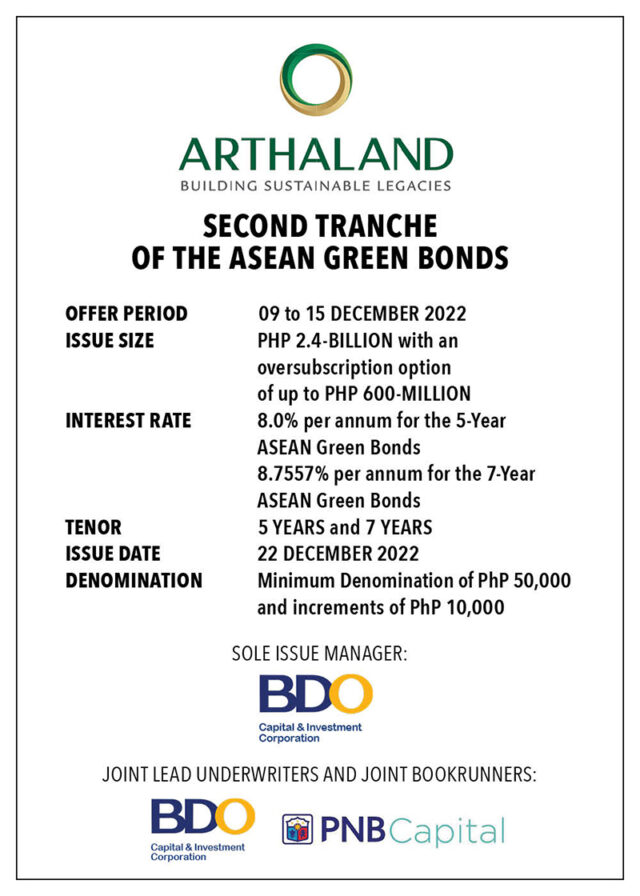
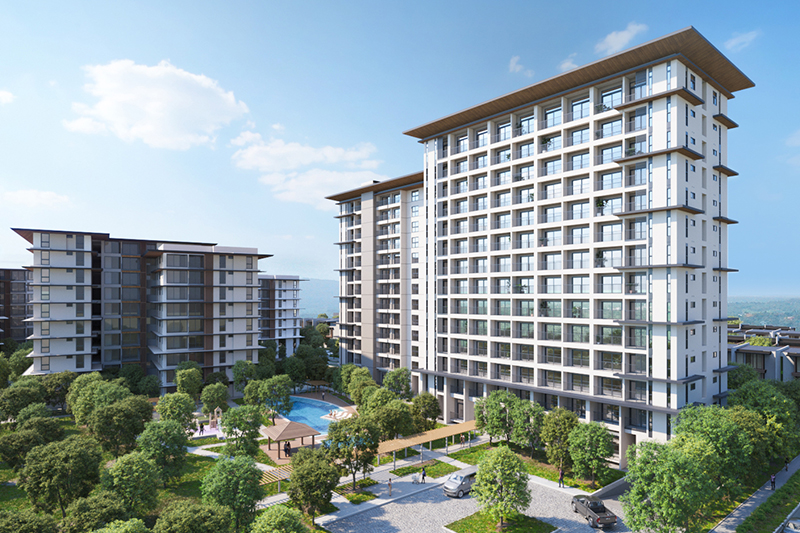
Arthaland, the foremost sustainable real estate developer in the Philippines, kicks off its public offering of up to Php3 billion ASEAN Green Bonds which will be issued in two tenors: 5 years at 8.0% pa and 7 years at 8.7557% pa. The ASEAN Green Bonds are scheduled to be issued and listed on the Philippine Dealing and Exchange on December 22, 2022. The offer comprises the second tranche of Arthaland’s Php6 billion ASEAN Green Bond Program for which Arthaland established the first Green Framework by a real estate company in the Philippines.
Arthaland’s commitment to sustainability
The Offer aligns with Arthaland’s unparalleled commitment to sustainability. Arthaland is the only developer which has a development portfolio composed entirely of sustainable projects certified under multiple global and national standards for green buildings.
Arthaland was the first real estate developer in Asia and the first signatory from the Philippines to the Net Zero Carbon Building Commitment of the World Green Building Council. As a signatory to this program, Arthaland officially committed to decarbonize its portfolio by 2030. By doing so, it placed itself and the Philippines in the forefront of the global initiative for climate action.
Arthaland Century Pacific Tower (BGC, Taguig). The first Net Zero Carbon-certified building in the world.
Arthaland’s flagship office project, the Arthaland Century Pacific Tower, was recognized as the first Net Zero Carbon Project in the world as certified under the EDGE Green Building Program of the IFC.
“Climate change is pervasive and does not discriminate. That is why everyone should join hands to help address it. Our ASEAN Green Bonds allow people to participate in climate solutions to help make the world greener.” Jaime C. González, Arthaland Vice-Chairman and President
Key milestones
This year, Arthaland celebrated several milestones on its path towards dramatically growing its portfolio of high quality, sustainable projects in key urban areas in Metro Manila, Cebu and Laguna.
Handover of two of Arthaland’s largest projects
Cebu Exchange and Savya Financial Center, two of Arthaland’s largest multi-certified sustainable projects, are operational in 2022. Both projects successfully initiated handover to its buyers in accordance with pre-pandemic handover schedules.
Launch of new residential projects
Arthaland launched two new residential projects within the second half of 2022:
Una Apartments is the first of six mid-rise residential towers in Sevina Park, an eight-hectare master-planned sustainable residential community in Binan, Laguna.
Una Apartments (Biñan, Laguna). On-track to the be the first multi-certified sustainable mid-market development in the Philippines.
Eluria, Arthaland’s multi-certified luxury condominium project in Legazpi Village, Makati, offers spacious limited-edition designer homes differentiated by its unsurpassed quality, attention to detail, and exceptional white glove services.
Eluria (Legazpi Village). Envisioned to be the most exclusive residential address in Makati, pushing the boundaries of sustainable living.
The launch of these new residential projects adds to the on-going residential projects including the Sevina Park Villas, a low-density community within the Sevina Park estate, and Lucima, the first premiere, sustainable condominium project in Cebu Business Park, Cebu. Given these, Arthaland has visibility in achieving approximately five-fold growth in its development portfolio in the next few years.
Lucima (Cebu City). Poised to be the country’s first quadruple-certified sustainable high-rise residential development in Southern Philippines.
Use of proceeds for the offer
Arthaland’s ASEAN Green Bond offering comes at a time when Arthaland is preparing for the next stage in its story. A substantial portion of the proceeds from the offer will fund the necessary investment of Arthaland in new certified sustainable residential projects which will allow Arthaland the flexibility to develop and launch within the next 10 years or more.
The intended use of proceeds for the offer complies with Arthaland’s Green Framework which provides the basis for the issuances of green bonds and loans, and which enables the Company to use the proceeds to finance a portfolio of eligible projects relating to green buildings.
PhilRatings assigned an issue credit rating of PRS Aa with a Stable Outlook for this offer. Obligations rated PRS Aa are of high quality and are subject to very low credit risk. The issuer’s capacity to meet its financial commitment on the obligation is very strong. A Stable Outlook is assigned when a rating is likely to be maintained or to remain unchanged in the next 12 months.
“With the built sector generating close to 40% of annual global CO2 emissions, our commitment to sustainability stems from the desire to provide a better tomorrow for future generations. There is more work to be done, and we hope that, with the support from regulators and the financial sector, more institutions will be motivated to issue green financial instruments.” Jaime C. González, Arthaland Vice-Chairman and President.
Spotlight is BusinessWorld’s sponsored section that allows advertisers to amplify their brand and connect with BusinessWorld’s audience by enabling them to publish their stories directly on the BusinessWorld Web site. For more information, send an email to online@bworldonline.com.
FOREIGN DIRECT INVESTMENT (FDI) net inflows dropped by 8% in September, amid monetary tightening and a looming global economic slowdown.
Data released by the Bangko Sentral ng Pilipinas (BSP) on Monday showed FDI net inflows declined by 7.9% to $626 million in September from $680 in the same month in 2021. This was also 19.1% lower than the $774-million FDI net inflows in August.
The September figure was the lowest monthly net inflow of FDI in two months, or since the $502 million in July.
“The decline in FDI net inflows reflected the decrease in non-residents’ net investments in debt instruments, which more than offset the growth in their net equity capital placements,” the central bank said in a statement.
BSP data showed non-residents’ net investments in debt instruments of local affiliates fell by 36.8% to $351 million in September, from $555 million in the same month in 2021.
Meanwhile, investments in equity and investment fund shares more than doubled to $276 million in September, from $125 million a year ago.
Reinvestment of earnings also slipped by 4.8% year on year to $88 million in September.
ING Bank N.V. Manila Senior Economist Nicholas Antonio T. Mapa said in an e-mail that the FDI net inflow remained positive in September, but was lower year on year.
“One positive (factor), however, from the data release was the fact that ‘fresh’ FDI or equity other than reinvestment of earnings was up,” he added.
Non-residents’ net investments in equity capital (other than reinvestment of earnings) surged by 474.5% to $187 million in September, from $33 million in the same month last year.
Broken down, equity capital placements rose by 158.7% to $230 million, while withdrawals dropped by 24.2% to $43 million.
The equity placements were mainly from Singapore, Japan and the United States, and invested mostly in financial and insurance, manufacturing, and real estate industries.
GLOBAL JITTERS For the first nine months of the year, FDI net inflows dropped by 10% to $6.7 billion from $7.5 billion in the comparable year-ago period.
“FDI remained subdued amid lingering concerns on global economic slowdown, higher inflation, and the depreciation of the peso,” the BSP said.
BSP data showed foreign investments in debt instruments declined by 12% year on year to $4.69 billion in the January-to-September period.
Investments in equity and investment fund shares also dropped by 5.2% to $2.02 billion in the nine-month period.
Net foreign investments in equity capital dipped by 2.9% to $1.1 billion. Equity capital placements slipped by 12.2% to $1.3 billion, while withdrawals fell by 43% to $192 million.
Most of these placements were from Japan, Singapore, the United States, and Malaysia.
Reinvestment of earnings dropped by 7.7% to $924 million in the January-to- September period.
Mr. Mapa noted overall FDI was down by 10% in the January-to-September period “with investors still possibly worried about the global and domestic economic challenges faced by the Philippines in 2023.”
“Apart from a seasonal slowdown, it seems FDI is strained on down factors in September, including rising inflation, peso weakness, and rate hikes,” Security Bank Corp. Chief Economist Robert Dan J. Roces said.
Inflation zoomed to 6.9% in September, bringing the average inflation in the nine-month period to 5.1%. Inflation remained elevated as food and transport costs continued to spike.
At its Sept. 22 meeting, the BSP raised its benchmark interest rate by 50 basis points (bps) to 4.25% to curb inflation.
The peso finished that month’s trading at P58.625 per dollar on Sept. 30. In September alone, the peso has weakened by P2.48 or 4.2% from its Aug. 31 close of P56.145.
The decline in FDI net inflows is expected to continue through 2023.
“We expect this downtrend to persist through 2023 with the lagged impact of the Fed’s aggressive rate hikes to tamp US inflation, our own rate hike’s effects, and expectations of a global economic slowdown,” Mr. Roces said.
“If the risk factors prove to be tame, then investor confidence may improve and FDI should recover,” he added.
The US Federal Reserve has raised its policy interest rate by 375 bps since March, and is expected to continue policy tightening to cool inflation at its Dec. 13-14 meeting.
The BSP is widely expected to raise policy rates by 50 bps on Thursday. A BusinessWorld poll conducted last week showed 14 out of 15 analysts expect the Monetary Board to continue hiking borrowing costs.
The BSP lowered its projection for FDI net inflows to $8.5 billion by end-2022, from $10.5 billion previously.
The BSP expects FDI net inflows at $11 billion by end-2023, lower than its previous estimate of $12.5 billion. — Keisha B. Ta-asan
THE PHILIPPINE BANKING industry’s bad loans fell for the eighth straight month in October, bringing the nonperforming loan (NPL) ratio to its lowest in 26 months, data from the Bangko Sentral ng Pilipinas (BSP) showed.
Based on BSP data, banks’ gross NPL ratio dropped to 3.41% in October, from 4.42% a year ago and 3.42% in September.
The October bad loan ratio was the lowest in more than two years or since 2.84% in August 2020.
Soured loans declined 14.9% to P411.632 billion in October, from P483.98 billion a year earlier. This was also 0.7% lower than P414.606 billion in September.
Loans are considered nonperforming once they remain unpaid for at least 90 days after the due date. They are deemed as risk assets as borrowers are unlikely to settle these loans.
“Falling NPLs is consistent with the nearly full reopening of the economy,” Bank of the Philippine Islands (BPI) Lead Economist Emilio S. Neri, Jr. said in a Viber message.
Since March this year, Metro Manila and most provinces in the country have been under the most lenient alert level, allowing businesses to operate at full capacity.
“With output finally returning to pre-pandemic (levels) and with more businesses restoring a healthy balance in their cash flows, fewer have difficulty meeting their loan obligations,” Mr. Neri said.
According to BSP data, banks’ gross loan portfolio expanded by 10% to P12.06 trillion in October from P10.96 trillion a year ago. However, it dipped 0.4% from P12.11 trillion in September.
Past due loans decreased by 13.9% to P486.753 billion from P565.777 billion a year earlier. These borrowings were equivalent to 4.03% of the industry’s total loan portfolio, down from 5.16% a year earlier.
Meanwhile, restructured loans slipped 3.1% to P327.355 billion from P337.818 billion in October last year. This brought the ratio to 2.71% in October, from 3.08% a year ago.
Banks continued to beef up loan loss reserves to P429.204 billion, up by 3.8% from P413.376 billion. With this, its ratio stood at 3.56% in October.
Lenders’ NPL coverage ratio — which shows the allowance for potential losses due to bad loans — surged to 104.27% from 85.41% a year earlier.
The month-on-month easing of the NPL ratio reflected the government’s efforts to bring the economy to greater normalcy, Rizal Commercial Banking Corp. Chief Economist Michael L. Ricafort said in a Viber message.
He cited measures such as the voluntary wearing of face masks, easing of travel restrictions, and the resumption of face-to-face schooling in August.
Mr. Ricafort said this allowed borrowers greater capacity to repay loans, as more jobs were created and revenues increased.
“Increased confidence by borrowers such as consumers, businesses, industries, and other institutions increased loan growth among the fastest in nearly four years,” he said.
Earlier data released by the central bank showed bank lending continued to grow at its fastest pace in nearly four years, expanding by 13.9% year on year in October to P10.56 trillion. This was slightly quicker than the 13.4% loan growth in September.
“The improving NPL numbers also seem to suggest that as long as credit conditions improve, we don’t need ultra-low interest rates to keep borrowers afloat,” Mr. Neri said.
The BSP has raised benchmark interest rates by 300 basis points (bps) so far this year, bringing the overnight reverse repurchase rate to 5% to tame inflation.
Headline inflation at the national level rose to 8% year on year in November from 7.7% in October. It was the eighth straight month that inflation exceeded the central bank’s 2-4% target.
A BusinessWorld poll last week showed 14 out of 15 analysts expect the Monetary Board to continue hiking borrowing costs at its Dec. 15 meeting.
For 13 analysts, the central bank may deliver a 50-bp rate increase, while one economist sees a 25-bp hike.
BSP officials earlier said Philippine banks’ NPL ratio may peak at 8.2% in 2022.
As of end-December 2021, the ratio stood at 3.99%. — Keisha B. Ta-asan