Home Blog Page 5512

PHL expecting healthcare technology transfer from Taiwan after MoU signing

EXPO.TAIWAN-HEALTHCARE.ORG

By Alyssa Nicole O. Tan, Reporter

THE Philippine healthcare industry could benefit from technology transfer following the signing of an agreement between Taiwan’s Institute for Biotechnology and Medicine Industry (IBMI) and hospitals in the Asia-Pacific, a Philippine hospital industry official said.

“Initially, it is more of establishing relationships between the hospitals and of course, the Taiwan group of companies and then from there, we will see what benefits we will get eventually from having this relationship,” Private Hospitals Association of the Philippines, Inc. (PHAPi) President Jose Rene D. de Grano told BusinessWorld on the sidelines of the Taiwan Healthcare Expo held in Taipei.

“Most probably, it’s going to be more of a transfer of technology, transfer of artificial intelligence, those things and that will probably improve, by a lot, the healthcare system in our country, because you know, our technology in the Philippines is (far behind),” he added.

Mr. De Grano said the memorandum of understanding (MoU) will facilitate Taiwan-Philippines collaboration in the fields of smart hospitals, cancer treatment, and biotechnology.

“The Philippine Hospital Association welcomes any initiative that paves the way to building a strong operation and collaboration with medical industry stakeholders in Taiwan,” Philippine Hospital Association (PHA) President Edmundo B. Lopez said in a speech. “This will surely benefit those in our respective health centers in pursuit in our attainment of our health reform agenda, with the continuous development and improvement of our healthcare system.”

Mr. Lopez said the MoU will help improve the standard of care and safety in the Philippine healthcare.

“On behalf of the Philippine Hospital Association, I am delighted to sign this MoU with IBMI to collectively facilitate collaboration and initiatives to name a few, in the field of smart hospitals, safe and quality healthcare innovations, advancement in prevention, diagnostics and treatment technologies, friendly hospitals, and digitalization enhancements,” he said.

“The Healthcare Expo is an important platform for public-private cooperation in the development of our next-generation health industry. It is also a key venue for showcasing the impressive results of Taiwan’s cross-disciplinary collaboration across healthcare, biotechnology, and digital technology,” Taiwan President Tsai Ing-wen said during her opening speech at the expo.

She noted that Taiwan has conducted exchanges in medicine and public health in accordance with its New Southbound Policy partners across the region, including the Association of Southeast Asian Nations (ASEAN), South Asia, Australia and New Zealand.

“Our Ministry of Health and Welfare recently announced that it will loosen regulations to let hospitals in Taiwan more easily establish overseas branches in Southeast Asia, helping further expand Taiwan’s regional healthcare,” she said.

The Taiwan government, industry and academics, she added, will work with its biotechnology industry “to further improve public welfare, create more business opportunities, and continue to distinguish itself on the international stage.”

IBMI President Chi-Huey Wong told BusinessWorld at the forum that “the next step probably (will involve) hospitals here and (continuing the discussion) about what is the best business model for collaboration.”

The information technology industry must work with healthcare professionals to come up with more efficient and cost-effective ways of managing hospitals, he added, noting that this may be of “great interest” to the Philippines.

“I think it’s important to know each other, and then to understand, for example, the difference in culture between the two countries, and we may come up with a good business model,” Mr. Wong said.

He underscored the importance of understanding the needs of partners before arriving at a mutually acceptable compromise.

Mr. Wong said that the IBMI first reached out to the Philippines in 2017, but described the rate of progress as slow.

“We want to speed up these kinds of collaboration, we need to have more interactions,” he said.

Philippine Medical Association President Jose P. Santiago, Jr. told BusinessWorld that the Philippine healthcare environment has changed since the pandemic hit.

“We’re now aware of COVID, and continuously question how we can deal with COVID in the future, just in case there’s another surge,” he said.

Mr. Santiago said that the Philippines should take advantage of the interest expressed by Taiwan, since “we have to really redirect our healthcare system and accelerate the course of its development.”

He noted interest in improving the Philippines’ capabilities in artificial intelligence, biotechnologies, and stem cell therapy, calling the expo a venue for finding partners that can help elevate the standard of care in the Philippines.

“Our organization will strive to encourage opportunities for further cooperation in the expansion of our networks overseas, especially here in Taiwan,” Mr. De Grano said.

“We expect future cooperation and coordination to have matchmaking events like this and conferences between the two countries and other ASEAN countries,” he added. “Probably by next year, we will have to communicate with them. I hope it will happen sooner than later.”

The Philippines can hold events to exchange ideas and technologies with businesses, hospital and industry experts from Taiwan, Mr. De Grano said, noting as well opportunities to exchange manpower through training.

RCEP seen signed by early 2023

REUTERS

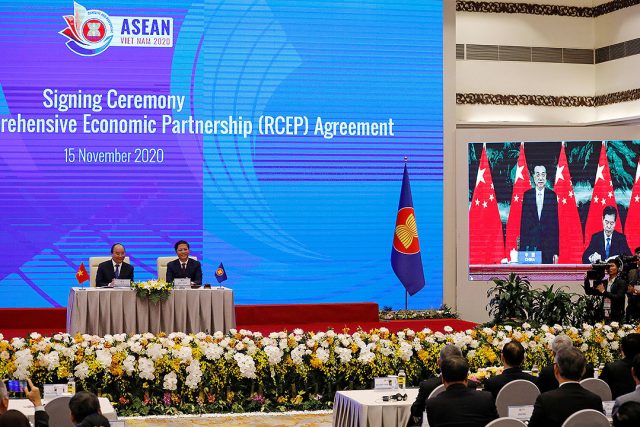
THE Department of Trade and Industry (DTI) said the Philippines could finally sign on to the Regional Comprehensive Economic Partnership (RCEP) trade agreement by early next year.

Trade Undersecretary Ceferino S. Rodolfo told reporters on the sidelines of the recent National Export Congress 2022 in Pasay City that the DTI is hoping that the Senate will give its concurrence to RCEP by the first quarter.

“We have been in constant coordination with the senators with respect to the RCEP and other free trade agreements (FTAs) that we are negotiating… Given the importance of the RCEP and the urgency, we remain optimistic that this will be considered positively by the Senate. Hopefully first quarter of next year,” Mr. Rodolfo said.

According to Mr. Rodolfo, the RCEP paperwork is currently with the Senate Committee on Foreign Relations following the transmission of the instrument of ratification from President Ferdinand R. Marcos, Jr.

“On Dec. 6, the Senate read the RCEP into the record. They calendared it and essentially passed it to the Senate Committee on Foreign Relations. The President has already transmitted the instrument of ratification to the Senate,” Mr. Rodolfo said.

“We will work with the Senate Committee on Foreign Relations so that we can respond to whatever questions they may still have about the RCEP with the view towards facilitating the Senate concurrence to the ratification,” he added.

Trade Secretary Alfredo E. Pascual has said that the Cabinet approved and requested the concurrence of the Senate, adding that Mr. Marcos has reviewed and given the go-ahead for RCEP ratification.

“When I asked President Marcos about the RCEP, he said that he has already reviewed it and that it is okay with him. In October… the Cabinet, as a whole, made a decision to request the concurrence of the Senate,” Mr. Pascual said.

The RCEP, billed as the world’s largest FTA, started taking effect in the various jurisdictions on Jan. 1. Participants include the 10 members of the Association of Southeast Asian Nations (ASEAN), Australia, China, Japan, South Korea, and New Zealand.

The Philippines and Myanmar are the only remaining countries that have yet to finalize their participation in RCEP.

The previous Congress failed to give its concurrence as some senators raised concerns about the lack of safeguards for the agriculture sector. Former President Rodrigo R. Duterte ratified the RCEP in September 2021. — Revin Mikhael D. Ochave

LGUs must step up crisis communication capacity

PHILIPPINE STAR/ MICHAEL VARCAS

LOCAL government units (LGUs) must ramp up their crisis and risk communication efforts through digitalization and technology upgrades in order to make them better prepared against the pandemic and other emergencies, according to the Philippine Institute for Development Studies (PIDS).

“Local governments have been at the forefront of the pandemic response since the COVID-19 crisis started in 2020. One of the most critical aspects of a pandemic response is risk communication and crisis communication,” PIDS said in a study written by Sheila V. Siar and Pauline Joy M. Lorenzo.

“The role of LGUs in crisis and risk communication is crucial to manage the risks of the COVID-19 pandemic and mitigate its negative impacts. However, with or without a pandemic, local officials are the government actors directly closest to citizens; thus, they play a prominent role in communication tasks. This responsibility becomes more crucial when a disaster strikes as its impacts and effects are felt most strongly at the local level,” it added.

The study said improving the information and communications technology infrastructure must leverage modern communication tools to improve government responsiveness.

“Affordable, fast, and reliable internet connection is also vital for government offices to use internet-based tools for service delivery and for the public to access government services,” it said.

The study cited the need for social media and messaging platforms to improve their responsiveness to citizen concerns, make them more accessible to the public, and increase organizational transparency and accountability.

“Hiring dedicated personnel for social media is essential to fully exploit the capabilities of different platforms and respond to public inquiries and concerns,” it added.

Social media analytics can also help promote effective communication, according to the study.

“While the government increasingly uses social media, there is limited use of data gathered from social media channels to measure performance and inform decisions and strategies. This can be attributed to the low usage of social media analytics due to a lack of awareness and knowledge,” PIDS said.

It recommended the establishment of social media listening or monitoring channels for problems and opportunities.

“Training and capacitating government personnel on analytics approaches is key to more effective use of social media in communicating and engaging with target audiences,” it added.

The study recommended capacity building in risk communication, science communication, and crisis communication.

“Capacitating government staff, particularly disaster risk reduction officers, health officers, and information officers on the abovementioned key subfields of strategic communication is essential for them to effectively carry out their communication functions during disasters and health emergencies,” it added.

It also said that training in public communication during health emergencies needs to be addressed, given the country’s limited experience in dealing with epidemics and pandemics.

PIDS recommended training LGU personnel on communication planning, monitoring, and evaluation.

“Whether or not the situation is a crisis, LGUs should have a strategic communication plan. A communication plan is essential in setting goals and objectives, identifying the audience, message, channels, timing, and resources, and specifying accountabilities,” it said.

“Along with a plan, a clear communication monitoring and evaluation system should be in place to track outcomes against targets, identify communication pitfalls and areas for improvement, and evaluate the success of communication interventions,” it added. — Luisa Maria Jacinta C. Jocson

Registered births, deaths continue to decline in first 8 months

PHILSTAR

REGISTERED births and deaths declined by 22.3% and 34.6% respectively from a year earlier in the eight months to August, the Philippine Statistics Authority (PSA) reported on Thursday.

Citing preliminary data from its Vital Statistics Report, the PSA said recorded births in the January-August period totaled 662,780, lower than the 852, 960 registered a year earlier.

Meanwhile, deaths fell to 366,918 from 560,839 a year earlier.

Calabarzon (Cavite, Laguna, Batangas, Rizal, Quezon) logged the most births and deaths with 100,118 and 54,533, respectively.

Births in the region accounted for 15.1% of all births in the Philippines while deaths accounted for 14.9%.

The National Capital Region logged 81,170 births during the first eight months against the year-earlier 100,680, for a decline of 19.4%. The capital region accounted for 12.2% of the total births in the Philippines.

Metro Manila reported 44,048 deaths or 12% of the national total.

In a separate statement, the PSA said ischaemic heart diseases, cerebrovascular disease, and neoplasms remained the leading causes of death in the first eight months.

Deaths due to ischaemic heart diseases during the period amounted to 67,601 or 18.4% of all deaths while cerebrovascular diseases totaled 37,936 or 10.3% of the national tally.

Neoplasms (37,470) accounted for a 10.2% share of the total.

Deaths associated with COVID-19 totaled 12,772 in the eight months to August, or 3.5% of all registered deaths.

The COVID-19-associated deaths included 8,963 cases or 2.4% of the total in which the virus had been identified at the time of death, making the disease the 11th leading cause of death during the period.

Deaths in which COVID-19 had not been identified amounted to 3,809 cases, accounting for 1% of the total.

Metro Manila recorded the most deaths due to COVID-19 with 3,176 or 24.9% of the national tally.

This was followed by Calabarzon with 2,017 (15.8%), and Central Luzon with 1,690 (13.2%).

Meanwhile, the Bangsamoro Autonomous Region in Muslim Mindanao logged the fewest COVID-19 deaths of any region with 35 cases during the period.

Vital Statistics data showed that registered marriages increased 11.4% year on year in the first eight months to 256,854.

Calabarzon posted the most marriages with 37,614 or 14.6% of the national total, while Metro Manila registered 31,444, or 27.4%.

The PSA’s COVID-19 death tally was based on death certificates lodged with health officers at the local government unit level.

This tally differs from the one maintained by the Department of Health, which is based on a surveillance system which counts only confirmed cases.

The Vital Statistics report was compiled from tallies generated by city or municipal Civil Registrars, consolidated by the PSA’s Provincial Statistical Offices, and then submitted to the Office of the Civil Registrar General. — Abigail Marie P. Yraola  

UN: Philippines lacks trained staff vs child abuse

PHILSTAR

THE UNITED Nations (UN) special rapporteur on the sale and sexual exploitation of children on Thursday said the Philippines lacked trained officials at the village level to monitor reports of child sexual abuse.

“I am concerned that local government politics negatively impacts the child protection structure due to regular changes of personnel,” Mama Fatima Singhateh, the UN special rapporteur on the sale and sexual exploitation of children, told a news briefing in Manila streamed live on Facebook.

She met with Justice Secretary Jesus Crispin C. Remulla at his office on Thursday to discuss government efforts to combat the exploitation of children online. The Department of Justice (DoJ) posted videos and photos of her courtesy on its Twitter page.

Mr. Remulla was joined by Justice Undersecretary Raul T. Vasquez, inter-agency task force on trafficking head Nicholas F. Ty and Justice spokesman Jose Dominic F. Clavano IV.

Ms. Singhateh said the government should train more prosecutors to handle child sexual exploitation cases.

Data from the DoJ dated July and sent to reporters on Thursday showed there were 1,914 victim-survivors of human trafficking last year. The agency said 33% of the total were minors.

At least two other special rapporteurs will visit the country to help bolster the country’s human rights initiatives, the Justice chief said last month.

The UN special rapporteurs on extralegal killings and freedom of expression are set to hold capacity-building programs in the country next year.

The coronavirus pandemic has worsened children’s vulnerability to violence and exploitation, the UN Children’s Agency (UNICEF) said in a report in April 2021.

“Globally, around 1.8 billion children live in 104 countries where violence prevention and response services have been disrupted due to COVID-19,” it said. “In the Philippines, the Office of Cybercrime of the DoJ reported a 260% increase in cyber-tips related to online sexual exploitation and abuse of children.”    

Violence against children takes many forms. It can be physical, emotional, or sexual, the UN agency said. “It happens in all countries and any setting — in a child’s home, community school and online.”

In the Philippines, even before the pandemic, children experienced high prevalence of violence whether at home, in school, the workplace, community or during dating, according to the 2015 National Baseline Study on Violence against Children by the Council for the Welfare of Children and UNICEF Philippines.

In August the DoJ, Interior and Local Government, Social Welfare and Information and Communications departments formed a task force to combat the online exploitation of children.

Mr. Remulla has said he would ask telecommunication companies to enforce filters to block malicious websites and payments possibly linked to child abuse.

The government will also coordinate with the United States Department of Homeland Security to track down foreigners exploiting kids.

Data from the Interior and Local Government department showed authorities conducted 227 operations combating online sexual exploitation and convicted 67 people behind illegal websites from 2017 to July 2022.

In 2017, UNICEF said one of three internet users were children below 18 and were at risk of harmful content and contact.

The National Bureau of Investigation (NBI) in March said the Philippine Internet Crimes Against Children Center, a separate task force, had rescued 134 sexually exploited children and arrested 15 offenders from 51 operations since last year.

The NBI that month also opened its Cyber Trafficking in Persons Monitoring Center, which tracks down human trafficking cases in cyber-space.

“Law enforcement agencies around the world know that the Philippines is one of the favorite places for these perverts who exploit children,” Mr. Remulla told a press briefing on Aug. 23.

“This is not a source of pride but a source of shame, which is why we are declaring war against the exploitation of children.” — John Victor D. Ordoñez

Marcos to attend APEC Summit in US in November, says ambassador

OFFICE OF THE PRESS SECRETARY

PHILIPPINE President Ferdinand R. Marcos, Jr. will attend the Asia Pacific Economic Cooperation (APEC) Summit in the United States in November, according to its ambassador to the US.

“President Marcos will be coming in November for the APEC meeting in the West Coast,” Philippine Ambassador Jose Manuel G. Romualdez told CNN Philippines on Thursday. “I am confirming that President Marcos will be attending together with all the leaders who have been invited to APEC.”

The presidential palace did not respond to a Viber message seeking comment.

The summit will be held in San Francisco, California on Nov. 12, US Vice-President Kamala D. Harris earlier said, noting that the US would work with APEC economies to pursue enhanced sustainability and decarbonization initiatives.

The Philippine president is also expected to meet with business groups during his stay in the US.

“By that time, we are ready to show the economic reforms and programs so that they will be enticed to come to Philippines,” Mr. Romualdez said.

Mr. Marcos attended the recent APEC meeting in Thailand, where he told global leaders threats such as climate change and conflicts all boil down to the fundamental concern of ensuring sufficient and sustainable food supply.    

“First, food security is a serious global problem,” he said in a speech at the APEC CEO Summit in Bangkok. “This is felt by every household, by every family, by everyone.”

“The issues that the world faces now — from climate change, to inflation, to war — are viewed by the ordinary Filipino through the lens of food security,” he said.    

The Philippine leader said climate change and food insecurity are “very closely interconnected,” noting that there have been steep declines in farm output and productivity due to changing weather patterns.

Mr. Marcos, 65, took the helm of the Philippine Agriculture department in June, vowing to boost local food production. 

He also asked his fellow leaders to continue reinforcing global health systems, not only against new and emerging variants of the coronavirus, but also against other infectious diseases that may emerge. 

Mr. Marcos said the global economy could not afford another series of lockdowns and travel bans that deflate consumer confidence, dampen tourism recovery and derail the stability of global markets. 

“Governments must continue to invest in pandemic preparedness and in ensuring the resilience of the global health system,” he said. “Adopting the One-Health approach and strengthening health surveillance systems for emerging and re-emerging infectious diseases, from the human-animal-environment interface, can be part of the solution.”

The Philippine leader said in his first address to Congress in June the country would no longer enforce lockdowns during the pandemic.   

Mr. Marcos also rallied Asia-Pacific leaders to do more to address the effects of climate change, which he said is “the most pressing existential challenge of our time.”   

He said global agreements that seek multilateral solutions to the climate crisis, particularly the United Nations Framework Convention on Climate Change and the Paris Agreement, have been in force “but not enough progress has actually been made as emissions continue to rise.” — A.N.O. Tan

Korean-funded Panguil Bay Bridge in Northern Mindanao more than halfway done 

DPWH

THE DEPARTMENT of Public Works and Highways (DPWH) announced on Thursday that the Korean-funded Panguil Bay Bridge, a sea crossing bridge project in Mindanao, is now 61% complete.  

The P7.375-billion bridge project will connect Tangub City in Misamis Occidental to Tubod town in Lanao del Norte, both within the Northern Mindanao Region.   

The department and its partners are accelerating the vast pipeline of superstructure construction activities for the Panguil Bay Bridge Project, which is at 61% to date,the DPWH said in a statement.  

The project is financed by a loan agreement between the Philippines and Korean Export Import Bank.  

The bridgenot only represents a long dream come true of the people of Lanao Del Norte and Misamis Occidental but a milestone highlighting how the design and construction of a modern bridge with sea offshore excavation depth of up to more than 50 meters has evolved,the department said.  

DPWH Secretary Manuel M. Bonoan said the administration hopes to expedite the completion of major infrastructure projects, including the Panguil Bay Bridge, to help the Philippines recover from the economic impact of the pandemic.  

On Wednesday, DPWH Senior Undersecretary Emil K. Sadain conducted a construction site inspection at the Panguil Bay Bridge project.   

Bridging the geographical gap between Tubod and Tangub City/Ozamis City area, the Panguil Bay Bridge will reduce travel time between Lanao Del Norte and Misamis Occidental from two hours to just seven minutes,the department noted.  

The project, which was officially started in 2020, is expected to be completed by December 2023.   

The construction was affected during this last quarter of 2022 by a climate in the project area that is often rainy with strong currents of Panguil Bay,the department said. Arjay L. Balinbin 

Bohol official says tourism code to address overpricing issues 

THE CHOCOLATE Hills in Bohol. — BOHOL.GOV.PH

A PROVINCIAL Board member of Bohol said price regulation for goods and services will be included in the proposed local tourism law after another issue of overcharging, this time involving van drivers.   

Board Member Tita V. Baja, chair of the committee on tourism and urban/rural development, said regulating the prices or commissions, may be considered in crafting the new Bohol Tourism Code, which is now 90% complete.”  

In a statement from the provincial government, Ms. Baja said one concrete step for regulation is mandatory accreditation from the local government.   

Ms. Baja has received reports that van drivers ferrying visitors to Chocolate Hills were demanding high commission from all-terrain vehicle operators while overcharging guests at the same time.  

Please dont do that,she said in the vernacular, noting that such practices would discourage visitors and affect the reputation of Bohol, one of the most popular tourist destinations in central Philippines.   

In August, a social media post about excessive pricing on food served at the Virgin Island prompted the provincial government to prohibit dining operations on the island.   

Meanwhile, a groundbreaking ceremony was held Wednesday in the town of Dauis for the Department of Tourisms (DoT) rest area project, the sixth so far in the country.    

Dauis is strategically situated between Tagbilaran City, the provincial capital, and Panglao, where the international airport and beach destinations are located, DoT said in a statement on Thursday.   

The Tourist Rest Area will have an information center, shop for local products, cafe, and restrooms, among other facilities. Rest areas have also been launched in Bukidnon, Davao del Norte, Baguio City, and two towns in Cebu.    

Construction will be funded by the Tourism Infrastructure and Enterprise Zone Authority, while the host local government unit will be in charge of management under the DoTs monitoring.   

Tourism Secretary Christina Garcia Frasco, who led the groundbreaking ceremony, also met with Bohols tourism stakeholders as part of her nationwide direct consultations initiative.   

As we move forward in this new era of tourism development, I hope for your continued collaboration in order to usher in the countrys economic recovery,she told the group.  

One of the main concerns raised was strengthening coordination with the Department of Environment and Natural Resources on the regulation and preservation of eco-cultural areas in the province, according to DoT.   

As of September 30, Bohol recorded more than 222,000 visitors this year, 24% higher than the 179,000 in full year 2021. MSJ

CIAC given oversight functions over privately-run Clark airport 

Clark International Airport
STOCK PHOTO | Image by BCDA.GOV.PH

GOVERNMENT-OWNED Clark International Airport Corp. (CIAC) has secured oversight functions over the privately-run Clark International Airport, according to its officer-in-charge.  

The Department of Transportation (DoTr) has tasked CIAC to exercise regulatory supervision and oversight of activities occurring within the Clark Civil Aviation Complex, including Clark International Airport,CIAC Officer-in-Charge Darwin L. Cunanan said in a statement on Thursday.  

Clark International Airport, located about 96 kilometers north of the capital, is operated by the Luzon International Premier Airport Development (LIPAD) Corp.   

The consortium is composed of Filinvest Development Corp., JG Summit Holdings, Inc., Philippine Airport Ground Support Services, Inc., and Changi Airports Philippines (I) Pte. Ltd., a wholly owned subsidiary of Changi Airports International.  

The DoTr gave CIAC the authority to represent the department in the functions of its administrative supervision over LIPADs airport operations, so we shall be working closely with LIPAD in ensuring that operations abide by international standards and other rules and regulations as provided for by the national government,Mr. Cunanan said  

The Transportation department exercises policy and operational supervision over the government-owned corporation.  

According to Mr. Cunanan, the DoTr wants CIAC to contribute to the overall efficiency of the Philippine air transportation system.”  

As the national governments aviation authority in Clark, we have been ordered to oversee the day-to-day operations of the airport simultaneous with our day-to-day management of aviation-related business activities within the civil aviation complex,he added. Arjay L. Balinbin 

Political dynasties, parliament representation raised in consultations for Bangsamoro, election codes

BW FILE PHOTO/ TSBASMAN

ADDRESSING political dynasties and ensuring fair representation in parliament were among the issues raised as members of the Bangsamoro transitional government held consultations this week for the proposed regional laws on elections and local governance.   

The latest round of discussions was held in the island provinces of Basilan, Sulu, and Tawi-Tawi, where groups of Bangsamoro Parliament members met with local leaders and multi-sector representatives.  

Among the concerns raised were the proposed (local governance) codes inclusivity, its provisions on qualifications and disqualifications for elective local positions, and anti-political dynasties,the Bangsamoro Parliament said in a statement.   

Deputy Speaker Laisa M. Alamia noted that a provision against political dynasties would be unprecedented in the country.  

There is currently no enabling Philippine law that prohibits members of the same family or clan from concurrently or consecutively running for the same or different positions within a locality or at the national level.   

Section 40 of the proposed Bangsamoro Local Governance Code, which lists the basis for disqualification, includes Those who are related within the second civil degree of consanguinity or affinity to any incumbent local official running for an elective position.” 

This covers positions within the same province, city, municipality, or barangay.   

Election watchdog National Citizens’ Movement for Free Elections (NAMFREL), during consultations in October for the draft Bangsamoro Electoral Code, also put forward the adoption of an anti-political dynasty provision.  

NAMFREL recommended that, Candidates must not be related within the second civil degree of consanguinity or affinity to any incumbent elected national official or to any incumbent elected regional, provincial, city, municipal, or barangay official.”  

Meanwhile, officials in Tawi-Tawi, the farthest province from the southern mainland Mindanao, raised the need to consider the geographical characteristic of island localities for defining districts in the Bangsamoro region.   

The redistricting will determine representation in the Bangsamoro Parliament, whose members will be also be voted.  

Section 10 of Article 7 of the Bangsamoro Organic Law provides that parliamentary districts shall be apportioned based on population and geographical area, provided that each district shall comprise, as far as practicable, contiguous, compact, and adjacent territorial jurisdiction.”  

Tawi-Tawi Provincial Board member Dayang Carlsum S. Jumaide, who represents the womens sector, stressed the need to take into account the islands population and its remote location.  

Although the redistricting for parliamentary representation under the Bangsamoro Organic Law states that districts must be contiguous, compact, and adjacent, Island municipalities like those in Tawi-Tawi are separated by vast water, which criteria (contiguous, compact) may not apply as we perceive and believe, Ms. Jumaide said. 

Parliament Member John Anthony L. Lim, who is from Tawi-Tawi, agreed and said, Financial viability should be one of the criteria in apportioning the parliamentary districts to give a chance to smaller local government units to have representatives in the Parliament.”   

Bangsamoro Chief Minister Ahod B. Ebrahim has earlier committed to have both the Bangsamoro Electoral and Local Governance Codes passed within the first quarter next year.   

Another series of public consultations are scheduled this month in the regional capital Cotabato City, the provinces of Maguindanao and Lanao del Sur, and the regions Special Geographic Area. Marifi S. Jara

P6.5B needed for proposed subsidy on informal workers’ social insurance contribution  

A MEAT vendor at a public market in Manila qualifies as an informal worker based on House Bill 347 or the Magna Carta for Workers in the Informal Economy. — PHILIPPINE STAR/ RUSSELL PALMA

AROUND P6.5 billion in public funds will be needed annually to cover a proposed subsidy for the social insurance contribution of informal sector workers, according to the lawmaker who recommended the provision.   

Rep. Arlene D. Brosas of womens rights party-list Gabriela said the latest estimate is based on about 17 million Filipinos considered to be working in the informal economy.  

Last time (it was estimated), it was around the amount of P6.5 billion,she told BusinessWorld in a Viber message in mixed English and Filipino.   

In a separate text message, she said the number of informal workers should ideally not increase significantly if government can set up programs and policies on sustainable job creation.  

Supposedly workers in the informal economy do not increase because you have an industry that provides you a job, pays you, and establishes your rights. If more and more people are entering the informal economy, something is wrong with the governments management, she said.  

Ms. Brosas made the subsidy recommendation during the House committee meeting on labor and employment on Wednesday, where House Bill 347 or the Magna Carta for Workers in the Informal Economy was tackled.   

She said government can subsidize the monthly contribution of informal workers to the Social Security System (SSS), the state-run insurance program and pension fund for the private sector.  

The lawmaker said her proposal includes allinformal economy workers in line with the spirit of the proposed law.    

Under House Bill 347, informal economy workers include those who are self-employed, members of cooperatives, non-regular employees, agricultural and fishery workers, and those in legal but unrecognized or unregulated employment relationships, among others.   

We are only helping them (informal economy workers) up until the time that they can find a formal work or job,Ms. Brosas said in Filipino during a Makabayan bloc press conference on Thursday.   

Kabataan Party-list Rep. Raoul Danniel A. Manuel noted in the same press conference that the number of self-employed workers increased during the COVID-19 pandemic. Beatriz Marie D. Cruz

2023 bar exams set for September 

PHILIPPINE STAR/RUSSELL PALMA

THE SUPREME Court (SC) on Thursday confirmed that next year’s bar examinations will be held in September, earlier than the usual November schedule, which would allow for an earlier release of results.   

In a bulletin, the tribunal said the test for aspiring lawyers will be held on Sept. 17, 20 and 24.  

“The 2023 bar examinations shall thus proceed as it is nowdigitalized and regionalized, with a further-condensed schedule and carefully-streamlined scope for administrative efficiency,” said Associate Justice Ramon Paul L. Hernando, designated 2023 bar exams chairperson.  

Topics that tackle similar subject matter will be combined to modernize the implementation of the exams, he said in a statement on Dec. 4.  

This year’s exams were held on November 10, 13, 15 and 20 at 14 testing sites across the country.  

Last year’s exams were the first to be administered digitally and with multiple sites.  

Mr. Hernando noted that holding the exams in September will allow bar passers to seek employment earlier.  

A total of 8,241 takers passed the 2020/21 bar exams, which translates to a 72.8% passing rate.  

Chief Justice Alexander G. Gesmundo had said the bar exams would continue the digital format to take full advantage of new technology.    

“Exploit your last semester in law school to the fullest and your law review courses to the last minute as opportunities for mastery,” Mr. Hernando said addressing examinees for next year’s exams. John Victor D. Ordoñez