Home Blog Page 5514

Banks’ NPL ratio falls to 26-month low in Oct.

PHILIPPINE STAR/KRIZ JOHN ROSALES

THE PHILIPPINE BANKING industry’s bad loans fell for the eighth straight month in October, bringing the nonperforming loan (NPL) ratio to its lowest in 26 months, data from the Bangko Sentral ng Pilipinas (BSP) showed.

Based on BSP data, banks’ gross NPL ratio dropped to 3.41% in October, from 4.42% a year ago and 3.42% in September.    

The October bad loan ratio was the lowest in more than two years or since 2.84% in August 2020.    

Soured loans declined 14.9% to P411.632 billion in October, from P483.98 billion a year earlier. This was also 0.7% lower than P414.606 billion in September.

Loans are considered nonperforming once they remain unpaid for at least 90 days after the due date. They are deemed as risk assets as borrowers are unlikely to settle these loans.

“Falling NPLs is consistent with the nearly full reopening of the economy,” Bank of the Philippine Islands (BPI) Lead Economist Emilio S. Neri, Jr. said in a Viber message.

Since March this year, Metro Manila and most provinces in the country have been under the most lenient alert level, allowing businesses to operate at full capacity.

“With output finally returning to pre-pandemic (levels) and with more businesses restoring a healthy balance in their cash flows, fewer have difficulty meeting their loan obligations,” Mr. Neri said.

According to BSP data, banks’ gross loan portfolio expanded by 10% to P12.06 trillion in October from P10.96 trillion a year ago. However, it dipped 0.4% from P12.11 trillion in September.   

Past due loans decreased by 13.9% to P486.753 billion from P565.777 billion a year earlier. These borrowings were equivalent to 4.03% of the industry’s total loan portfolio, down from 5.16% a year earlier.

Meanwhile, restructured loans slipped 3.1% to P327.355 billion from P337.818 billion in October last year. This brought the ratio to 2.71% in October, from 3.08% a year ago.

Banks continued to beef up loan loss reserves to P429.204 billion, up by 3.8% from P413.376 billion. With this, its ratio stood at 3.56% in October.

Lenders’ NPL coverage ratio — which shows the allowance for potential losses due to bad loans — surged to 104.27% from 85.41% a year earlier.

The month-on-month easing of the NPL ratio reflected the government’s efforts to bring the economy to greater normalcy, Rizal Commercial Banking Corp. Chief Economist Michael L. Ricafort said in a Viber message.

He cited measures such as the voluntary wearing of face masks, easing of travel restrictions, and the resumption of face-to-face schooling in August.

Mr. Ricafort said this allowed borrowers greater capacity to repay loans, as more jobs were created and revenues increased.

“Increased confidence by borrowers such as consumers, businesses, industries, and other institutions increased loan growth among the fastest in nearly four years,” he said.

Earlier data released by the central bank showed bank lending continued to grow at its fastest pace in nearly four years, expanding by 13.9% year on year in October to P10.56 trillion. This was slightly quicker than the 13.4% loan growth in September.

“The improving NPL numbers also seem to suggest that as long as credit conditions improve, we don’t need ultra-low interest rates to keep borrowers afloat,” Mr. Neri said. 

The BSP has raised benchmark interest rates by 300 basis points (bps) so far this year, bringing the overnight reverse repurchase rate to 5% to tame inflation.

Headline inflation at the national level rose to 8% year on year in November from 7.7% in October. It was the eighth straight month that inflation exceeded the central bank’s 2-4% target.

A BusinessWorld poll last week showed 14 out of 15 analysts expect the Monetary Board to continue hiking borrowing costs at its Dec. 15 meeting.

For 13 analysts, the central bank may deliver a 50-bp rate increase, while one economist sees a 25-bp hike.

BSP officials earlier said Philippine banks’ NPL ratio may peak at 8.2% in 2022.

As of end-December 2021, the ratio stood at 3.99%. — Keisha B. Ta-asan

Foreign chambers urge Senate action on Open Access bill

A teacher uses her laptop at an elementary school in Manila in this undated file photo. — PHILIPPINE STAR/ RUSSELL PALMA

THE JOINT Foreign Chambers (JFC) called for Senate action on the proposed Open Access in Data Transmission Act, which is aimed at improving internet service in the country.

The House of Representatives on Monday approved House Bill No. 6 or the Open Access bill on third and final reading.

“The members of the JFC expressed optimism that since the bill was approved early in the 19th Congress, the Senate will have enough time to deliberate and approve the measure, especially considering no less than the Senate President filed a counterpart to the Open Access bill filed by House Speaker Ferdinand Martin Romualdez, Jr.,” the foreign chambers said in a statement.

The Open Access bill was also approved by the House in the 17th and 18th Congress, but failed to hurdle the Senate both times.

The measure seeks to promote fair and open competition by easing barriers to entry in the telecommunications industry.

“The proposed Open Access in Data Transmission Act is critical to establishing a forward-looking and future-ready digital policy framework for the Philippines,” the JFC said.

The measure aims to “create the space” that will allow different service providers to build and operate data networks, giving broadband users more choices.

The Senate counterpart measures have been referred to the Committee on Science and Technology, which is chaired by Senator Alan Peter S. Cayetano.

The JFC previously said in a position paper sent to the House Committee on Information and Communications Technology that the passage of the bill would help provide fast, reliable, and affordable internet and data service in the country.

“Enactment of the bill will unlock the market and develop a competitive environment to the benefit of the Filipino public. It lowers regulatory barriers and costs of entry for market players offering internet service and promotes fair and open competition at different segments of the data transmission network,” the JFC said. 

“This will significantly improve data transmission services (faster internet speed and lower internet costs) throughout the country,” it added.

The Philippines ranked 55th out of 117 countries in the Digital Quality of Life Index 2022 released by virtual private network service provider Surfshark last September. Out of the five categories, the Philippines performed the worst in internet affordability, ranking 98th globally, down 26 places from 72nd a year prior.

“Internet in the Philippines is not affordable compared to global standards,” Surfshark said at that time.

Signatories to the JFC statement include the American Chamber of Commerce of the Philippines, Australian-New Zealand Commerce of the Philippines, Canadian Chamber of Commerce of the Philippines, European Chamber of Commerce of the Philippines, Japanese Chamber of Commerce & Industry of the Philippines, Korean Chamber of Commerce of the Philippines, and Philippine Association of Multinational Companies Regional Headquarters, Inc. — Revin Mikhael D. Ochave

Challengers sought for SMC’s Nasugbu-Bauan project

REUTERS

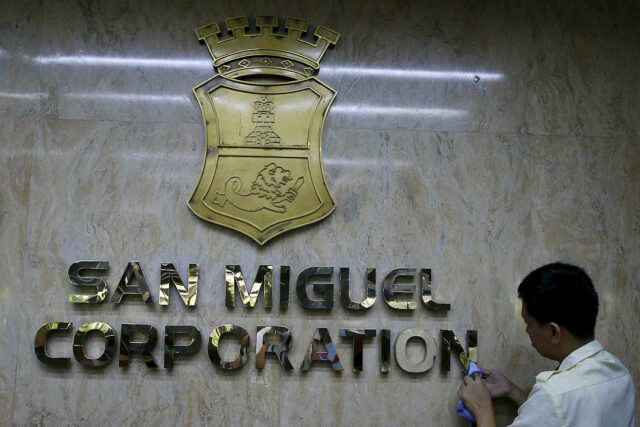
THE BATANGAS GOVERNMENT is looking for challengers for San Miguel Holdings Corp.’s proposal to build a 60.90-kilometer toll road from Nasugbu to Bauan.

In a newspaper advisory, the provincial government called for the submission of comparative proposals for the Nasugbu-Bauan Expressway (NBEX) joint-venture project with San Miguel Holdings, a unit of San Miguel Corp. (SMC).

The Batangas Provincial Selection Committee completed negotiations with San Miguel Holdings, the original proponent for the NBEX project, on Oct. 6 as part of the competitive challenge process.

“Under the negotiated terms of the joint-venture agreement, the private sector proponent will finance, design, construct, supervise, operate and maintain [the toll road] for a concession period of 35 years,” Batangas Provincial Selection Committee Chairperson Celia L. Atienza said in the advisory.

The four-lane NBEX will traverse the municipalities of Nasugbu, Tuy, Balayan, Calaca, Lemery, San Nicolas, Agoncillo, Taal, Sta. Teresita, Alitagtag, San Luis, and Bauan. It will have at least five access or interchange points at different locations from Nasugbu to Bauan.

Ms. Atienza said the committee will accept comparative proposals from private sector companies until Feb. 10, 2023.

The private sector proponents should have undertaken and completed a similar project under a similar arrangement, she added. Challengers “must acknowledge the right of the original proponent to match the best-qualified proposal submitted in the competitive challenge,” Ms. Atienza said.

Ms. Atienza said the province also requires an undertaking from the challengers that they will not “seek and obtain a writ of injunction or prohibition or restraining order… to prevent or restrain the competitive challenge process, the award of the project, and carrying out the project.”

An undertaking that the challengers will “not institute any criminal, civil, and/or administrative cases against the officials of the Provincial Selection Committee” is also required.

Without compliant comparative proposals submitted by Feb. 10, the NBEX project will be awarded to San Miguel Holdings.

To be eligible, the private sector proponent should be at least 60% owned or controlled by Filipinos. For a consortium with local and foreign companies, Filipinos should have at least 60% interest in the group.

The private sector proponent should also have a net worth of at least P15.9 billion or its equivalent in foreign currency as of its latest audited financial statement.

The challenger should also provide a letter from a bank indicating its good financial standing and that it is qualified to obtain credit to finance the project of at least P37.1 billion.

It should also have designed, constructed and operated a toll road of at least 60 kilometers, as well as used a toll collection system capable of integrating with other systems.

If it does not have the required construction experience, the challenger can submit its development experience of having undertaken a single tollway or similar project worth at least P53 billion.

San Miguel Holdings was also granted by the Cavite provincial government the original proponent status for the Cavite-Batangas Expressway (CBEX) project. The Cavite government is also seeking interested parties to submit comparative proposals for the project.

The CBEX project is a 27.06-kilometer toll road traversing through the municipalities of Silang, Amadeo, Tagaytay, Indang, Mendez, and Alfonso in Cavite, as well as Nasugbu in Batangas where a San Miguel company also operates a toll expressway, the 41.9-kilometer Southern Tagalog Arterial Road, which is commonly known as STAR Tollway. — Arjay L. Balinbin

Meralco tells SPPC: Pay added cost of market-priced power

BW FILE PHOTO

MANILA ELECTRIC Co. (Meralco) has asked a unit of SMC Global Power Holdings Corp. to pay the added cost it has been incurring for sourcing power from the spot market when the latter stopped supplying to the electricity distributor.

In a statement on Monday, Meralco said it had told South Premiere Power Corp. (SPPC) in a letter dated Dec. 12 to pay the difference between their contract price and the price at the Wholesale Electricity Spot Market (WESM), to which the utility is exposed amid a temporary restraining order (TRO) on their power supply contract.

“Meralco has been exhausting all efforts to protect its customers from potentially higher generation costs, while ensuring continuity of stable, reliable, and least cost power under the current circumstances,” the listed company said.

Meralco’s claim versus SPPC covers the additional costs it has been incurring during the 60-day TRO imposed on the parties’ power supply agreement (PSA) that was issued by the Court of Appeals in favor of SPPC.

The company said that since the cessation of supply starting on Dec. 7, it has been sourcing the 670-megawatt contract capacity from the spot market. SMC Global Power is the power arm of the listed conglomerate San Miguel Corp. (SMC).

The TRO was sought by SMC Global Power after the Energy Regulatory Commission (ERC) denied a petition it filed jointly with Meralco for a rate increase. The increase was meant to partially recover the losses incurred by SPPC and San Miguel Energy Corp. (SMEC), the administrators of the natural gas-fired power plant in Ilijan, Batangas, and the coal power plant in Sual, Pangasinan, respectively.

SMC Global Power sought to recover losses amounting to P5 billion while absorbing P10 billion. It claims to have lost P15 billion because of extraordinary circumstances, including soaring fuel costs, which were way higher than when its units forged the PSAs.

Last week, Meralco said that it had been sourcing power from WESM after SPPC stopped supplying to the company.

Data provided by the ERC showed that the contract between Meralco and SPPC accounted for 13.4% of the former’s power supply for November. It was priced at P4.2455 per kilowatt-hour (kWh) versus the average WESM price for the period which was P8.47 per kWh.

Aside from the additional cost of sourcing power from WESM, Meralco also said that it was asking SPPC to pay fines, penalties, and liquidated damages under the PSA.

“The claims will be on top of all applicable fines, penalties, and liquidated damages under the PSA in the event that the Court of Appeals eventually resolves the main case and denies the Petition of SPPC,” Meralco said.

Meanwhile, Meralco is rushing to seal a contract for emergency power supply after it secured from the Department of Energy a certificate of exemption from the competitive selection process.

So far, Meralco has negotiated with Aboitiz Power Corp., which offered 300 MW of capacity for two months or until Jan. 25. The company is also considering the offer of SMC Global Power, which offered the 1,200-MW capacity of its Ilijan plant in Batangas.

Separately on Monday, SMC Global Power said that it has an existing supply contract with the government over the so-called Malampaya banked gas.

In June, SMC purchased the remaining banked gas of state-led Philippine National Oil Co. (PNOC) at 70.26 petajoules for $1.2 billion. SMC said that PNOC has yet to deliver the banked gas it bought.

SMC Global Power’s statement comes after the Malampaya consortium on Sunday denied that it was refusing to deliver the banked gas to SMC Global Power.

The consortium claimed that SPPC has no live contract and delivering banked gas to it will be considered illegal.

Members of the Malampaya consortium are Prime Energy Resources Development B.V., which has a 45% stake; UC38 LLC, and PNOC Exploration Corp., which own a 45% and 10% interest, respectively. They are the contractors under Service Contract (SC) 38, which cover the Malampaya gas field.

Earlier, SMC said that the banked gas would support the fuel requirements of Ilijan until the first quarter of 2024. Its gas supply agreement ended in June, the consortium said.

“In fact, in our discussions for the sale of the banked gas, PNOC disclosed to SPPC that the government has fully paid the Consortium for the gas, which means that 100% of the gas should be deliverable to SPPC,” SMC Global Power said.

Meralco’s controlling stakeholder, Beacon Electric Asset Holdings, Inc., is partly owned by PLDT, Inc. Hastings Holdings, Inc., a unit of PLDT Beneficial Trust Fund subsidiary MediaQuest Holdings, Inc., has an interest in BusinessWorld through the Philippine Star Group, which it controls. — Ashley Erika O. Jose

Telcos vow ‘painless’ SIM registration processes

PHILSTAR FILE PHOTO

THE country’s mobile network operators announced on Monday that they are now preparing to roll out their registration processes for subscriber identity modules (SIMs).

Smart Communications, Inc., Globe Telecom, Inc., and DITO Telecommunity Corp. issued statements after the National Telecommunications Commission released the implementing rules and regulations (IRR) for the SIM Card Registration Act or Republic Act No. 11934.

The law, which took effect on Oct. 28, intends to regulate the registration and use of SIMs by requiring registration with mobile service providers as a prerequisite to activation.

Under the IRR, users should undertake registration of their own SIMs within 180 days (which can also be extended up to 120 days) from the effectivity of the law.

Anyone who provides false information or who uses fraudulent identification documents to register a SIM may face up to two years of imprisonment or a fine of not more than P300,000, according to the rules.

Mobile service companies that fail or refuse to register SIMs may also face fines of up to P1 million.

“We are ready to roll out our SIM Registration processes after months of preparations, which have included, among others, studying best global practices and technology solutions from other countries that have already implemented SIM registration,” Francis E. Flores, senior vice-president and head of consumer business group-individual at Smart, said in an e-mailed statement.

“We will release more information about the SIM registration portal via our official channels in the next few weeks,” he added.

For its part, Globe said it will launch its online SIM registration platform and start selling new SIMs in deactivated mode on Dec. 27.

“Our goal is to have a SIM registration process that is seamless, secure, inclusive and convenient for our customers,” Globe Group President and Chief Executive Officer Ernest L. Cu said.

DITO Chief Administrative Officer Adel A. Tamano said separately: “We support this important initiative of the government to protect the public from phishing and similar types of fraudulent activities.”

“We will do our level best to make the registration process as simple and painless as possible for new DITO subscribers and our 14 million existing customers,” he added. — Arjay L. Balinbin

Globe transfers ownership of 750 towers for P9.5B

REUTERS

GLOBE Telecom, Inc. announced on Monday the transfer of its 750 towers to independent tower company Frontier Tower Associates Philippines, Inc. or Frontier Towers for P9.5 billion.

“These tower assets are composed of 81% ground-based towers and 19% rooftop towers,” Globe said in a disclosure to the stock exchange.

“With this latest closing, a total of 1,550 out of the 3,529 towers have been transferred to Frontier Towers,” the telco added.

The company noted that it has already achieved 32% closing of its tower deal with the transfer of ownership of 2,251 out of 7,059 towers for P28 billion.

“The first closing was attained last Sept. 23 with the transfer of 800 towers to Frontier Towers for a cash consideration of P10 billion and another 701 towers to MIESCOR Infrastructure Development Corp. (MIDC) worth P8.4 billion last Oct. 14,” Globe said.

The proceeds will be used to fund debt and capital expenditures to support the company’s network expansion.

According to Globe, it expects the final closing to take place next year.

“We are happy that we have successfully completed 32% of this record-breaking initiative giving us much leeway to cover for our 2023 debt servicing requirements amidst the backdrop of rising interest rates,” Globe Chief Finance Officer Rizza Maniego-Eala said.

“This tower deal will also help us meet the changing consumer demand while ensuring that our network expansion is done in a sustainable and responsible way,” she added.

For the nine months ended Sept. 30, Globe saw its attributable total comprehensive income increase 37% to P24.9 billion from P18.2 billion previously.

Total revenues for the period went up 3% to P130.2 billion from P126.4 billion in 2021.

The growth was “led by corporate data and mobile services, supplemented by the sustained growth from non-telco services,” Globe said in a statement.

The company saw its total data revenues as a percentage of total service revenues increase to 81% from 79% in 2021.

Globe shares closed 0.46% lower at P2,150 apiece on Monday. — Arjay L. Balinbin

D&L Industries expects 2023 to be better than this year

D&L INDUSTRIES, Inc. is expecting another record year in 2023 after achieving record net income this year despite the pandemic restrictions during the first quarter, its top official said.

“Next year should be better [since] this year we lost January because of Omicron,” D&L President and Chief Executive Officer (CEO) Alvin D. Lao said in a media briefing on Monday.

“Just based on the thought that 10% of the year was really bad and we are still going to hit record profit, implies next year should be better than this year kasi mukhang wala ng lockdown (because I think there will be no more lockdowns),” he added.

The company is also set to open its Batangas expansion plants in the second quarter of 2023 which Mr. Lao said will help in increasing sales as these will upsize D&L’s manufacturing capacities.

The new plant is also expected to help in ramping up its exports, which currently account for 33% of D&L’s total revenues.

In relation to this, Mr. Lao said that the company will also benefit from China’s move to ease coronavirus-related restrictions.

“China is one big market. The reopening should be good for all companies, including us,” he said.

D&L delivers food and chemical products to China, which market comprises 5% of the company’s overseas sales, said Mr. Lao.

On Monday, D&L celebrated the 10th anniversary of its maiden listing at the Philippine Stock Exchange (PSE). Mr. Lao said that the company’s market capitalization rose to P56 billion from P15 billion in 2012.

Mr. Lao noted that the initial public offering has helped in increasing D&L’s foreign ownership to 14% from zero in 2012.

“We look forward to the next decade with excitement and optimism especially as our Batangas plant is set to commence commercial operations by the middle of next year,” Mr. Lao said.

“This plant represents the next leg of growth for the company and our aspiration to be recognized globally as a world-class Filipino manufacturing company,” he added.

In nine months to September, D&L posted a record-high income of P2.54 billion, up by 17.4% from P2.16 billion in 2021.

The company’s top line rose by 57.5% to P33.9 billion for the period from P21.53 billion in 2021.

“I am confident that this net income growth trajectory will not only be maintained but will be surpassed in the coming years as the company’s new P10.2 billion facility in Batangas becomes operational next year, 2023,” PSE President and CEO Ramon S. Monzon said.

“It is my sincere wish and hope that the D&L narrative is one that can be emulated by those planning to take their company public,” Mr. Monzon added. — Justine Irish D. Tabile

Leechiu sees office demand to maintain its growth next year

THE Philippine office demand is likely to keep its growth next year after surpassing the combined office demand for the past two years in 2022.

In a Leechiu Property Consultants (LPC) study, Philippine office demand reached 975,000 square meters (sq.m.) by mid-December.

“Up to mid-2022, it was difficult to visualize year-end demand hitting close to the 1 million sq.m. mark,” LPC Chief Executive Officer David Leechiu said in a statement.

“The results have exceeded expectations but we can’t put our guard down just yet,” he added.

During the first quarter, LPC recorded 124,000 sq.m. of office demand, while it recorded a peak during the third quarter at 313,000 sq.m.

Take-up leveled off in the last quarter at 283,000 sq.m. but the property consultant said it is likely to grow in 2023 due to a notable live requirement of 352,000 sq.m., which pertains to office transactions in various stages of completion.

Meanwhile, LPC Director for Commercial Leasing Mikko Barranda expects office demand from the information technology and business process management (IT-BPM) industry of 210,000 sq.m. or 44%.

“We can thus expect office demand from this sector to continue growing, more so because IT-BPM industry studies estimate that 1.1 million more full-time employees will be hired in the next six years,” Mr. Barranda said.

“This could mean, at the least, an additional annual 476,000 sq.m. of office space requirement up to 2028,” he added.

From 2021 to 2022, office demand from the sector increased by 68% with only some of the employees returning on-site for work.

However, Mr. Barranda expects IT-BPM firms to continue operating on-site in the next few years to maintain efficiencies.

Around 120,000 employees were recruited annually from 2021 to 2022 with 265,000 employees hired by the IT-BPM sector in the past three pandemic years.

The sector registered a cumulative net demand of 628,000 sq.m. in the past three years, which marked an 8% increase in the sector’s 7.5 million-sq.m. footprint.

“The IT-BPM sector continues to stabilize and anchor the economy — not only in Metro Manila but also in other key cities of the country. With traditional office occupiers now also enjoying recovery, real estate is likely to surpass its remaining obstacles in 2023,” Mr. Leechiu said. — Justine Irish D. Tabile

SES targets to connect rural Philippines via O3b mPOWER satellite

GLOBAL satellite connectivity solutions company SES S.A. announced on Monday that its O3b mPOWER Satellite Constellation System, which will be launched this week, will help provide connectivity to remote areas in the Philippines.

“The launch is scheduled for mid-December and is the first of the five O3b mPOWER launches,” SES said in an e-mailed statement. “The global terabit-level scalable constellation will begin providing services in Q3 (third quarter of) 2023.”

“O3b mPOWER will help further bridge the digital divide in previously unconnected areas in the [Philippines] by delivering high-quality connectivity in remote areas or where geography makes communications infrastructure expensive to build,” the company noted.

The Philippines currently has 76.01 million internet users, accounting for only 68% of the population.

The O3b mPOWER, which will also support 4G and 5G mobile deployments in remote areas, is expected to launch in the Philippines and other markets in the region next year.

The SES O3b mPOWER is a second-generation medium-Earth orbit system that offers low-latency connectivity ranging from 50 megabits per second to multiple gigabits per second to different organizations worldwide.

“The SES O3b mPOWER Satellite Constellation envisions pushing for digital inclusion and connecting the unconnected, especially those in remote areas all across the globe,” the company said.

At the same time, the project is seen to benefit various sectors, including telecommunications, maritime, aviation, energy, and governments. It is also expected to provide instant bulletproof recovery solutions in case of natural disasters by ensuring uninterrupted connectivity.

“The O3b mPOWER communications system comprises an initial constellation of 11 high-throughput and low-latency satellites as well as extensive ground infrastructure,” the company noted.

In the Philippines, there is high connectivity in urban areas, but the opposite applies to rural areas, according to SES.

“More than ever, the Philippines is recognizing the need for connectivity services to drive digital inclusion and bridge the digital divide across the country. Under the Department of Information and Communications Technology, several initiatives have been put in place to connect unserved and underserved areas of the country including geographically isolated and disadvantaged areas,” it added. — Arjay L. Balinbin

Disney to release Ant-Man, Elemental, Wish and more in 2023

ELEMENTAL

WE sang, we fantasized, and we bawled our eyes out while watching films at the Disney Content Showcase at Singapore’s Marina Bay Sands on Nov. 30 to Dec. 1, where the Walt Disney Company unveiled its slate of upcoming theatrical and streaming movies and series for 2023.

The showcase featured an expansive slate of global titles from Marvel Studios, Walt Disney Animation Studios, Pixar, and Walt Disney Pictures.

Pixar Chief Creative Officer Pete Docter spoke about the studio’s purpose of entertaining and connecting with audiences.

“These stories allow us to step outside of ourselves and live from someone else’s eyes. And when they celebrate unfamiliar people and cultures, it may also help us understand a bit more about each other,” Mr. Docter said. “That’s why we ask our filmmakers to pull from their own personal experiences when their crafting stories, so that our audiences can better connect when they see a version of their own lives up there on screen,” he said.

“Movies that are impactful today, will hopefully also be watched a few years from now.”

ELEMENTAL
Pixar Studios is set to release its new animated film, Elemental, about two elements who meet and discover how much they have in common, on June 16.  The film was inspired by the story of director Pete Sohn’s parents who migrated from Korea to the United States in the 1970s.

“Just like my parents, many people and families have left their homes to come to a new land with hopes and dreams to do the same thing [to create a life in their chosen land],” Mr. Sohn said during the showcase.

“So, when we decided to make a new film, [we wanted] to tell a story about anyone who has had to ever make a sacrifice or taken a risk…,” he said.

The film features elementally opposed characters: Ember (voiced by Leah Lewis) who is a hot-tempered young woman; and Wade (Mamoudou Athie), a go-with-the-flow sensitive guy. Ember wants to take over her father’s business and struggles to burn bright in a city surrounded by water.

“We wanted to make sure that she was made of fire instead of being on fire,” Mr. Sohn said.

Wade, meanwhile, is made of water with wavy hair like the ocean. His body is transparent, so his emotions are also evident all the time.

The film focuses on appreciating our differences and loved ones.

“A big theme of this movie is thanking our parents for the sacrifices they made for us,” said Mr. Sohn.

Other upcoming Pixar titles include Win or Lose, Elio, and Inside Out 2.

WISH
In line with Walt Disney Studios’ 100th anniversary in October next year, Disney Animation Studios will release the commemorative film Wish next November.

The story explores the legend of the wishing star. It follows 17-year-old Asha and her goat Valentino as they navigate Rosas, the kingdom of wishes where wishes can literally come true.

Wish merges the company’s original illustration style with the new animation technology.

“I am excited about honoring Walt Disney with the feature,” the film’s director Fawn Veerasunthorn said.

“Our art and technology team would come together to figure out how to combine the 20th century illustration look that inspired Walt [Disney] with the CG technology we have now,” she said.

IWÁJÚ
The Disney Animation Studios will also release the streaming series Iwájú, co-produced by African entertainment company Kugali.

Iwájú” is a Yoruba word that loosely translates to “future.” Set in a futuristic Lagos, Nigeria, the series will deal with issues of inequality, innocence, and defying the status quo.

“I have been saying since I took on this role that I was in search of the stories of the world to be told by the people of the world,” Walt Disney Animation Studios Chief Creative Officer Jennifer Lee said.

“We didn’t know what it would be. We thought maybe a small series of sorts and they presented us with a new powerful long-term series…,” Ms. Lee said.

THE LITTLE MERMAID
Meanwhile, Walt Disney Pictures will release its 20th live action adaptation of an animated film, The Little Mermaid, which premieres in May. It is based on Disney’s 1989 animated film of the same title.

“We started with a broad search to find who should be Ariel for this generation,” Walt Disney Studios president Sean Bailey said. By the end of the casting search, the film’s director, Rob Marshall, presented actress Halle Bailey to the studio.

“That was a little unusual but we had incredible trust in Rob, so we screen tested, and we all immediately felt the same thing,” Mr. Bailey said. “She (Halle Bailey) just was the part.”

Other upcoming Walt Disney Pictures titles include Haunted Mansion which will be released in August, and Peter Pan and Wendy. Snow White and Mufasa: The Lion King will premiere in 2024.

ANT-MAN AND THE WASP: QUANTUMANIA
For Marvel Studios, next year marks the beginning of Phase 5 of the Marvel Cinematic Universe with Ant-Man and the Wasp: Quantumania, set for release on Feb. 17.

In the third Ant-Man film, Scott Lang/Ant-Man and Hope van Dyne/Wasp, along with Hope’s parents and Scott’s daughter Cassie, explore the Quantum Realm that pushes their limits and pits them against Kang the Conqueror.

“They have to face one of the most formidable villains [that] Marvel has, Kang the Conqueror (played by Jonathan Majors). I think it’s a really exciting story coupled with the family dynamic that’s really interesting,” Marvel Studios co-president Louis D’Esposito said.

“From the very beginning, we knew that the two Iron Man (films), the first Captain America, and first Thor (films) were [going to] culminate in an Avengers movie,” Mr. D’Esposito said.

“When that plan worked out and was successful, we started introducing more and more characters, where they were not only being introduced for the upcoming Avengers movies,” he said, adding that superheroes would merge or make special appearances in individual superhero movies.

Regarding representation and diversity, Mr. D’Esposito borrowed a quote from Marvel Universe creator Stan Lee: “Marvel has always been and always will be a reflection of the world right outside our window.”

“Our films and streaming shows have to reflect that,” Mr. D’Esposito said. “We are an entertainment company. We set out to entertain, but when you couple that with diverse people in front and behind the camera, and they bring their respective point of view and ideas, that is magical…”

Marvel Studios’ other titles for 2023 include the films The Marvels (to be released on July 28) and Guardians of the Galaxy Vol. 3 (May 5). Streaming on Disney+ soon are Secret Invasion, and Loki Season 2. — Michelle Anne P. Soliman

EDC launches geothermal-powered EVs 

LOPEZ-LED Energy Development Corp. (EDC) launched a new electric vehicle (EV) powered by geothermal energy as part of the company’s decarbonization and sustainability efforts.

“Our long-term goal is to roll out this project in all EDC sites across the country. After all, what we want is to continuously be true and consistent with our mission to have a decarbonized future,” Gloria Amboy, EDC’s supply chain head for indirect category and program manager for EV projects, said in a media release on Monday.

EDC said its new EV will be powered by Geo 24/7, the company’s brand of baseload geothermal energy.

The EV will be powered by steam energy from a charging station located at Tongonan geothermal power plant in Kananga, Leyte, the company’s geothermal plant facility.

EDC said that it is also planning to launch two more EVs powered by Geo 24/7 in 2023 through its partnership with Hong Equipment and Development Corp. Currently, there are three Geo 24/7-powered vehicles in Leyte.

The diversified renewable energy firm said the first three EVs are from Hong Equipment and Development Corp. and will be tested for six months first to determine additional units for its other facilities in the country.

“More than just an electric vehicle, what makes it special is it is powered by geothermal, which makes it a 100% renewable energy-powered vehicle. Others are powered by electricity that usually comes from carbon-intensive coal. This EV is the vehicle of the future,” William Hong, vice-president for business development at Hong Equipment and Development.

Data from EDC’s website showed that the company has installed a renewable energy capacity of 1,476.59 megawatts (MW). Geothermal energy capacity is its major source of power with an installed capacity of 1,181.8 MW, which it said accounts for 61.3% of the country’s total. — Ashley Erika O. Jose

Dolly de Leon wins Best Supporting Performance at LA Film Critics Awards

DOLLY DE LEON in Triangle of Sadness.

FILIPINA actress Dolly de Leon bagged the Best Supporting Performance prize at 48th Los Angeles (LA) Film Critics Association Awards on Dec. 11 for her role in Triangle of Sadness.

The film, which explores notions of beauty and privilege, follows two models on a luxury cruise. However, an unexpected turn of events leaves everyone, from the staff to the billionaire guests, stranded on a deserted island, and roles are quickly reversed.

Directed by Ruben Ostlund, the won the Palme d’Or for Best Picture at the Cannes Film Festival in May this year.

Ms. De Leon was recognized for her portrayal of Abigail, a toilet cleaner who becomes the de facto leader of the survivors of the ship mishap. She shares the award with Ke Huy Quan of Everything Everywhere All At Once.

Both films have been released locally by TBA Studios this year.

Triangle of Sadness premiered in the Philippines as the opening film of the 10th QCinema International Film Festival in November.

“It’s an honor and a privilege to be recognized by critics who think outside the box and recognize the artistry of film-making. I’m proud to represent every individual who is struggling in their chosen industry — much like Abigail. Every single soul who’s watched the film would know what I’m talking about. If you haven’t, go out and find out. It’s still in cinemas dito sa ‘tin. Para sa ‘tin ‘to (…here. This is for us),” Ms. De Leon said in a statement.

Triangle of Sadness is still playing in 11 cinemas in Metro Manila — at Ayala Malls the 30th, Ayala Vertis, Bonifacio Central, Fisher Mall QC, Gateway, Glorietta, Greenbelt, Trinoma, Power Plant Makati, Greenhills, and Cinema ‘76.

It will also have a limited run in Cinematheque Centers of the Film Development Council of the Philippines in Manila, Iloilo, Davao, Bacolod City (Negros Centre), and Nabunturan in Davao de Oro.

To view the complete list of winners of the Los Angeles Film Critics Association Awards, visit Awards for 2022 – LAFCA. — MAPS

ADVERTISEMENT
ADVERTISEMENT