Home Blog Page 542

DPWH seeks charges vs Romualdez, 86 others in flood control scandal

PHILIPPINE STAR/EDD GUMBAN

By Ashley Erika O. Jose, Reporter and Erika Mae P. Sinaking

THE Department of Public Works and Highways (DPWH) has recommended the filing of criminal charges against 87 people over irregularities in flood control projects, including Leyte Rep. and former House Speaker Martin G. Romualdez and resigned Party-list Rep. Elizady S. Co.

Public Works and Highways Secretary Vivencio B. Dizon on Thursday said the agency, together with the Independent Commission for Infrastructure (ICI) and Department of Justice, is recommending charges of plunder, malversation, graft and bribery.

“The DPWH and the ICI, together with the Department of Justice, are recommending charges against 87 individuals,” he told a news briefing.

Also on the list are former Public Works Secretary Manuel M. Bonoan; former DPWH undersecretaries Roberto R. Bernardo and Maria Catalina E. Cabral; Senators Emmanuel Joel J. Villanueva and Jose P. Ejercito Estrada, Jr.; former Senator Ramon B. Revilla, Jr.; Commission on Audit Commissioner Mario G. Lipana; and contractor Cezarah C. Discaya.

Mr. Romualdez, through his spokesman Abdiel Dan Elijah S. Fajardo, said the ICI’s referral did not include any finding or conclusion of guilt.

“We take note of the DPWH secretary’s statement,” he said in a statement. “However, it is important to clarify that a DPWH ‘recommendation’ is not a finding, much less a determination of guilt.”

“It is not true that the ICI has recommended to the Ombudsman that former Speaker Ferdinand Martin G. Romualdez be charged with plunder or other serious crimes related to the flood control or 2025 budget issue,” he added.

Mr. Fajardo said Mr. Romualdez respects institutional processes and is confident the Office of the Ombudsman would independently assess the recommendations.

“We respect due process and will await the Ombudsman to independently evaluate the submissions based on evidence, not press conference soundbites,” he said.

Mr. Dizon said administrative action had been taken within the agency, with a total of 90 DPWH personnel either dismissed or suspended as investigations continue.

Authorities have also frozen about P13 billion worth of assets linked to the probe, including 4,679 bank accounts, 283 insurance policies, 255 vehicles, 178 real estate properties, 16 e-wallet accounts and three securities accounts, according to the DPWH.

The investigation followed President Ferdinand R. Marcos, Jr.’s order in his July 28 state of the nation address for a full review of flood control projects over the past three years. The President had said about P100 billion of the P545 billion allocated for flood control projects since 2022 had been cornered by only 15 contractors.

Mr. Dizon said the DPWH is working with several agencies as the probe expands. He added that the agency and ICI plan to submit additional case referrals to the ombudsman in January, including findings related to flood control projects in Cebu that were linked to severe flooding during Typhoon Tino.

“By January, we will be ready with our report… The number of cases to be filed will increase,” he said.

As part of internal reforms, he said the DPWH would conduct a large-scale recruitment drive next year to bring in new engineers and accountants. “The future of the DPWH will be in fresh blood.”

COA FINDINGS
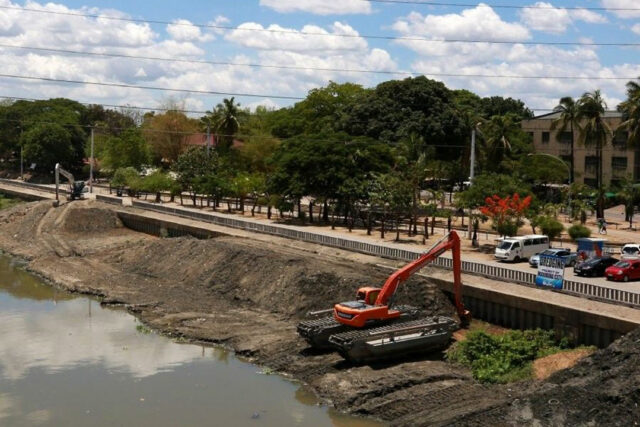
Meanwhile, the Commission on Audit (CoA) has filed four fraud audit reports involving flood control projects in Bulacan worth a combined P330.51 million, citing serious irregularities in works implemented by DPWH-Bulacan First District Engineering Office and awarded to a private construction firm.

In a statement, CoA said the reports were transmitted on Wednesday to the ICI for possible criminal, civil and administrative action, including potential referrals to the Office of the Ombudsman.

The fraud audit covered four flood control and riverbank protection projects implemented from July 2022 to May 2025.

CoA said inspections found that in several cases, audit teams were brought to project sites that differed from those stated in approved plans, without written authority or approved variation orders to justify the changes.

Technical inspections, satellite imagery, and document reviews showed major gaps in project execution and documentation, the commission said.

“These reports solidify our mandate to hold negligent public officials and private contractors accountable for compromised infrastructure spending,” CoA Chairman Gamaliel A. Cordoba said in the statement.

One of the projects flagged was the P77.2-million construction of a riverbank protection structure in the village of Calero, Malolos City, where inspectors found no structure at the approved location.

Another was a P99-million riverbank protection project in Malis, Guiguinto, which CoA said was built at a site different from what was approved. Inspectors also observed visible cracks, the absence of certificates of acceptance and the lack of a master plan covering all river flood control works in the area.

A P77.2-million flood mitigation project along Bulusan River in Calumpit was also cited, after auditors found no slope protection structure at the approved site despite reports indicating full completion.

In the village of Namayan, Malolos City, a P77.12-million riverbank protection project showed no structure at the approved location months after the contract had expired. CoA said the structure later identified by DPWH personnel was built without authority.

A total of 16 people may be held liable for the anomalies, including DPWH engineering and project personnel as well as representatives of the private contractor that handled all four projects, it said.

CoA said those involved may face corruption charges, malversation of public funds, falsification of documents and violation of procurement laws.

The audit findings add to growing scrutiny of flood control projects nationwide, as authorities step up oversight following allegations of widespread misuse of public funds in infrastructure spending.

Marcos vows to press ahead with Philippine military modernization

PRESIDENT Ferdinand R. Marcos, Jr. chats with AFP Chief of Staff General Romeo S. Brawner, Jr. the oath-taking ceremony for promoted generals at Malacañan Palace. — REVOLI CORTEZ/PPA POOL

PHILIPPINE President Ferdinand R. Marcos, Jr. on Thursday said the government would prioritize military modernization, signaling sustained investment in capabilities and logistics to support the Armed Forces of the Philippines’ (AFP) long-term defense posture.

“As your President and your commander-in-chief, I reaffirm this administration’s commitment to the continued modernization of the Armed Forces,” he said at the oath-taking ceremony of promoted generals and flag officers at the Presidential Palace.

His remarks come as tensions remain elevated in the South China Sea, a vital maritime corridor through which roughly a third of global trade passes each year. The Philippines has faced repeated confrontations with Chinese vessels in disputed waters, raising concerns over maritime security and freedom of navigation.

Mr. Marcos said loyalty to the Constitution and democratic institutions remains the military’s “sacred trust,” adding that the AFP must continue sharpening its readiness through joint exercises and closer coordination with international partners.

The Philippines has deepened defense cooperation with longstanding ally the US, while expanding ties with Japan, Australia and South Korea. These partnerships cover training, joint exercises and maritime security, reflecting Manila’s push to strengthen deterrence and operational capability.

Participation in multilateral platforms such as the Association of Southeast Asian Nations (ASEAN) Defense Ministers’ Meeting-Plus has also helped the AFP improve interoperability, disaster response and counterterrorism coordination, the President said.

Such engagements contribute not only to national defense but also to stability in the Indo-Pacific region, he added.

The country has visiting forces agreements with the US, Australia, Japan, New Zealand and Canada, with talks ongoing with France. These arrangements allow joint military exercises, training programs and faster deployment of foreign troops for both security operations and humanitarian assistance.

Mr. Marcos also cited recent measures aimed at supporting uniformed personnel, including an increase in the daily subsistence allowance for military and police members to P350.

“All these reflect our principle that honoring service means ensuring that those who serve are given the support and dignity that they rightfully deserve,” he said.

The President described the promotions as part of a generational transition in military leadership, calling on senior officers to uphold constitutional loyalty while preparing the force for future security challenges. A more capable AFP, he said, would be central to protecting sovereignty and maintaining stability in the years ahead.

He also acknowledged the families of the promoted officers, noting their sacrifices, particularly during the holiday season. “We recognize your patience, your sacrifices and your support.”

China claims most of the South China Sea, a strategic waterway that facilitates more than $3 trillion in trade annually. These claims overlap with the exclusive economic zones of the Philippines, Vietnam, Malaysia, Brunei and Indonesia.

A 2016 international arbitral ruling found Beijing’s sweeping claims had no legal basis under international law, a decision China rejects. 

Earlier this week, Philippine and US naval forces held joint exercises in the disputed waters, underscoring their shared commitment to a rule-based regional order.

The drills followed an incident in which Chinese coast guard vessels fired water cannons at Philippine fishing boats near Sabina Shoal, injuring three fishermen and damaging two boats, according to Manila’s Defense department. — Chloe Mari A. Hufana

Philippines rejects China claim of ‘hyping’ sea clash

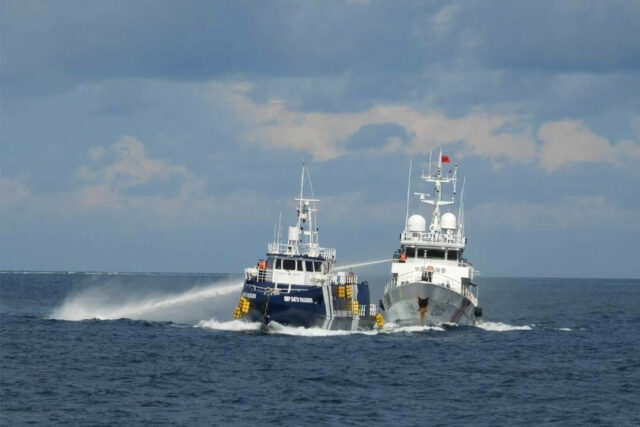
FILE PHOTO of a China Coast Guard vessel fires a water cannon at the BRP Datu Pagbuaya near Thitu Island, in the latest flare-up between Manila and Beijing in the disputed South China Sea. — PCG

THE Philippines’ Defense department on Thursday rejected China’s claim that Manila was “hyping” a recent sea incident where Filipino fishermen got hurt, saying the facts showed dangerous actions by Chinese maritime forces in disputed waters.

In a statement, Defense spokesman Arsenio R. Andolong said China’s use of so-called control measures near Sabina Shoal endangered lives and violated basic maritime norms. The remarks followed a clash on Dec. 12 involving Philippine fishing boats and China Coast Guard vessels.

“The Philippines is not hyping the issue,” he said. “The facts speak for themselves. These are aggressive, excessive and dangerous actions of an encroaching state.”

The Chinese Embassy in Manila did not immediately respond to a request for comment via Viber.

The Philippine Coast Guard last week said three Filipino fishermen were injured after two fishing boats were damaged when China Coast Guard ships fired water cannons at them near Sabina Shoal. China’s foreign ministry later said the measures were necessary to protect its sovereignty.

Mr. Andolong said no amount of reframing could change the reality that Filipino fishermen were hurt while operating lawfully within the Philippines’ exclusive economic zone.

“Using water cannons, cutting anchor lines, and blocking humanitarian assistance are actions that place lives at risk and violate basic maritime safety norms,” he said.

Sabina Shoal is among several features in the South China Sea where encounters between Philippine and Chinese vessels have become more frequent. Both sides have accused each other of escalating tensions after repeated incidents involving water cannon blasts and close-quarter maneuvers.

“We will not be intimidated from benefitting from our resources by China’s constant bullying, prevarication or so-called effective measures,” Mr. Andolong said.

The Philippines has described China’s conduct in the waterway as coercive and escalatory, while Beijing insists its actions are lawful steps to defend its sovereignty.

China claims almost the entire South China Sea under its so-called nine-dash line map that overlaps the exclusive economic zones of the Philippines, Vietnam, Malaysia, Indonesia, and Brunei.

In 2016, a United Nations-backed arbitral tribunal ruled that China’s sweeping claims had no legal basis under international law, a decision Beijing has rejected.

Sabina Shoal lies about 150 kilometers west of Palawan. Philippine and Chinese vessels have clashed near the area in recent years, with the shoal widely viewed as a key point for resupply routes to Filipino troops stationed at the BRP Sierra Madre, a grounded naval ship at Second Thomas Shoal.

On Monday, the US expressed support for the Philippines and condemned what it described as China’s increasingly coercive behavior in the South China Sea. The statement coincided with joint US-Philippine naval drills in the contested waters.

The Philippines has stepped up cooperation with allies and partners through joint exercises and security engagements as it seeks to strengthen its defense posture amid rising tensions with China. — Kenneth Christiane L. Basilio

PHL may miss green shift gains sans nickel reform

REUTERS

By Erika Mae P. Sinaking

THE Philippines risks missing out on the full economic and social gains from the global green transition if it continues to rely on raw nickel extraction without improving job quality, safety and domestic value creation, according to a research brief released this week by the International Labour Organization (ILO).

In its study on decent work in renewable energy and critical mineral supply chains across Asia and the Pacific, the ILO said the Philippines could remain trapped in a low-value, extractive model, even as global demand for critical minerals accelerates, unless targeted reforms are introduced.

“Unless deliberate policies are put in place to uphold decent work and increase value addition, participation in supply chains, including those critical for the energy transition, can present the risk of perpetuating economic models based on extracting raw materials with limited value addition, rather than creating pathways for structural transformation and upgrading,” the ILO said.

Nickel is a vital part of the green energy transition and is a critical component for many renewable energy technologies including battery production.

The Philippines is the world’s second-biggest nickel producer after Indonesia and, together with its neighbor, supplies more than 75% of global demand for the mineral, which is vital for electric vehicles, batteries and renewable energy systems.

Unlike Indonesia, which has pursued aggressive domestic processing policies, the Philippine nickel industry remains largely concentrated on raw ore extraction, the ILO said.

Sector-wide data suggest mining wages are slightly higher than those in comparable industries. However, the ILO’s field research on Philippine nickel supply chains points to persistent gaps in working conditions, said Julius H. Cainglet, vice-president of the Federation of Free Workers.

About 70% of mining jobs are manual and extraction-focused, according to the brief. Workers interviewed cited delayed or withheld wages, mandatory deductions and the need to buy their own protective equipment.

Occupational risks, including exposure to nickel dust and unsafe transport routes, were also raised by workers and surrounding communities.

Union representation remains limited in nickel mining. Where unions exist, workers questioned their independence and effectiveness, particularly for subcontracted workers, who make up most of the workforce. In several areas, no union activity was reported.

“The Philippines continues to open its doors to multinational corporations that extract nickel, copper and other critical and transition minerals for processing outside the country,” Mr. Cainglet told BusinessWorld in a Facebook Messenger chat.

This leaves the country with minimal economic returns while communities bear the long-term environmental and social costs, he pointed out.

He said labor standards are unevenly applied, with stronger protections for regular, unionized workers and weaker safeguards for agency and seasonal staff. “In many enterprises, these precarious workers outnumber regular workers,” he added.

Mr. Cainglet questioned whether mining could meaningfully support a green transition without a coherent industrial policy. “Mining will never be green,” he said, adding that the absence of a clear strategy limits the country’s ability to guide how resources are extracted and processed.

He also criticized the government’s focus on “better jobs” rather than “decent work.” “A job may be better but might still fall below standards, he said, stressing that decent work requires respect for labor rights, social protection and dialogue.

The Philippine Nickel Industry Association (PNIA) said the sector is not focused solely on raw exports and already has processing facilities, including refineries and high-pressure acid leaching plants. Further downstream investment, however, is constrained by market conditions.

“Putting additional plant facilities are still not economically viable at the moment because of the low London Metal Exchange nickel prices and higher production costs compared with Indonesia and China,” PNIA President Dante R. Bravo said in a text message.

He said the industry complies with labor laws and has a strong safety record. “We are one of the safest nickel mining sectors in the world,” he said, adding that there are no known child labor or major human rights violations.

He added that the green transition could still bring improved opportunities if processing investments become viable, leading to workforce upskilling and technology transfer. But preparation is needed, including skill development, lower power costs, streamlined permits and clearer policy direction.

With global demand for critical minerals projected to triple by 2030 and quadruple by 2040, the ILO said the Philippines faces a clear choice: remain a raw ore exporter with persistent labor gaps, or use the green transition to support industrial upgrading, formal employment and better-quality jobs.

Palace suspends government work

THE Philippine government will suspend work in all public offices on Dec. 29 and Jan. 2, 2026, extending the year-end holiday break to allow state employees to travel and participate in New Year celebrations.

Offices providing basic, vital and health services, as well as agencies tasked with disaster preparedness and emergency response, will remain operational during the suspension, the Palace said in Memorandum Circular No. 111 dated Dec. 18.

The policy does not automatically apply to the private sector, leaving it up to company heads to decide whether to suspend work on the two additional days.

The circular takes effect immediately. — Chloe Mari A. Hufana

SSS to offer emergency loan in Dec.

SSS FACEBOOK PAGE

PHILIPPINE President Ferdinand R. Marcos, Jr. said state-run Social Security System (SSS) members will gain access to a loan facility designed to provide quick, low-cost relief during periods of national emergency, starting this December.

In a video message released on Thursday, Mr. Marcos said that the SSS will offer emergency loans with a 7% interest rate, accompanied by a six-month moratorium on repayments to ease the immediate financial burden on borrowers. 

Loan amortization will not be required during the first half-year after release.

The country is under a one-year state of national calamity following successive storms, including a super typhoon, that battered the climate-vulnerable nation.

“Starting this December, the SSS will be able to provide what is called an emergency loan,” Mr. Marcos said in Filipino.

“You can use this loan for your needs, especially, as I mentioned, during emergencies; this is what you can access from the SSS.”

The President added he is continuing to work with the SSS to explore additional options for safer and more equitable microloans and emergency loan programs for Filipinos. — Chloe Mari A. Hufana

Luzon tollway traffic to rise 5%

METRO PACIFIC Tollways Corp. (MPTC) expects traffic across its Luzon toll network to rise by as much as 5% this holiday season as the Pangilinan-led operator prepares to waive toll fees on Christmas and New Year.

“Our goal this holiday season is to have motorists spend less time on the road and more time with their families… We have prepared early, deployed full manpower, and have initiated barrier-up operations, counterflow measures, free towing services, and toll-free passage,” Metro Pacific Investments Corp. (MPIC) and MPTC Chairman Manuel V. Pangilinan said in a media release on Thursday.

MPTC, the tollway arm of MPIC, is preparing for the expected traffic surge this upcoming holiday with the deployment of its full manpower, and other initiatives like free towing services, and toll-free passage, barrier-up operations to allow safer and more convenient travel for motorists.

MPTC said its average vehicle across its network in Luzon is currently at 688,000.

All roadworks and lane closures will also be suspended from 6 a.m. on Dec. 19 until noon of Jan. 5, except for emergency safety repairs, MPTC said, adding that additional traffic, toll and emergency and medical response teams will also be deployed.

MPTC is the operator of North Luzon Expressway (NLEX), Subic-Clark-Tarlac Expressway (SCTEX), Manila-Cavite Expressway (CAVITEX), and Cavite-Laguna Expressway (CALAX).

It said that MPTC is waiving toll fees on NLEX, SCTEX, NLEX Connector, CAVITEX, and CALAX on Dec. 24 at 10 p.m., until Dec. 25, at 6 a.m.; and Dec. 31 at 10 p.m., and Jan. 1, at 6 a.m.

MPTC is the tollways unit of MPIC, one of three key Philippine subsidiaries of Hong Kong-based First Pacific Co. Ltd., along with Philex Mining Corp. and PLDT Inc.

Hastings Holdings, Inc., a unit of the PLDT Beneficial Trust Fund’s MediaQuest Holdings, Inc., holds a majority stake in BusinessWorld through the Philippine Star Group, which it controls. — Ashley Erika O. Jose

BoC to deliver 130,000 abandoned balikbayan boxes

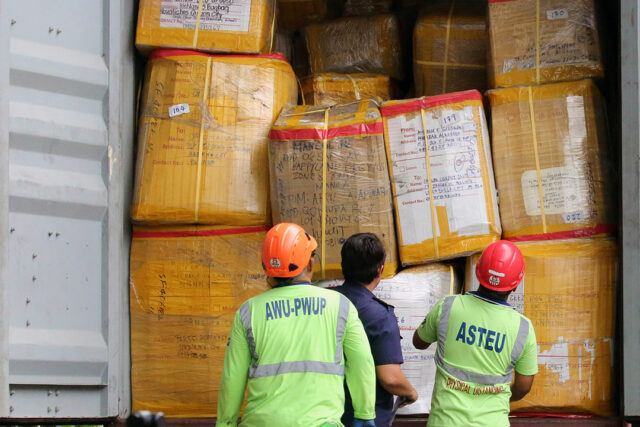
THE Bureau of Customs led the turnover of abandoned balikbayan boxes during a ceremony at its headquarters in Manila on Dec. 18, 2025. — PHILIPPINE STAR/EDD GUMBAN

THE Bureau of Customs (BoC) said up to 130,000 abandoned balikbayan boxes will be delivered free to overseas Filipino workers (OFWs) ahead of the holiday celebration.

“This is one of the problems we immediately addressed at the start of our term. We recognize the sacrifices of our OFWs, and every balikbayan box is the product of their hard work for their families,” BoC Commissioner Ariel F. Nepomuceno said on Thursday.

This comes after President Ferdinand R. Marcos, Jr. approved a P30-million fund for the logistics and processing support of the balikbayan boxes.

Mr. Nepomuceno also said OFWs no longer need to go to the BoC to pick up their boxes, as they will be delivered to their homes.

He also said the BoC will run after freight forwarders, failing to deliver the boxes up to 2 years and abandonment of balikbayan boxes at ports.

“The distribution of these balikbayan boxes is free. There should be no payments. Anyone asking for money may be reported to the Bureau of Customs,” BoC Deputy Commissioner and Chairperson of the Balikbayan and OFW Action Center Michael C. Fermin said. — Aubrey Rose A. Inosante

10th ID backs DND’s peace program

COTABATO CITY — Officers and personnel of the Army’s 10th Infantry Division (ID) have assured Defense Secretary Gilberto C. Teodoro, Jr. of their commitment to the government’s Comprehensive Archipelagic Defense Operations (CADO) Program during a dialogue at their headquarters on Wednesday.

The Department of National Defense’s (DND) CADO Program is focused on enhancing the tactical and community peacebuilding initiatives of the Armed Forces.

Radio reports in Central Mindanao on Thursday stated that Mr. Teodoro, while at Camp Gen. Manuel T. Yan in Mawab town Davao de Oro, also lauded the units of the 10th ID, under Major Gen. Alvin V. Luzon, for continuously implementing, along with local government units (LGUs), a multisector community initiative that have fostered tranquility in remote areas where the now tactically dysfunctional New People’s Army (NPA) once operated with impunity.

Mr. Teodoro also talked about the CADO Program, which is focused on the strengthening of the operational capabilities of the Armed Forces.

Mr. Luzon said Mr. Teodoro was accompanied to the 10th ID’s headquarters by Major General Adonis Ariel G. Orio, commander of the Eastern Mindanao Command.

Mr. Teodoro also commended the personnel of all units under the 10th ID, scattered in towns and cities in Regions 10, 11 and 13, for their activities complementing the joint peace and security initiatives of LGUs, the indigenous communities and former members of the NPA who have returned to the fold of law.

“The visit of Defense Secretary Teodoro to our headquarters boosted our morale and inspired us to work harder in spreading peace and calm in our area of responsibility,” Mr. Luzon said on Thursday.

Different units of the 10th ID had secured the surrender of 1,323 NPA members in the past six years through backchannel dialogues supported ng LGU officials and leaders of the indigenous communities in towns and cities under its jurisdiction. — John Felix M. Unson

Recto commits to achieving PHL’s long-term socioeconomic targets

FINANCE SECRETARY RALPH G. RECTO — PHOTO FROM DEPARTMENT OF FINANCE FACEBOOK PAGE

THE GOVERNMENT is focusing on delivering on its long-term socioeconomic goals, as outlined in the Philippine Development Plan 2023-2028 and Ambisyon Natin 2040, Executive Secretary Ralph G. Recto said, in response to slowing economic growth following the infrastructure corruption scandal.

At the 90th anniversary of socioeconomic planning late on Dec. 17, Mr. Recto said the administration will prioritize funding and execution of programs that aim to cut poverty to single-digit levels by 2028, expand infrastructure and strengthen resilience against global shocks.

“Let me assure you: the Marcos, Jr. administration is fully committed to delivering the Philippine Development Plan and realizing Ambisyon 2040,” he said, according to a transcript from his office. “It is one of the few things in governance that should never be up for debate.”

The economy slowed sharply in the third quarter, expanding just 4%, the weakest reading in more than four years, and the lowest since the coronavirus pandemic.

In the first nine months, growth averaged 5%, well short of the government’s 5.5%–6.5% target range.

The downturn was caused by a slowdown in government spending and weaker investor confidence after it was revealed that public works officials, legislators, and contractors conspired to deliver substandard or non-existent flood control projects.

Fiscal pressures intensified in October, when public expenditures declined for a third consecutive month to P430.6 billion, down 7.76% from a year earlier.

Mr. Recto, the former Secretary of Finance, called for a culture of planning that transcends political cycles, stressing that sustained nation-building is essential to securing economic progress for both current and future generations.

He also noted the role of evidence-based policymaking in safeguarding development gains, highlighting the progress made in reducing poverty and the impact of inclusive, data-driven planning.

He noted that poverty has fallen from 23.5% a decade ago to 15.5% in 2023 and stressed that the government is determined to push the rate down to single digits by 2028.

“We chose to believe that our development should not be dictated by political whims but by data, direction, and discipline,” he said.

“This means that years of planning have sent millions of children to school, provided millions of families with roofs over their heads, and given millions of Filipinos greater dignity in their daily lives.”

Mr. Recto, who served briefly as socioeconomic planning secretary and director-general of the National Economic and Development Authority (NEDA) in 2008, highlighted economic planners’ pivotal role in shaping a more resilient and inclusive Philippines. — Chloe Mari A. Hufana

Three regions approve wage hikes starting early January

BW FILE PHOTO

THREE regional wage boards approved hikes in minimum pay to take effect early 2026, the National Wages and Productivity Commission (NWPC) said.

In the Caraga region, the daily minimum wage for non-agricultural workers will increase to P455 starting Jan. 3 and will further rise to P475 on May 1, up from the current rate of P435, according to the Regional Tripartite Wages and Productivity Board (RTWPB) XIII. The approval was announced in a NWPC social media post on Thursday.

For domestic workers, monthly minimum wages will also come in for adjustment. In chartered cities and first-class municipalities, pay will increase by P500 to P6,500, with other municipalities to see commensurate increases.

Workers in the Zamboanga Peninsula (Region IX) are set to receive a P25 increase in daily minimum wage under Wage Order No. RIX-24, according to the NWPC.

Non-agricultural establishments with 10 or more employees, including retail and service businesses, will see wages rise from P414 to P439 in January, with a second tranche bringing the rate to P464 in June 2026.

Agricultural establishments and businesses employing nine or fewer workers will have their daily minimum wages increased from P401 to P426 in January, and to P451 in June.

Meanwhile, employees in Mindoro, Marinduque, Romblon, and Palawan or Mimaropa (Region IV-B), including domestic workers, will benefit from new wage adjustments effective Jan. 1.

For establishments with 10 or more workers, daily wages will rise from P430 to P455, while establishments with less than 10 employees will see wages increase from P404 to P455.

With these minimum wage updates, Northern Mindanao (Region X) remains the sole region yet to implement wage adjustments for this year’s cycle. — Erika Mae P. Sinaking

Business groups cite role of dynastic politics, opaque procurement in corruption scandals

PHILIPPINE STAR/MIGUEL DE GUZMAN

FOUR business organizations said reforms are urgently needed to address corruption in infrastructure projects, citing the need to overhaul procurement process and minimize the negative influence of dynastic politics.

The groups, which include the Management Association of the Philippines, cited earlier cases of official corruption, such as the pork barrel scam, the ZTE broadband deal, and the Pharmally procurement, noting that they represent recurring irregularities in how the government spends.

“These cases reveal a troubling pattern: corruption flourishes where political patronage and dynastic influence intersect with opaque procurement processes, weak oversight, and poor accountability in the use of public funds,” they said.

“Other countries have confronted similar challenges — and many have succeeded in reducing corruption by enforcing transparency in major projects, responding quickly to red flags, and clearly assigning institutional responsibility. The Philippines can — and must — do the same,” they added.

The groups demanded full transparency across the project life cycle starting with the Department of Public Works and Highways (DPWH).

“All disbursements and variations to contracts should be made publicly accessible online and linked to the Modernized Philippine Government Electronic Procurement System (mPhilGEPS),” they said.

The groups also sought the disclosure of beneficial ownership among government contractors to raise transparency and deter money laundering.

They said that the government should interconnect Securities and Exchange Commission Cooperative Development Authority beneficial ownership data and Bureau of Internal Revenue tax records with mPhilGEPS “to enable real-time verification and automatically flag suspicious payments.”

The groups are also seeking to grant the Commission on Audit, the Department of Budget and Management, DPWH, and the Anti-Money Laundering Council the authority to initiate joint audits within 90 days after initial indications of malfeasance.

Citing the example of Hong Kong and Singapore, the groups said that acting before the funds are dissipated disrupts corruption networks.

They backed the launch of a public dashboard with secure whistleblower channels to track delays, cost overruns, and repeat contract winners.

“Citizen oversight strengthens accountability,” they said.

“We stand ready to support these reforms by sharing technical insights, participating in consultations, and assisting independent monitoring — always with full respect for institutional independence and the rule of law,” they said.

“The window for reform is open, and we should seize the momentum without delay,” they added.

The other signatories to the statement were the Institute of Corporate Directors, the Institute for Solidarity in Asia, and the Justice Reform Initiative. — Justine Irish D. Tabile

ADVERTISEMENT
ADVERTISEMENT