Home Blog Page 4951

Cebu Pacific resumes Clark-GenSan flights 

CAAP

BUDGET carrier Cebu Pacific has resumed flights between the Clark International Airport in northern Philippines and General Santos City in the south, boosting the revival of trade ties between the two areas that was disrupted by the coronavirus pandemic.  

An inaugural flight was welcomed at the General Santos Airport on Wednesday, signaling the start of thrice a week services for the route, the Civil Aviation Authority of the Philippines (CAAP) said in a statement.   

This new development is expected to provide greater accessibility and convenience to travelers, boost the economic activity in the region, and further enhance the airport’s capacity to accommodate the increasing number of passengers,CAAP said.  

Cebu Pacific launched flights between GenSan and Clark in Pampanga in Feb. 2020, just a month before travel restrictions were imposed due to the pandemic.   

The GenSan City government first forged a partnership with Clark Development Corp. (CDC) in Sept. 2019, alongside agreements with the Pampanga cities of Angeles, Mabalacat and San Fernando, to boost trade and tourism ties.   

A new agreement was signed between GenSan and CDC in Oct. 2021 to revitalize the partnership.   

General Santos City Airport Manager Joel G. Gavina, meanwhile, said CAAP is working on further improving services at the airport by setting up a passenger boarding bridge and drop-off area within the year. MSJ

Solon backs merging of some subjects to focus on math, reading skills 

PHILIPPINE STAR/ MICHAEL VARCAS

A SOLON has backed the Education departments proposal to streamline the curriculum for kindergarten to Grade 3 to give more attention to developing studentsreading comprehension and mathematical abilities.  

We need to lessen the subjects and focus on (developing the students) functional literacy,Pasig City Rep. Roman T. Romulo, chair of the House Basic Education and Culture Committee, said in a Laging Handa briefing on Wednesday. 

A draft of the Department of Educations (DepEd) 2022 Basic Education Curriculum features a new subject called SIKAP, which combines social studies, culture and history, and physical education in the first four years of school. 

Mr. Romulo said the proposal to merge the three subjects would help students focus more on subjects like reading comprehension and math.  

Doing this would ensure an exponential growth in our studentslearning,Mr. Romulo said.  

According to DepEds Bureau of Curriculum development, SIKAP will provide learners with essential knowledge, skills and attitudes enabling them to develop personal and cultural consciousness in becoming active and creative members of their respective communities.”  

Streamlining the subjects would help teachers and students give ample time to strengthen functional literacy, which includes, but is not limited to reading comprehension, which is one of the identified causes of low educational achievement among Filipino students,the Education department said.  

The proposal would also help decongest the curriculum”.  

For Grades 4 to 10, Social Studies or Araling Panlipunan will become a standalone subject while Music, Arts, and Physical Education and Health will be merged. Beatriz Marie D. Cruz

Morong taps NGA 911 for next-gen emergency system 

MORONG’S emergency response units participate in a tournament with the Philippine Army on March 3. — MDRRMO MORONG, RIZAL

THE SMALL town of Morong in Rizal is adopting an advanced emergency communication system that makes calling and response times faster and more efficient.  

The local government said it signed an agreement on April 24 with Next Generation Advanced 911 (NGA 911) for the companys next-generation digital technology for emergency communication and public safety servicessystem that is used in the United States.   

We are partnering with NGA 911 to equip our public safety officers with a system that will enable them to provide immediate emergency assistance and help us adapt to the ever-changing landscape of public safety,Mayor Sidney B. Soriano said in a statement.  

Morong, located east of the capital Manila with a population of about 70,000, is the first local government in the country to tap the NGA 911 technology. The town already has an emergency operations center that will be enhanced with the new system.  

Whether the emergency is medical, fire, crime or accident, we need to provide fast and effective response. The NGA 911 Call Handling System will let us respond faster and more efficiently,the mayor said.  

NGA Philippines Country Manager Robert Andrew Llaguno said their digital-led system will enhance response capabilities with faster reaction time, accurate location tracking, consolidation of communication channels, call routing, collaboration and mapping.” 

Its IoT (internet of things) capabilities allows interaction beyond regular devices like smart phones, desktops and gadgets. It allows seamless integration with public safety technology and systems like CCTVs, two-way radio, and social media apps to provide front liners with valuable information, resulting to better situational awareness and quicker, more efficient response, he said.

Lady Bulldogs rout UST Golden Tigresses, grab solo second spot

UAAP

Games On Saturday
(Filoil EcoOil Center)
9 a.m. — NU vs ADMU (men)
11 a.m. — NU vs ADMU (women)
3 p.m. — UE vs DLSU (women)
5 p.m. — UE vs DLSU (men)

DEFENDING titlist National University (NU) moved on the cusp of securing a twice-to-beat edge, exacting sweet vengeance on University of Santo Tomas (UST) with a 25-16, 25-21, 17-25, 25-14 win in University Athletics Association of the Philippines (UAAP) Season 85 women’s volleyball tournament yesterday at the Filoil EcoOil Centre.

Alyssa Solomon and Mhicaela Belen connived with 17 and 16 points, respectively, as the Lady Bulldogs broke a tie with the Golden Tigresses and seized the solo second spot at 10-3.

Santo Tomas slid to third, tied with Adamson at 9-4. The rampaging NU, with its fifth straight win, owns its fate to clinch the No. 2 seed and the other win-once bonus after No. 1 La Salle (12-1) with a win against Ateneo on Saturday.

Ms. Belen added 12 receptions with Jen Nierva (10 digs and 16 receptions) and Lams Lamina (14 sets) setting the table in NU’s bounce-back win after a 23-25, 25-27, 25-17, 25-22, 11-15 loss in the first round.

Save for a third-set defeat, the Lady Bulldogs were on their elements all game long highlighted by a spirited comeback in the second set from a 12-16 deficit to finally return the favor on the Golden Tigresses.

It was Santo Tomas that snapped NU’s 20-game winning streak last time out that sparked a domino effect on the title holder’s stumble against De La Salle twice before regaining form in the homestretch with fifth straight wins.

Eya Laure (17) and Imee Hernandez (14) put up efforts for the Golden Tigresses, who will have to win against the University of the Philippines (1-11) and hope for NU’s loss to force a playoff for the No. 2 seed. — John Bryan Ulanday

Yulo sees action at last leg of FIG Artistic Gymnastics series in Cairo

GYMNAST CARLOS YULO — REUTERS/PHIL NOBLE

FILIPINO world champion Carlos Edriel Yulo will try to add more gold medals to his already massive collection as he sees action in the final leg of the 2023 FIG Artistic Gymnastics World Cup Series starting today in Cairo, Egypt.

The 23-year-old pocket-sized dynamo from Leveriza in Manila had already raked in three mints — one in floor exercise in Doha, Qatar and two in floor exercise and parallel bars in Baku, Azerbaijan both last month — that went with one silver and two bronzes.

So far, the Tokyo Olympian has the most gold won among the galaxy of stars in the loaded field and could keep it that way if he can win some more in the Egyptian capital where the fourth and last edition of the inaugural event would be staged.

The event is part of Mr. Yulo’s preparation for next year’s Paris Games where he would gun for the one hardware that he hasn’t won yet — an Olympic gold.

From Cairo, Mr. Yulo will fly back to Manila on Sunday to join the rest of the national team plunging straight into battle in the 32nd Southeast Asian Games slated May 5 to 17 in Phnom Penh, Cambodia.

There, Mr. Yulo will be gunning for a maximum four gold in individual all-around, team event, parallel bars and horizontal bars due to unjust restriction imposed by the host nation.

In last year’s Hanoi Games, Mr. Yulo blew away the opposition by harvesting five mints and a couple of silver. — Joey Villar

Behind Nikola Jokic’s triple-double, Nuggets close out Timberwolves

NIKOLA JOKIC — RON CHENOY-USA TODAY SPORTS

NIKOLA Jokic had 28 points, 17 rebounds and 12 assists to lead the host Denver Nuggets past the Minnesota Timberwolves 112-109 on Tuesday night, closing out their first-round Western Conference playoff series in five games.

Jamal Murray scored 35 points, Bruce Brown and Aaron Gordon had 14 each and Michael Porter, Jr. grabbed 10 rebounds for Denver. The top-seeded Nuggets are headed to the Western Conference semifinals for the fourth time in five seasons.

Anthony Edwards put up 29 points, Karl-Anthony Towns had 26 points and 11 rebounds and Rudy Gobert had 16 points and 15 rebounds for the eighth-seeded Timberwolves. Nickeil Alexander-Walker finished with 14 points and Taurean Prince added 13 points.

The game was tied at 102 when Mr. Jokic took over in the final 1:30. He hit two free throws, scored off of his own miss and converted a three-point play to make it 109-104 with 28.1 seconds left.

Mike Conley hit a 3-pointer and Mr. Edwards sank a putback around two free throws by Brown to make it 111-109 with 3.4 seconds left. Mr. Jokic split a pair of free throws with 2.5 seconds left, and Mr. Edwards missed a 3-point attempt at the buzzer.

Mr. Murray opened the fourth with a 3-pointer to put Denver ahead 80-77, and the lead grew to five before Prince hit a 3-pointer, Mr. Gobert converted a three-point play and then tied it at 86 on a dunk with 8:34 left.

Mr. Porter hit his first 3-point attempt after missing his first five and then had a steal that led to a Brown layup and a 91-86 lead.

Minnesota cut the gap to a point, the Nuggets went back ahead by five but a three-point play from Towns made it 97-96.

Mr. Porter sank another 3-pointer after a Gordon offensive rebound to give Denver a 100-96 lead with 3:35 left. Mr. Towns missed a 3-point try at the other end before Mr. Gordon’s dunk pushed the lead to six.

The Timberwolves responded to tie it at 102 with 1:46 left.

Minnesota led by 15 early but Denver rallied to take a 48-47 lead into halftime. The Nuggets went up by four and the Timberwolves held a five-point edge in the third quarter, but the teams were tied at 77 heading into the fourth. — Reuters

PBA D-League Aspirants’ Cup kicks off at Ynares Arena

PBA MEDIA

Games Today
(Ynares Sports Arena)
2 p.m. — Phil. Sports Performance vs Marinerong Pilipino-San Beda
4 p.m. — Centro Escolar University vs EcoOil-De La Salle

TOPEX Robinson’s much-awaited debut for De La Salle University has to wait a little bit.

EcoOil-De La Salle kickstarts its title defense bid without Mr. Robinson for the meantime when it takes on Centro Escolar University (CEU) as the PBA D-League Aspirants’ Cup unwraps at the Ynares Sports Arena.

Action sizzles at 4 p.m. for the main match after the 2 p.m. duel of Marinerong Pilipino-San Beda University and new club Philippine Sports Performance Gym.

Deputy mentor Gian Nazario will call the shots for the Green Archers for now in place of Mr. Robinson, who’s set to run errands in the United States.

“Coach Gian will handle the team as I’ll be traveling to the (United) States but as I’ve always been saying, our mindset is we will always compete,” said Mr. Robinson, who steered Zark’s Burger-Lyceum to the D-League title in 2018.

Mr. Robinson, after his coaching stint with Phoenix in the PBA, took the coaching reins in Taft earlier this year in lieu of Derrick Pumaren, who towed the team to the Aspirants’ Cup title this year. Leading his wards are veterans Evan Nelle and Mark Nonoy with Gilas Pilipinas’ SEA Games training pool members Kevin Quiambao, and brothers Mike and Ben Phillips.

CEU, meanwhile, will be guided by Jeff Perlas, Mr. Robinson’s former assistant in Lyceum, with Jerom Santos and Franz Ray Diaz at the helm following a 14-0 championship sweep of the UCBL.

In the first match, second-year San Beda coach Yuri Escueta continues the rebuild of his young team following the graduation of key players led by ace gunner James Kwekuteye.

“We still have a new team. Our goal is to compete every game, continue to strengthen our system and apply it in games to prepare us for the upcoming NCAA season,” he said.

Standing in his way is coach John Paolo Lao with ex-PBA players Jonjon Gabriel and Val Acuña at the helm for PSP after a campaign in the Pilipinas Super League for Cagayan De Oro.

PBA stalwarts CJ Perez and Jericho Cruz of San Miguel, with Magnolia’s Jackson Corpuz, are interestingly listed in the coaching staff of PSP, owned by Phoebus Apollo Samson. — John Bryan Ulanday

RoS’s Nambatac suspended for two days without pay for playing at exhibition game

RAIN or Shine (RoS) yesterday added Rey Nambatac to its list of suspended players after the latter was found to have played in an unsanctioned game too.

The spitfire guard was assessed a two-game suspension without pay for violating his live contract that disallows him to play in league outside the PBA without the franchise’s permission.

“Rain or Shine Team Management has also found that Rey Nambatac breached his PBA Uniform Players’ Contract by participating in an exhibition game. A fine of two days worth of salary has been imposed on Rey,” said the team through its official Facebook page.

Mr. Nambatac was the second Rain or Shine player sanctioned by the Elasto Painters after also suspending bruiser Beau Belga for a total of 21 days, six of which he already served and the rest he is currently serving.

Mr. Belga’s suspension was bigger because he played in pick up games in Cebu where he was one of several players directly involved in a brawl, Davao and Laguna.

Mr. Nambatac should also get a summon from PBA commissioner Willie Marcial for his misdeed. — Joey Villar

Orlando Magic forward Paolo Banchero wins NBA Rookie of Year in near-unanimous vote

ORLANDO Magic forward Paolo Banchero was the runaway winner of the NBA Rookie of the Year, the league announced Tuesday.

Mr. Banchero received 98 of the 100 first-place votes from a panel of sportswriters and broadcasters to earn the Wilt Chamberlain Trophy.

He said of the honor, “I remember when I first got drafted, my agent Mike Miller … looked at me and he asked me if I was going to be Rookie of the Year, and I confidently said, ‘Yes.’ It was just a goal I’ve always had and something I’ve had my eye on from the second I got drafted. I’m glad I was able to do it.”

Mr. Banchero averaged 20 points, 6.9 rebounds and 3.7 assists in 72 games (all starts) after being the No. 1 overall selection by the Magic in the 2022 draft. He made 85 3-pointers and recorded 60 steals and 39 blocked shots.

Mr. Banchero, 20, received 494 total points in the balloting, more than double runner-up Jalen Williams (241) of the Oklahoma City Thunder. Utah Jazz big man Walker Kessler (114) was third and received the other two first-place votes.

Mr. Banchero, who played college basketball at Duke, is the third Orlando player to win the award. The others are Shaquille O’Neal (1993) and Mr. Banchero’s agent, as Mr. Miller won the award in 2001.

Mr. Banchero had six 30-point efforts, second among Magic rookies behind Mr. O’Neal (10).

Mr. Williams, the 12th overall pick from Santa Clara, averaged 14.1 points, 4.5 rebounds and 3.3 assists in 75 games (62 starts). Mr. Kessler, the 22nd selection from Auburn, was a major force as a defender by blocking 173 shots, a 2.3 average. He averaged 9.2 points and 8.4 rebounds in 74 games (40 starts). He was acquired by the Jazz two weeks after the draft in the trade that sent three-time Defensive Player of the Year Rudy Gobert to the Minnesota Timberwolves.

Mr. Kessler was drafted by the Memphis Grizzlies and traded to Minnesota on draft night. — Reuters

Speaking out on transgender issues

ALEXANDER GREY-UNSPLASH

Our series on transgender female athletes has prompted more discussions emanating from a variety of sources. One sports columnist from a broadsheet called to exchange notes and to point out the Philippines’ own history of transgender and suspected trans female athletes even before the term and concept were coined.

I told our friend, who heads a prominent National Sports Association (NSA), that each sport seems to have come up with its own guidelines, We will tackle that development in another part of this column. One would think that allowing sports administrators to formulate their own policies on trans athletes would help satisfy the supporters and opponents of this fairly new phenomenon. We had also thought the loud call for a separate trans athlete category would help still the waters. But no, there’s now a call for standard guidelines and not a per-sport policy.

As expected, the debate over transgender matters has spread to other parts of society, with some of our friends commenting in our chat group on the issue as a larger societal concern.

One friend asked, “Sad to say this (SOGI) is being taught in schools. What does SOGI stand for? What does SOGI mean? SOGI stands for Sexual Orientation and Gender Identity. Since we all have a sexual orientation and gender identity, it includes all of us. Every student understands and expresses their gender differently, with interests and choices that are common or less common for their biological sex.”

No one can disagree with my friend’s definition or understanding of SOGI — it is inclusive and therefore includes everyone regardless of how they identify themselves. What probably one can disagree with is the comment that “sad to say this SOGI is being taught in schools.”

I would think that the school is the best place for the youth to learn about this reality which makes life in the 21st century so different from the period when girls in so-called exclusive schools were prohibited from wearing sleeveless dresses or blouses. Would we rather that our youth become aware and be educated about SOGI on the street corners by people who were not trained to discuss such sensitive matters? Or should we just ignore them as if they don’t exist?

One colleague added that because of giving so much emphasis on SOGI and LGBTQ (lesbian, gay, bisexual, transgender, queer) issues, “‘Gender dysphoria’ appears to be reaching epidemic proportions among American pre-adolescent girls in a number of states.” Although no data was given to back up the claim, the fear expressed by the same colleague is that Filipinos are “trying to be sophisticated” and are known copycats.

Gender dysphoria is, per Google, “a term that describes a sense of unease that a person may have because of a mismatch between their biological sex and their gender identity. The sense of unease or dissatisfaction may be so intense it can lead to depression and anxiety and have a harmful impact on daily life.”

The county’s legal system and lawmakers were next on our colleagues’ agenda as they articulated what are really practical concerns. “We already have a law rejecting discrimination against LGBTQ. Also, there is a Supreme Court ruling that birth certificates cannot be altered unless there is manifest error.” Our colleagues warn that “the SOGI law hopes to change the law allowing gender amendments and possibly same sex marriage, etc.” As experienced businessmen, they add, “One area of potential major adjustments will be actuarials based on gender, i.e., insurance, pensions, etc. Another will be medical prescriptions some (dosages) based on gender. We are entering the complications of the ‘WOKE’ age.” Our colleagues could not resist lashing out at our lawmakers, when they ask, “Why is this (SOGI law) being given attention by our lawmakers? There are more pressing issues facing the country. Wrong model USA.” Another countered, “No, we have wrong lawmakers.” If one, however, brings up the concerns raised earlier, indeed there are so many consequences and problems that have to be addressed in order to respond to the interest and needs of a sector in society who has rights too.

The reference to “WOKE” is in reference to a way of thinking in America that cultivates a broader awareness of sexism, slavery, oppression of African Americans, white privilege, etc.

As mentioned earlier, sports bodies have come up with their own guidelines to respond to the needs and interests of the sports trans community.

Tennis produced the first high-profile trans athlete in the person of Renee Richards. According to reports, Richards underwent gender reassignment therapy in 1975 and started playing in women’s tournaments.

Richards’ reassignment was later discovered and sparked a massive wave of protest among cisgender tennis players. Twenty five out of 32 women who were to play in a warmup tournament to the US Open refused upon learning that Richards would take part. Wikipedia states that as a result, the United States Tennis Association (USTA) and the Women’s Tennis Association (WTA) introduced the Barr Body Test which identifies a person’s sex chromosomes. Richards refused to take the test and was banned from the US Open. She filed a lawsuit in 1977 claiming that her civil rights were violated, and that the policy was unfair. The New York Supreme Court ruled in her favor saying that the Barr Body test as the sole determinant of sex was “grossly unfair” and ruled Richards legally a female.

At the Olympics, in 2014, the International Olympic Committee (IOC) allowed transgender athletes to participate in the Olympic Games.

In 2015, the IOC changed its guidelines in acknowledgment that legal recognition of gender could be difficult in countries where gender transition is not legal, and requiring surgery may be a violation of the human rights of the athlete.

Debates on trans athletes will continue. We have a complex society which produces new ideas as new generations take over. We just have to conduct continuing dialogues and exercise patience and tolerance.


Philip Ella Juico’s areas of interest include the protection and promotion of democracy, free markets, sustainable development, social responsibility and sports as a tool for social development. He obtained his doctorate in business at De La Salle University. Dr. Juico served as secretary of Agrarian Reform during the Corazon C. Aquino administration.

Not a very simple registration

PHILIPPINE STAR/MIGUEL DE GUZMAN

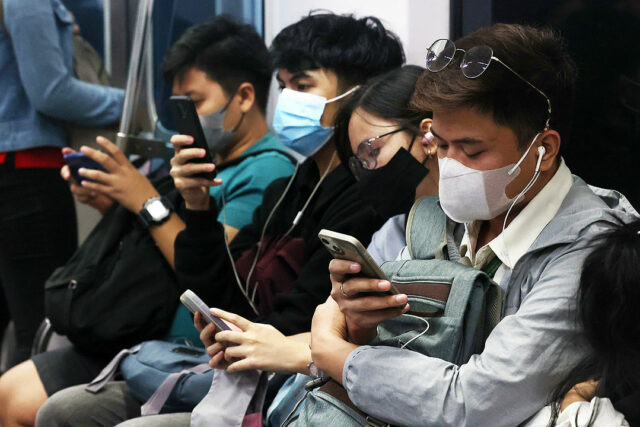
The Supreme Court had declined to restrain, even temporarily, the registration of mobile phone SIM cards as required by law. But while it exercised judicial restraint on the matter, its action was mooted by the Executive’s decision to extend the registration deadline by three months. A deadline previously set by law.

The extension considered estimates by the Department of Information and Communications Technology (DICT) that some 15 million to 20 million SIM cards already issued have yet to be registered. To date, roughly 82 million SIM card owners have complied with the registration requirement that was initiated more than four months ago.

Many failed to complete the registration process, lacking government-issued identification, or lacking internet access, or simply refusing to register for one reason or the other. Extending the deadline was perhaps the right decision. Public clamor for more time was addressed, while the Supreme Court is also given more time to resolve questions on the constitutionality of the SIM registration law.

Moving forward, however, my concern is this. If, for the sake of discussion, the Supreme Court finds reason and justification to nullify the SIM registration law and to invalidate the required registration, then what happens to all the registration data so far collected? How will the 82 million registered SIM users be affected?

The crux of the matter is the right to privacy, according to the petitioner against the SIM registration law. The National Union of Journalists of the Philippines, in its petition, wants the Court to stop the government and telecommunication companies from “using, storing, transferring, and processing all information gathered” during SIM registration and to get rid of all information already received.

The group claimed that requiring SIM registration violated the freedom of speech and was a violation of the right to privacy of communication, among others. I will not debate the merits of the petition and leave it to legal experts to discuss. Early resolution by the Court, perhaps within the 90-day extension period, will be best for all.

If the petitioners against SIM registration are the same petitioners against the use of a National ID, then I laud them for their consistency. On the other hand, to those who agreed to apply for a national ID but oppose SIM registration, I believe they should clarify themselves as to why one is acceptable as opposed to the other.

The data required for SIM registration is simple information that is already available in most government databases. These include full name, date of birth, gender, and home address. When using a photo ID to register, then the process captures an image or photo as well. The difference is that one’s personal information is now linked to a SIM serial number and a mobile number.

Is this difference enough to consider the SIM registration law unconstitutional? Does it constitute a form of “prior restraint” particularly on media persons from exercising their profession? Does it pose an obstacle, hindrance, or any form of restraint on the right to free speech and expression? Does it impinge on the freedom of the press? Does it violate the right to privacy? If one is not a media practitioner, or in the political opposition, should the issue matter at all? These questions as well as others raised by the petitioners require urgent resolution by the Court.

In this line, the 90-day extension was a master stroke. People get more time to decide on how to move forward on their SIM registration. The Court also gets more time to deliberate on the case. And the Executive doesn’t find itself butting heads meantime with journalists against SIM registration. It also pushes the deadline — and the controversy — past the congressional Easter break. Congress, if need be, can act on the matter after the opening in end-July.

The Court’s refusal to issue a temporary restraining order is indicative of its inclination on the matter, in my opinion. Moreover, if it views SIM registration as nothing more than collection of readily available personal data, then I also believe the SIM registration law will not be nullified. It is really a question of whether linking that personal data directly with the use of a mobile communication device can be considered a violation of any constitutional right.

On whether or not the collection of personal data during SIM registration is constitutional, I believe this will be upheld. After all, the same personal data and biometrics are collected during the processing and issuance of a National ID, or a driving license, or a passport, or any other government-issued identification.

As to linking such personal data to the ownership and use of a property like a mobile phone, again, I believe this can be justified. The same applies to those who register their ownership of real property or motor vehicles or firearms, among others. Even media entities go through some form of identification and registration of companies, properties, and vehicles used in their conduct of the business of media and in the practice of the media profession.

In a newspaper column in 2020, former Chief Justice Artemio Panganiban noted that the national ID law would “easily pass constitutional challenge because of the simplicity of the required personal data.” After all, “these simple personal data are already publicly disclosed in drivers’ licenses, passports, senior ID cards as well as in ID cards issued by the Social Security System (SSS) and the Government Service Insurance System (GSIS).” I believe this reflection will also have some bearing on the present case.

But as I argued in a column last December, I noted that the SIM registration database – matching names with pictures and mobile numbers as well as other personal information – will be another “digital footprint” that can be hacked, and the information possibly misused. And the Data Privacy Act is simply no match to those who intend to do harm. Moreover, whether such information can be used against journalists is anybody’s guess. It will depend largely on the fortitude of telecommunication companies to resist government attempts to unduly access such data.

Then couple this with the ability to track phones and their owners through GPS and cell sites, and match this with face-recognition software employed through public and private CCTV networks, then “Big Brother” is now more a reality than fiction. But “Big Brother” may no longer be the government watching us, but it is that network of computers and mobile phones and other electronic devices that develop, capture, and analyze digital footprints and allow those with legal and illegal access to our information to better understand us and to make “informed” decisions about how to either serve us, or steal from us.

In this line, if the SIM registration is deemed illegal by the Court, then purging all data collected should be the end of the issue. However, if the Court upholds the law, then the big challenge is how policymakers, regulators, and government and industry leaders can sufficiently and effectively protect the public, the government, and businesses from data breach and the illegal or improper use of that data to pursue political or business interests.


Marvin Tort is a former managing editor of BusinessWorld, and a former chairman of the Philippine Press Council

matort@yahoo.com

Growth projection, electricity generation and PPP Center

Last week, the Development Budget Coordination Committee (DBCC) held a press conference on the revised macroeconomic and fiscal targets from 2023-2028. The DBCC — or the economic team — is composed of the Secretaries of the Departments of Finance and Budget and Management (DoF and DBM), the National Economic and Development Authority (NEDA), and the Governor of the Bangko Sentral ng Pilipinas.

It is good that the economic team is keeping the original growth targets at 6-7% for 2023, and 6.5-8% for 2024-2028. As argued in this column last Monday, the Philippines’ quarterly GDP growth momentum in 2022 plus employment data as of February 2023 show that the domestic economy is dynamic, and local businesses can sustain a virtuous cycle of production-consumption at higher and rising levels.

I also think that the macroeconomic assumptions to make the growth projections are realistic. For instance, the Dubai crude price of $70-$90/barrel for 2023-2024, and $60-$80/barrel for 2025-2028. The actual Dubai prices from January 2023 to the present range from $75-$85/barrel, so there are four months of actual data that support the assumption already. Oil price pressure is stabilizing if not declining because many countries continue to buy cheap Urals or Russia oil, which is $10-$15/barrel cheaper than Dubai and other OPEC exporters. This competition is somehow good for us.

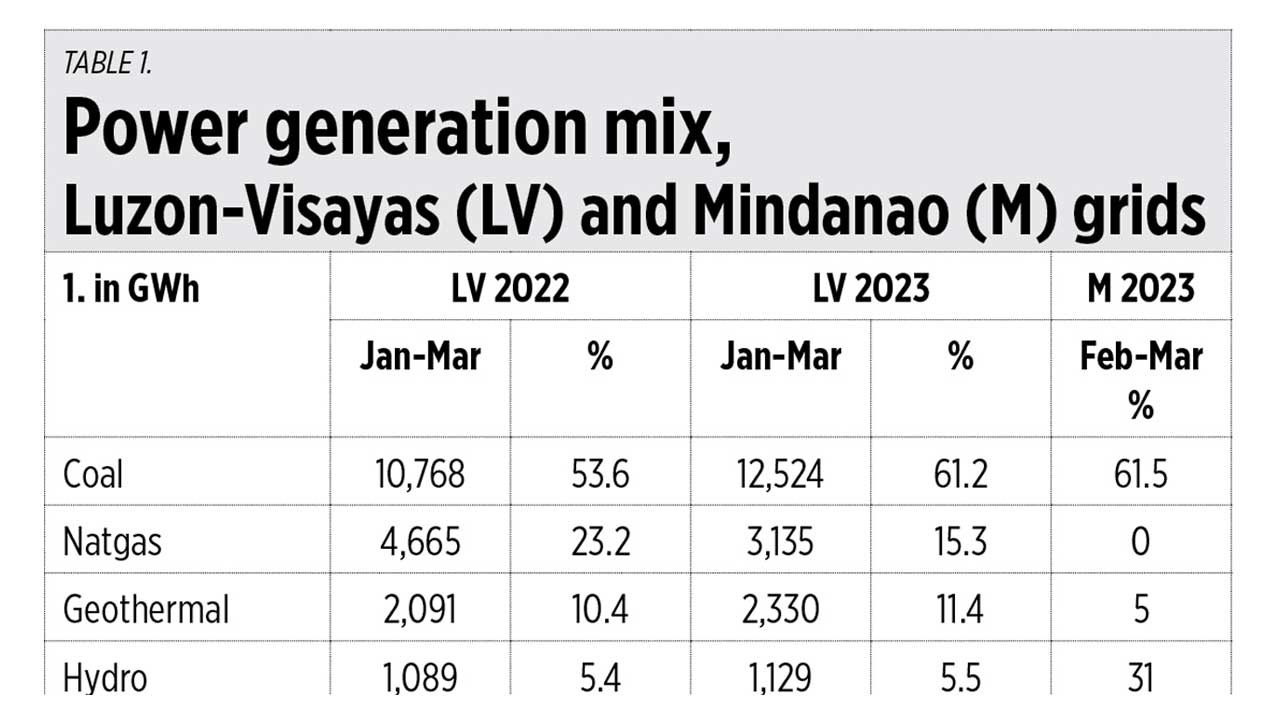
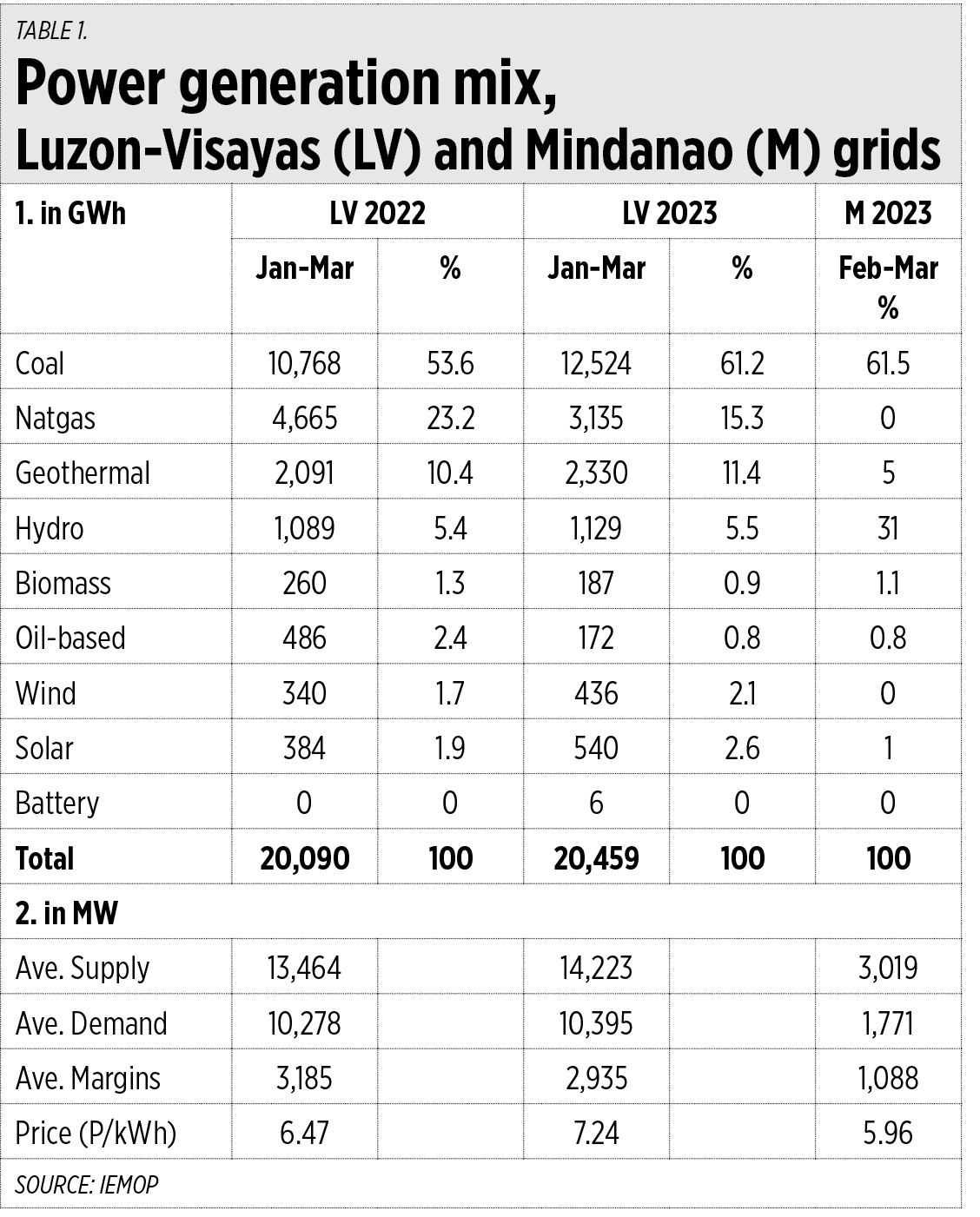
This week, the Independent Electricity Market Operator of the Philippines (IEMOP) released the mid-April update for power supply-demand prices. I computed the total power generation by source or technology, then averaged in supply-demand, January-March 2023, and compared them with same period last year.

The share of coal in installed capacity has not increased — roughly about 40% of the total — but actual power generation has increased from 54% in the first quarter 2022, to 61% of the total generation this year. So, it is unwise and dangerous for the country to listen to the climate lobby about restricting and even killing coal power because their beloved wind-solar can contribute only 4.7% of total generation.

Electricity prices have increased from an average of P6.47/kWh last year to P7.24/kWh this year mainly because of declining power margins; demand is picking up while supply is not rising at commensurate levels (see Table 1).

Meanwhile, in Boo Chanco’s column in the Philippine Star last week (April 24), “Cabinet Rigodon,” he wrote: “When the President says we need the private sector to partner with the government for big projects, he must make sure the NEDA, PPP Center, and all the other bureaucrats get the message and not add to the red tape for approvals. Proponents complain that there is so much back and forth on requirements that waste time…”

As stated earlier, I am following the work of the economic team including NEDA and the PPP Center (Public-Private Partnership Center of the Philippines) and I can say that Boo’s assessment of the bureaucracy at these two agencies, especially the PPP Center, is lousy. There are three reasons why I think so.

One, there is a robust number of PPP projects in the pipeline which are processing faster. I checked the PPP Center website — there are 100 projects costing P2.249 trillion in the pipeline already: 15 projects in transportation (airports, seaports, rail, terminal), 15 on toll roads, nine in property development, six in health, six in water and sanitation, five in information and communications technology (ICT), four in solid waste management, three in power/energy, and one in tourism.

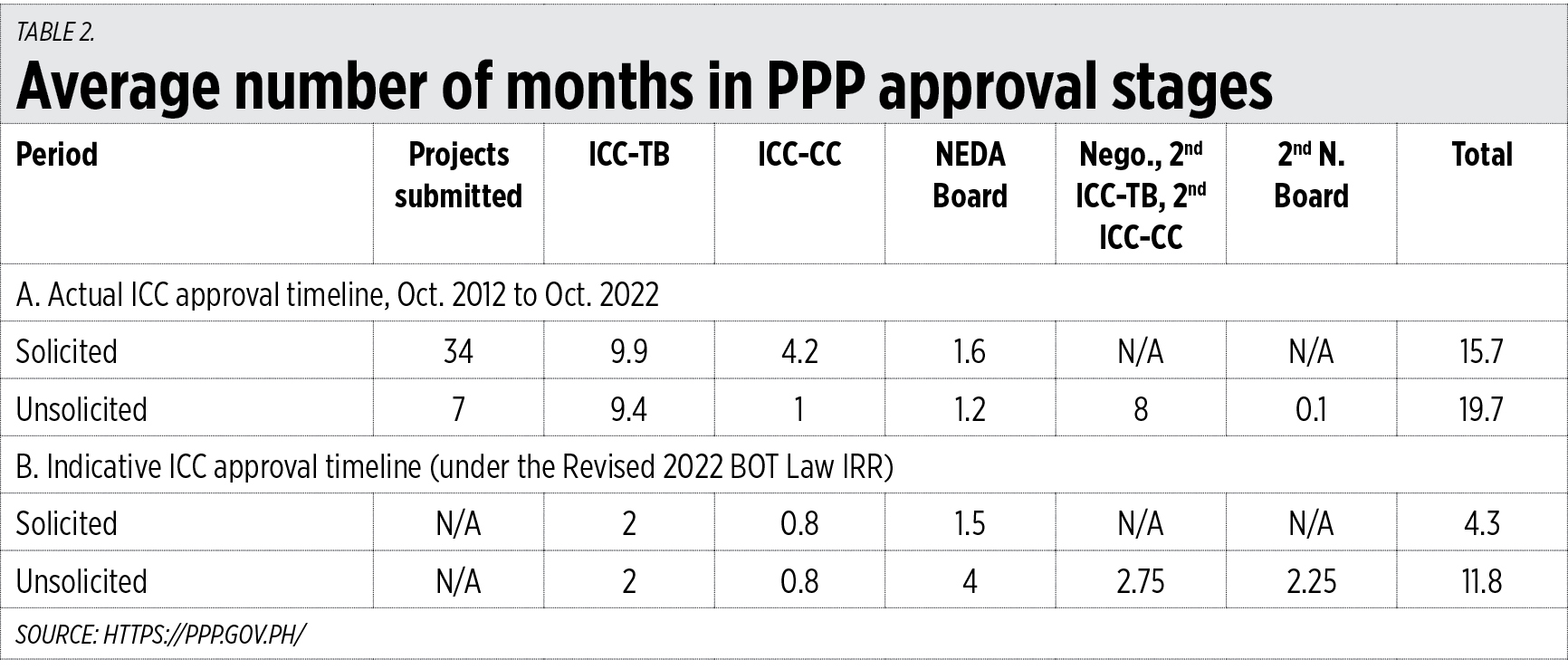
Two, the PPP Center has to observe and follow the project approval timelines of the 2022 Revised IRR of the Build-Operate-Transfer (BOT) Law, which addresses bottlenecks and seeks to streamline the process. If there is very fast approval, some people will complain of “undue haste,” that the projects are not well-studied, that there is no due diligence by government.

In the past, the actual Investment Coordination Committee (ICC) approval timeline, that passed through the Technical Board (TB) and Cabinet Committee (CC), was an average of 15.7 months for solicited projects and 19.7 months for unsolicited projects. Under the Revised 2022 BOT Law IRR, Indicative ICC approval timelines are projected to be down to only 4.3 months for solicited and 11.8 months for unsolicited projects. These indicative timelines could be shorter if all documents are sufficient to aid decision making, or longer if conditional approval is given (see Table 2).

Three, the economic team now holds regular meetings for the ICC-TB, ICC-CC, and the NEDA board. I asked some friends in NEDA about the frequency of meetings, they told me that in less than a year, the Marcos Jr. administration has already held 10 ICC-TB meetings, three ICC-CC meetings, and six NEDA board meetings with two PPP matters on the agenda. The PPP Center just makes sure that all the requirements are met and acts on them, it does not wait for schedules anymore.

There, the numbers speak for themselves — there is less bureaucracy, there is faster approval of projects that will help businesses and the economy overall.

Meanwhile, the BusinessWorld Economic Forum (BWEF) 2023 will roll out on May 25 at the Grand Hyatt Manila at Bonifacio Global City, Taguig. The theme this year is “The Digital Future: Accelerating Business and Sustainability.”

As an advocate of individual liberty and free market economics, I think more digital business can support this advocacy because there will be less bureaucratic and arbitrary interventions. And investors from abroad — or even digital workers in remote beach resorts in the country with access to the web — can follow the rules and status of their compliance. But safeguards should be in place so that future authoritarian governments will not harvest and use digital information on people and businesses for more dictatorial policies and impositions.

To see the speakers, agenda, and to register for the BWEF 2023, check here: https://www.bworldonline.com/bwefthedigitalfuture/.


Bienvenido S. Oplas, Jr. is the president of Bienvenido Oplas, Jr. Research Consultancy Services, and Minimal Government Thinkers

minimalgovernment@gmail.com

ADVERTISEMENT
ADVERTISEMENT