Home Blog Page 4923

PHL financial system ‘resilient’ amid offshore bank issues

THE Philippine financial system remains resilient despite issues affecting the global banking sector, the World Bank said.

“The financial system remains resilient, as banks are overall well-capitalized, with sufficient capital and liquidity buffers, and no material exposure to recently failed banking institutions,” it said in its Philippines Monthly Economic Developments report.

Financial markets across the globe were sent on edge after the collapse of the Silicon Valley Bank and Signature Bank in the United States, which marked one of the biggest banking failures since the financial crisis in 2008.

A crisis of confidence also hit Credit Suisse, which resulted in a state-led rescue by its Swiss rival UBS Group.

The World Bank said that the Philippine financial sector’s resilience comes from its improved asset quality, as its nonperforming loan (NPL) ratio has returned to pre-pandemic levels.

Data from the central bank showed the banking industry’s gross nonperforming loan ratio increased to 3.31% in February from 3.28% in January.

However, it was lower compared with the 4.24% print in February 2022.

Total NPLs, which are unpaid loans for more than 90 days, fell by 13% year on year to P411.19 billion as of end-February from P472.66 billion in the comparable year-ago period.

Bank profitability has also continued to show “considerable improvement,” the World Bank said.

“As of the fourth quarter, return on assets, return on equity, and net interest margin were higher than their pre-pandemic levels. The system-wide liquidity of the banking sector remains broadly adequate,” the lender said.

Bangko Sentral ng Pilipinas (BSP) Governor Felipe M. Medalla previously said that Philippine banks do not have exposure to the US banks that failed.

Mr. Medalla said this was due to banks’ foreign currency deposit units’ assets being mostly loans and Philippine dollar bonds and sovereign bonds of countries with high credit ratings.

The BSP also earlier said that it is “prepared to withstand possible shocks.”

The central bank said it has implemented structural reforms, such as the adoption of risk management standards and prudential limits and requirements and strengthened its surveillance mechanisms and coordination efforts to ensure the safety of banks. — L.M.J.C. Jocson

In Air, Michael Jordan’s silence speaks volumes about the marketing of Black athletes

THE FILM Air, which tells the story of Nike’s signing of Michael Jordan, isn’t actually about Michael Jordan at all.

It’s about the beauty of design and the seduction of marketing. It’s about power suits, purple Porsches and Rolexes. It’s about white men languishing through midlife crises who salivate over the branding potential of a star basketball player.

As for Jordan? Audiences just see his back as he strolls into the Nike offices and his hands as he admires the Air Jordan prototype — but never his face. In the entire film, he utters only three words.

Much has been made about Michael Jordan’s representation or lack thereof in Air.

How could a film about one of the most famous Black men in the world obscure his presence?

The film’s true power is its ability to convey an unnerving truth about the sneakers’ mystique: Jordan’s athletic ability was crucial to the success of Nike and Air Jordan; not so much his face — and definitely not his words.

In this way, Air becomes the story of how a struggling company created one of the most successful brands in the world on the back of a Black body, a tale as old as the nation itself.

In 1983, Nike’s marketing director, Rob Strasser, wrote an internal memo explaining the importance of using star athletes to sell their products: “Individual athletes, even more than teams, will be the heroes; symbols more and more of what real people can’t do anymore — risk and win.”

This memo appeared during a turbulent period for Nike. The company had gone public in 1980 with a listless opening. In 1984, the company posted its first losing quarter and initiated a monthlong wave of layoffs employees called the “St. Valentine’s Day Massacre.”

Who would be that hero? The ailing shoe company sought a body brimming with transcendent talent, a superhuman athlete.
Enter the Chicago Bulls’ Michael Jordan, of whom Boston Celtics legend Larry Bird once said, “I think he’s God disguised as Michael Jordan.”

During the summer of 1984, Nike shoe designer Peter Moore and Strasser gathered in the Washington, D.C., office of Jordan’s agent, David Falk.

In a scene authors Rodrigo Corral, Alex French and Howie Kahn detail in their 2017 book, Sneakers, Falk, after exchanging pleasantries, looked to Strasser and said, “Rob, I’ve got an idea. I want to marry Michael to your airbag technology.”

Nike had developed its air cushions in 1977. It involved infusing the midsoles of shoes with pockets of pressurized gas to absorb shock, but the company was having a difficult time marketing it.
Falk then paused for dramatic effect, before uttering, “Air Jordan.”
In 1985, Nike released the first Air Jordan sneaker. A year later, Nike sold US$100 million worth of Air Jordan shoes and apparel, boosting the company’s profits to $59 million from only $10 million the year before.

After 38 years and 37 iterations of their flagship line of basketball shoes, Jordans have become a transcendent cultural talisman memorializing Michael Jordan’s career and basketball’s influence on American life — but also, his labor.

Today, Nike is worth a staggering $200 billion. Meanwhile, the Jordan brand, which was spun off into its own company in 1997, brings in billions of dollars per year, of which Jordan pockets 5%.
I’m writing a book that explores the intimate connections between sneakers and Blackness. In it, I argue that the Black body’s long history of objectification and commodification undergirds the branding, mass consumption and culture of sneakers.

What Air does better than anything else is to unbox a provocative, sobering truth about Jordans’ meteoric rise: They are cast as literal extensions of Black bodies. They represent the literal molding of a Black man’s feet, with their vulcanized rubber, leather and laces encapsulating Black athletic greatness and cool.
Finally figuring out how to sell Nike’s airbag technology was the other side of Air’s recipe for success.

In truth, Nike Air was a curiosity. It was unstable and unreliable. But runners became enamored with the idea of a cushioning technology they couldn’t see and much less understand. People knew they loved the sensation of Air even though the “how” remained a mystery.

The seemingly simple concept of explaining Air had eluded the company. In an interview with journalist Scoop Jackson, Bruce Kilgore, Nike designer responsible for the Air Force 1, articulated the difficulty of taking the air midsole from idea to execution to market: “How do you take something inherently unstable and put [it] into [a basketball shoe] that is all about stability?”

But six years after the development of the air midsole, David Falk cracked the code of Nike’s transparent, little black box: Don’t market the technology. Market the body that wears it.

This marketing ploy to shift the attention of consumers from mundane pockets of polyurethane to on-court performances, while indeed innovative, centers an incredibly old tradition of Americans seeing Black bodies as being spectacularly convertible to profit.

Air Jordans romanticize an American wistfulness for the stoic and branded Black workhorse. John Henry, the legendary steel driver, was a hero, and so, too, is Jordan. For Black bodies — Jordan and Henry, but also athletes like Damar Hamlin, who suffered a near-fatal injury during an NFL game in early 2023 — heroism is articulated through the hypnotizing anthem of toil and exhaustion.

Sports provide an easy cover for the perpetuation of this myth. Disgraced sports commentator Jimmy “The Greek” Snyder once said, “The Black is a better athlete to begin with … They can jump higher and run faster.”

How far removed is the marketing of Air Jordans from the words of Jimmy the Greek?

As the voiceover in the first Air Jordan television ad proclaims, “Who says man was not meant to fly?”

Before Nike’s dominance, brands like Pony, Converse and Adidas were popular on street corners and basketball courts around the country — a history told by DJ and author Bobbito Garcia in his 2003 book, Where’d You Get Those?

Nike and the Air Jordan, however, represented a watershed moment in which this bubbling market of “sneaker fiends,” as Garcia calls them, went mainstream. Through artful placement in Black films — specifically Spike Lee’s Do the Right Thing — with an assist from Michael Jackson and hip-hop culture and music, the Air Jordan line transformed sneakers into one of the most important footwear items and fashion brands the world has ever witnessed.

Nike would go on to feature scores of other Black athletes in its ad campaigns, and the names of these heroes ring off the tongue sharp and proud like a trumpet’s blare: Bo Jackson, Penny Hardaway, Kobe Bryant, Venus and Serena Williams, Lebron James.

None of this would be possible without Nike’s big bet on Jordan.
So why does a film give Michael Jordan, the man who had so much to do with Nike’s success, so little to say?

I believe the answer is as uncomfortable as it is simple: Michael Jordan isn’t the film’s subject, but its object.

In one of the film’s more memorable scenes, Nike marketing executive Sonny Vaccaro, played by Matt Damon, goes to visit the Jordan family in Wilmington, North Carolina.

When he arrives, he greets James, Michael’s father, before being passed off to the real decision-maker: Deloris Jordan, the matriarch of the Jordan clan. Viola Davis portrays Deloris with a drowning depth. Every utterance and glance simmers.

“Five generations of Jordans are buried in these forests,” she announces as she sits with Vaccaro in their backyard. She’s polite but distant. Her piercing eyes know to be wary of unannounced visits from white men in shiny cars. Everyone wants a piece of her son, and it’s her job to keep him whole.

In the film, before unveiling the Air Jordan 1 to Vaccaro and Strasser, Peter Moore, played by Matthew Maher, describes the shoe: “It has the logic of water, like shoe was always here, like it always existed.”

What Moore cannot know is how right he really is. Deloris Jordan and those five buried generations have always been here.
The Black body, from America’s inception, has always been there, as cotton and as sugar, ripe for the picking. — The Conversation via Reuters Connect

A. Joseph Dial is a Disco Network Postdoctoral Research Fellow at Purdue University.

Reaching your financial goals fuss-free is now possible with Singlife’s new and innovative products

Investment with insurance coverage is now within reach for every Juan and Maria in just a few taps in GCash

Singlife Philippines launched two more innovative products on GCash: Cash for Goals and Ready, Set, Grow. Both products are designed to make investing as simple, convenient, and flexible as possible—so anyone can start using it to achieve their financial goals. And because Singlife is digital only, therefore giving the customer direct control, all of the money is invested ensuring maximizing the return on investment.

Start small and go as big as you can!

You can start with as little as PHP 750 per month on Ready, Set, Grow, and PHP 1,000 per month on Cash for Goals – ideal plans to start the discipline of setting aside money for later. And when you’re ready, you can increase your monthly investments or decide to save for a longer period.  It’s up to you.

Fees are minimized to grow your money faster

Singlife does not charge entry fees. The company believes that this money can be better used to grow your money faster. 100% of your money is invested. Others can charge 20%-30% of your premiums to pay for coffee meetings, leatherette policy folders, and incentives for salespeople.

Best fund managers in the country

Your investments are managed by some of the most awarded investment managers in the country – Metrobank Trust Group and Atram. These institutions have a long history in the market and are experts in finding the best deals and in ensuring that the risks and returns of the funds are managed according to expectations.

Freedom and flexibility

You can change your monthly investment amount anytime, pause it for a couple of months, withdraw from your investments either fully or partially, or add money whenever you like.  You can do all of this through your GCash app—no need for lengthy forms and painful calls or meetings with an agent.

“Singlife provides customers with a better way to save, plan, and protect their financial future,” said Rien Hermans, CEO, Singlife Philippines. “We developed Cash for Goals and Ready, Set, Grow to help customers achieve their financial goals easier, faster, and to make this a good experience. With these products more people will be able to save a substantial amount that brings their dreams within reach.”

With Singlife Philippines’ new investment-linked insurance products on GCash, achieving financial goals has never been easier. Click on the links provided to learn more about Cash for Goals and Ready, Set, Grow, or go to GCash, GInsure, then go to Goals.


Spotlight is BusinessWorld’s sponsored section that allows advertisers to amplify their brand and connect with BusinessWorld’s audience by enabling them to publish their stories directly on the BusinessWorld Web site. For more information, send an email to online@bworldonline.com.

Join us on Viber at https://bit.ly/3hv6bLA to get more updates and subscribe to BusinessWorld’s titles and get exclusive content through www.bworld-x.com.

KMC to open 2 new sites this month

KMC SOLUTIONS is planning to open two new flexible office developments this month, after inaugurating its latest site in SM North EDSA Tower 1, Quezon City last week.

In a statement, KMC said its flexible office facility will open at Jollibee Tower along Emerald Avenue, Pasig City on May 18. It will have 741 seats over 1,869 square meters (sq.m.) of floor space.

The new KMC facility located in Lexmark, Cebu Business Park will open on May 25. It will have 1,215 seats over 5,590 sq.m. of floor space.

KMC’s new site in SM North EDSA Tower 1 has 553 seats across 2,449 sq.m. of floor space. It offers hot desks with retractable outlets, a pantry, mind and body training room, shower facilities, and an ice cream machine.

“Our new office layouts are sensitive to the changing nature of work, with flexible solutions that allow for truly collaborative, meaningful professional engagement. We cater to individuals that need space to express themselves, employees who work best from the sofa, or people that need the structured surroundings of a more traditional office,” Gian Reyes, vice-president of marketing at KMC Solutions, said in a statement.

PSE aims to provide platform for listed companies

PHILIPPINE Stock Exchange, Inc. (PSE) is hosting another “investor day” program as it aims to provide a platform to discuss the first-quarter earnings and projects of publicly listed companies or PLCs, it said on Monday.

“PSE STAR (Strengthening Access and Reach) had two runs last year and both were well-received. We are continuing this activity to provide more PLCs an avenue to share their earnings performance and growth prospects to a bigger audience,” Ramon S. Monzon, PSE president and chief executive officer said.

“We also want to give investors and analysts access to the top executives and investor relations teams of the featured PLCs through this activity,” Mr. Monzon added.

The companies that will discuss their earnings, projects, and growth strategies are Aboitiz Power Corp., Alliance Global Group, Inc., Cebu Landmasters, Inc., Filinvest REIT Corp., JG Summit Holdings, Inc., MacroAsia Corp., Manila Electric Co., Raslag Corp., and Wilcon Depot, Inc.

The local bourse operator will also discuss economic prospects and sector outlook, which will be given by Bloomberg analysts.

The virtual program is co-hosted by Bloomberg L.P., with the Fund Managers Association of the Philippines and Trust Officers Association of the Philippines as event partners.

The event is set to return on May 9 to 10. PSE STAR is free of charge and is open to equity analysts, fund managers, and institutional and retail investors. — Adrian H. Halili

BSP allows banks to set up eight new branches

BW FILE PHOTO

THE BANGKO SENTRAL ng Pilipinas (BSP) approved eight new bank branches in the fourth quarter of 2022, higher than the same period a year prior, amid an increased number of applications for physical offices.

The BSP green-lit eight new regular branches in the period, higher compared with just one regular branch approved in the fourth quarter of 2021, based on a circular letter posted on the central bank’s website signed by Assistant Governor Arifa A. Ala.

It also approved 11 new branch-lite units (BLUs) of universal and commercial banks, thrift banks, and rural and cooperative banks.

Two of the newly approved regular branches belonged to China Banking Corp. (China Bank), and one regular branch was for Robinsons Bank Corp.

The BSP allowed three thrift banks to open regular branches and branch-lite units. Two regular branches were for the First Consolidated Bank, Inc., while Dumaguete City Development Bank, Inc. and Wealth Development Bank Corp. each had one BLU approved.

Meanwhile, Rural Bank of Apalit, Inc. was allowed to open three regular branches in Rizal and Bulacan. BINHI Rural Bank, Inc., LifeBank – A Rural Bank and Rural Bank of Bambang Inc. can open a total of seven new BLUs.

During the last three months of 2022, 18 banks opened regular branches, BLUs, and microfinance units in the country. This was higher compared with only 13 banks during the same period in 2021. 

The central bank said there were 15 regular branches that were opened in different locations around the country in the fourth quarter of last year.

Four of the newly opened regular branches were owned by BDO Unibank Inc., and one by China Bank in Tanza, Cavite. Land Bank of the Philippines also opened a regular branch in Tayabas City and seven BLUs across the country.

Five rural bank regular branches were opened in different areas and 40 rural bank BLUs. Meanwhile, four regular branches and 15 BLUs were set up by thrift banks.

Branch-lite units have limited banking activities compared with regular branches, but it could still provide a wide range of products and services suited for the needs of the market except for clients with aggressive risk tolerance.

Regular offices are traditional brick and mortar branches operating within a building and offer full banking services. — K.B. Ta-asan

Netflix boosts Asian leads, lags in Latino roles — report

NETFLIX, Inc. NFLX.O has increased the number of Asian and women in lead roles, but still lags in representing Latinos, the disabled, and women of color, a study by the streaming platform and the University of Southern California (USC) found. While Hollywood has made strides in diversity in recent years, some communities criticize the lack of progress, both on and off screen.

To understand the lack of representation in the industry, Netflix partnered with USC and founder of the Annenberg Inclusion Initiative, Dr. Stacy L. Smith, to analyze the inclusion metrics of the streaming service from 2018 to 2021 based on gender, race/ethnicity, LGBTQ+, and disability.

The study released on Thursday showed increased opportunities for women in lead roles, directing, and key creative jobs.

However, Netflix still lacks significant representation of characters with disabilities, gender-balanced storytelling in series, roles for girls and women of color, and opportunities for women writers.
Despite 27% of the US population identifying as disabled, only 1.1% of all characters in Netflix films and series have a disability, the study found.

Latinos, who make up 12% of the US population, acted in 4.5% of main cast roles on Netflix in 2021, up from 2.6% in 2018. That compares with 17.1% for Black actors and 9.4% for Asian actors.
Only 1.9% of writers for Netflix films have been Latino, the study said.

Asian casting has improved markedly, with 41.5% of Netflix series having an Asian lead or co-lead in 2021, after making up only 4% of leads and co-leads in both films and series in 2018.

Shows featuring girls and women have increased significantly, from 46.4% in films and 50.6% in series in 2018 to 55% for both in 2021. — Reuters

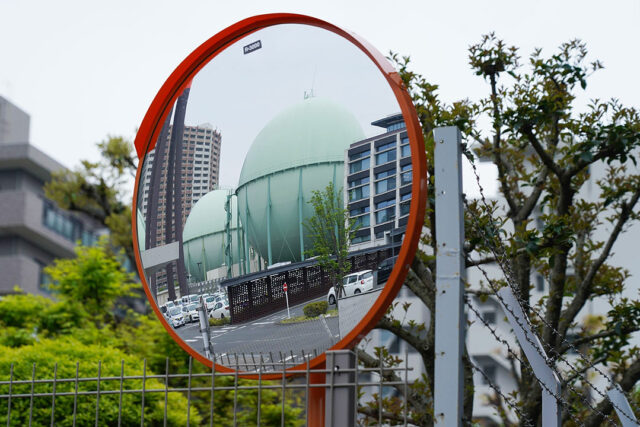
Tokyo Gas to build zero-carbon town near city’s new fish market

BLOOMBERG

TOKYO Gas Co. will embark on a large-scale redevelopment of land it owns near the city’s new fish market, in a bid to create a town with virtually zero carbon dioxide emissions.

The company will spend tens of billions of yen to make Shin-Toyosu a “circular future city” that captures and reuses carbon emitted from electricity and heat supply, said Takashi Anamizu, president of the utility’s real estate unit. It will formulate a plan in the current fiscal year.

The area — encompassing about 200,000 square meters (2.2 million square feet) adjacent to Toyosu Market — will be developed in phases, with offices, commercial facilities and residences. The first stage is expected to be completed around 2030.

Environmental considerations are becoming more important in real estate development. There is a growing trend to decarbonize the power supply of buildings by installing features including solar panels, energy-saving equipment and storage batteries. According to Tokyo Gas, this will be the first time in Japan that entire buildings, including the heat supply, will be decarbonized.

Anamizu aims to expand the Shin-Toyosu initiative to other areas. “We would like to take this one step further than a demonstration project and one step closer to practical application,” he said.

Shin-Toyosu used to house a plant of Tokyo Gas, which produced gas from coal, as well as a thermal power plant. With the relocation of the Tsukiji fish market, the company sold part of the former site and exchanged it for adjacent land owned by the Tokyo Metropolitan Government, leading to its current ownership of the development area. — Bloomberg

Toyota recalls certain GR Supra, 86 models

PHILSTAR FILE PHOTO

TOYOTA Motor Philippines Corp. (TMP) has issued a recall on selected units of its two sports car models, GR Supra and 86, due to the lack of emission control labeling.

The car manufacturer said in an advisory dated March 14 posted on the Department of Trade and Industry (DTI) website that the customer satisfaction campaign covers 1,836 officially sold vehicles in the Philippines.

Broken down, the recall campaign consists of 170 units of the GR Supra with a production period of March 29, 2019 to June 5, 2020 and 1,666 units of the 86 with a production period of April 12, 2012 to April 9, 2021.

“Toyota GR Supra and 86 vehicles were not equipped with the emission control label for the Philippines region,” TMP said in the advisory.

“In line with its corporate commitment to product safety and quality, Toyota has initiated a customer satisfaction campaign for emission control label on certain Supra and 86,” it added.

Under the campaign, TMP’s dealers will apply the emission label on the affected vehicles at no charge to the vehicle owners.

The application of the emission control label on vehicles is mandated under the implementing rules and regulations (IRR) of Republic Act No. 8749 or the Philippine Clean Air Act.

Some of the information needed in the emission control label include the full corporate name and trademark, engine type displacement in metric units, and the engine tune-up specification and adjustment as recommended by the manufacturer.

“The label, of durable material, shall be affixed by the manufacturer, assembler or importer in such a manner that it cannot be removed without defacing such label. It shall be affixed in a readily visible position in the engine compartment or any conspicuous area under the hood, or under the seat in case of a motorcycle,” the IRR said. — Revin Mikhael D. Ochave 

Insurers must tap technology amid increased digitalization

THE INSURANCE SECTOR must catch up with the banking industry in terms of digitization to boost its operations and ensure continued growth, industry officials said.

“You see the banks, they’re way ahead of the insurance industry. We’re both considered financial institutions, but we’re playing catch up to the banking industry,” Philippine Insurers and Reinsurers Association, Inc. Executive Director Michael F. Rellosa told BusinessWorld in an interview last month.

Mr. Rellosa said technology that aims to aid insurance agents is currently being developed with the help of both foreign and local technology companies.

“We realize the importance of agents and we don’t want to disenfranchise them. So, we’re equipping them to be able to better service our clients or our common client via technology,” he said.

“As we harness the power of insurtech, we feel that it can only make our Advisors’ performance and productivity stronger. It doesn’t necessarily mean cutting or stopping recruitment — if at all, it’s just going to make our Advisors better at what they do,” Sun Life Philippines Chief Operations and Digital Enterprise Officer Gaurav Mishra said separately.

Mr. Rellosa said the industry relied on the legacy systems before the coronavirus pandemic, but the lockdown required them to use technology to reach out to clients.

“If there’s anything positive that came out of the pandemic, it’s the realization of the industry that we really have to tech up,” he said.

He added that the implementation of International Financial Reporting Standard (IFRS 17) in 2025 will require insurers to adapt.

“It’s going to necessitate a huge change in the way we currently do things in our offices. So, even the legacy systems that I was talking about may have to be updated or changed altogether to be compliant with IFRS 17 requirements,” he said.

Mr. Mishra said IFRS 17 will “allow greater comparability and increase transparency.”

“Legacy systems are often the cause of insurers not being agile and nimble enough to allow instantaneous and high-volume digital transactions. Larger scale modernization projects are often needed to make these capabilities possible,” he said.

“Legacy mindset also largely contributes to the difficulty, as it stunts and limits creativity in implementing new insurtech-infused processes, business models, products, and ways of working,” Mr. Mishra added.

While banks and insurance companies could be on similar ground in terms of digitization, banks are more aggressive in implementing new technologies, he said.

“As clients transact more frequently with banks, digital transformation is more accelerated since clients have high expectations on digital services, and banks compete for attention,” Mr. Mishra said.

“This is not to say that the insurance industry is more relaxed — ultimately, we also compete for clients’ attention, and more and more — digital capabilities are becoming one of the top reasons why clients choose an insurer,” he added. — A.M.C. Sy

Actress Eva Green wins London court case over fee for failed film

HOLLYWOOD actress Eva Green on Friday won a legal fight with producers and financiers whom she sued in London’s High Court for her fee for a failed film in which she was to star.

The French actress, whose film credits include the James Bond movie Casino Royale, sued White Lantern Films and SMC Specialty Finance for the $1 million fee she said she was owed for the planned independent movie A Patriot, in which she was to play the lead role as a soldier.

Judge Michael Green said in a written ruling that Eva Green was entitled to payment of the $1-million fee.

The production company had launched a counter claim against Ms. Green for breach of contract, blaming her for the science fiction film’s failure before it went into production in late 2019, saying she had never intended it to go ahead. Ms. Green, 42, appeared in court in January to say she had become concerned the film’s production team had been cutting corners, citing how her stunt training had been reduced from four weeks to five days.

White Lantern’s lawyers said Ms. Green, also an executive producer on the project, had made unreasonable demands about crew, locations, and equipment.

They cited WhatsApp messages from Ms. Green in which she described a producer as a “f**king moron” who should be fired and another as “evil”. She described funders of the movie as “a**eholes” and some proposed crew members as “s**tty peasants”.

But the judge said that, while Ms. Green “may have said some extremely unpleasant things” about the film’s producer and crew, “this was born from a genuine feeling of concern that any film…would be of very low quality”.

“I fought tooth and nail to defend the beautiful film that I loved and had signed on for,” Ms. Green said in a statement. “A film that spoke of a cause I hold dear — climate change — and warned of the resource wars and mass migration that would occur if we don’t address the problem.

“I stood my ground and, this time, justice prevailed.”
White Lantern Films and SMC Specialty Finance said in a statement: “We are naturally disappointed by today’s judgment and the court’s findings. We are carefully considering our options as to potential next steps, including appeal.” — Reuters

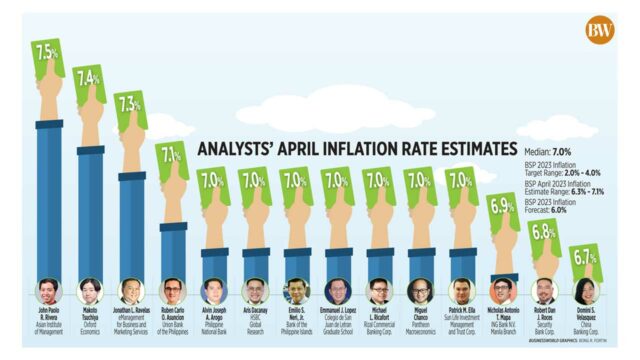
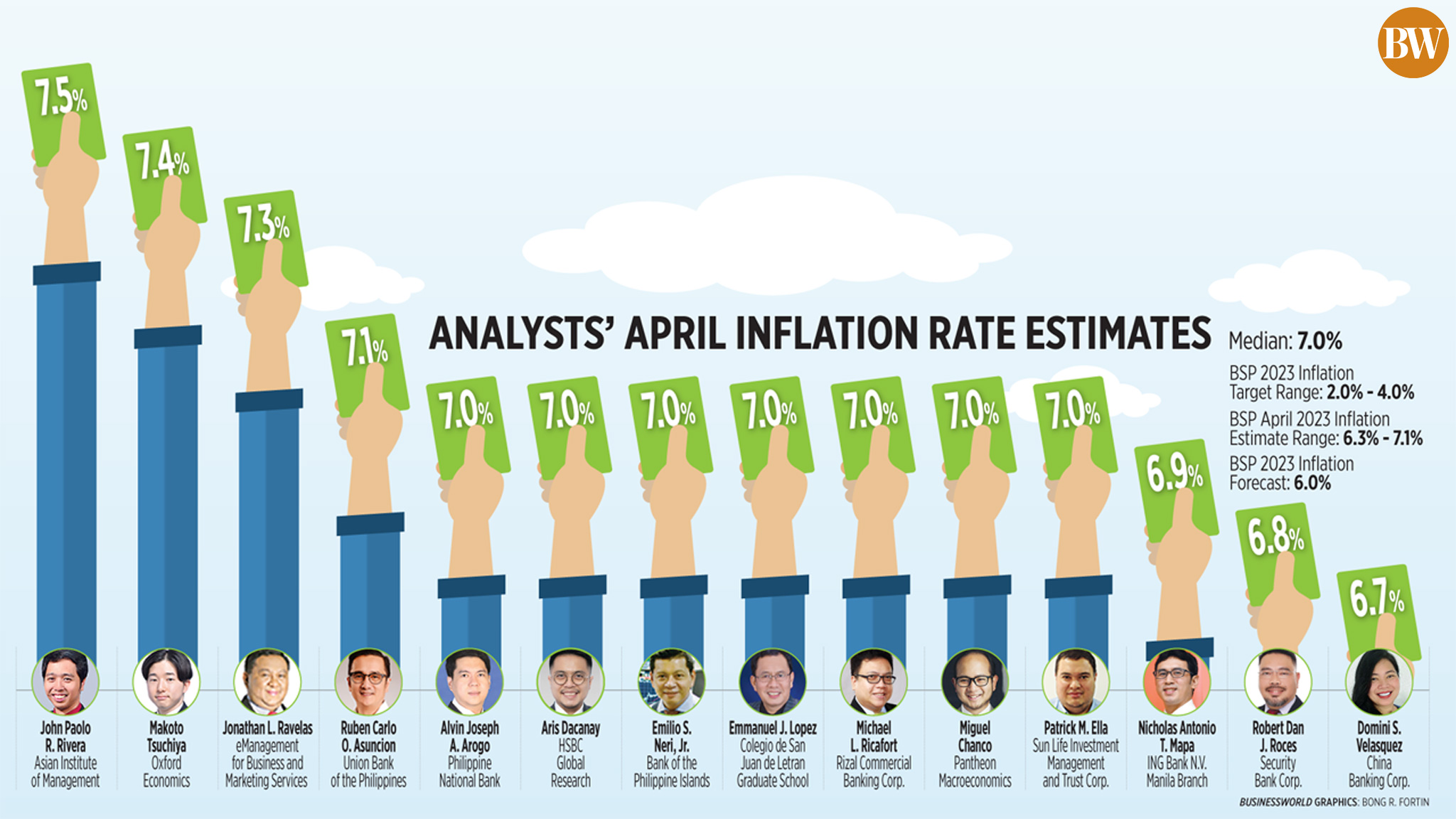
Analysts’ April inflation rate estimates

INFLATION likely further eased in April amid lower food prices, electricity rate cuts, and favorable base effects, analysts said. Read the full story.

Analysts’ April inflation rate estimates

ADVERTISEMENT
ADVERTISEMENT