Home Blog Page 4924

We are not bound to walk this path again

VECTORJUICE-FREEPIK

Last week, we wrote about the scars and deeper wounds in the Philippine labor market with a recall of the International Labor Organization’s (ILO) forecast at the height of the pandemic in April 2020. The ILO projected that “one quarter of total employment in the Philippines is likely to be disrupted by the impact of COVID-19 on the economy and labor market.”

It’s sad enough that we have suffered lower earnings and working hours, or outright loss of jobs because of the virus, but that it has also been holding hostage a whole generation of our young people with sub-standard learning and training is just too much. It’s like inflicting a hairline fracture on our future.

But are we bound to walk this path again?

As we celebrate Labor Day on May 1 next week, we received an advisory from the health authorities that while Metro Manila and other provinces are under Alert 1, some 26 provinces ranging from Benguet and Ifugao in Northern Luzon to Sulu and Tawi-Tawi in Southern Mindanao, continue to languish under Alert 2. Vaccination remains limited three years after the virus first appeared in Wuhan, China. The Pharmally scandal continues to be archived. We have yet to appoint the head of the Health department.

This is no joke.

Confirmed cases nationwide continued to rise as last week’s average daily new infections expanded by 32%. This translates to 450 cases against the previous week’s 341. While the share of severe cases is less than half a percent and hospital use is below capacity, these last three years should have taught us to be more risk-conscious and pro-active in arresting a possible surge as we struggle against the heat of summer. This is the best time to go to the beach, or a resort, and propagate the virus.

Which reminded me of the Bangko Sentral ng Pilipinas (BSP) launch of the book, Labor Market Implications of the COVID-19 Pandemic in the Philippines, on March 1 this year. We recall reading on the BSP website BSP Governor Philip Medalla saying, “much remains to be learned about the economic implications of COVID-19 pandemic, not just in the labor market but … (also in) the development of human capital.”

It is just incredible that the coverage in the press has been quite muted, given the awesome content of the 400-page volume.

Written by BSP staff, university professors, research experts, and former public officials, the contributions in the book range from the impact of the pandemic on employment, wages, and labor productivity to the retirement system and overseas remittances. It is also refreshing to read policy papers on monetary policy and the labor market as well as possible areas of collaboration between monetary policy and public finance in the post-pandemic era.

Which brings us to the more structural dimensions of the pandemic. This was very well captured by the second article in the book, entitled “Labor Productivity, Structural Change, and COVID-19,” written by former National Economic and Development Authority (NEDA) Secretary and now University of the Philippines (UP) Professorial Lecturer Emmanuel F. Esguerra and UP Associate Professor Karl L. Jandoc.

Esguerra and Jandoc observed that the pandemic further impinged on the Philippines’ modest labor productivity gains in the last two decades. Earlier, reflective of the kind of economic and policy environment in the Philippines as well as the existing labor market institutions, those modest gains unsurprisingly failed to put the country ahead, or at least at par, with its regional peers. The authors cited the World Bank (2018) which reported that structural change has hardly contributed to the country’s growth in productivity.

Using the standard breakdown of labor productivity into intrasectoral and intersectoral components, the paper argued that labor productivity has been growing since 2000 except during the Global Financial Crisis of 2008-2009 and, of course, the steep decline during the pandemic. About four-fifths of productivity growth derived from within-sector productivity gains.

Within-sector, or intrasectoral, gains result from firms’ adoption of new technology, improvement of production processes, or higher efficiencies realized due to international trade. There was very little from structural change, or intersectoral components, or when labor moves from lower to higher productivity sectors.

It was important for Esguerra and Jandoc to have zeroed in on labor productivity because, as the literature demonstrates, “the gaps in per capita incomes and material wellbeing across countries are traceable to differentials in productivity.” Progress is driven by productivity gains.

Citing the study by M. McMillan and D. Rodrik (“Globalization, structural change, and productivity growth in making globalization socially sustainable,” 2011), the paper made the point that structural change could in fact reduce, rather than increase, economic growth. This was experienced in some parts of Latin America and Sub-Saharan Africa. Globalization appeared to have failed to effect structural change, with labor moving in the wrong direction. Labor displacement due to trade liberalization gave way to workers moving away from manufacturing to lower productivity services.

What is tragic in the case of the Philippines is that, as the World Bank (2016) quote clarified: “Economic growth created jobs, but failed to improve their average quality. Most workers have not benefited from growth in terms of higher real wages. This is in sharp contrast to developments in other Asian countries, which saw a considerable increase in real wages.”

Part of the reason is our failure to build the country’s manufacturing base and provide high-productivity jobs to low-skilled and semi-skilled workers alike. Up to this day, one can say that even agriculture remains primitive, services remain mostly informal.

Where do we expect productivity and economic growth to come from?

The pandemic’s economic scarring and deskilling impact, especially on the young people, is too graphic to be ignored. Their learning and training activities were severely impaired. Therefore, what else can we expect but a further deterioration in labor productivity and the quality of the workforce in the future. There is no such thing as simply restoring the labor force to where they were before the pandemic. The economic milieu was flawed in the first place. What the health crisis did was simply to show the weaknesses of the system, and to exacerbate them.

Esguerra and Jandoc’s resonating message is indisputable. It is imperative to increase investments in human capital for reskilling and to overhaul the school curricula to reverse the learning losses during the pandemic. They also called for more careful formulation of industrial policy because of how global trade is unfolding today, that getting into global value chains may not work as before because the big players have increasingly shifted to reshoring or nearshoring. De-industrialization has also been reported even at lower income levels.

The paper suggested relying more on the intrasectoral component of labor productivity. There is value in nurturing tradeable services to leverage on labor in the informal sector and drive them to higher productivity sectors. The regulatory framework should be further liberalized. Budget support should be available to provide complementary inputs to education and training activities like school buildings and curriculum development. Low-end services cannot be ignored. Policies can be enhanced to expand intangible capital including business development, advertising, and software. Digitalization is indispensable.

By no means did the authors suggest moving away from agriculture. In fact, they suggested that enhancing labor productivity here would have the biggest potential impact in reducing poverty and inequality. More investments are critical. Agriculture continues to suffer from lack of scale, stifling traditional intervention measures like commodity price support and input subsidies, and weak labor market regulations. A rethink of public policies should address these weaknesses that were made more apparent during the pandemic.

Today, society is enamored with a whole-of-nation approach to cover all grounds, that nothing is missed, no one is left behind. There should be no issue that the BSP ought to popularize the key messages contained in this book, and extract from there the policy implications and concrete measures to the public.

We don’t need a pandemic resurgence to motivate this, the persistence of economic and social problems that have pulled us back behind many ASEAN counterparts are more than enough.

We are not bound to walk this path again.


Diwa C. Guinigundo is the former deputy governor for the Monetary and Economics Sector, the Bangko Sentral ng Pilipinas (BSP). He served the BSP for 41 years. In 2001-2003, he was alternate executive director at the International Monetary Fund in Washington, DC. He is the senior pastor of the Fullness of Christ International Ministries in Mandaluyong.


Crypto Shopping: Navigating the world of digital money with exchange platforms

FREEPIK

For this week, I thought I would discuss crypto exchange platforms. A crypto exchange is a platform for buying and selling cryptocurrencies, which are two very important actions, basically the backbones, for anyone getting into cryptocurrencies. So, before you start your trading journey let’s talk about these platforms and get familiar.

Crypto exchanges are used for trade and offer price discovery through trading activity, and some even offer storage. However, it’s important to first differentiate between crypto exchange and crypto wallet. A crypto wallet is mainly a digital wallet that stores your cryptocurrencies, whereas a crypto exchange is a platform where digital transactions are primarily facilitated. Before these platforms existed, people had to work really hard to get their digital money by doing something called mining or by finding someone who had some to sell.

But now, there are many different crypto exchange platforms that offer lots of different digital money options, and some of them also keep your digital money safe.

Different crypto exchange platforms can have different prices and ways of doing things, so you have to look around to find the one that works best for you and makes you feel safe.

So, let’s discuss the advantages and disadvantages of crypto exchange platforms, how they work, and maybe even get down to which are the best ones for your needs.

Let’s jump right into some of the advantages of crypto exchange platforms.

• They can be super helpful if you want to buy or sell cryptocurrencies because they make it really easy to trade digital money without having to go through a lot of complicated steps. For example, you can usually just connect your bank account or credit card.

• Plus, many exchanges have helpful tools that show you how the prices of different cryptocurrencies are changing over time, so you can make informed decisions about when to buy or sell.

• And as for security, many crypto exchange platforms have really good security features in place to protect your digital money from hackers and scammers.

I know this is starting to sound a little too good to be true, but like all new and exciting innovations, there are some challenges involved. What are the things you should look out for from crypto exchange platforms? The two main things I will mention are regulation and manipulation.

• Regulation is one of the biggest challenges, since governments and financial institutions are still figuring out how to classify and regulate cryptocurrencies. Additionally, there are cybersecurity risks that come with storing and trading digital assets online.

• Another issue that can affect some crypto exchange platforms is market manipulation. This happens when someone tries to manipulate the price of a particular cryptocurrency in order to profit from it, which, although highly unethical, does happen sometimes.

Although risk is common in any established financial institution, the level of risk varies between crypto and other existing securities because of the regulations in place to mitigate these risks. It’s really important to choose an exchange with strong security measures, to avoid cybersecurity risks. Also, consider one with a good reputation and a track record of ethical behavior to avoid falling victim to market manipulation.

We’ve talked about pros and cons, now, what are the best platforms out there? Well, according to a recent article by Andy Rosen, who provided a list of top exchanges based on factors such as fees, security, user experience, and available cryptocurrencies, some top choices are: Coinbase, eToro, and Robinhood crypto to name a few. Let’s go through them.

COINBASE
• Coinbase is a well-established cryptocurrency exchange platform that allows users to buy and sell a variety of cryptocurrencies.

• It is available in over 100 countries and has more than 68 million registered users.

• The platform offers a user-friendly interface that makes it easy for beginners to start investing in cryptocurrencies.

• It charges fees that are relatively high compared to some other exchanges, but these fees can be reduced by using Coinbase Pro.

• Coinbase takes security seriously and stores most of its users’ funds in offline cold storage.

• It offers insurance protection in case of any losses due to security breaches.

• Coinbase supports a range of payment methods, including bank transfers, credit/debit cards, and PayPal.

• It also has a mobile app that allows users to buy, sell, and trade cryptocurrencies on the go.

• One potential downside is that Coinbase’s customer support has been criticized in the past for being slow to respond to users’ issues.

eTORO
• eToro is a user-friendly trading platform for both novice and experienced traders.

• The platform allows traders to invest in stocks, cryptocurrencies, and other assets.

• eToro has a social trading feature that allows users to copy the trades of successful traders.

• The platform offers educational resources such as webinars, videos, and blog articles.

• eToro has a mobile app that allows users to trade on-the-go.

• The platform charges no commission fees on trades, but instead generates revenue through spreads.

• eToro has a minimum deposit requirement of $50.

• The platform is regulated by financial authorities in the UK, Australia, and Cyprus.

ROBINHOOD
• Robinhood is a commission-free brokerage app that offers trading in stocks, options, ETFs, and cryptocurrencies.

• The app’s user interface is intuitive and user-friendly, making it easy for beginner investors to navigate.

• Robinhood offers a cash management account that earns interest and provides ATM access and debit card usage.

• The platform does not charge commission fees, which makes it ideal for small investors.

• Robinhood offers limited customer support, which can be frustrating for some users.

• The platform has been criticized for its lack of security measures and technical issues.

• Robinhood is a good option for beginner investors who want to start trading without paying commission fees, but experienced investors may prefer a more established brokerage with better customer support and security features.

This list only serves as a loose guide and you should do your own research and decide based off of your own pros and cons list.

In conclusion, crypto exchange platforms are an essential tool for anyone looking to buy or sell cryptocurrencies. They make it easy to trade digital money and offer useful tools for monitoring price changes. With proper security measures in place, users can feel safe and confident about their transactions. While regulation and market manipulation remain challenges, they are not unique to crypto and can be mitigated by choosing a reputable and secure exchange. By considering factors such as fees, security, user experience, and available cryptocurrencies, you should find the exchange that best fits your needs. Happy trading!


Dr. Donald Lim is the founding president of the Blockchain Association of the Philippines and the lead convenor of the Philippine Blockchain Week. He is also the Asian anchor of FintechTV.

Annual growth of 6.5-8% until 2028: How?

KRAPHIX -FREEPIK

THE KEY outcomes of President Bongbong Marcos’ Philippine Development Plan 2023-2028 — to increase income per capita, reduce poverty, and create employment — rest on a necessary condition: to attain a 6.5-8% annual growth rate through 2023 to 2028. If achieved, the Philippines would resemble its East Asian neighbors, which attained similarly high growth rates decades ago. This is much needed given the still low wages and per capita income of the country. Yet, this “target” poses several questions.

First, it is not clear where the government’s 6.5-8% target comes from: whether it is a wish, or a figure derived from an economic model. If it is the former, then it is simply the growth needed (under some assumptions and back-of-the-envelope calculations) to attain the outcomes. In the latter case, it would be a statement of what the Administration believes will happen, based on its understanding of how the economy functions (a model).

Secondly, what would be remarkable about the Philippines’ growth performance, if this target is attained, is that the age of growth miracles came to an end years ago. We know that abnormally rapid growth is rarely persistent. The lack of persistence in country growth rates implies that current growth is not a good predictor of future growth. It also means that rapidly growing countries cannot post unusually high growth, or much higher than the world’s historical average of 2% plus 2% standard deviation, for extended periods. The Philippines’ GDP grew fast in 2022, but this was partly the effect of leaving behind the pandemic, and of fully reopening the economy. Many experts question that growth will reach 6% in 2023.

Thirdly, growth miracles, particularly in Asia, have almost always been driven by labor-intensive manufacturing, and export-led growth. The Philippines skipped these. The conditions to generate such a growth process are harder to meet in the new global economy, due to changes in manufacturing technologies and the global context. Skill-biased technological progress has reduced job creation in manufacturing, resulting in an increasing share of employment in less-productive service activities. Moreover, globalization and the associated rise in competition in world markets (e.g., the rise of China as a manufacturing power) have made industrialization much more difficult for newcomers to achieve fast growth via exports.

Fourthly is the question of sustainability. Attaining a relatively high growth rate one year might be possible for a number of reasons; but maintaining it for six consecutive years is quite another: it would be the first time that the Philippines attains such a feat.

Finally, a country’s long-run growth rate has a limit, a maximum. Actual growth tends to fluctuate (above or below) around this maximum. It cannot deviate from it permanently. When it does (from above or from below), there are forces that bring it back, like a pendulum. There are two such maxima in any economy. One is on the supply side, what economists call potential growth. This is the maximum growth rate that the technical conditions of production allow. It is given by the sum of the growth rates of labor productivity and of the labor force. For example, when a country’s growth rate is above its potential, unemployment will decline, while wages will increase, leading to inflationary pressures, with the consequence that the central bank will increase its reference interest rate and the economy will cool, thus bringing growth down.

The other limit is on the demand side. This is based on the fact that developing countries’ growth rates are constrained by the current account of the balance of payments: they need to import capital goods for their development. The problem is that imports have to be paid mostly in dollars, euros, or yen, which means that developing countries need to earn these currencies. They can obtain them through capital flows but these are not guaranteed. Hence, they have to export and be paid in these currencies. If imports are larger than exports, they will run deficits. History teaches us that this situation is not sustainable and sooner or later a crisis will follow.

Therefore, there is a growth rate consistent with current account equilibrium, referred to as the balance-of-payments-equilibrium growth rate. In its simplest form, this is given by the product of the country’s trade partners (where the country exports) growth rate times a very important variable which captures the non-price competitiveness of exports relative to that of imports. Indeed, especially important for a developing country is the set of non-price attributes of its export basket. These refer to how attractive a country’s exports are in foreign markets due to quality, reliability, speed of delivery, distribution network, etc. This variable is high for countries that export machinery, cars, electronic products, or chemicals (Germany, South Korea). It is low for countries that export agricultural products and natural resources, or simple manufactures (the Philippines).

The above discussion implies that, in order to have a sensible discussion of how fast a country can grow in the medium to long-term, authorities should have an idea of what potential and balance-of-payments-equilibrium growth rates are; and also understand which one is the binding constraint on growth. My experience tells me that, for developing countries, the demand side constraint is the one that bites first. This is because before achieving its potential growth rate, an economy’s actual growth performance can be curtailed by macro constraints. For emerging economies, the external constraint associated with the current account balance is particularly significant, given these countries’ dependence on the availability of foreign exchange to finance their imports. Current account deficits can be sustainable and, indeed, necessary in the short run — especially when they allow for faster capital accumulation. But countries cannot finance ever-growing current account deficits in the long run, as there is a limit beyond which the deficit becomes unsustainable (or is perceived as such by financial markets) and a balance-of-payments crisis ensues. Thus, countries that find themselves in balance-of-payments problems may be forced to constrain growth while the economy still has surplus capacity and surplus labor — that is, while the actual growth rate is still below the potential growth rate.

It is very difficult to properly estimate potential and balance-of-payments-constrained growth rates for the Philippines given the severe recession in 2020. With this caveat, our estimates indicate that:

• The Philippines can grow fast by international standards but it will be difficult to maintain a growth rate above 6-6.5% during this administration’s term. Both potential and balance-of-payments-equilibrium growth rates are at about 6% at best, not higher.

• Barring crises, the Philippines can still attain for a few years annual growth rates of 5-6% without forcing macroeconomic imbalances. In time, labor force growth and labor productivity growth will decline, and so too will potential growth decline.

• Labor productivity growth has been the main driver of potential growth during the last 15 years. A significant determinant of labor productivity growth is the performance of the manufacturing sector. For a country like the Philippines, still far from the technological frontier, attaining a relatively high growth rate of labor productivity is not a chimera. Labor force growth is declining but still positive (contributing above one percentage point to potential growth).

• With a world economy (i.e., market for the Philippines’ exports) predicted to grow at about 3%, it will be very difficult for the Philippines to attain a growth rate over twice this rate.

• Overseas workers’ remittances contribute slightly over one percentage point to the balance-of-payments-equilibrium growth rate. This means that, even to maintain the current balance-of-payments equilibrium growth rate at about 6%, the Philippines would have to continue depending on these remittances, which is not a sign of development.

Policy makers need to focus their attention on increasing the non-price competitiveness of the country’s export basket. This requires understanding the importance of structural change, the essence of what development is about. Indeed, what all Asian fast-growing economies did during the last decades, was to increase the sophistication (non-price competitiveness) of their exports. The export structure of the Philippines has changed during the last decades, and its non-price competitiveness has increased, but it is still far from what the country needs to attain and sustain a higher growth rate. If the structure of the export basket does not change, the Philippine economy will continue being uncompetitive in world markets and will not experience a significant increase in wages and per capita income.

Summing up: 6.5-8% growth during 2023-2028? It will be very difficult unless the world economy improves significantly, or the structure of the Philippine economy shifts in the direction of exporting a more sophisticated export basket that competes in world markets not on price but on the quality of its products. The six-million-dollar question is: who will lead transformation that the Philippine economy needs? This will be the topic of a subsequent article.


Jesus Felipe is distinguished professor of Economics and director of the Angelo King Institute, De La Salle University.

When the legal profession goes left

FREEPIK

Thousands more will be joining the legal profession, as the recent Bar passers take the Lawyer’s Oath (on this, see my April 21 column, “A new lawyer’s oath. And not necessarily for the better”). This brings to mind something once said by Theodore Roosevelt: “To educate a man in mind and not in morals is to educate a menace to society.

LAWYERS AND SOCIETY
Clearly, law schools have done their best — ostensibly — to create ethical lawyers that will do good for society. And yet, one aspect of the legal profession that needs to be understood is that the judiciary plays a huge role in the direction with which non-judicial lawyers (i.e., practicing and non-practicing lawyers, lawyers in the academe, business, politics, and so on) take. The judiciary, especially the Supreme Court, has — in practice — the unquestioned authority to determine who joins the legal profession, who can be disqualified, and even the continued training and quality of the lawyers themselves.

Considering the impact that lawyers have on society itself, it behooves everyone, not only lawyers, to examine the measures being taken by the judiciary regarding the training and quality maintenance of the legal profession. It is one thing to talk of legal philosophy in the classroom, it is quite another to be indoctrinating certain philosophies and applying the same in a manner approaching judicial legislation. All the more if such philosophies or ideologies are quite contrary to the values and principles of the Filipino people themselves, as well as contrary to the values and principles of the Constitution.

FEMINIST AND QUEER. AND MARXIST.
As a purely hypothetical scenario, let’s say a judicial officer advocates for the implementation of feminist or queer legal theories. Again, if such discussions were to take place within the academe, such would be perfectly welcome (provided, of course, that opposing views are welcomed as well). The problem in this scenario is it’s a judge advancing the said theories. Doing so would inevitably lead to certain unavoidable and quite unfortunate consequences. Indeed, to pass off such theories as if they’re practicable frameworks applicable to a working society is already ill-advised. First of all, they are what their name actually states: “theories.” And to use the country as a laboratory for such theory is utterly irresponsible.

And yet, setting that aside, the content of the theories alone should make responsible officials pause, particularly if such also go against whatever the Constitution stands for. Both feminist and queer legal theories, if not by conception but definitely in their present incarnation, are quite evidently Marxist in essence.

Take feminist legal theory, which takes the view that “women’s subordination was neither biologically natural nor God-given; instead, the class relations of capitalism enforced the gender hierarchies that anchored women’s oppression. Marxist feminists viewed this patriarchal family as integral to capitalism, and thus a site of oppression that must be destroyed.” (Marxist and Socialist Feminism, Elisabeth Armstrong, 2020)

Interestingly, while the new Code on Professional Responsibility and Accountability emphatically proscribes misinformation by lawyers, yet — in our hypothetical scenario — we see for example said a judicial officer advancing basically an unproven, practically false idea, of the “patriarchy,” being as it is an essential component of feminist legal theory:

“The theory of patriarchy, which says that there is a fundamental division between men and women from which men gain power, is accepted without question today by most of the left. The theory was developed by feminists such as Juliet Mitchell and Miriam Dixson who, in her book The Real Matilda, was inclined to blame Irish working-class men for women’s oppression, using the theory of patriarchy as the basis for her argument.”

And thus again, the essentially Marxist nature of feminist legal theory: “The Marxist analysis is that the historical roots of women’s oppression lie in class society. The specific forms this oppression takes today are the result of the development of the capitalist family and the needs of capital. Therefore, the struggle to end the rule of capital, the struggle for socialism, is also the struggle for women’s liberation. Because class is the fundamental division in society, when workers, both women and men, fight back against any aspect of capitalism they can begin to break down the sexism which divides them. Their struggle can begin to ‘transform the existing categories’.” (“The poverty of patriarchy theory,” Sandra Bloodworth, Marxist Left Review, 2020)

BIAS FOR SOGI, LGBT, AND DIVORCE
There is also the problem of perceived bias. For a judicial officer to be advancing such theories is ill-considered as it betrays a bias with regard to issues that feminist and queer legal theory are obviously in favor of: same sex marriage, gender identity and sexual orientation, and LGBT issues. Thus: “There develops the division of labor, which was originally nothing but the division of labor in the sexual act, then that division of labor which develops spontaneously or ‘naturally’ by virtue of natural predisposition.”

In other words, inequality according to Marx is the result of a “division of labor in the sexual act.” This division of labor is implicitly built on the distinction between male and female. This effects later divisions in labor and thus inequality. Thus: “if the sexual act and the division between genders is the very root of all inequality, the only means by which this inequality can be negated is through the androgenization of human nature, wherein the sexual difference between man and woman is abolished. Feminist readers of Marx, like Simone de Beauvoir and Shulamith Firestone, seized on this supposedly profound insight in Marx.” (“Marxism and the Gender Revolution,” Crisis Magazine, November 2021; see also “‘SOGIE Human Rights’: How is the European Court of Human Rights Shaping Queer Emancipation?,” Eleanor Currie, 2019).

Another potential issue that could go before the courts is a possible divorce law, which again feminist legal theory is in favor of: “Feminists would generally see the decline of marriage as a tradition as a good thing, because traditional marriage is a patriarchal institution. Most divorce proceedings are initiated by women which suggests that marriage works less well for women than for men.” (“Sociological Perspectives on Declining Marriage and Increasing Divorce on Society,” Karl Thompson, 2015)

CONFLICT THEORY AGAINST THE CONSTITUTION
The foregoing could also be said in relation to our hypothetical judge advocating for “conflict legal theory,” which was “first developed by Karl Marx” and essentially posits that “society is in a state of perpetual conflict because of competition for limited resources.”

The problem with conflict theory is its divisiveness. It goes against our constitutional call for unity, as well as “freedom, love, equality, and peace.” It holds that “social order is maintained by domination and power, rather than by consensus and conformity.” Thus, “those with wealth and power try to hold on to it by any means possible, chiefly by suppressing the poor and powerless. A basic premise of conflict theory is that individuals and groups within society will work to try to maximize their own wealth and power.”

Conflict legal theory also goes against the family and religion, which the Philippines has lifted up with constitutional value, and seeks to subvert our Constitution’s stated policy towards an “independent national economy effectively controlled by Filipinos” and encouragement of “private enterprise”:

“One common criticism of conflict theory is that it fails to capture the way in which economic interactions can mutually benefit the different classes involved. For example, conflict theory describes the relationship between employers and employees as one of conflict, in which the employers wish to pay as little as possible for the employees’ labor, while the employees wish to maximize their wages. In practice, however, employees and employers often have a harmonious relationship. Moreover, institutions such as pension plans and stock-based compensation can further blur the boundary between workers and corporations by giving workers an additional stake in the success of their employer.” (“Conflict Theory Definition, Founder, and Examples,” Adam Hayes, 2022)

NEITHER LEFT NOR RIGHT BUT THE CONSTITUTION
It’s bad enough if lawyers, acting as officers of the court and not as public advocates acting as clients themselves, try to impose their ideology on their clients, parties before the court, or the judges themselves. The same goes for legal academics that, instead of educating law students on the fundamentals of the law, try to indoctrinate them instead on their favored ideology. It is all the more unfortunate if judges, with their significant power, responsibility, and prestige, would seek to impose their personal beliefs on lawyers that by practice, habit, and tradition defer to them with utter trust.

In this, the remedy is to look at the Constitution and its author — our people. The product of centuries, even millennia, of human experience, it would be good for our officials of the court to rely on the wisdom contained in such experience and work within palpably proven legal frameworks, rather than subjecting our people to the role of laboratory animals vulnerable to consequences we cannot even begin to imagine foreseeing.


Jemy Gatdula is a senior fellow of the Philippine Council for Foreign Relations and a Philippine Judicial Academy law lecturer for constitutional philosophy and jurisprudence

https://www.facebook.com/jigatdula/

Twitter  @jemygatdula

Sudan fighting flares but military approves ceasefire extension

SMOKE is seen rising from buildings during clashes between the paramilitary Rapid Support Forces and the army in Khartoum North, Sudan, April 22, 2023. — REUTERS

 – Sudan‘s army and a paramilitary force battled on Khartoum’s outskirts on Wednesday, undermining a truce in their 11-day conflict, but the army expressed willingness to extend the ceasefire.

The army late on Wednesday said its leader, General Abdel Fattah al-Burhan, gave initial approval to a plan to extend the truce for another 72 hours and send an army envoy to the South Sudan capital, Juba, for talks.

The Sudanese armed forces and the paramilitary Rapid Support Forces (RSF) previously agreed to a three-day ceasefire that was due to expire late on Thursday. There was no immediate response from the RSF to the proposal from the Intergovernmental Authority on Development (IGAD), a regional bloc.

The military said the presidents of South Sudan, Kenya and Djibouti worked on a proposal that includes extending the truce and talks between the two forces.

“Burhan thanked the IGAD and expressed an initial approval to that,” the army statement said.

US Secretary of State Antony Blinken and African Union Commission Chairperson Moussa Faki Mahamat discussed working together to create a sustainable end to the fighting, the State Department said in a statement on Wednesday.

Some of Wednesday’s heaviest battles were in Omdurman, a city adjoining Khartoum where the army was fighting RSF reinforcements from other regions of Sudan, a Reuters reporter said. Heavy gunfire and airstrikes could be heard into the evening.

In Khartoum, which together with two bordering cities is one of Africa’s largest urban areas, gangs marauded and there was widespread looting.

Since fighting erupted on April 15, air strikes and artillery have killed at least 512 people, wounded nearly 4,200, destroyed hospitals and limited food distribution in the vast nation where a third of the 46 million people were already reliant on humanitarian aid.


MALNOURISHED CHILDREN

The World Health Organization said only 16% of health facilities were functioning in Khartoum and predicted “many more deaths” due to disease and shortages of food, water and medical services including immunization.

An estimated 50,000 acutely malnourished children have had treatment disrupted due to the conflict, and those hospitals still functioning are facing shortages of medical supplies, power and water, according to a UN update on Wednesday.

Deadly clashes broke out in Geneina in West Darfur on Tuesday and Wednesday resulting in looting and civilian deaths and raising concerns about an escalation of ethnic tensions, the update said.

The crisis has sent growing numbers of refugees across Sudan‘s borders, with the U.N. refugee agency estimating 270,000 people could flee into South Sudan and Chad alone.

Foreigners evacuated from Khartoum have described bodies littering streets, buildings on fire, residential areas turned into battlefields and youths roaming with large knives.

The White House said a second American had died in Sudan.

“It was horrible,” said Thanassis Pagoulatos, the 80-year-old Greek owner of the Acropole Hotel in Khartoum, after arriving in Athens to the embrace of emotional relatives.

“It has been more than 10 days without any electricity, without water, and five days nearly without food,” he added, describing shooting and bombing. “Really, the people are suffering, the Sudanese people.”


FORMER DICTATOR LEAVES PRISON

Beyond the humanitarian crisis, civilian groups fear the violence will enable the military to tighten its grip and revive the sway of an ousted autocrat’s loyalists.

The army said Omar al-Bashir, the 79-year-old former dictator toppled in 2019, had been transferred from Khartoum’s Kober prison to a military hospital, along with at least five of his former officials, before hostilities started.

Over the weekend, thousands of inmates were freed outright from prison, including a former minister in Bashir’s government who, like him, is wanted on war crimes charges by the International Criminal Court in The Hague.

Bashir’s three-decade reign came to an end with a popular uprising four years ago. He has been in prison, with spells in hospital, on Sudanese charges related to the 1989 coup that brought him to power.

“This war, which is ignited by the ousted regime, will lead the country to collapse,” said Sudan‘s Forces of Freedom and Change (FCC), a political grouping leading an internationally backed plan to transfer to civilian rule.

The plan was derailed by the eruption of fighting between the regular army and the paramilitary Rapid Support Forces (RSF). The two sides and the FCC missed an April deadline to launch the transition to democracy, largely over disputes about merging the security forces.

Civilian groups have blamed groups loyal to Bashir of seeking to use conflict to find a way back to power. The RSF, whose leader General Mohamed Hamdan Dagalo rose to power under Bashir but later dumped him, has strongly opposed the Islamists who backed the former army autocrat.

Sudan‘s army took over in a coup two years after the toppling of Bashir. The whereabouts of Bashir came into question after a former minister in his government, Ali Haroun, announced he had left Kober prison with other former officials.

The ICC in The Hague has accused Bashir of genocide, and Haroun of organizing militias to attack civilians in Darfur in 2003 and 2004. It declined to comment on the situation. – Reuters

Hyundai Motor to exit Russia, selling its plants – media report

STOCK PHOTO | Image by J W. from Pixabay

 – South Korea’s Hyundai Motor Co. plans to exit Russia and sell its manufacturing plants there to a Kazakh company, South Korean media reported on Wednesday.

South Korean TV network MBC reported that negotiations to sell Hyundai‘s factories in Russia are in the final stage, adding that the automaker has been waiting for a final approval from the Russian government.

“It is true that there are ongoing discussions regarding the sale, but nothing has been decided,” Hyundai Motor said, according to the TV network.

Hyundai Motor suspended operations at its Russian operation last year. In March, the automaker said it was reviewing “various options” for its Russian operation.

In a statement to Reuters on Thursday, Hyundai Motor said it was reviewing various scenarios for the future of its business in Russia, adding no decision had been made so far.

Many factories in Russia have suspended production and furloughed workers due to shortages of high-tech equipment because of sanctions and an exodus of Western manufacturers since Moscow invaded Ukraine last year.

Hyundai Motor, together with affiliate Kia Corp., is among the world’s top 10 biggest automakers by sales and builds about 200,000 vehicles per year in Russia, about 4% of its global production capacity.

Along with Renault, Hyundai and Kia were among top three selling brands in Russia before the war. Now as global players have pulled out, Chinese brands are replacing them in Russia‘s war economy. – Reuters

Coursera eyeing more PHL partners, launches AI features

Online training service Coursera said it targets to expand its partnerships with schools, businesses, and government agencies in the Philippines as digital transformation and economic recovery continue to shape the country.

Philippine-based users on the platform grew by 28% in 2022, thanks to an additional 400,000 new learners, according to Coursera. 

“More digital data comes into the work that organizations do. More Filipinos go to apps now, so we have to adjust,” said Raghav Gupta, Coursera APAC managing director, in an exclusive interview with BusinessWorld.

He added that there are now close to 1.8 million Coursera users in the Philippines, of which 49% are men and 51% are women, indicating the highest percentage of women in Asia Pacific countries.

“Aside from technical skills, we see more value being placed in leadership skills to be built by everybody,” Mr. Gupta said, describing what their partners invest in.

Coursera’s partners in the Philippines include Ayala Corp., Bank of the Philippine Islands, and Globe Telecom, Inc., Mapua University, National Teachers’ College, and the Department of Science and Technology (DoST).

The program with DoST, geared towards workforce recovery from the pandemic, saw almost 75,000 learners come to the platform, clocking about 1.4 million hours of learning, according to the platform.

INTEGRATING NEW TECH
Now, Coursera is leveraging new technologies to improve learning for all its users, namely artificial intelligence (AI) chatbot ChatGPT and virtual reality (VR) applications.

Coursera Coach, a virtual coach that answers questions, gives feedback, summarizes lectures, and helps prepare for job interviews, is being piloted and will be available in the coming months.

“Our hope is that we progress online learning from passive and active to interactive. Coach is going to be available to everybody on the platform,” Mr. Gupta said.

Meanwhile, the platform is also piloting an AI course-building tool for teachers. It will basically be a content creation engine for teachers.

To ensure that learners won’t be getting information from just about anywhere, Coursera’s ChatGPT will only retrieve expert content from 200 top universities and 100 leading companies.

It will not just be any data from the wider internet, said Mr. Gupta.

Finally, he added that Coursera will be integrating VR into their courses, such as public speaking courses.

“If you want to practice, you can come in and choose an environment, like aboard room with 10 board members or an auditorium with 500 people — whichever environment that you must practice for,” he said.

These new features will be launched for the wider public within the next few weeks. — Brontë H. Lacsamana

Facebook owner Meta touts AI might as digital ads boost outlook; shares jump

Meta

Meta Platforms Inc. CEO Mark Zuckerberg said on Wednesday that AI was helping the company boost traffic to Facebook and Instagram and earn more in ad sales, as it forecast quarterly revenue well above analyst expectations.

Meta shares surged 12% in after hours trading, adding over $50 billion to its market value and continuing a rally in tech shares that started after Google parent Alphabet Inc. and Microsoft Corp. posted strong results on Tuesday.

Meta narrowed its cost outlook range for the year, saying expenses could be less than the company forecast in March, and also beat expectations for first-quarter profit and revenue, which rose for the first time in nearly a year.

The company, which has been slow to adopt AI-friendly hardware and software systems for its main business, has carried out several expensive overhauls to bolster its core business, including a massive project to upgrade AI capacity.

“At this point, we are no longer behind in building out our AI infrastructure,” Mr. Zuckerberg said on a conference call. “And to the contrary, we now have the capacity to do leading work in this space at scale.”

AI recommendations increased time spent on Instagram by 24% in the January-March quarter, Meta said.

“I think similar to Alphabet, a lot of Meta‘s AI investments have gone into the advertiser side,” said James Cordwell, analyst at Atlantic Equities.

“So as a consumer we’re maybe not seeing the fruits of their labor in that area, but it certainly seems as if they are able to use more advanced algorithms to maintain a certain level of ad targeting.”

Meta has also kicked off an aggressive cost-cutting drive, with plans to eliminate 21,000 jobs and flatten its middle-management structure as it works towards Mr. Zuckerberg’s goal of turning 2023 into the “year of efficiency”.

The results indicated that austerity drive was “off to a stronger than expected start for Meta,” said Insider Intelligence principal analyst Debra Aho Williamson.

“In this economic environment—and after the disaster that was 2022—3% year over year revenue growth is an accomplishment. Meta‘s strong guidance for Q2 revenue is another indicator that the company may be starting to come out of the woods.”

The social media giant faced a bruising 2022 as a pandemic-era e-commerce boom sputtered, while rivals like TikTok captured young users and Apple Inc’s privacy updates cut access to the user data around which it built its ads business.


COST CONTROL

Spending on the AI retooling has spiked the company’s capital expenditures, which came in slightly under expectations at $7.1 billion for the quarter. Analysts had forecast $7.2 billion in capital expenditures in the quarter, based on the company’s annual forecast of $30 billion to $33 billion, which it kept unchanged.

The company left open the possibility that it could increase capital expenditures as it builds products for generative AI, an emerging technology that can craft human-like writing, art and other content.

“Zuckerberg is well aware that his spending habits are being watched very carefully, and any renewed efforts to shift the budget to untested areas won’t go down well,” said Sophie Lund-Yates, lead equity analyst at Hargreaves Lansdown.

“That said, it’s very hard to penny-pinch your way to the top, leaving Meta walking a very fine line between keeping the lights on and making the future bright enough to excite investors.”

Meta said it continued to expect operating losses in its metaverse-oriented Reality Labs unit to increase in 2023. The company had been investing billions of dollars into the unit, which lost $13.7 billion last year.

Mr. Zuckerberg said he remained committed to the investments.

“A narrative has developed that we’re somehow moving away from focusing on the metaverse vision. I just want to say upfront: that’s not accurate,” he said. “We’ve been focusing on both AI and the metaverse for years now, and we will continue to focus on both.”

Meta narrowed its annual expenses forecast to between $86 billion and $90 billion, down from the $86 billion to $92 billion it had predicted in March, when it announced its second round of layoffs.

The company saiits quarterly price per ad decreased 17% from a year earlier, while it expects current-quarter revenue between $29.5 billion and $32 billion, compared with analysts’ estimates of $29.53 billion, according to Refinitiv data.

Net profit for the first three months of the year fell to $2.20 per share from $2.72 a year earlier, but beat expectations of $2.03 a share.

Revenue for the first quarter rose 3% to $28.65 billion, beating an average estimate of $27.66 billion. – Reuters

Metro Pacific plans delisting from stock exchange

MANILA – Philippine infrastructure conglomerate Metro Pacific Investments Corp said on Thursday its top shareholders will offer to buy out minority stockholders and conduct a voluntary delisting from the Philippine Stock Exchange.

The company did not provide a reason for the move, but its management has long said its shares were undervalued in the domestic bourse.

The tender offer price is P4.63 ($0.08) per share, an 8% premium versus Wednesday’s closing price and a price level last reached three and a half years ago.

“Metro Pacific intends to continue its business as currently conducted, particularly of owning and managing its portfolio of investments, as well as investing in other sectors of the economy, in the Philippines and other parts of Southeast Asia,” the company said in a disclosure.

Metro Pacific, which has interests in power, water, hospitals and toll roads, is a unit of First Pacific Co Ltd, which is owned by Indonesian tycoon, Anthoni Salim. It is valued at $2.2 billion. — Reuters


MPIC, which has a majority stake in Maynilad, is one of three Philippine units of Hong Kong-based First Pacific Co. Ltd., the others being Philex Mining Corp. and PLDT Inc.

Hastings Holdings, Inc., a unit of PLDT Beneficial Trust Fund subsidiary MediaQuest Holdings, Inc., has an interest in BusinessWorld through the Philippine Star Group, which it controls.

Medalla says: ‘Dangerous’ to cut rates faster than Fed

Bangko Sentral ng Pilipinas (BSP) Governor Felipe M. Medalla — KEISHA B. TA-ASAN

By Keisha B. Ta-asan, Reporter

BANGKO SENTRAL ng Pilipinas (BSP) Governor Felipe M. Medalla said on Wednesday it is “dangerous” to cut benchmark rates faster than the US Federal Reserve’s easing because it might cause the peso to further depreciate against the dollar.

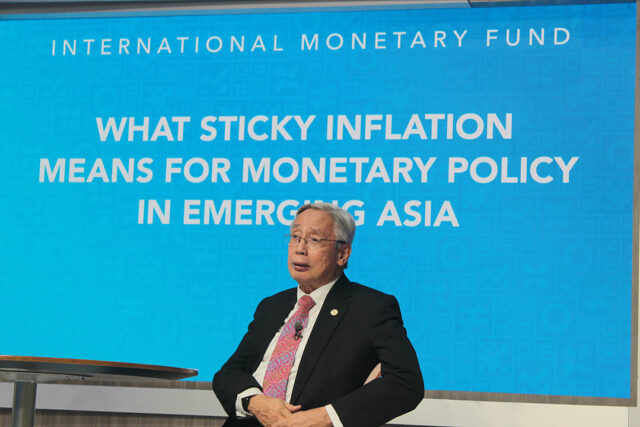
“If US inflation is sticky and the cuts are slow, it’s very dangerous for the Philippine central bank to cut faster than the US even if its inflation is falling faster,” he told reporters on the sidelines of a BSP event in Pasay City.

If the Philippines’ benchmark interest rate is lower than the US Fed, Mr. Medalla noted investors might flock to the dollar, putting more pressure on the peso.

The Monetary Board has raised borrowing costs by 425 basis points (bps) since May last year, bringing the key rate to 6.25%.

The US Federal Reserve, on the other hand, hiked the Fed fund rate by 25 bps to 4.75-5% last month. The Fed has raised the rate by 475 bps since March 2022.

Asked if the BSP will raise interest rates next month if the Fed continues its tightening cycle, Mr. Medalla said there is no need to mirror the US Fed because Philippine inflation is seen to slow within the target by yearend. 

Headline inflation eased to a six-month low of 7.6% in March from 8.6% in February. This brought the first-quarter inflation average to 8.3%.

The BSP’s full-year inflation forecast is 6%, although it expects inflation to return to the 2-4% target by the fourth quarter.

The Monetary Board is scheduled to meet on May 18, while the US Federal Reserve is set to discuss policy on May 2-3.

“If inflation will fall to 3% [by the end of the year], how can you justify an interest rate of 6.25%? From that point of view, we should at least not match the Fed. Even if they raise theirs, we may not have to raise ours,” Mr. Medalla said in mixed English and Filipino.

“Now, will that cause an overly weak peso? Maybe not because the markets know we have more than enough reserves,” he said, adding that the central bank could participate in the foreign exchange market to mitigate the impact of the strong dollar.

The peso closed at P55.62 a dollar on Wednesday, eight centavos weaker than Tuesday’s P55.54 finish, based on data from the Bankers Association of the Philippines.

Latest central bank data showed the country’s gross international reserves had inched up by 2% to $100.2 billion as of end-March from $98.2 billion at end-February.

Mr. Medalla said the Philippines likely expanded by 6% in the first quarter, lower than 8.2% a year earlier and 7.1% in the fourth quarter of 2022.

“Lower than last year, but not too much,” he said.

ING Bank N.V. Manila Senior Economist Nicholas Antonio T. Mapa said headline inflation might ease to 6.9% in April, and this would likely prompt the Monetary Board to pause on May 18.

“A print below 7% could be enough to elicit a pause from the BSP at the May policy meeting,” he said.

Union Bank of the Philippines, Inc. Chief Economist Ruben Carlo O. Asuncion said the BSP might still hike policy rates by 25 bps next month.

“We continue to expect one last BSP policy rate hike of 25 bps in May to 6.5% before the pause-and-hold, to enable nominal interest rates to stay relatively neutral or close to the inflation outlook this year running at 6% if not higher,” he said.

April inflation data are scheduled to be released on May 5.

Budget utilization at 98% as of end-March

Construction workers rest on a sidewalk at the Tagaytay City Sports Park in Tagaytay City. — PHILIPPINE STAR/EDD GUMBAN

THE CASH utilization rate of government agencies reached 98% at the end of the first quarter, the Department of Budget and Management (DBM) said on Wednesday.

Data from the DBM showed that the National Government, local governments and state-owned companies used 98% or P835.5 billion of the P852.79 billion in notice of cash allocation issued in January to March.

This was slightly lower than the usage rate of 99% a year earlier.

At the end of March, the remaining unused allocations totaled P17.29 billion.

Notice of cash allocations  are a quarterly disbursement authority that the DBM issues to agencies, allowing them to withdraw funds from the Bureau of the Treasury to support their spending needs.

“This may have to do with the early approval of the 2023 national budget, as well as the further reopening of the economy towards greater normalcy with no more large lockdowns since 2022 and as a policy priority going forward,” Rizal Commercial Banking Corp. Chief Economist Michael L. Ricafort said in a Viber message.

President Ferdinand R. Marcos, Jr. signed the P5.286-trillion 2023 national budget on Dec. 16, 2022. This was the “fastest and earliest date that a national budget had been signed,” according to the DBM.

“Agencies are aggressive in spending due to less constraints and greater avenues for productive spending,” John Paolo R. Rivera, an economist at the Asian Institute of Management, said in a Viber message.

Mr. Ricafort noted rising prices and financing costs might have led to the increased funding requirements of the government.

In March, the government said it would allot P9.3 billion for a two-month subsidy for more than nine million poor households to help mitigate the impact of inflation.

The last payout of the government’s targeted earlier cash transfer program ended in January. The program provided P18.3 billion in subsidies to about 9.2 million beneficiaries.

Inflation averaged 8.3% in the first quarter, still above the central bank’s 6% full-year forecast and 2-4% target.

As of March, line departments used P567 billion or 97% of their allotments, leaving P17.29 billion unused.

The Budget, Education, Energy, Environment, Foreign Affairs, Health, Interior and Local Government, Labor, Public Works, Science and Technology, Trade and Transportation departments all posted a budget usage rate of 100%.

Also at 100% were the Office of the Press Secretary, Joint Legislative-Executive Councils, Commission on Audit, Commission on Elections, Office of the Ombudsman and Commission on Human Rights.

The Department of Migrant Workers had the lowest usage rate of 48% as of March.

Meanwhile, budgetary support to government-owned companies as well as allotments to local government units were also fully used.

Budget Secretary Amenah F. Pangandaman earlier said that the DBM would slash the budgets of agencies with a low use rate.

“We have released most of the budget. Hopefully (utilization) is ongoing, all the procurement procedures, so they will be able to implement [these]. Especially in the infrastructure sector, I’ve released everything, so they can procure,” she said in a roundtable briefing with BusinessWorld editors and reporters last week.

“Some agencies have already come up to me because they saw their Tier 1, there were deductions because of their (low) utilization,” she added.

The DBM released P4.31 trillion or 81.9% of the P5.286-trillion 2023 national budget at the end of March. This was slightly faster than last year when the DBM had released P3.48 trillion or 69.4% of the P5.02-trillion budget as of the end of the first quarter. — Luisa Maria Jacinta C. Jocson

Proposed withholding tax on online sellers expected to boost compliance

STOCK PHOTO | Image by andrespradagarcia from Pixabay

By Luisa Maria Jacinta C. Jocson, Reporter

THE BUREAU of Internal Revenue’s (BIR) proposal to require online platform providers to impose a creditable withholding tax on their partner merchants is expected to improve tax compliance, experts said.

“The withholding tax system is a good control mechanism to ensure that all income earned by individuals or businesses is properly taxed. It allows the BIR to secure information from withholding agents and compare it with the income declared by sellers in their tax returns,” Richard R. Ibarra, a tax director at P&A Grant Thornton, said in a phone interview.

“The online platform providers will be mandated to withhold and remit tax to the BIR. As such, the online sellers will have no choice but to correctly declare their sales transactions,” he added.

Last week, the BIR announced its plan to amend Revenue Regulation No. 2-98, which sets the rules for withholding tax on income. The rules do not cover transactions by online platforms.

The draft rule calls for a creditable withholding tax of 1% on one-half of the gross remittances of online platforms to their partner sellers or merchants.

It defined an online platform as any entity that serves as an intermediary, where sellers and buyers of goods and services transact through the use of information technology and other electronic means, and deputized it to act as the government’s withholding agent.

These include marketplaces, food delivery services, lodging accommodation, travel or transportation, payment or remittances such as e-wallets, and other services.

The proposed withholding tax will also be imposed in addition to other existing withholding tax obligations, the BIR said.

Online platforms that do not require business registration from sellers will only collect withholding tax on single transactions of goods or services worth P10,000 and if the same buyer and seller have engaged in at least six transactions, regardless of amount per transaction, in the previous or current year.

Eleanor L. Roque, tax principal of P&A Grant Thornton, said online providers would need to have the systems and procedures in place to capture the withholding tax.

“It’s additional compliance cost for online platform providers,” she said in a Viber message.

Ms. Roque said the BIR should allow for situations where the seller’s total taxable income does not exceed P250,000 a year.

“This amount is not taxable; hence, any creditable withholding tax will not be useful for the online seller. So, the withholding tax should only apply if the taxable income of the seller exceeds P250,000 annually,” she said.

Under the Tax Reform for Acceleration and Inclusion law, people with income below P250,000 are exempt from paying personal income tax.

Mr. Ibarra said the BIR should also find ways to better educate online sellers on their compliance requirements.

“One challenge is the lack of documentation compliance by online sellers. They usually do not issue valid invoices or official receipts. Either they are not aware of the requirements, or they just do not know how to comply,” he said.

Albay Rep. Jose Maria Clemente S. Salceda, chairman of the House Ways and Means Committee, said in a Viber message the proposal would improve BIR efforts in collecting income tax from online merchants.

But the proposal is “not yet an imposed tax in the strictest sense” because it is credited against future income tax liabilities.

“Furthermore, the rate is analogous with the standard rate imposed on the income of credit card companies to establishments (50% of 1%) since online service providers are also financial intermediaries of payments to merchants. They even have their own layaway or installment options similar to credit cards. So, nothing irregular or unusual in this new regulation,” Mr. Salceda said.

“The better way is to include everyone in the VAT (value-added tax) regime so that we can lower the rate — perhaps to even 8% or 9%. But that requires the force of legislation,” he added.

The BIR has been seeking ways to tax the digital sector, as e-commerce surged during the pandemic as people were forced to stay home.

Last year, the digital economy accounted for 9.4% of the gross domestic product, equivalent to P2.08 trillion. This exceeded the pre-pandemic level of P1.96 trillion in 2019.

Employment in the digital economy rose by 8.2% to 6.05 million last year.

The Department of Trade and Industry estimates the number of entities doing business as online sellers at two million as of 2022.