Home Blog Page 4925

Spain braces for scorching summer temperatures in spring

An aircraft flies over San Lorenzo beach in Gijon, northern Spain, July 24, 2016. — REUTERS/ELOY ALONSO

MADRID — Spain is bracing for a week of temperatures as high as 40C that are forecast to shatter records for April, as officials laid out plans to open public swimming pools early and adapt school schedules, while meteorologists warned of the risk of wildfires.

Coinciding with a long-running drought, the cause of the predicted temperatures is “the progressive entry of a very warm and dry air mass from Africa coupled with atmospheric stability (meaning unchangeable weather) and strong sunshine,” Spain’s weather agency AEMET said on Tuesday.

These unseasonable temperatures would be “typical of summer”, AEMET added, with the mercury expected to creep up to 38-40 degrees Celsius (100-104 Fahrenheit) in the southern Guadalquivir Valley that includes the city of Cordoba.

That would be the highest figure for April since Spanish meteorological official data-keeping began in 1961.

The heat means large parts of the country would be at high or extreme risk of wildfires, AEMET said.

Ricardo Torrijo, a senior meteorologist at the agency, told Reuters the weather was a thermal ridge – or wave of high temperatures – extending from Africa to the Iberian Peninsula.

He said it did not meet the official definition of a heatwave, which occurs when the maximum daily temperatures are unusually hot over an extended period.

The government of the central Madrid region on Monday announced an action plan, including allowing schools to adapt their timetables around peak temperatures and to ensure air conditioning at health centers.

Under the plan, Madrid’s many outdoor swimming pools will open a month earlier than usual, in mid-May.

The capital’s subway system is also set to increase air conditioning and make trains more frequent to avoid overcrowding.

In the hottest region of Spain, the southwestern city of Seville has boosted its emergency services budget and brought in extra healthcare worker numbers in case of heat exhaustion during the “Feria de Abril” (April, or spring, fair) that last year attracted an estimated 500,000 revelers.

PROLONGED DROUGHT
Spain has seen 36 consecutive months of below-average rainfall. Reservoirs at 50% of their capacity – slightly higher than last year, but below the average of the last decade.

Environment Minister Teresa Ribera said the coming months were likely to be “complicated”.

“Apart from extreme episodes such as the one we will experience this week in terms of temperature, we will probably see average rainfall in May, June and July; but given that in recent months rain has been well below average, this would lead to a scenario of concern,” she said.

In response to the drought, the government announced tax breaks worth 1.8 billion euros ($1.98 billion) for 828,000 farmers whose crops are depleted.

The rebates involve a general reduction in taxes of 25%, but if crops such as olives or almonds are particularly affected, they could reach 50%. — Reuters

Stung by losses, Filipino players ditch Axie Infinity crypto game

Image Source: https://axieinfinity.com/

 – At the height of cryptocurrency’s pandemic boom, migrant worker Gian Carlo McGlay thought he had found a way to ride out lockdowns and provide an income to dozens of jobless people from his hometown in the Philippines.

But Mr. McGlay’s dreams of leading a team of “play-to-earn” cryptocurrency gamers focused on the Axie Infinity game quickly fell apart as crypto prices crashed, leaving the 32-year-old with losses of one million Philippine pesos ($18,000).

“Nothing was left. My Axie Infinity assets became worthless so I just gave them away,” said Mr. McGlay.

One of a new breed of blockchain-based online games that blend entertainment with financial speculation, Axie Infinity also attracted investors who saw it as a way to introduce more people to cryptocurrency.

Axie players can earn cryptocurrency by cashing in tokens they win in the game – called smooth love potion (SLP). For a while, it was a lucrative business.

Mr. McGlay’s “scholars” – a term used for players who cannot afford to buy the game‘s characters themselves so instead rent them off so-called managers in exchange for a cut of their earnings – initially earned 5,000-10,000 pesos per week.

In contrast to other Axie managers, Mr. McGlay – who worked as a fisherman in Alaska before the pandemic – said he made zero profit from the enterprise, letting his scholars keep all of their earnings.


SCHOLARS AND MANAGERS

At its peak, Axie Infinity drew 2.7 million active daily users but those numbers have plunged to about 250,000, according to Cryptogambling.tv, a website focused on cryptocurrency games.

Half of the game‘s players came from the Philippines – and many others from developing countries such as Indonesia, Brazil, Venezuela and Peru.

Yield Guild Games (YGG), a group that invests in NFT games, said it “prioritized providing scholarships in emerging economies where job opportunities are lacking and government relief has been limited” during the pandemic.

But many managers like Mr. McGlay were left facing big losses as the value of the game‘s SLP tokens fell 99% from its February 2022 peak, mirroring a collapse in the price of cryptocurrencies.

Axie Infinity was dealt another blow in March 2022 when hackers stole about $615 million in cryptocurrency from a blockchain network that lets users transfer crypto in and out of the game.


POTENTIAL GAINS

While some Axie managers say their motives were philanthropic, other small investors were motivated by the potential gains.

Christopher Cruz, 36, a Filipino businessman and cryptocurrency trader who used to manage 200 Axie scholars, said he earned as much as 600,000 pesos a day from the game by taking a 60% cut of his players‘ income.

“I felt like a drug lord,” Mr. Cruz said. “I could buy everything I wanted – every item inside the mall was never too expensive – during that time.”

His scholars, who were mostly high school students and gig workers from poor provinces, earned a daily income of 450 pesos, just below the minimum wage of 470 pesos in regions outside the capital, Manila.

A Filipino doctor, who asked not to be named, said it was “extremely easy” to recruit players during the pandemic and that her earnings as a manager were similar to her income from her regular job.


‘GREED GOT THE BEST OF US’

SLP tokens were worth 3 pesos each when Mr. McGlay, Cruz and the doctor joined the game. The token’s value peaked at 20 pesos, before plunging steadily in late 2021. Today, it stands at about 0.16 pesos.

“It’s no longer worth it. The gameplay also became more difficult,” Mr. Cruz said, adding that it was now difficult to earn 50 SLP per day – down from 150 in its heyday.

Losing their new income source, legions of scholars abandoned the game, turning to gig work as delivery riders or online clothes seller or taking up full-time education.

The players who were motivated purely by the financial rewards of the game have moved on to other things now,” said YGG Philippines manager Luis Buenaventura.

He said YGG continues to rent out Axie‘s non-fungible token (NFT) characters to interested players, “but it’s not as necessary as it once was since those NFTs are all really affordable now”.

Axie‘s dizzying ups and downs should serve as a warning sign to potential investors in the volatile crypto world, said Elaine Tinio, a marketing professional in Manila who used to play the game for up to four hours a day to boost her income.

Thrilled by her initial profits, she spent more and more money on Axie characters before a sharp decline in the value of the game‘s SLP token left her facing a loss of 200,000 pesos, equivalent to about five months of her salary.

“Greed got the best of us,” she said. – Reuters

UK food banks give out record amount as rising living costs drive hardship

REUTERS/TOBY MELVILLE/FILE PHOTO

Britain’s biggest food bank network said the amount of emergency food parcels it distributed rose 37% to a record 3 million in the year to March as more people faced hardship in a cost-of-living crisis that shows little sign of easing.

The Trussell Trust, which supports a network of 1,300 food bank centers across the United Kingdom, said on Wednesday more than a million parcels were provided for children.

It said over the year, 760,000 people used a food bank in its network for the first time, an increase of 38% year-on-year.

This included an unprecedented rise in the number of employed people, who are no longer able to balance a low income against rising living costs.

Britons have been pressured for more than a year by high inflation which has outstripped pay growth for almost all workers.

Last month government forecasters estimated UK households were in the midst of the biggest two-year squeeze in living standards since comparable records started in the 1950s.

Official UK data published last week showed overall consumer price inflation fell to 10.1% in March. However, prices of food and non-alcoholic drinks were 19.1% higher in March than a year earlier, the biggest such rise since August 1977.

Grocery inflation in April was 17.3%, according to industry data.

The Trussell Trust also noted that the number of parcels provided in the year to March was more than double the annual amount distributed by food banks five years ago.

“The continued increase in parcel numbers over the last five years indicates that it is ongoing low levels of income and a social security system that isn’t fit for purpose that are forcing more people to need food banks, rather than just the recent cost of living crisis or the COVID-19 pandemic,” Emma Revie, the trust’s chief executive, said.

She called on the UK government to ensure the benefits system covers essential costs. – Reuters

Google parent announces stock buyback, modest beat on ad sales

REUTERS

Alphabet Inc. said on Tuesday it would buy back $70 billion in stock and posted first-quarter profit and revenue above estimates as demand rose for cloud services and ad sales held up better than expected.

Investors cheered the buyback plan, sending shares of the Google parent as much as 4% higher in after-hours trade before they pared gains to trade up 1.6%. Demand rose for cloud services and Google‘s ad sales held up better than expected.

Alphabet reported a slight dip in first-quarter ad sales from a year earlier to $54.55 billion, which nonetheless beat analyst estimates of $53.71 billion. It was the third such decline for the company since it went public in 2004, but was the second in a row following a fourth-quarter ad sales drop of 3.6%.

Excluding items, Alphabet reported earnings per share of $1.17, beating an average estimate of $1.07 per share.

Google exceeded both revenue and earnings per share expectations this quarter, but reasons for investor optimism are modest,” said Insider Intelligence senior analyst Max Willens.

He said turning a profit in cloud computing was “notable” but “the reality is that Google Cloud remains comfortably behind its two most important competitors, and its growth is slowing.” Sales for the unit rose to 28% to $7.41 billion.

As well, advertisers, who contribute the bulk of Alphabet’s sales, have curtailed their spending in response to a shift by consumers back to in-store shopping in the wake of eased masking and other restrictions. Marketers are experimenting more with new platforms like TikTok, which attracts a more youthful audience.

The company, meanwhile, has been looking to keep a tight control on costs amid recession fears and in January decided to cut about 12,000 jobs. Chief Financial Officer Ruth Porat told investors on a conference call that she expected capital expenditures this year to be “modestly higher” than in 2022.

Alphabet has otherwise sought to pare spending, including on employee perks and use of company resources. Porat told workers in an internal email in March that they should anticipate additional cost-cutting measures in the coming months.

She said on Tuesday’s call that Alphabet endeavors to “durably engineer our cost base” in order to invest in priorities like cloud computing and artificial intelligence.

Alphabet’s Google unit has been scrambling to keep pace with rivals, notably Microsoft Corp., in rolling out new artificial-intelligence software that can generate long-form responses to queries and other prompts. Microsoft committed $10 billion to OpenAI whose ChatGPT software has been the talk of Silicon Valley since a free version was introduced in November.

Microsoft on Tuesday also beat Wall Street estimates for third-quarter profit and revenue, driven by growth in its cloud computing and Office productivity software businesses, pushing its shares up 8.5% in after-market trading. Shares of rival tech companies Meta Platforms Inc. and Amazon.com Inc. were up 2.3% and 5.3%, respectively.

Alphabet’s revenue for the quarter ended March 31 stood at $69.79 billion compared with estimates of $68.95 billion, according to Refinitiv data.

It reported net profit of $15.05 billion for the first three months of the year compared with $16.44 billion a year earlier. – Reuters

Putin signs decree taking over Russian assets of two foreign firms

President Vladimir Putin on Tuesday signed a decree establishing temporary control of the Russian assets of two foreign energy firms, signaling Moscow could take similar action against other companies if need be.

The decree – outlining possible retaliation if Russian assets abroad are seized – showed Moscow had already taken action against Uniper SE’s Russian division and the assets of Finland’s Fortum Oyj.

The decree said Russia needed to take urgent measures to respond to unspecified actions from the United States and others it said were “unfriendly and contrary to international law”.

The shares in the two entities have been placed in the temporary control of Rosimushchestvo, the federal government property agency, the decree said.

In February, US Treasury Secretary Janet Yellen said Russia should bear the costs of damage caused by its war on Ukraine, adding though there were “significant legal obstacles” to confiscating major frozen Russian assets.

The CEO of state-owned bank Bank VTB PAO had on Monday said Russia should consider taking over and managing the assets of foreign companies such as Fortum, only returning them when sanctions are lifted.

Rosimushchestvo said more foreign firms could find their assets under temporary Russian control, TASS reported. The agency would ensure the assets were run in accordance with their importance for the economy.

“The decree does not concern ownership issues and does not deprive owners of their assets. External management is temporary in nature and means the original owner no longer has the right to make management decisions,” TASS cited the agency as saying.

Last October European Council President Charles Michel said the EU was looking at using Russian assets frozen under sanctions against Moscow towards rebuilding Ukraine.

Asset sales by investors from “unfriendly” countries – as Moscow terms those that imposed sanctions against Russia following its invasion of Ukraine – require approval from a government commission and, in some cases, the president.

In February, Uniper valued its majority stake in Russian division Unipro at a symbolic 1 euro to reflect the likely chance a planned sale to a Russian buyer would fall through. Fortum had already warned shareholders there was a risk its Russian assets could be expropriated. – Reuters

Biden makes 2024 presidential run official as Trump fight looms

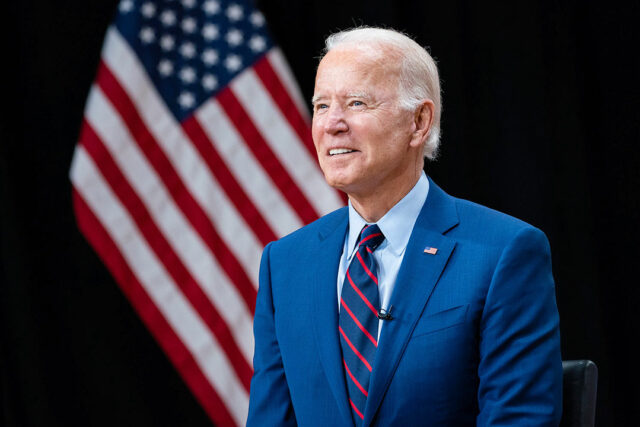
US PRESIDENT JOSEPH R. BIDEN — WHITEHOUSE.GOV

 – President Joe Biden launched his re-election bid on Tuesday with a promise to protect American liberties from “extremists” linked to former President Donald Trump, who he beat in 2020 and might face again in 2024.

Mr. Biden made his announcement in a video released by his new campaign team that opens with imagery from the Jan. 6, 2021, attack on the US Capitol by Trump‘s supporters.

“When I ran for president four years ago, I said we’re in a battle for the soul of America, and we still are,” Mr. Biden said. “This is not a time to be complacent. That’s why I’m running for re-election.”

“Let’s finish this job. I know we can,” he said.

He described Republican platforms as threats to American freedoms, vowed to fight efforts to limit women’s healthcare, cut Social Security and ban books, and blasted “MAGA extremists.”

MAGA is the acronym for the “Make America Great Again” slogan of Trump, who is the early frontrunner in the Republican primary race. If he wins, he will face off against Biden again in the November 2024 election.

Mr. Biden, 80, must overcome Americans’ concerns about his age in order to win re-election, with 44% of Democrats saying he is too old to runa Reuters/Ipsos poll completed on Monday found.

Mr. Trump, 76, also faces concerns about his age with 35% of Republicans saying he is too old.

The poll showed that a majority of registered voters don’t want either Mr. Biden or Mr. Trump to run again.

While Mr. Biden‘s approval rating is relatively low, his aides are confident he can beat Trump again. The Reuters/Ipsos poll showed him with a lead of 43% to 38% over his Republican rival among registered voters.

In his campaign video, Mr. Biden squarely targeted Mr. Trump and his allies.

“Around the country, MAGA extremists are lining up to take on those bedrock freedoms, cutting Social Security that you paid for your entire life, while cutting taxes for the very wealthy, dictating what healthcare decisions women can make, banning books, and tell people who they can love, all while making it more difficult for you to be able to vote,” Mr. Biden said.

In the two years since he took over from Mr. Trump, Mr. Biden won Congress’ approval for billions of dollars in federal funds to tackle the COVID-19 pandemic and for new infrastructure, and oversaw the lowest levels of unemployment since 1969, although a 40-year inflation highs have marred his economic record.

Speaking to a meeting of North America’s Building Trades Unions on Tuesday, Biden said his economic plan was working but there is “more to do.” Mr. Biden listed his policy achievements and the crowd chanted “four more years!”

Mr. Biden‘s age makes his re-election bid a historic and risky gamble for the Democratic Party, especially if he faces a much younger Republican candidate.

Democrats already face a tough election map to hold the Senate in 2024 and is the minority in the House of Representatives now.

Mr. Biden would be 86 by the end of a prospective second term, almost a decade higher than the average US male’s life expectancy.

Doctors declared Mr. Biden, who does not drink alcohol and exercises five times a week, “fit for duty” after an examination in February. The White House says his record shows that he is mentally sharp enough for the rigors of the job.

Mr. Biden will be joined in his 2024 quest by his running mate, Vice President Kamala Harris, who is featured prominently in his campaign video.


TRUMP MATCHUP AGAIN?

In a statement about Biden‘s candidacy, Mr. Trump criticized the president over his record on immigration, inflation, and the chaotic US pullout from Afghanistan in 2021.

“American families are being decimated by the worst inflation in half a century. Banks are failing,” Mr. Trump said on his social media platform. “We have surrendered our energy independence, just like we surrendered in Afghanistan,” he said.

Marking a sharp contrast to Mr. Biden‘s campaign announcement, Mr. Trump is on trial in a civil lawsuit this week over writer E. Jean Carroll’s accusation that he raped her in a department store dressing room in the mid-1990s.

The former president, who is not required to attend the trial, has denied raping Ms. Carroll.

Mr. Biden is unlikely to face much competition from inside his party. No senior Democrats have shown signs of challenging him.

Potential and declared Republican presidential candidates have begun framing the 2024 election around cutting back government spending amid still-high inflation, restricting abortion, crime in Democratic-run cities and illegal immigration.

The two leading Republican contenders, Trump and Florida Governor Ron DeSantis, want to limit the access of transgender children to sports teams and gender-affirming medical care, and restrict how schools teach LGBTQ+ issues and America’s history of race.

During a briefing with reporters, White House spokesperson Karine Jean-Pierre at first declined to answer a question about whether Biden would serve out another four-year term if re-elected.

“I wanted to be sure that I didn’t go into 2024 more than is appropriate under the law,” she wrote later on Twitter. “But I can confirm that if re-elected, (Biden) would serve all 8 years.”

Mr. Biden ran a mostly virtual campaign to defeat Trump in the 2020 election as COVID raged.

With pandemic restrictions mostly over in the United States, the 2024 race is likely to be a much different, more physical affair.

After losing to Mr. Biden in 2020, Trump refused to concede defeat, falsely claiming that there had been widespread electoral fraud.

His supporters stormed the US Capitol building in Washington on Jan. 6, 2021, in support of his claims but they failed to halt certification by Congress of Mr. Biden‘s win.

Mr. Biden‘s campaign video suggests he plans to regularly remind voters of those events between now and the next election.

Other Mr. Biden themes may include strong US support for Ukraine in its war against Russia and what the White House says are Republican plans to unravel federal healthcare. – Reuters


New, bigger, and more luxurious Lexus Manila Showroom to rise in Bonifacio Global City

Present at the groundbreaking ceremony were (from L-R) Federal Land Vice-President Alvin Ty, Mitsui & Co. Philippines General Manager & Country Chairman Kazuhiro Nomura, Lexus Philippines President Atsuhiro Okamoto, Lexus Manila Vice-Chairman Vince Socco, Lexus Manila President Raymond Rodriguez, Lexus Philippines Vice-Chairman Dr. David Go, ASEC President Theresa Esquivel, and Federal Land Senior Vice-President (Project Development Group) Stephen Comia.

The all-new Lexus Manila showroom will be the pinnacle of the luxury motoring experience for the growing number of Lexus customers

To welcome more customers into the luxurious world of Lexus, a new Lexus Manila Showroom will soon rise still within Bonifacio Global City. This address will be able to accommodate Lexus’s growing clientele as the brand further expands its business in the Country; showcasing Lexus’ unique design language; while providing increased service capacity to better serve valued customers better.

Anticipating the needs of guests is a hallmark of Lexus. This unique form of Japanese hospitality is known as ‘omotenashi’—and it was first embodied in the current Lexus Manila Showroom located at 34th street. When it opened in 2009, the establishment was built to deliver the finest luxury experience in the Philippines. Soon, the upgraded Lexus Manila showroom will further embody that philosophy with integrated new technologies to fit the changing luxury market. The new Lexus Manila will be located at 8th Avenue, Grand Central Park, BGC Taguig.

Just like the newest brand and guest experience center of Lexus at Mitsukoshi BGC which was opened earlier this year –The design of the facade follows the Lexus L-Finesse philosophy. This signature style draws heavily on the deeply rooted principles of Japanese hospitality and aesthetics, while simultaneously having the ability to expand into a highly dynamic, evolving concept. The design is distinctly Japanese: formal and minimalist with horizontal and clean lines. This straightforward approach evokes beauty and simplicity.

A relaxing sensory experience is at the heart of every Lexus showroom. The ground floor area where the main showroom is located will have a full-height curtain wall glazing accentuated by wood-finished elements.

These treatments add up to the lightness and softness of the façade, and are inspired by Lexus design.

At Lexus, everyone is treated as a valued guest. This elevated hospitality is integral to the brand and utmost effort is given in the name of customer satisfaction. This superlative service at its finest is all part of the luxurious experience and should be expected from the newest Lexus Manila showroom when it opens its doors in the 1st  half of 2024.

To learn more, visit the Lexus website at lexus.com.ph or visit their social media pages on Facebook and Instagram.

To arrange a consultation with your personal sales consultant, visit the Lexus Remote page at https://fal.cn/3eSWW.

You may also download the MyLEXUS App available on both Android and iOS users to receive live updates and access other premium services.


Spotlight is BusinessWorld’s sponsored section that allows advertisers to amplify their brand and connect with BusinessWorld’s audience by enabling them to publish their stories directly on the BusinessWorld Web site. For more information, send an email to online@bworldonline.com.

Join us on Viber at https://bit.ly/3hv6bLA to get more updates and subscribe to BusinessWorld’s titles and get exclusive content through www.bworld-x.com.

House panel OK’s estate tax amnesty extension

THE HOUSE Ways and Means Committee approved on Tuesday a bill seeking to extend the estate tax amnesty period, which is set to end by mid-June, for another two years.

House Bill No. 7409 proposes to extend the period of availment of estate tax amnesty to June 14, 2025, from the current deadline of June 14, 2023.

Ways and Means Committee Chairman and Albay Rep. Jose Ma. Clemente S. Salceda said the tax amnesty has yet to be optimized.

“Families still struggle to comply with documentary as well as cash requirements. Hence, our leadership filed this measure to give more time to our constituents to clear their obligations,” he said during a committee hearing on Tuesday.

The bill was co-authored by House Speaker Ferdinand Martin G. Romualdez, Ilocos Norte Rep. Ferdinand Alexander A. Marcos, Majority Floor Leader Zamboanga City Rep. Manuel Jose M. Dalipe and TINGOG party-list representatives Yedda Marie K. Romualdez and Jude A. Acidre.

If passed into law, this would be the second extension of the estate tax amnesty under Republic Act (RA) No. 11213, which initially ran from 2019 to June 14, 2021. RA 11569, which was approved by the previous Congress, also extended the amnesty period for two years from June 15, 2021 to June 14, 2023.

Mr. Salceda noted the coronavirus pandemic had hampered many families’ attempts to settle their estates, which is why RA 11569 had removed the requirement of proof of settlement in the payment of the estate tax.

“I sincerely hope this will be the last time we extend RA 11213 — because it defeats the purpose of tax compliance if violations will always be forgiven,” Mr. Salceda said.

Erwin Vincent G. Alcala, national executive vice-president of the Philippine Institute of Certified Public Accountants, agreed saying this should be the last extension since the amnesty may be subject to abuse.

The current law gives taxpayers a one-time opportunity to settle unpaid tax obligations covering estates of those of decedents who died on or before Dec. 31, 2017. Under the law, a 6% tax rate is imposed on each decedent’s total net taxable estate at the time of death without penalties.

During the hearing, the Ways and Means Committee approved a provision that would exempt heirs from paying a 6% donor’s tax on any donated estates worth P1 million and below. This is an increase from the current P250,000 threshold under section 99 of the National Internal Revenue Code.

“There’s no longer a need for estate tax because you can already donate to your children before you die rather than ask them to pay a 6% estate tax after you die,” Mr. Salceda said.

The Bureau of Internal Revenue (BIR) had set a P6-billion target collection from the estate tax amnesty.

BIR Assistant Commissioner Maria Luisa I. Belen told the House committee that a total of 133,860 taxpayers have availed of the amnesty from 2019 to present, generating P7.4 billion for the government.

Broken down, 61,566 availed of the first estate tax amnesty from 2019 to June 14, 2021, which yielded P4.89 billion. Since June 15, 2021, the second extension has yielded P2.52 billion from 72,294 individuals so far.

Juanito H. Balbastre III, officer-in-charge of the BIR law and legislative division, addressed concerns that the process of availing the estate tax amnesty is tedious.

“We accept the availment of estate tax amnesty even without the proof of settlement considering it was clearly provided under the law that that requirement can be removed,” he told the committee, citing the BIR’s Revenue Regulations 17-2021.

The House of Representatives aims to pass the bill on second reading when session resumes on May 8. The bill is not included in the Legislative Executive Development Advisory Council’s common legislative agenda. — Beatriz Marie D. Cruz

Digital sector’s share to GDP dips in 2022

THE DIGITAL SECTOR’S contribution to the Philippine economy slipped in 2022, even as its gross value added (GVA) breached P2 trillion, the Philippine Statistics Authority (PSA) reported on Tuesday.

Citing preliminary data, the PSA said the digital economy contributed 9.4% to gross domestic product (GDP), equivalent to a GVA of P2.08 trillion, last year.

Its contribution to GDP last year was slightly lower than the 9.6% seen in 2021, and the smallest since the earliest available PSA data since 2018.

Digital industry’s share to GDP slows in 2022PSA data showed the digital economy, in absolute terms, grew by 11% or P205.44 billion last year from P1.87 trillion in 2021.

This marked the second straight year of growth after the sector contracted by 11.3% in 2021.

The latest PSA results showed that the digital economy has exceeded the pre-pandemic level of P1.96 trillion seen in 2019.

According to the PSA, the digital economy covers digital transactions such as e-commerce and online media/content.

Nicholas Antonio T. Mapa, senior economist at ING Bank N.V. Manila Branch, said the digital economy’s growth was quite healthy in 2022.

“We can explain the lower contribution to the overall GDP figure to the fact that the real economy (activities outside the digital economy) grew at a much faster pace,” he said in an e-mail.

The Philippine economy expanded by 7.6% last year, the fastest growth since the 8.8% reading in 1976.

Domini S. Velasquez, chief economist at China Banking Corp., said usage of digital technology is bound to increase.

“Traditional businesses continue to ramp up digitalization and the outlook for BPOs (business process outsourcing) remain robust, increasing demand for technology. The DICT’s (Department of Information and Communications Technology) thrust of improving e-governance in government transactions will also help drive the digital economy,” she said in an e-mail.

PSA data showed e-commerce posted the highest growth among the sub-components at 26.5% in 2022, quicker than the 8% in 2021. E-commerce’s share to the economy reached 20%, equivalent to P416.12 billion, in 2022.

Digital media and content grew by 11.8% last year, slightly faster than the 10.1% in 2021. Its contribution to the economy slightly increased to 2.8% or P57.41 billion.

On the other hand, digital-enabling infrastructure’s growth slowed to 7.5% last year from 7.8% in 2021.

Digital-enabling infrastructure contributed 77.2% or P1.6 trillion to the Philippine economy, slightly higher than the P1.49 trillion in 2021. This sub-component covers computers, electronic products, telecommunications services, among others.

In 2022, the number of Filipinos employed in the digital economy rose by 8.2% to 6.05 million from 5.59 million in 2021.

Nearly three-fourths or 4.67 million were employed by companies involved in digital-enabling infrastructure, followed by e-commerce with 1.23 million and digital media/content with 147,984.

Ms. Velasquez said trade tensions between the US and China may weaken electronic imports from China, which is part of the Philippines’ value chain, but this could also divert some US demand to the Philippines.

“Moving forward, there are some headwinds such as the planned imposition of value-added tax (VAT) on digital services and a weaker global outlook which will translate to tepid demand for semiconductors,” she added.

Finance Secretary Benjamin E. Diokno earlier said the proposed VAT digital service providers will generate P13.7 billion in revenues if implemented next year.

The measure has been approved by the House of Representatives but is still pending in the Senate. — Abigail Marie P. Yraola

Philippines drops further in 2023 Chandler Good Government Index

THE PHILIPPINES’ ranking in a global good governance index worsened after it dropped three spots to rank 66th out of 104 countries. Read the full story.

Philippines drops further in 2023 Chandler Good Government Index

Philippines falls in global good governance index

HONOR GUARDS hold the Philippine flag in Caloocan, Nov. 30, 2020. — PHILIPPINE STAR/ MICHAEL VARCAS

By Kyle Aristophere T. Atienza, Reporter

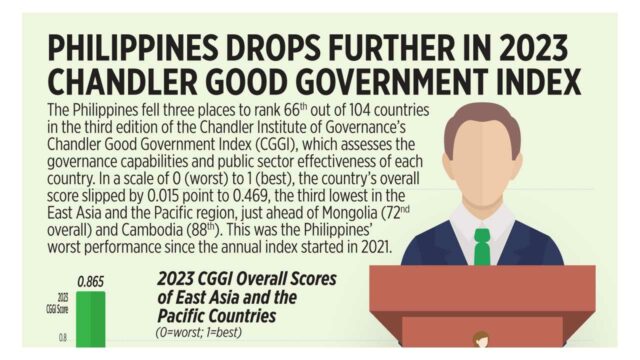
THE PHILIPPINES’ ranking in a global good governance index worsened after it dropped three spots to rank 66th out of 104 countries.

The country’s overall score slipped by 0.015 point to 0.469, the third lowest in the East Asia and the Pacific region, according to the Chandler Institute of Governance’s 2023 Chandler Good Government Index (CGGI) released on Wednesday.

This was the Philippines’ worst performance since the annual index started in 2021, when it ranked 61st. The country placed 63rd in 2022. 

Philippines drops further in 2023 Chandler Good Government IndexIn the Asia-Pacific region, Manila lagged behind Singapore (1st), New Zealand (10th), Japan (13th), Australia (16th), South Korea (18th), Malaysia (33rd), China (36th), Indonesia (46th), Thailand (47th) and Vietnam (49th).

The Philippines was only ahead of Mongolia (72nd) and Cambodia (88th).

Singapore topped the index, followed by Switzerland, Finland, Denmark, Norway, Sweden, the Netherlands, Germany, United Kingdom, and New Zealand.

At the bottom of the list are Venezuela, Zimbabwe, Mali, Nigeria, Lebanon, Mozambique, Burkina Faso, Zambia, Iran, Ethiopia, and Madagascar.

According to the CGGI, the Philippines scored 0.359 in Leadership and Foresight, 0.480 in Robust Laws and Policies, 0.443 in Strong Institutions, 0.554 in Financial Stewardship, 0.536 in Attractive Marketplace, 0.401 in Global Influence and Reputation, and 0.493 in Helping People Rise.

“It is alarming that the ranking of the public sector capability and performance of the Philippines has decreased,” Dennis F. Quilala, a political science professor at the University of the Philippines, said in an e-mail.

“This is more disconcerting given that our neighbors have improved their performances,” he said. 

Mr. Quilala noted that compared with 2022, the Philippines scores went down in key areas such as leadership, laws and policies, and financial stewardship.

“Since 2022, ethical leadership, rule of law, quality of the judiciary, capacity of institutions to implement programs, and protection of property rights have been concerns,” he said. “Philippine scores on these indicators are below global standards. It is possible that this year, these have remained below global standards and more indicators have gone down.”

Mr. Quilala said it will be a challenge for the Marcos administration to improve the capacity of the government in providing services to its citizens.

“The CGGI ranking of the Philippines in 2023 provides a guide to what the Marcos administration needs to do in improving the bureaucracy,” he said.

Zy-za Nadine Suzara, executive director of governance think tank I-Lead, said the Philippines’ ranking in global governance indices continue to fall and far below its Southeast Asian neighbors. 

“We dropped two notches in this year’s CGGI, falling to the 66th place, while Vietnam climbed seven notches to 49th place,” she said. “Indonesia, Thailand, and Vietnam’s ranking are in the middle tier. We are below that.”

Ms. Suzara urged the Marcos administration to work harder to fix government institutions, improve spending efficiency, and drive innovation in strategic areas.

“These are among the key pillars where we lag behind the global average score. Clearly, the President and his administration should address those governance gaps if it wants to generate concrete investment from its foreign trade promotion activities,” she said.

Policy analyst Michael Henry Ll. Yusingco said Filipino voters should look at the index and acknowledge that it’s up to them to change the quality of governance in the country.

“For as long as we vote for bad leaders, our place in this index will never change,” he said.

President Ferdinand R. Marcos, Jr.’s predecessor, Rodrigo R. Duterte, had been criticized for failing to uphold good governance standards during his six-year term, as his administration faced allegations of corruption and human rights violations.

Mr. Marcos is seen veering away from some of Mr. Duterte’s key policies, including the former president’s pivot away from western countries such as the United States.

“What the index implies is that even by the neoliberal bent of the Philippine state when it comes to engaging with economic actors (i.e. prioritizing policies that are market friendly even if they don’t necessarily promote democracy and improve the quality of life), the Philippines under Marcos is failing by that standard,” Hansley A. Juliano, a political economy researcher, said via Messenger chat.

Philip Arnold “Randy” P. Tuaño, dean of the Ateneo School of Government, said that to improve the country’s good governance ranking “we need to eventually improve our capacity to strengthen our ability to respond to events that adversely affect our public institutions.”

BSP launches credit scoring model

BW FILE PHOTO

THE BANGKO SENTRAL ng Pilipinas (BSP) has launched a credit scoring model that is expected to enhance credit risk assessment by lenders.

The Credit Risk Database (CRD) Scoring Model was developed as part of a technical cooperation program between the BSP and the Japan International Cooperation Agency (JICA).   

It is expected to serve as an additional tool that lenders can use to analyze the creditworthiness of micro-, small-, and medium-sized enterprises (MSMEs).

The CRD utilizes a data-driven approach to boosting lenders’ confidence in financing MSMEs, especially those without credit history or enough collateral, the BSP said.

“The CRD scoring model will [not only] contribute to bridging the funding gap to MSMEs, but it will also enhance credit risk management among financial institutions,” BSP Governor Felipe M. Medalla said at the launch event on Tuesday.

Sakamoto Takema, chief representative of JICA, said the CRD can contribute to the BSP’s goal of enhancing access to finance under the National Strategy for Financial Inclusion.

“The overall goal is to enhance the capacity of credit risk assessment of each financial institution, and to promote risk-based lending rather than collateral based lending. It will strengthen the country’s financial system by expanding and streamlining lending to MSMEs,” Mr. Takema said.   

Mr. Takema said JICA has agreed to extend the CRD project period for another year and will extend support for phase 2.

The CRD project was launched virtually in December 2020 at the height of the pandemic. The project has expanded with the help of 32 participating rural and universal and commercial banks.

BSP Deputy Governor Bernadette Romulo-Puyat said the CRD is a tool that may significantly expand credit access of small and medium enterprises.

“MSMEs make up 99.6% of business establishments in the country providing 64.7% of employment to the country’s workforce and contribute about 35.7% to the country’s gross domestic product,” she said.

Mr. Medalla noted that there is a “one-size-fit-all policy” towards lending to small businesses in the country, citing the Republic Act 6977 or the Magna Carta for MSMEs.

“A highly specialized Japanese bank for instance — [which] has less than a hundred employees because they are focused on lending to Japanese firms in the Philippines — are being told to lend to MSMEs and agriculture,” he said, adding that the law becomes a “tax” on foreign investors.

Mr. Medalla said that banks have opted to incur penalties for noncompliance instead of taking on the risks associated with lending to small businesses.

Lenders are mandated by the Republic Act 6977 or the Magna Carta for MSMEs to allocate 10% of their credit portfolio for small businesses to boost the sector — 8% for micro and small enterprises (MSEs) and 2% for medium-sized enterprises.

In April 2020, the BSP allowed MSME loans to be counted as part of banks’ reserve requirements in a bid to boost lending to the sector at the height of the pandemic. — Keisha B. Ta-asan

ADVERTISEMENT

ADVERTISEMENT