Benilde Open Design and Art merges the natural and the technological
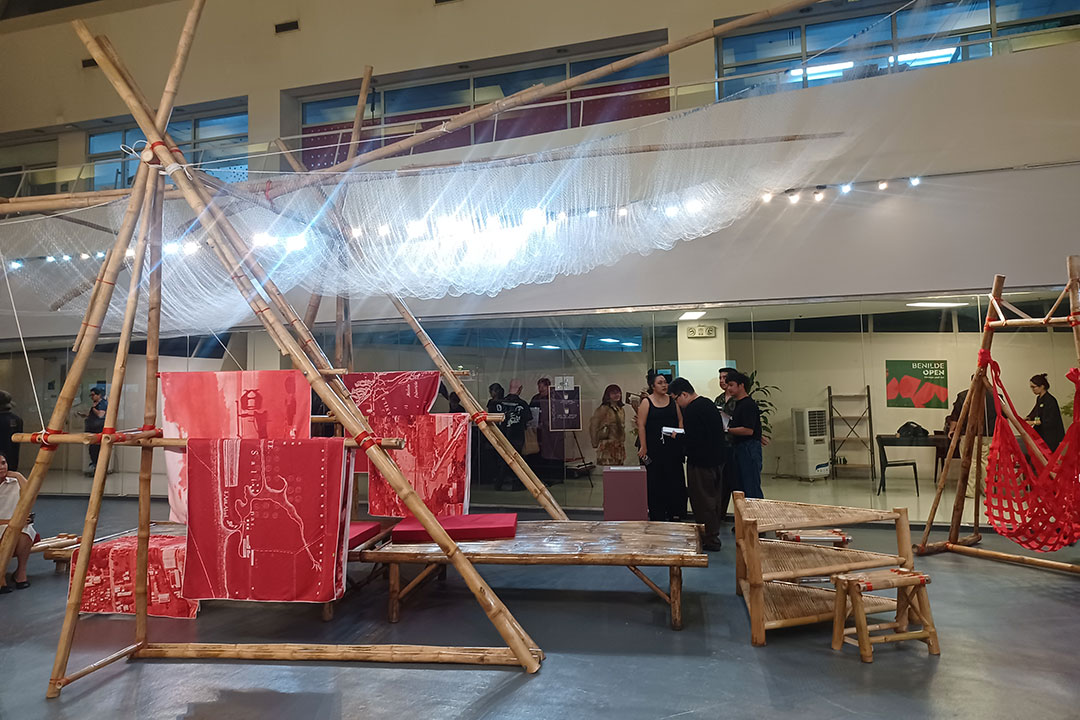
FILLING the gallery space with an inviting area of soft seats and hammocks with a netted canopy overhead, Karl Castro’s Maytubig emerged as part of the second set of Benilde Open Design and Art grants. The pop-up cultural space is another in his series titled Locus Pocus: Kinetic Social Infrastructures for Rest and Collective Care, derived from the aesthetics and labor of fishing culture.
The installation at Benilde was one of the most popular on opening night, offering a public space for rest shaped by human and ecological memory. Built in collaboration with fishermen from Talim Island, its canopy draws from the salambao, a traditional lift net once common in Manila Bay and its river networks, and the sakag, a manual push net still commonly used for shrimp fishing.
“I want people to think about our literal relationship with water in the area where Benilde is,” Mr. Castro told the media prior to the launch of Benilde Open on April 11. Malate, Manila, where the campus sits, used to have waterways leading up to Manila Bay.
“I’m grateful to the fisherfolk communities whose knowledge and craft are at the heart of this structure, which makes rest a form of remembering and a temporary act of reclamation,” he said.
He is one of the 10 grantees chosen to receive P300,000 to realize design and art projects encompassing various fields, under the theme “Extension of Nature” for this edition.
Meanwhile, media artist Mac Andre Arboleda turned to the digital sphere to examine colonial crimes against nature, with a project titled Nutrition Month (Presented by Mayor Alice Guo). In a sonic archive format, it cleverly uses the figure of Alice Guo as a lens to investigate the various trends and systems that define the Filipino today.
“It’s presented as a satirical billboard and evolving archive, mimicking the language of government campaigns and online scams,” Mr. Arboleda told BusinessWorld. He posited that a research-driven yet grassroots approach to the complex social media landscape is critical to make real progress.
For him, be it the seafaring network of Filipinos abroad, the e-sabong networks locally, or the complications behind acceptance of gender identities in the Philippines, there is much yet to be studied online.
SELECTION PROCESS
The Benilde Open Design and Art is a grant-giving body organized by De La Salle College of Saint Benilde (CSB). For its second edition, the showcase is installed across the 6th and 12th floors of the CSB campus, where students and visitors can browse through the works.
It invited creatives from all fields of design and art — like traditional crafts, textiles, industrial design, video, and architecture, to name a few — to participate. The 130 proposals received were narrowed down to 10 professional grantees, each of whom received a P300,000 grant to fulfill their projects.
This year, the international selection committee was composed of Freddie Anzures, Creative Partner at HPIQ; Jiho Lee, curator at the National Museum of Modern and Contemporary Art in Korea; architect Mireia Luzárraga of TAKK; Natalie Huni, managing director and head of design at Wells Fargo; and Timothy Moore, curator of contemporary design and architecture at the National Gallery of Victoria and director of Melbourne Design Week.
“It was very difficult to select because there’s hundreds of creatives and we were really confronted with the variety of disciplines. What was helpful was the theme, which looks at nature,” Mr. Moore told BusinessWorld. “As a jury, we were really interested in projects that challenge the binary relationship between nature and human, projects that look at how nature is complex and entangled in our lives.”
He added that Benilde Open is unique in that it commissions “prototypical work that tests out ideas in a gallery setting,” unlike other similar grants of this scale. “It’s brave to have this kind of incubator for people at different stages of their career. It’s quite unique globally, an opportunity that we don’t see a lot,” he said.
FAMILIAR MADE NEW
Some projects reinterpreted day-to-day rituals and materials to develop new forms.
Technospoonism: Wearable Cutlery for a Reimagined Kamayan by designer Bianca Carague presents a speculative jewelry collection that reimagines the Filipino tradition of eating using one’s hands. Her experimentation in form resulted in rings that double as forks, cuffs that also function as plates, and pendants that may carry food.
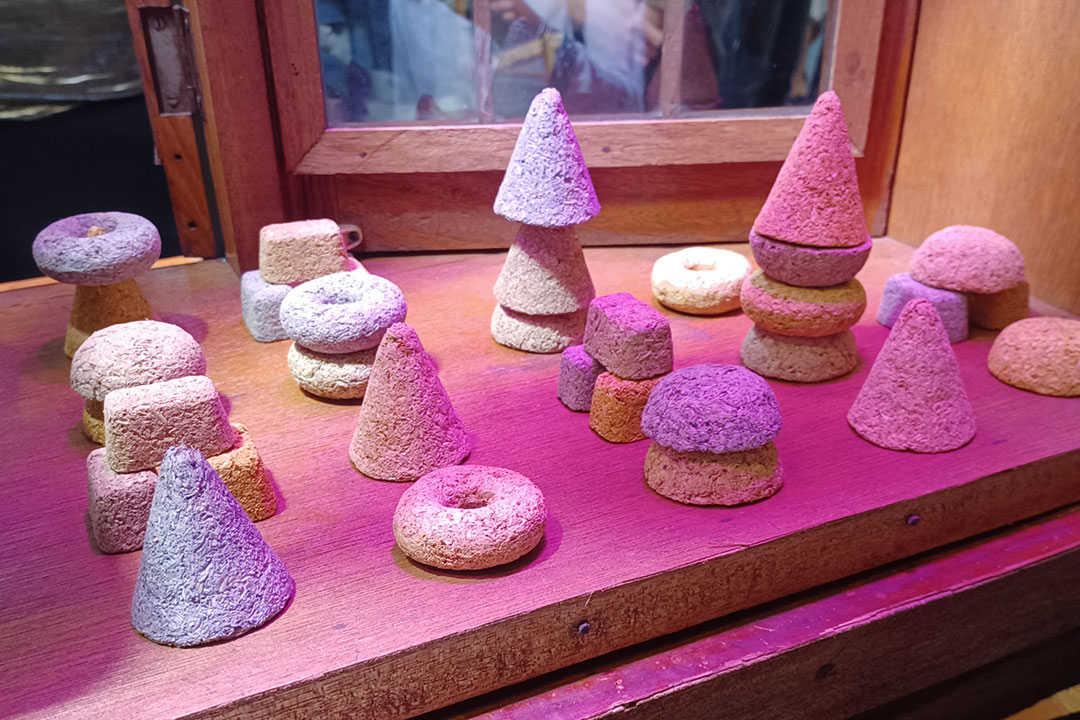
Datirati by Niño Tayao revisits childhood play through a stacking toy made from agricultural waste. Using organic materials like rice husks, corn husks, various seeds, and starch, his series of toys invites people to contemplate the life cycle of objects.
“Coming from an industrial design background, I found that the agri-waste materials carried nostalgia. I feel that I’m working with a living thing that’s very fragile,” he said. “The uncertainty is kind of a metaphor for the climate we have right now.”
CIVIC LIFE, PUBLIC SPACE
For artist Krishner Appay from Sulu, whose project A Cultural Revival of the Tausug Luhul Giyuting Tree of Life presents appliqué textiles developed with local artisans, the Benilde Open is an opportunity to keep traditional textile knowledge alive.
“Sulu traditional art has to be passed on to the next generation, even in the reality of modernization. This traditional knowledge deserves wider recognition, appreciation, and preservation,” she told BusinessWorld. “This exhibit also challenges the notion that local artisans can only create for local audiences. It can go beyond the community.”
More representations of civic life appear across the showcase. Andi Osmeña’s Waste of Space is an answer to the scarcity of accessible public spaces in Metro Manila. She uses upcycled materials like sachets to put up temporary gathering spaces that communities can build on their own.
“Public space is becoming more topical in light of car-centric infrastructure and rising prices of oil and gas. Metro Manila gets the brunt of it. This is something that we can take hold with our own hands, which is why the materials I chose are simple, inexpensive, and made from post-industrial waste,” said Ms. Osmeña.
“We can do things guerrilla,” she added. “From it, I want people to find hope and small pockets of joy.”
Meanwhile, an exploration of life on Negros Island was captured on film by artists and filmmakers Kiri Dalena and Ben Brix. Common Ground, a multi-channel video installation, examines ecological volatility and colonial agricultural histories on the island.
Both explained that, aside from filming the experiences of locals, they were able to pick up on the contradictions and tensions in the region.
SPECULATIVE DESIGNS
Another video installation among the grantees was helmed by filmmaker Mikael Joaquin. His work, The Memory of Flood, speculates a future Manila reshaped by rising waters.
“It presents an imagined landscape where flooding water has shaped the city. I hope audiences feel the fragility of the image,” he told BusinessWorld.
He said that the video contemplates how Manila’s coastline is drastically ever-changing. It is centered on a lone figure facing the sea while a color image of Dolomite Beach is projected on a thin, makeshift-screen made of gauze.
Nicolei Racal’s What If Snow Falls in the Philippines? is another speculative work, which imagines a fictional climate catastrophe through a textile-based installation.
Atlas of Water Futures by architectural studio Uno Sinotra, led by Mona and Buddy Ong, tackles flooding with an inflatable bubble-dome installation, developed from workshops with children in Cebu.
For selection committee member Freddie Anzures, the 10 final projects stood out because they contained “narratives that relate to cultures globally, just executed in a Filipino lens.”
“They all have a collective aspect, a community aspect, and that is what I would love to see represent the Philippines on a global level,” he explained. “I think a lot of the projects capture a Filipino-ness, though the Philippines is made up of a lot of different cultures. The geographical nature of the country hinders its ability to have a solid identity, so the variety is part of its identity. It’s a collage.”
The Benilde Open Design and Art 2026 exhibition is on view until April 27 on the 6th and 12th floors of the CSB’s School of Design and Arts campus in Pablo Ocampo St., Malate, Manila. — Brontë H. Lacsamana