Home Blog Page 4731

Alfamart opens first Pangasinan location to hit 1,500th stores

ALFAMART has opened its 1,500th store and first location in Pangasinan, the minimart chain of SM Markets said on Wednesday.

“We will continue to look for communities in need of access to basic food products in both urban and hard-to-reach places to make everyday shopping more convenient for the families living in these communities,” said Alfamart Chief Operating Officer Harvey T. Ong in a statement.

The new store located near Urdaneta City’s residential cluster is Alfamart’s first branch within the province.

Alfamart has so far opened about 100 stores as it continues the minimart chain’s goal to open 250 stores within the year.

The company said that the new store marks the 1,500th branch established since it opened its first concept store in 2014.

“In just six years, the super minimart concept has achieved significant scale by blending two grocery formats of a supermarket and a convenience store into one,” the company said.

“This unique service enabled the company to provide everything one needs at home such as frozen meats, vegetables, seafood, and more, in order to truly serve the immediate needs of every community,” it added.

Mr. Ong added the company had partnered with local lessors by renting their land or building space while partnering with local contractors for the construction of the stores.

“We provide opportunities for local product suppliers by carrying their products in Alfamart stores. Lastly, we provide employment opportunities to the local community members,” he said.

Alfamart Philippines is a joint venture between the SM group and PT Sumber Alfaria Trijaya Tbk (Alfamart Indonesia), creating the minimart chain of SM Markets, the food retail brand of SM Retail, Inc.

SM Retail is one of the core businesses of SM Investments Corp., which serves as the holding company of the SM group with interests in retail, property, and banking. SM Investments’ shares fell by 1.73% or P16 to P910 on Wednesday. — Adrian H. Halili

Nokia sees interconnect solutions boosting PHL data center industry

STOCK PHOTO | Image by DC Studio from Freepik

By Justine Irish D. Tabile, Reporter

BUSINESS-TO-BUSINESS solutions provider Nokia expects the development of data center interconnect solutions in the Philippines to support the industry’s growth.

“Nokia is a leader in terms of data center interconnect solutions. Data center interconnect solutions are, as we know, networking infrastructure that help connect multiple data centers,” Nokia Philippines Head Carlos Alberto Reyes said in an interview.

Mr. Reyes said the Philippines is a strategic location for data centers, making it a viable prospect for data center interconnect solutions.

“The Philippines, at this moment, has a very interesting development of the business in the data center because of the geographical location and because of the different multiple subsea cables that connect the Philippines to the world,” he said.

“At this moment, we consider that the data center interconnect solutions of Nokia can strongly support the development of the data center industry that is developing in the Philippines,” he added.

He added that data center interconnect solutions will help in storing large amounts of data from Philippine firms.

“Many of the sectors that are in the Philippines require a high amount of data to be managed at storage like the banking and business process outsourcing industries, and all of these are reliant on the data center ecosystem that is currently growing in the Philippines. Our solution in Nokia can strongly help the development of these solutions and the performance of the data centers in the Philippines,” Mr. Reyes said.

He said Nokia’s data center interconnect solutions, which have the highest speed optical links, offer secure protocols and high performance, can contribute to the growing data center industry in the country.

He added that many industries in the Philippines are interested in tapping the services of data centers.

“The Philippines is preparing very well in the direction to have the capacity of data centers and become a very important data center player in the world,” Mr. Reyes said.

For the industry to grow further, large enterprises, public organizations, and the government should collaborate, he said.

“Large enterprises, government and public organizations are working in the direction that they need to automate and digitalize the way they are working. This definitely requires a data center capacity to handle it,” Mr. Reyes said.

One of the challenges that organizations face is how to shift from their old systems to an automated one, he said.

“I think the concept of the data centers and the cloud are fundamental because they can facilitate the process of moving all this data in the proper way and in a cost-effective way,” Mr. Reyes added.

Deposit and loan growth boost lenders’ total resources

By Keisha B. Ta-asan, Reporter

THE Philippine financial system’s total resources rose at the end of April after sustained growth in banks’ deposits and loans, data from the Bangko Sentral ng Pilipinas (BSP) showed.

Resources of banks and nonbank financial institutions grew by 8.4% from a year earlier to P28.52 trillion.

“The higher resources of banks were due to the continued growth in deposits and loans, as well as the higher net income that adds to capitalization,” Michael L. Ricafort, chief economist of Rizal Commercial Banking Corp., said in a Viber message.

Banks include universal and commercial banks, thrift banks, as well as rural and cooperative banks. Nonbank financial institutions include investment houses, finance companies, security dealers, pawnshops and lending companies.

Nonstock savings and loan associations, credit card companies, private insurance firms, the Social Security System and the Government Service Insurance System are also nonlenders.

Based on central bank data, banking resources increased by 9.8% year on year to P23.48 trillion as of end-April. Big banks held P22.07 trillion of total banking resources, 10% higher than a year ago.

Resources of thrift banks hit P1.01 trillion, inching up by 3.9% from a year earlier. Total resources of rural and cooperative banks increased by 10.6% to P397 billion.

On the other hand, nonbanks’ resources grew by 2% to P5.03 trillion from a year earlier.

“For the coming months, continued growth in deposits, loans and net income as the economy further reopened, as well as more capital-raising activities by some banks would lead to higher total assets and resources,” Mr. Ricafort said.

The cumulative net income of the banking system rose by 42% to P94.62 billion as of March from a year earlier, separate data from the BSP showed.

Meanwhile, outstanding loans from big banks grew by 9.7% to P10.86 trillion in April. Domestic liquidity also rose by 6.6% annually to P16.3 trillion.

Remote work pay cuts send the wrong message

CHRISTINA WOCINTECHCHAT-UNSPLASH

CEOs frustrated that workers aren’t coming into the office more often are trying a new tactic: tying in-person attendance directly to higher pay.

At least one big law firm has explicitly linked office presence to employee bonuses. At other companies, the connection is more tacit. Google recently said it would use face time as a factor in performance reviews; executives didn’t have to spell out that these ratings influence compensation. Nor did IBM Chief Executive Officer Arvind Krishna need to explain what he meant when he said “your career does suffer” if you work remotely; if it’s harder to get a promotion, it’s naturally going to be harder to get a raise.

Leaders who want to experiment with this approach should proceed carefully. A compensation disparity hits differently when framed as a penalty for remote workers than as a bonus for commuters. And a clear policy is likely to work better than vague insinuations.

Some bonus for regular in-person attendance actually seems reasonable. Commuting is time-consuming, and something most people find unpleasant. It’s expensive, and not only because of the price of parking or train tickets — if you can’t be home in time to pick up your kid from day care, you’ll have to hire someone to do it. If you don’t have time to cook, you’ll have to get takeout. The costs add up.

And a study last year by Jose Maria Barrero, an economist, and several collaborators suggested that remote work lessened wage-growth pressures because workers value it so highly. As my colleague Jonathan Levin wrote at the time, “remote work has an ‘amenity value,’ much like a company car or an office gym.” Clawing back that amenity could be expensive: A survey of London workers conducted by Bloomberg Intelligence earlier this year found that employers would need to give hefty raises to lure people back to offices five days a week.

But the recent crop of CEO comments tying pay to office presence aren’t framing remote work as an amenity. They’re calling it a performance problem for which remote workers should be financially penalized. And that suddenly makes it less palatable.

Some of this is basic loss aversion, the psychological principle that bad is stronger than good. If you find $20, you’ll be mildly pleased. But if you lose $20, you’ll be seriously annoyed.

But there’s more going on here. There are questions of fairness. Several studies have shown remote workers are more productive. Shouldn’t workers be paid for their output? Not to mention that polls have consistently shown a preference for remote work among groups at greater risk of discrimination, such as women, older workers, people of color, and the disabled.

Yet paying for face time, rather than output, is a practice companies have long used. It’s part of the reason that men earn more than women do — on average, men tend to report spending longer hours working. Women — especially mothers — generally report less, because they do more unpaid labor at home.

To be clear, people who log more hours don’t necessarily get more done. But many managers have overlooked that detail. A pre-pandemic study of consultants showed that people who pretended to work long hours were rated highly by their bosses, regardless of their output. Employees who were honest about working “only” full time were penalized — even though they churned out just as much work.

This is why, for years, workers have used tricks to give the appearance of putting in more time than they are — leaving a jacket on the back of their desk chair, for example, or scheduling e-mails to send at odd hours. (Don’t pretend you’ve never been tempted.)

Many attempts to cut through the politicking and reward employees for their actual output — such as Best Buy’s long-gone “results only work environment” — have sputtered.

This isn’t to say that all remote workers are more productive — or that there’s no reason beyond company politics to show up in person. As pro-office executives are often quick to argue, even if remote employees write more lines of code or create more PowerPoints, that’s not the only way to create value. Mentoring, collaborating, contributing to a positive company culture — these create value, too. And most are more readily done in person than remotely.

But Barrero points out that although remote and in-person workers might be contributing in different ways, it would be hard to say which type of worker contributes more value overall. Moreover, he warns, in-office workers aren’t necessarily working all the time they’re present, even if that’s what managers assume: Recent data has found that, during working hours, in-office workers were more likely than remote workers to play computer games.

“The key is to think about why you want the employees to be in the office,” Barrero told me. “An extra day in the office where they would be doing the exact same thing at home just seems like capriciousness.”

Indeed. But whoever said companies were entirely rational?

If companies want to financially reward employees who take the trouble to come into the office more frequently, they should be explicit about it: Come in X many times, get Y amount of extra money. Then workers can decide if juice is worth the squeeze. And executives will have to be honest about the bottom-line value of an occupied seat.

BLOOMBERG OPINION

Cormac McCarthy, dark genius of American literature, 89

NEW YORK — Cormac McCarthy, whose nihilistic and violent tales of the American frontier and post-apocalyptic worlds led to awards, movie adaptations, and sleepless nights for his enthralled and appalled readers, died on Tuesday at the age of 89.

Mr. McCarthy — arguably the greatest American writer since Ernest Hemingway or William Faulkner, both of whom he was sometimes compared to — died of natural causes at his home in Santa Fe, New Mexico, according to a statement from publisher Penguin Random House that cited his son, John McCarthy.

Little known for the first 60 years or so of his life, rapturous reviews of 1992’s All the Pretty Horses — the first in “The Border Trilogy” — changed all that. The book was made into a movie — as were 2005’s No Country for Old Men and 2006’s Pulitzer Prize-winning The Road.

But Mr. McCarthy was never seen on the red carpet. An intensely private man, he almost never gave interviews. He granted a rare exception for Oprah Winfrey in 2007, telling her: “I don’t think (interviews) are good for your head. If you spend a lot of time thinking about how to write a book, you probably shouldn’t be thinking about it, you probably should be doing it.”

Mr. McCarthy wrote with a distinctive, spare style that eschewed grammatical norms but drew the reader in relentlessly to his world of blood, dust, and an unforgiving universe.

“He stood at the window of the empty cafe and watched the activities in the square and he said that it was good that God kept the truths of life from the young as they were starting out or else they’d have no heart to start at all,” he wrote in typical fashion in All the Pretty Horses.

NOT RESPECTABLE
Born Charles Joseph McCarthy, Jr. on July 20, 1933, in Providence, Rhode Island, Mr. McCarthy was one of six children in his Irish Catholic family, and later switched to using the old Irish name of Cormac.

His father was a lawyer and he was brought up in Tennessee in relative comfort. But middle America was not for him.

“I felt early on I wasn’t going to be a respectable citizen. I hated school from the day I set foot in it,” he told the New York Times in another rare interview in 1992.

He served in the Air Force in the 1950s and was married twice before the 1960s were out — first to Lee Holleman, who he met at college and with whom he had a son, and later to English singer Anne DeLisle, from whom he separated in 1976. After a short spell in Europe, he returned to Tennessee to settle near Knoxville, Tennessee and later moved to El Paso, Texas and then to Santa Fe.

His first book The Orchard Keeper, set in rural Tennessee and published in 1965, landed with Faulkner’s last editor, who recognized the young writer’s potential. But despite positive reviews — and some shocked reaction — for this and other early works like Child of God and Outer Dark, commercial success eluded Mr. McCarthy and he scraped by on writers’ grants.

In 1985 Blood Meridian was published, garnering little attention at the time, although it is now considered his first truly great novel and perhaps his best. With lots of violence and no heroes, it tells the tale of a gang of scalp hunters in the mid-19th century West.

All the Pretty Horses, a coming-of-age book that kicked off a trilogy centered around Texas ranch hands at the close of the frontier, finally brought him acclaim in the 1990s.

The trilogy was followed by No Country for Old Men, a deeply disturbing and yet riveting Western crime novel about a drug deal gone wrong, quickly adapted into a movie by Joel and Ethan Coen that won the 2007 best picture Oscar.

This was the time that also saw the publication of The Road — perhaps even darker than what went before. Set in a world where an unnamed disaster has ended society and food production, a father and his son walk through a devastated landscape occupied by desperate people. The full depths of human depravity are on display — but also the love that the small family is able to sustain through it all. The Road won multiple awards and was also made into a movie in 2009.

Then came a long period until two new companion novels were released in 2022 — interconnected books The Passenger and Stella Maris that were unmistakably Mr. McCarthy, now approaching 90 years of age, albeit somewhat gentler — and, perhaps, valedictory.

“Enough,” says one character for whom death is approaching. “I have never thought this life particularly salubrious or benign and I have never understood in the slightest why I was here. If there is an afterlife — and I pray most fervently that there is not — I can only hope that they won’t sing.”

In a statement, Nihar Malaviya, CEO of Penguin Random House, said, “Cormac McCarthy changed the course of literature. For 60 years, he demonstrated an unwavering dedication to his craft, and to exploring the infinite possibilities and power of the written word.”

Mr. McCarthy was married three times, divorcing his third wife Jennifer Winkley in 2006. He had two children: Cullen, born in 1962, and John, born in 1998. — Reuters


Dingdong eyes restaurant reservations, retail shops, motorcycle taxis

LAST-MILE delivery solution startup Dingdong plans to explore restaurant reservations, retail shops, and the motorcycle taxi business to diversify its services.

“To further enhance the seamless experience, we will introduce a unique feature that allows customers to reserve tables at our wide selection of partner restaurants,” Dingdong Founder and Chairman Dong Dantes said in an e-mail interview.

“Looking ahead, our application aims to expand its services to include retail shops, incorporating exciting and innovative features that set a new standard in the e-commerce space. We are also exploring the possibility of entering the motorcycle taxi business in the near future,” he added.

According to Mr. Dantes, one of the growth areas for delivery businesses in the Philippines is the growing demand and shift in consumer preferences.

“Delivery service providers are expanding beyond their traditional role of goods delivery, venturing into sectors such as food, grocery, and pharmacy delivery,” Mr. Dantes said.

“This strategic diversification allows them to access new revenue streams and reach a broader customer base,” he added. “This expansion also creates opportunities for partnerships and cross-promotion with local businesses, driving mutual growth.”

On May 30, Dingdong and on-demand food and door-to-door delivery mobile application RiderKo signed a memorandum of agreement to create an all-in-one platform for local delivery service.

Starting June 12, the Dingdong application, powered by RiderKo, will be available for download on App Store for iOS and Play Store for Android.

Aside from diversification, Mr. Dantes also sees technological advancement and customer demand for sustainable options as growth areas for the delivery services industry.

“Advancements in technology have revolutionized the delivery services industry. From real-time tracking to route optimization and automated systems, technology plays a vital role in improving efficiency, reducing costs, and enhancing the overall customer experience,” said Mr. Dantes.

“Another growth factor in the delivery service industry is the sustainability and eco-consciousness of the customers: Customers and businesses are increasingly conscious of reducing their carbon footprint and opting for eco-friendly delivery options, such as electric vehicles and environmentally friendly packaging,” he said.

Mr. Dantes said delivery service providers that will prioritize sustainability are likely to gain a competitive edge.

“This is the reason why in our pipeline, we are looking at providing e-motorcycles in the future,” he said.

Dingdong is set to pilot e-motorcycles from Passenger Urban and Rapid Electric Vehicle Solutions, Inc. (PURE-EV) as a delivery option. 

“We take great pride in being the first to introduce e-motorcycles from PURE-EV to meet the evolving delivery demands of our valued customers,” he said.

“In the coming days, we will be piloting this innovative offering, demonstrating our commitment to embracing cutting-edge technology and driving positive change in the industry. These endeavors serve as inspiration and fuel our dedication to continuous innovation and excellence,” he added. — Justine Irish D. Tabile

Xiaomi launches new Redmi Note 12 series phones

REDMI NOTE 12S

SMARTPHONE brand Xiaomi last week launched in the Philippines the newest phones in its Redmi Note 12 series, the Note 12 Pro and Note 12S.

Tomi Adrias, Xiaomi Philippines marketing head, said at the launch event last week that the additions to the Redmi Note 12 series aim to enhance smartphone features that matter to the lifestyles of today’s youth.

“The new models expand their smartphone options, so they could find the right device that matches their personality and everyday needs,” Mr. Adrias said.

“We promise to commit to providing accessible technology at an affordable price,” he added.

The Redmi Note 12 Pro has a 108-megapixel (MP) main camera and an 8-MP ultra-wide angle camera, supporting 4K video resolution.

It has a 6.67-inch FHD+ AMOLED DotDisplay with a 120Hz refresh rate and support from Dolby Vision and Dolby Atmos.

The phone is also powered by a Snapdragon 732G processor and a 5,000mAh battery with 67W turbocharging.

The Redmi Note 12 Pro is available in the colors Star Blue, Glacier Blue, Polar White, and Graphite Gray.

Meanwhile, the Redmi Note 12S has a 6.43” FHD + AMOLED DotDisplay with a 90Hz refresh rate and 180Hz maximum sampling rate.

It is powered by a MediaTek Helio G96 processor and 5,000mAh battery with 33W fast charging.

Available colors include Ice Blue, Pearl Green, and Onyx Black.

The recommended retail price for the Redmi Note 12 Pro is P14,999, while the Redmi Note 12S is priced at P12,999.

Both products have 8GB of RAM and 256GB of internal storage.

The new smartphones are now available for purchase online and in authorized Xiaomi stores. — Miguel Hanz L. Antivola

BSP term deposit yields rise ahead of Federal Reserve policy meeting

MARI GIMENEZ-UNSPLASH

By Keisha B. Ta-asan, Reporter

TERM DEPOSIT YIELDS of the Philippine central bank rose on Wednesday, ahead of the US Federal Reserve’s policy meeting.

Demand for the Bangko Sentral ng Pilipinas’ (BSP) term deposit facility (TDF) stood at P286.877 billion, higher than the P240 billion on the auction block. Last week, bids reached P249.767 billion against P220 billion on offer.

The central bank raised the volume for the TDF auction to P240 billion and adjusted the allocation between the seven- and 14-day tenors, BSP Deputy Governor Francisco G. Dakila, Jr. said in a statement.

“Total tenders reached P286.877 billion, higher than the BSP’s expected volume range,” he said. “The respective bid-to-cover ratios for the seven-day and 14-day TDF stood at 1.183x and 1.210x, further reflecting market participants’ preference for both tenors.”

Tenders for one-week term deposits reached P153.730 billion, surpassing the P130-billion offer. Last week, bids hit P133.675 billion against P120 billion on offer.

Banks asked for yields ranging from 6.55% to 6.6144%, narrower than 6.375% to 6.625% on June 7. The average rate for the seven-day debt rose by 1.1 basis points (bps) to 6.5933%.

Meanwhile, the 14-day deposits attracted P133.147 billion in bids, higher than P110 billion being sold by the central bank. Last week, tenders hit P116.092 billion against a P100-billion offer.

Accepted rates for the two-week debt ranged from 6.5% to 6.6299%, also narrower than 6.3% to 6.6344% last week. This caused the tenor’s average rate to increase by 0.54 bp to 6.5981%.

The BSP has not auctioned off 28-day term deposits for more than two years to give way to its weekly offerings of securities with the same tenor.

The central bank uses the term deposits and 28-day bills to mop up excess liquidity in the financial system and to better guide market rates.

“The BSP’s monetary operations will remain guided by its assessment of prevailing liquidity conditions and market developments,” Mr. Dakila said.

The higher TDF yields on Wednesday followed the higher rates of US Treasuries, Michael L. Ricafort, chief economist at Rizal Commercial Banking Corp., said in a Viber message.

The two-year Treasury yields hit 4.707% over night, the highest since March, before easing by 4 bps to 4.6519% in Asian hours, Reuters reported.

The benchmark 10-year yields also climbed to the highest in two-and-half weeks at 3.8450%. They were last down by three bps to 3.8056%.

The US Federal Reserve may also pause its tightening cycle on June 15, Mr. Ricafort said. “However, the markets recently priced in a possible 25-bp Fed rate hike on July 26, as also signaled earlier by some Fed officials.”

The Fed is widely expected to hold off on raising interest rates after a softer US inflation report. Consumer prices in the US rose by 4% in May, the slowest in more than two years, easing from April’s 4.9%.

However, sticky core inflation may still prompt the US central bank to hike policy rates after this week’s meeting. US core inflation slightly slowed to 5.3% from 5.5% a month ago.

“Any future Fed rate moves could be matched by the BSP to maintain a healthy interest rate differential and help stabilize the peso exchange rate and overall inflation,” Mr. Ricafort said.

Last month, the Philippine central bank kept the key rate at 6.25%. It was its first pause after increasing borrowing costs nine times straight since May last year, for a total of 425 bps.

Inflation eased to an eight-month low of 6.1% in May. To date, it has averaged 7.5%, still above the BSP’s 5.5% full-year forecast and 2-4% target. — with Reuters

Actor Treat Williams killed while riding motorcycle

Treat Williams in a scene from Chesapeake Shores in 2016.

The actor Treat Williams, known for his roles in Hair and Everwood, was killed in a motorcycle accident on Monday, his longtime agent said.

Barry McPherson, Williams’ agent for 15 years, confirmed that the actor was killed when the motorcycle he was driving was involved in an accident with a car in Dorset, Vermont.

Williams was 71.

People magazine, citing Jacob Gribble, the fire chief in Dorset, reported the accident took place when a car turned into Mr. Williams on Route 30. Mr. Gribble told the magazine that Mr. Williams was the only person hurt in the accident, and that he had been airlifted to a hospital in Ticonderoga, New York.

Mr. Williams’ break-out role was for the 1979 movie Hair, based on the Broadway musical. He also starred in Everwood as a neurosurgeon who moved his family from New York City to Colorado. — Reuters

Financing sustained growth: Tax reforms

(Third of four parts)

The government economic team or the members of the Development Budget Coordination Committee (DBCC) will hold another Philippine Economic Briefing (PEB) today in Singapore with a clear goal of attracting more foreign investments to create more jobs in the country. The economic team also went to Singapore and Jakarta for the first PEB in the second week of September last year.

Very likely among the important announcements to be made by the team will be on the recently enacted economic liberalization measures like the Public Service Act Amendment and Retail Trade Liberalization, the proposed Maharlika Investment Fund, and taxation policies.

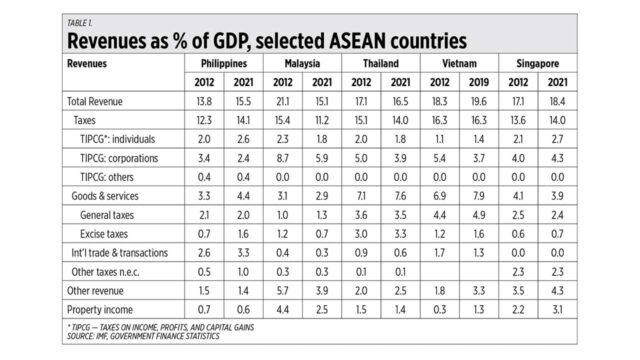
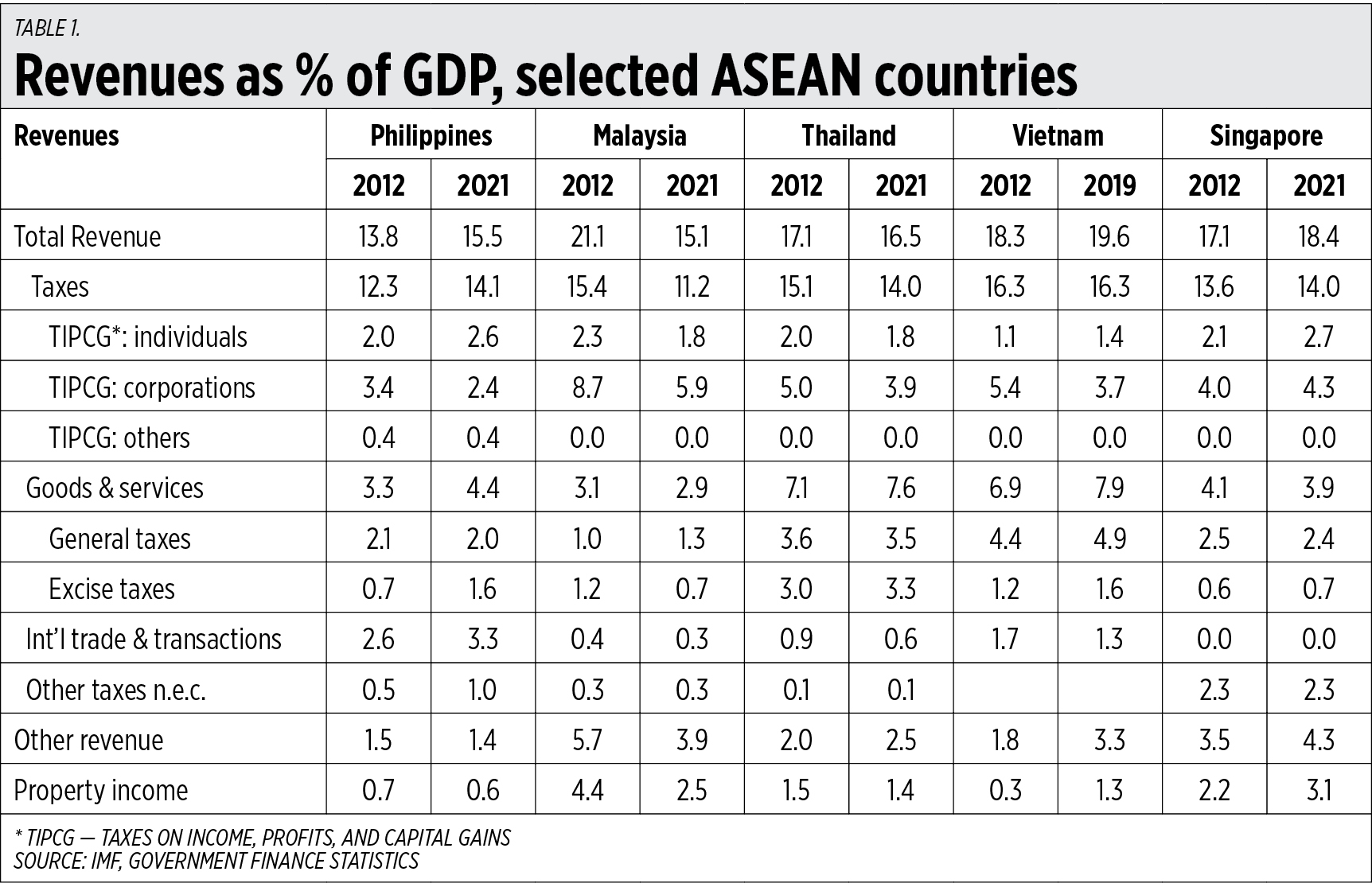
I checked the revenues/GDP ratio of some ASEAN countries and saw that the ratio is generally similar among them — 15-18% in 2021. Vietnam’s was 20% in 2019 but there was no data for 2021. Note that this is for National Government revenues alone and does not include the revenues of local government units (LGUs) as they have their own local taxes, fees, and other sources of income. If LGU revenues are included, overall revenues/GDP ratio can easily rise to 16-17%.

One notable thing in the Philippines’ tax policy is that it imposes relatively high taxes on international trade, both exports and imports, at 3.3% of GDP. Whereas Singapore has zero, Malaysia has only 0.3%, Thailand 0.6%, and Vietnam 1.3%.

The Philippines has the highest VAT rate in the ASEAN at 12%, yet its revenues from general taxes including VAT is low, only 2%, while Thailand and Singapore with VAT rates of only 7% and 8% have general taxes revenues of 3.5% and 2.4% respectively (see Table 1).

Finance Secretary Benjamin Diokno has acknowledged the problem in the country’s VAT system. He noted that from 2016 to 2020, the Philippines collected an average of P723 billion from VAT, which is just 0.40 of the expected VAT collection. The ASEAN average is 0.57 — Thailand has the highest VAT efficiency at 0.79, while Singapore has 0.71 efficiency.

Mr. Diokno has attributed the low efficiency to the many VAT exemptions granted by the government in various sectoral laws. He is correct and I believe reviewing those VAT exemptions should have been done yesterday, or at least today.

Here are recent tax-related reports in BusinessWorld: “Government urged to consider inflation impact of new taxes” (May 14), “Excise tax collection below target due to illegal tobacco — BIR” (May 18), “Tax reforms generated P202.8B in revenues in 2022” (May 29), “PHL posts lowest VAT efficiency in region” (May 31), “Gov’t warned against overdependence on ‘regressive’ sin taxes” (June 4), “Tax system being outmaneuvered by digital companies” (June 5), “PHL needs a more ‘dynamic’ excise tax regime — solon” (June 5), “EV industry lobbying for incentives to support new-vehicle adoption” (June 13).

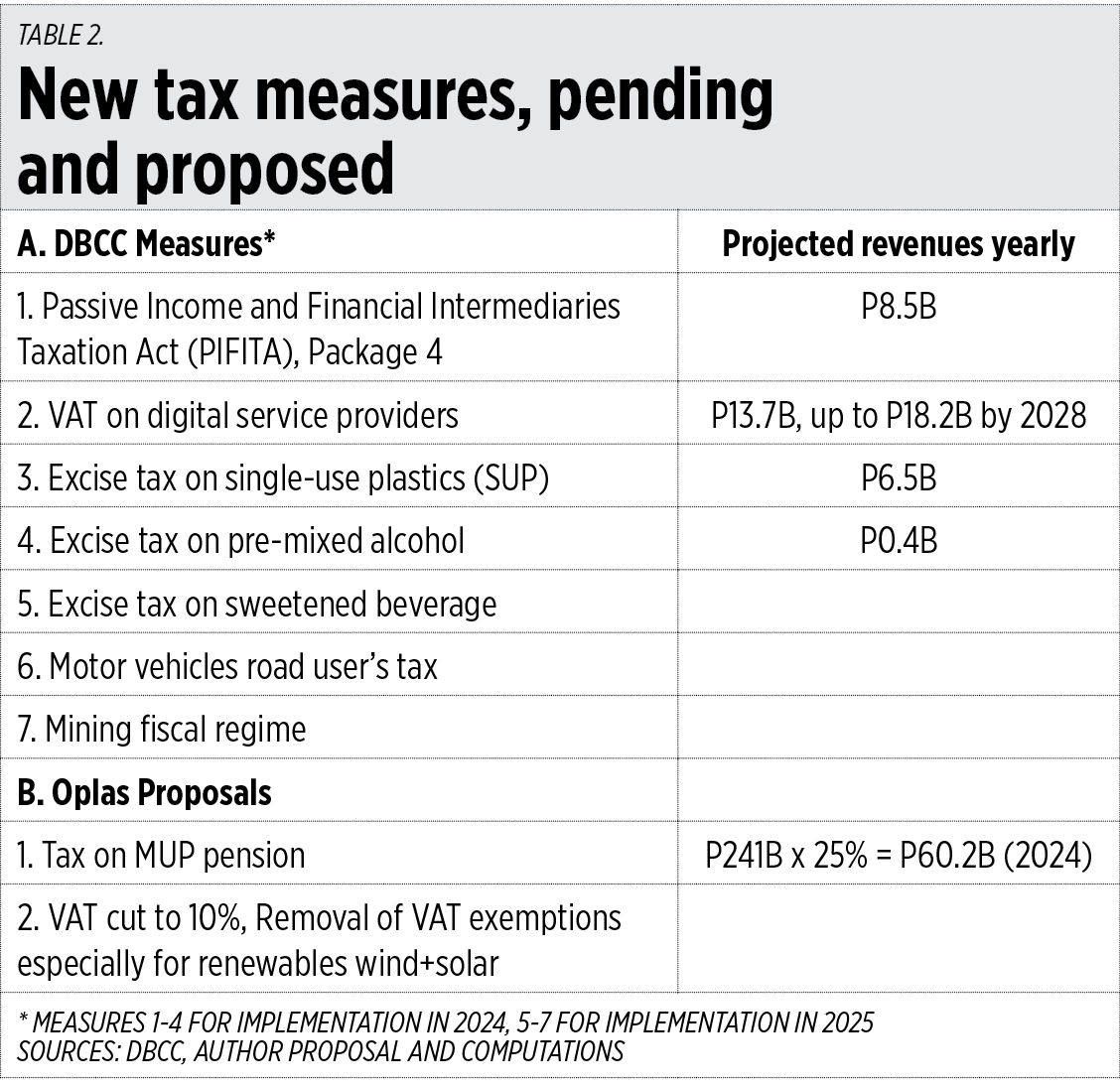
The DBCC has listed seven new tax measures, but they have not yet released updated revenue projections publicly. So, I built this table with projections of some measures mentioned in BusinessWorld. The first four measures are projected to give the government some P29 billion a year.

I add my own two proposals. One, imposing an income tax on military and uniformed personnel (MUP) pension which is big — P160 billion in 2021, P164 billion in 2022, and is projected to be P214 billion in 2023 and P241 billion in 2024, rising further in succeeding years. Currently the MUP pensions are big and tax free.

In 2022, the average monthly pensions were P4,528 for the Social Security System, P13,600 for the Government Service Insurance System, and P40,049 for the MUP. The projected average MUP pension in 2023-2024 would be about P43,000/month and up. This falls in the 25% income tax rate.

My second proposal is to bring the Philippines VAT rate back to 10% from 12%, then remove the VAT exemption of many sectors (see Table 2).

Imposing a VAT of 10% on the sales of renewables will have an upward price effect on power consumers. But bringing down VAT from 12% to 10% for coal, gas, and oil plants, which constitute about 80% of total power generation, will have a price deflation effect for the consumers. Overall, the consumers will likely be better off.

Many MUP pensioners may likely oppose taxation of their pension and they are wrong to do so. First, while in active service they contributed nothing for their own pension; second, their pension comes 100% from taxes and they do not want to contribute to the tax too. This will give them a bad image and public perception that their motto “To serve and protect” refers more to themselves, their superiors, and their pension, and less the public.

The above tax measures should be coupled with spending cuts, borrowings cuts, and, later, tax cuts as the public debt continues to decline. Then more public and private resources will be devoted to more infrastructure, better justice administration, and more business innovations.


Bienvenido S. Oplas, Jr. is the president of Bienvenido S. Oplas, Jr. Research Consultancy Services, and Minimal Government Thinkers

minimalgovernment@gmail.com

PLDT Enterprise, PEZA promote

RODION KUTSAEV-UNSPLASH

THE Philippine Economic Zone Authority (PEZA) has partnered with the business-to-business arm of PLDT Inc. to support information and communication technology (ICT) industries and promote the country’s digital ecosystem.

PLDT Enterprise said in a statement on Wednesday that its agreement with the PEZA seeks to promote the country’s capabilities in becoming a digital hub in the global business market. The partnership will be supported by PLDT Enterprise’s expertise and solutions.

PEZA Director General Tereso O. Panga said the partnership is part of the agency’s efforts to lure more investments into the Philippines. 

“We firmly believe in the Philippines’ competitiveness in becoming a business destination for global investments. In doing so, we will continue with our mission to proactively pursue investment leads and seek out new opportunities to showcase the country’s potential,” Mr. Panga said.

Melvin Jeffrey Chan, PLDT Enterprise vice-president, said the partnership allows PEZA-certified companies to accelerate their businesses via the company’s communication network.

“We aim to enhance the country’s digital prowess while exploring opportunities to co-innovate with domestic and foreign investors,” he said.

Meanwhile, PLDT Enterprise said it remains committed to enabling industries and pushing for digital transformation and automation in the country through its infrastructure. 

“As part of our commitment to empower businesses, we continue to expand our reach as a solutions provider so we may be able to address the various needs of industries and contribute to the country’s economic growth,” PLDT Enterprise First Vice-President Vic Tria said.

PLDT Enterprise, the corporate business arm of PLDT, offers fixed-line, wireless, and ICT solutions that help business owners adapt to evolving technological needs by providing access to solutions that optimize efficiency, continuity, and connectivity, and enhance customer experience.   

Hastings Holdings, Inc., a unit of PLDT Beneficial Trust Fund subsidiary MediaQuest Holdings, Inc., has a majority stake in BusinessWorld through the Philippine Star Group, which it controls. — Revin Mikhael D. Ochave

With no big customers named, AMD’s AI chip challenge to Nvidia remains an uphill fight

TRUSTPAIR.COM

ADVANCED Micro Devices Inc. (AMD) Tuesday gave new details about an artificial intelligence (AI) chip that will challenge market leader Nvidia Corp., but the company left out what Wall Street wanted to know — who plans to buy it.

Santa Clara, California-based AMD said the forthcoming chip, which will start trickling out in the third quarter followed by mass production beginning in the fourth quarter, will have 192 gigabytes of memory.

That could help tech companies get a handle on the spiraling cost of delivering services similar to ChatGPT, AMD Chief Executive Lisa Su told Reuters in an interview. She spoke following a keynote presentation in San Francisco during which Ms. Su showed an AI system on the MI300X chip writing a poem about the city.

“The more memory that you have, the larger the set of models” the chip can handle, Ms. Su said. “We’ve seen in customer workloads that it runs much faster. We really do think it’s differentiating.”

But unlike past presentations where AMD has talked up a major customer for a new chip, AMD did not say who will adopt the MI300X or a smaller version called the MI300A. The company gave no details on how much the chip will cost or how it will bolster its sales.

AMD’s shares have doubled in price since the start of the year and touched a 16-month high earlier on Tuesday, but closed down 3.6% after the presentation on the AI strategy. Nvidia shares finished 3.9% higher at $410.22, making it the first chipmaker to close with a market capitalization above $1 trillion.

“I think the lack of a (large customer) saying they will use the MI300 A or X may have disappointed the Street. They want AMD to say they have replaced Nvidia in some design,” said Kevin Krewell, principal analyst at TIRIAS Research.

Nvidia, whose shares have surged 170% so far this year, dominates the AI computing market with a market share of 80% to 95%, according to analysts.

Nvidia has few competitors working at a large scale. While Intel Corp. and several startups such as Cerebras Systems and SambaNova Systems have competing products, Nvidia’s biggest sales threat so far is the internal chip efforts at Alphabet Inc.’s Google and Amazon.com’s cloud unit, both of which rent their custom chips to outside developers.

Aside from the AI market, AMD said it has started shipping high volumes of a general purpose central processor chip called “Bergamo” to companies such as Meta Platforms.

Alexis Black Bjorlin, who oversees computing infrastructure at Facebook parent Meta, said the firm has adopted the Bergamo chip, which targets a different part of AMD’s data center business that caters to cloud computing providers and other large chip buyers.

But investors were searching for news on AI. Nvidia’s lead there has come not only from its chips, but also from more than a decade of providing software tools to AI researchers and learning to anticipate what they will need in chips that take years to design.

AMD on Tuesday provided updates to its Rocm software, which competes against Nvidia’s Cuda software platform.

Soumith Chintala, a Meta vice-president who helped create open-source software for artificial intelligence, during the presentation said he has worked closely with AMD to make it easier for AI developers to use free tools to switch from the “single dominating vendor” of AI chips to other offerings like those from AMD.

“You don’t actually have to do that much work — or almost no work in a lot of cases — to go from one platform to the other,” Mr. Chintala said. 

But analysts said just because sophisticated companies like Meta can wring good speeds from AMD chips, that was no promise of broader market traction with less sophisticated buyers.

“People still aren’t convinced that AMD’s software solution is competitive with Nvidia’s, even if it is competitive on the hardware performance side,” said Anshel Sag, an analyst at Moor Insights & Strategy. — Reuters

ADVERTISEMENT
ADVERTISEMENT