Notice: Function _load_textdomain_just_in_time was called incorrectly. Translation loading for the Newsmag domain was triggered too early. This is usually an indicator for some code in the plugin or theme running too early. Translations should be loaded at the init action or later. Please see Debugging in WordPress for more information. (This message was added in version 6.7.0.) in /data/bwonline/walaakomaisip/wp-includes/functions.php on line 6131
BusinessWorld Online | BusinessWorld: The leading and most trusted source of business news and analysis in the Philippines | Page 4109                                   
Home Blog Page 4109

Further tightening seen with inflation unlikely to ease

THE BANGKO Sentral ng Pilipinas (BSP) may hike rates again this year, with inflation not expected to return to its target amid an increase in spending during the holiday season, analysts said.

“I do think BSP can hike by another 25 basis points (bps) on Nov. 16 and stay at 6.75% until the second half of 2024. That’s enough time to restrict further inflationary expectations,” Security Bank Corp. Chief Economist Robert Dan J. Roces said in a Viber message.

A rate hike could also be necessary at the November meeting to maintain an ample rate differential with the US central bank and stabilize the peso, Rizal Commercial Banking Corp. (RCBC) Chief Economist Michael L. Ricafort said in a Viber message.

The central bank is more likely to keep its key policy rate unchanged than hike by 25 bps at its Nov. 16 meeting, BSP Governor Eli M. Remolona, Jr. said on Friday.

Mr. Remolona said a “really bad” development on inflation may prompt the Monetary Board to hike rates by 50 bps at its Nov. 16 meeting, but he does not expect that to happen.   

The Monetary Board resumed tightening monetary policy as it delivered a 25-bp rate hike in an off-cycle move last week. This brought the key interest rate to a fresh 16-year high of 6.5%.

Rates on the overnight deposit and lending facilities were also raised by 25 bps to 6% and 7%, respectively. The BSP’s first policy move in seven months brought the cumulative rate increases since May 2022 to 450 bps.

Meanwhile, the US Federal Reserve’s target rate is at 5.25-5.5%.

“Rates will remain elevated until inflation is not tempered,” Oikonomia Advisory & Research, Inc. President and Chief Economist John Paolo R. Rivera said in a Viber message. “Inflation will likely not fall within target by this last quarter of 2023 as holiday consumption is not responsive to rate hikes.”

Rate hikes could help in slowing consumption and loan demand, which would cause inflation to ease, but aren’t that effective in managing supply-side issues, Mr. Rivera added.

Security Bank’s Mr. Roces sees inflation easing to the BSP’s 2-4% target by January or February next year but rising again in March if food prices remain elevated.

Mr. Remolona last week said they expect inflation to ease “very briefly” in the first quarter of 2024 but remain above target from March to July before returning within the 2-4% goal late next year.

He said their staff’s risk-adjusted forecast for 2024 rose to 4.7% from 4.3% previously, well above the 2-4% target range.

Headline inflation quickened to 6.1% in September from 5.3% in August, marking the 18th straight month that inflation exceeded the central bank’s 2-4% target.

For the first nine months, inflation averaged 6.6%.

The BSP could keep rates steady if inflation remains within their expectations, RCBC’s Mr. Ricafort said.

The central bank could cut rates late next year if the Fed begins easing, he added. — A.M.C. Sy

RLC Residences breaks ground for two towers

RLC Residences recently broke ground for new buildings of its two condominium projects, SYNC and Sierra Valley Gardens.

“We are very proud of these milestones and equally excited to start constructing these new buildings. Sierra Valley Gardens Buildings 3 and 4 and SYNC N-Tower are among the many projects we recently launched to the public, each with unique features tailored to the needs and lifestyle of condo-seekers,” RLC Residences Senior Vice-President and Business Unit General Manager John Richard B. Sotelo said in a statement.

SYNC is a four-tower residential development located in Bagong Ilog, Pasig City. It is currently the only condominium in the area with direct access to C5 Road.

N-Tower, the third building of the development, was launched last October 2022. It has over 20 indoor and outdoor amenities exclusively available to residents.

Meanwhile, Sierra Valley Gardens is described as the first smart suburban community in Cainta, Rizal.

Located within the Sierra Valley destination estate, the condominium project offers studio to two-bedroom units with balcony options. It also has, resort-like amenities and facilities, plus direct access to the soon-to-rise mall and office buildings within the estate.

Gen Z has become the master of comedic deflection

FREEPIK

“CAN WE GET a cute drink and snacks after this?” reads the text on a recent TikTok image of men with machine guns in army gear. It’s intended to depict the attitude of young female US soldiers while storming a building in Gaza. The post, created by a Gen Zer whose popular feed abounds with Taylor Swift lip-syncs and dance videos, is captioned: “I love this trend #thedraft #war #foryou #fyp #funny.”

It’s one of scores of “funny” posts that have collectively racked up hundreds of millions of views on TikTok in the two weeks since the Hamas attacks on Israel triggered a brutal war in the region.

Other posts include self-deprecation (“celebrating because no matter how bad life gets, I can’t be drafted… because I’m on antidepressants”) and songs for the soldiers who make it to the frontlines. The latter is presented like a playlist for a reality these content creators are choosing to treat as fiction. They are in response to an AI-manipulated video of President Joseph R. Biden calling for a draft of American “sons and daughters” and fixate in particular on the futility of drafting young women. This deepfake video of Biden, which went viral on TikTok and Facebook, has since been removed from both platforms. Still, its impact continues to play out in the rash of Gen Z videos spoofing America’s involvement in an increasingly widespread crisis.

The satirical content seems innocuous compared with the atrocities unfolding in the Middle East, and not all young Tik-Tokers are responding with mockery, of course. Some are producing serious citizen journalism. But the popularity of the brazenly unserious online reactions reminds us that our future workforce and leaders are coming of age during back-to-back crises.

In recent conversations with psychologists and youth counselors, I’ve realized that in the face of painful realities, many Gen Zers have become masters of comedic deflection.

Devorah Heitner, author of Growing Up in Public: Coming of Age in a Digital World, told me that “satire can be an important form of expression for a generation that has been overexposed and desensitized to shocking events. They can benefit from comedy as a safe and creative way to play at the edge of the outrageous, to test what feelings are appropriate.”

In the past year, TikTok has been teeming with parodies of news events ranging from the Oceangate submarine explosion to the death of Queen Elizabeth to the shooting down of China’s spy balloon.

Heitner isn’t suggesting that making memes about any of these events — least of all a deadly conflict — is appropriate. It isn’t, by conventional standards. But the 26-and-under crowd is experiencing childhood and entering adulthood during unconventional times. Playing in the background of their daily lives are the effects of a global pandemic, successive natural disasters, mass shootings, and acts of police brutality.

Linda Charmaraman, director of the Youth, Media & Wellbeing Research Lab at Wellesley Centers for Women, agreed that it could be better for Gen Z to have a place for expression (even if it’s irreverent) than to have no outlet at all. “Sarcasm can be a sign of weakened self-esteem, an expression of a lack of control, masking vulnerability. But comedy can also be cathartic. They’ve got to feel the feels.”

And while they’re processing those feelings, perhaps the more pertinent topic we should consider is the responsibility that parents, educators and policymakers have in providing better mental health support and stronger social media guardrails.

Larissa May, the Gen Z founder of Half The Story, an organization that advocates for online safety and what she calls “digital wellbeing,” said that what’s most concerning is not so much that her generation is creating flippant or comedic TikToks. What they’re consuming is the biggest worry. Alongside the satirical draft posts, algorithms are pushing far more potentially damaging content into their feeds: “The most emotionally provocative content on social media travels so much faster than factual or educational content,” says May. “The algorithms force-feed not just misinformation but fear, anger and propaganda.”

The latest attempt to address this issue has come in two forms: a bipartisan group of 42 attorneys general suing Meta for making addictive content for teens, and policymakers scaling up efforts to pass landmark online safety legislation.

It should be obvious why we need such actions and laws. Charmaraman reminded me that most adolescents, especially those under 14, don’t have the cognitive tools to distinguish between what’s real and fake or mitigate the impulse to consume ever more provocative information. They, especially, need better support from parents and educators to make sense of what they see. This could be through conversations at the dinner table and media literacy lessons in schools.

While it can be valuable for kids to have a space to react — even inappropriately — on social media, Heitner emphasized that “they also need a space to reflect.”

The adults in the room are going to have to be there to help create such an environment. It’s where younger generations can process and refine these reactions and do the deeper work of coming to terms with the relentlessly shocking cultural and political landscape that surrounds them.

BLOOMBERG OPINION

Filinvest Land launches on-site mobile service desks for clients

LISTED property developer Filinvest Land, Inc. (FLI) recently launched on-site mobile service desks to improve the company’s customer services across its projects.

In a statement, FLI said the first on-site mobile service desks were recently unveiled at its Sorrento Oasis and Bali Oasis mid-rise building developments, which are both located in Pasig City.

The mobile service desks provide customers with a more convenient option to access services such as statement of account updates, status inquiries, document submission, and home loan application assistance.

“Both mobile service desks in the two Oasis projects served an estimated 100 customers who availed themselves of various services in each development,” FLI said.

According to FLI, the two developments where the on-site mobile service desks were launched are part of the company’s Aspire by Filinvest brand.

“We believe in putting our customers first, and our commitment to customer centricity is unwavering. Our introduction of FLI mobile service desks is a testament to this commitment, as we strive to provide convenience and accessibility to our valued customers,” FLI Senior Vice-President for Operations Reynaldo Juanito S. Nieva said.

Meanwhile, FLI said that it plans to launch the mobile service desks in key cities across the country where the company’s projects are located.

“In FLI, product excellence and customer centricity are achieved by conducting the business with integrity and keeping standards high — all to better serve and retain the company’s customer base,” the company said.

“To ensure service quality, FLI is guided by a set of policies and procedures, which cover service quality, improvement processes, customer satisfaction surveys and addressing customer issues,” it added.

Shares of FLI were last traded on Oct. 27 at 60 centavos apiece. — Revin Mikhael D. Ochave

In Britney Spears’ new book, an unlikely hero — her lawyer

AMAZON.COM

By Jenna Greene

AMAZON.COM

IN HER new memoir, pop superstar Britney Spears offers up an unexpected hero: her lawyer.

Greenberg Traurig partner Mathew Rosengart in 2021 succeeded in freeing Ms. Spears from a 13-year conservatorship that the singer called “the darkest chapter of my life” and “the worst thing that could possibly ever happen to my music, my career, and my sanity.”

That is, she writes, until she hired Mr. Rosengart, who in short order succeeded in ousting Ms. Spears’ father as conservator, then ending the conservatorship altogether.

Ms. Spears writes in The Woman in Me published on Oct. 24 that while Mr. Rosengart’s legal strategy won the day, the lawyer also made sure she knew that she was instrumental in her own victory.

“He told me that I deserved the credit for what happened,” Ms. Spears writes.

Such validation after years of being controlled by her father meant “everything” to her, Ms. Spears added, describing Mr. Rosengart as “amazing.”

Praise from any client is always nice, of course. But when it comes from a world-famous singer who has sold 100 million records?

The recognition in Ms. Spears’ memoir was “particularly appreciated, because of Britney’s iconic status, and the stakes were so incredibly high,” Mr. Rosengart told me via e-mail.

Ms. Spears in her book doesn’t mention the 2,650-lawyer Greenberg Traurig firm by name — underscoring the old adage that clients hire the lawyer, not the firm — but her depiction of Mr. Rosengart is certainly a public relations (PR) windfall for him.

Not that he particularly needs it. Some of Ms. Spears’ fans on social media started calling him “RosenGod” after the conservatorship win, and Ms. Spears last year posted a photo with him on Instagram, the two both (coincidentally) outfitted in pink, writing “This man has turned my life around.” The photo got more than 1 million likes.

Still, Ms. Spears in her 275-page book for the first time details her experience in challenging the conservatorship — and makes it clear that Mr. Rosengart was key.

Ms. Spears did not respond to my attempt to reach her for comment via her publisher Simon & Schuster.

Ms. Spears’ father Jamie Spears, who was appointed conservator in 2008 after Spears was hospitalized for psychiatric evaluation, is represented by Alex Weingarten, a partner at Willkie Farr & Gallagher. Mr. Weingarten declined comment.

When the arrangement was put in place, the judge ruled it was “necessary and appropriate” to protect Ms. Spears and her estate, Reuters reported.

Except it went on for years, even as Ms. Spears continued to rake in millions via new albums and live performances.

And then she hired Mr. Rosengart.

The Los Angeles-based litigator and former US Justice Department prosecutor has represented entertainment industry clients including Sean Penn and Steven Spielberg, as well as corporations such as Meta Platforms and Verizon Communications in a wide range of litigation.

But his work on behalf of Ms. Spears in challenging the conservatorship was something new.

“The initial issue that attracted my attention was that this young woman, who had literally earned hundreds of millions of dollars as a performer, had been stripped of her civil liberties, for well over a decade, with no end in sight,” he said. “We worked closely together to restore those rights and her dignity, which had also been stripped away.”

The parties continue to fight over issues including payment of Jamie Spears’ legal fees, according to multiple media reports.

Ms. Spears, who shot to fame in 1999 at age 17 with her debut album Baby One More Time, writes of what she calls her “wild spell” preceding the conservatorship. She was going through a divorce, lost custody of her two sons, shaved her head, and had “been high on Adderall and acted crazy.”

At the same time, she noted, plenty of male artists have also had substance abuse or mental health issues. “No one tried to take away their control over their body and money,” Ms. Spears wrote.

It’s an accusation that resonates with Mr. Rosengart, who said he also wondered whether there was a “misogynistic component” to Ms. Spears’ situation, he told me. “Would this have happened to a man?”

According to Ms. Spears, the court-approved arrangement gave her father control over virtually all day-to-day aspects of her life such as what she ate and where she went.

The singer’s father also shared control over his daughter’s estate with lawyer Andrew Wallet, who did not respond to phone and e-mail messages seeking comment.

Ms. Spears complained that Mr. Wallet was “paid $426,000 a year for keeping me from my own money.” After 42 years of practice, Mr. Wallet voluntarily resigned his California bar membership in 2022, bar records show.

She also criticized but did not name her “weird-ass” court-appointed lawyer, who she said “didn’t seem eager to help me understand what was going on or to fight for my rights.”

But Ms. Spears said she thought she wasn’t allowed to pick her own counsel.

Not true.

“The whole world knew I needed a new lawyer, and I finally realized the same thing,” she wrote.

She said she turned to her social media team and a friend to find Mr. Rosengart. “Once Mathew was in my corner, I felt that I was getting closer to the end,” she wrote.

Mr. Rosengart was “appalled that I’d been denied my own lawyer for so long,” Ms. Spears wrote. “He said even vicious criminals get to pick their own lawyers, and he said he hated bullying.”

Mr. Rosengart told me it’s a fundamental legal tenet that conservators must act in the best interests of conservatees, but in Ms. Spears’ case, “this clearly was not working,” he said.

Instead, Ms. Spears “found it to be a soul crushing, traumatic experience and she felt bullied and yet, she wasn’t being heard,” he said. “That was troubling, to say the least, and it was an honor to be in a position to help.” — Reuters

JTI Philippines opens new office in BGC

JTI Philippines recently moved to its new office in Bonifacio Global City, Taguig.

JT Group President and CEO Masamichi Terabatake led the formal inauguration of the new offices of JTI Philippines located on the 11th and 12th floors of Ore Central Tower at the corner of 31st Street and 9th Avenue.

In his speech, Mr. Terabatake said the new office is a “reflection of JTI’s success” and an affirmation of the company’s belief in the “potential, not only of the Philippines as a market, but especially of its people.”

Japan Ambassador to the Philippines Koshikawa Kazuhiko said the inauguration of the new JTI Philippine office is another milestone for JTI that “also signals a strong vote of confidence in the Philippines, underpinning JTI’s commitment to creating jobs in support of national development even against the backdrop of the recent pandemic.”

JTI Philippines General Manager John Freda said the office is “more than being a new physical space, it’s a place for collaboration, where everyone can work together as one team and a place that enables employees to bring their best to JTI.”

JTI also operates its own business processing office Global Business Services with over 600 employees in McKinley West. It also has manufacturing facilities in Malvar, Batangas, with a workforce of almost 900.

Ueda faces fallout risk as BoJ mulls yields, prices, yen

THE BANK of Japan’s (BoJ) Kazuo Ueda is in a tight spot. If he stands pat on policy this week he risks sending the yen to a multi-decade low and opening up his yield control program to speculative attack in the market.

At the same time, if he raises the ceiling on 10-year yields under yield curve control (YCC) — explicitly or implicitly — the governor may invite long-term rates to rise to levels inconsistent with economic fundamentals, jeopardizing his goal of achieving stable inflation.

In a sign of just how fraught the discussions on policy may be, BoJ officials are likely to monitor yield movements until the very last minute before deciding on whether to adjust YCC, according to people familiar with the matter.

“The BoJ is in an extremely tough position,” said Tsuyoshi Ueno, senior economist at NLI Research Institute in Tokyo. “Whatever it does, it can’t make everybody happy.”

Most economists surveyed by Bloomberg think Ueda wants to see more evidence of wage growth and a more solid price trend before scrapping the BoJ’s negative interest rate next spring. Three-quarters of them think he can do that without adjusting policy settings during the two-day gathering that concludes on Tuesday.

The others disagree. They think Ueda has to make some kind of move to buy time if he doesn’t want to pivot on policy yet.

Three of the main factors fueling the speculation of a change in the pipeline are the yen, yields and prices.

The yen set a fresh year-to-date low last week, raising the specter of potential government intervention to prop it up. One of the main factors driving the currency’s weakness is the BoJ’s continued stimulus aimed at spurring inflation, a stance at odds with higher interest rates around the world aimed at suppressing price growth. It was little changed at 149.57 versus the dollar at 12:48 p.m. in Tokyo.

Government bond yields are, meanwhile, closing in on the bank’s 1% ceiling, a level the BoJ said in July was unlikely to be reached. The yield touched a fresh decade high of 0.89% Monday, after gains last week that prompted additional bond-buying by the central bank. Meanwhile, an auction of two-year government notes Monday drew the lowest bid-to-cover ratio since 2010.

Each round of bond-buying by the BoJ serves as a reminder to investors of its ultra-easy policy, keeping downward pressure on the yen.

The extra bond purchases also raise questions about the effectiveness and even the viability of the bank’s easing program.

Back in 2016, when the bank was on pace to buy ¥119 trillion ($795 billion) in bonds, officials opted to move away from quantitative easing as it put in place yield curve control to make its stimulus more sustainable. But this year the bank is on track to match or even pass that record based on figures through Oct. 27 as it pulls out the stops to defend its framework.

“No other central bank has to face these complicated problems,” said NLI’s Mr. Ueno. “It shows the challenge of trying to stick with YCC.”

The other major challenge for Mr. Ueda is explaining how much distance is left before he achieves his inflation target. Already price growth has stayed above the BoJ’s 2% target for more than a year and half, prompting a raft of government measures to limit the cost-of-living crunch it has triggered, with more due in an economic package expected later this week.

The surprise acceleration in Tokyo consumer inflation in October will add pressure on policy makers. Friday’s data, a leading indicator for national trends, showed that prices excluding fresh food rose 2.7% in the capital.

The bank is expected to raise its price forecasts for this fiscal year and next at the meeting. That would mean the BoJ is forecasting Japan’s key inflation to stay above 2% for three consecutive years. That’s a feat the nation hasn’t attained since the early 1990s and it would beg the question of why the BoJ is keeping stimulus in place.

The latest take on the distance from achieving the goal, people familiar said, is that the bank’s target of stable inflation at 2% isn’t yet in sight despite progress largely in line with expectations. That suggests there won’t be any major moves toward policy normalization at the meeting, such as an end to negative rates.

Market players see more likelihood of change. Ten-year overnight-indexed swaps are already above the BoJ’s effective yield ceiling, suggesting traders are betting on or at least hedging against a rise in bond yields.

There are various options for adjusting the YCC settings if changes are made. They include simply raising the rate for daily fixed rate operations from the current 1%, scrapping a 0.5% reference point on yield movements and adjusting how the bank conducts the policy on a daily basis, according to the people familiar.

Raising the cap on yields would narrow the rate differential with the US, thereby helping ease pressure on the yen. It would also further pave the way toward a normalization of policy by allowing yields to move closer to freely traded levels.

But it would also weaken the power of the BoJ’s stimulus just as it appears to be closing in on its stable inflation goal after more than a decade of massive asset buying. It may also offer a signal of fear for market speculators on the prowl. The collapse of the Reserve Bank of Australia’s yield target in 2021 shows the risks of giving market players the impression a central bank is on the run.

The BoJ is likely to raise the de facto yield limit of 1% to 1.5% at the upcoming meeting “because the yield is already close to the current ceiling, which may encourage market players to test the line,” Shusuke Yamada, head of Japan currency and rates strategy at Bank of America in Tokyo, said in an interview.

Among the majority of economists seeing the BoJ standing firm for now, Shigeto Nagai, former head of BoJ’s international department, said changing the upper limit as a precaution against the impact of soaring US yields would render YCC meaningless.

Yet, Nagai, currently head of Japan economics at Oxford Economics, said the bank will probably continue to hint at the chance of ending negative rates or tweaking the YCC down the road, as that would be useful in reducing downward pressure on the yen.

Among the minority who see change Kentaro Koyama, chief Japan economist at Deutsche Securities and a former BoJ official, warns that the pressure on YCC could be extremely strong by the next meeting in December given the inflation outlook and rising market expectations for normalization

“It’s hard to imagine the BoJ will do nothing at this meeting,” he said. — Bloomberg

Philippines one of the worst countries for women in Asia

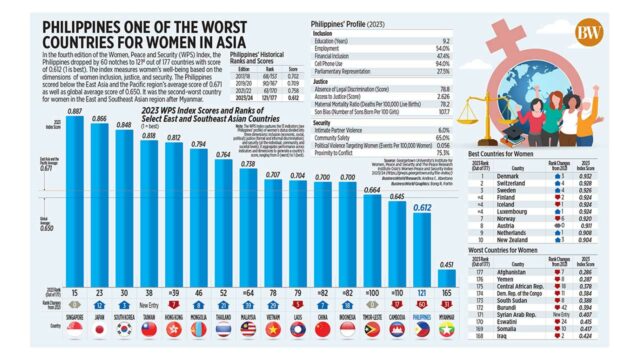
In the fourth edition of the Women, Peace and Security (WPS) Index, the Philippines dropped by 60 notches to 121st out of 177 countries with score of 0.612 (1 is best). The index measures women’s well-being based on the dimensions  of women inclusion, justice, and security. The Philippines scored below the East Asia and the Pacific region’s average score of 0.671 as well as global average score of 0.650. It was the second-worst country for women in the East and Southeast Asian region after Myanmar.


Philippines one of the worst countries for women in Asia

PH1 World Developers receives back-to-back real estate awards

PH1 World Developers earns the Real Estate Innovation of the Year by The Outlook 2023 Philippine Real Estate Awards by Lamudi.

PH1 World Developers (PH1WD) is making waves with back-to-back property development awards this September.

The company took home two top spots in this year’s Lamudi Philippines The Outlook 2023 Real Estate Awards. PH1 World Developers was named “Real Estate Innovator of the Year” for using “progressive building solutions to address the country’s housing backlog,” and “Best Boutique Developer in Luzon” for addressing the “specific aesthetic and functional needs of its clientele.”

Meanwhile, PH1WD projects also received awards for excellence in concept and design. My Enso Lofts, located in Timog, Quezon City, was recognized as “Best Loft Type Condominium” by Southeast Asian awards-giving body DOT Property Awards last Sept. 14.

PH1WD President Gigi Alcantara expresses her gratitude for My Enso Lofts’ Best Loft Type Condominium Development award by DOT Property Philippines Awards.

“We are honored by the support shown by our peers in property development as we pursue our mission to disrupt property development conventions in the Philippines,” said Gigi Alcantara, PH1WD President.

“These awards are a testament to the dedication of our incredible team and the belief of our clients and partners in our developments. We will continue to introduce innovative concepts to our properties and innovative engineering solutions to deliver extraordinary experiences for our customers,” she continued.

Extra Space at No Extra Cost

PH1 World Developers receives the Top 10 Developer of the Year award from BCI Asia Awards.

My Enso Lofts and Modan Lofts Ortigas Hills both feature PH1WD’s unique “Extra Space at No Extra Cost” offering made possible through the developer’s exclusive Add-Loft Technology that increases the total volume of livable space in condo units by up to 38% — at no extra cost to the buyer.

“Through this concept, we give more than extra space to our customers. We also give extra value to their investment thanks to the value-engineering capabilities of our parent company Megawide,” said Ms. Alcantara.

In July of this year, PH1WD was officially acquired by listed infrastructure developer Megawide Construction Corp., a strategic move for both parties that unlocks more possibilities in the areas of design, engineering and construction of vertical and horizontal projects.


Spotlight is BusinessWorld’s sponsored section that allows advertisers to amplify their brand and connect with BusinessWorld’s audience by enabling them to publish their stories directly on the BusinessWorld website. For more information, send an email to online@bworldonline.com.

Join us on Viber at https://bit.ly/3hv6bLA to get more updates and subscribe to BusinessWorld’s titles and get exclusive content through www.bworld-x.com.

Bargain hunting, rate concerns to drive trading

REUTERS

INVESTORS may pick up bargains in the coming days following the Philippine stock market’s recent decline, but worries over interest rates could continue to affect sentiment, with the US Federal Reserve’s policy decision also due this week.

The Philippine Stock Exchange index (PSEi) went down by 56.50 points or 0.93% to close at 5,961.99 on Friday, while the broader all shares index shed 19.55 points or 0.59% to end at 3,246.47.

Week on week, the PSEi dropped by 180.91 points or 2.95% from its close of 6,142.90 on Oct. 20.

“With already two consecutive weeks of decline, we may see bargain hunting [this] week. However, a strong rally may not yet be seen due to the downside risks that are still in play,” Philstocks Financial, Inc. Senior Research Analyst Japhet Louis O. Tantiangco in a Viber message.

“With the BSP (Bangko Sentral ng Pilipinas) now expecting inflation to take longer before falling within the 2-4% target, concerns that the high policy rates will be kept for a while, or possibly even raised further may weigh on market sentiment,” he said.

The BSP last week delivered an off-cycle 25-basis-point (bp) rate hike, as it warned inflation will remain above the 2-4% target until the middle of 2024.

The Monetary Board raised its target repurchase rate to 6.5%, the highest in 16 years, or since the 7.5% seen in May 2007. Rates on the overnight deposit and lending facilities were also raised by 25 bps to 6% (from 5.75%) and 7% (from 6.75%), respectively.

The BSP’s first policy move in seven months brought the cumulative rate increases since May 2022 to 450 bps.

“Investors are also expected to continue monitoring the developments on the US’ interest rates and the Israel-Hamas conflict. A rise in the US long-term Treasury yields and a worsening of the Israel-Hamas war may pull the market lower, while a decline in the yields and a de-escalation of the war is seen to boost sentiment,” Mr. Tantiangco added.

“We think that the market may test deeper support levels if it fails to bounce back to the critical 6,000 support level at the start of [this] week, especially as investors may continue to adopt a cautious stance given the upcoming Fed meeting,” China Bank Securities Corp. Research Associate Lance U. Soledad said in a Viber message.

Volume could be muted due to holidays this week, Mr. Soledad said.

For this week, online brokerage 2TradeAsia.com placed the PSEi’s support at 5,800-5,900 and resistance at 6,000-6,100.

“Chart-wise, of the market is able to get back above 6,000, it is expected to trade within the 6,000-6,150 range. If it fails to do so, however, the market is expected to trade within the 5,700-6,000 range,” Mr. Tantiangco said. — S.J. Talavera

Netherlands to send warship to patrol South China with Philippines next year

AN AERIAL VIEW of the BRP Sierra Madre at the contested Second Thomas Shoal on March 9, 2023. — REUTERS

By John Victor D. Ordoñez, Reporter

THE NETHERLANDS plans to send one of its warships to patrol the South China Sea with the Philippines, the Dutch Minister of Foreign Affairs said on Monday, amid worsening tensions between Manila and Beijing.

“We are planning to send a Dutch frigate in 2024 to the South China Sea to do its duty over there,” Dutch Minister of Foreign Affairs Hanke Gerdina Johannette Bruins Slot told a news briefing near Manila, the Philippine capital.

The Chinese Embassy in Manila did not immediately reply to an e-mail seeking comment.

“But we haven’t decided which ports it will embark on, but that’s part of the planning,” she added.

The Dutch foreign minister’s visit to the Philippines is the first in more than 30 years.

“Any expression of support from the international community, in this case the Dutch, strengthens Philippine position in the West Philippine Sea,” Jan Robert R. Go, an associate professor of political science at the University of the Philippines, said in a Facebook Messenger chat, referring to areas of the South China Sea within the country’s exclusive economic zone.

“Any additional support in the form of joint patrols would also augment our admittedly lacking capacity. However, this may also create greater anxiety on the part of the Chinese, especially if those Dutch vessels are militarily equipped,” he added.

He cited the need for caution to stop escalating tensions. “The last thing we want is a violent confrontation and China may not hesitate in responding once challenged.”

The Philippines would eye more joint patrols and freedom of navigation missions in the South China Sea after collisions with Chinese ships at Second Tomas Shoal, Jonathan M. Malaya, assistant director general of the National Security Council, said last week.
On Oct. 23, the country filed a diplomatic protest against China and summoned its envoy in Manila after the Oct. 22 collisions.

The Chinese Embassy in Manila said it had lodged stern representations to the Philippines over the “trespassing” of the Philippine vessels at Second Thomas Shoal.

China Coast Guard vessel 5203 collided with an Armed Forces of the Philippines-contracted indigenous resupply boat 13.5 nautical miles (25 kilometers) east-northeast of BRP Sierra Madre, the National Task Force for the West Philippine Sea said on Oct. 22.

A Chinese maritime militia vessel had also bumped a Philippine Coast Guard patrol vessel that was escorting the resupply mission about 6.4 nautical miles northeast of the shoal, it said.

“Both our countries are committed to upholding the international law of the sea, that’s why we will work jointly to build capacity concerning the content and relevance of the law of the sea,” Ms. Bruins Slot said.

“The Netherlands stands with the Philippines in the full observance of international law in the South China Sea,” she added, reiterating the Netherlands’ support for a 2016 arbitral ruling by a United Nations-backed tribunal in the Hague that voided China’s claim to more than 80% of the waterway.

The court ruled China had violated the Philippines’ sovereign rights in its exclusive economic zone by building artificial islands and failing to prevent its citizens from fishing in the zone.

China has ignored the ruling. Aside from the Philippines and China, Brunei, Malaysia, Taiwan and Vietnam also have claims to parts of the waterway.

Philippine Foreign Affairs Secretary Enrique A. Manalo told the same briefing the countries would also cooperate in increasing trade and investments, enhancing cyber-security and addressing the online exploitation of children.
“The Philippines and the Netherlands share the same unflinching commitment to the rules-based international order,” he said.  “The bilateral relations [have] always been anchored by our collaboration at sea, due to our common heritage as maritime nations.”

The Philippines’ top envoy said the two countries brought up ensuring the safety and security of more than 22,000 Filipino seafarers working in Dutch-owned and Dutch-flagged vessels around the world.

Ms. Bruins Slot said the Netherlands and the Philippines would explore investment deals with Dutch companies involved in agriculture and water management.

The Philippines and the Netherlands had also discussed the war between Israel and the Islamist Hamas militant group, she said, citing a need to pursue humanitarian solutions to the conflict.

Meanwhile, Philippine Ambassador to the Netherlands Jose Eduardo E. Malaya told reporters on the sidelines of the briefing the Philippine Department of Trade and Industry would also cooperate with the Dutch Ministry of Economic Affairs on business-to-business engagements.

“Both sides expressed a commitment to enhance economic engagements and they saw enormous potential here in the Philippines,” he said.

The ambassador cited the collaboration between San Miguel Corp. and Dutch company Royal Boskalis Westminster N.V., which is handling land development work for the New Manila International Airport project in Bulacan through its local unit Boskalis Philippines, Inc.

The P740-billion airport project started construction in 2021 and is expected to be completed by the end of next year.

“It is my hope that we take our relations to new heights in the decades to come and broaden the scope of our cooperation for the mutual benefit of our two nations and peoples,” Mr. Manalo said.

US may lose focus on South China Sea issue amid Israeli war vs Hamas, analysts say

PEOPLE react as Palestinians search for casualties at the site of an Israeli strike on a residential building in Gaza City, Oct. 25, 2023. — REUTERS

THE UNITED STATES risks losing focus on a belligerent China and the wider freedom of navigation issue in the Indo-Pacific region with its involvement in the wars between Israel and Hamas militants and between Russia and Ukraine, geopolitical analysts said.

This gives China room to consolidate its influence in the region, they said. 

Richard Heydarian, a senior lecturer at the Asian Center of the University of the Philippines, in a series of X posts doubted that the US could handle Israel’s war in Gaza, the Russia-Ukraine war and China’s aggression in the South China Sea simultaneously.

Chinese authorities “clearly believe that America is too distracted by conflicts elsewhere,” he said, days after the Chinese Coast Guard blocked a Philippine resupply mission to Second Thomas Shoal in the South China Sea that led to collisions between Chinese and Philippine vessels.

“It’s China, more than any other revisionist act, that cannot only challenge US primacy, but also literally pose an existential threat to key Asian allies,” Mr. Heydarian said.

He said the US had spent $61.4 billion (P3.5 trillion) and $14.3 billion for Ukraine and Israel — way bigger than the $2 billion allocated by Washington for the entire Indo-Pacific region.

The US embassy in Manila did not immediately reply to a Viber message seeking comment.

Hamas militants backed by a barrage of rockets stormed from the blockaded Gaza Strip into nearby Israeli towns, killing dozens and kidnapping others in an unprecedented surprise attack on Oct. 7.

DFA said a Filipina had sought the help of the Philippine Embassy in Tel Aviv after her Filipino husband was seen in one of the videos on social media of captives being rounded up by the militant Palestinian group.

Security experts also said US support for Israel, which has rejected calls for a ceasefire in Gaza after the Oct. 7 surprise attack by Hamas militants, and its veto of a United Nations (UN) resolution calling for a humanitarian pause in the war-torn Palestinian territory had eroded its credibility in the Global South, potentially weakening its influence on the Philippines.

The 193-member UN General Assembly last week passed a resolution drafted by a group of 22 Arab countries calling for a sustained and immediate “humanitarian truce” in Gaza amid Israel’s continued bombardment of the narrow strip, with the US and Israel leading 14 countries in rejecting the measure.

The Philippines was one of 45 countries that abstained.

Maria Thaemar C. Tana, an international relations assistant professor at the University of the Philippines Department of Political Science, said US support for Israel has largely been regarded as an obstacle to achieving peace and stability in the Middle East, with Washington accused of failing to advance calls for an Israel-Palestine peace process. 

“The declining US credibility in the Middle East due to its unwavering support for Israel could have indirect but significant implications for US-Philippines relations,” she said in a Facebook Messenger chat. “For one, it may raise questions about the dependability of US commitments and alliances.”

She noted that the US is seen prioritizing strategic interests over democracy and human rights, “leading to criticism of its inconsistent advocacy for liberal values.”

The US has played an important role in the push for human rights and democratic norms in the Philippines, whose human rights situation has been criticized by the international community amid the government’s deadly war on drugs.

If the US loses credibility in the Middle East, it may seek to rebalance its foreign policy priorities, “which could affect the allocation of resources, attention, and diplomatic efforts in other regions, including Southeast Asia [and the entire] Indo-Pacific region,” Ms. Tana said.

“Should Arab and Muslim countries read Washington’s swift and unequivocal support for Israel as a sign of partiality, it may undermine America’s role as an honest broker in the thorny dispute and open space for other mediators, not least its rival China,” Lucio B. Pitlo, a research fellow at the Asia-Pacific Pathways to Progress Foundation, said via Messenger chat.

“A major ground offensive in Gaza, especially if seen with the US blessing, will complicate America’s relations with Muslim countries from the Middle East to Southeast Asia,” he added.

Some Filipino Muslims held a protest in the Bangsamoro region in southern Philippines this month, condemning Israel’s attack on Gaza. They also likened the Palestinian cause to the Bangsamoro’s struggle in Mindanao.

More than 7,000 people have died in Gaza, and the death toll continues to rise as Israel pounds the strip with airstrikes, according to Palestinian authorities.

A ground invasion of Gaza has become more imminent after the Israeli military issued an “urgent plea” at the weekend for Palestinians to head south immediately as it vowed to neutralize Hamas militants.

Amid the conflict, China has tried to present itself as a mediator, calling for a two state-resolution. Its Foreign Ministry has cited the “historical injustices” committed against Palestinians.

“Any action America does here that continues to coddle Israel will provoke resentment [in the Philippines],” with pro-China blocks “politicizing anything that America does as a provocation,” said Hansley A. Juliano, who teaches political science at the Ateneo de Manila University.

“Within the government, we might see a secret consensus to not say anything to rock the boat given our security ties with the US, even at the expense of our credibility in maintaining global human rights standards,” he added. — Kyle Aristophere T. Atienza

ADVERTISEMENT
ADVERTISEMENT