Home Blog Page 4082

Actual export sales, leads generated by trade shows valued at $970 million

ANUGA.COM

THE Department of Trade and Industry (DTI) said trade shows and other export promotion activities generated around $970 million in booked sales and leads in the first nine months.

A report issued by the DTI’s Export Marketing Bureau (EMB) indicated that the DTI participated in 36 trade promotion events in the first nine months.

“The $970-million export sales were either booked with purchase orders or are still under negotiation,” according to Bianca Pearl R. Sykimte, EMB director.

Among the recent activities of the department is the Natural Products Expo East (NPEE) 2023, where coconut exporters generated $26.08 million.

Participants included Francoeur Merchandising, Lionheart Farms Philippines Corp., Magicmelt Foods, Inc., Mardak Global Export, Inc., Pasciolco Agri Ventures, Philippine Craft Distillers, Inc., Tongsan Industrial Corp., and Marigold Manufacturing Corp.

“The delegation was able to conduct 104 business-to-business (B2B) meetings during NPEE 2023 and another 12 B2B meetings with major suppliers in the US east coast,” the DTI said.

The EMB also participated in the Manila FAME 2023, which ran from Oct. 19 to 21, where it generated $3.79 million in preliminary export sales.

The Chamber of Mines of the Philippines (CoMP) 19th Mining Philippines International Conference and Exhibition generated for seven coconut-focused companies P17.29 million in initial export sales.

At the Anuga Germany 2023, 10 Philippine coconut exporters tallied $10.98 million in initial sales.

The delegation to Germany included AG Pacific Nutriceuticals Corp., Ahya Coco Organic Manufacturing Corp., Amazing Foods Corp., Cocoplus Aquarian Development Corp., Dignity Products and Services, Inc., Greenlife Coconut Products Philippines, Inc., Pasciolco Agri Ventures, Tongsan Industrial Development Corp., Tropicana Food Products, Inc., and Wellnesscare International Corp.

An EMB-organized delegation tallied $46 million in firm and under-negotiation sales at the External Development Summit in Canada. — Justine Irish D. Tabile

Are satellite airtime fees taxable in the Philippines?

The tax system operates on the territoriality principle. This means that the power of the government to tax is limited within the territorial bounds of the Philippines. This rule emphasizes the importance of establishing a situs within the Philippines before income can be taxed. So, what happens when part of the source of income is located in outer space? Does the Philippines have any right to tax such income generating activities? Turns out that the answer is yes.

In the case of Aces Philippines Cellular Satellite Corp. v. CIR (G.R. No. 226680), the Supreme Court ruled that income payments made to a nonresident foreign corporation (NRFC) for satellite airtime fees are taxable within the Philippines.

In this case, Aces Bermuda, a nonresident foreign corporation, entered into an agreement with Aces Philippines in which Aces Bermuda sells satellite communications time to Aces Philippines, which in turn would have the exclusive right to distribute these services to Philippine subscribers. The BIR assessed Aces Philippines for failure to withhold taxes on income payments to Aces Bermuda. Aces Philippines, however, argues that such income is sourced outside of the territorial jurisdiction of the Philippines and therefore should not be subject to withholding tax.

Aces Philippines explained that the satellite system is primarily composed of three pieces of infrastructure:

1. Garuda 1, a communications satellite in outer space operated by Aces Bermuda;

2. Network Control Center in Indonesia owned by Aces Bermuda; and

3. Gateways within the Philippines owned by Aces Philippines.

Aces Philippines further explained the process by which a call is made through the satellite system. First, the satellite receives the call and then beams it to the Network Control Center in Indonesia which would determine the exact Philippine gateway the call is to be routed to. Second, the Philippine gateway then receives the call. Aces Philippines argues that the income generating activity of Aces Bermuda is restricted to the first and second steps of the process.

In short, Aces Philippines asserts that the services of Aces Bermuda only contemplate the determination of which Philippine gateway should be used in receiving the call and transmitting the signal to the gateway. Since the services are performed in outer space and in Indonesia, Aces Philippines argued that these operations are outside the taxing jurisdiction of the Philippines.

The Supreme Court, however, rejected the argument and ruled that in determining the income generating activity of Aces Bermuda, the process should be taken as a whole rather than piecemeal due to the interconnected nature of the satellite, the network control center, and the gateways. At the point of transmission, Aces Philippines has not been given access to the Aces System yet. It is only when the call is routed to its gateway located in the Philippines that Aces Philippines is able to connect its subscriber to the intended recipient of the call.

In this sense, the gateway’s receipt of the call signifies completion or delivery of Aces Bermuda’s services. Furthermore, the agreement between Aces Philippines and Aces Bermuda shows that Aces Bermuda only charges Aces Philippines once the call is received by the gateway and utilized by the Philippine subscriber. Evidently, the income-generating activity of Aces Bermuda is the receipt of the call rather than mere transmission. Since the receipt of the call occurs in gateway infrastructures located within the Philippines, the income should be subject to Philippine income tax.

In order to further support its position, Aces Philippines argued that Aces Bermuda maintains no equipment nor owns any infrastructure within the Philippines. Aces Philippines argued that situs denotes a concept of some physical presence or some tangible and visible activity. Since Aces Bermuda does not own the gateways located inside the Philippines, there is no physical presence within the Philippines.

The Supreme Court likewise rejected this argument, ruling that the fact that Aces Bermuda does not own the gateways is of no moment. It cannot be denied that the gateways were constructed primarily to serve the needs of the Aces system. Furthermore, the agreement between Aces Philippines and Aces Bermuda shows that it was Aces Bermuda that provided the necessary equipment and software to enable Aces Philippines to construct the gateways in the first place. In short, the Supreme Court ruled that even though Aces Bermuda does not own the gateways located in the Philippines, Aces Bermuda has sufficient economic and beneficial interest in these Philippine properties, inasmuch as its Philippine operations depend on those facilities.

ACES V CIR AND IT SERVICE PROVIDERS
Due to the promulgation of Aces v. CIR, some Revenue Officers have started to use the case as a legal basis to justify the imposition of income tax on Information Technology (IT) services rendered by NRFCs outside of the Philippines. This, however, should not be the case since the circumstances of IT service providers are different from those of satellite service providers.

In the case of Aces v. CIR, the Court ruled that the income-generating activity is partially conducted within the Philippines. In order for Aces Bermuda to render its services, it had to utilize gateway infrastructure located within the Philippines. Even if Aces Bermuda operated the satellite in outer space and the Network Control Center in Indonesia, it could not provide its services completely outside of the Philippines because it needs the terrestrial gateways that will receive the signal from the satellite. Since the income generating activity is only completed when received by the gateway in the Philippines, the Court ruled that the situs of the income was in the Philippines and therefore, subject to tax.

The above circumstances, however, are not present in IT services rendered outside of the Philippines by NRFCs. Examples of IT services are help desk support, cloud services, backup and disaster recovery, network security, software and hardware development, among others. These IT services are normally conducted remotely and outside of the Philippines’ territorial limits. The IT service providers do not normally require the construction, utilization, and maintenance of infrastructure within the Philippines for them to render their IT services. Evidently, when it comes to IT services, the provision of such service is completed wholly outside of the Philippines. There is no need for specialized equipment located within the Philippines to complete the services. Therefore, the circumstances of IT services provided by NRFCs are not similar to the circumstances in the Aces case.

As the Court elucidated in the case of Saint Wealth Ltd. v. BIR (GR No. 252965), what is important in determining whether an activity could be subjected to Philippine tax laws is whether the revenue-generating activity occurs within the Philippines. In IT services, it is evident that the income generating activities of NRFCs providing IT services are outside of the Philippines. As discussed above, no portion of such activities could be said to have occurred within the territorial bounds of the Philippines.

At first glance, it would seem that the case of Aces v. CIR allowed for the extraterritorial application of the tax laws of the Philippines. However, a more careful reading of the case reveals that this is not true. The Supreme Court was able to establish the situs within the Philippines that would warrant the application of Philippine tax laws to Aces Bermuda.

Let’s Talk Tax is a weekly newspaper column of P&A Grant Thornton that aims to keep the public informed of various developments in taxation. This article is not intended to be a substitute for competent professional advice.


Nolan Redji D. Domingo is an associate of the Tax Advisory & Compliance Practice Area of P&A Grant Thornton. P&A Grant Thornton is one of the leading audits, tax, advisory, and outsourcing firms in the Philippines, with 29 Partners and more than 1000 staff members.

Tweet us: @GrantThorntonPH

Facebook: P&A Grant Thornton,

pagrantthornton@ph.gt.com

www.grantthornton.com.ph

64 Filipinos to come home from Israel this week

A view shows houses and buildings destroyed by Israeli strikes in Gaza City, Oct. 10, 2023. — REUTERS

By John Victor D. Ordoñez, Reporter

SIXTY-FOUR migrant Filipino workers are expected to come home from Israel this week, the Department of Migrant workers (DMW) said on Monday, amid the worsening war between Israel and the Palestinians Islamist group Hamas.

In a statement, the agency said 22 overseas Filipino Workers (OFW) — 19 caregivers and three hotel workers — were scheduled to arrive in the Philippines on Monday afternoon.

The group is the fifth batch of Israel-based Filipino migrant workers to come home. A sixth batch of 42 OFWs will return to the Philippines on Tuesday, it added.

The body of one of the four Filipino caregivers killed during the conflict was to be brought back by her sister on Monday, the DMW said.

The two groups will bring the total number of OFWs repatriated to 184.

“The DMW expects more returning OFWs as hostilities between Israel’s Defense Forces and Hamas show no signs of toning down in the coming weeks,” it said.

The first batch of 15 Filipino caregivers and a month-old infant from Israel arrived in the Philippines on Oct. 18.

Israel launched extensive airstrikes in Gaza after Hamas militants backed by a barrage of rockets stormed from the blockaded Gaza Strip into nearby Israeli towns, killing 1,400 people, mostly civilians, in a surprise attack on Oct. 7

The country also enforced a blockade and deployed tens of thousands of Israeli troops for a ground assault on the Palestinian enclave.

The Philippine Department of Foreign Affairs (DFA) on Sunday said attacks along the route to the Rafah Border Crossing have delayed the evacuation of about 20 Filipinos to Egypt.

Foreign Affairs Undersecretary Jose Eduardo A. de Vega said in a WhatsApp message on Sunday his office had yet to confirm who was behind the attacks.

“There are conflicting stories so we cannot confirm anything,” he said. “All we wish to emphasize is that so far, our countrymen in Gaza are uninsured, but we wish them to be able to cross as soon as possible.”

The Philippine envoy said all 136 Filipinos in Gaza have been allowed to leave the strip after the Rafah border crossing opened last week.

As many as 500 foreign nationals, including two Filipino doctors and several injured Palestinians would be allowed to leave the enclave.

President Ferdinand R. Marcos, Jr. on Nov. 3 told reporters Israel Foreign Minister Eli Cohen had committed to ensure the immediate evacuation of Filipinos trapped in the conflict.

About a third of more than 30,000 Filipinos in Israel live in Tel Aviv, according to the Overseas Workers Welfare Administration. A fifth live in the central district, 12% live in Israel’s third-largest city Haifa and 6.4% are from the northern district.

A tenth of the Filipinos live in the capital Jerusalen, while 5.3% live in the southern district, near Gaza.

Nine of 10 Filipinos in Israel work as caregivers, 8% are permanent residents, 497 are student-interns and 19 are tourists.

Israel is still under Alert Level 2, while Gaza is under Alert Level 4 for forced repatriation.

More than 10,000 Palestinians have died since the war started last month, according to Gaza’s Health Ministry.

Mr. De Vega on Sunday told ABS-CBN Teleradyo the Philippine Embassy in Egypt was trying to convince some Filipinos to cross to safety as the Israeli government was still undecided on whether to allow their Palestinian spouses to also leave Gaza.

“It is better now that there is permission to cross,” Mr. De Vega said. “They will still be able to return to their spouses after the war,” he added.

Marcos orders military to maximize use of troops amid geopolitical tensions

PPA POOL PHOTO

By Kyle Aristophere T. Atienza, Reporter

PHILIPPINE President Ferdinand R. Marcos, Jr. on Monday ordered the Department of National Defense (DND) and Armed Forces of the Philippines (AFP) to review security strategies and maximize the deployment of forces amid geopolitical challenges.

“As we move now from focusing on ensuring internal security for the country, we now have to bolster the country’s external defenses,” he said at the 67th anniversary of the Naval Special Operations Command (Navsocom) in Cavite province south of the Philippine capital.

“I exhort the DND and the AFP to maximize and strategically review the deployment of our forces to ensure that their strategies remain responsive to the current and future geopolitical realities,” he added.

The President said the military must harness the skills of specialized units in preparing for all contingencies. The naval command’s expertise in sea, air and land should be used to support naval defense and enhance maritime security, he added.

Navsocom, an elite unit of the Philippine Navy, has helped the government against smuggling and other illegal activities at sea, he said.

The Philippines has been boosting defense ties with its allies including the US, Japan and Australia amid worsening tensions with China.

Mr. Marcos is on the right track to pursue security ties with allies to deter Chinese aggression in the South China Sea amid opposition from minority lawmakers and militant groups, political analysts said.

The geopolitical landscape has changed, with an increasingly belligerent China as well as authoritarian threats including from one-man state North Korea, they added.

“These people are still thinking that the world has not become what it is right now,” Antonio P. Contreras, who used to teach political science at De La Salle University in Manila, said by telephone. “Even if the Philippines wants to stay out of any conflict, it will always be implicated because we are strategically located. And China is getting bolder and bolder.”

The Philippines and Japan have agreed to start talks on a reciprocal troop access deal, strengthening military cooperation amid rising maritime tensions in the region and an increasingly assertive China.

Japanese Prime Minister Fumio Kishida, who visited Manila at the weekend, said Mr. Marcos and he had agreed to work together closely with the United States and, in a veiled reference to China, shared concern about “unacceptable” attempts to “unilaterally change the status quo by force” in the East and South China Seas.

‘PACIFIST STANCE’
Senate President Juan Miguel F. Zubiri at the weekend said they would ratify the Philippine-Japan deal.

But Senate Minority Leader Aquilino Martin “Koko” L. Pimentel III and some minority congressmen said the Philippines should never allow itself to become a base of any foreign military.

The senator noted amid discussions on the proposed military accord, which is similar to the Philippines’ status of visiting forces agreement with Australia and visiting forces agreement with the US, there has been no talk of whether Filipino troops would be allowed to stay in Japan.

Bagong Alyansang Makabayan (Bayan) accused Washington of making the Philippines “a staging ground” for its military in Asia.

“The US keeps telling the Philippines that they are here for our security. That’s a fake claim, if ever there was one,” it said in a statement, as it opposed the joint naval drills among the Philippines, US, Japan and South Korea set for Nov. 9. The United Kingdom will observe the drills.

Hansley A. Juliano, who teaches political science at the Ateneo de Manila University, said Bayan and its allies such as the Makabayan bloc in Congress are “ideologically committed to their belief that any foreign presence involving the US is an imposition of their neocolonial power.”

“That is predictable, expected and perhaps grounded in the historical past,” he said in a Facebook Messenger chat.

The three-year Philippine-American war that started in 1899 killed more than 4,000 Americans and more than 20,000 Filipino combatants, according to the US State Department, adding that as many as 200,000 Filipino civilians “died from violence, famine and disease.”

“These injuries will continue to cast a cloud on the goodwill of the American presence here. They (critics) have the right to keep raising criticisms and opposition in this vein,” Mr. Juliano said. But these critics have failed to provide a solution beyond asserting an “independent foreign policy.”

“The pacifist stance can only be sustained when it is backed by deterrence to war. We are already surrounded by China and our neighbors in ASEAN (save perhaps Vietnam) are inconsistent about how to stand up to China,” he added.

While the Philippines should have an independent foreign policy, “it needs a good number of sticks and carrots” to get what it wants, Joshua Bernard B. Espeña, who teaches foreign relations at the Polytechnic University of the Philippines, said in a Facebook Messenger chat.

“The logic of the Filipino struggle and the danger of becoming a battleground is an inherent risk for any country willing to defend it,” he added.

Mr. Espeña said left-leaning groups’ opposition to the modernization of the Philippine military “under the pretext of militarization of politics jeopardizes its “very interest in staving off external powers in our waters.”

Aside from the South China Sea dispute, the region also must deal with tensions in the Taiwan Strait. Nuclear threats from North Korea also continue to hound the Korean Peninsula.

Opposition to the Philippines’ security alliance with the US — Manila is a treaty ally of Washington — is nothing new. The Senate in 1991 rejected the renewal of the lease of Philippine military bases to the US.

This led to the dismantling of an American air base in Clark, Pampanga and a US naval base in Subic, Olongapo. The two sites have since been converted into economic hubs.


Senate OK’s bill promoting ‘world-class’ Philippine products

THE PHILIPPINE Senate on Monday approved on final reading a bill that seeks to boost the competitiveness of Philippine products, especially those made by small enterprises.

Senators approved Senate Bill 2426 or the Tatak Pinoy Strategy Act, which was authored and sponsored by Senator Juan Edgardo “Sonny” M. Angara. The measure seeks to make Filipino-made products comparable to its foreign counterparts.

The bill will set up a council that will oversee government initiatives to aid local enterprises as part of the government’s push to cut the country’s reliance on imports.

The body will be co-headed by the secretaries of Trade and Finance departments and the National Economic and Development Authority. It will also have members from the private sector.

Under the bill, domestic products will be prioritized in government procurement.

The measure aims to expand the capacities of micro, small and medium enterprises to produce world-class products to boost exports.

In June, Marikina Rep. Stella Luz A. Quimbo filed a similar bill before the House of Representatives seeking to “systematically expand” the productive capabilities of local businesses for export.

House Bill 8525 seeks to maximize the benefits of global trade agreements such as the Regional Comprehensive Economic Partnership (RCEP).

The Philippines has an unrealized export potential of $49 billion (P2.7 billion), the International Trade Center said in a study last year.

Mr. Angara has said the measure would help the Philippines achieve its goal of becoming a middle-class economy by 2040.

He said the bill would allow local business owners to boost income by producing more sophisticated products.

In August, NEDA Secretary Arsenio M. Balisacan told senators the state plans to raise domestic production this year, adding that it is temporarily resorting to imports to stabilize prices.

“Supporting domestic industries and hastening the process of transforming the Philippine economy demands that stakeholders from the public and private sectors organize, plan, align and integrate their respective efforts,” Mr. Angara said in his sponsorship speech on Aug. 29.

“For true economic development to happen, it needs to be pursued collectively and collaboratively by all sectors of society.” — John Victor D. Ordoñez

Int’l community deplores killing of Filipino radio broadcaster

THE PHILIPPINE National Police released on Monday this composite sketch of the killer of radio commentator, Juan T. Jumalon, who was gunned down during his live broadcast last Sunday in Calamba, Misamis Occidental. — PNP

AMBASSADORS of western democracies, including the European Union, France, the United Kingdom (UK), and Germany, have strongly condemned the killing of a Filipino radio commentator during his live broadcast in Misamis Occidental last Sunday and called for an end to all forms of impunity in the Philippines.

Radio broadcaster Juan T. Jumalon, 57, died on the spot after being shot in the head while broadcasting in his home-based radio station, 97.4 Gold FM, in the town of Calamba, Misamis Occidental.

Journalists must be able to “do their job free of violence,” UK Ambassador to the Philippines Laure Beaufils said in an X post, noting that a “free media is the cornerstone of democracy.” “I am shocked by the murder of Juan Jumalon. I call on the (Philippine) authorities to bring the perpetrators to justice promptly,”

French Ambassador Marie Fontanel of France said a “constant fight against impunity is the only way” to protect journalists, lawyers or human rights defenders and “secure democracy based on the rule of law.”

“Free and independent journalism is the basis of a vibrant and lively democracy. Impunity must not be tolerated,” German Ambassador Andreas Pfaffernoschke said.

On Monday, the Philippine National Police (PNP) released a computer-generated image of the gunman who shot and killed Mr. Jumalon, who used “Johnny Walker” as his name in his radio programs.

Interior Secretary Benjamin “Benhur” Abalos said the newly created Special Investigation Task Group (SITG) that is tracking down the perpetrator has been named “SITG Johnny Walker” and stressed upon the PNP President Ferdinand R. Marcos’ order to bring the culprit to justice.

Brig. Gen. Ricardo G. Layug, Jr., director of the Police Regional Office 10 based in Cagayan de Oro City, said local case investigators are looking into four possible motives behind the murder but declined to give details.

The Philippines has remained on the Committee to Protect Journalists’ (CPJ) list of countries where killings of journalists go unpunished.

In the CPJ’s 2023 Global Impunity Index, the Philippines ranked eighth. The country lagged behind Myanmar but was ahead of Mexico

The index took into consideration the deliberate killings of journalists in relation to their work from Sept. 1, 2013 to Aug. 31, 2023. Manila’s death toll increased to 20 this year from 14 last year, it noted.

“While Ferdinand Marcos Jr. has adopted a more conciliatory approach toward the media since becoming president in June 2022, CPJ reported that a culture of self-censorship persists and Marcos’ change in tone has not yet been accompanied by substantive actions to undo the damage wrought to press freedom under the Rodrigo Duterte administration,” it said.

Meanwhile, a coalition of 52 countries across the world advocating for media freedom raised serious concerns about the murder of Mr. Jumalon and welcomed the commitment of Philippine authorities to bring the perpetrators to justice.

In a statement, the Media Freedom Coalition said it is crucial for the government to pursue a swift and transparent investigation “to prevent the chilling effect such violence can have on the ability of journalists to report news freely and safely.”

It also urged the Philippine government to “take further actions to create a safe environment for journalists to carry out their work without fear for their lives and safety, and to address impunity for crimes against them.” — Kyle Aristophere T. Atienza and John Felix M. Unson

Japan pledges seen to create jobs

REUTERS

THE COUNTRY’S labor sector is hopeful that Japan Prime Minister Fumio Kishida’s commitment to support infrastructure projects in the Philippines will usher in foreign investments and spur job creation.

In a statement on Sunday, the Trade Union Congress of the Philippines (TUCP) welcomed Japan’s pledge to aid in the country’s defense and economic recovery. “Prime Minister Kishida’s state visit will signal an intensified focus on bringing in Japanese foreign direct investments as well as reinvigorated official development assistance,” TUCP president and House Deputy Speaker Raymond Democrito C. Mendoza said.

“More foreign investments translate to hundreds of thousands of new, permanent, and decent jobs with security of tenure and living wages,” he added.

Mr. Kishida had said Japan will continue supporting the Marcos administration’s Build, Better, More program on infrastructure, including the Dalton Pass (a mountain pass in Central Luzon), and the Metro Manila Subway.

Mr. Mendoza said the TUCP hopes that the development assistance from Japan will also cover the proposed national railway system which will connect regional and provincial agro-industrial hubs to “further create new jobs, ensure food security, [and] decongest urban metropolitan areas by promoting rural development.” — Jomel R. Paguian

Senate probes crime-linked POGOs

SENATE.GOV.PH

THE SENATE Committee on Women will investigate Philippine Offshore Gaming Operations (POGO) at a building in Pasay City that was shut down by the local government last Friday due to human trafficking and other crimes.

“The Committee on Women will also conduct an ocular inspection of the building on Friday (Nov. 10) to understand the scale of the problem,” said Senator Ana Theresia N. Hontiveros-Baraquel, who noted that “Pasay police officers were either negligent or complicit” in covering up for the POGOs.

Colonel Jean S. Fajardo, Philippine National Police (PNP) spokesperson, said over the weekend that the Pasay City police chief and 27 other police officers had been relieved from their posts due to the nefarious activities at the POGO hub.

On Monday, Senator Sherwin T. Gatchalian filed a resolution seeking to probe the involvement of criminal syndicates within the POGO firms.

Mr. Gatchalian said that the numerous reports of human trafficking victims from these POGO from points to organized crime groups operating within these outfits.

“These syndicates have already corrupted our enforcers enabling them to operate freely even beside the police station,” he said.

The Presidential Anti-Organized Crime Commission earlier this month discovered torture devices and rescued a total of 731 suspected human trafficking victims from the Pasay POGO hub. — John Victor D. Ordoñez

Bids on for P2.5-B Clark project

THE BASES Conversion and Development Authority (BCDA) announced on Monday that it is now inviting bids for the commercialization of the information and communications technology (ICT) infrastructure in New Clark City.

“Given that the services involved in the commercialization of passive ICT infrastructure are not typically provided by the public sector, the BCDA is looking for a joint venture partner that has expertise in this field,” the notice said.

A document from the BCDA showed that the projected total cost of the project over the joint venture term — that is 25 years and extendable for a period of 10 years — is approximately P2.5 billion.

The project will be undertaken through a joint venture and involves the commercialization, expansion, repair and maintenance of BCDA’s passive ICT infrastructure.

The pre-qualification conference for the project will be held on Nov. 14 at the Asian Development Bank.

It will cover the passive conduits, fiber optic cables, chambers, and colocation facilities, among others, located in New Clark City which is envisioned to be “a smart, green, and disaster-resilient city.”

It also includes the last mile connection direct to home or office up to the network termination point within the lettable area of a building.

To participate in the bidding process, interested parties need to submit a letter of intent prior to purchasing the Instructions to Private Sector Participants Volume 1 – Forms and Annexures for a non-refundable fee of P250,000.

The BCDA set the final date of submission of eligibility requirements on Dec. 18. — Justine Irish D. Tabile

Mindanaoans back new DA chief

New Agriculture Secretary Francisco Tiu Laurel Jr. (left) tells media that his priority is to increase food production and modernize agriculture. Joining him at Monday’s media conference at the DA Office in Diliman, Quezon City was DA Senior Undersecretary Domingo F. Panganiban. — PHILIPPINE STAR/JESSE BUSTOS

COTABATO CITY — Mindanaoans on Monday gave newly appointed Agriculture Secretary Francisco Tiu Laurel, Jr. their vote of confidence, expecting him to complement their efforts to empower the agriculture and fisheries sectors in the six Bangsamoro provinces in the south.

Two members of the 80-seat Bangsamoro regional parliament, Hadji Nabil A. Tan and Kadil M. Sinolinding, Jr., separately told reporters Monday that they look forward to Mr. Laurel’s capability to help strengthen agro-fisheries in the region.

The Bangsamoro Autonomous Region in Muslim Mindanao’s (BARMM) regional planners said at least 75 percent of the residents in the six BARMM provinces, Maguindanao del Norte, Maguindanao del Sur, Lanao del Sur, Basilan, Sulu and Tawi-Tawi, rely mainly on farming and fishing to generate income needed to sustain their families.

A bill for agricultural modernization was recently filed before the Bangsamoro parliament.

Governors Jim H. Salliman of Basilan, Mamintal A. Adiong, Jr. of Lanao del Sur, and Emmylou T. Mendoza of Cotabato also expressed confidence in the President’s choice as Agriculture chief and vowed for Mr. Laurel’s leadership.

“I know Secretary Laurel will reach out to the farming and fishery sectors in my province, where we have thousands of constituents engaged in daily fishing activities in Lake Lanao and in propagation of short-term crops as means of livelihood,” Mr. Adiong said.

“We are convinced that Secretary Laurel will open widely to Bangsamoro residents the door to his office. While we now have regional autonomy and an agriculture ministry, we still need to remain connected with the central office of the Department of Agriculture,” Mr. Sinolinding said.

“We shall willingly support his leadership in that department,” said Ms. Mendoza, who has jurisdiction over Kidapawan and 17 largely agricultural towns in Region 12. — John Felix M. Unson

UN urged to check rights violations

REUTERS

FISHERFOLK and environmental groups urged the United Nations (UN) on Monday to conduct an impartial investigation into reports of environmental and human rights violations under the Marcos administration.

The call was made by such groups as the Pambansang Lakas ng Kilusang Mamamalakaya ng Pilipinas (PAMALAKAYA) and the Kalikasan People’s Network for the Environment as UN special rapporteur Ian Fry was due in Manila for a state visit from Nov. 6 to 15.

Fry is set to examine the impacts of climate change on human rights and the protection of environmental human rights defenders.

“The UN expert’s visit is timely especially in the face of worsening impacts of climate change and how it fuels human rights abuses in the grassroots communities,” PAMALAKAYA national chairperson Fernando Hicap said, citing how environmental activists who defend Manila Bay from the ongoing reclamation projects now face cases of abduction and judicial harassment.

Aside from human rights violations linked to the Manila Bay reclamation, indigenous groups are threatened by state-sanctioned projects encroaching on their land, Kalikasan national coordinator Jon Bonifacio said in an interview.

“We hope that the UN initiative will shed light on the situation the people on the ground face, as we understand it to be truly grave,” he said. — Jomel R. Paguian

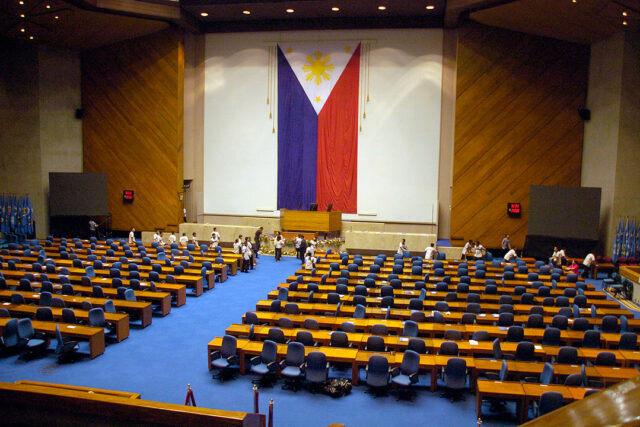
House asserts ‘integrity and honor’ against Duterte remarks

BW FILE PHOTO

THE HOUSE of Representatives adopted on Monday a resolution to defend its “integrity and honor” amid former president Rodrigo R. Duterte’s scathing remarks about congressmen after they voted to strip his daughter, Vice President Sara Duterte-Carpio, of her office’s confidential funds for next year.

In adopting House Resolution (HR) No. 1414, the Chamber expressed solidarity and support for the leadership of Speaker Ferdinand Martin G. Romualdez.

Mr. Duterte described the House as the “most rotten institution” in the country after congressmen on Oct. 10 stripped several agencies including the Office of the Vice President and the Education department of their confidential funds, transferring P1.23 billion worth of these budgets to security agencies amid worsening tensions with China.

“The one who uttered that word is our chairman from PDP-Laban… the former President Rodrigo Roa Duterte,” said House Senior Deputy Speaker and Pampanga Rep. Aurelio D. Gonzales, Jr., immediately after stepping down as a member of Mr. Duterte’s party, Partido Demokratiko Pilipino-Lakas ng Bayan (PDP-Laban).

In a rare occurrence, the House plenary was constituted into one whole committee to act on the resolution.

“The House has always taken criticisms as part and parcel of a healthy, vibrant, and working democracy, but it takes exception to statements made that undermine the independence, integrity and reputation of the institution,” the congressmen said in HR 1414.

Representatives from parties PDP-Laban, National Unity Party, Nacionalista, Lakas-CMD, Nationalist People’s Coalition, Party-list Coalition Foundation, Inc., also gave their statements to support to Mr. Romualdez.

The resolution also cited that the Chamber prioritizes the safety and security of House members.

Party-list Rep. France L. Castro filed a grave threat complaint against Mr. Duterte on Oct. 24 after he allegedly threatened to kill her in a TV interview.

Mr. Duterte said he had told his daughter to say that she would use her intelligence funds to kill Maoists in Congress, including Ms. Castro. “Your first target in your intelligence fund is France, the communists, whom you want to kill,” he said in Filipino.

Mr. Duterte also accused Mr. Romualdez of orchestrating political attacks against her daughter, whom he described as a “good candidate” for the presidency. — Beatriz Marie D. Cruz

ADVERTISEMENT
ADVERTISEMENT