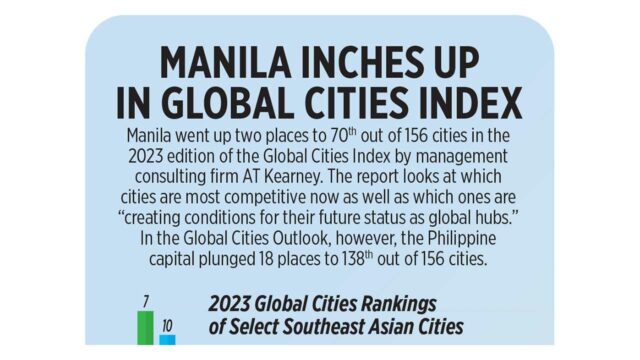
Manila inches up in Global Cities Index
PHILIPPINE SHARES climbed on Monday after the peso closed at the P55-per-dollar level for the first time in three months and as the market awaits the release of inflation and gross domestic product (GDP) data this week.
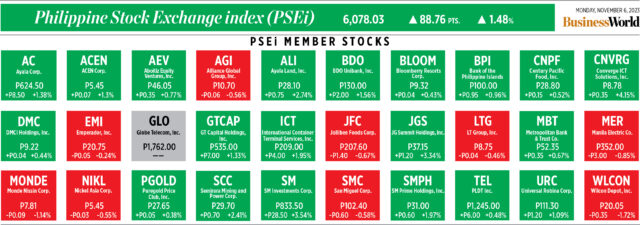
The Philippine Stock Exchange index (PSEi) went up by 88.76 points or 1.48% to close at 6,078.03 on Monday, while the broader all shares index rose by 29.10 points or 0.89% to end at 3,292.15.
“The PSEi has risen for the third consecutive time as the peso strengthened against the dollar, now trading below the P56 level. This is driven by diminishing expectations of another US Federal Reserve rate hike following last week’s rate pause,” Unicapital Securities, Inc. Senior Equity Research Analyst Carlos Angelo O. Temporal said.
The peso closed at P55.91 a dollar on Monday, rising by 19 centavos from Friday’s P56.10 finish, data from the Bankers Association of the Philippines’ website showed.
This was the peso’s best close in more than three months or since it finished at P55.74 on Aug. 4.
“Following the holiday break last week, the local bourse surged… due to the strong Philippine manufacturing PMI (purchasing managers’ index) data and a drop in US long-term Treasury yields,” Philstocks Financial, Inc. Research Analyst Claire T. Alviar said in a Viber message.
“Upcoming economic data releases including but not limited to inflation rate and GDP growth rate, which are both expected to be better than the previous report helped lift the market,” Ms. Alviar added.
The Philippine Statistics Authority will release October inflation data on Tuesday and the third-quarter GDP report on Thursday.
A BusinessWorld poll of 13 analysts yielded a median estimate of 5.7% for October headline inflation, within the 5.1-5.9% forecast of the Bangko Sentral ng Pilipinas.
Meanwhile, a separate poll of 17 economists and analysts last week yielded a median estimate of 4.9% for third quarter GDP growth, faster than the preliminary 4.3% expansion recorded in the second quarter.
If realized, this would bring the nine-month GDP growth average to 5.2%, still below the government’s 6-7% full-year target.
Almost all sectoral indices went up on Monday, except for industrials, which declined by 2.50 points or 0.02% to 8,495.78.
Holding firms climbed by 126.43 points or 2.2% to 5,853.91; property went up by 43.68 points or 1.71% to 2,590.31; financials rose by 17.55 points or 1.03% to 1,721.71; services increased by 13.72 points or 0.92% to 1,490.66; and mining and oil added 87.12 points or 0.88% to end at 9,894.27.
Value turnover went up to P4.02 billion on Monday with 323.74 million shares changing hands from the P3.76 billion with 301.35 million issues seen on Friday.
Advancers narrowly outnumbered decliners, 87 versus 86, while 51 shares closed unchanged.
Net foreign selling went down to P172.65 million on Monday from P506.65 million on Friday. — S.J. Talavera
THE PESO ended at the P55-a-dollar level for the first time in three months on Monday amid expectations of strong gross domestic product (GDP) growth last quarter.
The local unit closed at P55.91 per dollar on Monday, strengthening by 19 centavos from its P56.10 finish on Friday, based on Bankers Association of the Philippines data.
This was the peso’s best close in more than three months and was the first time it ended at the P55 level since its P55.74-per-dollar finish on Aug. 4.
The peso opened Monday’s session at P55.80 against the dollar. Its weakest showing was at P55.93, while its intraday best was at P55.73 versus the greenback.
Dollars exchanged dropped to $1.15 billion on Monday from $1.84 billion on Friday.
“The peso appreciated amid market views of a potential rebound in the third-quarter domestic economic growth report this week,” a trader said in an e-mail.
A BusinessWorld poll of 18 economists and analysts conducted last week yielded a median estimate of 4.9% for third-quarter GDP growth.
This would bring the nine-month GDP growth average to 5.2%, still below the government’s 6-7% full-year target.
The Philippine Statistics Authority will release third-quarter GDP data on Thursday.
The peso was supported by the seasonal increase in remittances and opposing signals from the US Federal Reserve and the Bangko Sentral ng Pilipinas (BSP), Security Bank Corp. Chief Economist Robert Dan J. Roces added.
“The peso continued to track the regional rally, appreciating as dollar strength faded with the Fed pausing last week and looking like they could refrain from hiking further. This confirms that there was very little pressure on the peso, with the currency not in need of policy support,” ING Bank N.V. Manila Senior Economist Nicholas Antonio T. Mapa said in a Viber message.
The Fed kept its benchmark interest rate steady at the 5.25%-5.5% range for a second straight time during its meeting from Oct. 31 to Nov. 1.
The US central bank has hiked rates by a cumulative 525 basis points (bps) since it began its tightening cycle in March last year.
Meanwhile, the BSP implemented an off-cycle 25-bp hike on Oct. 26 ahead of its Nov. 16 meeting, bringing its policy rate to 6.5%.
The BSP has raised interest rates by 450 bps since May 2022 to temper inflation.
For Tuesday, the trader said the peso could strengthen further amid likely slower October inflation.
The trader expects the peso to move between P55.75 and P56 per dollar on Tuesday, while Mr. Roces expects it to range from P56.50 to P56.90 for the week. — AMCS
NEWLY appointed Agriculture Secretary Francisco Tiu Laurel, Jr. said in his first briefing as head of his department that he will favor raising domestic production over importing food to fill supply gaps.
“I am not pro-importation, I am pro-production, I was a producer in my past life. I believe that the Filipinos can produce more,” Mr. Laurel, who formerly headed a commercial fishing company, said on Monday.
He said the key to raising production is to modernize the industry as rapidly as possible, in accordance with the strategy set by the Palace.
“The President’s directive is to increase production in almost all sectors of agriculture and all commodities, but of course there is special emphasis on rice,” Mr. Laurel said on Monday.
Mr. Laurel added that the Department of Agriculture is preparing measures to keep rice prices under control.
“It is possible to lower the price, but we have to have our silos, our buffer stock, and we have to change some laws,” he added, without elaborating.
He said modernization would make agriculture more profitable and attractive to the younger generations.
“Modernizing is not easy, so it might take a little time, but we are going to do it as fast as possible,” he said.
Due to high grain prices, President Ferdinand Marcos, Jr. ordered price controls on rice on Sept. 5, which capped regular-milled rice at P41 per kilogram and well-milled rice at P45. The controls were lifted on Oct. 5.
Mr. Laurel added that one of his major initiatives is to compile more accurate data on agricultural production.
“One of the major things I have to do from the start is to (revitalize), if possible, the Bureau of Agricultural Statistics so we will have accurate data,” he said, noting that the bureau’s current output is “incomplete.”
He said more accurate and timely data will aid in making decisions on whether to rely on domestic output as against importing food.
“We really have to import when it is needed, but in order to bring the right balance, we have to have the right data to manage it properly,” he added.
Mr. Laurel added that he plans to promote the proliferation of aquaculture and mariculture.
“The (fisherfolk) and small coastal (communities) can make money, but we have to change some policies to promote that better,” he said.
He added that the growth in seaweed production could further boost the fisheries industry.
During the second quarter, seaweed was the top item by volume of all fisheries products, according to the Philippine Statistics Authority. Output was 365,775 metric tons for the period, accounting for 33.9% of fisheries production. — Adrian H. Halili
THE Department of Energy (DoE) said it will once again certify energy projects of national significance (EPNS), which will qualify them for expedited permit processing.
Guidelines for the certification process due out in 60 days or so, the DoE said in an advisory dated Oct. 31.
The DoE said it will once more approve applications for EPNS status “to further rationalize and streamline the process of permitting and licensing of energy projects and thereby ensure their timely implementation.”
“The EPNS certificates to be issued by the DoE pursuant to the prospective guidelines shall be applicable to energy projects, particularly with processes that are not integrated in the Energy Virtual One-Stop Shop (EVOSS) System,” the DoE said.
In 2020, former Energy Secretary Alfonso G. Cusi put on hold EPNS certification to “evaluate the department’s effectiveness in securing regulatory requirements of energy projects.”
EPNS certification is authorized by Executive Order No. 30, signed by former President Rodrigo R. Duterte in 2017, which expedited the issuance of all regulatory and documentary requirements from local and National Government agencies.
EPNS certificates must be processed within 30 days from the complete submission of documentary requirements. — Sheldeen Joy Talavera
PRICES of meat products that will feature in the traditional Christmas feast are expected to rise by up to 4%, the Department of Trade and Industry (DTI) said, adding that producers are likely to absorb much of the higher operating costs.
Mary Jean T. Pacheco, officer-in-charge of the DTI Consumer Protection Group, said that the department is meeting with producers of items commonly used in the Christmas feast, known as Noche Buena.
“The meat processors said that their production costs increased by 15%-20%,” Ms. Pacheco said in an appearance on government television network PTV on Monday.
She added that the producers will absorb much of the cost increases and seek a “minimal” price increase of up to 4% on some meat products.
She said not all meat products will see a price increase. She added that only some Christmas ham producers are charging more, citing price monitoring reports.
“Our advice is for our consumers to choose the products that fit their budget and their taste,” Ms. Pacheco said.
She added that the DTI will issue a Noche Buena guide containing product and price information.
Separately, Ms. Pacheco said that the implementing rules and regulations (IRR) of Executive Order 41, which prohibits the collection of pass-through fees on national roads, could be signed within the week.
“The IRR is now going around as there are six government agencies that need to sign it. Hopefully, it could be signed already because we are already done with consultations, we are now at the ‘legal scrubbing’ stage,” she said.
The six government agencies that will have to approve the IRR are: the DTI, the Departments of Finance, the Interior and Local Government, Public Works and Highways, and Transportation, as well as the Anti-Red Tape Authority.
The DTI has said that the removal of pass-through fees was among the requests of the manufacturers seeking price increases.
“Although logistics is only a certain percentage of the total, we believe that because of the suspension of pass-through fees, the manufacturers will have a reduced burden,” Ms. Pacheco said.
“That is why we always tell the manufacturers to not implement a price increase because the government is trying to do its best to reduce their operating costs,” she added. — Justine Irish D. Tabile
HOUSEHOLD spending in the Philippines is forecast to expand 6.3% in 2024 with inflation easing and economic growth remaining robust, BMI Country Risk and Industry Research said.
In a report dated Nov. 3, BMI said it expects the sustained economic recovery to feed through to strong consumer spending.
In its previous consumer outlook report in August, BMI said Philippine household consumption will grow 5.5% this year.
“Our consumer spending outlook will be more positive, relative to 2023, as economic growth persists, and consumption levels normalizes. Easing inflationary pressures and healthy employment will form the base for stable consumer spending,” according to BMI, a unit of Fitch Solutions.
Private consumption, which typically accounts for three-fourths of the Philippine economy, rose 5.5% in the second quarter, slackening from the 6.4% growth posted in the first quarter and the 8.5% reading a year earlier.
This was the slowest household spending growth reading since the 4.8% contraction in the first quarter of 2021.
BMI said its forecast for household consumption in 2024 is in line with its projections that the economy will grow 6.2% next year, from 5.3% in 2023.
Economic growth likely picked up in the third quarter. A BusinessWorld poll of 18 economists and analysts last week yielded a median gross domestic product (GDP) growth estimate of 4.9% for the three months to September, against the 4.3% posted in the second quarter.
If realized, this would bring the nine-month average GDP expansion to 5.2%, still below the government’s 6%-7% full-year target. Authorities will release third-quarter GDP data on Nov. 9, Thursday.
Meanwhile, inflation is expected to decline to 4% in 2024 from a likely 6.1% average this year, BMI said.
“The risk now is that inflation remains elevated at these levels for longer than anticipated, which will accelerate the erosion of household purchasing power,” it said.
BMI sees inflation easing to 3.2% in 2025.
The Bangko Sentral ng Pilipinas (BSP) expects full-year inflation to come in at 5.8% in 2023, before easing to 3.5% in 2024 and 3.4% in 2025. Officials have said the BSP could revise its inflation forecasts on Nov. 16 to account for October inflation data.
Headline inflation likely eased to 5.7% in October from 6.1% in September, a separate BusinessWorld poll indicated. If realized, October inflation would weaken from the 7.7% reading from a year earlier. It would also be the lowest rate since the 5.3% posted in August.
However, October would still mark the 19th straight month inflation exceeded the central bank’s 2-4% target band. The Philippine Statistics Agency will release October inflation data today, Tuesday.
“High levels of household debt remain a risk to our consumer outlook, as it limits the future availability of debt, but also draws on current disposable income levels, especially as debt servicing costs increase on the back of interest rate increases,” BMI said.
The BSP raised borrowing costs by 450 basis points between May 2022 and October. This has brought the key interest rate at 6.5%, the highest in 16 years.
BMI also said remittances from overseas Filipino workers (OFWs) will continue to be an important source of funding for many households in the Philippines, with demand for OFWs increasing globally.
“In particular, there is demand for Filipino workers skilled in jobs related to medical and health services, construction and housekeeping,” BMI said.
The BSP reported that cash remittances coursed through banks rose 2.7% year on year to $2.79 billion in August, the highest rate of growth since the 2.8% posted in May.
“However, we do highlight several risks to this income over 2023, mostly related to the negative impact from the rising inflation across several global markets,” it said.
“In addition, the possible weakening of the peso will reduce the amounts sent back by overseas workers in local currency. This could put pressure on households with fixed expenditures,” it added. — Keisha B. Ta-asan

THE Public-Private Partnership (PPP) Center said its Project Development and Monitoring Facility (PDMF) Committee has approved funding to support three transport projects.
The committee approved the applications for funding filed by the Department of Transportation (DoTr) for the provision of transaction advisory services for the unsolicited proposals for regional Airports, the Air Traffic Services (ATS) – Air Navigation Services (ANS) Project, and the rehabilitation, expansion, operations and Maintenance (O&M) of the Light Rail Line 2 (LRT-2).
“The transaction advisory services are proposed to be provided by the International Finance Corp. (IFC), a member of the World Bank Group, with extensive experience in PPPs in various sectors,” the PPP Center said.
It noted that the unsolicited proposals for regional airports include the upgrade, expansion, and O&M of the Bohol-Panglao, Laguindingan, and Bicol International airports.
“The private sector will undertake the financing, design, constructing, upgrading, commissioning and the O&M of the airports,” it added.
Meanwhile, the ATS-ANS project will include transaction advisory services.
“It involves the proposed financing, design, construction, modernization, upgrading, and O&M of air traffic services and air navigation services facilities for the Philippine and international airspace managed by the Philippines which will be undertaken by the private sector,” the PPP Center said.
“Through the modernization and upgrading of existing ATS-ANS facilities of the Civil Aviation Authority of the Philippines, there will be more efficient routing of aircraft in the Philippine and international airspace managed by the Philippines, increased capacity and improved quality of international and inter-regional air linkages, and more access to economic zone and options for exports,” it added.
For the LRT-2 project, the PPP Center said it is looking into the possible expansion of the system by three kilometers and the addition of three stations to the west and to the east.
“The private sector will undertake the financing, design, construction, commissioning, and O&M of the expanded LRT-2. The project is expected to reduce travel time, logistics costs, and road congestion, promote safer travel for vulnerable groups, alternative travel options, increase connectivity of economic centers, reduction of greenhouse gases and noise pollution from road vehicles, climate resilient transportation safety, increase in land value, as well as easier access to government services,” it said.
“The LRT project will be granted support covering due diligence of the project, assistance in securing the necessary government approvals, detailed structuring, marketing to potential investors, and assistance in the bidding process,” it added.
The PDMF is a revolving fund managed by the PPP Center to “enhance the investment environment for PPPs and develop a robust pipeline of viable and well-prepared PPP infrastructure projects.”
The PDMF Committee is chaired by the National Economic and Development Authority, with the Department of Finance serving as vice chair.
Its members include the Department of Budget and Management and PPP Center, which also serves as the PDMF Secretariat. — Luisa Maria Jacinta C. Jocson

THE Department of Agriculture (DA) launched three projects funded by the World Bank aimed at making farms and fisheries more climate-resilient.
“All these three projects will support the development of a more climate-resilient agriculture and fisheries sector in the Philippines,” World Bank Country Director for the Philippines Ndiame Diop said.
According to the DA, the World Bank invested a combined $920 million in the projects. These are the Philippine Rural Development Project (PRDP) Scale Up, Mindanao Inclusive Agriculture Development Project (MIADP), and the Philippine Fisheries and Coastal Resiliency Project (FISHCORE).
The PRDP Scale Up will be allocated $600 million, FISHCORE $200 million, and MIADP $120 million.
“Implementing these projects in the Philippines is hard work, but we are committed to supporting the DA … and working with all the stakeholders to get the projects implemented,” Mr. Diop added.
Agriculture Assistant Secretary and Spokesman Arnel V. de Mesa said that the three projects are aimed at focusing, organizing, and clustering farmers and fisherfolk associations, and indigenous peoples’ organizations.
The objective is “to engage agri-fishery activities (and consolidate) their production to attain economies of scale,” Mr. De Mesa added.
The agency will also collaborate with the private sector for better market linkages and technology access and to sustain partnerships with local governments “for more aligned national and local priorities in agriculture development.”
“All of these would run for about six years,” he told reporters at the sidelines.
The DA has awarded funding to 20 projects of P4 billion to build agricultural infrastructure like farm-to-market roads, water systems, and warehouses.
“The MIADP and FISHCORE will probably start next year, but the PRDP Scale Up has projects in its pipeline, so project bidding could start this year,” he said. — Adrian H. Halili
THE coffee industry will need funding of at least P2 billion annually for the next five to seven years to hit an 80% self-sufficiency rate from the current 15%, an industry official said on Monday.
“In Vietnam, the yield is 2 kilos per tree (at the minimum, but) in the Philippines, (the yield is) 300 grams per tree,” Gregoria Ruth P. Novales, vice-president for corporate affairs at Nestlé Philippines, told the House agriculture and food committee.
The Philippine Coffee Industry Roadmap seeks to increase the self-sufficiency of the industry to about 47%, according to Enrique G. Dela Cruz, project development officer for the Department of Agriculture’s (DA) high value crops development program (HVCDP).
“Our problem is actually (that) we don’t have the production. As a matter of fact, the Japanese were here ordering around a hundred metric tons (but) we couldn’t give them that; (output is) not even sufficient for our own local requirements,” Mr. Dela Cruz said.
David T. Santos, who heads of the national banner program on coffee and cacao under the Philippine Council for Agriculture and Fisheries, said that the roadmap is focused on providing various coffee varieties, fertilizer, equipment, post-harvest facilities, training for farmers, and a coffee database.
Joycel R. Panlilio, project development officer IV of the Agriculture department’s HVCDP, said the DA initially sought P600 million next year to develop the coffee industry, but got only P84 million.
Legislators are currently deliberating a bill that seeks to develop the Philippine coffee industry along the lines of the industry roadmap.
Coffee is the second-leading drink in the Philippines next to water, Ms. Novales said.
The Philippines has around 80,000 coffee-farming families, with the average age of farmers at 58, according to Mr. Dela Cruz. — Beatriz Marie D. Cruz
THE evolution of the digital economy lags in the Philippines, even though its citizens lead the world in terms of internet use, an official said at a briefing.
“What the study says is that while the internet users in the Philippines are amongst the most engaged in the world, our digital participation remains low compared to others,” according to Mary Jean T. Pacheco, assistant secretary of Digital Philippines and officer-in-charge of the Department of Trade and Industry (DTI) Consumer Protection Group.
A study conducted by Google, Temasek and Bain & Co. found that digital participation in the Philippines remains low even with internet users who are among the world’s most engaged.
It concluded however that low digital participation “signals sizable headroom for digital economic growth over the medium to long term as incomes grow.”
GoDigital Pilipinas Executive Director and Private Sector Advisory Council member Mishy O. Co said low levels of digital participation indicate a reluctance to use digital tools.
“I think as Filipinos, we are so used to being served by people where there is human touch and intervention. And the reason why we were so engaged in social media is because we are entertained (by the content), which makes it like a service for us,” she said.
“I think (the gap between) the watchers and content creators (is large), and I think that says something about our skills. We are not yet ready to jump into using the digital tools that are available right now because it requires learning something we are not used to,” she added.
Asked how could this be addressed, Ms. Co said: “First is, of course, advocating for and educating people. When we educate people, we also advocate and once we do that, that is the time that we can jump into a movement.”
She added that households should let the younger generations evangelize for the digital movement and allow the older generations to adapt through them.
Ms. Pacheco said the DTI’s E-commerce Roadmap is hoping to implement a Digital Payments Transformation Roadmap (DPTR) encompassing businesses and consumers.
“The first goal in the DPTR is to digitize merchant payments, and we all know that the DTI is promoting the digitalization of micro, small, and medium enterprises (MSMEs),” she said.
“And another part of the DPTR is to promote financial inclusion … we want more consumers to have access to all of these payment facilities,” she added. — Justine Irish D. Tabile