Home Blog Page 40

On university rankings and global asymmetries

STOCK PHOTO | Image from Freepik

Universities across the world, including our own, are being quietly but profoundly reshaped. Corporatization, commercialization, and metrification, amplified by global university rankings and politicized governance, are transforming the university from a public institution into a competitive enterprise. The result is a narrowing of what we mean by “excellence,” privileging what can be counted over what truly counts, reinforcing global inequalities, and pressuring universities — especially in the Global South — to conform to external standards.

This is not an abstract concern. It affects how we teach, what research gets done, whose knowledge is valued, and how societies think about themselves.

The modern university was founded on a revolutionary idea: the pursuit of knowledge free from external control. This freedom was never meant as a privilege for academics, but as a necessity for society. The university was envisioned as an institution where scholars could pursue truth wherever it might lead, free from religious dogma, political authority, or economic interests. A space where people could think critically, challenge orthodoxies, and imagine alternative futures.

But universities founded in colonial contexts, carried a deep paradox. The University of the Philippines (UP) was established by American colonizers in 1908 as an instrument of imperial rule, designed to reproduce colonial hierarchies and knowledge systems. Yet over time, it evolved into a site of anti‑colonial and nationalist scholarship, student activism, and critical inquiry. Its history shows that even institutions with colonial origins can become spaces of decolonization, challenging Western epistemologies, developing curricula grounded in local experience, and providing room for scholars to critically examine society and power.

Today, these ideals of academic freedom, critical thinking, and the university’s public mission are under strain. In many countries, public funding hasn’t kept pace with the growth and costs of higher education. Public universities are pushed to look for income beyond government support. New technologies, especially AI, and the rapid expansion of higher education worldwide are forcing us to confront difficult questions about access, funding, and purpose.

Faculty face heavier workloads and fiercer competition for shrinking research budgets. Tightening visa regulations and geopolitics restrict the mobility of students and scholars. And academic freedom is under constant threat from political actors who see universities as threatening to established interests.

These pressures raise a fundamental question: what kind of institution is the university meant to be?

I use the term “public good” deliberately. Yes, universities benefit individuals, but universities also create broader social value. They generate new knowledge, address complex problems, serve the public. UNESCO categorizes education and knowledge in this sense as public good. Universities advance medicine, contribute to our understanding of climate change and social inequalities. They create spaces for critical inquiry where scholars can challenge power structures and examine uncomfortable truths. They train citizens to help build the economy and participate in public life. They help communities through research grounded in local realities and responsive to local needs.

These aren’t incidental benefits. They define what universities are for. Yet these public dimensions are precisely what erode when universities are governed primarily by rankings, market pressures, and short-term performance metrics.

One visible manifestation of this transformation is the creeping corporatization and contractualization of higher education. Universities are increasingly run like businesses, where performance metrics, revenue targets, and cost-cutting measures dictate priorities. Administrative structures now mirror corporate hierarchies. University leaders are increasingly expected to act as CEOs, prioritizing revenue generation over academic excellence and public purpose. Growing numbers of staff are employed on temporary contracts with low pay and little security, undermining both their well-being and the quality of their work.

Education itself is being recast as a private commodity. Professors are treated as managed employees, students become clients and customers, and knowledge becomes a product. The university experience is narrowed to employability, often at the expense of intellectual development and social responsibility.

When institutions prioritize revenue and market positioning, the kinds of knowledge production that serve society but do not generate immediate profits or high citation counts become marginalized. This market-driven model is fundamentally at odds with the public mission of universities.

Perhaps one of the most insidious drivers of this transformation is the growing obsession with metrics and global university rankings.

As a mathematician, I am not opposed to numbers. But I worry when our worth as institutions of learning, knowledge production, and public service is reduced to numbers, and we lose sight of the bigger picture and the real impact of our contributions. Numbers can be seductive. They lend the appearance of credibility while creating a false sense of objectivity. We must guard against letting superficial precision overshadow the deeper, more time-consuming evaluation of intellectual and artistic work.

The rise of “audit cultures” has normalized assigning numbers to academic output and ranking institutions, colleges, and individual scholars. These produce control rather than creativity, conformity rather than curiosity. Studies show that audit cultures produce tighter top-down controls and power hierarchies rather than leveling playing fields.

The increasing metrification of academia is reshaping university agendas, distorting university priorities, and undermining our values. We no longer read, we just count!

Consider the world university rankings by Times Higher Education and QS (Quacquarelli Symonds). Their emergence in these last two decades has created a hyper-competitive landscape, where citations, international faculty, and industry income have become proxies for institutional prestige. These rankings privilege what are easily counted — publication counts, citation indices, and international collaborations — while sidelining equally important measures such as public service, community impact, teaching quality, and holistic student development. Universities are pushed to pursue what is measurable rather than what is meaningful.

The pressure to climb rankings favors disciplines that generate “high-impact” publications, often in STEM fields, while marginalizing socially critical areas such as the humanities and social sciences. Hiring and promotion increasingly rely on impact factors and citation indices, replacing scholarly judgment with bean-counting. Faculty are nudged toward safe, fundable projects instead of bold or locally grounded research. Combined with growing administrative demands, this publish-or-perish culture has contributed to widespread burnout and mental health crises.

Metric obsession is encouraging “salami-slicing” of papers to increase publication count, gaming citation networks, publication in predatory journals, and participation in weak conferences that are merely profit-making scams. Goodhart’s Law warns us: “When a measure becomes a target, it ceases to be a good measure.” Gaming metrics inevitably distorts behavior.

I am not naive about political realities — public universities must demonstrate value to taxpayers. But there’s a difference between evaluation and bean-counting.

Digitized citation databases like Scopus and Google Scholar have accelerated this trend. Metrics like the h-index or journal impact factor have become simplistic shorthand for quality. Rankings have become branding devices, packaging education as a consumer product.

More troubling still, global university ranking systems privilege Western definitions of excellence, English language journals, Anglo-American institutional models, and Global North funding priorities. Universities in the Global South are pressured to meet these standards, reinforcing academic dependency and weakening locally relevant, decolonial scholarship. Elite institutions get to define what counts as legitimate knowledge while important work rooted in local realities struggles for recognition. This directly undermines the capacity of universities to serve as public goods responsive to their own societies.

For too long, excellence has been defined by competition, rewarding visibility, citation counts, and selectivity. This often narrows inquiry, discourages risk-taking, and reinforces the dominance of well-resourced institutions. It’s time to widen the lens.

True quality lies not only in outputs, but in the conditions under which knowledge is produced: academic freedom, secure employment, mentoring, collaboration, integrity, and care. When research agendas are driven primarily by market needs or donor preferences, questions that challenge existing power structures are sidelined. This weakens the university’s critical role in society.

So what do we do? We need to reassert the university’s public mission: critical thinking and academic excellence, inclusive education, meaningful research, and service to society. We must engage critically with rankings and explore alternative systems of assessment — public service, social impact, teaching quality. Use rankings, if at all, as one tool among many, not the defining measure.

We must resist rewriting institutional missions to fit indicators. Focus instead on creating the conditions that make good teaching and research possible: mentoring, fair workloads, secure career pathways, academic freedom, research integrity, and making knowledge accessible in multiple languages. Reward collaboration and locally grounded inquiry, especially when their impact lies beyond citation windows. Balance quantitative indicators with qualitative, mission-aligned measures so universities remain spaces of genuine learning, innovative research, and public service.

Metrics can be useful but they become problematic when allowed to define what matters and replace judgment, mission, and ethics.

This brings me to academic freedom, which is not peripheral to excellence, but is its precondition.

Academic freedom is essential to the university’s dual role as knowledge producer and social critic. The University of the Philippines (UP), founded by colonizers yet evolved into a decolonizing institution, has long grappled with its role as both state-funded national university and defender of academic freedom. During Martial Law, when dissent was suppressed, UP became a space of resistance.

Academic freedom is not an abstract entitlement. It is a practice — shaped in difficult questions, principled dissent, and scholarship that amplifies marginalized voices. Its purpose is to equip society with clarity and courage, allowing evidence, reason, and ethical judgment to prevail over fear and force. Academic freedom fulfills its value precisely when scholars pursue uncomfortable truths, challenge orthodoxies, speak for the excluded.

In times of disinformation and polarization, universities must stand as bastions of reasoned debate, evidence-based argument, and principled dissent. This freedom to think and speak out is what enables the university to serve as a moral compass for society — a public good function that no other institution can adequately fulfill.

Public universities are not corporations and should not be run as such. While we must be responsible stewards of resources, our primary accountability is to education, scholarship, and the public good. Not to balance sheets, or KPIs. Universities are human communities, not just systems of production. The well-being of students, faculty, and staff must be central. Our institutions must foster not only productivity but also dignity, creativity, joy, and meaning in learning and discovery.

The university we need is not a factory of metrics, but a sanctuary for thought, for meaningful research, teaching, and public service. It cultivates critical minds and ethical citizens, contributes to social progress, and remains a space for imagining better futures.


Fidel Nemenzo, D.Sc., is a professor of mathematics and former chancellor of the University of the Philippines Diliman. This article is based on a keynote talk delivered at the Berlin University Alliance and Berlin Center for Global Engagement meeting on “Beyond Excellence in International Research Cooperation,” Nov. 27, 2025, at the Technische Universität Berlin, Berlin, Germany.
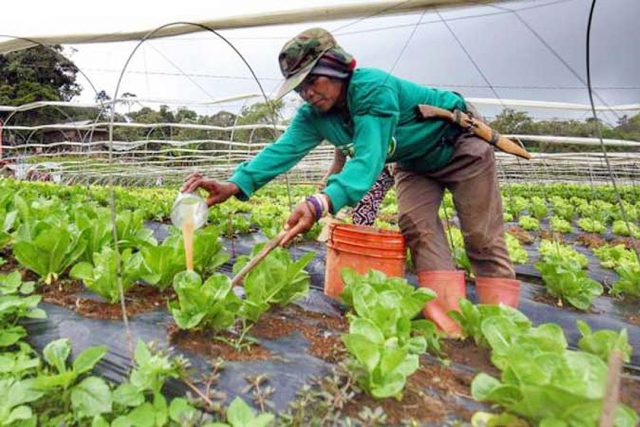
Farm logistics support expanded; North Luzon fuel subsidy readied

BW FILE PHOTO

THE Department of Agriculture (DA) said it is expanding government-supported hauling operations and preparing a fuel subsidy program to cushion the impact of rising fuel prices on vegetable farmers and truckers in Benguet, Ifugao, and Mountain Province.

In a statement on Sunday, Agriculture Secretary Francisco P. Tiu Laurel, Jr. said the planned fuel subsidy aims to stabilize deliveries and ease cost pressures on transporters, as surging oil prices continue to drive up logistics expenses.

The DA said industry participants reported that freight costs have doubled or tripled in recent weeks, with rising fuel costs adding an estimated P1 to P2 per kilo for vegetables shipped to Metro Manila.

The DA said it deployed its own fleet of trucks as well as the  local government units (LGUs) and farmers’ groups to transport produce from farms to trading centers and key markets.

The DA said it is paying for fuel for these operations and monitoring LGU reports to better direct produce to locations with limited supply.

The DA said it will consult with LGUs, state-run Food Terminal, Inc., and other officials to refine support measures for farmers and transport operators. — Vonn Andrei E. Villamiel

Fuel play

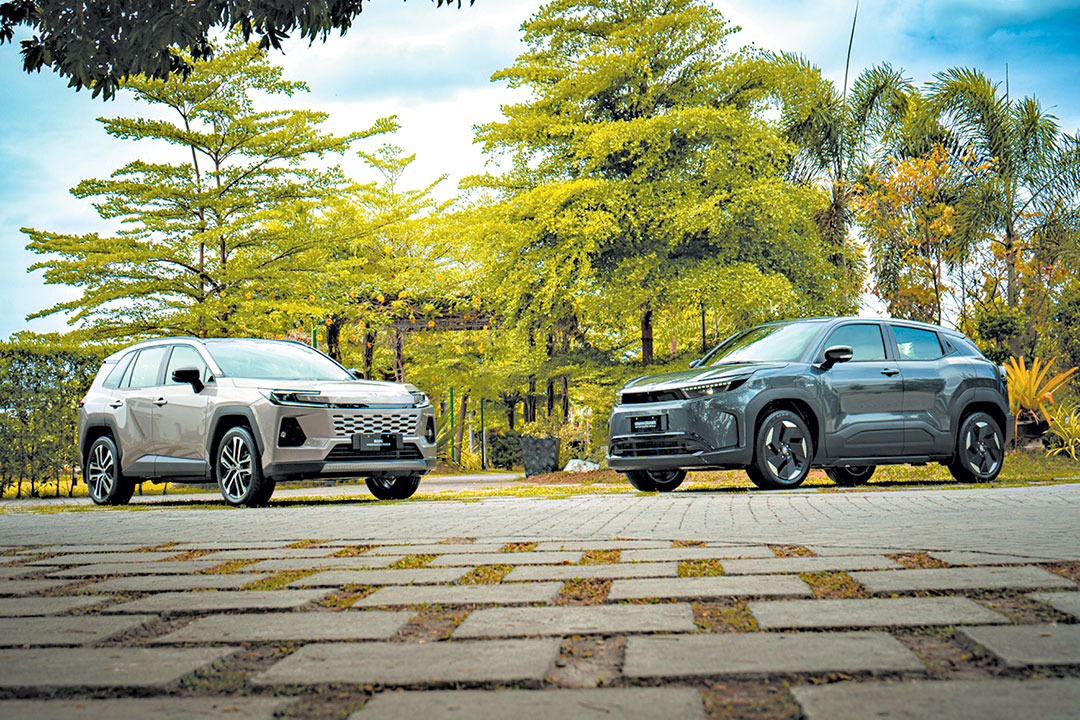
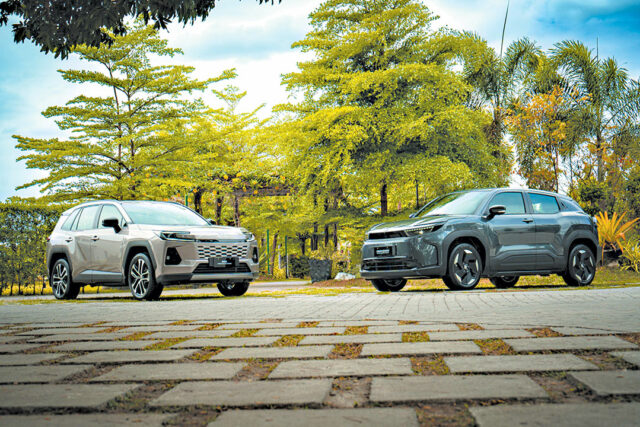
The all-new Toyota RAV4 (left) and Urban Cruiser promise performance with an eye on sustainability — particularly relevant during a time of meteoric rises in pump prices. — PHOTO BY KAP MACEDA AGUILA

Inadvertently opportune releases from Toyota

NOT TO BE facetious about it at all, but not a few have commented how the “pandemic feels” are back. This time, it’s not a virus that is keeping us home, twiddling our fingers with uncertainty, but skyrocketing fuel prices. Those and the crashing value of the peso versus the US greenback have now reached historically distressing levels — both veritably caused by machinations of men oceans away.

The recent news report of a transportation network vehicle service (TNVS) driver speeding off from a fuel station without paying his P5,000 fuel tab underscored the dire situation today that is pushing many to the breaking point. When it costs an arm and a leg to gas up, what are we to do?

In many cases, of course, there is no choice. We need to board our vehicles or be driven in one; we need to be transported from point A to point B.

Recently, Toyota Motor Philippines (TMP) held its “Go Electrified” drive for members of the media and content creators. Featured were, of course, electrified options from both the Toyota and Lexus brands. It needs to be said that TMP drew up the activity way before the Middle East crisis and the aforementioned resulting surge in pump prices. The main point is in flexing not just the breadth of choices for Toyota in the electrified realm, but the overarching message of striving for carbon neutrality via the brand’s multi-pathway approach. This consistent strategy for Toyota has meant espousing all manner of powertrains that all lead toward the desired outcome of less or no carbon emissions depending on the appetite and readiness of the global market. It means not forcing solutions where they are not feasible.

Having said that, “Go Electrified” ended up as an opportune time for the brand to showcase its models/variants that boasted very frugal use of fossil fuel — in some cases none at all.

“This activity is a good way for TMP to also be able to promote better driving habits, for us to be able to be more prudent as well, and showing sustainable options,” said TMP Assistant Vice-President for Marketing Services Division Jade Sison-Mendoza, in an exclusive interview with “Velocity.” She continued, “Hybrid has always been one of the more attainable ways to go into electric driving. In terms of our different ICE (internal combustion engine) vehicles, they are also fuel-efficient. But it’s always a matter of how you drive it, the attitude, the behavior.”

Arguably the centerpiece of the drive were two new introductions to the TMP portfolio: the all-new RAV4 and a new battery electric vehicle (BEV) model, the Urban Cruiser. Both had been mentioned in a previous presser early in the year as among the five models Toyota will release in 2026. The other models are the Land Cruiser 300 Hybrid, Land Cruiser FJ, and Hilux.

RAV4 WITH MORE
In 2025, TMP sold 947 units of the RAV4. That number is surely to be expected to trend upward this year with the introduction of the all-new, sixth-generation version. Under the hood is a 2.5-liter, 16-valve, four-banger hooked up to two electric motors for support. The front generator delivers 136kW, the rear puts out 54kW. The RAV4 runs on Toyota’s E-Four AWD System, and boasts total system output pegged at 239ps. Drivers can access the performance via an e-CVT transmission, with the lower Adventure variant (priced at P2.183 million) getting a mechanical shifter versus the shift-by-wire Limited grade (P2.499 million).

Though the Limited is the better appointed RAV4, an informal survey of driver participants showed that many would be perfectly happy with more affordable Adventure. Aside from the difference in gear shifters, the Limited receives larger alloys (20 inches versus the 18s of the Adventure), auto-leveling headlamps, dual daytime running lamps, a panoramic moonroof versus a smaller “tilt and slide” in the Adventure, leather seating, memory settings in the power seats, power-adjust passenger seat, driver and passenger seat ventilation, electrochromic rearview mirror, head-up display, adaptive high beam, intelligent parking assist, and others.

In my estimation, not having these features in the Adventure shouldn’t be a dealbreaker. Both variants of the RAV4 hit a sweet spot in space, ability, comfort, and, yes, fuel efficiency — values that should earn it a spot on car browsers’ consideration lists. Taking turns driving it from Manila to Pampanga, the model routinely hit a thirst rate of 20kpl and better, stretching fuel supply with ample support from the electric motors.

The RAV4 feels familiar, and that’s a good thing. This newest version should appeal to the fans of the model and those owning the previous versions. Its skillset and appointments should feel familiar — better even. Albeit experienced in a limited fashion, driving and riding in the RAV4 appear to be equally satisfying. In fact, I took a peaceful nap in the backseat as we headed north.

SOLID BEV IN THE URBAN CRUISER
Think of the Urban Cruiser as the Ativ’s fully electrified sibling. They are now the lowest-hanging fruit in their respective powertrain category for Toyota. Following the introduction of TMP’s first full-electric offering in the bZ4X late last year, the Urban Cruiser lowers the price of entry in the BEV segment of Toyota.

Priced at P2.135 million versus the P2.699 million of the most affordable bZ4X, the Urban Cruiser is a crossover that is, based on our limited seat time with it, named most appropriately. It should be solid as a city go-getter for singles, new couples or even empty nesters wanting to go pure electric.

The Urban Cruiser, measuring 4,285mm, 1,800mm, and 1,635mm in length, width, and height, respectively, is smaller compared to 4,690mm, 1,860mm, and 1,650mm of the bZ4X. The wheelbase measurement of the Urban Cruiser is at 2,700mm versus the bZ4X’s 2,850mm. The last measurement is typically a good indicator of cabin (i.e. passenger) space.

TMP proffers a maximum range between charging sessions of 475 kilometers for the Urban Cruiser, which is not bad at all when compared to the 570 kilometers of its bigger sibling. That’s two trip from Manila to Clark and back, with lots of charge to spare. While we’re at it though, let me get back to my earlier point about the model being aptly named. It should excel in urban environments — the everyday commute to and from work, for instance, with the occasional out-of-towner enabled by its surprisingly useful range. The Urban Cruiser’s boot also offers decent space, and has a solid plastic tonneau cover that shields your stuff from prying eyes.

The two-tone, synthetic leather and plastic execution within is also tasteful and pleasant, set off by the bi-level dashboard and upright digital screen which houses both the very legible instrument cluster and infotainment display. Sit at the rear though and you’ll feel the Urban Cruiser is indeed much smaller than the bZ4X. Headroom for me (I stand 5’10”) was a bit limited, and so the moonroof is a rather welcome sight because this feature definitely helps to increase the sense of space. There are no second-row air vents, though. Instead, there are a couple of charge points in the console/armrest (a USB-A and a USB-C) for passengers here.

I’ll be honest, sitting at the rear of the Urban Cruiser already isn’t a particularly pleasant proposition for someone my size, but the stiff suspension of the vehicle made the experience a little more challenging. Road imperfections seemed to be directly communicated to my behind, and a particularly bad stretch of road bounced me up that I bonked my head. Lesson: Buckle up, even when you’re in the rear bench.

I wasn’t able to drive it for a meaningful stretch, so I’ll hold off on a more complete verdict. But the use case for the Urban Cruiser is, again, as obvious as its name. As a point-to-point everyday BEV promising the vaunted QDR (quality, durability, and reliability) of the Toyota badge it sports, the Urban Cruiser should appeal to anyone shopping at the price point — ready and raring to go electric amid the current fossil fuel concerns and beyond.

“Moving forward, there might be also new technologies. Eventually, maybe we will introduce a plug-in hybrid electric vehicle,” intimated Mrs. Sison-Mendoza. “Going back to that multi-pathway approach, there is no one and clear solution for us to be able to achieve that. And there are different lifestyles, there are different customers, there are different driving habits or different behaviors. It’s a myriad of things that we should be able to deliver to customers, and we feel that that would be the best way for us to be able to introduce that through a multi-pathway approach. Because in the end, like you said very well, it’s for us to be able to achieve carbon neutrality.”

Megawide to start Baguio terminal construction next year

THE BAGUIO CITY Integrated Terminal project involves leasing, operating, and maintaining an intermodal terminal to serve provincial buses arriving from outside Baguio City. — BAGUIO CITY PUBLIC INFORMATION OFFICE OFFICIAL FACEBOOK ACCOUNT

MEGAWIDE Construction Corp. is targeting the first quarter of 2027 to begin construction of its P1.19-billion Baguio City transport terminal project, a company official said.

“The next step is the design phase. So, now, we are starting that process. It is very challenging because of the terrain. We are finding the most efficient way to design it,” Megawide Chief Business Development Officer Jaime Raphael C. Feliciano told reporters on the sidelines of an event on March 11.

In January, the company signed a lease agreement with the Baguio City Government to implement the project, following the receipt of the notice of award last year.

“We are hoping by Q1 of next year we can start (construction). We just have two challenges right now,” he said.

Mr. Feliciano said one challenge is the transfer of the waste-sorting facility at the site, which the city must relocate after identifying a new location.

Megawide is also arranging temporary housing for about 27 families who will be affected by the project.

“We will provide them temporary housing or shelter. We will also find ways for them to be able to work in the project, for example construction or supervisors or whatever their skill sets allow them,” he said.

The project is expected to be operational by the second half of 2028, Mr. Feliciano added.

The Baguio City Integrated Terminal is designed to handle up to 25,000 passengers daily and will initially serve seven southbound routes, including La Union, Pangasinan, Tarlac, Pampanga, Bulacan, Metro Manila, and Cavite via the planned South Luzon Integrated Terminal Exchange.

The terminal will be built on a five-hectare property in Barangay Dontogan, about five kilometers from Baguio City proper.

The project is expected to ease traffic congestion in the city by relocating provincial buses and UV Express vans outside the central district. — Ashley Erika O. Jose

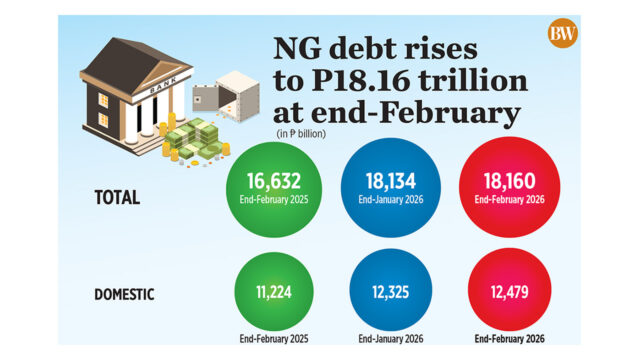
NG debt rises to P18.16 trillion at end-February

THE National Government’s (NG) outstanding debt hit a fresh high of P18.16 trillion as of end-February, reflecting a stable and well-managed debt position, the Bureau of the Treasury (BTr) said on Wednesday. Read the full story.

Peso may stay above P60 on prolonged Iran conflict

REUTERS

THE PESO could hold above the P60 line versus the US dollar this week on continued preference for the safe-haven currency due to the prolonged Middle East conflict.

On Wednesday, the local unit jumped by 58.8 centavos to end at P60.16 against the greenback from its all-time-low P60.748 finish on Tuesday, data from the Bankers Association of the Philippines showed. This came following signals from US President Donald J. Trump on a possible end to Iran war.

Week on week, the peso surged by 39 centavos from its P60.55 finish on March 27. Philippine markets were closed on April 2 and 3 for Holy Week.

For this week, the peso could see some pressure in catch-up trading after the two-day break as Mr. Trump again made fresh threats towards Iran, causing renewed market volatility and flight to the safe-haven greenback.

“[Market players] will continue to monitor developments in the Iran war,” a trader said by phone.

The US’ continued military operations in Iran despite talks of a ceasefire will keep the peso weak, Rizal Commercial Banking Corp. Chief Economist Michael L. Ricafort added in a Viber message.

Meanwhile, the release of March Philippine inflation data on Tuesday (April 7), which likely showed a faster print due to the war’s impact on domestic fuel prices, would also provide the market with leads, the trader added.

A BusinessWorld poll of 18 analysts yielded a median estimate of 3.8% for March headline inflation, faster than the 2.4% in February and 1.8% in the same month a year ago. This is close to the upper end of central bank’s 3.1%-3.9% forecast for the month and its 2%-4% annual target.

If realized, the headline print would be the fastest in 20 months or since the 4.4% seen in July 2024.

The trader sees the peso moving between P60 and P60.50 per dollar this week, while Mr. Ricafort expects it to range from P59.90 to P60.40. — Aaron Michael C. Sy

Cyberattack targeted Italy’s Uffizi but nothing stolen, museum says

EAST CORRIDOR (FIRST CORRIDOR) — UFFIZI.IT

ROME — Florence’s Uffizi Galleries said on Friday they had been hit by a cyberattack earlier this year, but denied a newspaper report that the incident caused a major security breach or theft of data.

The statement came after Corriere della Sera daily reported that the attack had emptied the Uffizi’s servers and prompted the emergency transfer of valuable jewels to the Bank of Italy.

The Uffizi said it had been targeted by a cyberattack on Feb. 1, but added that nothing had been stolen and no information lost. It also denied that the hackers had obtained security maps or that employees’ phones had been infiltrated.

The Uffizi Galleries display some of Italy’s most celebrated artwork, including Botticelli’s Birth of Venus and Primavera paintings, along with Michelangelo’s Doni Tondo.

The museum said the only disruption caused by the attack was linked to the time needed to restore backups, adding that it had released a statement about the incident after it had happened.

Corriere reported that hackers had infiltrated the network of the Uffizi, Palazzo Pitti, and the Boboli Gardens, had taken control of the photographic server and sent a ransom demand to the personal phone of Uffizi director Simone Verde.

The Uffizi said a full backup of the photo server existed.

It also said the closure of a section of the Palazzo Pitti and subsequent removal of valuables to the Bank of Italy was tied to renovation work planned last autumn and had nothing to do with the cyberattack.

The Uffizi added that the replacement of its surveillance cameras mentioned in the article had been recommended by the police in 2024. The upgrade was accelerated after thieves last year targeted Paris’ Louvre Museum, stealing jewels worth $102 million that are still missing, it added.

“The cameras had been in the process of being replaced for a year. The situation was not at all like the Louvre’s. The Galleries did have cameras, but they were analog and are now digital,” the Uffizi said.

In March, three paintings by French masters Pierre-Auguste Renoir, Paul Cezanne, and Henri Matisse were stolen from a museum in northern Italy. — Reuters

Humans have found the keys to Mother Nature’s R&D lab

STOCK PHOTO | Image from Freepik

By Gautam Mukunda

INSIDE National Geographic’s March issue is the photo of a tractor tire dangling from a thread. Not metaphorically, but literally, because the thread is spider silk — five times stronger than steel but produced by genetically engineered silkworms. As National Geographic put it, this “supersilk” is “poised to upgrade far more than our clothing.” They’re right, but the real story is much bigger.

The next wave of economic impacts from the biotech revolution’s isn’t going to come from medicine, but rather the $6-trillion global chemical industry. Tools built to fight disease turn out to be even more powerful when they’re aimed at manufacturing.

Biotechnology was initially all about medicine. Treating cancer or fixing genetic disorders requires altering living systems. Because you can’t do that with a wrench (well, not productively), naturally the first industry to invest heavily in biological engineering was the one that does it every day. And doing anything in the life sciences was initially really hard and expensive since the basic tools had to be invented from scratch.

Pharma was just about the only industry that could afford to keep throwing money against the wall until some of it stuck. Large pharmaceutical companies report gross profit margins around 76%, roughly double the S&P 500 average. Those margins exist because people will pay almost anything for a drug that saves their life. And the industry needed every penny of that cushion. Only about 7% of drugs entering Phase I clinical trials ever reach the market. The other 93% are write-offs.

The failure rate isn’t because pharmaceutical scientists are incompetent. It’s because living systems are almost inconceivably complicated. The human body may be the most complex system in the known universe. Your body contains roughly 37 trillion cells, each running an estimated billion chemical reactions per second. We can predict eclipses millennia in advance and land a robot on a specific crater on Mars. But we can’t reliably predict what a new molecule will do inside humans.

For example, Merck & Co. ran a major clinical trial of its Vioxx drug to prove the painkiller was gentler on patients’ stomachs than older alternatives. Instead, the trial revealed that Vioxx patients had twice the rate of serious cardiovascular events. A second trial, designed to test whether Vioxx could prevent colon polyps, confirmed the cardiac risk. An estimated 88,000 Americans had heart attacks from taking the drug. A painkiller meant to reduce suffering in one organ system was silently destroying another, and nobody saw it coming. This is what happens when you try to engineer a system you don’t really understand.

Decoding human physiology is the Everest of science. But when you’ve been training to climb Everest, normal mountains get a lot easier. Crispr technology has made gene editing fast, cheap, and precise. The cost of reading a human genome has fallen from billions of dollars to about $200, and the cost of writing DNA has dropped by more than a factor of a thousand, following what’s called Carlson’s Curve and outpacing Moore’s Law. (Biotechnologists are the only people in the world who look at Silicon Valley and ask, “Why are you so slow?”)

These tools were developed to fight disease. But an enzyme doesn’t know whether it’s working inside a human body or a fermentation tank. And that’s what opens the door to the chemical industry. Because once you take the human body out of the equation, everything gets easier.

Gaurab Chakrabarti was doing PhD research on a pancreatic cancer drug at UT Southwestern in Dallas when he started talking to Sean Hunt, a chemical engineer at the Massachusetts Institute of Technology, about what biological tools could do outside of medicine. Ten years later — or about the time it would take a pharma company to bring a single drug to market — their company, Solugen, Inc., converts corn sugar into industrial organic acids using enzymes instead of petrochemical processes. They’ve broken ground on a factory in Minnesota that will produce up to 120,000 tons of chemicals a year, backed by a $214-million Department of Energy loan guarantee. In a steel tank, you control the environment, tuning temperature, pH, and inputs. Mistakes stay in the reactor. You don’t need FDA approval. Nobody dies if a batch goes wrong.

The industrial biotech opportunity goes well beyond replacing petrochemicals. Evolution has spent billions of years optimizing biological materials, and some of them have extraordinary properties. Spider silk is just one example. Tooth enamel is harder than steel, ranking above iron, nickel, and silver on the Mohs hardness scale, but built at body temperature from calcium and phosphate. No forge required. The cartilage in your knee has friction 10 to a 100 times lower than ice sliding on ice.

We cannot predict which of these materials will prove commercially valuable first. But making materials that are tougher, slicker, and stronger has been a central endeavor of human science since cavemen first polished rocks. As our ability to engineer biology improves, the catalog of materials that evolution has already prototyped becomes available for industry to exploit.

You don’t need to go to a lab to see the proof of concept. It’s sitting right under your rib cage. Your liver synthesizes proteins, metabolizes toxins, regulates glucose, produces bile, and manages cholesterol, all at the same time, at body temperature, running on nothing but what you eat and drink. No factory on earth can match it. The biotech revolution spent decades trying to harness that kind of power for medicine. The next chapter is harnessing it for everything else. Nature has been running the world’s most advanced R&D lab for billions of years. We’re just now figuring out how to use the results.

BLOOMBERG OPINION

Food security task force to monitor supply, prices during emergency

PHILSTAR FILE PHOTO

THE Department of Agriculture (DA) said it established a food security task force to monitor supply and price disruptions during the energy emergency.

Agriculture Secretary Francisco P. Tiu Laurel, Jr. said in a statement that the task force institutionalizes what had previously been an ad hoc monitoring system within the agency.

“Since the start of the war, we’ve been operating on an ad hoc basis. Now we are formalizing the task force so reports are standardized and more detailed, enabling faster and better decision making,” he said.

The task force will oversee developments in the supply and pricing of essential commodities, as well as track imports and exports. It is expected to produce daily briefings for submission to Congress and the Office of the President.

He said earlier monitoring efforts were conducted on an informal basis following the onset of geopolitical disruptions.

The task force will also assess the impact of shipping disruptions, particularly in the Middle East, on major agricultural exports such as bananas and pineapples.

To mitigate the impact, the DA said it is working with financial institutions, including the Land Bank of the Philippines, to extend assistance to affected exporters.

The DA is also exploring alternative export markets in Africa, Australia, Europe, and Southeast Asia. — Vonn Andrei E. Villamiel

New players, new rules

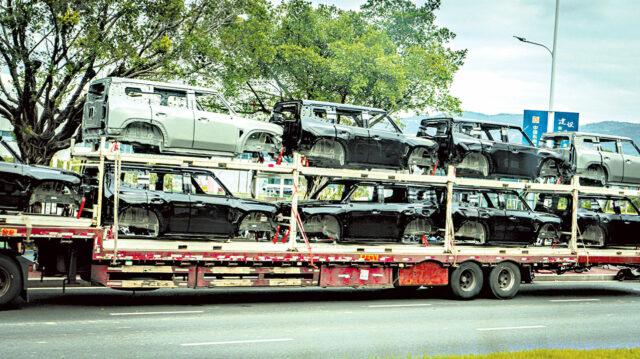
Market disruptor: SUV chasses on the move in China — PHOTO BY KAP MACEDA AGUILA

Emerging global brands are rewriting the PHL automotive playbook

WHEN I LEFT the Philippines to live in Switzerland back in 2021 at the height of the pandemic, the local automotive landscape still felt familiar — predictable, even. The usual hierarchy held firm, shaped by decades of brand loyalty, and defined by a handful of dominant players.

Returning home in late 2023 however, I was surprised to find an automotive scene that was already significantly different. What had once been a predictable, exclusive sales field among established Japanese, Korean, and European marques had transformed into something far more dynamic — dare I say, even far more crowded. Upon my arrival, I remember noticing showrooms that carried names that were unfamiliar to me. Billboards introduced car brands that just a few years prior would have drawn blank stares from even the most engaged enthusiasts.

Among those leading this new wave are global entrants such as BYD, Jetour, Lynk & Co., VinFast, Omoda, and Jaecoo — each arriving with distinct identities, aggressive strategies, and a clear intent to capture market share. MG, which had already established its presence before my departure, has only strengthened its foothold, evolving from a curiosity into a legitimate volume player, cracking the list of top 10 auto marques in sales. And BAIC’s own trajectory in the Philippines has also taken a notable turn for the better, following a change in its official Philippine distributorship. The brand has begun to reposition itself with a more upscale sensibility while bringing in a more thoughtfully curated model lineup that signals a clear departure from its earlier, more basic market approach.

It seems that this is not simply an age of a strong influx of new brands but a special period of fundamental shifts in the structure of the Philippine automotive industry. For those of us who have observed it over time, the transformation is as striking as it is consequential.

Walk through any major car trade show today and the changing of the field is impossible to ignore. New entrants have arrived with full model lineups from day one, backed by their global manufacturing scale and deep capital reserves. And the ambition of these new players extends beyond niche participation; they are here to compete across multiple segments simultaneously.

For VinFast, the Philippine market represents part of a broader regional expansion strategy, using affordable electric mobility as both its identity and differentiator. BYD, on the other hand, leverages its position as one of the world’s largest electric vehicle (EV) and battery manufacturers to introduce highly reliable electrified vehicles at unprecedented price points.

Meanwhile, the multi-brand strategy of Chery — through Jetour, Omoda, and Jaecoo — allows it to target distinct demographics with greater precision, from practical family buyers to design-conscious urban consumers and even lifestyle off-roaders.

Perhaps one of the most important changes to note is that there has been some major pricing disruption. What truly distinguishes this new generation of entrants is not just their origin, but their pricing philosophy.

For years, Filipino car buyers operated within a clearly defined value equation. Affordability meant compromise, while premium features required a significant financial leap. That equation is now being actively rewritten.

These days, sub-P1-million crossovers are being marketed with features once reserved for higher segments. These can now have large infotainment screens, advanced driver-assistance systems, and elevated interior appointments. Electrified vehicles, from hybrids to BEVs (battery electric vehicles), are being priced within striking distance of their internal combustion counterparts. And it sure is a nice marketing proposition to dangle the benefit of number-coding exemptions on Metro Manila’s public roads.

There is well-thought strategy in all of this. The new entrants are now undercutting established players while actively overdelivering on their product features. They are also accelerating consumer adoption of these new energy vehicles by capitalizing on perceived value. And in doing so, they are compressing traditional pricing tiers — forcing legacy manufacturers into uncomfortable recalibration.

Unlike previous waves of new entrants, many of today’s players are not attempting to outcompete incumbents on their strongest ground. Instead, they have chosen to redefine the battlefield by using electrification as their gateway. Maybe for brands like VinFast and BYD, the Philippines presents a relatively open landscape where no single player has yet established unshakable dominance in the EV space. This creates a rare opportunity to shape consumer perception, define their expectations and build loyalty in a category that is fast changing and still in its formative years. In this sense, one can look at electrification as a form of competitive reset, rather than just a technological shift.

Moreover, I think we can point out that gone are the days of cautious, incremental expansion. Today’s new entrants are moving with speed and intent, fast establishing their dealership networks, forging partnerships with major local conglomerates and investing in after-sales and support infrastructure quite early in their market lifecycle. And for EV-focused brands, this extends to better charging solutions, improving ownership ecosystems, and pushing for greater digital integration.

As a common denominator, the modern automotive proposition is no longer defined solely by the vehicle, but it is also increasingly shaped by the total ownership experience.

So, of course there is pressure on legacy brands. The arrival of these aggressive new competitors is triggering industry-wide reassessment because the Philippine automotive market — long characterized by stability — is now evolving into a far more fluid and cutthroat space. And perhaps this shift is advantageous because it may be gradually tilting the power toward the Filipino consumer.

Having said all that, the road far ahead is still far from guaranteed for these new entrants. After all, the Philippine market has historically rewarded not just innovation, but consistency. Durability, reliability, and after-sales support remain critical to long-term success. For new auto brands to prosper, their early momentum must still be sustained by the tangible Filipino ownership experience. But regardless of individual outcomes, their collective impact has already reshaped the competitive automotive landscape.

What remains to be seen is which players — old and new — will adapt quickly enough to define what comes next.

First Gen says deals vetted amid Lopez, Inc. row

FIRSTGEN.COM.PH

POWER PRODUCER First Gen Corp. said its deals undergo “transparent and rigorous evaluations” and are approved by its board, amid disputes within the Lopez family’s holding company.

“First Gen would like to emphasize that it enters into contracts and agreements only after conducting transparent and rigorous evaluations, and only upon thorough review and approval by its Board of Directors,” the company said in a statement on Sunday.

The statement comes as the 71% majority of Lopez, Inc. — the ultimate parent company of the Lopez Group — raised concerns over transactions carried out under the leadership of the group’s president and chief executive officer, Federico “Piki” R. Lopez.

A court order temporarily blocked his ouster and allowed him to remain in his post.

Lopez, Inc. is the Lopez Group’s private holding company and parent of businesses including publicly listed firms Lopez Holdings Corp. and First Gen.

Mr. Lopez currently serves as chairman of First Gen, the largest clean and renewable independent power producer in the Philippines.

As a publicly listed company, First Gen said it strictly follows the law to ensure all stockholders have equal access to material information. This includes infrastructure deals with Enrique K. Razon, Jr., which were unanimously approved by the entire board, First Gen said. — Sheldeen Joy Talavera

Aboitiz says Laguindingan airside operations upgraded

PHILSTAR FILE PHOTO

ABOITIZ InfraCapital, Inc. (AIC) said it has carried out airside upgrades at Laguindingan International Airport (LIA) to improve safety and operational efficiency.

“While these improvements take place behind the scenes, they play a critical role in delivering a seamless passenger journey at Laguindingan International Airport,” AIC Vice-President and Head of Airports Rafael M. Aboitiz said in a media release on Sunday.

The company, the infrastructure arm of the Aboitiz group, upgraded the airport’s apron — the paved area for aircraft parking — to provide clearer guidance for aircraft and ground personnel.

“These improvements help streamline aircraft movement on the ground, contributing to more efficient turnarounds and minimizing potential delays,” AIC said.

“These latest airside upgrades build further on recently completed runway works at LIA, which have included the repainting of apron bollards and pedestrian lanes, as well as runway inspections, rubber removal, and crack repairs to ensure optimal surface conditions for aircraft operations,” it added.

AIC also operates the Bohol-Panglao International Airport. — Ashley Erika O. Jose