Home Blog Page 40

Stuff to Do (04/10/26)



Relive the Bee Gees onstage

ON April 10 and 11, “The Best of The Bee Gees” is set to take the stage of the Newport Performing Arts Theater in Pasay City. Featuring tribute artists Russel Davey, Evan Webster, and Gregory Wain, the band will be joined by the Manila Symphony Orchestra under conductor George Ellis. The concert revisits the group’s greatest hits album, Greatest, with orchestral renditions of disco and pop tracks.


Watch a Fil-Am short film about disability, community

TWO Filipino-American filmmakers, Steven Charles Ching and Bettina Someros, have released a short film about the intersections of disability, community, and vulnerability. Titled I Will Be Fine, it centers on an immigrant narrative. The film follows a young man with limited vision who passes his driving test and must decide: does he risk a dangerous drive home to prove his independence, or lean into his friends for support? The full film may be viewed here (https://www.youtube.com/watch?v=Wfd7RZ_MAV0).


Listen to OneRepublic’s new anthem

GRAMMY-NOMINATED band OneRepublic has returned with a new single, “Need Your Love.” Out via BMG, the track is a soaring, arena-ready pop-rock anthem, showcasing the band’s signature blend of heartfelt lyrics and powerful hooks. Produced by Grammy-winning writer and producer Ryan Tedder and co-written alongside James Essien, the track aims to highlight the importance of love over materialistic pursuits. It is out now on digital music platforms.


Binge-watch the animé Gintama on the big screen

TO celebrate 20 years of Gintama, Robinsons Movieworld is hosting an exclusive marathon screening happening on April 12 at Robinsons Galleria, Quezon City. “Gintama on Theater: The 20th Anniversary Saga” brings together some of the series’ arcs on the big screen. The one-day event offers fans a unique opportunity to relive the animé franchise from noon to 8:20 p.m., featuring four fan-favorite story arcs. Tickets for the marathon screening are priced at P1,500, and each pass comes with four key visual A3 posters and one commemorative ticket.


Catch the milestone show of an Andres Bonifacio musical

ON April 13 at 7 p.m., the Philippine Stagers Foundation is presenting Bonifacio “Ang Supremo” Isang Musikal, an epic musical retelling of Philippine hero Andres Bonifacio’s life and legacy. Written and directed by Vincent Tañada with music by Pipo Cifra, the production traces his journey from self-taught laborer to revolutionary leader. The performance marks the Grand Gala Farewell Show of the award-winning musical, following more than 700 performances nationwide.


Check out Culture Wars’ debut album

AUSTIN-BRED rock collective Culture Wars have officially released their first album. Upon signing a fresh deal with AWAL, the alternative band is representing itself with a guitar-driven rock album, which aims to bridge the raw grit of ’90s guitar rock and the cinematic sheen of modern pop. Titled Don’t Speak, its various tracks fuse surf-rock pulses, ’80s synth textures, and strong guitar work. It’s out now on all digital music platforms.
Duty Free Philippines steps up promos for April

DUTY FREE PHILIPPINES

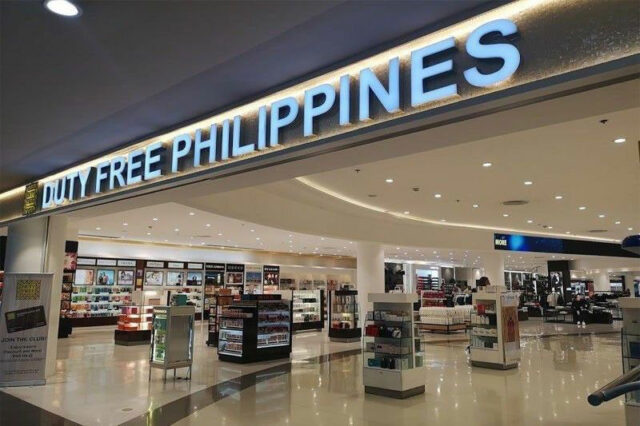
DUTY FREE Philippines Corp. (DFPC) is expanding promotional activity across its airport and travel retail locations this month, rolling out discounts, limited-edition items, and a raffle campaign to drive sales as travel costs rise.

“The initiative reflects our continued efforts to strengthen retail engagement within the country’s primary gateways while aligning offerings with evolving traveler needs,” the company said in a statement on Thursday.

“As an attached agency of the Department of Tourism, DFPC plays a key role in generating revenues that support tourism development, while continuing to expand and modernize its retail footprint,” it added.

The campaign will run at the Ninoy Aquino International Airport Terminals 1, 2 and 3, Clark, Fiesta Mall and Luxe Duty Free.

DFPC will offer gift-with-purchase items at select Mactan-Cebu International Airport terminals on weekends and release exclusive merchandise, including limited-edition scarves from a collaboration with artist Kulas, at Luxe Duty Free from April 10 to 26.

A summer raffle will run from April 15 to 30 across participating locations. Shoppers who spend at least $150 in a single or accumulated same-day purchase will get one raffle entry upon registration, while those who spend at least $250 on select fashion brands will get double entries.

Prizes include overnight stays at partner hotels. — Alexandria Grace C. Magno

Rising trade deficit with China is a national security threat

STOCK PHOTO | Image by User6702303 from Freepik

Anti-Filipino propagandists, to rally support for China’s illegal territorial claims, make much of the latter as the Philippine’s biggest trading partner. Unfortunately, they pass over the fact that most of that trade goes one way. Suffice to say, the Philippines suffers from a huge trade deficit with China and while such is blithely dismissed in theoretical, classroom reality fashion — supposedly giving benefits in terms of efficiency, openness and consumer welfare — the imbalance actually presents a profound national security concern.

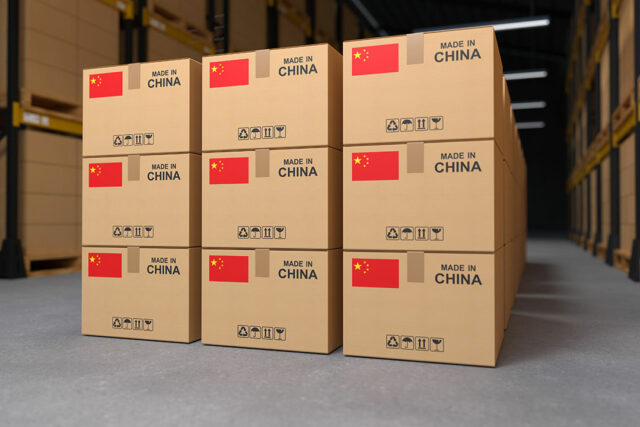
As of 2025, the Philippines posted a total trade deficit of approximately $49.7 billion. China accounts for the largest share of that imbalance ($28.9 billion), with imports from China exceeding $38 billion. That’s roughly 25% to 30% of total Philippine imports. Or to put it another way: one out of every $3 or $4 the Philippines spends on imports goes to the country hostilely trying to grab our territories.

Unfortunately, this trade imbalance is not only a one-time snapshot. Monthly figures reveal a disconcerting structural dependence: China consistently dominates as the Philippines’ top import source, often approaching or exceeding 28% share in any given period. “Trade deficits can create substantial problems in the long run. The worst and most obvious problem is that trade deficits can facilitate a sort of economic colonization. If a country continually runs trade deficits, citizens of other countries acquire funds to buy up capital in that nation,” according to  Investopedia.

To be clear, trade deficits are not inherently bad. Unfortunately, for the Philippines, its widening trade deficit with China is partly financed by debt. As of late 2025, the Philippines’ outstanding external debt stood at $147.65 billion. Admittedly, 14.3% of this is short-term debt, which is generally used to finance trade and imports. Nevertheless, the point remains that the Philippines is vulnerable to “economic colonization,” where Chinese entities are enabled to buy critical assets, natural resources and infrastructure.

That circumstance is aggravated by Philippine dependence on products it precisely needs to survive a war: electronic products, machinery and transport equipment, textiles, telecommunication-related inputs, industrial raw materials and mineral fuels. Electronics alone accounts for roughly a quarter of total imports. Machinery and transport equipment follow closely. Together, they form the backbone of infrastructure, communications, manufacturing and other defense-related logistics.

Hence why the trade deficit with China is the terrifically troubling weak link in our national defense strategy. Its size, concentrated in high-value sectors, reflects an economy that generates demand without the means to supply but also very much willing to go its own way regardless of the national security needs of the country.

While indeed, national security is economic security, it’s also the other way around: an economy composed of few manufacturing firms, limited industrial upgrading and individual income constrained by the absence of high-productivity sectors bleed into our strategic geopolitical needs. As mentioned, our ridiculous dependence on China for critical goods (i.e., electronics, machinery and industrial inputs) is an obvious vulnerability. Because ultimately, national defense is defined by military capability and supply chain resilience. General Dwight Eisenhower puts it this way: “Amateurs talk tactics, professionals talk logistics.”

If the Philippines cannot secure access to essential components for a considerable period, safeguard infrastructure or guarantee communication integrity, it cannot sustain its economy when subjected to stress. And war, to put it mildly, is a monstrous stressor.

Tragically, our economic dependence narrows our security options. The ability to assert national interest becomes conditioned by the need to maintain economic flow. Interestingly, one sees that in the political surveys and in the national conversation: no matter how much our struggle with China is framed in existential terms, our people rightly still see the priority as economic.

For decades, Philippine economic policy emphasized openness without corresponding emphasis on capability. The assumption has been that integration into global markets will, over time, generate domestic strength. But data suggests otherwise. Integration without industrial strategy produces dependence, not resilience.

To address it requires more than marginal adjustment. It requires a shift in orientation: from passive participation in global trade to active development of domestic capability. This includes targeted industrial policy, diversification of supply sources and investment in sectors that underpin both economic growth and national security. A move to decouple away from China is a good forward step.

While obviously imposing economic costs, even likely at shock levels, nevertheless, there are benefits: national security (reducing reliance on China for critical goods, such as semiconductors, pharmaceuticals, rare earths mitigates risks from geopolitical tensions, such as potential conflicts over Taiwan); supply chain diversification (a more diversified, less concentrated supply chain); and local innovation (increased domestic patenting and technological independence, though with significant short-term productivity costs).

Because the question is not whether the Philippines benefits from trade. It does. The question is whether the current structure of that trade enhances or constrains the country’s ability to act in its own interest.


Jemy Gatdula is the dean of the UA&P Law School and is a Philippine Judicial Academy lecturer for constitutional philosophy and jurisprudence. The views expressed here are his own and not necessarily of the institutions to which he belongs.

https://www.facebook.com/jigatdula/

Twitter @jemygatdula

Unusual, but effective hiring techniques

IJEAB/FREEPIK

I was interviewed for a director position by the first vice-president (FVP) of a major bank. After asking two questions, he offered me an expensive, sparkling bottle of mineral water from the refrigerator in his room. Instead of asking his secretary, he served the water like a waiter in a fancy restaurant. Was that a part of the hiring process? — Silver Compass.

We’re not sure about the motive of the interviewer. We can only speculate. However, by analyzing the context of your story, it’s possible that the interviewer’s secretary was not at her desk. That’s why the FVP played the part.

If the stakes are high — the importance of a vacated post, the final stage of the interview process, and the rank of the interviewer, it’s possible that you’re being subjected to an unusual hiring technique. But not in the way most people think. It’s not about the mineral water alone, but the way it was served to you.

But still, why did you say the interviewer acted like “a waiter in a fancy restaurant?” In a fine-dining environment, the service of bottled mineral water is treated with the same ceremony as a bottle of fine wine.

If that’s not the case, you might just be imagining that special attention is being given. The truth of the matter is — many candidates, including those in the final stage of the hiring process are not prepared to handle “unscripted human moments,” especially in a job interview where a $40 Perrier was served.

That’s where the applicant’s real personality leaks out. It’s not about the expensive sparkling water. Rather, it’s about you being subjected to subtle observation.

WHAT’S YOUR REACTION?
High-ranking executives form their judgments even from small cues, especially if the applicant is on top of the short list. Offering expensive mineral water in an unusually attentive way can be a deliberate attempt to get a reaction. 

How did you respond to the interviewer’s service? How did you acknowledge the effort? Did you appear confused by the gesture? How did you maintain presence and ease?

It could be that the interviewer is checking your sense of entitlement and humility. Do you accept it as a right or courtesy? If you’re applying for a director-level position, it’s possible, they’re not just hiring competence, but also checking your behavior using a “microscope.”

OTHER UNUSUAL HIRING TECHNIQUES
If you’re part of the short list (top two candidates) and you’re on the final stage of the process, some high-ranking interviewers would even go to the extent of giving you the opportunity to prove your worth. Instead of asking questions, they would resort to the following:

One, giving real work tests. Instead of asking ho-hum interview questions, expect certain interviewers to give you an on-the-spot actual performance on the job. This includes writing a real marketing strategy, solving an actual business problem, or handling an irate client call.

Two, hosting a “lunch interview” test. This is done to test how you treat the restaurant wait staff, observing your table manners, the kind (and the price) of food and beverage that you ordered, or whether you are focused on your meal rather than the interview questions.

Three, handling a panel stress interview. This requires about three to four people asking questions that would make you uncomfortable. They may ask absurd or confrontational questions. If not, one or two interviewers may create a situation that would force you to decide on whose side you are. The goal is to determine your emotional control and resilience.

Four, checking the applicant’s behavior. Some organizations do this by secretly evaluating shortlisted candidates even before an interview starts. How did an applicant behave while waiting at the reception? What is feedback from a receptionist or security guard? Did the applicant bother to engage them with casual, small talk?

Five, conducting a reverse job interview. Instead of an employer asking questions, an applicant is allowed (sometimes coerced) to conduct the interview. The questions would revolve around the following: What would you change here? What sort of questions do you have for our management style? Are you brave enough to challenge a stupid policy?

The list above is incomplete. Expect more than usual. In general, however, unusual hiring techniques would force you to answer at least three basic questions: Who are you in your current job? How is your relationship with people? And why are you here?

The more creative you are, the better, because every job interview gives you the risk of being biased, being tricked by a prospective employer, or being given false signals.

Smart employers test all shortlisted candidates in the same manner, with very few adjustments. They don’t rely on rehearsed interview answers. Instead, they combine structured or stress interviews, real work tests, behavioral assessments, among others. In job interviews by top bankers, even a bottle of water can become a risk management tool.


Consult Rey Elbo for his free insights on people management. Send your workplace questions to elbonomics@gmail.com or DM him on Facebook, LinkedIn, X or https://reyelbo.com.

Workplaces should be safe spaces

There is no need to belabor the irony of various public figures making what have been widely considered as misogynistic remarks, being front and center in the news last March, which is National Women’s Month.

But to prevent employees from thinking that crude, rude, and lewd behavior is acceptable, employers would do well to revisit related legal obligations, particularly under Republic Act No. 11313 or the Safe Spaces Act. Among others, it requires employers to establish certain measures meant to prevent gender-based sexual harassment in workplaces, such as internal mechanisms to investigate complaints, and a code of conduct or workplace policy to reiterate the prohibited conduct and state their consequences.

The prohibited acts include not only any unwelcome sexual advances or requests for sexual favors or any act of a sexual nature, but “conduct that is unwelcome and pervasive and creates an intimidating, hostile or humiliating environment for the recipient.”

Providing training, complaint procedures and codes of conduct may seem easy enough to accomplish but an organization that is serious about compliance may also first need to recognize and understand ingrained mentalities that can impact actual implementation and compliance. No officer or employee will likely consider themselves as bastos or insensitive, and yet certain conduct might be routinely dismissed as just being humorous, “naughty,” or “playful” (and thereby seeking to reduce threatening acts by grown men to antics of little boys).

Objects of harassment may be seen as going along with the behavior (e.g, laughing it off), but organizational leaders will need to consider that many times the unspoken or even subconscious reason is that the object precisely is compelled to get along, to be accepted, or garner what a speaker in one podcast on this topic described as patriarchal benefits.

Today, most people probably know that inappropriate touching and sexual invitations are no-nos, but sexual harassment can take other forms.

In the case of LBC Express-Vis, Inc. vs. Palco (G.R. No. 217101, Feb. 12, 2020), a female employee of the petitioner reported to the company that she was being sexually harassed by a fellow employee who was a team leader — unwanted flirting, offers to lend money, touching including attempts to kiss the female employee (plus one that landed). The employer suggested that she request a transfer to another team. After about a week from filing a formal complaint, the employee resigned. She eventually filed a case against the employer for constructive dismissal, saying that the company, by allowing a working environment that was unsafe, had forced her to resign.

The Supreme Court ruled in her favor noting, among others, that there was unreasonable delay in the action taken by the company on the complaint. The company investigated the matter only after 73 days from the report, and suspended the harasser only after two months from the end of the administrative hearing or four months from the filing of the complaint, without having preventively suspended him before then. The persons in charge of the investigation had told the complainant that it would be difficult to prove her claims because there were no witnesses, and suggested that the kiss was a mere “beso.”

The Supreme Court court observed that “[i]ndifference to complaints of sexual harassment victims may no longer be tolerated. Recent social movements have raised awareness on the continued prevalence of sexual harassment, especially in the workplace, and has revealed that one of the causes of its pervasiveness is the lack of concern, empathy, and responsiveness to the situation. Many times, victims are blamed, hushed, and compelled to accept that it is just the way things are, and that they should either just leave or move on.”

In this case, the acts complained of took place before the Safe Spaces Act became law, so that the latter was not applicable, but the court still noted it to emphasize the need to “accord more importance to complaints of sexual harassment and recognize the severity of the offense” In the end the cause of the company’s liability was “insensibility, indifference and disregard” for the security and welfare of its employees.

The views expressed herein are the author’s own and do not necessarily reflect the opinion of her office as well as FINEX.


Rose Marie M. King-Dominguez is a senior partner of SyCip Salazar Hernandez & Gatmaitan and the head of the firm’s Special Projects Department. She is a FINEX member.

‘Ketamine Queen’ sentenced to 15 years in death of Friends star Matthew Perry

Matthew Perry in Friends. — IMDB

A DRUG DEALER dubbed the “Ketamine Queen” was sentenced on Wednesday to 15 years in prison in connection with Friends star Matthew Perry’s 2023 death, including her role in supplying the dose of the powerful anesthetic that killed the actor.

Jasveen Sangha, who admitted to running a “stash house” for illegal narcotics out of her home in the North Hollywood district of Los Angeles, pleaded guilty in September to five felony drug counts stemming from Mr. Perry’s death at age 54.

Ms. Sangha, wearing beige prison garb for the hearing in Los Angeles federal court, expressed remorse for her role in Mr. Perry’s death in a statement she delivered before being sentenced.

“I take full responsibility for my actions. These were horrible choices that ultimately proved tragic,” Ms. Sangha, 42, told US District Judge Sherilyn Garnett.

The judge imposed a 15-year term, as federal prosecutors had recommended. The dual US-British citizen had faced a possible sentence of up to 65 years.

Ms. Sangha’s sentence was harsher than those given to two physicians already sentenced in the case. Two more convicted co-defendants — another drug dealer and Mr. Perry’s former personal assistant — have yet to be sentenced.

The defense had urged Ms. Garnett to limit Ms. Sangha’s sentence to time already served since her 2024 arrest, about one year and eight months.

Judge rebuffs leniency argument

Ms. Sangha’s lawyer argued she suffered from her own substance abuse problems but has remained sober since her arrest and has demonstrated a willingness to improve her life and the lives of others, including organizing and leading weekly Narcotics Anonymous meetings.

The judge said she took into account the fact that Ms. Sangha had continued selling illegal drugs for six months after Mr. Perry’s death, exhibiting a lack of remorse at the time.

Mr. Perry was found by his live-in personal assistant floating face down and lifeless in a hot tub at his Los Angeles home on Oct. 28, 2023.

An autopsy report concluded Mr. Perry died from the “acute effects of ketamine,” which combined with other factors in causing him to lose consciousness and drown.

Ketamine, a short-acting but potent anesthetic with hallucinogenic properties, is sometimes prescribed to treat depression and other psychological disorders but has gained popularity as an illicit party drug.

DECADES OF SUBSTANCE ABUSE
Mr. Perry had acknowledged decades of substance abuse that overlapped with the height of his fame playing the sardonic but charming Chandler Bing on the 1990s hit NBC television comedy Friends.

His death came a year after publication of Mr. Perry’s memoir, Friends, Lovers, and the Big Terrible Thing, which chronicled bouts with addiction to prescription painkillers and alcohol that had come close to ending his life more than once.

In the months before his death, Mr. Perry had claimed to have regained sobriety. But according to federal law enforcement officials, Mr. Perry had been undergoing medically supervised ketamine infusions for depression and anxiety at a clinic where he became addicted to it.

When doctors there refused to increase his dosage, Mr. Perry turned to unscrupulous providers willing to exploit his addiction for their own financial benefit, authorities said.

Within weeks, he was dead from an overdose of ketamine supplied by Ms. Sangha, known to her customers on the street as the “Ketamine Queen.” Ms. Sangha acknowledged selling 51 vials of ketamine to a go-between dealer, Erik Fleming, who then sold the doses to Mr. Perry through the actor’s personal assistant, Kenneth Iwamasa.

Prosecutors said Mr. Iwamasa later injected Mr. Perry with at least three shots of ketamine from those vials, resulting in the actor’s death.

As part of her deal with prosecutors, Ms. Sangha pleaded guilty to one count of maintaining a drug-involved premises, plus three counts of illegal distribution of ketamine and one count of distributing ketamine resulting in death.

Ms. Sangha admitted she was aware that vials she sold to Mr. Fleming were intended for Mr. Perry. She also admitted to selling ketamine to a person in 2019 who died hours later from an overdose.

Mr. Perry’s stepfather, broadcast journalist Keith Morrison, recalled how the actor brought joy to his family and wrote a best-selling book and a play even while struggling with addiction.

“All those possibilities died with him. He should have had another act, two more acts,” Mr. Morrison said in a victim-impact statement before sentencing.

Messrs. Fleming, Iwamasa and physicians Mark Chavez and Salvador Plasencia have pleaded guilty to drug offenses. Mr. Plasencia was sentenced to 2-1/2 years in prison. Mr. Chavez got eight months of home confinement.

Ms. Sangha’s defense attorney Mark Geragos took issue with the disparity of the charges and sentencing so far.

“There’s no way that Jasveen is five times more culpable than the person who injected Matthew Perry with the drug, or the doctor who got the drug,” Mr. Geragos told reporters after the hearing.

Mr. Iwamasa has not been sentenced. The maximum he faces for the single count he pleaded guilty to is 15 years. — Reuters

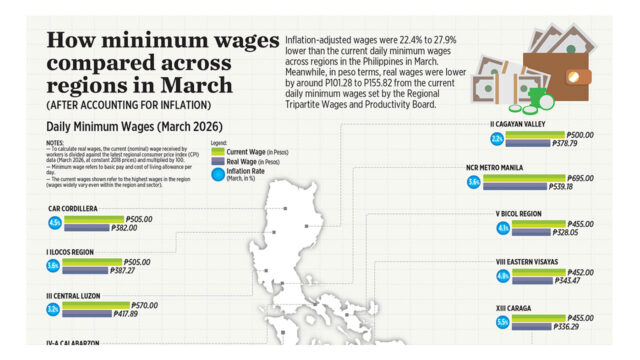
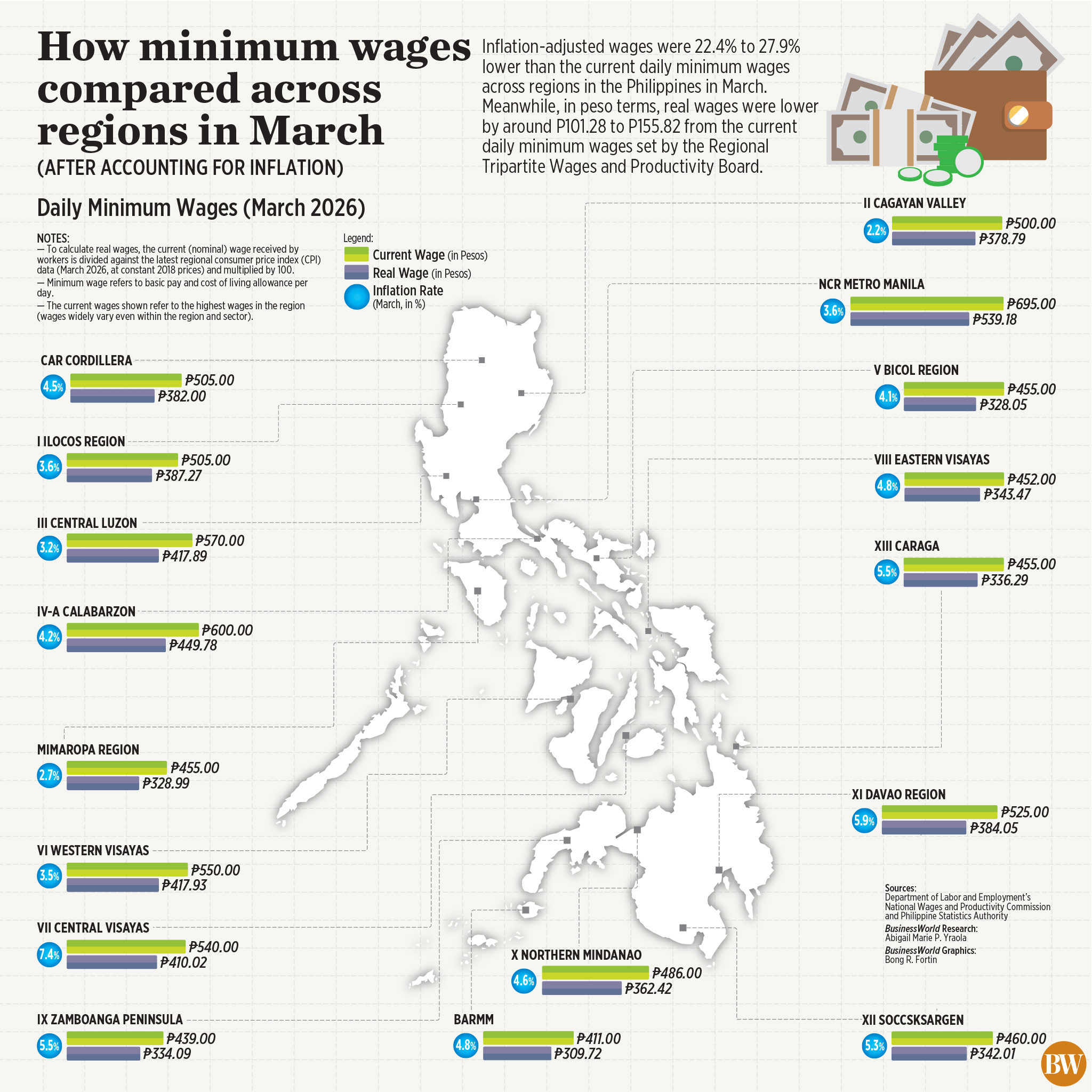
How minimum wages compared across regions in March

(After accounting for inflation)

Inflation-adjusted wages were 22.4% to 27.9% lower than the current daily minimum wages across regions in the Philippines in March. Meanwhile, in peso terms, real wages were lower by around P101.28 to P155.82 from the current daily minimum wages set by the Regional Tripartite Wages and Productivity Board.


PHL shares to consolidate amid fragile ceasefire

PHILIPPINE STAR/KRIZ JOHN ROSALES

STOCKS may consolidate when trading resumes on Friday after a holiday as investors carefully assess risks amid the fragile truce between the United States and Iran.

On Wednesday, the Philippine Stock Exchange index (PSEi) climbed by 2.21% or 132.04 points to close at 6,089.91, while the broader all shares index went up by 1.94% or 65 points to end at 3,415.16.

This was a near one-month high for the PSEi as the market joined a global relief rally after the US and Iran agreed to a temporary ceasefire.

F. Yap Securities Investment Analyst Marky Carunungan said Wednesday’s rally was driven by easing tensions, but he said gains may be limited.

“With gains already frontloaded and the ceasefire still temporary, we expect the market to consolidate when trading resumes on Friday, with upside becoming more selective,” he said in a Viber message.

Any signs of a renewed escalation in the conflict could wipe out gains and shift markets back into risk-off mode, he added.

Regina Capital Development Corp. Head of Sales Luis A. Limlingan likewise said that the Philippine market will take its cue from “any developments from the two-week ceasefire negotiations.”

Asian share markets were in a sober mood on Thursday as cracks quickly began to appear in the fragile Gulf truce, nudging oil prices back up and reminding investors the inflationary fallout would last a long time yet, Reuters reported.

Crucially, there was scant sign that the Strait of Hormuz was open in any meaningful way, with Iran flexing its control over the vital oil artery and demanding tolls for safe passage.

President Donald J. Trump took to social media to declare US forces would remain in the Gulf until a deal was reached and complied with, otherwise the shooting would begin again. Meanwhile, Israel carried out its heaviest strikes on Lebanon since its conflict with Iran-backed Hezbollah militia began last month, killing more than 250 people on Wednesday.

As a result, prices for US crude futures bounced 3.1% to $97.33 a barrel and Brent rose 2.1% to $96.86.

At midday, Japan’s Nikkei dithered either side of flat, after jumping 5.4% the previous session. South Korea dipped 0.4%, following a leap of 6.8%.

Chinese blue chips slipped 0.6%, while MSCI’s broadest index of Asia-Pacific shares outside Japan eased 0.7%.

On Wall Street, S&P 500 futures and Nasdaq futures were both off 0.2% as Wednesday’s surge petered out.

For a mixed Europe, EUROSTOXX 50 futures eased 0.1%, while DAX futures fell 0.5% and FTSE futures rose 0.4%.

With oil prices still around 40% higher than pre-conflict, an inflationary spike is about to show up in the hard data across the globe. — A.G.C. Magno with Reuters

Gov’t agencies face 20% cut in non-essential spending

BW FILE PHOTO

THE Department of Budget and Management (DBM) said it will issue a circular ordering National Government (NG) agencies to reduce non-essential spending by 20%, citing the need to create additional fiscal space.

“We will be issuing the circular on this for all National Government agencies,” Budget Secretary Rolando U. Toledo said at a House hearing on Wednesday.

In a statement issued on Thursday, the DBM said efficiency measures include limiting official travel, maximizing virtual engagements, strengthening energy conservation efforts, and streamlining operational expenditures.

“We exempted education, health, social, general public service, and defense (operations) with frontline services and significant supplies and materials required based on their mandated functions,” Mr. Toledo said.

Depending on the level of compliance, he said the measure is expected to generate savings of between  P12.8 billion and P25.6 billion. 

A legislator on Wednesday proposed cuts as deep as 40%, noting that the projected savings accounted only for 0.3% of the total budget for 2026.

“The DBM welcomes the proposal from our lawmakers to increase the reduction in non-essential government spending from 20% to 40%,” Budget Undersecretary Goddes Hope O. Libiran told BusinessWorld via Viber.

The DBM will undertake a careful and data-driven assessment of the proposal, including an estimate of projected savings, impact on operations, and second-order effects on service delivery and economic activity.

“While expenditure rationalization is a necessary tool during periods of fiscal stress, it must be calibrated to ensure that it does not inadvertently constrain critical government functions or dampen ongoing priority,” Ms. Libiran said.

“Therefore, any adjustment to the current 20% reduction policy will be guided by rigorous analysis, implementation feasibility, and alignment with the administration’s broader fiscal consolidation strategy,” she added.

The DBM has identified P238 billion in available funding to support the government’s response to the energy crisis.

Sourced from the 2026 General Appropriations Act, the funding pool will support fuel subsidies for the transport sector, assistance to farmers and fisherfolk, healthcare support, and other targeted social protection programs. — Justine Irish D. Tabile

Fuel rollback seen possible next week after Iran truce

PHILIPPINE STAR/KRIZ JOHN ROSALES

SOME RELIEF from consecutive fuel price increases could be coming as early as next week as global fuel prices tracked downward after the US announced a two-week ceasefire in its war against Iran, industry officials said.

Bri-gitte Car-mel C. Lim, senior vice-pres-id-ent and chief oper-at-ing officer of Top Line Busi-ness Devel-op-ment Corp., a Cebu-based fuel distributor, said there are strong indications of a rollback next week based on the trends in the first three days of trading this week.

“However, we usually wait for full-week trading before confirming, as market movements can still change,” Ms. Lim told BusinessWorld. “We remain hopeful that the downward trend continues.”

An industry official who declined to be identified told BusinessWorld that initial projections show gasoline prices could drop by as much as P2.50 per liter next week, while diesel may either remain unchanged or fall by P1.

The estimates were based on the three-day trading of the Mean of Platts Singapore (MOPS), a benchmark used for refined oil products.

“MOPS prices and premiums have softened due to the ceasefire deal in the Middle East. However, modest rebounds are seen based on today’s projections,” the source said.

Global markets, particularly those heavily dependent on imported oil such as the Philippines, continue to face volatility in both supply and prices amid the ongoing disruptions in the Middle East and the Strait of Hormuz.

US President Donald J. Trump said the US will stop attacking Iran for two weeks, hours before his deadline for Tehran to reopen the waterway.

In a hearing on Wednesday, Energy Secretary Sharon S. Garin said that it is remains difficult to predict how the ceasefire will impact fuel prices.

“I think the problem will be stay longer than the war itself. It will take some time (before prices) go back to P100 (per liter) or below,” Ms. Garin told legislators.

Fuel companies carried out another round of price increases this week, with increases ranging from P15-P19.80 per liter for diesel and P1.50-P5.90 per liter for gasoline. 

According to global energy price database Global Petrol Prices, the Philippines posted some of the largest increases in gasoline and diesel prices since the outbreak of fighting in the Persian Gulf.

Ms. Garin has said prices may not immediately retreat due to the extensive damage to energy infrastructure in the Middle East, particularly Qatar.

“The speed of the increase in pump prices will not be the same as the drop in prices. In fact, it will be way, way slower (because of the infrastructure damage),” she said. — Sheldeen Joy Talavera

New SIPP expected by next SONA in July

THE Board of Investments (BoI) said it is planning to release the Strategic Investment Priority Plan (SIPP) 2025-2028 before the President delivers his State of the Nation Address (SONA) in July.

“It will be released before the SONA,” Trade Undersecretary Ceferino S. Rodolfo told reporters on the sidelines of the opening day of the Manila International Auto Show on Thursday. 

The DTI is considering adding coal mining and production to the SIPP, he added.

The draft SIPP currently confers priority status to industries that address modern basic needs, as well as export activity and sustainability-driven industries.

The modern basic needs list includes agriculture, fisheries and forestry, manufacturing, halal, kosher, and organic-related activities, services, healthcare and disaster risk reduction management services, infrastructure and logistics, and energy.

Tier-2 priority activities includes goods and services not locally produced and import-substituting activities, while Tier 3 includes highly strategic and innovation-driven activities.

Sustainability-driven industries include industrial and hazardous waste treatment, bulk water treatment and supply, wastewater treatment, and environment or climate change-related projects.

The BoI is set to hold hybrid public consultations with industry, the public, and other partners on the Proposed Partial General Policies  and Specific Guidelines of the draft SIPP.

The SIPP outlines priority industries eligible for tax incentives under the Corporate Recovery and Tax Incentives for Enterprises to Maximize Opportunities for Reinvigorating the Economy Act.

The incentives framework seeks to attract high-value investments to support economic growth and industrialization.

According to the Foreign Investment Promotion and Marketing Plan, the government aims to increase foreign direct investment (FDI) by 5%, with an additional percentage point of growth expected annually until 2028.

Net FDI inflows slumped to a five-year low $7.791 billion in 2025, according to the Bangko Sentral ng Pilipinas. — Beatriz Marie D. Cruz

Changan PH sees sales of 2,500 units this year led by hybrid vehicles

CHANGAN.PH

CHINESE AUTOMAKER Changan PH expects sales to hit 2,500 this year, led by hybrid electric vehicles (HEVs).

“Our target for the year is 2,500 sales, and that’s both the ICE (internal combustion engine) and the EVs,” Changan PH Business Unit Director Ryan Bermudez told BusinessWorld.

For 2026, Mr. Bermudez expects hybrid EVs to account for 70% of the company’s sales, with ICE vehicles will make up 30%. Last year, 80% of Changan’s sales were ICE engines.

He said high fuel prices are expected to boost demand for EVs, as consumers seek more energy‑efficient alternatives to gasoline‑powered vehicles.

“We all know that with fuel prices going up, the perception is there’s going to be a shift to EVs,” Mr. Bermudez said.

Despite this, he noted that gas-powered vehicles remain a practical option for some buyers.

“In terms of the balance of pricing, a hybrid sedan would cost you close to a million pesos. But for an ICE engine, a compact sedan would cost you less than P800,000,” Mr. Bermudez said. 

He added that Filipinos’ awareness of EVs remain limited due to the lack of charging infrastructure nationwide.

“We see companies building charging stations. However, how visible are they to the consumer?” Mr. Bermudez said.

At the end of February, EV sales jumped 66.9% to 5,701, according to a joint report by the Chamber of Automotive Manufacturers of the Philippines, Inc.  and the Truck Manufacturers Association. The segment includes battery EVs, plug-in hybrid EV, and HEVs.

Overall vehicle sales dropped 9.4% to 69,538 units in the two months to February.

For this year, Changan is hoping to launch five models.

The company launched two ICE cars in the first quarter — the entry-level CS15 in January and the Eado Plus car in March. 

At the Manila International Auto Show on Thursday, the company launched its CS35 Max model, which it describes as “a balance of an ICE and a PHEV.” Changan also previewed its CS55 vehicle, which will have ICE and HEV variants.

The company will launch another EV model in the third quarter, Mr. Bermudez said.

“If you look at the cars that we are launching in the Philippine market, it’s a balanced line-up that will cater the needs of our  consumers,” he said.

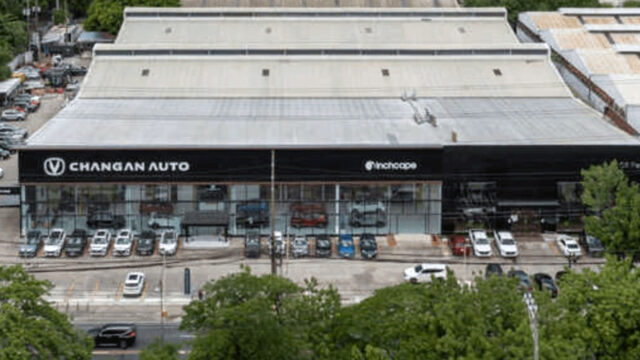
Changan is exclusively distributed in the Philippines by Inchcape Philippines, a joint venture between British automotive distributor Inchcape PLC and CATS Group of Companies. Beatriz Marie D. Cruz

ADVERTISEMENT
ADVERTISEMENT