Home Blog Page 3803

Boeing checks hit paperwork snag; US investigators search for missing part

REUTERS

Safety checks on some Boeing jets hit a snag over paperwork on Sunday, as US authorities searched for a missing panel that blew off a new Boeing 737 MAX 9 jet in midair on Friday.

The Federal Aviation Administration on Saturday ordered the temporary grounding of 171 Boeing jets installed with the same panel after the eight-week-old Alaska Airlines jet was forced to make an emergency landing with a gap in the fuselage.

“They will remain grounded until the FAA is satisfied that they are safe,” the agency said in a statement on Sunday.

The door plug tore off the left side of an Alaska Airlines jet following takeoff from Portland, Oregon, en route to Ontario, California, forcing pilots to turn back and land safely with all 171 passengers and six crew on board.

The force of the 737 MAX 9 decompression was so strong it blew open the cockpit door, according to a person briefed on the investigation.

The accident has put Boeing back under scrutiny as it awaits certification of its smaller MAX 7 as well as the larger MAX 10, which is needed to compete with a key Airbus AIR.PA model.

On Saturday, the FAA initially said the required inspections would take four to eight hours, leading many in the industry to assume the planes could very quickly return to service.

But criteria for the checks have yet to be agreed between the FAA and Boeing, meaning airlines have yet to receive detailed instructions, people familiar with the matter said.

The FAA must approve Boeing’s inspection criteria before inspections can be completed and planes can resume flights.

Of the 171 planes covered by the order, 144 are operating in the United States, according to data from aviation analytics firm Cirium. Turkish Airlines, Panama’s Copa Airlines and Aeromexico said they were grounding affected jets.

Typically, whenever planemakers order routine maintenance checks, they get paperwork approved by regulators in advance.

But because the response to the unexpected Alaska Airlines incident was relatively swift, Boeing has not yet secured FAA approval to tell airlines how to carry out the regulator’s order.

The FAA has the final word on how the order is implemented.


FLIGHTS CANCELED

Alaska Airlines said on Sunday it was “just waiting for the direction from the FAA and Boeing so our inspections can begin.” The airline canceled 170 flights affecting nearly 25,000 customers and said travel disruptions from the grounding were expected to last through at least midweek.

United Airlines canceled 230 flights on Sunday, or 8% of scheduled departures, after parking all 79 of its 737 MAX 9s awaiting the inspection directions.

“We’ve begun steps such as removing the inner panel to access the emergency door, and begun preliminary inspections while awaiting final instructions,” United said in a statement.

Boeing declined to comment on whether it had submitted its inspection criteria to the FAA, which had no further comment.

In message to employees on Sunday, Boeing CEO Dave Calhoun said the company’s response to the accident must be the team’s focus right now.

“When serious accidents like this occur, it is critical for us to work transparently with our customers and regulators to understand and address the causes of the event, and to ensure they don’t happen again,” Mr. Calhoun said.

The company plans to hold a company-wide webcast on safety on Tuesday to address its response. It also canceled a leadership summit for company vice presidents previously scheduled for Monday and Tuesday.


SEARCH FOR PANEL

It is too early to say what caused Friday’s event, National Transportation Safety Board (NTSB) Chair Jennifer Homendy told reporters on Saturday.

The aircraft panel is likely to have landed somewhere in the western suburbs of Portland, but has not yet been found.

The NTSB has asked the public for help finding the panel and also plans to ask commercial property owners to check the rooftops of industrial buildings in the area.

The extra exit door is typically installed by low-cost airlines using more seats that require additional evacuation routes. However, those doors are plugged on jets with fewer seats like the Alaska Airlines plane. To passengers, the area looks like a normal window seat.

A cell phone was located Sunday in the search area that may have blown out of the plane, according to the person familiar with the investigation.

In 2019, global authorities subjected all MAX planes to a wider grounding that lasted 20 months after crashes in Ethiopia and Indonesia linked to poorly designed cockpit software killed a total of 346 people.

Boeing has delivered 214 of the 737 MAX 9 model, or 15% of the more than 1,300 MAX aircraft in service, most of which can still fly, including 737 MAX 9 jets with ordinary doors instead of the replacement panels.


CABIN ISSUES

The fuselage for Boeing 737s is made by Kansas-based Spirit AeroSystems, which also manufactured and installed the plug that suffered the blowout.

Sources familiar with the process said Boeing also has a potential role, since it typically removes the semi-fitted door panel after receiving the fuselages by rail from Spirit. It uses the gap to feed in cabin equipment and speed up production, before completing final installation.

Spirit referred questions to Boeing, which did not respond to a request for comment on who carried out final installation. – Reuters


US opposes displacement of Palestinians, Blinken assures Arab leaders

US Secretary of State Antony Blinken. Official White House — CAMERON SMITH VIA FLICKR

 – US Secretary of State Antony Blinken assured Arab leaders on Sunday that Washington opposes the forcible displacement of Palestinians from Gaza or the occupied West Bank, as he looked to kickstart talks on Gaza’s post-war future.

Jordan’s King Abdullah had raised his country’s concerns over displacement with Mr. Blinken during their meeting in Amman, according to a palace statement, as Israel pushes on with its military campaign that has turned much of Gaza to rubble and left its 2.3 million residents on the verge of starvation, according to aid workers.

“Palestinian civilians must be able to return home as soon as conditions allow. They cannot, they must not, be pressed to leave Gaza,” Mr. Blinken said at a press conference following a separate meeting with top Qatari officials in Doha.

Most of Gaza’s residents have been displaced by the conflict, and violence has also flared in the West Bank, including a deadly clash in the city of Jenin on Sunday.

King Abdullah told Blinken that Washington had a major role to play in pressuring Israel into an immediate ceasefire, and warned of the “catastrophic repercussions” of the continuation of the war in Gaza, which began when Hamas attacked Israel on Oct. 7, killing 1,200 people and taking some 240 hostage.

Israel’s subsequent air and ground assault had killed 22,722 Palestinians by Saturday, according to Palestinian health officials.

Mr. Blinken is touring the region amid heightened fears that Israel’s offensive against Palestinian Hamas militants in Gaza will spark a broader regional conflagration.

“This is a moment of profound tension for the region. This is a conflict that could easily metastasize, causing even more insecurity and suffering,” he told reporters in Doha.

The trip comes after a drone strike in Beirut killed a senior Hamas leader and Israel exchanged fire with Iran-backed militia Hezbollah across its northern border with Lebanon. Washington is also rallying allies to deter attacks on Red Sea shipping by Houthi militants who control most of Yemen.

Mr. Blinken arrived in Jordan late on Saturday and met King Abdullah on Sunday before traveling to Qatar for meetings with Emir Sheikh Tamim bin Hamad al-Thani and Prime Minister Mohammed Bin Abdulrahman al-Thani, who also serves as foreign minister.

In Doha, Mr. Blinken said discussions included efforts to free the more than 100 hostages still believed to be held by Hamas after an earlier agreement mediated by Qatar broke down.

Qatar’s prime minister said the killing of a Hamas leader by an Israeli drone strike has affected Doha’s ability to mediate between the Palestinian group and Israel.

Washington wants Israel’s Arab neighbors to play a role in reconstruction, governance and security in Gaza in expectation that Israel’s assault will eliminate Hamas, which has run the territory since 2007, officials have said.

The US delegation aims to gather Arab states’ views on the future of Gaza before taking those positions to Israel, the US official said, acknowledging that stances would be far apart.

Mr. Blinken will end the day in the United Arab Emirates.


HUMANITARIAN CRISIS

In a camp for displaced people in Rafah, southern Gaza, some Palestinians called on Blinken to live up to US calls for a two-state solution to the conflict.

“We hope that it is a visit for our benefit, for peace’s benefit and for the benefit of establishing a Palestinian state next to a Jewish state, in line with U.N. resolutions … and with what America has been calling for,” said Moussa al-Atawneh, a 76-year-old displaced man.

In Amman, Mr. Blinken visited a World Food Programme (WFP) warehouse storing canned food bound for Gaza.

WFP acting country director for Palestine Laura Turner said ahead of a meeting with Blinken that he should push to halt the conflict and for Israel to open border crossings into northern Gaza.

“That’s where the population is that we haven’t been able to access for six weeks and we’re most concerned about,” Turner said, adding that aid sent north from southern Gaza was being seized en route by other Palestinians also in dire need of food.

Mr. Blinken said the US was working to keep aid routes into the strip open and to multiply them.

“We are intensely focused on the very difficult and indeed deteriorating food situation for men, women and children in Gaza, and it’s something we’re working on 24/7,” Mr. Blinken said. – Reuters

Senior Vatican official makes case for a married priesthood

AERIAL VIEW of St. Peter’s Basilica, Vatican City — ALAN LIU-UNSPLASH

 – The Roman Catholic Church should “seriously think” about allowing priests to marry, a senior Vatican official and advisor to Pope Francis said in an interview published on Sunday.

“This is probably the first time I’m saying it publicly and it will sound heretical to some people,” Archbishop Charles Scicluna of Malta, who is also adjunct secretary in the Vatican’s doctrinal office, told the Times of Malta.

Pope Francis has ruled out any chance that he would change the Roman Catholic rule requiring priests to be celibate. But it is not a formal doctrine of the Church and so it could be changed by a future pope.

A Vatican spokesman did not immediately respond to a request for comment.

Scicluna, perhaps best known for his investigations of sexual abuse crimes, noted that priests were allowed to marry in the first millennium of the Church’s history and that marriage is allowed today in the Eastern rite of the Catholic Church.

“If it were up to me, I would revise the requirement that priests have to be celibate,” he said. “Experience has shown me that this is something we need to seriously think about.”

Scicluna, 64, said the Church had “lost many great priests because they chose marriage”.

He said “there is a place” for celibacy in the Church but that it also had to take into consideration that a priest sometimes falls in love. He then has to choose “between her and the priesthood and some priests cope with that by secretly engaging in sentimental relationships”.

The debate over whether Roman Catholic priests should be allowed to married has been around for centuries.

Priests are allowed to marry in the Eastern Rite of the Catholic Church as well as in the Orthodox, Protestant and Anglican Churches.

Opponents of a married priesthood say celibacy allows a priest to dedicate himself entirely to the Church.

In 2021, the pope dismissed a proposal to allow some elderly married men to be ordained in remote areas in the Amazon where in some places the faithful saw a priest as little as once a year. – Reuters

PHL dollar reserves dip in December

DATA from the Philippine central bank showed gross international reserves (GIR) fell to $102.45 billion as of end-December. — REUTERS

THE PHILIPPINES’ dollar reserves slipped by 0.3% as of end-December, as the National Government paid some of its debt obligations, but still ended the year above the central bank’s $100-billion projection.

Preliminary data from the Bangko Sentral ng Pilipinas (BSP) showed the gross international reserves (GIR) fell to $102.45 billion as of end-December from $102.72 billion in November.

However, the end-December level of dollar reserves rose by 6.6% from $96.15 billion as of end-2022.

The GIR was also higher than the BSP’s end-2023 projection of $100 billion.

“The month-on-month decrease in the GIR level reflected mainly the National Government’s payments of its foreign currency debt obligations,” the BSP said in a statement late on Friday.

At its end-December level, the GIR is enough to cover 7.7 months’ worth of imports of goods and payments of services and primary income.

It is also equivalent to about six times the country’s short-term external debt based on original maturity and 3.8 times based on residual maturity.

Having an ample level of foreign exchange buffers safeguards an economy from market volatility and is an assurance of the country’s capability for debt repayment in the event of an economic downturn.

Rizal Commercial Banking Corp. Chief Economist Michael L. Ricafort in a note said that foreign exchange deposits and gold holdings of the BSP went down as of end-December despite the 1.8% month-on-month increase in global gold prices. 

Based on BSP data, foreign currency deposits plummeted by 62.5% to $716.3 million as of end-December from $1.91 billion a month prior, and by 24% from $942.8 billion as of end-2022. 

The country’s gold reserves were valued at $10.56 billion as of end-2023, lower by 2.4% than $10.82 billion a month earlier but up by 13.8% from $9.28 billion as of end-2022.

Mr. Ricafort said this was offset by an increase in foreign investments due to “the hefty gains in the US/global financial markets in November-December 2023.”

The BSP’s reserves in the form of foreign investments rose by 1.4% to $86.63 billion as of December from $85.42 billion as of November. This was also 6.2% higher than $81.37 billion seen a year ago.

According to the BSP, net international reserves inched up by 0.5% to $102.4 billion as of end-December from $101.9 billion a year ago.

Net international reserves are the difference between the BSP’s reserve assets (GIR) and reserve liabilities such as short-term foreign debt, and credit and loans from the International Monetary Fund (IMF).

The Philippines’ reserve position in the IMF dipped by 2% month on month to $771.4 million and by 2.3% from $789.8 million from a year ago.

Special drawing rights held by the Philippines — or the amount the country can tap from the IMF — stood at $3.78 billion in December, falling by 0.3% month on month but 0.5% higher than $3.76 billion in the previous year.

Mr. Ricafort also noted that the proceeds of the National Government’s Islamic bonds have already been added in the country’s dollar reserves as of December.

In December, the Treasury department said it has raised $1 billion from the sale of 5.5-year Sukuk bonds. The issued bonds were met with high demand as bids reached nearly five times the offer.

For the coming months, proceeds from investment banking activities abroad and dollar bond issuances by the National Government may continue to support the country’s GIR, Mr. Ricafort said

However, this could be offset by government plans to reduce foreign borrowings and better manage foreign exchange risks, he added.

The BSP is expecting to have $102 billion in dollar reserves by end-2024. — Keisha B. Ta-asan

Inflation likely to remain within BSP’s 2-4% target range for most of 2024

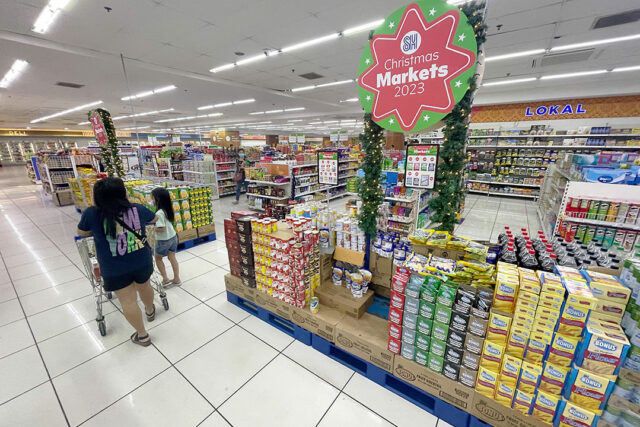
People shop at a supermarket, Dec. 22, 2023. — PHILIPPINE STAR/MIGUEL DE GUZMAN

By Keisha B. Ta-asan, Reporter

HEADLINE INFLATION is seen to remain mostly within the 2-4% target range this year, which may prompt the Bangko Sentral ng Pilipinas (BSP) to begin policy easing, according to analysts.

Makoto Tsuchiya, an economist from Oxford Economics, said inflation will likely settle within the BSP’s target range in the coming months due to base effects. 

“Inflation will then edge up again during the second quarter also due to base effects, but overall, we think the annual inflation will remain within the target in 2024,” he said in an e-mail interview.

Preliminary data released by the Philippine Statistics Authority (PSA) on Friday showed headline inflation slowed to 3.9% in December from 4.1% in November and 8.1% a year ago.

This is the first time inflation hit the 2-4% target in nearly two years. December’s inflation print was also the slowest reading in 22 months or since 3% in February 2022.

However, full-year inflation stood at a 14-year high of 6% in 2023. This was above the 5.8% in 2022, marking the second straight year that average inflation breached the BSP’s 2-4% target band.

According to Mr. Tsuchiya, the slowdown in December inflation was due to lower food and energy prices.

“Among food items, rice prices edged up given continued supply-side issues, but this was more than offset by lower vegetable prices, which declined on the year. Energy prices further led the disinflation, likely due to lower global fuel prices,” he said.

Based on PSA data, the index for food and non-alcoholic beverages slowed to 5.4% in December from 5.7% in the previous month. Food inflation alone went down to 5.5% in December from 5.8% in November and 10.6% a year ago.

However, rice inflation accelerated to 19.6% in December from 15.8% in November. This was the highest print since the 22.9% recorded in March 2009.

The slower December inflation print can also be attributed to the slower growth in prices of housing, water, electricity, gas and other fuels index.

“Our long-held position that headline inflation would return to the BSP’s 2-to-4% target range by the end of 2023 — despite the surprise headline resurgence in August and September — has officially been vindicated,” Pantheon Macroeconomics Chief Emerging Asia Economist Miguel Chanco said in a note.

He said core inflation, which eased to 4.4% in December from 4.7% in November and 6.9% in December 2022, will likely continue to slow as well in the coming months.

“Overall, we continue to believe that annual average inflation will drop sharply to 2.8% this year, comfortably below the BSP’s 4.2% projection, opening the door for the 100-basis-point (bp) in policy rate cuts we expect to see,” he said.

UPSIDE RISKS
However, upside risks to the inflation outlook remain, Mr. Tsuchiya said.

“Weather disturbance will continue, while geopolitical uncertainty could swing commodity prices up and down. We observe other inflationary pressures such as transport fare hikes and minimum wage hikes, but we don’t think they will materially change the picture,” he said.

The El Niño weather phenomenon is seen to enter a stronger phase in January, persisting until May, which would likely lead to weaker agricultural output and food price increases in the country.

In September 2023, the Land Transportation and Regulatory Board raised the minimum fare to P13 for traditional jeepneys and P15 for modern jeepneys. Wage hikes were also implemented in some regions last year.

“More important is the inflation expectation, but here too we know the BSP is highly cautious, so we believe any unwanted inflationary development will be tamed quickly,” Mr. Tsuchiya added.

Meanwhile, the Metrobank Research and Business Analytics Department said it sees average inflation to hit 4.3% this year, slower than the 6% full-year average in 2023, but still above the 2-4% target.

“Our above-target baseline forecast for 2024 remains largely driven by the risk of upward pressure on rice prices, given that exporting countries, particularly, Thailand and Vietnam, have cited that dry spells and flash floods last year have led to a forecasted fall in crops through to 2024,” it said.

Metrobank Research also sees headline inflation to pick up to above 2-4% from second quarter onwards.

Still, dissolving price pressures amid easing core inflation will likely prompt the BSP to consider cutting borrowing costs as early as June, the bank said.

“We think that policy rates may not need to be as restrictive as current levels throughout the year, especially if core inflation continues to move lower,” Metrobank Research added.

The BSP has kept its key interest rate steady at a 16-year high of 6.5% since October, after tightening borrowing costs by 450 basis points from May 2022 to tame inflation.

BSP Governor Eli M. Remolona, Jr. earlier said the Monetary Board is not considering any policy rate cuts in the coming months, as inflation should be seen firmly within the 2-4% target range.

The BSP will have its first policy review this year on Feb. 15.

BoI eyes up to P1.5-trillion investments in 2024

Fireworks are seen over the Makati central business district, Dec. 31, 2023. — MATRIX IMAGES / GEORGE BUID VIA REUTERS CONNECT

THE BOARD of Investments (BoI) is aiming to approve as much as P1.5 trillion in investment pledges this year.

Trade Secretary Alfredo E. Pascual said the BoI’s official target is to approve P1.1 trillion in investment commitments this year.

“But our internal target, of course, is to exceed what we have achieved in 2023,” he said at a media briefing on Friday.

Trade Undersecretary and BoI Managing Head Ceferino S. Rodolfo said the agency’s internal target is to greenlight between P1.3 trillion and P1.5 trillion in investment pledges this year.

For 2023, the BoI approved P1.26 trillion in investment pledges, a 73% increase from the P729 billion worth of commitments approved in 2022.

However, this fell short of the BoI’s P1.5-trillion internal target, which was revised upward from the initial P1-trillion goal.

Under the Program Expenditure Classification, the BoI is aiming to increase its investment approvals by 10% this year.

According to Mr. Rodolfo, the investment promotion agency would have been able to hit the P1.5-trillion mark if the projects worth P272 billion were approved during the Dec. 28 meeting.

“These are several projects which still have documentary requirements and transparency requirements,” he said.

Mr. Pascual expressed confidence the BoI will be able to surpass its 2023 investment approvals.

“You will see, the year is just starting but the BoI has around P300-billion investment eyed to be approved this year. So hopefully, we will be able to achieve and exceed what we were able to achieve in 2023,” the Trade chief said.

The BoI approved investment commitments for 311 projects mainly in renewable energy, telecommunication infrastructure, and the export of copper, gold, and other metals.

“Upon full operations, the projects are expected to produce 49,030 jobs for Filipinos,” the BoI said in a press release.

By sector, the renewable energy (RE) and power sector had the biggest investment commitments accounting for P987.12 billion or a 141% increase from P409.02 billion in 2022.

Investor interest in RE projects surged after the Philippine government allowed full foreign ownership in the sector starting November 2022.

Foreign nationals and foreign-owned entities are now allowed to explore, develop and use RE resources in the country such as solar, wind, biomass, ocean or tidal energy. Foreign ownership of RE projects was previously limited to 40%.

Other sectors that attracted investments include information and communication (P96.04 billion), mining (P79.19 billion), manufacturing (P22.05 billion), and infrastructure (P21.47 billion). 

“An important aspect of the BoI approvals is that a bigger proportion of the approvals are actually foreign investments rather than local investments. Two-thirds are foreign investments, which is used to just comprise 20%,” Mr. Pascual said. 

“This is indicative of how the Philippines is becoming attractive for foreign investors,” he added.

Foreign investment approvals accounted for P766.97 billion of the total approvals or 61%, while local investments made up P493.23 billion or 39%.

Germany was the top source of foreign investments last year accounting for P393.28 billion, which mainly went into wind energy projects.

The other top sources are the Netherlands (P333.61 billion), Singapore (P21.45 billion), United States (P3.55 billion), and the British Virgin Islands (P2.13 billion).

Mr. Rodolfo said he expects the RE sector to continue attracting foreign investments.

“Yes, it will be RE, but in addition to RE, we will now be seeing investments in RE equipment manufacturing. Second, mineral processing, which we expect to come out from the previous presidential visits,” he said.

He said that a lot of foreign investments, mainly in RE, are expected to come from Europe. The BoI is also expecting more investments to come from South Korea, US, China and Japan. — Justine Irish D. Tabile

Philippines’ top 1,000 companies post P16.7 trillion in revenues in 2022

By Lourdes O. Pilar, Researcher

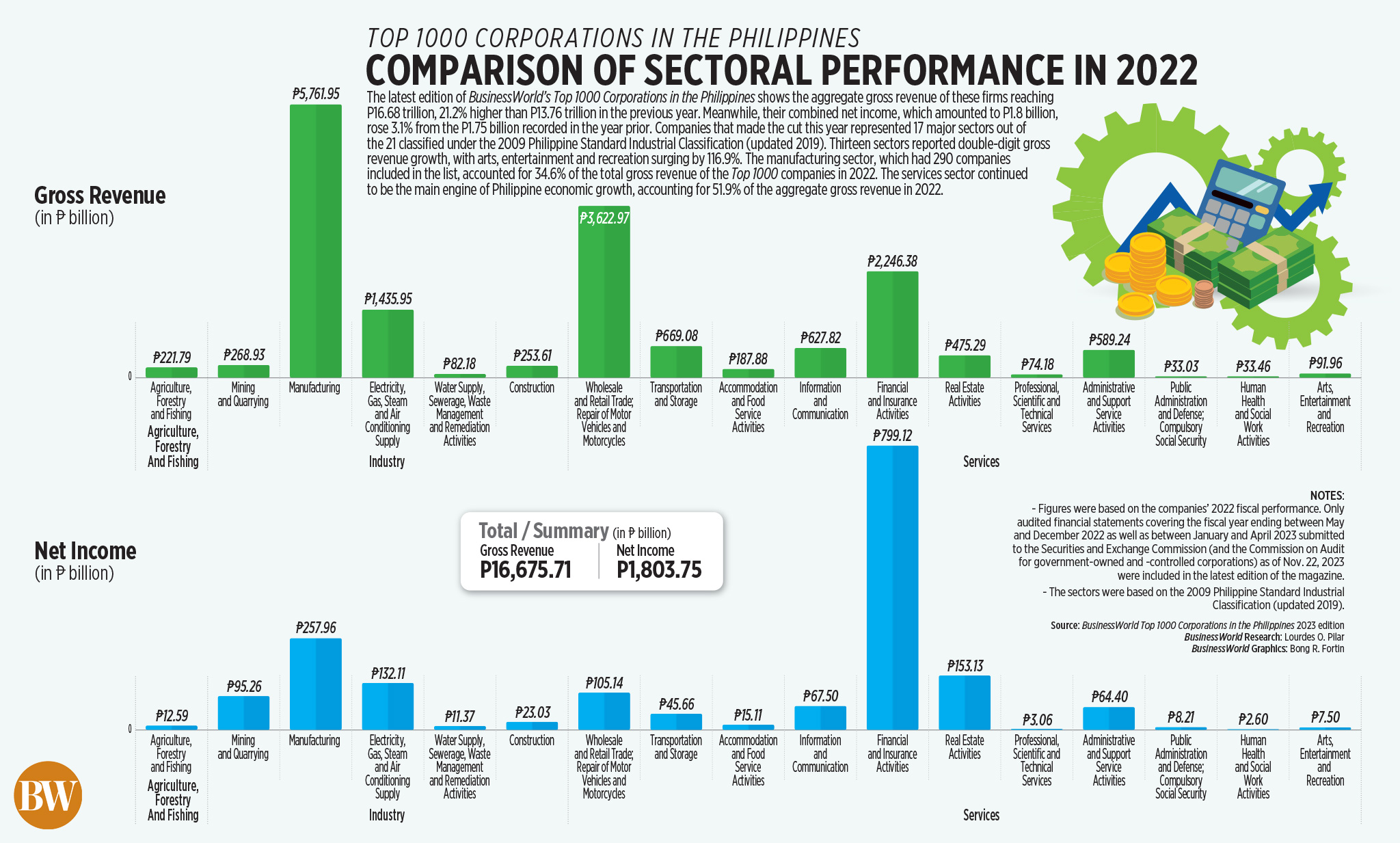
THE TOP 1,000 corporations in the Philippines showed resilience in 2022 after posting a combined gross revenue of P16.68 trillion, as economic activity picked up after pandemic-related restrictions were lifted.

The BusinessWorld Top 1000 Corporations in the Philippines report showed the firms’ aggregate gross revenue surged by 21.2% in 2022 from P13.76 trillion posted in 2021.

This was the fastest revenue growth in two years following the 13.2% contraction recorded at the height of the coronavirus pandemic in 2020.

Top 1000 Corporations in the Philippines: Comparison of sectoral performance in 2022

BusinessWorld defines gross revenue as the combination of net sales and nonoperating income.

Meanwhile, the top corporations’ combined net income rose by 3.1% to P1.8 trillion in 2022 from P1.75 trillion in the year prior.

The firms’ financial performance reflected the Philippine economy’s strong rebound in 2022.

In 2022, the country’s gross domestic product (GDP) grew by 7.6% in 2022, faster than the 5.7% growth recorded in 2021 and the highest in more than 40 years or since the 8.8% growth in 1976.

It also exceeded the government’s 6.5-7.5% GDP growth target for the year.

On its 37th year, the BusinessWorld Top 1000 ranks private and public stock corporations based on gross revenue using the latest available full-year audited financial statements.

The latest edition of the Top 1000 had a gross revenue cutoff of P2.976 billion, 32% higher than the previous edition’s P2.254 billion.

Out of the 1,000 companies in the list, 827 saw an increase in gross revenue in 2022, higher than the 793 companies in the previous year.

The report showed 631 companies posted a net income growth in 2022, while 369 saw a decline in profit.

There were 70 firms that swung to a profit in 2022 after recording a net loss in the previous year, while 22 companies slumped to a net loss.

Meanwhile, 29 firms remained in the red.

Firms included in the Top 1000 list represented 17 out of the 21 major sectors under the 2009 Philippine Standard Industrial Classification (updated 2019).

Thirteen sectors reported at least double-digit gross revenue growth, with the arts, entertainment and recreation sector’s revenues surging by 116.9% in 2022. The human health sector’s revenues eased to 5.3% in 2022 from 19.3% in the previous year.

On the other hand, revenues of real estate activities declined by 0.8%, while those of the public administration and defense, compulsory social security sector dropped by 10.9%.

The manufacturing sector, which had 290 companies included in the list, accounted for 34.6% of the total gross revenue of the Top 1000 companies in 2022.

The services sector continued to be the main engine of Philippine economic growth, accounting for 51.9% of the aggregate gross revenue in 2022.

Multinational companies included in the Top 1000 list made P5.51 trillion, 17.4% more than in the previous year. They accounted for 33.1% of the Top 1000’s gross revenues.

Exporting firms recorded a 15% increase in revenues to P2.95 trillion, although this was slower than the 19.7% growth in the previous year. The sector accounted for 17.7% of the list’s total gross revenues.

The latest Top 1000 report included 139 corporations, of which 37 are first-time entrants.

Petron Corp. returned as the largest corporation in the Philippines in 2022, ending Manila Electric Co.’s (Meralco) two-year stint as the country’s top-grossing company.

Petron, which last topped the list in 2019, posted P438.87 billion in gross revenue in 2022, which was an 82.1% increase from P240.94 billion the previous year.

The oil refiner and distributor also topped the list in terms of net sales with P430.73 billion, but its net income fell by 4.9% to P2.54 billion. Petron ranked 179th in net income.

Meralco ranked second in the list, as its gross revenue rose by 30.9% to P382.42 billion from P292.09 billion in 2021. It also placed second in net sales with P371.76 billion. The company posted a net profit of P21.69 billion in 2022, up by 1.8% from P21.3 billion in the previous year.

Shell Pilipinas Corp. remained in third spot as its gross revenue jumped by 63.3% to P292.88 billion from P179.39 billion in 2021. The petroleum refinery ranked third in terms of net sales (P291.48 billion) and 109th in net income (P4.08 billion).

Also included in the top 10 were BDO Unibank, Inc. (P209.29 billion in gross revenues); Mercury Drug Corp. (P177.59 billion); PMFTC, Inc. (P176.99 billion); Toyota Motor Philippines Corp. (P173.27 billion); Globe Telecom, Inc. (P158.87 billion); TI (Philippines), Inc. (P154.93 billion); and Philippine Airlines (P145.8 billion).

The Top 1000 magazine also provides a separate table to show how companies compare with each other on a consolidated basis.

With this consolidated table, readers will be able to see how additional revenues com-ing from subsidiaries can boost a conglomerate’s rank.

The top 200 conglomerates list was led by Top Frontier Investment Holdings, Inc. and subsidiaries with P1.58 trillion in gross revenue in 2022, higher by 61.8% from 2021. It is the largest shareholder of San Miguel Corp. (SMC). However, the conglomerate’s net income fell by 45.8% to P23.86 billion in 2022 from P44.06 bil-lion in 2021.

Listed diversified conglomerate SMC and its subsidiaries came in second, with P1.58 trillion in gross revenues, a 61.4% increase from P979 billion previously.

Petron and subsidiaries claimed the third spot with P865.58 billion in gross revenues, a 96.4% increase year on year.

The rest of the top 10 conglomerates included SM Investments Corp. (P557.68 billion); Meralco (P445.34 billion); San Miguel Food and Beverage, Inc. (P360.18); Aboitiz Equity Ventures, Inc. (P335.65 billion); Ayala Corp. (P332.62 billion); JG Summit Holdings, Inc. (P313.98 billion); and GT Capital Holdings, Inc. (P245.31 billion).

The BusinessWorld Top 1000 Corporations in the Philippines can be purchased directly by reaching out to BusinessWorld’s Circulation Department at (+632) 8527-7777 locals 2651 to 2654 or via e-mail at circ@bworldonline.com. The portable document format (PDF) version will also be available for purchase at https://bworld-x.com/.

Community competition

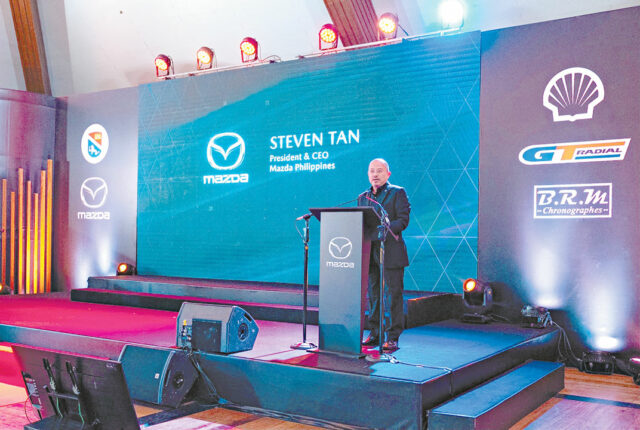
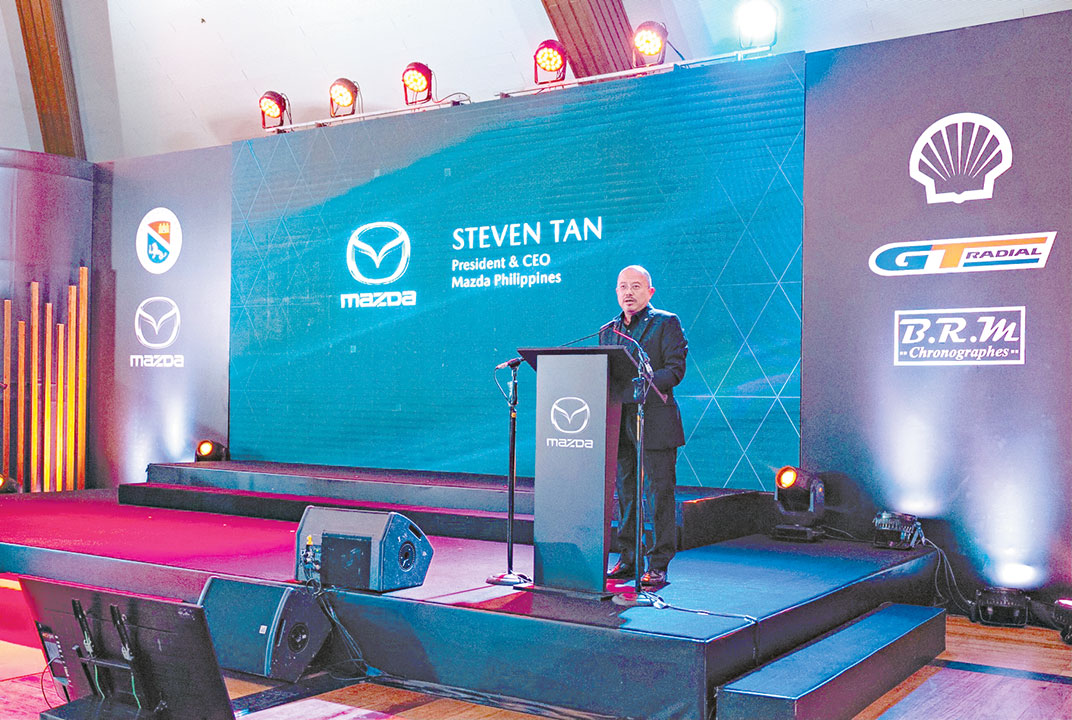
Mazda Philippines President and CEO delivers a speech at the awards night. — PHOTO BY ANGEL RIVERO

Season 2 winners of the MSCC Miata Spec Series awarded

THERE’S SOMETHING really beautiful about having a Mazda Miata race series in the Philippines — and I’m not just talking about the spectacle of seeing this many MX-5s. I’m talking about the energy and philosophy behind it. You see, a Mazda Miata race is a gentleman’s (or gentlewoman’s) race — period. Participants race hard, but at the end of the day, they’re all family. So, people have an elevated respect for preserving each other’s vehicles. It’s a very unique dynamic that is birthed out of each Miata owner’s passion for the iconic car, and for driving.

Something magical happens in there because behind the steering wheel of a Miata, enthusiasts not only discover its incredible balance and agility, but they begin to embrace a special ethos — that which is founded on an intangible connection between man and machine, that it basically elevates the driving experience to an art form. Does that sound too profound for you? I can tell you that this energy is real — I’ve hung out with these people myself, and it’s truly something to write about.

It’s therefore been very nice that the MSCC (Manila Sports Car Club) Miata Spec Series has continued on to a second season in 2023. And before the year formally ended, the victors were awarded at the Manila Polo Club.

The MSCC Miata Spec Series Awarding Gala unfolded as a kaleidoscope of automotive enthusiasm. Mazda Philippines President and CEO Steven Tan pointed out during his opening remarks that while one prominent element of the race series is the iconic car, the other element is certainly the driver. He also shared how happy he was to witness how the race series brought different combinations of people together: father and child, husband and wife, and the like.

The race season itself also turned out to be quite exciting, as it was hard to tell until the very end who was going to win. Some were only leading by two points before the last race — so it could have been any driver’s race. And each leg was hard fought.

Windy Imperial attested, “It may not be the biggest, but it is the best race series to join! There is no coincidence that the Miata is the best-selling roadster ever. It’s the most-raced sports car, too!” He also emphasized that not a single Miata has ever retired because of reliability issues — even if it’s racing hard. He went on to say that this is only evidence of “the strength of the car, and also the strength of the organization behind it.”

And as each category winner enjoyed recognition on stage, the energy in the room also exuded the spirit of camaraderie among people united by their shared affection for the charming roadster. The occasion did not just celebrate victories on the asphalt, but the significance of a community bound by a passion for driving.

So it appears that when on the racetrack, each Mazda Miata becomes not just a contender, but also some kind of a conduit for enthusiasts to channel their ardor for driving pleasure into. This way, I suppose, everybody wins!

Congratulations to all the race victors!

Ford Territory: Driving to new ground

PHOTO BY DYLAN AFUANG

We experience the improvements found on Ford’s strong-selling crossover

By Dylan Afuang

THE LATEST Territory crossover that Ford Philippines has said sold 5,000 units since its April 2023 launch — adding to the 20,000 units sold by the nameplate’s first iteration — seemed like the perfect vehicle for road trips.

It had the ingredients for being such, as made apparent during an experiential driving event the company had staged. The event featured the model’s two variants, the Titanium (P1.335 million) and the Titanium X (P1.599 million).

And although this wasn’t the occasion’s deliberate objective, we were also able to observe the improvements of the newest vehicle over its predecessor — even when the former is built upon the same structure of the original, much of which was derived from a Chinese vehicle.

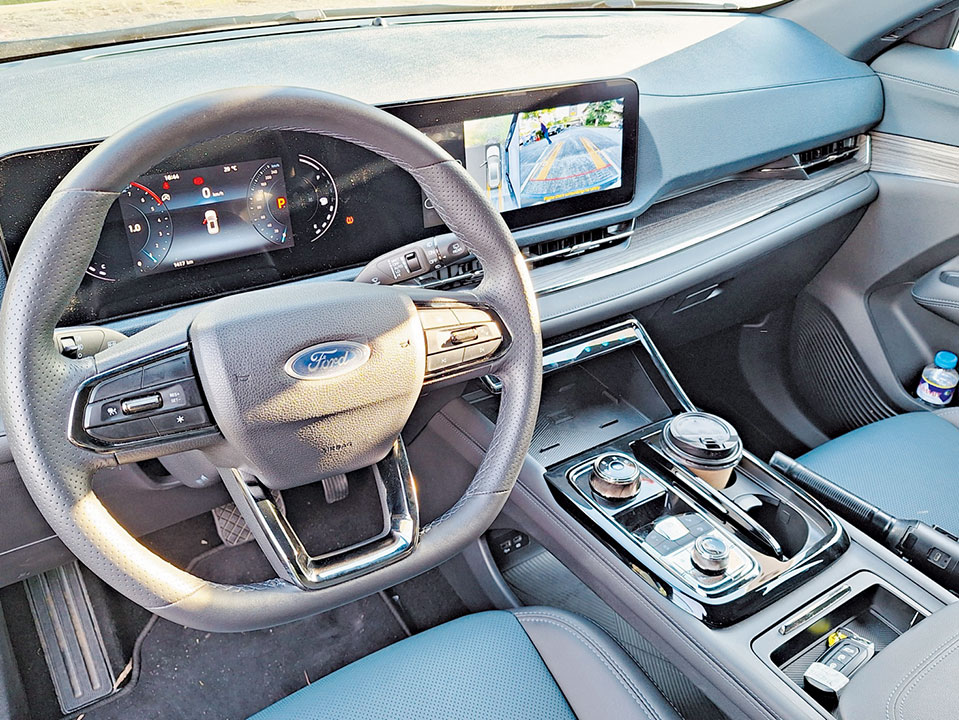
Before setting off, the new Territory already made good first impressions. It dropped Ford’s design touches oddly mixed with Yusheng’s sheetmetal of the previous model, in favor of seamless curves and subtle bulges. The crossover’s cohesive styling is the result of the Chinese-penned “Progressive Energy Through Strength” design language.

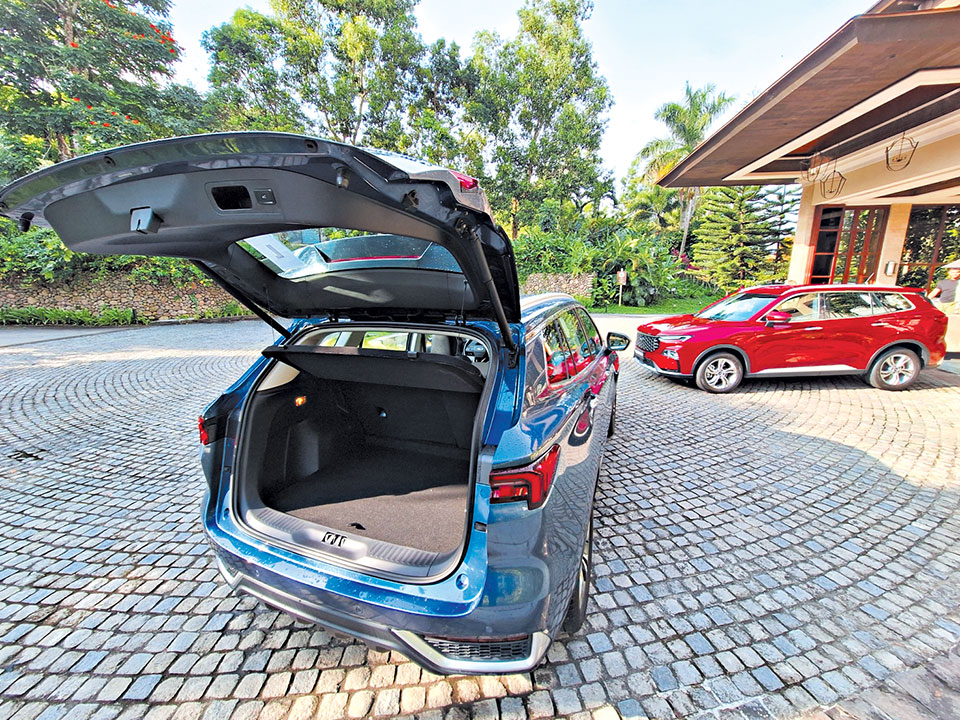
While it measures a few millimeters narrower than the old car, this compact crossover’s dimensions are larger elsewhere, which lends to its more sizable road presence — and most notably, opens up more room inside the cabin for five passengers and the stuff they may bring along for the journey.

Aside from being more spacious than before, the interior room feels that it exceeds the class average. The cockpit is roomy even with the wide center console, and two rear occupants can sit cross-legged when the middle seat isn’t occupied. Cargo area is as expansive at 448 liters with a wide opening and accessible loading lip.

In the Titanium X variant, that cargo area can be accessed through a powered tailgate. Shared between the two variants are comfortable power-adjustable driver seats, keyless entry with push-start ignition, digital climate controls, and wireless Apple CarPlay and Android Auto projected upon a 12-inch touchscreen.

On the move, we didn’t find controlling the climate functions and the driving modes through screens neither intuitive nor safe. On the other hand, the sharpest driving mode maximized the already brisk 158hp and 248Nm of torque output of the 1.5-liter turbo engine, and quickened the shifts of the smooth seven speed dual clutch automatic that spun the front wheels.

The Territory also steered a tad sharper than it used to, the cabin better insulated the outside noise, and the ride exhibited a serene quality. Even though the laid-back crossover is better suited to highways than on back roads, there’s a newfound quality in its driving experience.

Once driving ended, proximity sensors and a 360-degree camera made parking easier, or we relegated the task to Ford’s Active Park Assist technology (standard on both variants), while the Titanium model features blind-spot warning and standard cruise control, and lane-keeping assist, frontal collision avoidance, adaptive cruise control are found on the X.

All of these — and the Territory’s five-year warranty or up to 150,000 km, whichever comes first — make it an attractive choice for roads short and, quite possibly, long, too.

PSE told to explain trading halts much sooner

REUTERS

By Revin Mikhael D. Ochave, Reporter

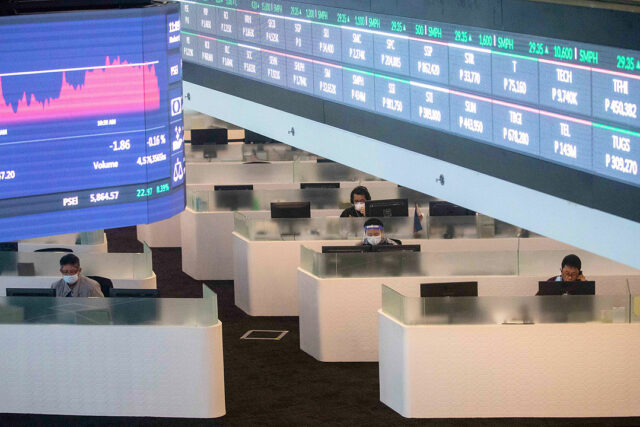
THE Philippine Stock Exchange (PSE) should promptly disclose the cause of trading halts to ensure confidence in local financial markets, analysts said at the weekend after the bourse halted trading for two hours on Jan. 3 due to a technical glitch.

“Prolonged trading halts are disruptive, so hopefully we do not see any recurrence,” Juan Paolo E. Colet, managing director at China Bank Capital Corp. said in a via Viber message. The PSE should have explained the glitch “much sooner.”  

“They should have explained the situation much sooner. Timely disclosure of information is essential to financial markets, and this is something we have to keep in mind if we want to ensure confidence in our local stock market,” he added.

The PSE provided more details about the glitch in a statement two days later.

It said the Jan. 3 trading halt from 9:32 to 11:55 a.m. was due to a glitch encountered by its mobile trading application and its process of authenticating all accounts. This affected at least a third of trading participants.

The main index closed 0.8% lower.

“The technical problem encountered was the inability of at least one-third of the trading participants to connect to PSE’s front-end order management system and for some of these the trading participants, the inability to send orders to the trading system,” the PSE said.

The front-end order management system sends buy-and-sell orders for processing to the trading system.

The PSE said the issue happened in one of the four silos in the system, which experienced stalled processes given the iterative authentication steps.

The bourse and front-end order management system developer have implemented a design optimization on the mobile trading application and were working on further enhancements to prevent the issue from happening again, it added.

“The PSE remains steadfast in its commitment to engage with all stakeholders and service providers towards continuously improving and future-proofing its products, systems, and services for the investing public,” the market operator said.

Any disruption in the local bourse does not look good “especially from the point of view of international professional fund managers,” Michael L. Ricafort, chief economist at Rizal Commercial Banking Corp. said in a Viber message.

“Reliability of the trading infrastructure is one of the criteria of international investors, especially the ability to freely buy or sell stocks during trading days,” he said. “This is also part of their market risk and operational risk assessment for investing in the local stock market.”

“The reliability, security, and integrity of the local stock market trading system and overall infrastructure would also determine the level of international investor confidence,” he added.

Technical issues also caused the PSE to open late in January 2023 and to cancel trading for an entire day in January 2022.

The bellwether Philippine Stock Exchange index on Friday gained 0.41% or 27.12 points to close at 6,629.64. The broader all-share index added 0.48% or 16.76 points to close at 3,502.52.

Shell, NEO unveil EV charging hub in Taguig

From left are Shell Real Estate Program Manager Pol Atuelan, Shell Real Estate EV Portfolio Asia Manager Millicent Ngo, Shell Engineering Manager Ronald Gatbonton, Shell Head of E-Mobility and Innovations Jolo Valdez, Shell Mobility Vice-President Randy Del Valle, NEO CEO Raymond Rufino, NEO President Charlie Rufino, NEO Co-Managing Director and Chief Sustainability Officer Gie Garcia, and NEO Co-Managing Director Carlo Rufino.

SHELL PILIPINAS CORP. and real estate firm NEO revealed the latest Shell Recharge electric vehicle (EV) facility late last year. Located at Seven/NEO Bonifacio Global City in Taguig, the charging service (as we go to press) is free of charge. This is the latest addition to the Shell Recharge network which now has ultra-rapid charging stations at Shell SLEX Mamplasan and at the recently opened Shell TPLEX exit in Rosario, La Union.

The Shell Recharge charging station has AC22kW charging points capable of charging two vehicles simultaneously. The EV charging location is 100% renewable as it is fully powered by geothermal energy — the first-ever for Shell globally.

At the opening event, the first EVs to be charged were Shell’s very own service vehicles used to transport Shell staff from Shell Business Operations Manila. Said Shell Vice-President for Mobility Randy Del Valle, “Shell is already a global leader in the EV space, and we are happy to work with our customers and partners across private and public sectors as we decarbonize mobility and power progress in the Philippines. NEO is a leader in sustainable real estate and shares Shell’s vision of a lower-carbon future.”

NEO has the country’s first net-zero portfolio of buildings certified by the Philippine Green Building Council’s (PhilGBC) Advancing Net Zero Philippines and the International Finance Corp.’s EDGE Zero Carbon. NEO is led by its CEO Raymond Rufino, who also sits in the Urban Land Institute FY24 advisory board.

JLL expects more property conversions this year

By Sheldeen Joy Talavera, Reporter

MORE Philippine real estate may be converted into housing and retail spaces this year as property developers repurpose out-of-date buildings, according to JLL.

“With many buildings now out of date — if not yet out of use — and others simply failing to generate suitable yields, conversions are increasingly on the cards,” Walid Goudiard, JLL head of project and development services, said in an e-mailed reply to questions last week.

Developers might diversify more property assets because of the conversion, JLL said.

Sean Coghlan, JLL’s global head of capital markets, said the diversification “will take different forms” depending on location. “Even for those sectors which are currently out of favor, we still see a place for global diversified portfolios.”

In a report, JLL said the conversion of existing office real estate into housing in the Asia-Pacific region is driven by high demand for urban living.

“We will see easing interest rates — estimated Q3 onwards — and construction costs should trend down in 2024,” JLL Philippines head of capital markets P. Ryan Isip said.

Construction prices in Metro Manila at the wholesale and retail levels fell by 1.7% and 1.1%, respectively, in November, data from the Philippine Statistics Authority showed.

Growth in the wholesale and retail segments remained steady for at least two straight months.

“We can expect expansion in both retail and residential property in 2024,” Mr. Isip said.

Juan Paolo E. Colet, managing director at China Bank Capital Corp. expects the residential and retail segments to perform well this year.

“Potential tailwinds for residential properties are lower borrowing costs, higher remittances from overseas Filipinos, and continued economic expansion,” he said in a Viber message.

“Meantime, malls and other retail real estate will benefit from increased foot traffic due to lower inflation and more experience-based offerings to attract consumers,” he added.

Philippine inflation eased to 3.9% in December — the slowest in 22 months — thanks to slower increases in the prices of key food items and utility costs.

December inflation was the slowest reading in 22 months or since the 3% print in February 2022.