Home Blog Page 3601

WB: PHL inflation seen within 2-4% band each month of 2024

A woman buys food items at a supermarket in Quezon City, March 4, 2022. — PHILIPPINE STAR/ MICHAEL VARCAS

INFLATION in the Philippines may settle within the 2-4% target band for every month in 2024, the World Bank (WB) said, though it warned of the need to remain alert for risks to the inflation outlook.

At the 2024 International Tax Conference, World Bank Philippine Senior Economist Ralph van Doorn said containing inflation through both monetary and non-monetary measures remains the main challenge this year.

“We think it’s likely that inflation will stay over the whole year between 2-4%,” he told reporters on the sidelines of the event. “We know there are risks to it, but we’ll have to see if they materialize. If we see that these risks are becoming more concrete, then we will have to also make adjustments to our projections.”

The Philippine Statistics Authority reported that headline inflation decelerated to an over three-year low of 2.8% in January, marking the second straight month it fell within the Bangko Sentral ng Pilipinas (BSP) target range of 2-4%.

In its December update, the World Bank projected Philippine inflation to settle at 3.6% this year and 3% in 2025. The BSP expects inflation to average 3.6% this year and 3.2% in 2025.

Asked if easing inflation could prompt the BSP to cut borrowing costs, Mr. Van Doorn said it is difficult to forecast what the BSP will do.

“We have to really let the central bank do its job,” he said. “The BSP has a very data-driven approach, so it will look carefully at inflation, at underlying core inflation and inflation expectations before making a decision on rate cuts.”

The BSP has kept its benchmark interest rate unchanged at a 16-year high of 6.5% for three straight meetings. It had hiked rates by 450 basis points (bps) between May 2022 and October 2023 to tame inflation.

BSP Governor Eli M. Remolona, Jr. has said that the Monetary Board may consider a rate cut in the second half, but cited as a condition that inflation be firmly within the 2-4% target.

Mr. Van Doorn said the World Bank sees global and domestic risks for the Philippine economy this year.

“We see tensions and wars in various parts of the world, and that means this all could have an effect on supply chains, on food supply, on fuel prices,” he said.

“If that happens, it’s most likely to have an effect on many countries that import food and fuel, and the Philippines is one of them,” he said.

Another risk is that major central banks may keep their own monetary policy tighter for longer, as global inflation may be “stickier-than-expected,” which could affect the Philippines as well.

The BSP is widely expected to maintain an interest rate differential with the Federal Reserve to shield the peso from depreciation pressures and volatility.

The Fed has kept borrowing costs unchanged at 5.25-5.5% since September, following the combined 525 bps worth of rate hikes implemented between March 2022 and July 2023.

“Our third risk would be more of a domestic nature. We see the risk of El Niño, the impact it could have on the agricultural sector, and that could have an effect on the food supply and food prices,” Mr. Van Doorn said.

He also cited uncertainties like the proposed minimum wage hikes, which could stoke inflation and add pressure to inflation expectations.

“It’s important to be very careful in considering these wage hikes to make sure that inflation expectations remain anchored at between 2-4%,” he said.

Legislators have been considering whether to increase minimum wages in the private sector by P100.

Meanwhile, investments into the Philippines will be challenging this year due to a slower global growth outlook, he said.

“But we also see that that country has done a lot (to) attract investment, passing very important laws that promote investment competitiveness. It’s important to implement these and make sure investors know about it,” Mr. Van Doorn said.

The central bank reported that net inflows of foreign direct investment (FDI) grew 27.8% year on year to $1.048 billion in November.

This was the highest FDI net inflow level recorded for an individual month since the $2.662 billion posted in December 2021.

Month on month, net FDI inflows rose 60% from $655 million in October.

The BSP projects FDI net inflows of $8 billion by the end of 2023 and $10 billion at the end of 2024.

Separately, Finance Secretary Ralph G. Recto met with World Bank Group Managing Director and Chief Financial Officer Anshula Kant to discuss how to improve the bank’s lending terms for the Philippines and identify potential areas for partnership.

“The World Bank committed to introducing innovative financial instruments tailored to the needs of the Philippines,” the Department of Finance (DoF) said in a statement on Tuesday.

“These include instruments specifically designed to sharpen the country’s crisis toolkit to ensure swift access to funding during times of emergency,” it said.

The DoF and the World Bank reiterated their strong commitment to boost the government’s socioeconomic agenda through their partnership, the DoF added. — Keisha B. Ta-asan
Prototyping wafer fab deemed crucial for chip industry development

REUTERS

By Justine Irish D. Tabile, Reporter

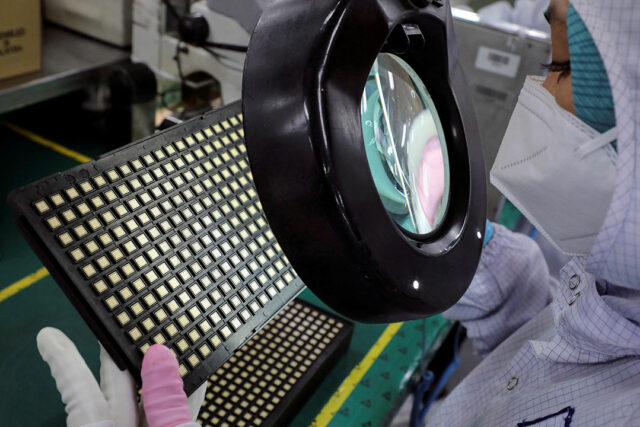
THE GOVERNMENT economic team’s coordinating secretary, Frederick D. Go, said the establishment of a laboratory-sized wafer fabrication plant for prototyping will address the current gaps in the chip industry’s capabilities.

“We are targeting to boost what we are already good at and to grow the integrated circuit (IC) design industry by establishing a prototype or laboratory-sized wafer fab,” according to Mr. Go, who heads the Office of the Special Assistant to the President for Investment and Economic Affairs.

Speaking at the World Trade Center Metro Manila late Monday, Mr. Go said that the semiconductor industry is already strong in the assembly, testing, and packing elements of the value chain.

He said the development of the new capability is a presidential priority, with the Board of Investments (BoI) and the Department of Trade and Industry (DTI) directed to pitch possible investors.

He added that the government-owned National Development Co. (NDC) will support and fund the project.

“Obviously, we have to get the support of the various agencies to roll out these priority programs and initiatives,” Mr. Go said.

“I told DTI and BoI that we want to really grow the semiconductor and microelectronics sectors. And one way to really do it is by doing this project, and I’m very glad that they’re very supportive of this,” he added.

Mr. Go also said that he will seek the support of the Department of Science and Technology (DoST), Semiconductor and Electronics Industries in the Philippines Foundation, Inc. (SEIPI), and the private sector.

“We can probably put this together with the support of the DoST, DTI, and SEIPI. If you put all these three and the private sector participants together, I believe we can get this done,” he said.

He added that a full-sized wafer fabrication plant may be possible in the future with “a mature assembly and packaging industry, a strong IC design industry, and reduced power costs.”

“Unfortunately, I think that would be beyond my term in office. But we must lay the foundation now,” he added.

NDC General Manager Antonilo DC. Mauricio, who also attended the event, said the company is often tapped for projects such as the prototype wafer fabrication plant.

“Since we are a government investment company, we identify gaps that need a corporate vehicle for national development. And normally, since there’s no other company like us, they think about us for pushing opportunities like this,” Mr. Mauricio said.

Philippine Economic Zone Authority (PEZA) Director General Tereso O. Panga said a wafer fabrication plant is on the wish list of the US delegation expected to visit the Philippines.

“That is the purpose of the US delegation’s trip here — to look at the possibility of putting up a wafer fabrication plant,” Mr. Panga said on the sidelines of the event. “It’s upcoming, but we are also in coordination with the US Trade and Commercial Section.”

Mr. Panga recently met with US officials led by Economic Counselor Phil Nervig, Trade and Investment Economic Officer Tom Pohlman, Commercial Specialist Easter Villanueva, and Economic Specialist Alta Paraiso.

The US is currently diversifying its chip sourcing and building up its on capacity in light of the risks posed by a potential disruption of chip supply from Taiwan.

PEZA reports that the US is the investment promotion agency’s second largest foreign investor, accounting for 14.16% of its registered business enterprises, including Texas Instruments, Collins Aerospace, Analog Devices, Concentrix, MOOG, Teradyne, and JP Morgan Chase Bank.

“With PEZA being home to the largest industry players in the semiconductor industry, the parties also discussed collaboration through the CHIPS and Science Act, a US policy initiative aimed at diversifying its semiconductor supply chain,” PEZA said in a statement on Tuesday.

Expected on March 11-12, the US Presidential Trade and Investment Mission will be led by US Secretary of Commerce Gina Raimondo.

“With the incoming high-level trade mission to be dispatched by President Joseph R. Biden in March, PEZA is bullish on welcoming more US companies to increase their investment portfolio in the economic zones from the current P404.37 billion pesos,” Mr. Panga said.

Unfunded Mindanao rail may need to undergo further NEDA review

JOHANNES PLENIO-UNSPLASH

THE Department of Transportation (DoTr) may need to bring the feasibility study for the Mindanao Railway project back to the National Economic and Development Authority (NEDA) to update the proposal, with the withdrawal of financing from China requiring an overhaul of cost estimates and a change of contractors.

Transportation Secretary Jaime J. Bautista in a briefing on Monday said the government has not sought financing from the Japan International Cooperation Agency (JICA) or other official development assistance (ODA) sources for the project.

“We will need to review the detailed engineering design and since this project has been delayed, we might need to again bring this to NEDA for updating,” he said.

Earlier this month, Mr. Bautista said the DoTr will continue to work on the first phase of the Mindanao Railway project after withdrawing its request for ODA from China.

The DoTr will also continue the various pre-construction activities in Davao City while negotiating funding for the project.

“We inherited this project from the previous management and they have started working with some landowners so there are lot owners already paid,” Mr. Bautista said.

“But since we will update the feasibility study, we will have to again look at the numbers and if the cost is more than 10%, we will need to go back to NEDA. Also, we’ll need to look at the ridership because the alignment is almost similar to the existing highway,” he said.

He said the government is hoping to update the feasibility study within the year, calling the Mindanao rail project “important,” noting, “we’ve already promised this.”

Mr. Bautista also said NEDA approval process has been efficient, citing the Manila International Airport project, which only took six weeks to approve.

“As long as we give the right information and numbers to NEDA, they will be able to work fast and issue the approval,” he said.

Last year, the DoTr said it is considering applying for ODA with Japan, South Korea, or India to fund the government’s three major railway projects, including the Mindanao Railway, after ruling out China as a funding source.

The decision to withdraw the Philippine request for ODA from China was due to lack of progress in signing a loan deal.

Finance Secretary Ralph G. Recto said there is a possibility the project could be implemented as a public-private partnership (PPP).

“We already have the new PPP Code. We are just awaiting as well as the updated feasibility study of the project and then we can discuss the best way to procure the project,” he said.

Jeremy S. Regino, undersecretary for railways, said the financing could very well involve DoTr budget funds, ODA, or private partners, adding that the mix of financing “will make the project more viable.”

Meanwhile, JICA Chief Representative Sakamoto Takema said the aid agency has not received any information from the Philippine government regarding the project.

“We respect the preparation of the well-organized plan like the master plan. We don’t know the details of the project. We need to see more information, maybe after (the proposal is updated) by DoTr,” he said.

The first phase of the Mindanao Railway project covers the 102-kilometer segment from Tagum City, Davao del Norte to Digos City, Davao del Sur. This segment is valued at P81.6 billion.

Once finished, the line will serve around 122,000 passengers a day and is expected to reduce travel time to one hour from the current three hours from Tagum City to Digos.

Separately, Mr. Regino said the Philippines has not terminated its negotiations on the Philippine National Railways (PNR) South Long-Haul project with China, and discussions are still ongoing.

“In fact, the CEXIM (China EXIM Bank) technical team was here last December and looking into the progress of our right of way acquisition, and another study is being conducted by the Chinese consultants,” he said.

The Duterte government in February 2022 awarded to China Railway Design Corp. a contract to build the PNR South Long-Haul project. State-owned Export-Import Bank of China, however, has not confirmed whether it will approve the loan.

“What was terminated was the Mindanao rail and the Subic-Clark (lines) but South Long-Haul has not been terminated. But we are trying to determine certain timelines so that we can move forward,” Mr. Regino said.

Mr. Recto said the study will need to have made progress before financing talks can begin.

“Personally… I prefer PPP to minimize government exposure as much as possible,” he said. “But if there are no takers and it’s a very important project and that it has to be funded, then we go through ODA.”

The PNR south long-haul project consists of a 560-kilometer rail line that will connect Metro Manila to southern eastern Luzon. It was allocated P3 billion worth of funding in the 2024 national budget.

Rail travelers to and from Bicol are expected to experience a reduction in their trip duration to four hours from the current 12.

Meanwhile, the Subic-Clark railway consists of a 71-kilometer rail line connecting the Port of Subic to Clark, the site of an international airport. — Keisha B. Ta-asan

Wearables industry warns more jobs at risk if wage hike bill becomes law

RIO LECATOMPESSY-UNSPLASH

THE Confederation of Wearable Exporters of the Philippines (CONWEP) said more jobs in the wearables industry could be lost if the P100 wage hike bill is signed into law, noting that previous wage increases are estimated to have resulted in the loss of 21,912 jobs.

In a briefing on Tuesday, CONWEP Executive Director Ma. Teresita Jocson-Agoncillo said the industry is projecting job losses just from the wage hikes implemented last year and in 2022.

Citing feedback from foreign clients, Ms. Jocson-Agoncillo said that “a legislated minimum wage hike with the recent increase on the Regional Tripartite Wages and Productivity Board (RTWB) last September and October is like the final nail in our coffin.”

CONWEP estimated a decline of at least 12% in industry employment this year to 160,888 direct and indirect jobs, without even considering the proposed P100 wage hike.

“Our projection of a dip of another 12-15% in industry employment was projected without incorporating the additional legislated wage increase,” she said.

In 2022 and 2023, the industry recorded a 2% and 13% decline in employment, respectively, following the pullout from the Philippines of a major European client, which she said was “just one brand in the sportswear sector. One (company) had to retrench 7,000 workers between 2022 and 2023,” she said.

“For this particular brand in Region VII (Central Visayas), close to 10,000 workers were retrenched. There was another factory manufacturing the same brand which also had to retrench 2,800 workers,” she added.

She said that the European brand shifted production to Vietnam following the signing of a free trade agreement between Vietnam and the European Union, while a US brand in sportswear and sport equipment also has plans to pull out ahead of the looming P100 wage hike.

“Mere news (about) the Senate pushing for a P100 minimum wage increase alarmed investors and buyers,” she said.

She said that the US brand, which currently employs 6,000 workers, is planning to pull out and move to Indonesia and Cambodia “if the Philippines started to really get more expensive while not having been able to recover from the past two years’ increases in minimum wages.”

According to Ms. Jocson-Agoncillo, the two consecutive wage board-ordered increases in 2022 and 2023 increased wages by P73, P80, P106, and P64 in the National Capital Region, Region III or Central Luzon, Region IV-A or Calabarzon, and Region VII, respectively.

“The two consecutive mandated RTWB minimum wage increases (weakened) the industry’s competitive position … We were unable to protect jobs, unable to keep jobs in the country. So another regulated or even mandated wage increase will really be devastating,” she said.

CONWEP put the daily minimum wage in the Philippines at $6.7-11, more expensive than Vietnam ($5.45-7.84), Indonesia ($4.8-12.15), Laos ($2.5-3.15), and Myanmar ($2.28-2.76).

Meanwhile, the P100 wage hike is expected to lead to a 21% increase in labor costs, which constitutes 35% of total cost in the industry.

Asked how many jobs are at risk, Ms. Jocson-Agoncillo said passing the bill could result in the retention of only about 20-30% of the current workforce.

CONWEP has written President Ferdinand R. Marcos, Jr., the Senate, the Department of Trade and Industry, and the Department of Labor and Employment (DoLE), seeking a two-year subsidy and a freeze to the wage increase plans.

The group proposed a monthly P1,000 government inflation subsidy for two years for minimum wage earners, instead of a legislated increase in the minimum wage.

“We are currently exploring the possibility of tapping into the Adjustment Measure Program, which is in some form a Job Protection Program of DoLE,” Ms. Jocson-Agoncillo said.

Ms. Jocson-Agoncillo said this is similar to the government support measures for employers during the pandemic in order to preserve employment levels.

“We are hoping to tap this again — anything between a P600 and P1,000 inflation subsidy,” she added.

In the group’s letter, the two-year inflation subsidy was pitched as a means to allow the industry to recover, with global demand for apparel exports expected to remain soft until March 2026.

It added that Vietnam, China, and Cambodia have implemented support programs for their apparel exporters.

“That is the reason why we sent the letter, to look into a job protection program for the industry. We are already a distressed industry, so we request the government put this up first. Then by 2026, who knows, we can start to recover,” Ms. Jocson-Agoncillo said.

She said the subsidy will allow the industry to maintain a staffing level of 160,000.

CONWEP projects exports in 2024 to decline 11% to $1.2 billion in 2024.

“Our projections for 2024 don’t look good. We ran a survey because CONWEP represents 60-70% of the industry, and our projection shows that we may run another 11% at minimum to 15% maximum negative growth,” Ms. Jocson-Agoncillo said.

She said that the study does not cover data for textiles and only covers apparel, leather goods, and footwear.

“We are not interesting anymore to brands because we are not enjoying any preferential status for garments,” she added.

Ms. Jocson-Agoncillo said that January to February are usually the peak seasons for orders for the spring and summer collections.

“But we are not getting the orders. The orders are still soft, unlike in previous years,” she added.

She said that orders for spring and summer normally come in by December-February, with production runs set between March and May, just in time for the spring and summer schedules. — Justine Irish D. Tabile

Regulator probing possible smuggling in onions being sold online

BUREAU OF CUSTOMS

THE Bureau of Plant Industry (BPI) said it is looking into the possibility that the onions currently being sold online were smuggled into the country.

Noting that import permits issued to legitimate traders have been fully taken up, it said the onions sold online are less likely to have come in through regular channels.

“We are coordinating with the law enforcement agencies to verify… we will have to check,” BPI Director Gerald Glenn F. Panganiban said in a briefing.

Mr. Panganiban noted that the Philippine National Police will release a memorandum instructing its regional offices to support the BPI in investigating the sources of the onions being sold online.

He said shipments that bypass the regular Sanitary and Phytosanitary Import Clearance (SPSIC) permit and inspection process pose possible health risks.

“The alleged smuggled goods carry the risk of pests or diseases; that is why we should not patronize these products if we do not know (their) source,” Mr. Panganiban added.

“The issued SPSICs (for onions) from last year are fully utilized, and we are no longer issuing new clearances,” Mr. Panganiban said.

Agri Party-list Representative Wilbert T. Lee has said that farmers are losing between P10,000 and P15,000 per hectare a month due to competition from smuggled onions.

He added that onions sold online are currently being offered at P15 to P20 per kilogram.

Domestically grown red onions sell as retail for between P60 and P120 per kilo, while imported red onions fetch P90 to P100, according to Department of Agriculture (DA) price monitors as of Feb. 26.

Domestically grown white onions are selling for P60 to P90 per kilo, while imported varieties are offered at P80 to P120.

In late December, the DA said it plans to allow imports of 17,000 metric tons (MT) of red onion and 4,000 MT of yellow onion from China, India, and the Netherlands. — Adrian H. Halili

SHS curriculum to undergo pilot tests to integrate TVET

PHILSTAR FILE PHOTO

THE GOVERNMENT said on Tuesday that technical and vocational education and training (TVET) will be pilot tested as an integrated component of the senior high school (SHS) curriculum.

A technical working group will be created involving the Technical Education and Skills Development Authority (TESDA), Commission on Higher Education (CHED), and the Labor department for the integration of TVET, TESDA Deputy Director General Rosanna Urdaneta said at a Palace briefing.

She said after a meeting with the President that TVET integration into SHS tracks will be pilot tested in 2025. Afterwards, an executive order will be issued to revise the SHS curriculum accordingly.

The Philippine Institute for Development Studies last year said only 20%, or one in five senior high school graduates, joined the labor force last year. It said 70% of senior high school graduates opted to continue with their education.

TESDA last year identified 84 Training Regulations that can be embedded in the current SHS curriculum. It has held consultations with the Departments of Education and the Labor and Employment as well as the private sector.

TESDA said President Ferdinand R. Marcos, Jr. wants an assessment of the readiness of various regions to implement the changes, noting that small municipalities may require assistance. — Kyle Aristophere T. Atienza

DP World expresses interest in PHL logistics, industrial park investments

REUTERS

THE Department of Trade and Industry (DTI) said it met with Dubai port company DP World, which “expressed its interest in investing in logistics hubs and industrial parks in the Philippines.”

Trade Secretary Alfredo E. Pascual said in a statement on Tuesday that he met with the company on the sidelines of the Word Trade Organization’s 13th Ministerial Conference, discussion DP World’s plan to establish smart end-to-end supply chain logistics solutions, including container handling. It has a presence in over 150 ports, including Dubai’s Jebel Ali Port.

The DTI said it will connect DP World with potential local partners for infrastructure projects and sharing of best practices.

“We see significant economic potential in collaborating with DP World to develop the Philippines’ logistics sector, including industrial parks, economic zones, and digital solutions,” Mr. Pascual said.

“We are committed to fostering an environment that encourages such partnerships by creating policies that promote sustainable development, foreign investment, and innovation in the logistics sector,” he added. — Justine Irish D. Tabile

Lady Bulldogs and Lady Falcons lock horns in marquee UAAP duel

JULIUS DOMONDON/UAAP SEASON 86 MEDIA TEAM

Games Wednesday
(Smart-Araneta Coliseum)
10 a.m. — NU vs AdU (men)
12 noon — ADMU vs UP (men)
2 p.m. — NU vs AdU (women)
4 p.m. — ADMU vs UP (women)

BOTH out to string a streak, contenders National University (NU) and Adamson University (AdU) lock horns in a marquee duel as winless Ateneo de Manila University (ADMU) and the University of the Philippines (UP) spike for first victory in the University Athletic Association of the Philippines (UAAP) Season 86 women’s volleyball tournament at the Smart-Araneta Coliseum.

Game time is at 2 p.m. with the Lady Bulldogs (1-1) and the Lady Falcons (1-1) seeking a follow-up to their breakthrough wins to stabilize their Final Four bid after flat starts.

Still listless in two games so far, the Lady Eagles and the Fighting Maroons collide in the main game at 4 p.m. to mark the first encounter of former Ateneo mentor Oliver Almadro — now with UP — against his former team. NU, finalists of the last two seasons, bowed to unbeaten University of Santo Tomas (UST) in straight sets while Adamson absorbed the same fate against reigning champion De La Salle University in last week’s opener. But both teams were quick to regain their groove with NU escaping Ateneo in a five-set thriller followed by Adamson’s short work of UP in straight sets entering their big game. The lucky winner gets to catch La Salle, which tasted its first loss at the expense of UST last weekend, for the joint second spot nearing the halfway mark of the first round. “We need to adjust, especially against Adamson,” said coach Norman Miguel after a shaky start so far in his UAAP return, noting the necessary improvements on net and floor defense.

The same mindset goes for the Lady Falcons in a learning curve under new head coach JP Yude, who’s also the mentor of the Baby Falcons in a historic 14-0 sweep of UAAP girls’ volleyball for the school’s first juniors title. “It’s a test of character and attitude for us (against NU). What we need is to win one game at a time, one training at a time,” he said.

Meanwhile in the men’s division, three-time champion NU (1-1) also wants a stabilizing win against Adamson (1-1) at 12 noon after the battle between Ateneo (1-1) and winless UP (0-2) at 10 a.m.

The Bulldogs, after having its 34-game, five-year streak snapped in the opener against UST, trumped Ateneo in straight sets to get back on track with a win today pushing them to three-way with tie at No. 2 with Santo Tomas and De La Salle.

Far Eastern University paces the men’s play with a perfect start so far in three games. — John Bryan Ulanday

Retooled Bossing face Bolts as Philippine Cup kicks off

RETOOLED TEAM BLACKWATER BOSSING — PBA.PH

Games Wednesday
(Ynares Center, Antipolo)
4:30 p.m. – Blackwater vs Meralco
7:30 p.m. – TNT vs Rain or Shine

THE CHASE for the PBA’s crown jewel is on.

Blackwater Bossing, the busiest team in the run-up to the Season 48 Philippine Cup, tests its retooled armory that now includes Rey Nambatac and James Yap against intact Meralco Bolts to start off hostilities today at the Ynares Center in Antipolo.

The Bossing and the Bolts take the court at 4:30 p.m. Wednesday after which TNT, with Chot Reyes back at the helm, clashes with Rain or Shine at 7:30 p.m.

The Jeff Cariaso-coached Blackwater squad has made a couple of moves post-Commissioner’s Cup. From trades, they acquired Mr. Nambatac from Rain or Shine (ROS) and Jaydee Tungcab and Justin Chua from TNT and from free agency, they signed two-time MVP Mr. Yap after his release from ROS.

The new faces join forces with holdovers Troy Rosario, RK Ilagan, Rey Suerte and Christian David as the Bossing try to bounce back after a 1-10 showing in the previous conference.

“It’s now about moving forward, learning about each other more and improving as a team,” said Mr. Cariaso.

It’s a tough challenge right away against an opponent led by Chris Newsome, Cliff Hodge, Aaron Black, Bong Quinto and Allein Maliksi who narrowly missed a ticket to the semifinals of the Commissioner’s Cup.

Meanwhile, TNT hopes to give Mr.  Reyes a welcome-back gift in the form of a victory.

Mr. Reyes has reassumed the head coaching position after taking a backseat last year to concentrate on Gilas Pilipinas duties.

“Looking forward (to coaching return),” said the veteran mentor, who served as senior consultant while team manager Jojo Lastimosa called the shots in the last three conferences. “Hopefully, we can get all our players healthy (throughout).”

After placing eighth in the season-opening conference, the Tropang Giga bolstered their frontline by trading for Brandon Ganuelas Rosser and signing Barkley Ebona. Calvin Oftana, RR Pogoy, Jayson Castro and Kelly Williams are expected to anchor Reyes’ team. — Olmin Leyba

Gilas Pilipinas braces for European journey in OQT

TIM CONE — PBA.PH

GILAS Pilipinas will not reassemble until June to brace for a rocky European journey in the Paris Olympic Qualifying Tournament (OQT) but this early, the roadmap has been laid with hopes of fulfilling it in style.

Head coach Tim Cone said a bevy of European powers like the Luka Doncic-led Slovenia, Lithuania and the Czech Republic have invited the Philippine team for OQT preparations, the gateway to the Summer Olympics in Paris.

“We’re gonna work our way through those and see what we can do,” said Mr. Cone after Gilas’ perfect 2-0 start in the FIBA Asia Cup Qualifiers that will not have its second window until November.

The encounter with the said squads should serve as handy for Gilas, which will be up in Group A of the six-team OQT against Georgia and rising powerhouse Latvia, now the world No. 8 team that came off a remarkable fifth-place Cinderella run in the FIBA World Cup held in Manila last year.

Latvia also stunned Spain in the FIBA EuroBasket qualifiers last week, 79-75, while Brazil, Cameroon and Montenegro are other teams in Group B of the OQT slated on July 2-7 in Riga, Latvia with only the top team advancing to Paris.

Three more OQT legs participated by 18 squads are up in Spain, Greece and Puerto Rico to complete the final four tickets in the 12-team Paris basketball cast, led by host France, reigning Olympic gold medalist USA, World Cup champion Germany, Serbia, Australia, Canada, South Sudan and Japan.

But there’s a catch for Gilas, which will only have 10 days to spare if it pushes with the plan of testing mettle against European teams led by world No. 10 Lithuania and No. 11 Slovenia before the OQT.

Mr. Cone said the rigid schedule has been the consensus agreement as his crew plays in different leagues and the challenge is to make it work — explaining the reason for his 12-man core for every tournament for continuity purposes.

“This 2-0 start (in FIBA Asia Cup) is great but that’s a little, baby step on the way. We need to make a lot bigger strides. We’ve got Latvia and Georgia coming up so, can we get to that level?” clarified Mr. Cone.

“That’s gonna answer more questions for us.” — John Bryan Ulanday

PHL tankers continue their pursuit of breakthrough medal

CAPAS, Tarlac — Down but not out.

Unperturbed following a heartbreaking opening day effort, the Filipino tankers continued their pursuit of a breakthrough medal with Jamesray Mishael Ajido and Heather White spearheading their march to the finals of the 11th Asian Age Group Swimming Championships at the New Clark City here on Tuesday.

Mr. Ajido made it to the boys’ 12-14 50-meter freestyle finals after submitting the third fastest time of 24.24 seconds in the morning heats while Ms. White, a quintuple gold winner in last December’s Batang Pinoy, was second in the girls 15-17 50m free in 24.67 and third in the 100m butterfly in 1:03.63.

Mr. Ajido’s effort came just a day after he missed out on a medal in four finals events that he qualified to.

If he had snatched one, it would have jumpstarted the host country’s aspiration to make a dent in this massive event that stakes Olympic qualifying points to July’s Paris Games.

Miguel Bareto gave it his all too to deliver the breakthrough medal for the Filipinos but it still wasn’t enough as he wound up fourth in 1:53.79, or just a fraction of a second behind eventual bronze winner Tran Hung Nguyen, who timed in 1:53.77.

Mr. Bareto though has another chance as he plunges back into action in his pet event — the 100m freestyle — Wednesday.

Another local bet who could deliver the country its first medal is Micaela Jasmine Mojdeh, who registered with the second fastest time in the girl’s 15-17 400m individual medley where she clocked 5:15.45.

Meanwhile, the Japanese invasion was heavily felt Monday night as the land of the rising sun harvested a whopping 10 gold medals, four ahead of closest pursuer Hong Kong, China with six.

Southeast Asian powerhouse Thailand was at No. 3 with five mints while Vietnam (4), Kazakhstan (3), Chinese Taipei (2), India (2) and Macau, China (1) pocketed the rest of the medals staked in Day One. — Joey Villar

Team Japeth, Team Marc fight it out in PBA All Stars game

FIBA.BASKETBALL

GINEBRA boys Japeth Aguilar and Christian Standhardinger and the tandem of former Gilas Pilipinas teammates Marc Barroca and June Mar Fajardo will spearhead the two teams duking it out in next month’s PBA All Stars game in Bacolod City.

Mr. Aguilar, skipper of “Team Japeth,” picked his Gin Kings frontcourt partner Mr. Standhardinger as No. 1 selection during Monday night’s official draft at the TV5 Media Center. “Team Marc” counterpart Mr. Barroca of Magnolia drafted Mr. Fajardo of San Miguel Beer (SMB) as the second overall pick for the March 22 to 24 festivities.

Messrs. Aguilar and Standhardinger will be surrounded by familiar faces in Ginebra coach Tim Cone and fellow Gin Kings Scottie Thompson, Jamie Malonzo, Maverick Ahanmisi, and Stanley Pringle in “Team Japeth.”

Joining them are Paul Lee (Magnolia), Calvin Oftana (TNT), Chris Newsome (Meralco), Don Trollano (San Miguel), Marcio Lassiter (San Miguel), Arvin Tolentino (NorthPort), Tyler Tio (Phoenix), and Terrence Romeo (San Miguel).

Messrs. Barroca and Fajardo’s squad, which will be coached by SMB’s Jorge Gallent, will have Hotshots Jio Jalalon, Ian Sangalang, and Calvin Abueva, Jason Perkins (Phoenix), CJ Perez (San Miguel), Robert Bolick (NLEX), James Yap (Blackwater), Jayson Castro (TNT), Gabe Norwood (Rain or Shine), Cliff Hodge (Meralco), Juami Tiongson (Terrafirma), Nards Pinto (Ginebra), and rookie Ricci Rivero (Phoenix).

The composition of teams was picked from the pool the fans themselves voted into the annual activity.

Meanwhile, Brandon Ganuelas-Rosser, freshly acquired by TNT, and SMB’s Kyt Jimenez got the nod as top two picks in the Team Greats versus Team Stalwarts Game featuring rookies, sophomores and juniors.

Mr. Rosser will lead Team Greats to be coached by Ginebra assistant coach Patrick Partosa, while former Youtube sensation Jimenez will banner Team Stalwarts under Beermen deputy Peter Martin. — Olmin Leyba

ADVERTISEMENT
ADVERTISEMENT