Home Blog Page 3602

Southwoods up for great fight is quest for No. 9

CAGAYAN DE ORO — Manila Southwoods is bracing for its biggest fight in its dynastic reign in the Philippine Airlines (PAL) Regular Men’s Interclub championship with Eastridge coming up as a force with a program that already beat the Carmona-based squad three months ago.

“Yes, definitely,” Southwoods official Jerome Delariarte said when asked if Eastridge is a contender in the event that starts Thursday at Pueblo de Oro here. “They’re continuously improving. They finished second to us last year and beat us in the Am division of the Fil-Am (another team tournament in Baguio last December).”

Southwoods will still be fielding a rock-solid team built around pro-bound Aidric Chan, Lanz Uy and Ryan Monsalve, and Mr. Delariarte believes they have all the firepower they need.

“We have a pretty solid team, but championships are not won on paper,” Mr. Delariarte said as Southwoods shoots for its ninth straight title since 2014, a streak that had the squad parading such players as PGA Tour star Tom Kim and DP World Tour standout Yuto Katsuragawa.

Eastridge, meanwhile, will be coming into the event with all the confidence it needs, especially after having gained a year’s worth of experience since a runner-up finish last year in Cebu. And the most important thing for the Binangonan, Rizal club is that it already knows that taste of winning.

“For sure, we will be coming in better prepared this year,” Gimo Asuncion, the Eastridge GM who will be the non-playing skipper here, said.. “The boys are more experienced now and although we really have no expectations, will we be giving it our all this week.”

Gary Sales, the ex-pro turned businessman, will be seeing action in the centerpiece division for the first time and will be the stabilizing presence in the youth-laden Eastridge lineup. Jeff Lumbo, a discovery of Sales, looms as a player to watch.

Del Monte, which won the Seniors title last Sunday, will be leaning on its familiarity of both courses in an effort to win this event for the first time since 2011, which was also the year the Interclub was played in this part of Mindanao.

Three stalwarts of that victorious team that crashed the expected Canlubang-Luisita party will also be seeing action, with playing captain Yoyong Velez making it known that they are not about to back down from the challenge.

The 75th staging of the PAL Interclub is supported by diamond sponsors Mastercard and Asian Journal.

Platinum sponsors include Airbus, Primax Broadcasting Network and Araw Hospitality while gold sponsors are Tanduay and Asia Brewery.

Joining the event as silver sponsors are ABS-CBN Global, Radio Mindanao Network and Philippine National Bank.

VISA is a minor sponsor while Must Glow is joining as a donor.

Stewart pay cut

As expected, Breanna Stewart has agreed to return to the Liberty on a salary much lower than her value as the reigning Most Valuable Player of the Women’s National Basketball Association (WNBA). Even as her core designation allowed her to negotiate for a supermax deal worth around $235,000, she settled for a bottom line that would net her $60,000 less in 2024. Needless to say, her willingness to take a pay cut enables the seafoam to keep the starting lineup that got them to the Finals last year and subsequently try to improve on its bridesmaid finish.

Interestingly, Stewart is set to make even less than her immediate past pacesetting campaign. Considering that terms of her one-year, non-guaranteed contract were closed after the Liberty managed to get Jonquel Jones’ Hancock on a new accord, it’s clear that she set competitiveness as her first — and, perhaps, only — priority. Which, in and of itself, is far from surprising. After all, she cuts much higher paychecks from endorsement opportunities; among these is a landmark setup with Puma as one of a mere handful in the league to have signature sneakers.

As things stand, Stewart will have the lowest take-home figure in the Liberty’s First Five. Whether her sacrifice will translate to better results this year, however, is another matter altogether. With Stephanie Dolson moving to the Mystics and Marine Johannes taking time off from the WNBA, the bench looks to be too thin for comfort. In any case, there’s no question that she will continue to be the focal point of the offense. Notwithstanding her seeming bouts with fatigue in the 2023 Playoffs, she figures to feature first and foremost in coach Sandy Brondello’s system given her range, versatility, and court vision.

This time in 2025, Stewart will again be faced with a choice. That her contract is the shortest possible length puts pressure on the Liberty to keep the roster as heavy with talent as possible. On the whole, though, their intrinsic pluses give them first-mover-advantage status. Meanwhile, she’s back and ready. And if the here and now winds leads to the expected there and then, everything else will follow.


Anthony L. Cuaycong has been writing Courtside since BusinessWorld introduced a Sports section in 1994. He is a consultant on strategic planning, operations and human resources management, corporate communications, and business development.

‘Tough’ politics complicating deal-making, says WTO chief

A logo is pictured outside the World Trade Organization (WTO) in Geneva, Switzerland, Sept. 28, 2021. — REUTERS/DENIS BALIBOUSE

ABU DHABI — Trade ministers from around the world gathered in Abu Dhabi on Monday for a World Trade Organization (WTO) meeting that aims to set new global commerce rules, but its chief Ngozi Okonjo-Iweala and delegates sought to curb expectations.

The almost 30-year-old global watchdog, whose rules underpin 75% of global commerce, tries to strike deals by consensus, but such efforts are becoming more difficult amid signs that the global economy is fragmenting into separate blocs.

“Let’s not pretend that any of this will be easy,” Ms. Okonjo-Iweala said in her opening speech, describing the atmosphere as “tougher” than the WTO’s last 2022 meeting, citing wars, tensions and elections and signs that trade growth will undershoot the organization’s own estimate.

She called on ministers to “roll up their sleeves” and complete negotiations but seemed to rule out any deal in Abu Dhabi on reforming the body’s mothballed appeals court. “We are not there yet,” she said.

Thani Al Zeyoudi, conference chair and United Arab Emirate’s (UAE) foreign trade minister said in an opening address: “The multilateral trading system with the WTO at its core is at a critical juncture; it is confronting many challenges. “I now ask all of you to show the world that the WTO is alive and well and fully capable to deliver results that matter to people everywhere,” he said.

Some delegates privately voiced concerns that India’s trade minister, seen as the main holdout on some key issues including agriculture, was absent on Monday although New Delhi said he would be in Abu Dhabi on Tuesday.

NEW MEMBERS
Negotiators say they remain hopeful for an agreement that could buoy global fish stocks and protect fishermen by banning government subsidies.

Other outcomes from the four-day meeting that are either definite or achievable are the accession of two new members — Comoros and East Timor — and a deal among around 120 countries to remove development-hampering investment barriers.

Tougher areas are extending a 25-year moratorium on applying tariffs on digital trade, which South Africa and India oppose, and an agreement on agriculture trade rules that has eluded negotiators for decades.

Indian Commerce Minister Piyush Goyal, who was in New Delhi on Monday at a textiles event, repeated in a statement posted to the WTO website India’s insistence on a controversial stand-alone permanent waiver to WTO rules that currently restrict domestic agriculture subsidies on food items like rice.

“I think this week is really about trying to consolidate progress from two years ago and build on where possible, but I don’t think there’s going to be major new breakthroughs in new areas,” said Simon Conveney, Ireland’s minister for Enterprise, Trade and Employment, referring to the WTO’s 2022 meeting in Geneva.

US Trade Representative (USTR) Katherine Tai said the meeting was a chance to “chart a future path together” and that success should not be measured by the number of deals.

Her office later said she reaffirmed US priorities for the meeting, including “restoring transparency, rebuilding the WTO to address today is challenges, and dispute settlement reform.

Ms. Tai also met with Chinese Commerce Minister Wang Wentao, where she raised concerns about China’s excess steel capacity impacting global markets and the “ongoing imbalances caused by China’s state-led, non-market approach to trade policy,” USTR said.

One factor that could help the WTO negotiations is the determination of Okonjo-Iweala, a former Nigerian finance minister, whose insistence on all-night meetings helped deliver a package of deals in Geneva in 2022. She has already asked ministers to plan for the four-day talks to run overtime.

The European Trade Commissioner Valdis Dombrovskis said that uncertainty and multiple crises were impacting the rules-based global order. “This tense geopolitical environment makes multilateral organizations like the WTO much more, not less, important,” he said. — Reuters

New Zealand scraps world-first ban on tobacco sales for future generations

KLIMKIN/PIXABAY

WELLINGTON — New Zealand was set to repeal on Tuesday a world-first law banning tobacco sales for future generations, the government said, even while researchers and campaigners warned of the risk that people could die as a result.

Set to take effect from July, the toughest anti-tobacco rules in the world would have banned sales to those born after Jan. 1, 2009, cut nicotine content in smoked tobacco products and reduced the number of tobacco retailers by more than 90%.

The new coalition government elected in October confirmed the repeal will happen on Tuesday as a matter of urgency, enabling it to scrap the law without seeking public comment, in line with previously announced plans.

Associate Health Minister Casey Costello said the coalition government was committed to reducing smoking but was taking a different regulatory approach to discourage the habit and reduce the harm it caused.

“I will soon be taking a package of measures to cabinet to increase the tools available to help people quit smoking,” Mr. Costello said, adding that regulations on vaping would also be tightened to deter young people.

The decision, heavily criticized over its likely impact on health outcomes in New Zealand, has also drawn flak because of fears it could have a greater impact on Maori and Pasifika populations, groups with higher smoking rates.

Repeal flies in the face of robust research evidence, ignores measures strongly supported by Maori leaders and will preserve health inequities, said Otago University researcher Janet Hoek.

“Large-scale clinical trials and modeling studies show the legislation would have rapidly increased the rates of quitting among smokers and made it much harder for young people to take up smoking,” said Hoek, co-director of a group studying ways to reduce smoking. — Reuters

Sweden to join NATO after Hungary ratification

A SWEDISH FLAG hangs outside a store on a busy street in Stockholm, Sweden, July 14, 2023. — REUTERS

BUDAPEST/STOCKHOLM — Hungary’s parliament approved Sweden’s NATO accession on Monday, clearing the last hurdle before the historic step by the Nordic country whose neutrality lasted through two world wars and the simmering conflict of the Cold War.

Hungary’s vote ended months of delays to complete Sweden’s security policy shift and followed a visit by Swedish Prime Minister Ulf Kristersson on Friday, during which the two countries signed an arms deal.

“Sweden is leaving 200 years of neutrality and military non-alignment behind,” Mr. Kristersson told a press conference.

“We are joining NATO in order to defend what we are and everything we believe in even better. We are defending our freedom, our democracy and our values, together with others.”

Hungarian Prime Minister Viktor Orban’s government has faced pressure from NATO allies to fall in line and seal Sweden’s accession to the alliance.

“We would like to welcome Sweden alongside Finland into the NATO alliance very, very soon,” said White House spokesperson Karine Jean-Pierre.

She encouraged Hungary’s government to quickly complete the process to allow Sweden’s entry into NATO.

“Sweden’s membership will make us all stronger and safer,” NATO Secretary General Jens Stoltenberg said on X.

Stockholm abandoned its non-alignment policy for greater safety within the North Atlantic Treaty Organization after Russia’s invasion of Ukraine in 2022.

With Sweden following Finland into NATO, Russian President Vladimir Putin has in effect achieved the very thing he sought to avert when he launched his war in Ukraine — an expansion of the alliance, Western leaders have said.

“When it comes to Russia, the only thing we can expect is that they will not like that Sweden is becoming a NATO member,” Mr. Kristersson said. “What they do in addition to that, we cannot know. We are prepared for all sorts of things.”

The accession of Sweden, which has not been at war since 1814, and Finland is the most significant expansion of the alliance since it took in members from eastern Europe after the Soviet Union collapsed in 1991.

While Sweden has increased cooperation with NATO in recent decades, contributing to operations in places such as Afghanistan, its membership is set to simplify defense planning and cooperation on the alliance’s northern flank.

“NATO gains a member that is serious and capable and it removes a factor of uncertainty in Northern Europe,” said Robert Dalsjo, senior analyst at the Swedish Defense Research Agency, a government think tank.  “Sweden gains security in a crowd … supported by American nuclear deterrence.”

Sweden also brings resources such as cutting-edge submarines tailored to Baltic Sea conditions and a sizable fleet of domestically produced Gripen fighter jets into the alliance. It is increasing military spending and should reach NATO’s threshold of 2% of gross domestic product this year. 

LONG ROAD TO RATIFICATION
Russia’s invasion of Ukraine fuelled support in Sweden for joining NATO, especially as neighboring Finland quickly moved to join.

“It’s been a long journey,” Josefine Wallbom, 23, a political science student, said in Stockholm. “Me and everyone else was maybe a bit skeptical in the beginning, but now I feel like it’s the right decision.”

Finland joined NATO last year. Sweden was kept waiting as Turkey and Hungary, which maintain better relations with Russia than other members of the US-led alliance, raised objections.

Turkey delayed ratification of Sweden’s membership, demanding tougher action against militants from the Kurdistan Workers’ party (PKK) it said had made a home in Sweden.

Sweden changed its laws and relaxed rules over arms sales to assuage Turkey. President Tayyip Erdogan also linked ratification with US approval of sales of F-16 fighter jets to Turkey, with Ankara now expecting the United States to work on securing the US Congress’ endorsement.

Hungary’s foot-dragging was less clear in nature, with Budapest mostly venting its annoyance over Swedish criticism of the direction of democracy under nationalist premier Orban rather than any concrete demands.

The Hungarian ratification, backed by a large majority of lawmakers, will now be signed by the country’s speaker of parliament and president within a few days. After that, the remaining formalities, such as depositing accession documentation in Washington, are likely to be concluded swiftly. — Reuters

Biden hopes for ceasefire in days as Israelis, Hamas take part in Qatar talks

Toy soldiers, Hamas and Israel flags are seen in this illustration taken, Oct. 15, 2023. — REUTERS

JERUSALEM/CAIRO/NEW YORK — United States President Joseph R. Biden said on Monday he hopes to have a ceasefire in the Israel-Hamas conflict in Gaza start by next Monday as the warring parties appeared to close in on a deal during negotiations in Qatar that also aim to broker the release of hostages.

The presence of both sides for so-called proximity talks — meeting mediators separately but in the same city — suggested negotiations were further along than at any time since a big push at the start of February, when Israel rejected a Hamas counter-offer for a four-and-a-half-month truce.

Mr. Biden said he hoped a ceasefire would start within days. “Well, I hope by the beginning of the weekend, by the end of the weekend,” he said, when asked when he expected a ceasefire to start.

“My national security adviser tells me that we’re close. We’re close. We’re not done yet. My hope is by next Monday we’ll have a ceasefire,” Mr. Biden told reporters during a visit to New York.

A US official said US negotiators had been pushing hard to get a pause-for-hostages deal by Ramadan’s beginning on March 10 and top US officials were working on the issue last week. The optimism appeared to grow out of meetings between the Israelis and Qataris, the official said.

In public, Israel and Hamas continued to take positions far apart on a possible truce, while blaming each other for delays.

After meeting Qatari Emir Sheikh Tamim bin Hamad Al Thani, Ismail Haniyeh, the reclusive head of Hamas, said his group had embraced efforts to find an end to the war, and accused Israel of stalling while Gazans die under siege.

“We will not allow the enemy to use negotiations as a cover for this crime,” he said.

Israeli Prime Minister Benjamin Netanyahu said Israel was ready for a deal, and it was up to Hamas to drop demands he described as “from another planet.”

“Obviously, we want this deal if we can have it. It depends on Hamas. It’s really now their decision,” he told US network Fox News. “They have to come down to reality.”

Al Thani’s office said Al Thani and the Hamas chief had discussed Qatar’s efforts to broker an “immediate and permanent ceasefire agreement in the Gaza Strip.”

A source told Reuters earlier that an Israeli working delegation had flown to Qatar to create an operational center to support negotiations. Its mission would include vetting proposed Palestinian militants that Hamas wants freed in a hostage release deal, the source said.

Israel continues to maintain in public that it will not end the war until Hamas is eradicated, while Hamas says it will not free hostages without an agreement to end the war.

“We’re totally committed to wipe Hamas off the face of the Earth,” Israel’s economy and industry minister, Nir Barkat, told Reuters at a conference in the United Arab Emirates, where his presence signaled Israel’s continued acceptance by Arab states that has angered Palestinian militants.

Senior Hamas official Sami Abu Zuhri told Reuters on Monday any ceasefire agreement would require “securing an end to the aggression, the withdrawal of the occupation, the returning of the displaced, the entry of aid, shelter equipment, and rebuilding.”

Israel is under pressure from its main ally the United States to agree on a truce soon, to head off a threatened assault on Rafah, the city in southern Gaza where over half the enclave’s 2.3 million people are sheltering, which Washington fears could become a bloodbath.

‘WE’LL GO IN’
Mr. Netanyahu insisted an assault on Rafah was still planned, and Israel had a plan to evacuate civilians from harm’s way. Asked if Israel would attack even if Washington asked it not to, Mr. Netanyahu said: “Well, we’ll go in. We make our own decisions, obviously, but we’ll go in based on the idea of having also the evacuation of the civilians.”

The momentum behind talks appears to have grown since Friday, when Israeli officials discussed terms of a hostage release deal in Paris with delegations from the United States, Egypt and Qatar, though not Hamas.

Since Hamas killed 1,200 people and captured 253 hostages on Oct. 7, Israel has launched an all-out ground assault on Gaza, with nearly 30,000 people confirmed killed, according to Gaza health authorities.

In a development that could have an impact on longer-term negotiations, the prime minister of the Palestinian Authority, which exerts limited civil control in parts of the West Bank, stepped down on Monday.

Mohammad Shtayyeh said he was resigning to allow for the formation of a broad consensus among Palestinians about political arrangements following the Gaza war.

The PA, recognized by the West as the official representative of Palestinians, lost control of Gaza to Hamas in 2007. Washington has called for reforms to the PA as part of an overall solution to govern Palestinian territories including Gaza after the war. — Reuters

Taiwan says 5 China coast guard ships entered waters near frontline islands

A NAVY miniature is seen in front of displayed Chinese and Taiwanese flags in this illustration taken April 11, 2023. — REUTERS

TAIPEI — Five Chinese coast guard ships entered prohibited or restricted waters around Taiwan’s frontline islands of Kinmen on Monday but left shortly after being warned away, a Taiwan minister said on Tuesday amid a continued rise in tensions with Beijing.

China’s coast guard this month began regular patrols around the Taiwan-controlled Kinmen islands, which are close to China’s coast, after two Chinese nationals died trying to flee Taiwan’s coast guard after their boat entered prohibited waters.

Kuan Bi-ling, head of Taiwan’s Ocean Affairs Council, which runs the coast guard, told reporters at parliament that the Chinese boats left the area shortly after Taiwan’s coast guard told them to leave.

“The political significance is high, which is a form of a declaration of sovereignty,” she said.

China’s coast guard, which has no publicly available contact details, has yet to comment.

China’s Taiwan Affairs Office said it would comment at its regular news briefing on Wednesday. It said this month that it recognizes no off-limits or restricted waters for Chinese fishing boats around Kinmen.

Taiwan, which China claims as its own territory despite the island’s rejection, has been wary of efforts by Beijing to ramp up pressure on Taipei following last month’s election of Lai Ching-te as president. Beijing considers Lai a separatist.

Taiwan has a large military garrison on Kinmen, the scene of frequent fighting during the height of the Cold War, but Taiwan’s coast guard patrols its waters.

Taiwan’s defense ministry said last week it is not bolstering its forces on the islands close to China, which include the Matsu archipelago up the coast from Kinmen.

Taiwan Defense Minister Chiu Kuo-cheng, also speaking at parliament, said he hoped what was happening around Kinmen would not escalate and would be “smoothly handled”.

“We don’t want to see any combat conditions occur,” he said.

Kinmen is a short boat ride from the Chinese cities of Xiamen and Quanzhou. Taipei has controlled it since the defeated Republic of China government fled to Taiwan in 1949 after losing a civil war with Mao Zedong’s Communists, who set up the People’s Republic of China.

Six Chinese coast guard officers last week boarded a Taiwanese tourist boat carrying 11 crew and 23 passengers to check its route plan, certificate and crew licences, leaving about half an hour later, Taiwan’s coast guard said.

China recognizes no sovereignty claims by Taiwan, and has accused Taiwan of acting “maliciously” by causing the deaths of the two Chinese nationals on the fishing boat, which had gotten too close to one of Kinmen’s heavily fortified islets.

Taiwan Premier Chen Chien-jen told reporters the government will enforce “necessary evictions” in accordance with standard operating procedures.

“We in Taiwan are concerned about safeguarding the rights of fishermen and the safety of the sea. In fact, all our practices are the same as those of other countries around the world,” he said. — Reuters

Draft Canada law would force social media companies to quickly remove harmful content

Figures are seen in front of displayed social media logos in this illustration taken on May 25, 2021. — REUTERS

OTTAWA — Canada on Monday unveiled draft legislation to combat online hate that would force major companies to quickly remove harmful content and boost the penalty for inciting genocide to life in prison.

The Liberal government of Prime Minister Justin Trudeau introduced the bill with the stated aim of protecting children from online predators.

The bill says major social media companies must quickly remove content that sexually victimizes a child as well as intimate content communicated without consent. In both cases, the content would have to be removed within 24 hours, subject to an oversight and review process.

A company found guilty of contravening the law could be fined a maximum of 6% of its gross global revenues, government officials said during a technical briefing.

“There must be consequences for those who violate the rules online … bad actors target our most vulnerable — our children. They spread vile hate and encourage impressionable people to commit violence,” Justice Minister Arif Virani told reporters.

Content providers would have to introduce special protections for children, including parental controls, safe search settings and content warning labels.

The bill covers social media, user-uploaded adult content and live-streaming services but not private and encrypted messaging services.

The bill would also sharply raise the penalties for those found guilty of advocating or promoting genocide. The proposed maximum sentence would be life in prison, up from the five years at present.

Whether all the provisions make it through to the final version is unclear. The bill must be studied by a parliamentary committee and then the upper Senate chamber, both of which can demand changes.

Other nations are moving to shield children from danger on the internet. Last October, Britain’s new Online Safety Law set tougher standards for social media platforms.

Canadian government ties with major internet companies are strained over Ottawa’s demand that they pay Canadian news publishers for their content.

Alphabet’s Google agreed last November to pay C$100 million ($74.05 million) annually to publishers while Meta decided to block news on Facebook and Instagram in Canada.

A Meta spokesperson said the company looks forward to collaborating with lawmakers and industry peers “on our long-standing priority to keep Canadians safe.”

A spokeswoman for Google said the company was unlikely to respond on Monday. — Reuters

Bitcoin breaks $57,000 as big buyers circle

Bitcoin cryptocurrency representation is pictured on a keyboard in front of binary code in this illustration taken Sept. 24, 2021. — REUTERS

SINGAPORE – Cryptocurrency bitcoin hit a two-year high above $57,000 in Asia trade on Tuesday on signs of heavy institutional buying, while smaller rival ether ETH= topped $3,200 for the first time in two years.

Bitcoin has rallied more than 10% in two sessions, helped by a Monday disclosure from crypto investor and software firm MicroStrategy that it had recently purchased about 3,000 bitcoins for an outlay of $155 million.

The original and largest cryptocurrency by market value has also been buoyed recently by the approval of bitcoin-owning exchange-traded funds (ETFs) in the United States. On Monday, trading volumes in several of the funds spiked and crypto-linked firms rallied too, in contrast to nervous broader markets. — Reuters

Vietnam plans union reform to avert trade woes, risking foreign firms’ unease

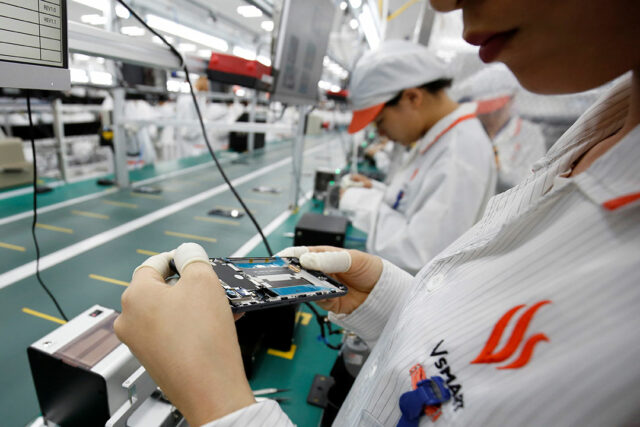
A MANUFACTURER works at an assembly line in Hai Phong, Vietnam. — REUTERS

HANOI – Communist-ruled Vietnam is expected to ratify this year the UN convention for the free establishment of trade unions, UN officials and diplomats said, in a move meant to cut risks of trade disputes but likely leaving some foreign companies uneasy.

The long-delayed measure would be a major formal step in the tightly controlled one-party nation where the only existing national trade union operates within the Communist Party structure, although it is unclear how and when the convention, once ratified, would be actually applied.

The Southeast Asian manufacturing hub, which is home to factories of international companies including Samsung Electronics, Intel, Foxconn and Canon, is highly reliant on commerce, which last year exceeded 160% of the $415 billion domestic economy.

It is required to apply UN standards on workers rights to avoid disputes over ‘social dumping’, which refers to the practice of countries competing unfairly with others over labour costs, under its multi-billion-dollar trade deals with the European Union and Pacific partners.

“We are confident Vietnam is committed to ratifying Convention 87 as early as possible,” Ingrid Christensen, the head in Vietnam of the International Labour Organization, the UN agency responsible for labour rights, told Reuters.

Convention 87 on the “freedom of association and protection of the right to organise” was adopted in 1948 and is one of the fundamental texts protecting labour rights worldwide.

In a meeting in December with foreign experts, Vietnam’s labour ministry officials said the ratification of the convention was expected in October 2024, according to a Hanoi-based diplomat. Other diplomats confirmed plans to ratify this year.

The Vietnamese Prime Minister’s office, the labor ministry and Vietnam General Confederation of Labour, the country’s only national union, did not reply to requests for comment.

After a decade of talks, parliament was expected to ratify the convention last year, just before the expiry of a January deadline agreed with Canada. With the deadline missed, Ottawa has in theory an additional argument to seek sanctions under the Comprehensive and Progressive Agreement for Trans-Pacific Partnership (CPTPP).

Canada, whose trade with Vietnam is worth over $10 billion, is reviewing a complaint about whether Vietnamese labour laws are in compliance with CPTPP’s obligations on workers’ rights, a Canadian government spokesperson said.

The EU, which had bilateral trade with Hanoi amounting to nearly $65 billion in 2022, sees the ratification of Convention 87 and amendments of relevant laws as “crucial” to comply with the existing agreements, EU Ambassador to Vietnam Julien Guerrier said.

SOME COMPANIES UNHAPPY?

However, “if the ratification leads to more real power for trade unions, some companies may be unhappy,” said Nguyen Hung, a specialist in supply chains at RMIT University Vietnam, warning that could impact foreign investment, including from Samsung, the largest investor in the country.

Freedom of establishment would “result in a disorderly proliferation of unions” and deterioration of industrial relations, according to notes seen by Reuters for a 2016 speech by Samsung’s former deputy head in Vietnam, Bang Hyun Woo. The notes said Bang’s views did not reflect Samsung’s.

Samsung declined to comment about Vietnam’s possible ratification and whether that could change its investment plans.

Vietnam will also raise by 6% the minimum wage in the business sector in July, following other hikes in the past. It will also increase from this year levies on large multinationals under a new global tax deal.

Vivie Wei, who leads investment consultancy Dezan Shira & Associates in Vietnam, said she saw no significant impact on foreign investors’ interest from enhanced unions rights or wage hikes.

Vietnam “does not position itself as the cheapest option” but has still been able to attract investments even after recent increases in salaries, she said. — Reuters

Australia’s gender pay gap report shows men earn 22% more

SYDNEY – Male employees in Australian private firms earn around 22% more than their women colleagues, official data showed on Tuesday, as the government released for the first time gender pay gaps at companies with more than 100 employees.

Under legislation passed in March 2023 Australian companies were required to reveal early this year the pay of their male and female employees. The Labor government hopes naming the companies will force them to narrow the gap.

The average total remuneration gender pay gap for 2022/23 was 21.7% in favour of men, while the difference in median base pay was 14.5%, the Workplace Gender Equality Agency (WGEA) said. Only one-third of companies have a median gender pay gap between the target range of -5% and +5%.

“By shining a light on gender pay gaps at an employer level, we are arming individuals and organisations with the evidence they need to take meaningful action to accelerate closing the gender pay gap in Australian workplaces,” federal Minister for Women Katy Gallagher said in a statement.

Several countries have been taking steps to force companies to report the difference in earnings of male and female staff. Britain in 2017 made it mandatory for all companies with more than 250 employees, resulting in the gap reducing over the years. The European Union enacted similar legislation in 2021.

Australia’s top banks and energy firms were some of the biggest laggards in gender pay parity. The median total remuneration gender pay gap at Commonwealth Bank, Australia’s largest bank was 29.9% while the gap at top power producer AGL was 33.2%.

Australian units of international investment banks like UBS and Morgan Stanley had more men holding the top jobs, driving the pay gaps in these firms to over 40%.

At the other end of the scale, the gap at supermarket operator Woolworths, one of Australia’s biggest employers, was just 5.7%.
It was 28.5% at the Australian operations of Thomson Reuters, the parent company of Reuters News.

CBA, AGL, Woolworths, UBS and Thomson Reuters did not immediately respond to request seeking comments on the report.

The report also showed significant variation across industries, with the mid-point employer gender pay gap at 31.8% in construction while it was 1.9% at hotels and restaurants. — Reuters

Overworked and underpaid, Nepal’s nurses quit jobs to head abroad

MEDICALERT-UK-UNSPLASH

KATHMANDU – For Nepali nurse Anshu, being picked for a job programme in Britain was long overdue recognition of her years of study and work – and a chance to boost her earnings.

“I finally feel my work has been valued,” said the 28-year-old, who asked to be identified only by her first name. She hopes her current monthly salary of 26,000 rupees ($196) at a private hospital in Nepal will rise to more than 10-times that in Britain.

But as she and several dozen other nurses prepare to leave, the bilateral government pilot under which they were recruited has fuelled concerns about an acute shortage of nurses and other medical professionals in the South Asian country.

Though only 43 nurses were accepted for the pilot phase, an official at the country’s Department of Foreign Employment (DoFE) told Context a second phase was planned and that Britain eventually wanted to recruit 10,000 Nepali nurses.

While that would help Britain plug labour gaps in the National Health Service (NHS), it could exacerbate Nepal’s shortages, nursing officials said.

“The situation is already worrying,” said Hira Kumari Niraula, director of Nepal’s Nursing and Social Security Division (NSSD), a government body involved in the provision of public health services.

“Recently we started community health nursing and school nurse programmes to make nursing service available in needy communities. But the challenge is in many places we are not able to find nurses who are willing to work,” Niraula added.

Nepal currently has less than half of the 45,000 nurses that it needs working in the country’s hospital, rural clinics and other healthcare facilities, according to the NSSD.

It is among 55 countries included in a World Health Organization red list of nations facing a severe shortage of healthcare workers.

“We are in a shortage situation but the government is encouraging nurses to migrate. Then who will stay in Nepal?” Niraula said.

The DoFE has defended the agreement signed with Britain, saying such accords ensure migrant nurses’ rights and help deter illegal migration and labour exploitation.

“There is news that Nepali nurses are being cheated, abused, and exploited abroad as they take backdoor entries,” said DoFE information officer Kabiraj Upreti. “This agreement can be a milestone.”

‘NO FUTURE’

From Zimbabwe to the Philippines, concern is growing about the loss of qualified medical staff attracted by better salaries to take up health and care jobs in countries such as Britain, Australia, Canada and the United States.

In Nepal, more than one-third of the 115,900 nurses registered with the Nepal Nursing Council (NNC) have sought documents to practice overseas.

About half of Nepal’s migrant nurses went to the United States, followed by Australia and Dubai. Just over 500 have already migrated to Britain.

But the causes of the country’s medical staffing shortfall go beyond migration, said Roshan Pokharel, secretary of the Ministry of Health and Population.

“We are very much aware that a large number of health workers are migrating. But that’s not their problem. It’s our problem that we are not able to provide permanent, long-term, and stable jobs to our health workers,” Pokharel said.

“Government has allocated only around 4% of the total budget to the health sector which is just not enough,” he added.

Limited financial resources for healthcare in the country of 30 million mean the lure of better-paid jobs abroad is stronger than ever for many nurses.

Tired of demanding working conditions and low pay, Grishma Basnet, 25, who works in the intensive care unit (ICU) at a private hospital in the capital, Kathmandu, has applied to work in the United States and is awaiting news on where she will go.

“I have to look after three patients in the ICU, whereas the global standard is one nurse should only look after one patient in the ICU. Isn’t this exploitation?,” said Basnet, who said she earned 15,000 rupees per month at present.

“Why should I stay in this country? There is no future here,” she said. — Thomson Reuters Foundation

ADVERTISEMENT
ADVERTISEMENT